CHNA&HIP Community Health Needs Assessment Health Improvement Plan Dubuque County, Iowa 2019 2021
←
→
Page content transcription
If your browser does not render page correctly, please read the page content below
CHNA&HIP

Community Health Needs Assessment
          Health Improvement Plan

           Dubuque County, Iowa
                   2019 – 2021
Participants
DUBUQUE COUNTY BOARD OF HEALTH                       TASK FORCE COMMITTEE MEMBERS
Chairperson Tom Bechen
                                                     HEALTHY BEHAVIORS AND LIFESTYLES
Rhonda Healey
                                                     Vicki Gassman           Hillcrest Family Services
Dr. Valerie Peckosh, DMD
                                                     Amy Cordingley          Hy-Vee
Dr. Jill Powers, DO FACP
                                                     Gwen M. Hall Driscoll   Mercy Medical Center
Todd Lange
                                                     Barb L. Barton          Mercy Medical Center
Tim Daly
                                                     Casey Smith             YMCA/YWCA
Dr. Ashley Klein, DVM
                                                     Sue Greene              Helping Services for Youth &
Diane Heiken, RPh
                                                                             Families
Patrice Lambert –                                    Brittany Demezier       Iowa State County Extension
Executive Director, Dubuque County Health            Danielle Day            Iowa State County Extension
Department                                           Kimberly Gonzales       Visiting Nurse Association
Bonnie Brimeyer –                                    Danielle Simpson        Visiting Nurse Association
Assistant Health Administrator                       Malissa Sprenger        Mercy Medical Center
Bailey Avenarius –                                   Debra Prier             Substance Abuse Services
Office Assistant                                                             Center

STEERING COMMITTEE MEMBERS                           DISEASE INFECTION CONTROL
                                                     Patricia Lehmkuhl       UnityPoint Finley Hospital
Patrice Lambert –                                    Gail Gates              Mercy Medical Center
Dubuque County Health Department - Facilitator       Denise Lippens          Visiting Nurse Association
Co-Chair of the Healthy Behaviors and Lifestyles     Cathy Tieskoetter       Visiting Nurse Association
Task Force                                           Rhonda Ramler           Dubuque Community School
Co-Chair of the Disease Infection Control Task                               District
Force                                                Wendy Scholbrock        UnityPoint Finley Hospital
Jonathan Wilke –                                     Wayne Dow               City of Dubuque
UnityPoint Finley Hospital -                         Meg Greenwood           Medical Associates Health
Co-Chair of the Healthy Behaviors and Lifestyles                             Clinic
Task Force                                           Gina Mallett            Iowa Department of Public
Stacey Killian –                                                             Health
Dubuque Visiting Nurses Association
Co-Chair of the Disease Infection Control Task
                                                     HEALTHCARE ACCESS
Force
                                                     Brooke Gomez            Crescent Community Health
Angela Petsche –
                                                                             Center
Crescent Community Health Center
                                                     Kathy Kane              Medical Associates Health
Co-Chair Healthcare Access Task Force
                                                                             Clinic
Joe Norris-
                                                     Tom Berger              Dubuque County EMA
Mercy Medical Center
                                                     Todd Lange              National Alliance of Mental
Co-Chair of Healthcare Access Task Force
                                                                             Illness
Mary Rose Corrigan-
                                                     Sue Whitty              Hillcrest Family Services
City of Dubuque Health Services
                                                     Brittany Hubanks        Visiting Nurse Association
Co-Chair of the Environmental Health Task Force
                                                     Jacquie Zwack           Visiting Nurse Association
Travis Schrobilgen –
                                                      Trish Kemp             Visiting Nurse Association
City of Dubuque Planning Service -
                                                      Sherri Edwards         Dubuque County Early
Co-Chair of the Environmental Health Task Force
                                                                             Childhood
Matt Daughenbaugh –
                                                     Tilly Frommelt          Mercy Medical Center
Mercy Medical Center
                                                 i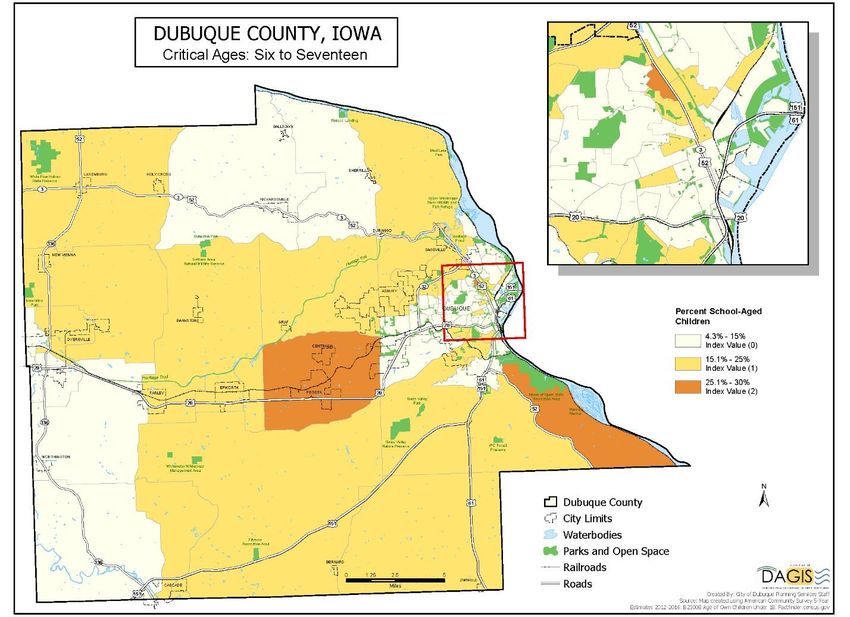
HEALTHCARE ACCESS CONTINUED
Angela Lauer        Mercy Medical Center
Karen Vaassen       UnityPoint Finley Hospital
Jennifer Cavanagh   Mercy Medical Center
Amy Phelps          Mercy Medical Center
Jane Wills          Mercy Medical Center
Ann Morris          Crescent Community
                    Health Center
Becky Wunderlin     Crescent Community Health Center

ENVIRONMENTAL HEALTH
Tim Link            City of Dubuque
David Koch          University of Dubuque
Bonnie Brimeyer     Dubuque County Health
                    Department
Cori Burbach        City of Dubuque
Dean Mattoon        City of Dubuque
Katie Kieffer       City of Dubuque
Michelle Zurcher    Visiting Nurse Association

                                                 ii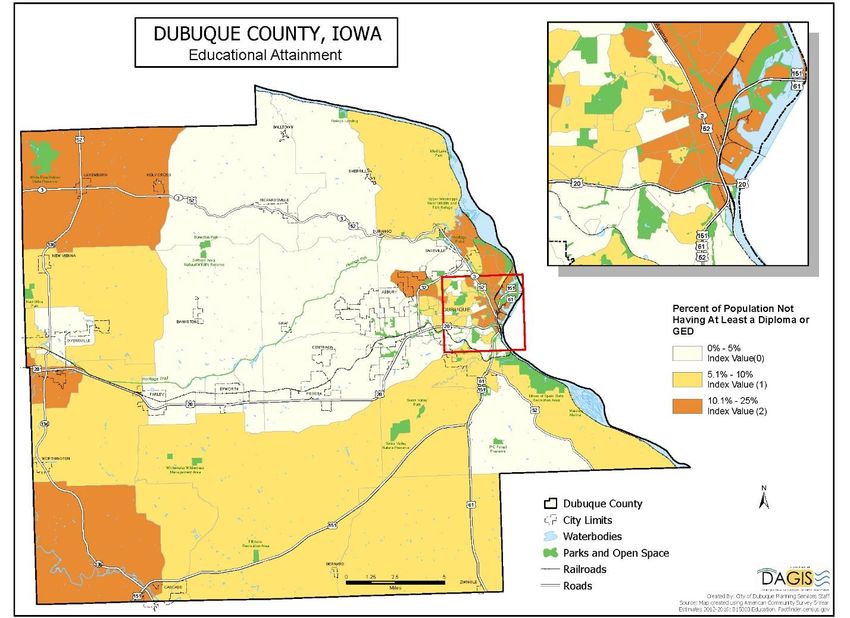
PARTICIPANTS ...................................................... i
The Steering Committee and
                                        COMMUNITY HEALTH NEEDS ASSESSMENT ....... 1
Task Force Members would                PUBLIC PARTICIPATION ....................................... 2

like to extend a Thank You to           COMMUNITY PROFILE ......................................... 3
                                        SOCIAL DETERMINANTS OF HEALTH ................... 6
all       the        residents,
                                        HEALTH RISK ASSESSMENT ................................. 7
community-based                         TASK FORCE REPORTS ....................................... 17

organizations,     businesses,          HEALTHY BEHAVIORS AND LIFESTYLES ............. 18
                                        HEALTHY BEHAVIORS AND LIFESTYLES - HIP..... 27
and      stakeholders       of
                                        DISEASE INFECTION CONTROL .......................... 29
Dubuque         County    who           DISEASE INFECTION CONTROL - HIP.................. 33
shared    thoughts,      ideas,         HEALTHCARE ACCESS ........................................ 36
                                        HEALTHCARE ACCESS - HIP................................ 41
expertise, and experiences
                                        ENVIRONMENTAL HEALTH ................................ 44
which made this plan a                  ENVIRONMENTAL HEALTH - HIP ....................... 53
living document.                        COMMUNITY INPUT SURVEY ............................ 56
                                        DRAFT DOCUMENT PUBLIC COMMENTS .......... 64

                                  iii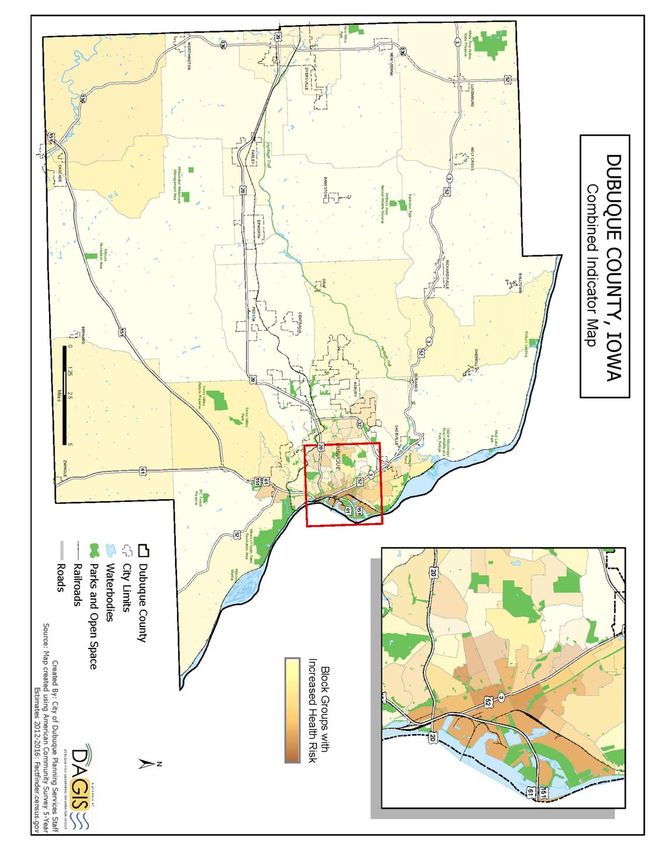
Community Health Needs Assessment
Purpose                                                Process
The Community Health Needs Assessment and              The development of a CHNA&HIP requires
Health Improvement Plan (CHNA&HIP) is an               participation from a variety of community
assessment of local health needs and report            organizations,     healthcare   providers,    local
identifying goals and strategies to meet those         governments, and stakeholders. Over the course
needs. Every three to five years, local health         of a year, these groups conduct meetings and
boards, in partnership with health care                solicit public input on community health issues. A
providers and community partners, lead a               Steering Committee of local health professionals
community-wide discussion with residents,              was formed to lead the CHNA&HIP planning
business owners, and community stakeholders            process, engage the public and report the findings
regarding the public health issues of the              to Iowa Department of Public Health.
community. This process, and the resulting
CHNA&HIP report, is required by the Iowa               Since public health encompasses such a wide
Department of Public Health to receive funding         range of topics and expertise, the CHNA&HIP
from the State to fulfill the duties of the            steering committee divided the workload into
Dubuque County Board of Health.                        four subcategories: Healthy Behaviors and
                                                       Lifestyles, Disease Infection Control, Healthcare
A CHNA&HIP is required of local hospitals to           Access, and Environmental Health.
obtain reimbursement under Medicare and
Community Health Centers. The hospitals                The time line below outlines the planning process
performed the CHNA in adherence with                   used by the Steering Committee to complete this
certain federal requirements for not-for-profit        project.
hospitals set forth in the Affordable Care Act
and by the Internal Revenue Service.                   October 2017: Project launched.
                                                       January 2018:   Public Survey to discover needs;
A CHNA&HIP provides guidance to local health                           additional research to identify needs.
care providers and public health officials on
the health needs of the community. The                 March to        Task Force Committees met to
report serves as a guide to prioritize health          April 2018:     review data for CHNA and formulate
resources to where they are needed most,                               Draft HIP.
allocate funding to address health issues, and         May 2018:       Steering Committee finalized Draft
identifies opportunities to improve local public                       CHNA&HIP.
health through collaboration and partnerships.         July 2018:      Steering Committee finalized reports.
                                                       August 2018:    Marketing, Public Input for
                                                                       CHNA&HIP Draft completed.
                                                       August 2018:    Board of Health presentation and
                                                                       approval.

                                                   1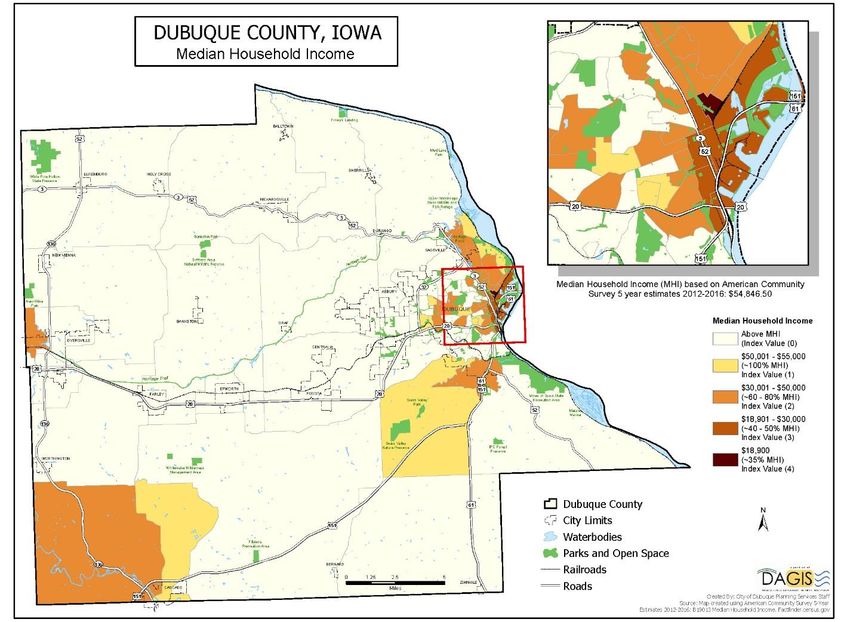
Public Participation
Involving the public is essential in any              health such as clean water, air, sanitation,
community planning process. The Steering              access to open spaces, and the built
Committee provided the public engagement              environment.
opportunities to share their ideas and
experiences, provide input, and help develop          Community Survey
the CHNA&HIP.
                                                      An electronic survey was distributed to
Stakeholder Task Forces                               individuals, organizations, sectors and media
                                                      release throughout the county to gather
Four Task Forces were formed, each with an            input on health needs and provide an
emphasis in one of the four topics (Healthy           opportunity for residents and business
Behaviors and Lifestyles, Disease Infection           o w n e r s to share their experiences and
Control, Healthcare Access, and Environmental         insight into community health issues. T h e
Health) of the CHNA&HIP. These task forces            survey was translated into Spanish language
were led by a member of the Steering                  and two responses were received using the
Committee. Local stakeholders and experts             Spanish translation. In the next cycle, the
were invited to participate in collaborative          steering committee will look to expand
meetings over the course of two months.               language availability based on the
These meetings were designed to share                 community. A paper survey was also available
information and data between organizations,           at the sites of the Steering Committee
identify strengths, weaknesses, opportunities         locations.
and roadblocks within the community, and
establish goals and priorities for inclusion in       Questions in the survey focused on what
the CHNA&HIP                                          health issues were most important, health
                                                      behaviors impacting community health, and
The Healthy Behaviors and Lifestyles Task             access to healthcare services. Respondents
Force focused on issues relating to physical          were able to provide suggestions on how to
fitness, access to healthy foods, smoking, drug       improve the health and quality of life of
and alcohol abuse, and other lifestyle choices        residents. The survey received 1301
that have an impact on health. Disease                responses, providing a diverse representation
Infection Control Task Force focused on               of Dubuque County, and information from
limiting the impact of communicable diseases          the survey helped guide the individual task
on the community. The Healthcare Access               forces in evaluating and prioritizing health
Task Force focused on access and                      needs and goals.
 quality of healthcare within the community,
and the Environmental Health Task Force
focused on external influences on public

                                                  2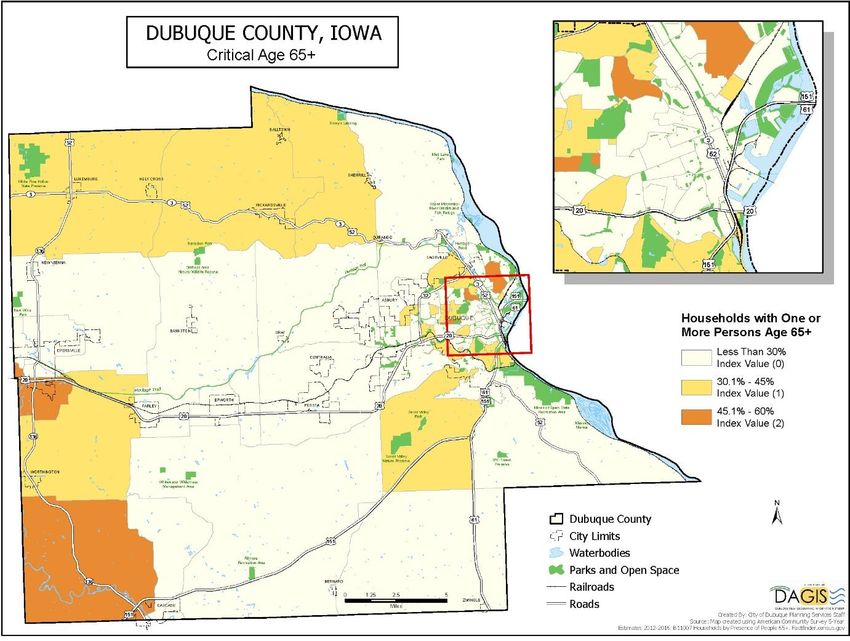
Community Input Sessions
The Steering Committee shared the draft               people. DataUSA, using 5-year American
goals and priorities of the CHNA&HIP through          Community Survey (ACS) data,
a Media Release and placed on multiple
agencies’ websites to give an opportunity for         says Dubuque County has a median age of
additional comments and revisions from the            38.5 and a median household income of
public on the goals and objectives of the             $56,000. Dubuque County, IA is the 7th most
CHNA&HIP document. A paper copy draft                 populated county in Iowa and borders Jo
CHNA&HIP was also available at the sites of           Daviess County, IL; Clayton County, IA;
the Steering Committee locations. A total of          Delaware County, IA; Jackson County, IA;
10 written public comments were received.             Jones County, IA; and Grant County, WI.
 Additionally, 9 public comments were                 There are twenty-one municipalities within
received at the BOH meeting on August 22,             the county. The largest of which, the City of
2018. Comments received will be considered            Dubuque, is also the county seat.
when working toward the goals in the next
three years.                                          Historically, the regional economy was
                                                      dominated by agriculture, meatpacking, and
                                                      manufacturing but has recently become
Community Profile                                     more diversified to include healthcare and
Dubuque County is located along the                   social assistance services, retail, and
Mississippi River in northeast Iowa. Located          technology.
within the Driftless Area - a region in
Minnesota, Wisconsin, northwestern Illinois,          Dubuque County has three regional medical
and northeastern Iowa of the Midwest that             facilities: Mercy Medical Center Dubuque,
was never glaciated - the geography of                Mercy Medical Center Dyersville, and
Dubuque County is one of stark contrasts;             UnityPoint-Finley Hospital (also in the City of
adjacent to the Mississippi River in the east,        Dubuque.) Other health care providers
is generally rugged, steep, and wooded                include medical groups such as Medical
topography, however, the western portions             Associates and Grand River Medical Group.
of the county are made up of rolling                  Additionally, there are nonprofit community-
farmland, forests, and prairies.                      based organizations providing health services
                                                      such as the Dubuque Visiting Nurses
The most recent estimate from Census                  Association (VNA), Crescent Community
Bureau's Population Estimates Program (PEP)           Health Center, and Hillcrest Family Services.
lists Dubuque County (2016) at about 97,000

Dubuque County Health Rankings 2018 (countyhealthrankings.org) presented the following
findings:

       Health Outcomes:     41 of 99                 Health Behaviors:              21 of 99
       Length of Life:      42 of 99                 Clinical Care:                  4 of 99
       Quality of Life:     46 of 99                 Social & Economic Factors:     35 of 99
       Health Factors:      27 of 99                 Physical Environment:          95 of 99

                                                 3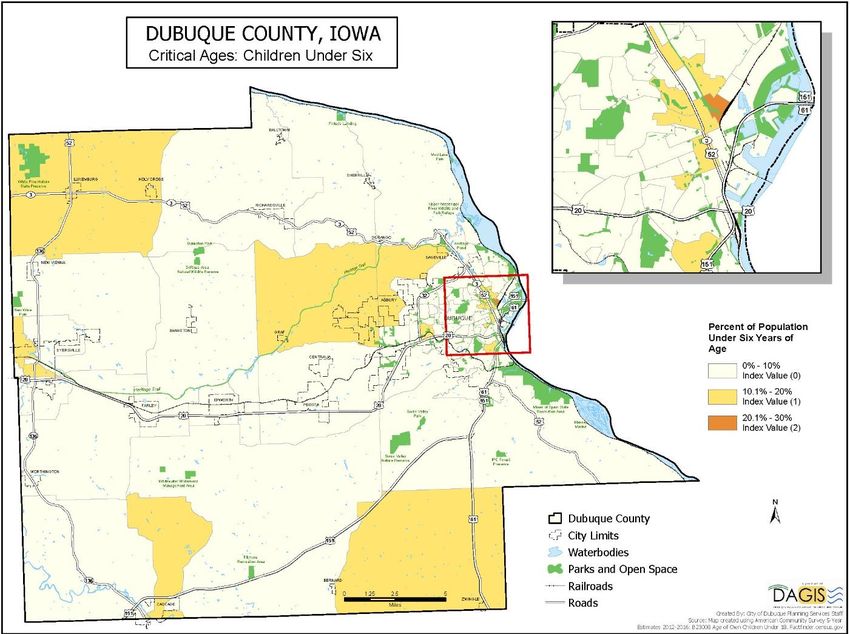
Leading Causes of Death Under Age                         Age-Adjusted
                                                                Deaths
                                    75                                      Rate per 100,000

                   Malignant neoplasms                           286               81.8

                   Disease of heart                              198               57.9

                   Accidents (unintentional injuries)             82               28.9

                   Chronic lower respiratory disease              48                13

                   Diabetes mellitus                              35               10.3
                  Source: CDC WONDER. Premature Mortality includes all deaths among people
                  under age 75 and the rates are age-adjusted to the US 2000 population. Since
                  counties have different age make-ups, age-adjustment can help in comparing
                  health measures between counties.

Community Profile statistics acquired from Census.gov, DataUSA.io, and countyhealthrankings.org.
    Source: Premature death in Dubuque County, IA. countyhealthrankings.org

                                                        4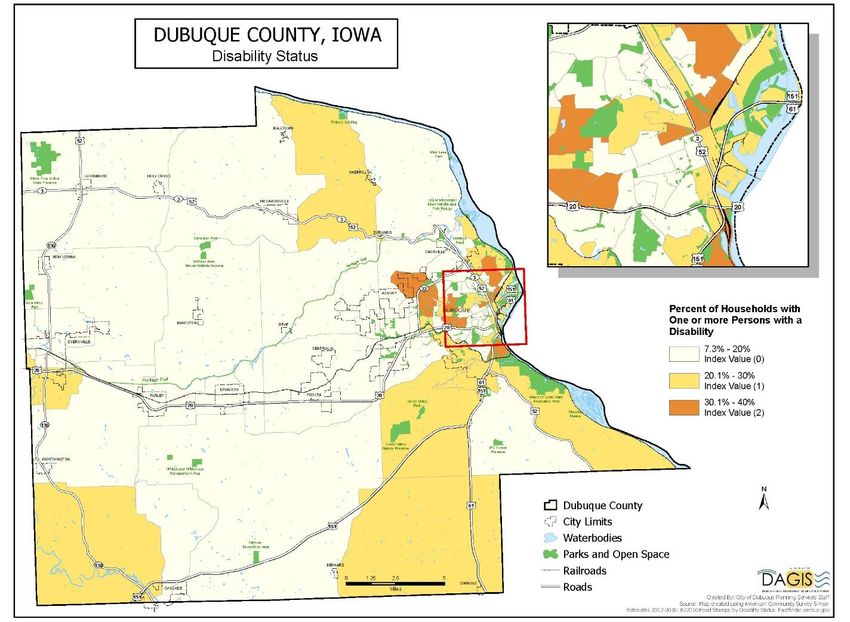
5
Social Determinants of
Health
Moving from             diseases       toward           Dubuque County as a whole, considers a
determinants                                            “place-based” organizing framework that
                                                        reflects several key social determinants of
                                                        health -economic stability, education, social
While public health has a long history of
                                                        and community context, health, health care,
confronting social conditions such as
                                                        neighborhood, and the built environment –
sanitation, healthy housing, and safe
                                                        ensuring each is incorporated into the
workplaces — factors referred to today as
                                                        CHNA&HIP. Just as poor diet or lack of physical
social determinants of health — much of the
                                                        activity are connected to chronic heart disease
field’s work in the past century focused on
                                                        or diabetes, where a person lives can
understanding and preventing diseases,
                                                        determine that person’s life expectancy or
building on enormous advances in science and
                                                        quality of life.
medicine.
                                                        Social determinants must be considered in the
Fast forward to 1988, when the then-Institute
                                                        Dubuque County Health Improvement Plan
of Medicine released “The Future of Public
                                                        and addressed through activities and actions
Health,” which concluded that public health is
                                                        that are intentionally designed to improve
“neither     clearly    defined,      adequately
                                                        where we live, work, and play.
supported, nor fully understood.” In its
recommendations, the report’s authors                   Social characteristics vary widely from place to
defined the mission of public health as                 place. When examining a community’s social,
“fulfilling society’s interest in assuring              economic and environmental conditions, it
conditions in which people can be healthy.”             becomes clear that no two neighborhoods are
Twenty years later, the World Health                    exactly alike, and therefore, have individual
Organization’s (WHO) Commission on Social               health needs and concerns. For example, a
Determinants released “Health Equity Through            neighborhood may have a greater risk of
Action on the Social Determinants of Health,”           exposure to lead based paint, while another
which stated, “social injustice is killing people       neighborhood has a larger number of persons
on a grand scale.” The report called on                 over age sixty-five. Each concern will demand
governments worldwide to act on social                  different health needs and services to address
determinants of health, which WHO defines as            the health risks associated with those
“conditions in which people are born, grow,             populations.
work, live and age, and the wider set of forces
and systems shaping the conditions of daily
life.”

Today, the evidence base on social
determinants gets bigger every day, from
studies that link poverty and shorter life
expectancy to those that document how
unconscious bias leads to lower quality health
care for African Americans. Healthy People,
which sets health goals for the nation across a
10-year period, included social determinants
as a stand-alone topic area in its 2020 round.

                                                    6
Health Risk Assessment
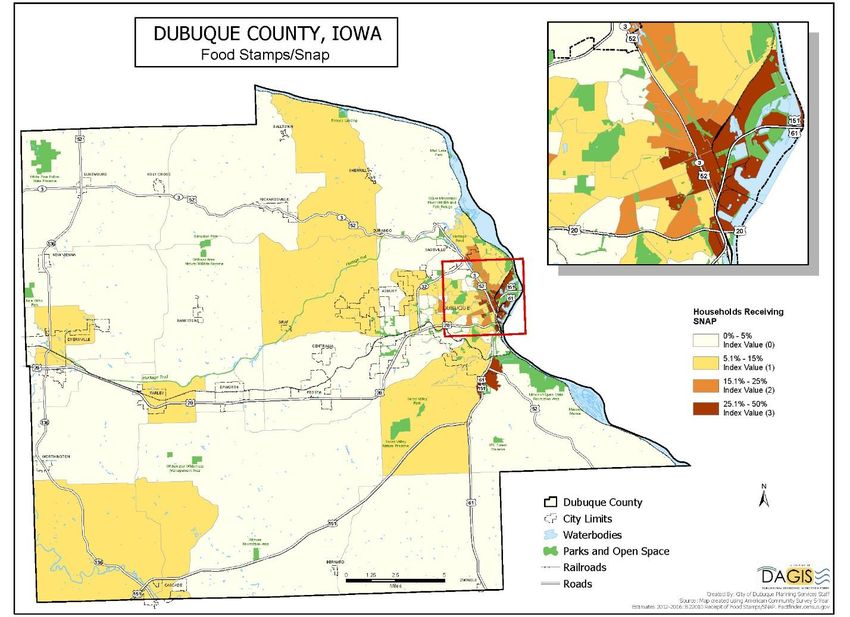
The steering committee looked at several American Community Survey 2012-
socio-economic indicators linked to poor 2016 5-Year Estimates
health. Utilizing data collected from the
American Community Survey (ACS) and the
About the American Community Survey
City of Dubuque Geographic Information
System (GIS), areas with elevated health risk
The American Community Survey (ACS) is a
were found at the Census ‘Block Group’ level.
nationwide, continuous survey designed to
provide communities with reliable and timely
Health Risk Indicators demographic, housing, social, and economic
data every year. Like the Decennial Census,
The following indicators were identified by the the ACS provides detailed data on
Steering Committee as contributing to higher demographic, social, economic, and housing
health risk levels. The ACS data ID is included characteristics throughout the US.
in parentheses.
The ACS differs from the Decennial Census by
Population Under 6 Years of Age (B23008) only surveying a sample of persons within a
School Age Children Ages, 6-17 (B23008) neighborhood or community, whereas the
Population 65+ Years of Age (B11007) Decennial Census surveys every household in
Minority % of Population (B02001) the country.
African American % of Population (B02001) www.census.gov/programs-surveys/acs/
Native Hawaiian/Pacific Islander
American % of Population (B02001) Indicator Maps
Hispanic/Latino Origin % of Pop. (B03002)
The following map series shows each indicator
No Diploma Age 25 Plus (B15003) by block group. The last map, titled
Local Unemployment (B23025) “Combined Indicator Map”, shows the
No Health Insurance (B27010) indicators to the left, layered for each block
Overcrowded Housing Units (B25014) group. Darker areas depict block groups with
Median Household Income (B19013) overall elevated health risk.
Poverty Status by Age (B17017)
SNAP Recipients (B22010)
Households Persons with Disability (B22010)
Households Without Vehicle Access (B25044)
Information on these indicators was collected
at the Block Group Level using 5-year ACS data
found at American FactFinder, converted to
excel, and imported into ArcMap.
www.factfinder.census.gov
78
9
10
11
12
13
14
15
16
TASK FORCE REPORTS

        17
HEALTHY BEHAVIORS AND LIFESTYLES
Data and other information used in the assessment
**Dubuque County and Iowa Health Data from County Health Rankings
(https://research.hs.iastate.edu/uturn/.)
Major findings:
1819
**Dubuque County Health Portrait 2017, from Community Commons (communitycommons.org/chna).
Major findings:
42% of Dubuque County Adults are reported overweight compared to 35% for Iowa.
28.7% of Dubuque County adults are not taking blood pressure medication when needed
compared to 19.1% in Iowa.
20 Dubuque County (51.21%) has a higher percentage of Medicare Beneficiaries with high blood
pressure than the Iowa average (50.98%).
77.4% Dubuque County female Medicare enrollees with mammogram in past 2 years compared to
68.5% for the statewide average.
82.6% Dubuque County adult females, age 18+, with regular pap test (age-adjusted) compared to
79.5% for the statewide average.
69.4% Dubuque County adults, age adjusted screened for colon cancer compared to the statewide
average of 60%.
10.1% of adults in Dubuque County smoke cigarettes, compared to 18.1% for Iowa.
Dubuque County has 31.5% age-adjusted estimated adult excessive drinking compared to the Iowa
average of 21.4%.
21**Iowa Community Partnerships for Tobacco Prevention
(https://idph.iowa.gov/Portals/1/userfiles/115/surveillance%2C%20evaluation%20and%20statistics/fy%20
18%20county%20snapshots/IowaCP_1HillCrestFS_v3.pdf)
7.8% of Dubuque youth have reported to smoking a cigarette in the past 30 days compared to
7.1% statewide.
**Iowa Department of Public Health core measures: (https://www.pht.idph.state.ia.us)
Major Findings:
Age adjusted heart attacks per 10,000 population.
22**2017 Cancer In Iowa, University of Iowa College of Public Health (http://www.public-
health.uiowa.edu/shri/wp-content/uploads/2018/03/W31750-V2-proof-002.pdf)
2324
Dubuque Community Survey Top Results (Found on page 53):
Survey respondents indicated that the top three barriers impacting community health include drug
abuse, obesity and poor diet.
25HEALTHY BEHAVIORS AND LIFESTYLES - SWOT ANALYSIS
Definition: What is a 'SWOT Analysis'--SWOT analysis is a process that identifies strengths, weaknesses,
opportunities and threats. Specifically, SWOT is a basic, analytical framework that assesses what an entity
(usually a business, though it can be used for a place, industry or product) can and cannot do, for factors
both internal (the strengths and weaknesses) as well as external (the potential opportunities and threats).
Strengths: Characteristics of the business or project that give it an advantage over others
Dubuque County Food Coalition Board formation
Double-Up Food Bucks (Dubuque Farmers’ Market)
Care For Yourself - WISEWOMAN Program (cancer screenings)
Opportunities for activities through YMCA/YWCA
Walking/running trails (Bee Branch)
Corporate wellness programs
Exercise facilities
Adult smoking rates
St. Stephen’s Food Bank
Coordination between health facilities and agencies
Opioid Response Team
Community youth programs
Dubuque Wellness Coalition
Real Recovery Sober Living
Weaknesses: Characteristics of the business that place the business or project at a disadvantage relative
to others
Substance abuse resources (facilities/transportation)
High electronic smoking device
Spike in the percentage of driving deaths with drinking involvement
Higher percentage of excessive drinking
Higher percentage of overweight population
Opportunities: Elements in the environment that the business or project could exploit to its advantage
5210 Grants
Live Healthy Iowa participation
Increase blood pressure screenings
Expand Wellness Coalition membership
Expand substance abuse resources
Opioid prescription, education and awareness
Harm Reduction – including needle exchange
Threats: Elements in the environment that could cause trouble for the business or project
Higher percentage of adults not taking blood pressure meds when needed
Percentage of alcohol consumption
Alcohol related driving deaths
Physical inactivity
Opioid and methamphetamine use and abuse
Stigma
26HEALTHY BEHAVIORS AND LIFESTYLES - HIP
2019-2021
BRIEF DESCRIPTION OF NEED:
42% of Dubuque County adults are overweight and 24% of Dubuque County adults are physically inactive. Both are of
major contributors to chronic disease. Obesity negatively affects body systems and increases the risk of many health
diseases including heart disease, cancer and diabetes.
GOAL:
Reduce the current level of overweight population in Dubuque County through improved food and physical activity
opportunities/environments.
OBJECTIVE:
Expand coordination and collaboration among agencies, organizations and entities that have expertise in food and
physical activity environments and maximize resources of existing programs and partnerships.
ACTIONS TO TAKE TO ADDRESS THE HEALTH NEED:
Increase Dubuque County Wellness Coalition membership.
Explore and share available grants focusing on the food and/or physical activity environment with appropriate
agencies and wellness providers.
Promote and support local food initiatives – e.g., Double-Up Food Bucks, Dubuque Farmer’s Market and
community gardening projects.
Promote corporate wellness programs and activities.
Promote and increase participation in community health promotion programs, e.g. Live Health Iowa and
Dubuque on the Move.
ANTICIPATED IMPACT OF THESE ACTIONS:
Decline in overweight population and chronic disease incidence.
PLAN TO EVALUATE THE IMPACT:
Overweight population as measured by Countyhealthrankings.org.
Participation data for Double-Up Food Bucks.
Participation data for community health promotion programs.
Physical inactivity as measured by the County Health Rankings.
27HEALTHY BEHAVIORS AND LIFESTYLES- Health Improvement Plan
2019-2021
BRIEF DESCRIPTION OF NEED:
28% of driving deaths involved alcohol impairment.
31.5% age-adjusted estimated adult excessive drinking compared to the Iowa average of 21.4%.
16 total opioid overdose and opioid related deaths in 2016 in Dubuque County.
15% increase in methamphetamine treatment admissions in Dubuque from 2013-2017. (SASC)
38% increase in methamphetamine treatment admissions over the past four years in Iowa.
Drug Submissions (in grams) to Iowa Division of Criminal Investigation Lab 2016-2018 during the first six months of recent
years:
1.8% increase marijuana
4.5% increase methamphetamine
1% increase cocaine
4.6% increase heroin
5% increase fentanyl
15% increase heroin/fentanyl mix
16% increase fentanyl/other
Heroin and Opiates Overdoses/Deaths 2016-2018:
2016: 28/9
2017: 22/8
2018 (through July 2018): 19/3
GOAL:
Expand and coordinate substance use preventative and interventional activities and resources.
OBJECTIVE:
Establish substance use treatments and resources through multi-disciplinary agency coordination.
ACTIONS TO TAKE TO ADDRESS THE HEALTH NEED:
Support current and future strategies for substance usage and opioid prescription, education and patient
management practices to reduce the development of substance use and opioid use disorders.
Coordinate continuing medical education credits on substance abuse/use for area physicians.
Dubuque Area Substance Abuse Coalition and Dubuque County Wellness Coalition collaboration.
ANTICIPATED IMPACT OF THESE ACTIONS:
Improved collaboration and coordination between agencies and health care providers to address substance use
needs.
Facilitate dissemination and implementation of evidence-based prevention and interventions.
PLAN TO EVALUATE THE IMPACT:
Percentage of substance usage, alcohol impairment, methamphetamine and opioid deaths will trend favorable.
Increase participation in the Prescription Monitoring Program.
28DISEASE INFECTION CONTROL
Data and other information used in the assessment
**Dubuque County and Iowa Health Data from County Health Rankings (countyhealthrankings.org)
Major Findings:
The sexually transmitted infection rate (417.1) is higher than the statewide rate (388.9).
**Dubuque County Health Portrait 2017, from Community Commons (communitycommons.org/chna).
Major Findings:
Percent of adults never screened for HIV/AIDS is higher (78.7%) than the Iowa average (73.82%).
29 Dubuque County age-adjusted percent of population age 65+ with pneumonia vaccination (68.5%)
is slightly below the Iowa average (69.9%).
Chlamydia infection rate per 100,000 pop. in Dubuque County (412.76) is higher than the
statewide average (382).
Gonorrhea infection rate per 100,000 pop. in Dubuque County (86.73) is higher than the statewide
average (53.1).
30**Iowa Department of Public Health – Iowa Acute Disease Monthly Update
Major Findings:
Survey Top Results:
• Responses from the community survey indicated that not getting flu shots/vaccinations, unprotected
sex and food safety are notable behaviors impacting infectious disease.
31DISEASE INFECTION CONTROL - SWOT ANALYSIS
Definition: What is a 'SWOT Analysis'--SWOT analysis is a process that identifies strengths, weaknesses,
opportunities and threats. Specifically, SWOT is a basic, analytical framework that assesses what an entity
(usually a business, though it can be used for a place, industry or product) can and cannot do, for factors
both internal (the strengths and weaknesses) as well as external (the potential opportunities and threats).
Strengths: Characteristics of the business or project that give it an advantage over others
Bi-Hospital Infection Control Committee
County/IDPH grants for preventative services for underinsured
Resources for free Sexually Transmitted Diseases (STDs) testing and education
Weaknesses: Characteristics of the business that place the business or project at a disadvantage relative
to others
Not reaching targeted high-risk population for specific diseases
Transportation to infectious disease care outside of county
Lack of routine laboratory testing in physician offices
Consistent county wide messages
Community efficiency when working with disease outbreaks
Opportunities: Elements in the environment that the business or project could exploit to its advantage
Increase infectious disease education to local providers
Testing through Accountable Care Organizations (ACOs)
Broaden participation on weekly Epidemiology update from Iowa Department of Public Health
Increase testing sites for human immunodeficiency virus (HIV) and STDs
Virtual, telehealth, computer screening, mobile clinics opportunities
Infectious disease and contracted transportation
Regional utilization of Infectious Disease care through contractual agreements
School clinics for immunizations
Dual reporting
Increase physician enrollment in Vaccines For Children
Increase promotion of programs
Threats: Elements in the environment that could cause trouble for the business or project
Stigma
Transportation to other cities as well as to the Westside of Dubuque
Aging healthcare provider population
Lack of Pandemic Influenza and plans
Availability of influenza test kits during outbreak
32DISEASE INFECTION CONTROL - HIP
2019-2021
BRIEF DESCRIPTION OF NEED:
Dubuque County currently has 70 known positive diagnoses for HIV with an estimated 14% still undiagnosed making the
need to increase testing vital to decreasing the number of undiagnosed. Individuals diagnosed and enrolled in case
management average an 85% suppression rate also decreasing the number of transmissions. Sexually Transmitted
Diseases continue to rise in Iowa. Chlamydia rates statewide rose from 416 in 2016 to 443.3 in 2017. Gonorrhea rates
have also rose from 83 in 2016 to 119.9 in 2017. Increasing education, testing, and community outreach for both HIV and
sexually transmitted diseases are essential components for a healthy community.
GOAL:
Increase the number of HIV tests to county residents.
OBJECTIVE:
The number of HIV tests given in Dubuque County will increase by 20%.
ACTIONS TO TAKE TO ADDRESS THE HEALTH NEED:
HIV Prevention grantees will increase community test sites by three sites.
Grantees will increase partnerships with social organizations to offer prevention strategies/additional testing.
Promote CDC “Know Your Status” and “Undetectable=Untransmittable”.
Information will be given to private physician offices to offer opt out testing to all patients receiving preventative
exams.
ANTICIPATED IMPACT OF THESE ACTIONS:
Increase community awareness
Find those who are undiagnosed
Decrease transmission rates
Increase incidence of prevention and safe practices
Increased physician office testing
Increased HIV testing
PLAN TO EVALUATE THE IMPACT:
Actual annual percentage of undiagnosed will decrease per Iowa Department of Public Health.
Number of tests given through HIV Prevention Grant will increase.
Number of physician offices routinely offering HIV testing
OBJECTIVE:
Decrease the rates of Gonorrhea and Chlamydia in Dubuque County by 2%.
33ACTIONS TO TAKE TO ADDRESS THE HEALTH NEED:
Promote STD testing in community and with private physician offices.
CDC promotional awareness materials distributed throughout the community.
Prevention promotion within community
Increase access to condoms in community
ANTICIPATED IMPACT OF THESE ACTIONS:
Increased physician office testing
Increased testing in Dubuque Community
Increased community awareness on STD
PLAN TO EVALUATE THE IMPACT:
Actual annual state rate of Gonorrhea and Chlamydia will decrease per Iowa Department of Public Health.
Number of tests given through HIV Prevention Grant will increase.
Number of physician offices routinely offering STD testing
34DISEASE INFECTION CONTROL - HEALTH IMPROVEMENT PLAN
2019-2021
BRIEF DESCRIPTION OF NEED:
Over the last three years numbers related to influenza have increased as shown:
State of Iowa reports 2015-2016:
*46 Influenza-associated mortalities all ages
*353 Influenza-associated hospitalizations
*7 Influenza-associated Long-Term Care Outbreaks Investigated
*3688 positive results for non-influenza respiratory virus
State of Iowa reports 2016-2017:
*135 Influenza-associated mortalities all ages
*1078 Influenza-associated hospitalizations
*57 Influenza-associated Long-Term Care Outbreaks Investigated
*5773 positive results for non-influenza respiratory virus
State of Iowa reports October 2017 to March 2018:
*244 Influenza-associated mortalities all ages
*5293 Influenza-associated hospitalizations
*83 Influenza-associated Long-Term Care Outbreaks Investigated
*8299 positive results for non-influenza respiratory virus
GOAL:
Increase the availability of influenza vaccination sites to county residents.
OBJECTIVE:
The number of flu vaccination at convenient sites such as worksites will increase by 3 sites each year.
ACTIONS TO TAKE TO ADDRESS THE HEALTH NEED:
Promote influenza vaccination within the county through social media sites.
Increase partnerships with pharmacies and community vaccinators to host influenza vaccination clinics at
worksites for reasonable cost.
ANTICIPATED IMPACT OF THESE ACTIONS:
With increased partnerships for influenza vaccination sites throughout the community, diagnosed cases of influenza will
decrease.
PLAN TO EVALUATE THE IMPACT:
Actual annual percentage of influenza in the State of Iowa will decrease.
35HEALTHCARE ACCESS
Data and other information used in the assessment
**Dubuque County and Iowa Health Data from County Health Rankings (countyhealthrankings.org)
Major Findings:
5% of adults in Dubuque County are uninsured compared to a statewide average of 6%.
Dubuque County is ranked eighth best of Iowa's 99 counties in Clinical Care.
36**Dubuque County Health Portrait 2017, from Community Commons (communitycommons.org/chna).
Major Findings:
Dubuque County has a lower percentage of the insured population receiving Medicaid (15.24%)
than the Iowa average (17.96%)
Dubuque County (140) has more mental health providers per 100,000 than the Iowa rate (125.1)
but well below the national average rate of 202.8.
19.99% of Dubuque County adults are without a regular doctor compared to 17.93% in Iowa.
37 Dubuque County has a lower percentage of uninsured population (5.46%) than the Iowa average
(6.82%)
Dubuque County has a lower percentage of uninsured population under 19 years old (2.79%) than
the Iowa average (3.63%).
Dubuque County has 72.07 dentists per 100,000 population compared to the state rate of 62.6.
38**Dubuque Emergency Department Volumes
FY10 FY11 FY12 FY13 FY14 FY15 FY16 FY17 FY18
Jul 3,808 3,859 3,982 3,996 4,015 4,142 4,237 4,494 4,074
Aug 3,719 3,971 4,135 3,986 3,858 4,353 4,341 4,428 4,068
Sep 3,678 3,720 3,897 3,993 4,114 4,594 4,406 4,465 4,016
Oct 4,033 3,936 3,931 3,834 3,932 4,350 4,310 4,449 3,969
Nov 3,917 3,570 3,619 3,674 3,602 3,800 3,962 4,047 3,829
Dec 3,366 3,503 3,551 4,120 3,727 4,642 4,223 4,159 3,991
Jan 3,445 3,624 3,713 3,894 3,894 4,217 4,149 4,423 4,435
Feb 3,276 3,657 3,643 3,310 3,337 3,544 3,938 4,077
Mar 3,654 3,980 3,973 3,742 3,692 4,595 4,378 4,294
Apr 3,637 3,746 3,782 3,747 4,003 4,329 4,216 4,071
May 3,936 3,910 4,081 3,499 4,204 4,137 5,094 4,101
Jun 3,709 3,646 3,838 4,009 4,038 4,248 4,413 4,084
Survey Top Results:
Survey respondents indicated that the top three barriers to keeping community from accessing
health services include out of pocket expenses/lack of insurance, lack of providers/difficulty of
getting an appointment, navigating the healthcare system.
39HEALTHCARE ACCESS - SWOT ANALYSIS
Definition: What is a 'SWOT Analysis'--SWOT analysis is a process that identifies strengths, weaknesses,
opportunities and threats. Specifically, SWOT is a basic, analytical framework that assesses what an entity
(usually a business, though it can be used for a place, industry or product) can and cannot do, for factors
both internal (the strengths and weaknesses) as well as external (the potential opportunities and threats).
Strengths: Characteristics of the business or project that give it an advantage over others
Crescent Community Health Center – dental and medical clinic
Care coordination and communication across agencies (Visiting Nurse Association, Crescent,
hospitals, schools, public and county health departments)
Transportation- awareness, accessibility and availability
Strong networking among providers
Community based funding for special projects (Community Foundation, County, Grants)
Integrated Home Health program at Hillcrest and the Pacific Island project at Crescent
School oral health screenings
High quality hospital and clinical care
Kindergarten survey
VNA working with families to identify gaps and improve access in the child care setting
Weaknesses: Characteristics of the business that place the business or project at a disadvantage relative
to others
Lack of adequate funding for needed programs and services
Crisis services are underutilized (mental health and substance use)
Lack of transportation to/for out of county for specialty services
Access to Medicaid managed care providers - persons have to continually switch insurance
companies to be seen locally, not enough providers who take one or both of the insurance
companies, lack of medical and dental providers
Opportunities: Elements in the environment that the business or project could exploit to its advantage
Telehealth
Contracted transportation to infectious disease specialty clinics and hospitals
Specialty care outreach clinics
Mobile clinics
Health care and health insurance literacy
Sharing information among health and social organizations
Outreach to business and faith-based partners
Social media
Threats: Elements in the environment that could cause trouble for the business or project
Aging population of health care providers
Medicaid program at the local, state and national level
Equitable funding for medical and dental providers
Nursing and allied health provider shortage
Difficulty in recruiting specialty care providers
40HEALTHCARE ACCESS - HIP
2019-2021
BRIEF DESCRIPTION OF NEED:
Lack of primary and specialty providers, access to care, access to primary care, elder care resources, and access to dental
and mental health services are continually a basis for concern in our community. Lack of information and data prevents
us from evaluating services that we have in place and services needed.
GOAL:
Develop and/or sustain mental health services in that are accessible, creative and evaluated.
OBJECTIVE:
Identify and employ strategies to assess mental health services and resources for all ages across Dubuque County in order
to improve awareness and accessibility for those in need.
ACTIONS TO TAKE TO ADDRESS THE HEALTH NEED:
Collect information across the County to develop a database that shows resources and services available,
providers, access to care to be used now and in the future
Development and implementation of effective mental health pre-screening and screening tools
Use of telehealth services for counseling
Increase the number of mental health patient beds available locally across all ages
Increase the number of mental health providers working in the mental health system
ANTICIPATED IMPACT OF THESE ACTIONS:
Number of increased providers
Crisis service utilization
New services developed
Established and active communication between providers, community agencies and businesses
Data collected with a baseline and year to year data to show improvement and barriers
Increased advocacy for mental health services
PLAN TO EVALUATE THE IMPACT:
Number of crisis services utilized by multiple agencies
Track number and type of mental health pre-screening and screening tools used
Number of current and new patient mental health patient beds available across all ages
Number of mental health providers
41HEALTHCARE ACCESS - HEALTH IMPROVEMENT PLAN
2019-2021
BRIEF DESCRIPTION OF NEED:
Lack of primary and specialty providers, access to care, access to primary care, elder care resources, and access to dental
and mental health services are continually a basis for concern in our community. Lack of information and data prevents
us from evaluating services that we have in place and services that are needed.
GOAL:
Establish the Dubuque County Health Care Access Coalition to provide on-going monitoring of health care access
challenges and to identify and employ strategies to improve health care access, navigation and health literacy in Dubuque
County.
OBJECTIVE:
Increase navigation in care coordination, health literacy, appropriate services and health care professionals. Provide
education and resources for all community members on how to utilize and access the health care system, especially in
the presence of a serious diagnosis.
ACTIONS TO TAKE TO ADDRESS THE HEALTH NEED:
Collect information across the County to develop a database that shows resources and services available,
providers, access to care to be used now and in the future
Encourage expansion of care coordinators/navigators, health literacy and education programs, and development
of resources and services for healthcare professionals and consumers.
Build/develop trusting relationships between providers, patients and family members to create advanced care
planning, good use of physician time and access appropriate services and education regarding the diagnosis and
needs of the patient
Create and expand palliative care resources in the community
ANTICIPATED IMPACT OF THESE ACTIONS:
Established an active communication between providers, community agencies and businesses.
Data collected with a baseline and year to year data to show improvement and barriers.
Increased access to health care services and providers.
PLAN TO EVALUATE THE IMPACT:
Increased expansion of care coordinators/navigators, health literacy and education programs and development
of resources and services for healthcare professionals and consumers.
Build/develop trusting relationships between providers, patient and family members to create advanced care
planning, proper use of physician time and access to appropriate services and education regarding the diagnosis
and needs of the patient.
Increased number of palliative care resources in the community.
42HEALTHCARE ACCESS- HEALTH IMPROVEMENT PLAN
2019-2021
BRIEF DESCRIPTION OF NEED:
Lack of primary and specialty providers, access to care, access to primary care, elder care resources, and access to dental
and mental health services are continually a basis for concern in our community. Lack of information and data prevents
us from evaluating services that we have in place and services that are needed.
GOAL:
To educate and increase awareness of regular preventive oral health care and the importance of accessing and
establishing a dental home.
OBJECTIVE:
Increase oral health care utilization.
ACTIONS TO TAKE TO ADDRESS THE HEALTH NEED:
Promote regular oral care across lifespan
Educate the community regarding the oral health link to general health
Promote care coordination for dental services
Assist and educate persons about obtaining dental insurance and accessing service providers
ANTICIPATED IMPACT OF THESE ACTIONS:
Greater utilization of oral health services
Lower the incidence of decay
Reduced number of emergency department visits for oral conditions
Increased early childhood oral health screenings
PLAN TO EVALUATE THE IMPACT:
Reduction in emergency room visits for dental treatment.
Increased number of oral health screenings.
43ENVIRONMENTAL HEALTH
Data and other information used in the assessment.
**Dubuque County and Iowa Health Data from County Health Rankings (countyhealthrankings.org), for
each year 2013 through 2017.
Major Findings:
Dubuque County (10.2) reported a higher rate of air pollution – air particulate matter than the
state (9.6).
Dubuque County (11%) had a lower percentage of the population driving longer commutes alone
than the statewide percentage (20%).
Dubuque County reported drinking water violations.
**Dubuque County Health Portrait 2017, from Community Commons (communitycommons.org/chna).
Major Findings:
Dubuque County (74.74) has a higher percentage of fast food establishments per 100,000
population than the state average (63.19).
Dubuque County (25.23) has a higher percentage of population with low food access than the
statewide average (21.41%).
44 Dubuque County (16.02) has a lower rate of grocery stores per 100,000 population than Iowa
(20.06).
Dubuque County (24.7%) has a comparable percentage of substandard housing units to the Iowa
average (24.44%).
** Dubuque Farmers’ Market (DFM):
In 2016, DFM attracted the Double Up Food Buck (DUFB) program for SNAP recipients by
providing $1:1 match to purchase fresh fruits and vegetables at the market. The DUFB voucher
redemption increased by 24% from 2016-17.
45**Iowa Department of Public Health core measures: (https://pht.idph.state.ia.us)
Major Findings:
Emergency visits due to heat related illness per 10,000 population.
46**Air Quality – Potosi Monitor
Survey Top Results:
• Survey respondents indicated that the top three environmental factors impacting community health
include healthy homes, drinking water and disaster preparedness.
4748
49
ENVIRONMENTAL HEALTH - SWOT ANALYSIS
Definition: What is a 'SWOT Analysis'--SWOT analysis is a process that identifies strengths, weaknesses,
opportunities and threats. Specifically, SWOT is a basic, analytical framework that assesses what an entity
(usually a business, though it can be used for a place, industry or product) can and cannot do, for factors
both internal (the strengths and weaknesses) as well as external (the potential opportunities and threats).
Strengths: Characteristics of the business or project that give it an advantage over others
Surface water- lower nitrate levels than state (Catfish Creek)
Reduction of PM 2.5 levels
Farmer’s Market- Local food access (also Supplemental Nutrition Assistance Program (SNAP),
Double Up Food Bucks (DUFB)
U.S. Department of Housing and Urban Development (HUD) funding for lead and healthy homes
and Resiliency/flood mitigation
Replaced 30+ private sewage systems since July 2009 in Dubuque County through Time of Transfer
process
Free H20 samples/tests for bacteria and nitrates through Dubuque County Health Department
(grants to counties)
Green Alleys
Bee Branch – Exercise, socialization, water quality
Less visits to Emergency Rooms for asthma
Use of native plants for landscaping throughout community
Ongoing improvements to Jule (Transit) routes, times of day/evening
Emerald Ash Borer plan for the City
Some county parks are smoke free
City annual water quality report
http://www.cityofdubuque.org/DocumentCenter/View/33406/2017-Water-Quality-Report
Dubuque Metropolitan Area Solid Waste Agency (DMSWA) Household hazardous waste collection
site
Permanent pharmaceutical drop-off collection sites (including drop off for opioids)
SNAP (Food Stamps) use is increasing in getting fresh produce: Mandatory for vendors to accept
SNAP at Farmer’s Market 2018
Weaknesses: Characteristics of the business that place the business or project at a disadvantage relative
to others
Surface water- higher phosphorus levels than state
Iowa not lowering blood lead level standard to 5 mg/dL
Different standards (hard to enforce, confusing) for HUD, IDPH, and CDC
Smoking in public spaces- Casinos and outdoor events/spaces in the City of Dubuque
4,000+ lead water service lines (City of Dubuque Water Plant adjusts H20 chemistry to prevent
corrosion)
What to do with glass? (Not recycling locally)
Lack of staff at Dubuque County Health Department for water testing/grants to counties leaving
money unspent
Pediculosis increasing
Bankston and Graf Water and waste water Infrastructure
Opportunities
HUD Resiliency funds and creating healthy, resilient homes
50 Cost Share Program for Catfish Creek (water quality)
Time of Transfer Law for private sewage disposal systems
Well rehabilitation/ Grants to counties for well/water testing
Integrated Pest Management (IPM) System in City and 9 pesticide-free parks
Garbage/recycling bins in public areas (parks in county) drop off sites in county
County-wide soil health policy (City grant through Catfish Creek Watershed Authority Board)
Connecting trails
Bee Branch Trail connection (upon completion of railroad culvert portion)
Harvest-able stream buffers and nut trees promotion (Catfish Creek WMA)
Public/private spaces for more gardening/orchards
Well water data from SHL
Promoting and utilizing Complete Streets concepts according to the City of Dubuque’s new
comprehensive plan Imagine Dubuque 2037: A call to Action.
Utilizing complete street principles for all road redesign and development
CO monitoring – State requirements for landlords
Grants for traffic signals, roundabout, Public Works vehicles (to address air quality PM 2.5 levels)
Opportunities: Elements in the environment that the business or project could exploit to its advantage
HUD Resiliency funds and creating healthy, resilient homes
Cost Share Program for Catfish Creek (water quality)
Time of Transfer Law for private sewage disposal systems
Well rehabilitation/ Grants to counties for well/water testing
Integrated Pest Management (IPM) System in City and 9 pesticide-free parks
Garbage/recycling bins in public areas (parks in county) drop off sites in county
County-wide soil health policy (City grant through Catfish Creek Watershed Authority Board)
Connecting trails
Bee Branch Trail connection (upon completion of railroad culvert portion)
Harvest-able stream buffers and nut trees promotion (Catfish Creek WMA)
Public/private spaces for more gardening/orchards
Well water data from SHL
Promoting and utilizing Complete Streets concepts according to the City of Dubuque’s new
comprehensive plan Imagine Dubuque 2037: A call to Action.
Utilizing complete street principles for all road redesign and development
CO monitoring – State requirements for landlords
Grants for traffic signals, roundabout, Public Works vehicles (to address air quality PM 2.5 levels)
Threats: Elements in the environment that could cause trouble for the business or project
Illegal dumping (support DATFOID) promote reporting of illegal dumping?
High percentage of fast food establishments
CDC Blood Acceptance Level now at a lower level with no increased funding to remove lead
hazards
Fluoride in drinking water- opposition
Bed bugs (Increase large Item pick up waste infested with bedbugs being set out curbside - risk of
being taken/used by someone before pick-up
Challenge of Bottle Bill in state legislature
Invasive plant species – Wild Parsnip, Garlic Mustard, Buck Thorne, etc.
Unsewered communities/subdivisions (not participating in IRIS)
51 Arsenic in drinking water- State Hygienic Lab (SHL)
Radon levels in Iowa and Dubuque above EPA action levels
Air B&B, Vacation Rental by Owner (VRBO) these refer to private temporary housing/rental- no
regulations, safety etc.
Arbovirus and Zika transmission, mosquitoes migrating North
https://idph.iowa.gov/cade/vectorborne-illness
52ENVIRONMENTAL HEALTH - HIP
2019-2021
BRIEF DESCRIPTION OF NEED:
Water quality refers to drinking water and ground water, the effects of substandard sewage systems, testing of rural
sewage systems, and utilization of public sewage systems along with meeting or exceeding and maintaining drinking
water quality based on federal guidelines and requirements.
GOAL:
Assure water quality that meets or exceeds state and federal guidelines and requirements.
OBJECTIVE:
Provide compliant sewage treatment to unsewered communities.
ACTIONS TO TAKE TO ADDRESS THE HEALTH NEED:
Develop Survey Tool to assess the condition of Dubuque County Resident’s sewage systems and infrastructure
Begin tracking communities installing compliant sewer systems as part of the Survey Tool
Educate citizens on the adverse health effects and the environmental impacts of improperly treated wastewater
and the importance of proper wastewater treatment
Identify and promote funding sources for repair of individual residences and community sewage treatment
systems. Follow the recommendations, support, and promote the Catfish Creek Watershed Management Plan.
Open link below to see plan for objectives and action steps.
http://www.cityofdubuque.org/DocumentCenter/View/25109
OBJECTIVE:
Provide safe drinking water through private water supplies for those not served by public water systems.
ACTIONS TO TAKE TO ADDRESS THE HEALTH NEED:
Educate on health and environmental impacts of unsafe drinking water through social-media, multi-media, and
community events and organizations
Promote well water testing through Grants to Counties Program
Explore funding sources to provide community sewage systems
Promote the availability of the State Hygienic Lab, Dubuque County Health Department, and City of Dubuque
certified water testing labs
ANTICIPATED IMPACT OF THESE ACTIONS:
Increased use of Grants to Counties Program
Increased number of well water tests performed by city and county labs
Increased requests for improved public and private sewage systems
Ongoing education and awareness of personal and environmental health ramifications of unsafe drinking water
Ongoing education and awareness on the importance of water testing in rural areas
Ongoing education and awareness on the role ground water and
PLAN TO EVALUATE THE IMPACT:
Compare to baseline of well water tests at Dubuque County Health Department and City of Dubuque lab
Compare to baseline of private sewage system permits for new construction and repairs/upgrades
Compare to baseline utilization of Grants to Counties funding within Dubuque County
53ENVIRONMENTAL HEALTH - HEALTH IMPROVEMENT PLAN
2019-2021
BRIEF DESCRIPTION OF NEED:
The Healthy Neighborhood need refers to healthy homes, the use of pesticides and nutrients, soil health, illegal
dumping of refuse/hazardous material/waste, complete streets, and access to physical activity and alternative forms of
transportation. Healthy Homes needs identified by the City of Dubuque Lead and Healthy Homes Programs include:
lead based paint in predominately old housing stock, moisture issues due to improper ventilation and water intrusion
from flooding, pesticide use, radon, carbon monoxide, and general safety issues. County-wide childhood lead poisoning
data is above state and national averages caused primarily by lead-based paint in older housing stock, and with a
concern more recently, of lead water service lines. Other health outcomes affected by residential environmental
contaminants include respiratory diseases such as asthma, allergies, injuries, and quality of life issues linked to
substandard housing. The community input survey noted Healthy Homes as the top environmental health issue.
GOAL:
Encourage Healthy Neighborhoods through environmental changes and sustainable practices that promote physical
activity and reduced exposure to environmental health risks
OBJECTIVE:
Facilitate alternative forms of transportation that support physical activity
ACTIONS TO TAKE TO ADDRESS THE HEALTH NEED:
Trail connectivity Bicycle safety and accessibility
Utilize the City’s comprehensive plan for Complete Streets, including the Tri-State Biking/Walking Plan and the
Dubuque Metropolitan Area Transportation Study (DMATS) board and 2045 Long Range Transportation Plan
Continue making improvements to the fixed-route bus service to provide more direct routes, efficient travel
options, and valued accessibility for the community
OBJECTIVE:
Reduce Environmental Health and Safety Risks in residential dwellings and outdoor public spaces
ACTIONS TO TAKE TO ADDRESS THE HEALTH NEED:
Educate on mosquito vector harborage and control and mosquito borne disease prevention i.e. West Nile, Zika
virus
Nutrient Soil Health through minimal use of pesticides and insecticides
Promote Integrated Pest Management (IPM) Principals and plans
Support the city of Dubuque IPM and pesticide free parks in the city and county
Promote IPM in schools, work sites, residential homes and institutions
Support the City’s inspection programs as well as the Green and Healthy Homes Initiative
Continue to seek funding for Lead and Healthy Homes programs (HUD, IDPH, etc.)
ANTICIPATED IMPACT OF THESE ACTIONS:
Reduction in arbovirus/pest and vector borne disease incidence
Institutions, schools, communities utilizing IPM
Reduced use of pesticides and insecticides / increased number of pesticide free parks and public spaces
Increased bicycle commuting
Increased miles of trails
Public information on mosquito harborage prevention via a variety of media outlets and social media
Timely vector/tick/arbovirus/disease information provided to health care providers
Public information on mosquito bite protection available via a variety of media outlets and social media
Increased radon testing
Increased number of Lead Certified and Lead-Safe Contractors
Reduced childhood elevated blood lead levels
54You can also read


