Community Vaccination Centers Playbook - April 9, 2021 Version 5.0 - pm - | FEMA.gov
←
→
Page content transcription
If your browser does not render page correctly, please read the page content below
pm

Community Vaccination
Centers Playbook
April 9, 2021
Version 5.0

 Version 5.0            Page | 1

Record of Changes

                                       This Playbook should be reviewed and updated as necessary.

Change #            Date                                                        Remarks
   1                2/19                            Incorporation of comments submitted from previous version
   2                3/15                                  Added five bullets to Critical Considerations Section
   3                3/26            Updated number of lives claimed by pandemic to 554,000 from 521,000 in the Background
                                                                                 Section
     4              3/15                                 Added Appendices Titles to Table of Contents Section
     5              3/15                   Removed specific refrigerate temperature language in Limiting Factor Section
     6              3/15                               Added Pre-Clinical action to each Facility Type Checklist
     7              3/15                                  Added Staffing considerations to Appendices A1-A5
     8              3/15                             Updated Staffing recommendations to Appendices A1, A2
     9              3/15                          Updated Appendix A-Type 5 (Mobile Vaccination Clinic definition)
    10              3/15                            Updated Mobile Vaccination Capability definition in Glossary
    11              3/15                                   Added additional Prep Act language to Appendix A
    12              3/26                                Updated and grouped Critical Considerations by Topic
    13              3/26            Added Ventilation links from CDC/NIOSH to Pre-Clinical Daily Actions Checklist for Fixed Sites.
    14              3/26             Added “multimodal” under “Facility Support Daily Operations Checklist” for each CVC Type.
    15              3/26                        Added “Public Information Officer” under Roles and Responsibilities
    16              3/26                             Added Wheelchairs to equipment list to Appendices A1-A5
    17              3/26                        Added ICS (Incident Command System) to Glossary and Acronym List
    18              4/09            Updated number of lives claimed by pandemic to 554,000 from 541,000 in the Background
                                                                                 Section
    19              4/09                                       Added an additional planning assumption
    20              4/09                                   Added the Type 2 full capacity total from the chart
    21              4/09                                   Added Staffing consideration to Appendices A1-A5

Ta b l e o f C o n t e n t s
         Record of Changes ........................................................................................................................................ 2
         Table of Contents ........................................................................................................................................... 2
         1.0 Situation .................................................................................................................................................. 3
         2.0 Mission and End State ............................................................................................................................ 5
         3.0 Execution ................................................................................................................................................. 5
         4.0 Administration ....................................................................................................................................... 19
         5.0 Oversight, Coordinating Instructions and Communications ............................................................... 19
         Appendices ................................................................................................................................................... 20
         Appendix A: COVID-19 Community Vaccination Center Typing ................................................................. 21
         Appendix A1: Facility Type 1 Force Packages by Positions and Equipment/Supplies ............................ 22
         Appendix A2: Facility Type 2 Force Packages by Positions and Equipment/Supplies ............................ 23
         Appendix A3: Facility Type 3 Force Packages by Positions and Equipment/Supplies ............................ 24
         Appendix A4: Facility Type 4 Force Packages by Positions and Equipment/Supplies ............................ 25
         Appendix A5: Facility Type 5 Force Packages by Positions and Equipment/Supplies ............................ 26
         Appendix B: Facility Type Conceptual Layouts .......................................................................................... 27
         Appendix C: State to Federal Coordination Flowchart ............................................................................... 34
         Appendix D: Defining Federally Supported Sites ....................................................................................... 35

Version 5.0                                                                                                                                                 Page | 2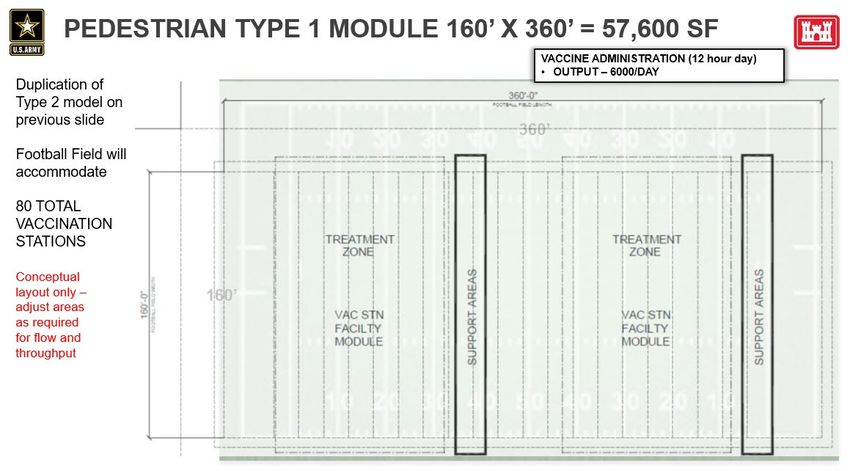
Appendix E: Critical Considerations for FEMA Employees ......................................................................... 36
         Appendix F: Communications Support for CVCs ....................................................................................... 37
         Acronyms List ............................................................................................................................................... 39
         Glossary ........................................................................................................................................................ 40
         Feedback Form ..................................................................................................................................44

1.0 Situation

1.1 Purpose
This playbook establishes guidance for providing federal support to Community Vaccination Centers (CVCs), to
include interagency coordination, resource support, facility setup, and other requirements. CVCs are essential
to support States, Tribes and Territories (STT) vaccine administration efforts. This guidance is not meant to be
proscriptive, and jurisdictions may need to adapt this guidance based on their particular requirements for
federal support.

1.2. Background
To date, the ongoing COVID-19 pandemic has claimed the lives of more than 554,000 Americans. While
mitigation measures such as social distancing and the wearing of masks are effective tools in preventing the
spread of COVID-19, an additional way to protect people and reduce the spread of this disease is with the
widespread administration of COVID-19 vaccines. As part of a national effort to speed the pace of COVID-19
vaccination campaigns, the President has directed the federal government to establish new federally supported
CVCs. As stated in the National Strategy for COVID-19 Response and Pandemic Preparedness, FEMA is charged
with supporting the set-up and operations of such CVCs.

1.3. Assumptions
    • Multiple federal agencies are able to supply or support STT staffing augmentation needs, based on
        authorization and identified staffing capability to support clinical and/or non-clinical requirement (e.g.
        vaccine administration vs. general crowd management and administrative support)
    • Federal staff may not be available to meet the totality of staffing needs
    • There will be a change in the available national vaccine supply, storage requirements for vaccine
        centers, and the number of doses required by recipients pending vaccine developments
    • Plans for operating and activating CVCs must be coordinated with STT authorities to support access to
        vaccination in jurisdictions
    • CVCs should expect a minimum of 1-3 days to ramp up to full operational capability when a new
        facility is established or new vaccination staff is brought in; for example, a Type 2 CVC might only do
        1,000 vaccinations in the first few days (or even the first week) while training is conducted and staff
        become familiar with the CVC operations, with 2,000 vaccinations in the following days or week,
        before reaching full capacity, which is 3,000 per day.
    • Staffing requirements may change as a function of the facility or location
    • All stationary clinics should be supported by STT presence during build-out and operations, including
        STT incident command and at least one clinical manager and/or representative from the STT health
        department/authority on site
    • All staff must have valid current and unencumbered licenses and/or certifications as applicable to
        their position

1.4. Critical Considerations

         Equitable Access
    •    Underserved and historically marginalized groups, including communities of color, persons with
         disabilities, and others – many of whom may live in neighborhoods with higher virus incidence – often

Version 5.0                                                                                                                                                    Page | 3
face greater barriers to information and resources necessary to register for and access vaccination
         services,. Therefore tailored outreach in partnership with community groups might be necessary
    •    It is critical that Civil Rights and Disability Integration advisors are consulted throughout CVC site
         selection, set-up, and operation, to ensure equitable access for all parties. The Civil Rights Checklist,
         created to assist in ensuring equitable access to the vaccine for the whole community, is vital for
         successful planning and should be diligently used by STT
    •    Equitable outcomes will be measured with data. It is imperative that STT recipients collect
         demographic data – and provide aggregated data when requested – to demonstrate equitable access
         and administration of the vaccine
    •    There is no citizenship requirement for vaccination and STTs should not require identification at CVCs

         Vaccine Distribution and Administration
    •    Command and control of the facility must be established to ensure applicable chains of command
         over federal and non-federal personnel are consistent with law and applicable MOUs and contracts
         that may pertain to the facility. In addition, whether the facility is STT-run or FEMA-run may impact
         safety protocols.
    •    Distribution processes for vaccines vary depending on manufacturer and jurisdiction
    •    Storage, preparation, vaccine administration timelines and required doses vary depending on
         manufacturer and the applicable FDA-issued vaccine Emergency Use Authorizations (EUAs)
    •    CVCs should have the capability to collect, organize, store, and transmit information if unable to
         access digital system platforms for vaccine administration, consistent with applicable laws.
    •    Planning for distribution of vaccine to members of Tribes must be coordinated with all the appropriate
         entities, including but not limited to FEMA regions, the Bureau of Indian Affairs (BIA) and/or Indian
         Health Service (IHS) to develop specific plans for direct IHS distribution and facilitate administration of
         vaccines to IHS Direct, Tribal Health Programs and Urban Indian Organizations who elected to receive
         vaccines through the BIA or IHS
    •    At a minimum, all COVID-19 mitigation mandates from CDC’s Interim Infection Prevention and Control
         Recommendations for Healthcare Personnel During the Coronavirus Disease 2019 (COVID-19)
         Pandemic must be adhered to. Jurisdictions may require mitigation measures in addition to these
    •    The STT ultimately have the authority to choose to set licensure/certification requirements for
         vaccinators working at their direction. However, STT should be advised that Declarations under the
         PREP Act for COVID-19 have vastly expanded the available pool of potential vaccinators, through the
         preemption of state laws under these declarations. STT should be encouraged, to the maximum extent
         possible, to utilize this expanded authority to use non-traditional vaccinators, authorized by the PREP
         Act
    •    Planners and CVC managers may find additional ways to increase vaccinations per day as they identify
         opportunities to implement continuous improvements (e.g., revising registration and check-in
         processes, improving vaccination draws, and improving patient and logistics movement through the
         clinic)
    •    The Regional Response Coordination Center (RRCC) must work with STT to address outreach and
         vaccine administration and develop plans for recipients who are homebound, unable to travel, have
         limited access to transportation, have mobility limitations, etc. through the use of CDC Homebound
         Persons Vaccination guidance.
    •    CVC site leadership must consider the relationship of site throughput and supply of vaccine, especially
         as vaccine supply increases, to ensure the site is taking advantage of efficiencies to match throughput
    •    CVC managers should assess operating trends, include average rate of people with registered
         appointments who did not show, and adjust daily registration, utilize standby appointments, and
         manage vaccine preparation towards the ends of shift to reduce spoilage
    •    All CVCs should ensure appropriate protocols are in place to address needle/emergency sharps
         injuries which might include medical evaluation, lab draws, post exposure prophylaxis, and long-term
         follow-up

Version 5.0                                                                                                Page | 4
Facility
    •    Personnel numbers, square footage and diagrams/floor plans are provided as examples and may
         need to be adjusted based on actual site requirements, STT regulations, etc. They are not prescriptive
         and can be tailored to the requirements of each CVC.
    •    Supply chain constraints due to the pandemic may lead to unanticipated challenges procuring
         supplies necessary for facility setup
    •    All jurisdiction COVID-19 mitigation mandates must be adhered to by staff and vaccine recipients
         (mask wearing, social distancing, washing hands/use of hand sanitizer)
    •    If a facility is under the jurisdiction of DHS/FEMA it must meet all DHS and FEMA requirements for
         facility access, physical security and information security in accordance with Federal policy and
         guidelines
    •    Drive-through CVC must develop plans to accommodate recipients arriving to the CVC through
         alternative means (e.g., buses, vans, or on foot and identify how they will be vaccinated e.g., aboard
         the vehicle, or disembark)

1.5. Limiting Factors
    • Current supply of COVID-19 vaccine does not meet national demand
    • Medical consumables and products in support of the vaccine administration may be limited
    • Cold-chain storage and handling requirements for each COVID-19 vaccine product will vary, and
        ongoing stability testing may impact these requirements. The most up to date storage and handling
        requirements for each vaccine can be found in the FDA’s appropriate manufacture vaccine’s Fact
        Sheet for Healthcare Providers Administering Vaccine
            o Cold-chain storage equipment is not necessarily available at all traditional vaccine
                 administration CVCs
    • Public health and medical personnel are a scarce resource (especially physicians, nurses, respiratory
        therapists, laboratory technicians, and emergency medical services staff/personnel)
    • STT partners are utilizing different processes of varying sophistication for information management
    • Vaccine recipients may not understand the registration process nor how to ask for an accommodation
        even if the state is providing language services
    • Effective communication access may be limited to virtual connections as in-person support is limited.
        Virtual connectivity may be limited in some areas
    • Availability of staff critical to facility selection and setup is limited (e.g., FEMA Offices of Disability
        Integration, Equal Rights)
    • Medical waste disposal requirements will vary by jurisdiction

2.0 Mission and End State

2.1. Mission
Provide support such as set up, equipment, information management, staffing, and CVC operation to existing
or new CVCs including mobile clinics in STT areas leveraging close coordination between the federal
government and all vaccination jurisdictions to foster timely and equitable distribution and administration of
COVID-19 vaccines.

2.2. End State
STT have a sustainable capability to administer vaccinations now and in the future.

3.0 Execution

3.1 Operations

3.1.1. Operational Approach

Version 5.0                                                                                              Page | 5
The federal government will support STT vaccination programs by providing resources for pre-existing facilities
and/or establishing new federally supported facilities. Facilities will be established as fixed facility, drive-
through facility, or as a mobile vaccination clinic (See Appendix A for additional information on CVC types). Site
selection for CVCs will be needs based, data driven, and in support of STT requests. The objective of federally
supported CVCs is to maximize the timely and safe administration of the vaccine to all recipients. Facility size
models will be based on throughput over a 12-hour shift and are as following:

                                      Facility Size Models (for new facilities)
          Type 1                  Type 2                  Type 3                   Type 4          Type 5 – Mobile Site
 Approximate capacity    Approximate capacity    Approximate capacity     Approximate capacity    Approximate capacity
 of 6,000 doses a day    of 3,000 doses a day    of 1,000 doses a day     of 250 doses a day      of 250 doses a day
 Minimum of 15,000 sf    Minimum of 7,500 sf     Minimum of 4,500 sf      Minimum of 2,500 sf     Minimum of 2,500 sf
 with adequate parking   with adequate parking   with adequate parking    with adequate parking   with adequate parking
 for at least 800        for at least 600        for at least 250         for at least 130        for at least 130
 vehicles                vehicles                vehicles                 vehicles                vehicles

3.1.2. Fixed Facility (Pedestrian) Checklist
The list of actions below facilitates the effective and efficient administration of vaccinations in a fixed facility,
pedestrian. These actions are formatted as a checklist but many of the actions will be initiated concurrently,
not sequentially. See Appendix B for conceptual layouts of the facility types.

                                                     Fixed Facility

                                                    Selection Actions

      If location not already identified by STT and approved by the region, conduct a search and sourcing
      process using either FEMA Logistics or General Services Administration (GSA) for site selection. Use
      Civil Rights Checklist to ensure equity
      Conduct vaccination site assessment (key participants: local public health officials, Safety, Security,
      Civil Rights, Emergency Management Officials, Fire Inspector & Office of Disability Integration
      Coordination)
      Using the FEMA Disaster Facility Setup Guide and Disaster Facility Setup Guide Updates or other
      appropriate criteria, support the jurisdiction in determining the spacing and layout needs for the
      required CVC
      Coordinate the appropriate license and space utilization agreement (LUA) and/or memorandum of
      understanding (MOUs)
      Ensure adequate traffic control plan, set-up space, and staging areas to accommodate operations
      Confirm communication lines (landline/cellphone and computer/internet) are operational and
      accessible for people with disabilities as required with mobile wireless access points (MiFi’s/Cradle
      points)
      Identify a location for stand-by ambulance at the CVC for management of recipients with on-site
      medical emergencies
      Identify pre-solicited, signed and or other standing agreements – either federal, state or local that can
      be extended in order to provide janitorial/custodial services. Also establish agreements for medical
      waste disposal services
      Coordinate with local authorities for on-site security, public transportation to the CVC, outreach, and
      other community impact considerations and requirements
      All CVCs should have emergency backup power to the storage equipment of the vaccine supply. This
      emergency power will ensure continuous cold storage in the event of a Public Safety Power Shutoff
      (PSPS), or storm interrupts the local electrical power supply
      Ensure location of the facility is added as an approved site in the CDC's Vaccine Tracking System
      (VTrckS) to enable ordering and delivery of vaccine to the CVC, have a signed CDC provider agreement,
      and have VaccineFinder sign up for vaccine dose tracking
Version 5.0                                                                                                  Page | 6
Review training plan and job action sheets for all staff and each required role as established by the STT
      Ensure facility opening dates are communicated to the public
      Develop a strategy for demobilization of the CVC or transfer of operation from Federal to STT

                                                  Pre-Clinical Actions

      Facilitate and coordinate the Resource Request Form (RRF) process for federally supported mission
      assignments to include staffing, contracting, and other resource requirements for the receiving site via
      the FEMA Regional Response Coordination Center (RRCC) in consultation with ESF8: Health and Human
      Services (HHS) Office of the Assistance Secretary for Preparedness and Response (ASPR)
      Coordinate with the jurisdiction to determine the type and the required throughput capacity of the CVC.
      (The number of persons preregistered in the receiving jurisdiction may be useful to estimate throughput
      needs)
      Confirm if federal support is for an existing community vaccination center or a new CVC that needs to be
      established
      Coordinate with jurisdiction to determine community requirements (urban, suburban, rural, remote) for
      vaccination CVCs (fixed, mobile, drive-through)
      Coordinate with the jurisdiction to identify any additional access and functional needs required at the
      CVC for potential vaccine recipients, to include sign language, captioning services, Braille, large print,
      and translation and interpreting for people whose language is other than English
      Review CDC’s Vaccine Storage and Handling Toolkit and FDA’s appropriate manufacture vaccine’s Fact
      Sheet for Healthcare Providers Administering Vaccine to ensure adequate storage is available on-site or
      if transportation will be required to bring the vaccine dosages to the CVC each day. Ensure vaccines
      were transported appropriately
      Ensure the vaccine allocation for the CVC will adequately support desired throughput for the day
      Review receiving jurisdiction regulations governing the practice of health care professionals. (This
      should be considered when determining clinic staffing and assignment of roles and responsibilities)
      Coordinate with the jurisdiction to determine access requirements, permissions, and training for
      required data systems for vaccine administration and distribution tracking
      Coordinate with the jurisdiction to determine vaccine allocation with receiving jurisdiction to include the
      quantity, type, and storage/handling requirements at the CVC
      Coordinate with the jurisdiction to ensure contingency plan is developed and in place if vaccinations are
      compromised and/or need replacement
      Ensure the medical screener discusses with potential vaccine recipients to identify
      persons with contraindications and precautions. Ensure staff follow CDC’s Interim Considerations:
      Preparing for the Potential Management of Anaphylaxis After COVID-19 Vaccination
      Stage the Advanced Life Support (ALS) ambulance at an appropriate location to be readily accessible to
      the whole facility
      Review CDC and NIOSH protocols for Preventing Needlestick Injuries in Health Care Settings and
      Emergency Sharps Information to promote education and safe work practices for handling needles and
      related systems.
      Review CDC’s Ventilation in Buildings guidance and ASHRAE/USACE Alternative Care Site HVAC
      Guidebook; coordinate with site facilities team to enhance ventilation when necessary.
      Ensure appropriate amount of medical documentation (intake forms, etc.) and has adequate locked
      storage areas

                                          Clinical Daily Operational Actions

      Ensure minimum staffing and work assignments and schedule is established for the day
      Confirm vaccine inventory is on-site to meet the expected throughput for the day
      Pre-screening of CVC staff is accomplished using temperature screening and symptom and exposure
      questionnaire
      Ensure appropriate quantity of Personal Protective Equipment (PPE) is staged and available for CVC staff
      based on anticipated daily burn rate. Ensure all staff have and utilize their PPE at all times
      Ensure availability of appropriate medical consumables based on the anticipated daily burn rate
      Ensure standby EMS crew(s) develop appropriate plans to access all areas of the CVC to provide care
      and transport to recipients including those not readily accessible by ambulance

Version 5.0                                                                                              Page | 7
Follow CDC’s Vaccine Storage and Handling Toolkit and FDA’s appropriate manufacture vaccine’s Fact
      Sheet for Healthcare Providers Administering Vaccine
      Ensure appropriate amount of sanitation and work surface disinfectant supplies
      Establish a process to verify the arriving potential vaccine recipients have an appointment that day to
      receive a vaccine
      Assign appropriate staff to the Recipient Exit Area/Exit Reviewer in order to observe recipients for
      adverse reactions to vaccine
      Establish a staging area to address any additional resource needs
      Ensure effective communication to facility support staff to track, monitor, and restock medical supplies
      Fill out all relevant information on the recipient’s CDC COVID-19 Vaccination Record Card and record the
      date and vaccine lot number and schedule the second vaccine shot (if applicable)
      Sanitize the vaccine administration work area after each vaccine administration
      Send the recipient to the observation area to wait for the described post-vaccination waiting time per the
      CDC guidelines outlined in CDC’s Interim Considerations: Preparing for the Potential Management of
      Anaphylaxis After COVID-19 Vaccination

                                      Facility Support Daily Operational Actions

      Conduct a pre-opening facility sweep to ensure that all safety and sanitization procedures have been
      followed and are in place
      Ensure minimum staffing, work assignments, and schedule is established for the day
      Ensure traffic/access control process is in place for the facility and the parking lot
      Conduct a Daily Shift/Safety Briefing with all CVC staff prior to opening the CVC
      Establish the day’s battle rhythm and ensure all CVC staff are aware of it
      Review and understand EEIs and other reporting requirements for all appropriate entities
      Ensure multilingual and multimodal signage is posted that describes the vaccine recipient flow starting
      from outside the facility including the Check-In/Screening Area, and all the way to Observation Area
      Ensure appropriate information technology (IT) support is available
      Stage Pre-Waiting Area where vaccine recipients wait to be sent to a vaccination station
      Ensure an area is set aside for staff to take allotted break(s)
      Verify all personnel are in place and all stations are ready to process vaccine recipients prior to opening
      the facility
      Ensure a process is in place for regular disinfecting of the CVC
      Conduct pre-screening of vaccine recipients at the Check-In/Screening Area using a temperature
      screening and symptom and exposure questionnaire
      Ensure process is in place to monitor and track facility supplies and track daily burn rates
      Monitor occupancy levels in the observation area to prevent over crowding
      Establish a staff accountability process to include a sign in (including temperature screening and
      symptom and exposure questionnaire) and sign out process
      Ensure a process is in place for proper handling/disposal of medical waste
      Ensure a process is in place for general facility waste handling

                                             Facility End of Shift Actions

      Conduct an end of day supervisor meeting with relevant staff
      Ensure all remaining vaccines are adequately secured and stored for the night
      Thoroughly sanitize all workstations and public areas
      Ensure all medical records (PII documents) are appropriately secured and stored
      Ensure CVC location is fully secured prior to departure

                                      Facility Close-out/Demobilization Actions

      Coordinate with jurisdiction to complete a post-CVC evaluation and ensure post-CVC reporting and
      recording of vaccinations administered are provided to the jurisdiction immunization information system
      (IIS)
      Create or reform a demobilization/transition plan upon rightsizing/closing facilities or transferring the
      CVC to another organization/agency
Version 5.0                                                                                              Page | 8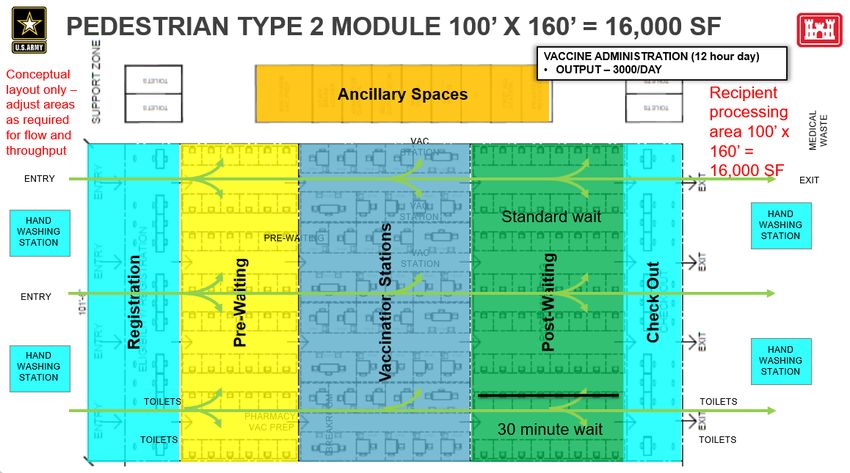
Close-out of all support contracts that were supporting the CVC and coordinate the transfer of the
      contract over to STT if necessary
      Establish a plan for the removal of all equipment and any mitigation for small damage to the facility and
      that equipment is disposed of in accordance with Federal regulations, and STT laws and procedures
      Complete final walk-through of the facility with the facility owner in order to secure release of liability and
      document condition of the facility upon departure
      Ensure the RRCC has reviewed reimbursement requests, paid all bills, and de-obligate funds
      Ensure the closeout of a Mission Assignment (MA) at the incident management (IM) and incident
      support (IS) levels according to RRCC defined process
      Ensure that a plan has been developed to right size or retrograde of Federal resources at the CVC as
      needed
      Ensure CVC closing dates are communicated by the Public Information Officers to the public if the CVC is
      not transitioned to STT management

3.1.3. Drive Through Facility Operational Checklists
The list of actions below facilitates the effective and efficient administration of vaccinations in a drive through.
These actions are formatted as a checklist but many of the actions will be initiated concurrently, not
sequentially. See Appendix B for conceptual layouts of the facility types.

                                                    Drive-Through Facility

                                                   Selection Actions

      If location not already identified by STT and approved by the Region, conduct a search and sourcing
      process using either FEMA Logistics or General Services Administration (GSA) for site selection. Use
      Civil Rights Checklist to ensure equity
      Conduct vaccination site assessment (key participants: Local Public Health Officials, Safety,
      Security, Civil Rights, Emergency Management Officials, Fire Inspector & Office of Disability
      Integration Coordination)
      Using the FEMA Disaster Facility Setup Guide and Disaster Facility Setup Guide Updates or other
      appropriate criteria, support the jurisdiction in determining the spacing and layout needs for the
      required CVC
      Coordinate the appropriate license and space utilization agreement (LUA) and/or memorandum of
      understanding (MOUs)
      Ensure adequate traffic control plan, set-up space, and staging areas to accommodate operations
      Confirm communication lines (landline/cellphone and computer/internet) are operational with mobile
      wireless access points (MiFi’s/Cradle points)
      Identify a location for stand-by ambulance at the CVC for management of recipients with on-site
      medical emergencies
      Identify pre-solicited, signed and or other standing agreements – either federal, state, or local that can
      be extended in order to provide janitorial/custodial services. Also establish agreements for medical
      waste disposal services
      Coordinate with local authorities for on-site security, public transportation to the CVC, outreach, and
      other community impact considerations and requirements
      All CVC facilities should have emergency backup power to the storage equipment of the vaccine
      supply. This emergency power will ensure continuous cold storage in the event of a Public Safety
      Power Shutoff (PSPS), or storm interrupts the local electrical power supply
      Add the location of the facility as an approved site in the CDC's Vaccine Tracking System (VTrckS) to
      enable ordering and delivery of vaccine to the CVC
      Review training plan for all staff and each required role as established by the STT
      Ensure adequate spacing allowance for social distancing from entry to exit
      Ensure warming and cooling stations are established for staff with adequate storage for PPE, vaccines,
      and other supplies
      Ensure facility opening dates are communicated to the public
      Develop a strategy for demobilization of the CVC or transfer of operation from Federal to STT

Version 5.0                                                                                                 Page | 9
Pre-Clinical Actions

      Facilitate and coordinate the Resource Request Form (RRF) process for federally supported mission
      assignments to include staffing, contracting, and other resource requirements for the receiving CVC via
      the FEMA Regional Response Coordination Center (RRCC) in consultation with ESF8: Health and Human
      Services (HHS) Office of the Assistance Secretary for Preparedness and Response (ASPR)
      Coordinate with the jurisdiction to determine the type and the required throughput capacity of the CVC.
      (The number of persons preregistered in the receiving jurisdiction may be useful to estimate throughput
      needs)
      Confirm if Federal support is for an existing community vaccination center or a new CVC that needs to be
      established
      Coordinate with jurisdiction to determine community requirements (urban, suburban, rural, remote) for
      vaccination CVCs (fixed, mobile, drive-through)
      Coordinate with the jurisdiction to identify any additional access and functional needs required at the
      CVC for potential vaccine recipients, to include sign language, captioning services, Braille, large print,
      and translation and interpreting for people whose language is other than English
      Review CDC’s Vaccine Storage and Handling Toolkit and FDA’s appropriate manufacture vaccine’s Fact
      Sheet for Healthcare Providers Administering Vaccine to ensure adequate storage is available on-site or
      if transportation will be required to bring the vaccine dosages to the CVC each day. Ensure vaccines
      were transported appropriately.
      Ensure the vaccine allocation for the CVC will adequately support desired throughput for the day
      Review receiving jurisdiction regulations governing the practice of health care professionals. (This
      should be considered when determining clinical staffing and assignment of roles and responsibilities)
      Coordinate with the jurisdiction to determine access requirements, permissions, and training for
      required data systems for vaccine administration and distribution tracking
      Coordinate with the jurisdiction to determine vaccine allocation with receiving jurisdiction to include the
      quantity, type, and storage/handling requirements at the CVC
      Coordinate with the jurisdiction to ensure contingency plan is developed and in place if vaccinations are
      compromised and/or need replacement
      Ensure the medical screener discusses with potential vaccine recipients to identify persons with
      contraindications and precautions. Ensure staff follow CDC’s Interim Considerations: Preparing for the
      Potential Management of Anaphylaxis After COVID-19 Vaccination
      Stage the ALS ambulance at an appropriate location to be readily accessible to the whole facility
      Review CDC and NIOSH protocols for Preventing Needlestick Injuries in Health Care Settings and
      Emergency Sharps Information to promote education and safe work practices for handling needles and
      related systems.
      Ensure appropriate amount of medical documentation (intake forms, etc.) and has adequate locked
      storage areas

                                          Clinical Daily Operational Actions

      Ensure minimum staffing and work assignments and schedule is established for the day
      Confirm vaccine inventory is on-site to meet the expected throughput for the day
      Pre-screening of CVC staff is accomplished using temperature screening and symptom and exposure
      questionnaire
      Ensure appropriate quantity of PPE is staged and available for CVC staff based on anticipated daily burn
      rate. Ensure all staff have and utilize their PPE at all times
      Ensure availability of appropriate medical consumables based on the anticipated daily burn rate.
      Ensure standby EMS crew(s) develop appropriate plans to access all areas of the CVC to provide care
      and transport to recipients including those not readily accessible by ambulance
      Follow CDC’s Vaccine Storage and Handling Toolkit and FDA’s appropriate manufacture vaccine’s Fact
      Sheet for Healthcare Providers Administering Vaccine
      Ensure appropriate amount of sanitation and work surface disinfectant supplies
      Establish a process to verify the arriving potential vaccine recipients have an appointment that day to
      receive a vaccine
      Assign appropriate staff to the Recipient Exit Area/Exit Reviewer in order to observe recipients for
      adverse reactions to vaccine
      Establish a staging area to address any additional resource needs
Version 5.0                                                                                             Page | 10
Ensure effective communication to facility support staff to track, monitor, and restock medical supplies
Fill out all relevant information on the recipient’s CDC COVID-19 Vaccination Record Card and record the
date and vaccine lot number and schedule the second vaccine shot (if applicable)
Sanitize the vaccine administration work area after each vaccine administration
Send the recipient to the observation area to wait for the described post-vaccination waiting time per the
CDC guidelines outlined in CDC’s Interim Considerations: Preparing for the Potential Management of
Anaphylaxis After COVID-19 Vaccination
Facility Support Daily Operational Actions
Conduct a pre-opening facility sweep to ensure that all safety and sanitization procedures have been
followed and are in place
Ensure minimum staffing, work assignments, and schedule is established for the day
Ensure traffic/access control process is in place for the facility and the parking lot
Conduct a Daily Shift/Safety Briefing with all CVC staff prior to opening the CVC
Establish the day’s battle rhythm and ensure all CVC staff are aware of it
Review and understand EEIs and other reporting requirements for all appropriate entities
Ensure multilingual and multimodal signage is posted that describes the vaccine recipient flow starting
from outside the facility including the Check-In/Screening Area, and all the way to Observation Area
Ensure appropriate information technology (IT) support is available
Stage Pre-Waiting Area where vaccine recipients wait to be sent to a vaccination station
Ensure an area is set aside for staff to take allotted break(s)
Verify all personnel are in place and all stations are ready to process vaccine recipients prior to opening
the facility
Ensure a process is in place for regular disinfecting of the CVC
Conduct pre-screening of vaccine recipients at the Check-In/Screening Area using a temperature
screening and symptom and exposure questionnaire
Ensure process is in place to monitor and track facility supplies and track daily burn rates
Monitor occupancy levels in the observation area to prevent over crowding
Establish a staff accountability process to include a sign (including temperature screening and symptom
and exposure questionnaire) in and sign out process
Ensure a process is in place for proper handling/disposal of medical waste
Ensure a process is in place for general facility waste handling
Facility End of Shift Actions
Conduct an end of day supervisor meeting with relevant staff
Ensure all remaining vaccines are adequately secured and stored for the night
Thoroughly sanitize all workstations and public areas
Ensure all medical records (PII documents) are appropriately secured and stored
Ensure CVC location is fully secured prior to departure
Facility Close-out/Demobilization Actions
Coordinate with jurisdiction to complete a post-CVC evaluation and ensure post-CVC reporting and
recording of vaccinations administered are provided to the jurisdiction immunization information system
(IIS)
Create or reform a demobilization/transition plan upon rightsizing/closing facilities or transferring the
CVC to another organization/agency
Close-out of all support contracts that were supporting the CVC and coordinate the transfer of the
contract over to STT if necessary
Establish a plan for the removal of all equipment and any mitigation for small damage to the facility and
that equipment is disposed of in accordance with Federal regulations, and STT laws and procedures
Complete final walk-through of the facility with the facility owner in order to secure release of liability and
document condition of the facility upon departure.
Ensure the RRCC has reviewed reimbursement requests, paid all bills, and de-obligate funds
Ensure the closeout of a Mission Assignment (MA) at the incident management (IM) and incident
Version 5.0 Page | 11support (IS) levels according to RRCC defined process
Ensure that a plan has been developed to right size or retrograde of Federal resources at the CVC as
needed
Ensure CVC closing dates are communicated by the Public Information Officers to the public if the CVC is
not transitioned to STT management
3.1.4. Mobile Vaccination Clinic Operational Checklist
The list of actions below facilitates the effective and efficient administration of vaccinations in a mobile
vacation clinic. These actions are formatted as a checklist but many of the actions will be initiated
concurrently, not sequentially. See Appendix B for conceptual layouts of the facility types.
Mobile Vaccination Clinic
Selection Actions
If location not already identified by STT and approved by the Region, conduct a search and sourcing
process using FEMA Logistics for site selection. Use Civil Rights Checklist to ensure equity
Ensure that parking area is assessed for safety and accessibility
Conduct vaccination site assessment (key participants: Local Public Health Officials, Safety,
Security, Civil Rights, Emergency Management Officials, Fire Inspector & Office of Disability
Integration Coordination)
Using the FEMA Disaster Facility Setup Guide and Disaster Facility Setup Guide Updates or other
appropriate criteria, support the jurisdiction in determining the spacing and layout needs for the
required CVC
Coordinate the appropriate license and space utilization agreement (LUA) and/or memorandum of
understanding (MOUs)
Ensure adequate traffic control plan, set-up space, and staging areas to accommodate operations
Confirm communication lines (landline/cellphone and computer/internet) are operational and
accessible for people with disabilities as required with mobile wireless access points
(MiFi’s/Cradle points)
Identify a location for stand-by ambulance at the CVC for management of recipients with on-site medical
emergencies
Identify pre-solicited, signed and or other standing agreements – either federal, state, or local that can
be extended in order to provide janitorial/custodial services. Also establish agreements for medical
waste disposal services
Coordinate with local authorities for on-site security, public transportation to the CVC, outreach and
other community impact considerations and requirements
All CVCs should have emergency backup power to the storage equipment of the vaccine supply. This
emergency power will ensure continuous cold storage in the event of a Public Safety Power Shutoff
(PSPS), or storm interrupts the local electrical power supply
Add the location of the facility as an approved site in the CDC's Vaccine Tracking System (VTrckS) to
enable ordering and delivery of vaccine to the CVC
Review training plan and job action sheets for all staff and each required role as established by the STT
Ensure facility opening dates are communicated to the public
Develop a strategy for demobilization of the CVC or transfer of operation from Federal to STT
Pre-Clinical Actions
Facilitate and coordinate the Resource Request Form (RRF) process for federally supported mission
assignments to include staffing, contracting, and other resource requirements for the receiving CVC via
the FEMA Regional Response Coordination Center (RRCC) in consultation with ESF8: Health and Human
Services (HHS) Office of the Assistance Secretary for Preparedness and Response (ASPR)
Coordinate with the STT to determine how much vaccine allocation to the CVC should expect from the
STT allocations of the vaccine
Coordinate with the jurisdiction to determine the type and the required throughput capacity of the CVC.
Version 5.0 Page | 12(The number of persons preregistered in the receiving jurisdiction may be useful to estimate throughput
needs)
Confirm if Federal support is for an existing community vaccination center or a new CVC that needs to be
established
Coordinate with jurisdiction to determine community requirements (urban, suburban, rural, remote) for
vaccination CVCs (fixed, mobile, drive-through)
Coordinate with the jurisdiction to identify any additional access and functional needs required at the
CVC for potential vaccine recipients, to include sign language, captioning services, Braille, large print,
and translation and interpreting for people whose language is other than English
Review CDC’s Vaccine Storage and Handling Toolkit and FDA’s appropriate manufacture vaccine’s Fact
Sheet for Healthcare Providers Administering Vaccine to ensure adequate storage is available on-site or
if transportation will be required to bring the vaccine dosages to the CVC each day. Ensure vaccines
were transported appropriately
Ensure the vaccine allocation for the CVC will adequately support desired throughput for the day
Review receiving jurisdiction regulations governing the practice of health care professionals. (This
should be considered when determining clinical staffing and assignment of roles and responsibilities)
Coordinate with the jurisdiction to determine access requirements, permissions, and training for
required data systems for vaccine administration and distribution tracking
Coordinate with the jurisdiction to determine vaccine allocation with receiving jurisdiction to include the
quantity, type, and storage/handling requirements at the CVC
Coordinate with the jurisdiction to ensure contingency plan is developed and in place if vaccinations are
compromised and/or need replacement
Ensure the medical screener discusses with potential vaccine recipients to identify
persons with contraindications and precautions. Ensure staff follow CDC’s Interim Considerations:
Preparing for the Potential Management of Anaphylaxis After COVID-19 Vaccination
Stage the ALS ambulance at an appropriate location to be readily accessible to the whole facility
Review CDC and NIOSH protocols for Preventing Needlestick Injuries in Health Care Settings and
Emergency Sharps Information to promote education and safe work practices for handling needles and
related systems.
Ensure appropriate amount of medical documentation (intake forms, etc.) and has adequate locked
storage areas
Clinical Daily Operational Actions
Ensure minimum staffing and work assignments and schedule is established for the day
Confirm vaccine inventory is on-site to meet the expected throughput for the day
Pre-screening of CVC staff is accomplished using temperature screening and symptom and exposure
questionnaire
Ensure appropriate quantity of PPE is staged and available for CVC staff based on anticipated daily burn
rate. Ensure all staff have and utilize their PPE at all times
Ensure availability of appropriate medical consumables based on the anticipated daily burn rate
Ensure standby EMS crew(s) develop appropriate plans to access all areas of the CVC to provide care
and transport to recipients including those not readily accessible by ambulance
Follow CDC’s Vaccine Storage and Handling Toolkit and FDA’s appropriate manufacture vaccine’s Fact
Sheet for Healthcare Providers Administering Vaccine
Ensure appropriate amount of sanitation and work surface disinfectant supplies
Establish a process to verify the arriving potential vaccine recipients have an appointment that day to
receive a vaccine
Assign appropriate staff to the Recipient Exit Area/Exit Reviewer in order to observe recipients for
adverse reactions to vaccine
Establish a staging area to address any additional resource needs
Ensure effective communication to facility support staff to track, monitor, and restock medical supplies
Fill out all relevant information on the recipient’s CDC COVID-19 Vaccination Record Card and record the
date and vaccine lot number and schedule the second vaccine shot (if applicable)
Sanitize the vaccine administration work area after each vaccine administration
Send the recipient to the observation area to wait for the described post-vaccination waiting time per the
CDC guidelines outlined in CDC’s Interim Considerations: Preparing for the Potential Management of
Version 5.0 Page | 13Anaphylaxis After COVID-19 Vaccination
Facility Support Daily Operational Actions
Conduct a pre-opening facility sweep to ensure that all safety and sanitization procedures have been
followed and are in place
Ensure minimum staffing, work assignments, and schedule is established for the day
Ensure traffic/access control process is in place for the facility and the parking lot
Conduct a Daily Shift/Safety Briefing with all CVC staff prior to opening the CVC
Establish the day’s battle rhythm and ensure all CVC staff are aware of it
Review and understand EEIs and other reporting requirements for all appropriate entities
Ensure multilingual and multimodal signage is posted that describes the vaccine recipient flow starting
from outside the facility including the Check-In/Screening Area, and all the way to Observation Area
Ensure appropriate information technology (IT) support is available
Stage Pre-Waiting Area where vaccine recipients wait to be sent to a vaccination station
Ensure an area is set aside for staff to take allotted break(s)
Verify all personnel are in place and all stations are ready to process vaccine recipients prior to opening
the facility
Ensure a process is in place for regular disinfecting of the CVC
Conduct pre-screening of vaccine recipients at the Check-In/Screening Area using a temperature
screening and symptom and exposure questionnaire
Ensure process is in place to monitor and track facility supplies and track daily burn rates
Monitor occupancy levels in the observation area to prevent over crowding
Establish a staff accountability process to include a sign (including temperature screening and symptom
and exposure questionnaire) in and sign out process
Ensure a process is in place for proper handling/disposal of medical waste
Ensure a process is in place for general facility waste handling
Facility End of Shift Actions
Conduct an end of day supervisor meeting with relevant staff
Ensure all remaining vaccines are adequately secured for the night
Thoroughly sanitize all workstations and public areas
Ensure all medical records (PII documents) are appropriately secured and stored
Ensure CVC location is fully secured prior to departure
Facility Close-out/Demobilization Actions
Coordinate with jurisdiction to complete a post-CVC evaluation and ensure post-CVC reporting and
recording of vaccinations administered are provided to the jurisdiction immunization information system
(IIS)
If relevant, create or reform a demobilization/transition plan upon rightsizing/closing facilities or
transferring the CVC to another organization/agency
Close-out of all support contracts that were supporting the CVC and coordinate the transfer of the
contract over to STT if necessary
Establish a plan for the removal of all equipment and any mitigation for small damage to the facility and
that equipment is disposed of in accordance with Federal regulations, and STT laws and procedures
Complete final walk-through of the facility with the facility owner in order to secure release of liability and
document condition of the facility upon departure.
Ensure the RRCC has reviewed reimbursement requests, paid all bills, and de-obligate funds
Ensure the closeout of a Mission Assignment (MA) at the incident management (IM) and incident
support (IS) levels according to RRCC defined process
Ensure that a plan has been developed to right size or retrograde of Federal resources at the CVC as
needed
Ensure CVC closing dates are communicated by the Public Information Officers to the public if the CVC is
not transitioned to STT management
Version 5.0 Page | 143.1.5. Responsibilities
The Regional Response Coordination Centers will delegate the following responsibilities to the CVCs:
• Resource accountability and tracking to inform resource request and allocations
• Upon the identification of an individual with disability or limited English proficiency provide appropriate
contact information or resource to ensure effective communication and meaningful access to
information
• Tactical control of all resources assigned to the CVCs
• Work assignment development for all assigned resources
• Maintenance and knowledge of the Community Vaccination Center Continuity of Operations (COOP),
Communications Plan and Organizational Chart
• Situational awareness and information reporting
• Other authorities deemed appropriate by the RRCC
3.1.6. Operational Strategy
Operational strategy development and implementation is a shared responsibility between the RRCC and the
CVCs. In short, the Vaccination Task Force is responsible for developing the overarching strategy, whereas the
Clinic Manager is responsible for task organization to implement that strategy. Specific responsibilities are
identified below:
Regional Response Coordination Center Responsibilities
The RRCC has the primary responsibility for directing the operational strategic approach to accomplish the end
state. The RRCC also receives input from the CVCs to contextualize and validate existing priorities and strategies.
The below are the action items for regions to consider for federal employees working in their area of
responsibility.
Regional Support to Federal
Employees Assigned to CVCs
Provide an ICS-consistent command and control structure in each state, tribe, and territory that is
accountable for all federal personnel in line with FEMA’s Core Values
Develop and maintain organizational charts for all personnel on all shifts
Support reception, staging, and onward integration of CVC staff
Ensure each responder has sufficient PPE, agency branded apparel, ready access to COVID-19 testing,
and other operating equipment
Oversee internal payroll team and all timekeeping activities, act as master timekeeper, and oversee
WebTA scheduling and trainings for CVC staff. Run bi-weekly premium pay reports and make
recommendations for work schedule modifications for CVC staff. Bi-weekly premium pay cap waiver
request (if necessary)
Complete daily accountability for CVC staff and manage weekend schedules for mission support staff to
conduct daily accountability
Coordinate and support workers’ compensation claims
Coordinate FEMA Reservist or other intermittent employee Federal Employee Health Benefits
registrations, as required
Mitigate personnel issues and manage employee relations activities involving CVC staff
Conduct DTS validation for CVC Event Details (maintain accuracy of duty locations, duty station
addresses and duty station sub-types, cross-check and verify alignment with ARC-GIS Duty Station
location.)
Conduct DTS validation for CVC Staff records (validate responders are on site, verify tour records,
deployed positions, per diem settings, temporary duty supervisors, lodging/rental car information.)
Ensure that employees have the opportunity to receive vaccinations in accordance with DHS and
STT negotiated agreements
Version 5.0 Page | 15Community Vaccination Center Responsibilities The CVCs have responsibilities for task organizing and prioritizing internal resources to implement the strategy to meet the throughput requirement. Reporting requirements are due daily to the RRCC by close of business. 3.1.7. Resource Coordination and Management Clinical, facility support, and administrative staff will be assigned to the CVCs. Staffing requests will be coordinated through the RRCC via established processes. Clinic Managers are responsible for tracking demobilization and leave dates and ensuring requests are made with adequate time for the transition of responsibilities. Staffing requirements will be defined through the RRF process and disseminated to the appropriate supply sources for fulfillment based on capability and capacity. Force packages or single resources will deploy to provide the critical staffing support identified by STT community vaccination operations. These support staff will adhere to current guidance and standards of practice included in the COVID-19 Vaccination Program Interim Playbook for Jurisdiction Operations. Variations may exist and/or specialties may be added according to the type and scale of vaccination effort. Deployment timelines will be determined by the providing agency to ensure compliance with pre-deployment testing, equipping, training and any other requirements identified. Detailed information regarding necessary staffing and supplies by facility type can be found in Appendix A1-A5. 3.1.8. Information Management at the CVCs Information management, for the purposes of this playbook, consists of three components: Data Collection and Storage, Reporting, and Requests. “Data Collection” is any data needed to complete patient registration, scheduling, or tracking/monitoring the vaccine doses. “Reporting” is any information that would inform situational awareness or resource decision making, to include Essential Elements of Information (EEI), outcomes, limiting factors, resource shortfalls, inventory stock, and processing delays. The EEIs will be designated by the NRCC/RRCC in the form of an Information Collection Plan (ICP) that will be socialized to ensure CVCs are aware of all necessary reporting requirements. “Requests,” primarily, are top down Requests for Information (RFI). RFIs may include inquiries from internal or interagency partners. Data Collection and Storage The recommended best practice for information management at federally supported CVCs is to integrate directly with STT processes for patient registration, scheduling, and other tasks requiring data collection and storage for vaccine doses. This supports the President's directive of "federal support" to STT vaccination campaigns by ensuring minimal disruption to existing processes. This unified approach also maintains a singular and familiar process for the general public. To this end, a Privacy Threshold Analysis has been authorized which allows federal employees and contractors to access and utilize state information systems for the collection and storage of information (including PII/PHI) necessary to the operation of a CVC. Each region must coordinate with their respective STT partners to procure a Memorandum of Understanding (MOU) stating that all PII/PHI collected at federally supported CVCs will only be entered and stored on STT run systems. Additionally, each MOU must state that all activities necessary to the integration of federally supported CVCs with STT systems (such as training and granting access to necessary employees) is solely the responsibility of the STT partner in question. In addition to reporting vaccines administered to the jurisdictions’ IIS or other reporting system, accurate reporting of every vaccination administered is a critical part of participation in the CDC COVID-19 Vaccination Program and vaccine administration and reporting requirements guidance are posted on CDC’s website. CDC has outlined expectations for jurisdictions to inform timely reporting. Reporting Well-functioning reporting mechanisms adopt a bottom-up approach. Accurate and useful reporting is typically communicated at the local level. Reporting, in the form of EEI, work assignments, outcomes, shortfalls, and limiting factors will go through the CVCs, whenever practical. Reporting requirement such as EEIs and Critical Information Requirements (CIRs) will be reported from the CVCs to the RRCC. Version 5.0 Page | 16
You can also read


