Comprehensive Bullying & Harassment Policy Manual 2021-2022 - Where SMART Leaders are made
←
→
Page content transcription
If your browser does not render page correctly, please read the page content below
Where SMART Leaders are made

Comprehensive Bullying
 & Harassment Policy
       Manual
       2021-2022

Model Policy Against Bullying and Harassment

                  **Please note: Any reference to “bullying” includes cyberbullying,
                                  whether or not specifically stated.

a. Statement prohibiting bullying and harassment:
    It is the policy of Navigator Academy of Leadership that all of its students and school
    employees have an educational setting that is safe, secure, and free from harassment and
    bullying of any kind. Navigator Academy of Leadership will not tolerate bullying and
    harassment of any type. Conduct that constitutes bullying and harassment, as defined herein,
    is prohibited.

b. Definition of bullying and a definition of harassment:
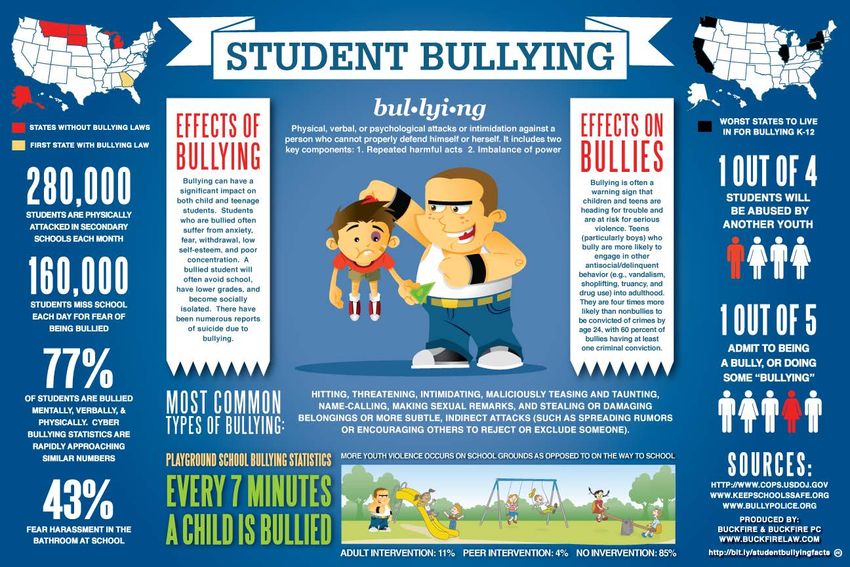
   Bullying includes cyberbullying and means systematically and chronically inflicting physical
   hurt or psychological distress on one or more students or employees. It is further defined as
   unwanted and repeated written, verbal, or physical behavior, including any threatening,
   insulting, or dehumanizing gesture, by a student or adult, that is severe or pervasive enough to
   create an intimidating, hostile, or offensive educational environment; cause discomfort or
   humiliation; or unreasonably interfere with the individual’s school performance or
   participation; and may involve but is not limited to:
        1. Teasing
        2. Social Exclusion
        3. Threat
        4. Intimidation
        5. Stalking
        6. Physical violence
        7. Theft
        8. Sexual, religious, or racial harassment
        9. Public or private humiliation
        10. Destruction of property

   Cyberbullying means bullying through the use of technology or any electronic
   communication, which includes, but is not limited to, any transfer of signs, signals, writing,
   images, sounds, data or intelligence of any nature transmitted in whole or in part by a wire,
   radio, electromagnetic system, photoelectronic system, or photooptical system, including, but
   not limited to, electronic mail, Internet communications, instant messages, or facsimile
   communications. Cyberbullying includes the creation of a webpage or weblog in which the
   creator assumes the identity of another person, or the knowing impersonation of another
   person as the author of posted content or messages, if the creation or impersonation creates
   any of the conditions enumerated in the definition of bullying. Cyberbullying also includes
   the distribution by electronic means of a communication to more than one person or the
   posting of material on an electronic medium that may be accessed by one or more persons, if
   the distribution or posting creates any of the conditions enumerated in the definition of
   bullying.

Modeled after the Florida Department of Education   1
Model Policy Against Bullying and Harassment
                                                                          Revised July 2021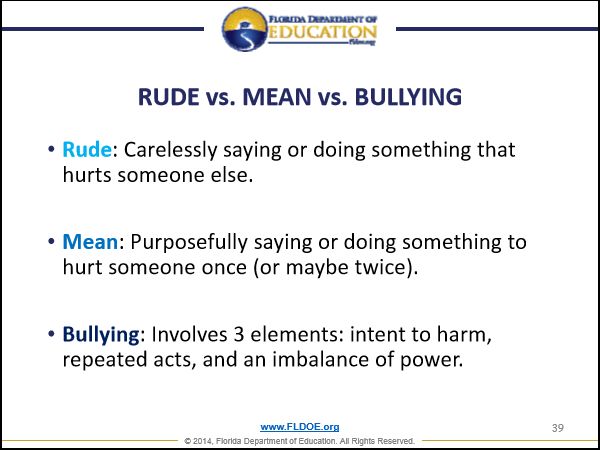
Model Policy Against Bullying and Harassment

   Harassment means any threatening, insulting, or dehumanizing gesture, use of data or
   computer software, or written, verbal or physical conduct directed against a student or school
   employee that:
      1. Places a student or school employee in reasonable fear of harm to his or her person or
         damage to his or her property;
      2. Has the effect of substantially interfering with a student’s educational performance,
         opportunities, or benefits; or
      3. Has the effect of substantially disrupting the orderly operation of a school.

   Bullying and harassment also encompasses:
       1. Retaliation against a student or school employee by another student or school
          employee for asserting or alleging an act of bullying or harassment. Reporting an act
          of bullying or harassment that is not made in good faith is considered retaliation.
       2. Perpetuation of conduct listed in the definition of bullying or harassment by an
          individual or group with intent to demean, dehumanize, embarrass, or cause
          emotional or physical harm to a student or school employee by:
              a. Incitement or coercion
              b. Accessing or knowingly and willingly causing or providing access to data or
                  computer software through a computer, computer system, or computer
                  network within the scope of the district school system and the school
              c. Acting in a manner that has an effect substantially similar to the effect of
                  bullying or harassment

   Cyberstalking as defined in s. 784.048(1)(d), F.S., means to engage in a course of conduct to
   communicate, or to cause to be communicated, words, images, or language by or through the
   use of electronic mail or electronic communication, directed at a specific person, causing
   substantial emotional distress to that person and serving no legitimate purpose.

   **Please note: Districts and schools have the flexibility to add additional specific categories
   of students to which bullying and harassment is prohibited in excess of what is listed.

c. Description of the type of behavior expected from each student and school employee of a
   public K-12 educational institution:
   Navigator Academy of Leadership expects students to conduct themselves as appropriate for
   their levels of development, maturity, and demonstrated capabilities with a proper regard for
   the rights and welfare of other students and school staff, the educational purpose underlying
   all school activities, and the care of school facilities and equipment.

   Navigator Academy of Leadership believes that standards for student behavior must be set
   cooperatively through interaction among the students, parents/legal guardians, staff, and
   community members producing an atmosphere that encourages students to grow in self-
   discipline. The development of this atmosphere requires respect for self and others, as well as
   for school and community property on the part of students, staff, and community members.
Modeled after the Florida Department of Education   2
Model Policy Against Bullying and Harassment
                                                                        Revised August 2018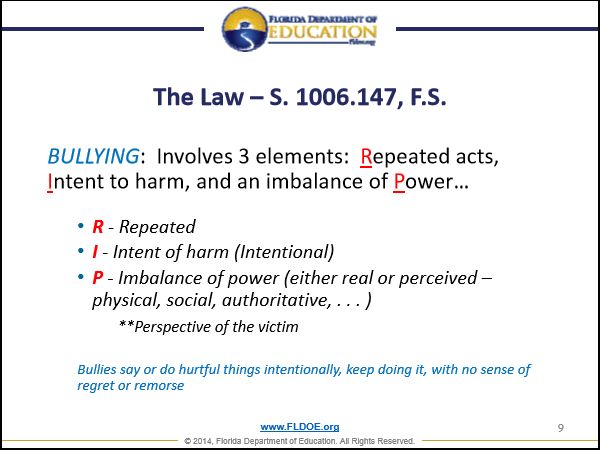
Model Policy Against Bullying and Harassment

   Since students learn by example, school administrators, faculty, staff, and volunteers will
   demonstrate appropriate behavior, treat others with civility and respect, and refuse to tolerate
   bullying or harassment.

   Navigator Academy of Leadership upholds that bullying or harassment of any student or
   school employee is prohibited:
       a) During any education program or activity conducted by a public K-12 educational
           institution;
       b) During any school-related or school-sponsored program or activity;
       c) On a school bus of a public K-12 educational institution;
       d) Through the use of data or computer software that is accessed through a computer,
           computer system, or computer network of a public K-12 education institution within
           the scope of the school, meaning regardless of ownership, any computer, computer
           system, or computer network that is physically located on school property or at a
           school-related or school-sponsored program or activity; or
       e) Through the use of data or computer software that is accessed at a non-school-related
           location, activity, function, or program or through the use of technology or an
           electronic device that is not owned, leased, or used by a school district or school, if
           the bullying substantially interferes with or limits the victim’s ability to participate in
           or benefit from the services, activities, or opportunities offered by a school or
           substantially disrupts the education process or orderly operation of a school.
       f) The above section (e) does not require a school to staff or monitor any non-school-
           related activity, function, or program.

     The policy shall also:
     A. Describe student responsibilities, including the requirements for students to conform to
     reasonable standards of socially acceptable behavior; respect the person, property, and
     rights of others; obey constituted authority; and respond to those who hold that authority
     B. Address appropriate recognition for positive reinforcement for good conduct, self-
     discipline, good citizenship, and academic success
     C. Explain student rights
     D. Identify disciplinary sanctions and due process

d. Consequences for a student or employee of a public K-12 educational institution who
   commits an act of bullying or harassment:
   Concluding whether a particular action or incident constitutes a violation of this policy
   requires a determination based on all of the facts and surrounding circumstances. The
   physical location or time of access of a computer-related incident cannot be raised as a
   defense in any disciplinary action. Consequences and appropriate remedial action for students
   who commit acts of bullying or harassment may range from positive behavioral interventions
   up to and including suspension or expulsion, as outlined in the District’s Code of Student
   Conduct. Consequences and appropriate remedial action for a school employee found to have
Modeled after the Florida Department of Education   3
Model Policy Against Bullying and Harassment
                                                                           Revised August 2018
Model Policy Against Bullying and Harassment
committed an act of bullying or harassment may be disciplined in accordance with district and
school policies, procedures, and agreements. Additionally, egregious acts of harassment by
certified educators may result in a sanction against an educator’s state issued certificate. (See
State Board of Education Rule 6B-1.006, FAC., The Principles of Professional Conduct of
the Education Profession in Florida.) Consequences and appropriate remedial action for a
visitor or volunteer, found to have committed an act of bullying or harassment shall be
determined by the school administrator after consideration of the nature and circumstances of
the act, including reports to appropriate law enforcement officials.
e. Consequences for a student or employee of a public K-12 educational institution who is
found to have wrongfully and intentionally accused another of an act of bullying or
harassment:
Consequences and appropriate remedial action for a student found to have wrongfully and
intentionally accused another as a means of bullying or harassment range from positive
behavioral interventions up to and including suspension or expulsion, as outlined in the
District’s Code of Student Conduct. Consequences and appropriate remedial action for a
school employee found to have wrongfully and intentionally accused another as a means of
bullying or harassment may be disciplined in accordance with district and school policies,
procedures, and agreements. Consequences and appropriate remedial action for a visitor or
volunteer, found to have wrongfully and intentionally accused another as a means of bullying
or harassment shall be determined by the school administrator after consideration of the
nature and circumstances of the act, including reports to appropriate law enforcement
officials.
f. A procedure for receiving reports of an alleged act of bullying or harassment, including
provisions that permit a person to anonymously report such an act.
At each school, the principal or the principal’s designee is responsible for receiving
complaints alleging violations of this policy. All school employees are required to report
alleged violations of this policy to the principal or the principal’s designee. All other members
of the school community, including students, parents/legal guardians, volunteers, and visitors
are encouraged to report any act that may be a violation of this policy anonymously or in-
person to the principal or principal’s designee.
The principal shall establish and prominently publicize to students, staff, volunteers, and
parents/legal guardians, how a report of bullying or harassment may be filed either in-person
or anonymously and how this report will be acted upon. The victim of bullying or harassment,
anyone who witnessed the bullying or harassment, and anyone who has credible information
that an act of bullying or harassment has taken place may file a report of bullying or
harassment. A school employee, school volunteer, student, parent/legal guardian or other
persons who promptly reports in good faith an act of bullying or harassment to the appropriate
school official and who makes this report in compliance with the procedures set forth in this
policy and handbook is immune from a cause of action for damages arising out of the
reporting itself or any failure to remedy the reported incident. Submission of a good faith
Modeled after the Florida Department of Education 4
Model Policy Against Bullying and Harassment
Revised August 2018Model Policy Against Bullying and Harassment
complaint or report of bullying or harassment will not affect the complainant or reporter’s
future employment, grades, learning or working environment, or work assignments.
Any written or oral reporting of an act of bullying or harassment shall be considered an
official means of reporting such act(s). Reports may be made anonymously, but formal
disciplinary action may not be based solely on the basis of an anonymous report.
g. A procedure for the prompt investigation of a report of bullying or harassment and the
persons responsible for the investigation. The investigation of a reported act of bullying
or harassment is deemed to be a school-related activity and begins with a report of such
an act:
The Procedures for Investigating Bullying and/or Harassment include:
- The principal or designee selects a designee(s), employed by the school, trained in
investigative procedures to initiate the investigation. The designee(s) may not be the
accused perpetrator (harasser or bully) or victim.
- Documented interviews of the victim, alleged perpetrator, and witnesses are
conducted privately, separately, and are confidential. Each individual (victim, alleged
perpetrator, and witnesses) will be interviewed separately and at no time will the
alleged perpetrator and victim be interviewed together.
- The investigator shall collect and evaluate the facts including, but not limited to:
o Description of incident(s) including nature of the behavior; context in which
the alleged incident(s) occurred, etc.;
o How often the conduct occurred;
o Whether there were past incidents or past continuing patterns of behavior;
o The relationship between the parties involved;
o The characteristics of parties involved (i.e., grade, age, etc.);
o The identity and number of individuals who participated in bullying or
harassing behavior;
o Where the alleged incident(s) occurred;
o Whether the conduct adversely affected the student’s education or educational
environment;
o Whether the alleged victim felt or perceived an imbalance of power as a result
of the reported incident; and
o The date, time, and method in which the parents/legal guardians of all parties
involved were contacted.
- Whether a particular action or incident constitutes a violation of this policy requires a
determination based on all the facts and surrounding circumstances and includes:
o Recommended remedial steps necessary to stop the bullying and/or harassing
behavior; and
o A written final report to the principal.
- The maximum of 10 school days shall be the limit for the initial filing of incidents
and completion of the investigative procedural steps. The highest level of
Modeled after the Florida Department of Education 5
Model Policy Against Bullying and Harassment
Revised August 2018Model Policy Against Bullying and Harassment
confidentiality possible will be upheld regarding the submission of a complaint or a
report of bullying and/or harassment, and the investigative procedures that follow.
h. A process to investigate whether a reported act of bullying or harassment is within the
scope of the school and, if not, a process for referral of such an act to the appropriate
jurisdiction. Computers without web-filtering software or computers with web-filtering
software that is disabled shall be used when complaints of cyberbullying are
investigated.
A principal or designee will assign a designee(s) that is trained in investigative procedures to
initiate an investigation of whether an act of bullying or harassment is within the scope of the
school.
The trained designee(s) will provide a report on results of investigation with
recommendations for the principal to make a determination if an act of bullying or harassment
falls within the scope of the school.
• If it is within scope of the school, move to Procedures for Investigating Bullying
and/or Harassment.
• If it is outside scope of the school, and determined a criminal act, refer to
appropriate law enforcement.
• If it is outside scope of the school, and determined not a criminal act, inform
parents/legal guardians of all students involved.
i. A procedure for providing immediate notification to the parents/legal guardians of a
victim of bullying or harassment and the parents/legal guardians of the perpetrator of
an act of bullying or harassment as well as, notification to all local agencies where
criminal charges may be pursued against the perpetrator:
The principal, or designee, shall promptly report via telephone, personal conference,
and/or in writing, the occurrence of any incident of bullying or harassment as defined by
this policy to the parent or legal guardian of all students involved on the same day an
investigation of the incident(s) has been initiated. Notification must be consistent with the
student privacy rights under the applicable provisions of the Family Educational Rights and
Privacy Act of 1974 (FERPA).
If the bullying or harassment incident results in the perpetrator being charged with a crime,
the principal, or designee, shall by telephone or in writing by first class mail, inform
parents/legal guardian of the victim(s) involved in the bullying or harassment incident about
the Unsafe School Choice Option (No Child Left Behind, Title IX, Part E, Subpart 2, Section
9532) that states “...a student who becomes a victim of a violent criminal offense, as
determined by State law, while in or on the grounds of a public elementary school or
secondary school that the student attends, be allowed to attend a safe public elementary
school or secondary school within the local educational agency, including a public charter
school.”
Modeled after the Florida Department of Education 6
Model Policy Against Bullying and Harassment
Revised August 2018Model Policy Against Bullying and Harassment
Once the investigation has been completed and it has been determined that criminal charges
may be pursued against the perpetrator, all appropriate local law enforcement agencies will be
notified by telephone and/or in writing.
j. A procedure to refer victims and perpetrators of bullying or harassment for counseling:
A school referral procedure will establish a protocol for intervening when bullying or
harassment is suspected or when a bullying or harassment incident is reported. The procedure
shall include:
• A process by which the teacher or parent/legal guardian may request informal
consultation with school staff (specialty staff, e.g., school counselor, school
psychologist, etc.) to determine the severity of concern and appropriate steps to
address the concern (the involved students’ parents or legal guardian may be
included).
• A referral process to provide professional assistance or services that includes:
o A process by which school personnel or parent/legal guardian may refer a
student to the school intervention team (or equivalent school-based team with
a problem-solving focus) for consideration of appropriate services. (Parent or
legal guardian involvement is required at this point.)
o If a formal discipline report or formal complaint is made, the principal or
designee must refer the student(s) to the school intervention team for
determination of counseling support and interventions. (Parent or legal
guardian involvement is required at this point.)
• A school-based component to address intervention and assistance as determined
appropriate by the intervention team that includes:
o Counseling and support to address the needs of the victims of bullying or
harassment;
o Research-based counseling/interventions to address the behavior of the
students who bully and harass others (e.g., empathy training, anger
management); and/or
o Research-based counseling/interventions which includes assistance and
support provided to parents/legal guardians, if deemed necessary or
appropriate.
k. A procedure for including incidents of bullying or harassment in the school’s report of
data concerning school safety and discipline data required under s. 1006.09(6), F.S. The
report must include each incident of bullying or harassment and the resulting
consequences, including discipline and referrals. The report must include, in a separate
section, each reported incident of bullying or harassment that does not meet the criteria
of a prohibited act under this section (reported as “unsubstantiated bullying” or
“unsubstantiated harassment”) with recommendations regarding such incidents
(cyberbullying incidents are to be included within the bullying incidents category):
Modeled after the Florida Department of Education 7
Model Policy Against Bullying and Harassment
Revised August 2018Model Policy Against Bullying and Harassment
The school will utilize Florida’s School Environmental Safety Incident Reporting (SESIR)
Statewide Report on School Safety and Discipline Data, which includes bullying and
harassment as incident codes as well as bullying-related as a related element code. The
SESIR definition of bullying is systematically and chronically inflicting physical hurt or
psychological distress on one or more students or employees that is severe or pervasive
enough to create an intimidating, hostile, or offensive environment; or unreasonably interfere
with the individual’s school performance or participation. The SESIR definition of
harassment is any threatening, insulting, or dehumanizing gesture, use of data or computer
software, or written, verbal, or physical conduct that 1) places a student or school employee in
reasonable fear of harm to his or her person or damage to his or her property, 2) has the effect
of substantially interfering with a student’s educational performance, opportunities, or
benefits, or 3) has the effect of substantially disrupting the orderly operation of a school
including any course of conduct directed at a specific person that causes substantial emotional
distress in such a person and serves no legitimate purpose.
If a bullying or harassment incident occurs then it will be reported in SESIR with either the
bullying or harassment code. If the bullying or harassment results in any of the following
SESIR incidents the incident will be coded appropriately using the relevant incident code
AND the related element code entitled bullying-related. Those incidents are:
• Alcohol
• Arson
• Battery
• Breaking and Entering
• Disruption on Campus
• Drug Sale/Distribution Excluding Alcohol
• Drug Use/Possession Excluding Alcohol
• Fighting
• Homicide
• Kidnapping
• Larceny/Theft
• Robbery
• Sexual Battery
• Sexual Harassment
• Sexual Offenses
• Threat/Intimidation
• Trespassing
• Tobacco
• Vandalism
• Weapons Possession
• Other Major (Other major incidents that do not fit within the other definitions)
Modeled after the Florida Department of Education 8
Model Policy Against Bullying and Harassment
Revised August 2018Model Policy Against Bullying and Harassment
Discipline and referral data will be recorded in Student Discipline/Referral Action Report and
Automated Student Information System.
Navigator Academy of Leadership will provide bullying or harassment incident, discipline,
and referral data to the Florida Department of Education in the format requested, through
Surveys 2, 3 and 5 from Education Information and Accountability Services, and at
designated dates provided by the Department. Data reporting on bullying, harassment,
unsubstantiated bullying, unsubstantiated harassment, sexual harassment and
threat/intimidation incidents as well as any bullying-related incidents that have as a basis sex,
race or disability should include the incident basis. Victims of these offenses should also have
the incident basis (sex, race or disability) noted in their student record.
l. A list of programs authorized by the school or school district that provide instruction to
students, parents/legal guardians, teachers, school administrators, counseling staff, and
school volunteers on identifying, preventing, and responding to bullying or harassment,
including instruction on recognizing behaviors that lead to bullying and harassment and
taking appropriate preventive action based on those observations:
Navigator Academy of Leadership ensures that schools sustain healthy, positive, and safe
learning environments for all students. It is important to change the social climate of the
school and the social norms with regards to bullying or harassment. This requires the efforts
of everyone in the school environment – teachers, administrators, counselors, school nurses,
other non-teaching staff (such as bus drivers, custodians, cafeteria workers, and/or school
librarians), parents/legal guardians, and students.
Students, parents/legal guardians, teachers, school administrators, counseling staff, and school
volunteers shall be given instruction at a minimum on an annual basis on the school’s Policy
and Regulations against bullying and harassment. The instruction shall include evidence-
based methods of preventing bullying and harassment, as well as how to effectively identify
and respond to bullying or harassment in schools.
Modeled after the Florida Department of Education 9
Model Policy Against Bullying and Harassment
Revised August 2018Model Policy Against Bullying and Harassment
Navigator Academy of Leadership provides the following list of authorized programs
including, but not limited to: (Programs listed below are provided as examples only.
Inclusion of programs within this list does not imply endorsement or promotion by the
Florida Department of Education. Specific programs authorized for use in your schools
will need to be determined by the Superintendent and/or appropriate school district staff.)
• Olweus Bullying Prevention Program (OBPP)
• PBS/PBIS (Positive Behavior Support)/Positive Behavioral Interventions &
Supports
• Monique Burr Foundations for Children, Inc.’s Child Safety Matters
• Second Step
• Aggressors, Victims, and Bystanders (AVB)
• Project Wisdom
• i-Safe
• Common Sense K-12 Digital Citizenship
• Creating a Safe and Respectful Environment in Our Nation’s Classrooms (for
teachers)
• Creating a Safe and Respectful Environment on Our Nation’s School Busses (for
bus drivers)
• Character Counts
• Values Matter
Decisions to include additional instructional programs or activities, not previously listed
within this policy, will be made on a case-by-case basis and authorized by individual school
principals.
m. A procedure for regularly reporting to a victim’s parents/legal guardians the legal
actions taken to protect the victim:
The Principal or designee shall by telephone and/or in writing report the occurrence of any
incident of bullying or harassment as defined by this policy to the parent or legal guardian of
all students involved on the same day an investigation of the incident has been initiated.
According to the level of infraction, parents/legal guardians will be notified by telephone
and/or writing of actions being taken to protect the child; the frequency of notification will
depend on the seriousness of the bullying or harassment incident. Notification must be
consistent with the student privacy rights under the applicable provisions of the Family
Educational Rights and Privacy Act o f1974 (FERPA).
n. A procedure for publicizing the policy which must include its publication in the code of
student conduct required under s. 1006.07(2), F.S., and in all employee handbooks:
Modeled after the Florida Department of Education 10
Model Policy Against Bullying and Harassment
Revised August 2018Model Policy Against Bullying and Harassment
At the beginning of each school year, the Principal shall, in writing, inform school staff,
parents/legal guardians, or other persons responsible for the welfare of a student of the student
safety and violence prevention policy.
Navigator Academy of Leadership shall provide notice to students and staff of this policy
through appropriate references in the District’s Code of Student Conduct and Employee
Handbooks, and/or through other reasonable means. The Principal shall also make all
contractors contracting with the school aware of this policy.
The Principal shall develop an annual process for discussing the school and district policy on
bullying and harassment with students in a student assembly or other reasonable format.
Reminders of the policy and bullying or harassment prevention messages such as posters and
signs will be displayed around each school and on school buses (if applicable).
Modeled after the Florida Department of Education 11
Model Policy Against Bullying and Harassment
Revised August 2018EMPLOYEE DISCRIMINATION / HARASSMENT/BULLYING
Employment Non-Discrimination and Non-Harassment
Navigator Academy of Leadership does not discriminate against anyone, to general operations of the
organization, and to any basis prohibited by applicable law or regulation. Navigator Academy of Leadership is
committed to an environment in which all individuals are treated with respect and dignity. We believe that
each individual has the right to work in a professional atmosphere that promotes equal employment
opportunities and prohibits discriminatory practices, including harassment. Therefore, the organization
expects that all relationships among persons in the workplace will be business-like and free of bias, prejudice
and harassment. Thus, Navigator Academy of Leadership does not and will not tolerate discrimination against
or harassment of or by our employees, students, vendors, or other person. The term “harassment” includes,
but is not limited to, slurs, jokes, and other verbal, graphic, or physical conduct relating to an individual’s race,
color, sex (including discrimination against or harassment of individuals of the same sex), pregnancy, religion,
national origin, ancestry, citizenship, age, disability, workers compensation claims, marital, veteran or any
other protected status. “Harassment” may include a range of subtle and not so subtle behaviors and also
includes unwelcome or unwanted sexual advances, requests or demands for favors, offensive touching, and
other types of conduct whether it be physical, verbal, graphic, or electronic communication (including e-mail
and facsimiles) of a harassing or sexual nature involving individuals of the same or different gender. This
includes, but is not limited to:
● Unwelcome or unwanted physical contact or sexual advances including, but not limited to, patting,
grabbing, pinching, brushing-up against, hugging, cornering, kissing, fondling, or any other similar
physical contact.
● Unwelcome requests or demands for favors including, but not limited to, subtle or blatant
expectations, pressures, requests or demands for sexual, unethical or illegal favors; or unwelcome
requests for dates or contacts. Such unwelcome requests or demands may or may not relate to an
implied or stated promise of preferential treatment, or a threat of negative consequences concerning
employment, including, but not limited to, promotion, demotion, transfer, layoff, termination, pay or
other form of compensation, and selection for training.
● Verbal and written abuse or unwelcome kidding including, but not limited to, that which is sexually-
oriented, including same-sex harassment; commentary about an individual’s body, sexual prowess or
sexual deficiencies; inappropriate comments about race, color, religion, sex, pregnancy, national origin,
ancestry, citizenship, age, disability, workers compensation claims, marital, veteran or other protected
status; dirty jokes or other jokes which are unwanted and considered offensive or tasteless; or
comments, innuendoes, epithets, slurs, negative stereotyping, leering, catcalls or other actions that
offend, whether sexually oriented or otherwise related to a prohibited form of discrimination or
harassment.
● Any form of behavior that unreasonably interferes with work performance, including, but not limited
to, unwanted sexual attentions, comments, interruptions, or other communications, whether sexually-
oriented or otherwise related to a prohibited form of discrimination or harassment, that reduces
productivity or time available to perform work-related tasks or otherwise interferes with work
performance.
● Actions that create a work environment that is intimidating, hostile, abusive, or offensive because of
unwelcome or unwanted conversations, suggestions, requests, demands, physical contacts or
Employee Discrimination / Harassment/Bullying 2018 Developed by: Charter Support UnitEMPLOYEE DISCRIMINATION / HARASSMENT/BULLYING
attentions, whether sexually-oriented or otherwise related to a prohibited form of discrimination or
harassment.
● The distribution, display, or discussion of any written or graphic material, including calendars, posters,
cartoons, or names, that belittles or shows hostility or aversion toward an individual, his/her relatives,
friends or associates or a group because of race, color, religion, sex (including same sex discrimination
or harassment), pregnancy, national origin, ancestry, citizenship, age, disability, workers compensation
claims, marital, veteran or other protected status.
All employees and applicants are covered by this policy and are strictly prohibited from engaging in any form
of discriminatory or harassing conduct. Further, no employee has the authority to suggest to another
employee or applicant that the individual’s employment, continued employment, or future advancement will
be affected in any way by entering into, or refusing to enter into, a personal relationship. Such conduct is a
direct violation of this policy.
Conduct prohibited by this policy is unacceptable in the workplace and in any work-related setting outside the
workplace, such as business trips, business meetings and business-related social events.
Violation of this policy will subject an employee to disciplinary action, up to and including immediate
discharge.
Retaliation is Prohibited
Navigator Academy of Leadership prohibits retaliation against any individual who reports discrimination or
harassment or participates in an investigation of such reports. Retaliation against an individual for reporting
harassment or discrimination or for participating in an investigation of a claim of harassment or discrimination
is a serious violation of this policy and, like harassment or discrimination itself, will be subject to disciplinary
action, up to and including termination.
Reporting Procedures and Investigation
Navigator Academy of Leadership strongly urges the reporting of all incidents of discrimination, harassment or
retaliation, regardless of the offender’s identity or position. Individuals who believe they have experienced
conduct they believe is contrary to the organization’s policy or who have concerns about such matters should
file their complaints with the Principal or any Member of the Governing Board or the Board’s designee,
whereupon the matter will be discreetly and thoroughly investigated. Navigator Academy of Leadership will
then take immediate steps to stop any behavior which violates this policy and see that it does not repeat itself.
Disciplinary action, up to and including termination, calculated to end the discrimination or harassment, will
be taken, when appropriate, against the offender(s).
Employees who have experienced conduct they believe is contrary to this policy have an obligation to take
advantage of this complaint procedure. An employee’s failure to fulfill this obligation could affect his or her
rights in pursuing any claim.
Early reporting and intervention have proven to be the most effective method of resolving actual or perceived
incidents of discrimination or harassment. Therefore, while no fixed reporting period has been established,
Employee Discrimination / Harassment/Bullying 2018 Developed by: Charter Support UnitEMPLOYEE DISCRIMINATION / HARASSMENT/BULLYING
the prompt reporting of complaints or concerns is strongly urged so that rapid and constructive action can be
taken.
The availability of this complaint procedure does not preclude individuals who believe they are being
subjected to harassing conduct from promptly advising the offender that his or her behavior is unwelcome
and requesting that it be discontinued.
Responsive Action
Conduct constituting harassment, discrimination or retaliation will be dealt with appropriately. Responsive
action may include training, referral to counseling and/or disciplinary action such as warning, reprimand,
withholding of a promotion or pay increase, reassignment, temporary suspension without pay or termination,
as the organization believes appropriate under all of the circumstances.
Any person utilizing this complaint resolution procedure will be treated courteously, and the problem will be
handled swiftly and as confidentially as possible in light of all the circumstances, with appropriate corrective
action being taken. The registering of a complaint will in no way be used against that individual, nor will it have
an adverse impact on their employment status. A record of the complaint and findings will become a part of
the complaint investigation record and that file will be maintained separately from the personnel files.
Conclusion
Individuals who have questions or concerns about this policy may talk with the Principal or any member of the
Governing Board.
Please keep in mind that the very nature of discrimination, harassment and retaliation makes it virtually
impossible to detect unless a complaint is appropriately reported. Do not assume that the organization is
aware of your problem! It is your responsibility to bring this information to the attention of the organization
so the issue can be resolved.
Training
New employee orientation training as well as annual employee handbook training shall include a component
on the harassment policy. All administrators are responsible for assuring that their staff members are familiar
with the policy on harassment and that new employees are oriented as necessary throughout each school
year. As part of the review of the Code of Student conduct at the beginning of the school year, this policy will
be discussed in student classes, school advisory councils, and parent and teacher associations. Students
enrolled after the beginning of the school year will be provided a copy of the Code of Student conduct and
advised of this policy.
Employee Discrimination / Harassment/Bullying 2018 Developed by: Charter Support UnitThe Leader in Me
“The Leader in Me teaches 21st century leadership and life skills to students and
creates a culture of student empowerment based on the idea that every child can be a
leader”
At Navigator Academy of Leadership, students will be provided with the opportunity to learn
and grow in an environment where they find their inner gift and where we nurture their
greatness so that every child can see their potential. Students will experience how hard work
leads their way to success in all areas of life.
Their I will > than their IQ
The Leader in Me was developed to fit a specific need in education that could be met by
applying the concepts that had been effectively used to revolutionize Fortune 500 companies
through Stephen Coveys 7 Habits of Highly Effective People published in 1989.
The Leader in Me program will allow our students to take active ownership of their learning.
Part of this can be achieved through the use of each student’s leadership binder. These
leadership binders will include:
• Personal mission statements
• Widely Important Goals (WIGs) one personal goal and two academic goals.
• Students will then track their data as it relates to their goals and celebrate
achievements
• Parents and teachers attend student-led conferences where the students
communicate their progress and goals through self-reflection
These leadership binders will play a huge role in tracking student data and empowering
students to own their learning and all their efforts in achieving academic excellence. Research
shows that Leader in Me schools experience a decrease in disciplinary referrals and an increase
in student self-confidence and achievement.The 7 Habits of Highly Effective People
Content from “The 7 Habits of Highly Effective People” is a key component of the overall The
Leader in Me process. The 7 Habits is a synthesis of universal, timeless principles of personal and
interpersonal effectiveness, such as responsibility, vision, integrity, teamwork, collaboration and
renewal, which are secular in nature and common to all people and cultures.
The Leader in Me is also aligned to many national and state academic standards. The process
teaches students the skills needed for academic success in any setting. These skills include critical
thinking, goal setting, listening and speaking, self-directed learning, presentation-making and the
ability to work in groups.
Instead of seeing children through the lens of a normal distribution curve—some kids are naturally
smart and others are not—The Leader in Me paradigm sees that every child is capable, every child
is a leader. This paradigm changes everything.
In the spirit of Habit 2 – “Begin with the End in Mind”, we have mapped out how we intend to
introduce the 7 Habits and how we will integrate the The Leader in Me throughout the school-
year. Please note that this is a work in progress and is only a tentative map. We will keep you
updated as the year progresses
o August and September: The 7 Habits, What Are They? – The goal is to get the
students familiar with the 7 Habits and using common language found within the
Leader in Me. Teachers begin to empower students as they reflect on their potential
and set goals.
o October: Habit 1 – Be Proactive
o November & December: Habit 2 – Begin with the End in Mind
o January: Habit 3 – Put First Things First
o February: Habit 4 – Think Win-Win
o March: Habit 5 – Seek First to Understand, Then to Be Understood
o April: Habit 6 – Synergize
o May and June: Sharpen the Saw
“We only get one chance to prepare children for a world none of us can possibly predict, what are
we going to do with that chance?” – Principal Muriel Summers, A.B. Combs ElementaryStudent Code of Conduct As a public charter school, Navigator Academy of Leadership also follows the Code of Student Conduct for our School District/County, with the addition of the Code of Collegiality. Rationale Navigator Academy of Leadership believes that behavioral excellence is essential to the effective academic and character development of each student. In order to help ensure success, Navigator Academy of Leadership will strive to make behavioral expectations clear so that students can make wise choices and “live” The 7 Habits. Navigator Academy of Leadership intends to recognize and celebrate the talents of every student. While we expect our students to be well behaved and exemplify the standards our school was founded on, we realize that clear boundaries are necessary to help them feel successful and understand expectations. Therefore, our behavior program has been developed to provide opportunities for students to learn and change any negative behaviors they may be exhibiting. We also realize that consequences need to be reasonable, clear, and administered fairly with the intention of creating positive change. When a student exhibits misbehavior, there are several avenues we can use within the school setting to help students change their behavior, and keep parents informed of what is happening. In order to fully develop our educational program and school culture, Navigator Academy of Leadership will follow a District Code of Student Conduct and the Board approved Code of Collegiality that will establish guidelines for model student behavior. The Code of Conduct and The Code of Collegiality will follow levels of infractions as leveled by the district. The intent is that the Code of Collegiality proactively sets guidelines and expectations and the Code of Student Conduct will provide rules and policies along with consequences with an opportunity for reflection so that students may learn from their mistakes. Included in the Code of Collegiality is our expectation for students to stand TAAL - Think, Act, Accountability, and Learn. In alignment with the 7 Habits, expecting students to stand TAAL will require them to:
School Behavior Consequences
The following list is a representative list of behaviors, not an all-inclusive menu. This list will assist the school’s
administration in determining the appropriate level of consequences for misbehavior of students at the school. Please
bear in mind that all criminal offenses will be reported to law enforcement officials.
 LEVEL 1 BEHAVIORS are acts that disrupt the                  LEVEL 2 BEHAVIORS are more serious than Level
 orderly operation of the classroom, school                   1 because they significantly interfere with
 function, and extracurricular activities or                  learning and/or the well-being of others.
 approved transportation.                                               Seriously Disruptive Behaviors
               Disruptive Behaviors                           ❑   Cheating
 ❑   Unauthorized location                                    ❑   Confrontation with a staff member
 ❑   Confrontation with another student                       ❑   Defiance of school personnel
 ❑   Cutting class                                            ❑   Failure to comply with previously prescribed
 ❑   Misrepresentation (lying)                                    corrective strategies
 ❑   Disruptive behavior (including behavior on the           ❑   False accusation
     school bus and at the school bus stop)                   ❑   Fighting (minor)
 ❑   Failure to comply with class and/or school rules         ❑   Harassment (non-sexual or isolated)
 ❑   Possession of items or materials that are                ❑   Petty theft (under $300.00)
     inappropriate for an educational setting                 ❑   Use of profane and provocative language directed
 ❑   Inappropriate public display of affection                    at someone
 ❑   Use of profane/crude language                            ❑   Possession of and/or use of tobacco products
 ❑   Unauthorized use of electronic devices                   ❑   Slander
 ❑   Violation of dress code                                  ❑   Vandalism (minor)

 LEVEL 3 BEHAVIORS are more serious than Level                LEVEL 4 BEHAVIORS are more serious acts of
 II because they endanger health and safety,                  unacceptable behavior than Level III. They
 damage property, and/or cause serious                        seriously endanger the health and well-being of
 disruptions to the learning environment.                     others and/or damage property.
           Offensive/Harmful Behaviors                                 Dangerous of Violent Behaviors
 ❑ Assault/Threat against a non-staff member                  ❑ Battery against a non-staff member
 ❑ Breaking and Entering/Burglary                             ❑ Grant theft (over $300.00)
 ❑ Bullying (repeated harassment)                             ❑ Hate crime
 ❑ Disruption on campus/disorderly conduct                    ❑ Hazing (felony)
 ❑ Fighting (serious)                                         ❑ Motor vehicle theft
 ❑ Harassment                                                 ❑ Other major crimes/incidents
 ❑ Possession or use of alcohol, unauthorized over-           ❑ Intent to sell/distribute or sale of alcohol,
   the-counter medications, drug paraphernalia,                 unauthorized over-the-counter medications, drug
   controlled substances and/or anything that alters            paraphernalia, controlled substances and/or
   mood or is used for mood altering                            anything that alters mood or is used for mood
 ❑ Possession of simulated weapons                              altering
 ❑ Sexual harassment; sexting (1)                             ❑ Sex offenses (other) (including possession and/or
 ❑ Vandalism (major)                                            distribution of obscene or lewd materials); sexting
                                                                (2)
 LEVEL 5 BEHAVIORS are the most serious acts of misconduct and violent actions that threaten life.
                                 Most Serious, Dangerous or Violent Behaviors
 ❑ Aggravated assault                                       ❑ Making a false report/threat against the school
 ❑ Aggravated battery                                       ❑ Sexual battery; sexting (3)
 ❑ Armed robbery                                            ❑ Possession, use, sale, or distribution of firearms,
 ❑ Arson                                                      explosives, destructive devices, and other weapons.
 ❑ Public display of sexual body parts
Discipline Matrix
The following are examples of the types of consequences the school administrator may administer based
on the level of the offensive behavior. These are representative and not prescriptive, the administrator
may handle each situation on a case-by-case scenario, using the following as general guidelines.
Misbehavior Range of Corrective Strategies (Consequences)
Plan 1: Parent/guardian contact (Behavior Slip); Student, parent/guardian/staff
conference; Revocation of the right to participate in social and/or extracurricular
Level 1 activities; Confiscation of electron device; Detention; Temporary assignment from
Offense class where the infraction occurred; Student contract; Replacement or payment for
any damaged property (if appropriate); Participation in counseling session related to
infraction; Behavior plan.
Plan 2: Parent/guardian contact; School-based program that focuses on modifying
the student’s inappropriate behavior or promotes positive behavior; Suspension
Level 2 from school for one to five days for habitual infractions; In-school suspension;
Offense Participation in counseling session related to the infraction Refer to outside
agency/provider; Diversion Center; Corrective strategies from Level 1;
Plan 3: Parent/guardian contact; Suspension from school for one to ten days; In-
school suspension; Corrective Strategies from Level I & II; Permanent removal from
Level 3 class (placement review committee decision required); Recommendation for
Offense alternative educational setting; Recommendation for expulsion; Participation in
counseling session related to the infraction; Refer to outside agency/provider.
Corrective strategies from previous plans.
Plan 4: Parent/guardian contact; Suspension from school for one to ten days; In-
school suspension; Participation in counseling session related to the infraction; Refer
Level 4 to outside agency/provider; Recommendation for alternative educational setting;
Offense Recommendation for expulsion; Corrective strategies from previous plans.
Plan 5: Parent/guardian contact; Suspension from school for ten days; In-school
suspension; Participation in counseling session related to the infraction; Refer to
Level 5 outside agency/provider; Recommendation for reassignment; Corrective strategies
Offense from previous plans.What Should I Do If I’m Bullied?
What is bullying? • Calmly tell the student to stop…or say nothing
Bullying happens when someone hurts or scares and then walk away.
another person on purpose. The person being
bullied has a hard time defending himself or • Use humor, if this is easy for you to do. (For
herself. Ususally, bullying happens over and over. example, if a student makes fun of your clothing,
laugh and say, “Yeah, I think this shirt is kind of
Sometimes bullying is easy to notice, such as with funny-looking, too.”)
hitting or name calling, and other times it’s hard to
see, like with leaving a person out or saying mean • Try to avoid situations in which bullying is likely
things behind someone’s back. Both boys and girls to happen. You might want to
bully, and both boys and girls get bullied. Bullying • Avoid areas of the school where there are not
is not fair, and it hurts. many students or teachers around.
• Make sure you aren’t alone in the bathroom
How to deal with bullying: or locker room.
• Tell your parents or other trusted adults. They can • Sit near the front of the bus.
help stop the bullying. • Don’t bring expensive things or lots of money
to school.
• If you are bullied at school, tell your teacher, • Sit with a group of friends at lunch.
school counselor, or principal. Telling is • Take a different route through hallways or
not tattling. walk with friends or a teacher to your classes.
• Don’t fight back. Don’t try to bully those who
bully you.
• Try not to show anger or fear. Students who bully
like to see that they can upset you.
These and other materials are available online at: www.stopbullyingnow.hrsa.govYou can also read


