COMPRESSION, MECHANICAL AND RELEASE PROPERTIES OF PARACETAMOL TABLETS CONTAINING ACID TREATED GREWIA GUM.
←
→
Page content transcription
If your browser does not render page correctly, please read the page content below
ISSN:0975-5772
                      Muazu J. et al / Journal of Pharmaceutical Science and Technology Vol. 1 (2), 2009, 74-79

   COMPRESSION, MECHANICAL AND RELEASE PROPERTIES OF
     PARACETAMOL TABLETS CONTAINING ACID TREATED
                     GREWIA GUM.
                                      *J Muazu1, H Musa2 and KY Musa3.
           1
             Department of Pharmaceutical Services, University of Maiduguri Teaching Hospital, Nigeria.
    2
      Department of Pharmaceutics and Pharmaceutical Microbiology, Ahmadu Bello University Zaria, Nigeria.
          3
            Department of Pharmacognosy and Drug Development, Ahmadu Bello University Zaria, Nigeria
Abstract
Grewia gum a natural gum from the bark of plant Grewia mollis was treated with hydrochloric acid at three different
concentrations and three different times. The gum have been evaluated as a binding agent in comparison with both
untreated gum and gelatin in paracetamol tablet formulations. Compressional properties of the formulations were
analyzed using density measurements and assessed by compression equation of Heckel. The mechanical properties
of the formulations were assessed using crushing strength and friability as well as crushing strength friability ratio.
The drug release properties of the tablets formed were assessed using disintegration and dissolution times. Tablet
formulations containing treated grewia gum exhibited low onset of plastic deformation, while that untreated gum
and gelatin were relatively high onset of deformation. The friability of paracetamol tablet formulation increases with
increase in acid concentration and treatment time. The crushing strength, disintegration and dissolution times
decreased with increase in acid concentration and treatment time. Tablets produced with untreated gum showed
higher crushing strength, disintegration and dissolution times and low friability than the gelatin and the treated gum.
Depending on the desired onset of action of medicament acid treated rewia gum can be used in formulation of
conventional tablets especially if the formulation does not require sustained release.
Keywords: Grewia gum, acid treated, binder, compression, Heckel equation, mechanical and release properties.
Introduction                                                           plant is safe for human consumption
Binding agents are used to impart the                                  (Onwuliri et al, 2006)
structural strength required during the                                Many researchers have carried out studies
processing, handling, packaging and                                    on      compaction      characteristics     of
transporting of tablets (Odeku, 2005).                                 pharmaceutical      powders     with many
A number of plant gums have been used as                               equations and expressions reported (Train
binding agents in tablet formulations (Rama                            1956, Heckel 1961, Cooper and Eaton 1962,
Prasad et al, 1998, Odeku and Itiola, 1998,                            Kawakita and Ludde 1970, Pilpel 1973).
Kalu et al 2007 and Odeku, 2005). These                                However the Heckel equation is one of the
gums have been used in producing tablets                               most widely used equation for describing the
with     different    mechanical    strength,                          compaction properties of powders (Oladapo
consolidation and drug release properties                              et al 2006, Odeku 2005, Ravindra et al 2006,
(Emege, 2008). The grewia gum was                                      Ohwoavworhua 2007 and Emeje 2008). The
sourced from the inner bark stem of Grewia                             Heckel equation analyses the ability of
mollis shrub or tree of family Tiliacaea,                              granules to undergo volume reduction, i.e
locally distributed within the Northern and                            compressibility. It describes the relationship
middle belt of Nigeria. In Northern Nigeria,                           of the compact, density to the applied
the mucilage from the bark is used as a                                pressure (Ravindra et al 2006).
thickener in cooking soup, bean cake called                            The Heckel equation relates the relative
kosai in Hausa. Phytochemical and histo-                               density, D, of a powder bed during
pathological studies were carried out on the                           compression to the applied pressure, P,
leaves and stem bark extracts of Grewia                                which provides information on the
mollis, the result revealed the presence of                            mechanism of powder consolidation during
tannins, saponins, flavonoids, glycosides,                             compact formation by the equation
balsam, phenols, terpenes, steroids and the                            1n(1/1-D) = kP + A……………( 1 )
absence of alkaloids in Grewia mollis bark                             Where k and A are constants.
while toxicological result showed that the
                                                                                                                    74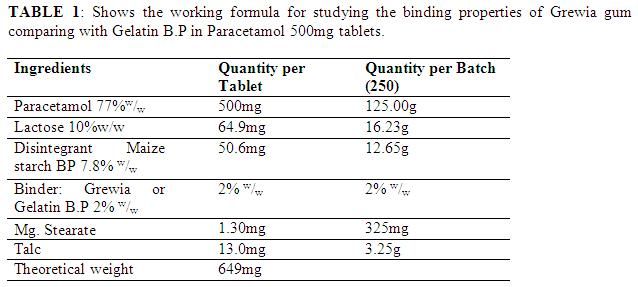
Muazu J. et al / Journal of Pharmaceutical Science and Technology Vol. 1 (2), 2009, 74-79

The slope of the straight line portion, K, is                      Germany.
the reciprocal of the mean yield pressure, Py,                     Methods
of the material. The intercept of the                              Extraction of Grewia gum
extrapolated linear portion, A, is a function                      The method of Nasipuri et al was adopted
of the original compact volume. From the                           for the extraction of grewia gum (Nasipuri et
value of A, the relative Density (DA) can be                       al 1996). The gum was size reduced using a
calculated using the following equation.                           laboratory blender and the size fraction <
DA = 1-e-A……………………… (2)                                            180 μm was used.
The relative density of the powder bed at the                      Modification of Grewia gum.
point when the applied pressure equals zero,                       The method of Audu-Peter et al (Audu-Peter
D0, is used to describe the initial                                et al, 2007) was adopted. Twenty grams of
rearrangement phase of densification as a                          gum powder was weighed and carefully
result of die filling and this is obtained from                    transfered into a round bottom flask and
the ratio of the loose density to the particle                     80ml of hydrochloric acid was poured into
density. The relative Density, DB, describes                       the flask to make slurry. The mixture in the
the phase of rearrangement of particles                            flask was then placed into a water bath of
during the initial stages of compression. The                      temperature 50oC and then clamped using
extent of rearrangement phase depends on                           retort stand and then allowed for time
the theoretical point of densification at                          interval of 1, 2 and 3 hours respectively
which deformation of particles begins.                             while constantly stirring using glass rod.
Thus, DB = DA - D0 ……………... (3)                                    This was repeated for each concentration
In the present study, Grewia gum has been                          (0.1N, 0.2N and 0.3N HCl. It was then
treated with acid and evaluated as a binding                       removed from the water bath and allowed to
agent in paracetamol tablet formulations in                        cool. Equal volume of equimolar
comparison with a standard binder, gelatin                         concentration of sodium hydroxide was used
BP using the compression equations of                              to neutralize the acid. About 80ml of ethanol
Heckel. Mechanical strength of the tablets                         was used to precipitate the gum after which
was assessed using crushing strength and                           it was placed in 80ml of distilled water and
friability while the release properties of the                     then a drop or two of silver nitrate solution
tablets were assessed by disintegration and                        was introduced – To test the presence of salt
dissolution times. Paracetamol was used as                         which is indicated by observed precipitate of
the model drug for the present work because                        silver chloride. Finally, ethanol was used to
of its poor compression properties; hence it                       precipitate the gum and then dried.
needs a binding agent among other                                  Preparation of granules
excipients to form satisfactory tablets                            The wet granulation method of massing and
(Odeku 2005).                                                      screening was employed and the batch size
 Materials and Methods                                             was 250 tablets.
The following materials were used as                               Quantities of paracetamol powder, lactose
procured      from      their    manufacturers;                    and maize starch were dry-mixed for 5
Hydrochloric acid, sodium hydroxide,                               minutes in a planetary mixer (Model A120,
magnesium stearate, maize starch,(B.D.H.
                                                                   Hobart Manufacturing Co., UK.) and then
Ltd, England),water bath with temperature
regulator, mettler electronic weighing                             moistened with distilled water or appropriate
balance (Gallenkamp), drying carbinet                              amounts of binder solutions to produce
(mono model N53 Gallenkamp), absolute                              granules containing different concentrations
ethanol, Erweka tablet machine(GMBH)                               of grewia gum or gelatin as binders.

                                                                                                              75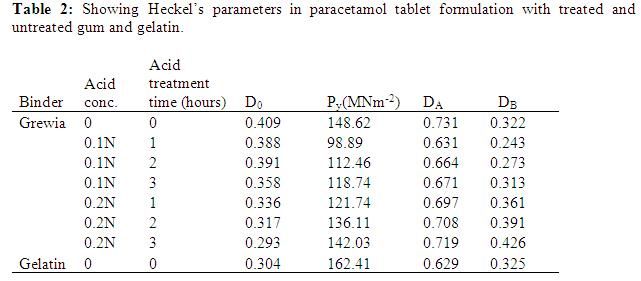
Muazu J. et al / Journal of Pharmaceutical Science and Technology Vol. 1 (2), 2009, 74-79

                                                                                            76
Muazu J. et al / Journal of Pharmaceutical Science and Technology Vol. 1 (2), 2009, 74-79
Massing was continued for 5 minutes and different time intervals and replaced with
the wet masses were granulated by passing equal amounts of fresh medium (0.1N HCl).
them manually through a wire mesh (1600 The sample was diluted and the amount of
paracetamol released was determined using
µm), dried in a hot air oven (Gallenkamp,
a UV spectrophotometer (Beckman and
UK) for 18 hours at 50 °C. Dried granules Coulter DU 520 series, UK) at 243 nm.
were sieved through a mesh (1400 µm) and Result and discussion
then stored in airtight containers. Fig. 1 shows representative Heckel plots for
Formulation of tablets paracetamol formulations containing
The granules were lubricated with 2.0%w/w binder. The mean yield pressure,
appropriate weight of lubricant/glidant (table py, was calculated from regions of the plots
1) Paracetamol tablets (500 mg) were showing linearity. The intercept, A, the
prepared from the 250 to less than 100 mm point at which an intact tablet was just
size fraction of granules by compressing formed during compression, was determined
them for 60 s with predetermined loads at from the extrapolation of the region used for
various compression pressure, on an Erweka the determination of py. The DA and DB
single punch tabletting machine (Erweka, values were calculated from equations 1 and
AR400 Germany) coupled with 12.5 mm die 2 respectively. The values of D0, Py, DA and
and flat-faced punches. After ejection, the DB for the formulations are presented on
tablets were Stored in a descicator Table 2.
containing silica gel for 24 h. There relative The D0 value, which represents the degree of
densities (R) were calculated using the initial packing in the die as a result of die
equation: filling for all formulation increased as the
R = m / Vt.ρs………………………(4) binder concentration is increased, implying
Where Vt is the volume of tablet (cm3) and that initial packing of the granules as a result
ρs is the particle density of solid material. of die filling increased with increase in
Crushing strength and friability tests binder concentration which confirmed the
Crushing strengths of the tablets were earlier work (Oladapo et al, 2006). In
determined at room temperature using general formulation containing grewia gum
Erwka Hardness tester (Erweka TBH 100, treated with 0.2N for 3 hours has the lowest
Germany). D0 value. As the time of treatment is
The percent friability of the tablets was increased the D0 value decreases, also as the
determined using an Erweka friabilator concentration of acid used in treatment is
(Erweka, Germany) operated at 25 rpm for 4 increased the D0 value decreases.
minutes. The DB value represents the particles
Disintegration and dissolution tests rearrangement phase in the early
Disintegration times of the tablets were compression stages and tends to indicate the
determined in distilled water at 37±0.5°C extents of particles or granules
using a disintegration tester (Erweka ZT 71, fragmentation, although fragmentation can
Germany). occur concurrently with plastic or elastic
The dissolution test was carried out on the deformation of constituent particle, DB value
tablets using the USP XXIII basket method generally decrease with increase in the
(Erweka dissolution tester, Type DT 700, concentration of acid and time of treatment.
Germany) rotated at 50 rpm in 900 mL of This indicates that granule fragmentation
0.1N HCl, maintained at 37 ± 0.5 °C. decreased with an increase treatment time
Samples (15 mL) were withdrawn at and acid concentration.
77Muazu J. et al / Journal of Pharmaceutical Science and Technology Vol. 1 (2), 2009, 74-79
3.5
3
2.5 0
0.1N 1hr
2 0.1N 2hrs
In(1/1‐D)
0.1N 3hrs
1.5 PVP
0.2N 1hr
1 0.2N 2hrs
0.2N 3hrs
0.5
0
0 50 100 150 200 250
Applied pressure (MNm‐2)
Figure 1. Heckel plots for Paracetamol tablet formulations containing gelatin, untreated grewia
gum and grewia gum treated with different acid concentration and time.
The Py value (mean yield pressure) is agent leads to an increase in plastic
inversely related to ability of material to deformation of the formulation and
deform plastically when compressed (Itiola, consequently to the formation of more solid
1991), the value of Py was observed to bonds with increase in tablet strength and
increase with increase in treatment time and resistance to fracture and abrasion (Odeku,
acid concentration, Implying that the onset 2005). Untreated grewia gum has higher
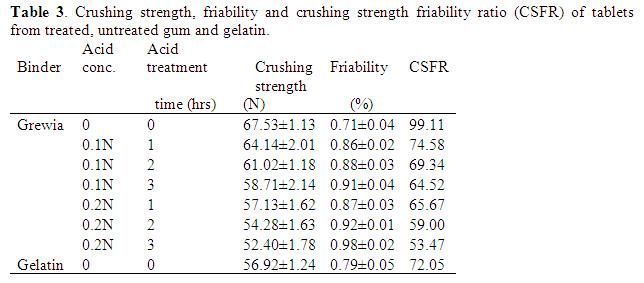
of plastic deformation in the formulation crushing strength than gelatin, while gelatin
occurred at lower pressure. has crushing strength higher than all treated
Treatment of grewia gum with 0.1N for gums. The crushing strength-friability ratio
1hour was observed to have lower Py value, (CSFR) can also be used to measure the
indicating less force might be possibly mechanical strength of tablets. The values of
needed to deform them. The relative higher CSFR for the tablets were also shown on
Py value observed in gelatin and untreated table 3; there was decrease in CSFR values
gum indicated that the granules were softer as a result of increased concentration of acid
more plastic and hence could deform and treatment time. .Treatment with acid
readily. therefore disorganizes the structure of the
The crushing strength values increased and gum and hence the low crushing strength
those of friability decreased with an increase and high friability.
in acid concentration and treatment time. It The release of medicaments from tablets can
is a well known fact that a high be assessed by disintegration and dissolution
concentration of a plasto-elastic binding times, the disintegration and dissolution
78Muazu J. et al / Journal of Pharmaceutical Science and Technology Vol. 1 (2), 2009, 74-79
times of the formulation were shown on [5] Itiola OA. (1991) Compression
table 4. The disintegration and dissolution Characteristic of Three Starches and the
Mechanical Properties of their Tablets.
times both decreased with increase in acid Pharm. World J. 8(3): 91-97
concentration and treatment time. However, [6] Kalu VD, Odeniyi MA, and Jaiyeoba KT.
tablets containing untreated grewia gum (2007) Matrix Properties of a New Plant
have highest disintegration and dissolution Gum in Controlled Drug Delivery. Arch
times. This might be as a result of the gum Pharm Res 30 (7): 884-889
[7] Kawakita K, Ludde, KH. (1970) Some
been intact (not disorganized) Considerations in Powder Compaction
All the tablets conformed to the British Equation. Powder Tech. 4:61-68.
pharmacopoeia requirement (BP, 2002) for [8] Odeku OA (2005) Assessment of Albizia
uncoated tablets on disintegration, i.e. tablet zygia gum as a binding agent in tablet
to disintegrate within 15mins. The time formulations. Acta Pharm. 55; 263–276
[9] Odeku OA and Itiola OA. (1998) Evaluation
required for 50% and 70% (t50 and t70 of khaya gum as a binder in a paracetamol
respectively) of paracetamol to be released tablet formulation, Pharm. Pharmacol.
were shown on Table 4. It also followed the Commun. 4; 183–188.
pattern of disintegration, disintegration is the [10] Ohwoavworhua FO, Adelakun TA and
first step of dissolution and the explanations Kunle OO. (2007) A comparative
Evaluation of the Flow and Compaction
are similar. Characteristics of α-Cellulose obtained from
Conclusion Waste Paper. Trop. J. Pharm. Res, 6 (1):
The present study showed that formulation 645-651
containing treated grewia gum as a binder [11] Oladapo AA, Michael AOand Oludele AI.
show similar onset of plastic deformation (2006) Compression, mechanical and release
properties of chloroquine phosphate tablets
under applied compression pressure, similar containing corn and trifoliate yam starches
mechanical and release properties with the as binder. Trop. J. Pharm. Res. 5 (2): 589-
standard (gelatin) however the untreated 596.
gum exhibit higher plastic deformation, [12] Onwuliri FC, Wonang DL, Onwuliri EA and
mechanical and release properties. This Mawak JD (2006) phytochemical,
Toxicological and Histopathological studies
suggests that treated gum can be used as a of some medicinal plants in Nigeria. Intern
binder in uncoated tablets and where Journal of Natural and Applied Sciences 2
sustained release is desired, untreated grewia (3): 225-230, 2006
can be used. [13] Rama Prasad YV, Krishnaiah YSR and
References Satyanarayana S. (1998) In vitro evaluation
[1] Audu-Peter JD, Isah S and Limasaya I of guar gum as a carrier for colon-specific
(2007) Evaluation of modified grewia gum drug delivery, J. Control. Rel. 51; 281–287.
as binder in paracetamol tablet. Nig. J. [14] Ravindra SD, Shamkant LS, Bhaskar C,
Pharm. Res 6 (1); 25-30 Kakasahib RM and Anant P. (2006)
[2] British Pharmacopoeia. Her Majesty’s Evaluation of a drug with wax-like
stationery office, University Press properties as a melt binder. Acta Pharm. 56:
Cambridge. 2002 Vol. l and ll. 451-461.
[3] Emeje M, Isimi C and Kunle O. (2008) [15] Train D. (1956) An investigation into the
Effect of Grewia gum on the mechanical compaction of powders. J. Pharm.
properties of Paracetamol tablet Pharmacol. 8: 745-761
formulations. Afr. J. Pharm. Pharmacol. 2: [16] United States Pharmacopeioa 23/National
1-6. Formulary 18, United States Convention,
[4] Heckel RW. (1961) An analysis of powder Rockville. 1995, pp. 1942-1943.
compaction phenomenon. Trans. Metall.
Soc. AIME. 221: 671-675.
79You can also read


