CONNECTING THE WORLD OF EDUCATION TECHNOLOGY - GLOBAL EDTECH ECOSYSTEMS 1.0 - JULY 2018 - GLOBAL EDTECH ...
←
→
Page content transcription
If your browser does not render page correctly, please read the page content below

GLOBAL EDTECH ECOSYSTEMS 1.0
 Connecting the world of
 Education Technology

July 2018
NAVITAS VENTURES - advancing innovation in education globally

CONTENTS
    Methodology		             04
    City Scores               05
    Exec Summary		            06
    Companies		               08
    Funding			                10
    Community		               14
    Support			                18
    Test Bed			               20
    City Profiles		           22

    View the individual
    EdTech city profiles at
    our interactive website
    EdTechCities.com
2
Welcome to
PROJECT
ECOSYSTEM
EdTech needs greater collaboration
Navitas is a global company operating across               As you dive into the profiles, you will see that we
more than 50 cities, and in my travels I have met          have combined a data-led approach with on-
hundreds of people who are passionately but                the-ground intelligence gathered from leading
independently working to achieve the same goal             influencers based in each city. These local inputs
– to improve student experiences and outcomes.             have been essential in assuring the quality of our
The people we meet – be it founders, teachers, or          work, helping us to validate hard data and gauge
other EdTech participants – all want to connect and        and compare the overall health of each EdTech
learn from each other, but find it difficult across this   environment.
young, fragmented sector.
                                                           If you love what you see, please visit our interactive
At Navitas Ventures we are looking to bridge this          website – EdTechCities.com – to explore each city
gap. Our first initiative, Project Landscape, created      in more depth.
a global map to help people navigate the rapidly
                                                           As always, we value your feedback and we listen,
changing world of EdTech. Our new initiative goes
                                                           so please don’t hesitate to reach out.
further, by creating a tool that will help the Global
EdTech community collaborate more easily.

We call this Project Ecosystem.

Project Ecosystem 1.0 showcases the EdTech
environment within 20 diverse cities around the
world. Our intention is that this project will allow
the sector to identify global best practice and
make mutually-beneficial connections. To support
your search, we have calculated a unique EdTech
index score for each city that measures its maturity       Tim Praill
against five dimensions of the EdTech environment          Head of Navitas Ventures
– companies, funding, community, support and               contactus@navitasventures.com
test bed.

                                                                                                                    3
METHODOLOGY
    Ecosystem 1.0 evaluates the EdTech environment
    within 20 cities

              20 diverse cities
              Cities have been chosen to represent the full breadth of maturity and
              diversity that exists across the global EdTech ecosystem. We recognize
              that the cities selected are not the 20 largest EdTech ecosystems.¹

              Consistent EdTech definition
              We have limited the scope to education companies that are innovative
              adopters of technology. We estimate this represents about 25000
              companies globally and excludes many education incumbents.²

              Five dimensions of the EdTech environment
              Each dimension contributes to an effective environment for EdTech
              development - from funding intensity to the level of government support.

                        Companies                       Funding                    Community                        Support                      Test Bed

                       The breadth                  The availability           The maturity of the           The level of Gov. /            The quality, size
                     and depth of the               and sources of             EdTech community              education support              and accessibility
                    EdTech landscape                EdTech capital              (e.g. incubators)              and innovation                 of the local
                                                                                                             potential of the city          education sector

              Combined into a weighted EdTech Index score
              Weighting is used to reflect the underlying importance of each dimension
              to the EdTech environment, and help identify the leading global cities.

    1. A report based on the 20 largest EdTech cities would be dominated by the US and China, reducing the diversity of the study; 2. Many large diversified incumbent edu-
    cation companies (such as TAL, New Oriental and Pearson) or diversified companies with education arms (such as SEEK and ROOBO) play an important role in EdTech but
    have largely been excluded from the scope of this report.

4
CITY SCORES                                                                                                                                          EDTECH
                                                                             COMPANIES      FUNDING     COMMUNITY       SUPPORT       TEST BED        INDEX1

                                    Weighting2 (maximum score)                   30            30            15            15            10               100

                                   1        Beijing                             30            26             14            13             6               88
       Global
                                  2          Bay Area                           26            30             10            14             8               86
      leaders
                                  3         New York                            26            24             15            12             9               85

                                  4          Boston                             23             17            15            14             9               76
  Challenger
                                  5         London                              23             17            15            11             8               72
    cities
                                  6         Shanghai                             21           20             10            11             7               68

                                   7         Bangalore                          23             17             8             7             5               58

                                  8         Paris                               20             12            11             9             6               58

                                  9         Tel Aviv                            20              9            13            11             5               57

                                  10         Stockholm                           18             9            10            14             6               56

                                  11         Singapore                           18             8            10            11             7               54

                                  12        Berlin                               15            12            10            10             6               53
    Emerging
     cities at                    13        Toronto                              17            11             9             9             6                51
    different
    stages of                     14         Delhi NCR                          20             14             7             5             6                51
    maturity
                                  15        Sydney                               17             6             8             9             6               45

                                  16        Tokyo                                11             9             7            11             6               42

                                  17         Kuala Lumpur                        11             6             6             8             6               37

                                  18        Nairobi                              14             6             9             5             4               37

                                  19        Cape Town                            14             6             8             5             3               35

                                 20          Sao Paulo                           12             6             7             5             4               33
1. The EdTech Index may not equal the sum of input scores due to rounding; 2. For more information on our methodology and how the scores for each dimension were
calculated, please visit EdTechCities.com
                                                                                                                                                                   5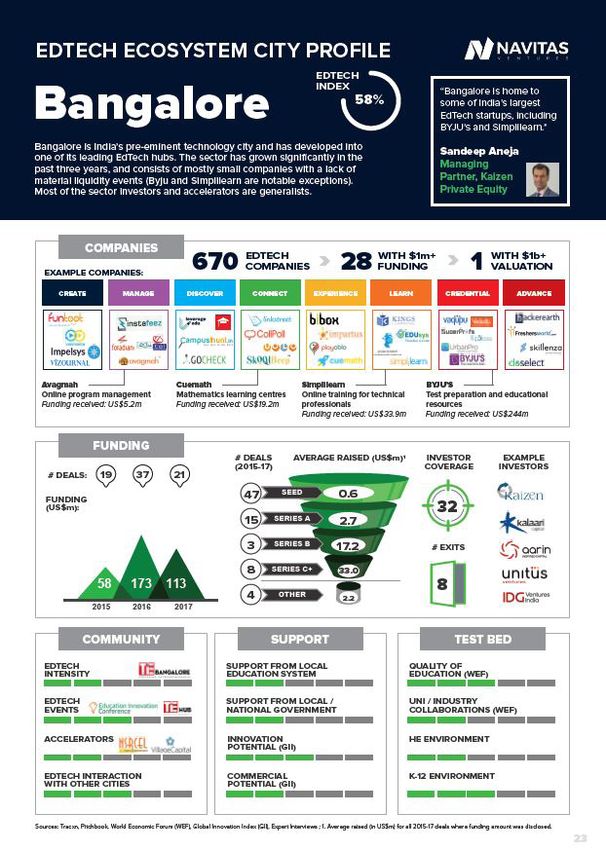
EXEC SUMMARY
    The 20 cities analysed are home to 40% of the global EdTech sector and
    operate at very different levels of maturity. Three cities dominate - Beijing,
    the Bay Area and New York - with each pursuing a different strategy for
    EdTech development

    Beijing is the leading example of a domestic                                            Hubs are self-sufficient ecosystems in their own
    champion – a city that dominates EdTech within                                          right, providing EdTech companies with everything
    the home country. These cities have support                                             they need to reach scale without leaving the city
    systems in place to help companies access early-                                        limits. EdTech companies benefit from immediate
    stage capital so that they can expand quickly and                                       access to funding, customers (students and
    dominate their large domestic markets.                                                  employers), and a highly supportive environment
                                                                                            from which to grow.
    Beijing has an EdTech sector with unparalleled
    depth. 3000 EdTech companies are headquartered                                          Below New York lies Boston and London. All three
    there, and the city benefits from the highest global                                    cities are recognized for their supportive EdTech
    concentration of EdTech companies per capita.                                           ecosystems, incorporating globally respected
    Strategic incumbents (TAL, New Oriental) and the                                        collaborators, a highly regarded events schedule,
    local government play key roles in supporting the                                       specialist accelerators and close integration with
    ecosystem and making it the dominant hub for                                            traditional education players. We expect each city
    Chinese EdTech.                                                                         to continue to build its EdTech offering and global
                                                                                            connectivity in the future.
    Outside of China, Bangalore is one of the most
    exciting domestic champions to emerge. If barriers                                      As the next generation of EdTech entrepreneurs
    to funding availability and sector support can                                          move to cities that offer the best environment for
    be overcome, Bangalore has the opportunity to                                           EdTech development,¹ accumulated advantage
    capture India's significant demographic potential                                       is expected to reinforce the leadership of the Big
    and exploding demand for workforce training and                                         Three. Location is undoubtedly important, but a
    alternative forms of education.                                                         Beijing, Bay Area or New York headquarters is not
                                                                                            a pre-requisite for success, with only six of the ten
    The Bay Area is the world's leading international                                       largest fundraisings in 2017 directed at companies in
    export city, focused on providing EdTech companies                                      these cities.²
    with the seed capital, technical expertise and market
    access needed to quickly build a category-leading                                       We expect that challenger and emerging cities will
    global product.                                                                         continue to mature and provide more complete
                                                                                            support for EdTech development in the future, often
    The Bay Area is unique across international export                                      by adopting best practice from the leaders. In a future
    cities in that it is globally-focused despite being                                     iteration of this report we also expect to profile the
    based in a large domestic market. Most other                                            next wave of EdTech cities competing on the global
    international export cities operate in relatively                                       stage, including Washington, Philadelphia, Phoenix,
    small domestic markets, forcing their companies                                         Austin, St Louis, Los Angeles, Seattle, Monterrey,
    to expand into larger education markets early in                                        Helsinki, Oslo, Tallinn, Shenzhen and Ho Chi Minh
    their lives. As a result, a number of companies                                         City.
    headquartered in international export cities, such
    as SmartSparrow (Sydney) or Matific (Tel Aviv) have
    established significant launchpad offices in larger
    markets early in their development.
                                                                                                  What can we learn from the
                                                                                                  Big Three EdTech cities:
    Rounding out the Big Three is New York, the
    world’s leading example of an EdTech Hub.
                                                                                                  Beijing, Bay Area and New York?

    1. More than half of the 2017 StartEd and Emerge Education accelerator cohorts were international; 2. Four in Beijing, one in Shanghai and one in the Bay Area.

6
Learnings from the global leaders - Beijing, the Bay Area and New York

        Build a complete ecosystem
        The Big Three have no weak links, with their continued development driven
 1      by excellence in each dimension of the EdTech environment. Their main
        challengers need to close the gaps in their ecosystem, in particular around
        EdTech funding availability, if they are to remain competitive.

        Create a density of EdTech activity
        The Big Three have created a broad pipeline of EdTech companies operating
 2      at all levels of maturity. Emerging cities will find it hard to compete across the
        entire learning lifecycle, and should instead focus on building density, capability
        and brand recognition in specific education technologies or applications.

        Bridge the gap to capital providers

 $3
        The Big Three benefit from a diverse network of angel, venture capital, private
        equity and strategic investors funding EdTech growth. Emerging cities need to
        increase generalist understanding of education as an asset class, and increase
        connectivity with international EdTech specialists to close the gap.

        Create empowered ecosystem leads
        The Big Three have well established ecosystem leads that drive improvements
 4      in EdTech maturity. If they have not already done so, emerging cities should
        consider creating an ecosystem champion to lead domestic and international
        collaboration and coordinate sector development.

        Unlock government and broader sector support
        New York and Beijing leverage extensive local government support, while all
 5      three cities have built strong partnerships with local universities. Tapping into
        these entities can provide emerging cities with the capability, scale and access
        needed to compete internationally.

        Realize the test bed potential of urban education systems
        Access to a broad test bed is a key driver of the success of hub cities like
 6      New York and London, as it provides EdTech companies with an immediate
        opportunity to prove out products and achieve scale. Other hubs could do more
        to open up urban education systems to EdTech companies and products.

                                                                                              7
COMPANIES
    The Company dimension of the EdTech index reflects the breadth and
    depth of the EdTech landscape (companies headquartered in the city)

    Which are the largest EdTech cities?                      Which cities create large companies?
    Beijing is the world’s largest EdTech city, home to       China closely matches the US in the creation
    3000 EdTech companies and more than 10% of the            of billion dollar EdTech companies. Beijing and
    global EdTech sector. There is considerable distance      Shanghai have supported seven companies to a
    between Beijing and the next group of cities, which       valuation over US$1b, compared to 11 across the
    includes Shanghai, New York, Delhi NCR and the            whole of the US (only two, Chegg and Udacity, are
    Bay Area, each home to between 800 and 1000               headquartered in the Bay Area and two, Ascend
    companies. Beijing also has the highest concentration     and Skillsoft, are in Boston). The major contributing
    of EdTech startups globally, at 120 EdTech companies      factors include the demographic potential of China,
    per million people. New York, the Bay Area and            the high proportion of household income spent on
    Bangalore also have high startup densities, followed      education, and the concentration of EdTech activity
    by Stockholm and Singapore.                               in Beijing and Shanghai.

                                                              In contrast, the Bay Area and Boston have the
    Which cities are growing quickly?                         highest proportion of startups that have received
    Almost all of the cities surveyed have enjoyed rapid      funding of >US$1m. Cities outside the US and
    growth in EdTech. A theme we consistently heard           China generally have a lower proportion of funded
    across markets as diverse as Paris, Cape Town, and        EdTech startups, indicating lower access to capital
    Tel Aviv was, “five years ago there was no EdTech,        or lower rates of startup success.
    and now there is a distinct sector.” In percentage
    terms, we suspect the fastest growing cities are likely   Which cities specialize?
    to be smaller ecosystems, with Southeast Asian cities
    emerging onto the global stage from virtually nothing     Most cities support companies across the
    in the past three years.                                  learning lifecycle, although some cities have
                                                              started to build deeper specialization.

                                                              China’s largest EdTech players are focused on the
                                                              domestic K-12 sector, with the after-school tutoring,
      “Beijing is home to over                                test preparation and English language learning
        3000 EdTech startups,                                 markets particularly well-served. In contrast, the
                                                              largest US companies are predominantly focused
           and is the center of                               on higher education and lifelong learning, and use
       EdTech development in                                  the US as a platform for international expansion.
      China. We expect to see
                                                              Environmental differences also contribute to city
      continued growth in this                                EdTech specialization. For example, cities with
          thriving ecosystem.”                                traditional education systems (such as Tokyo) and
                                                              those with greater central government control
                  Sophie Chen,                                (such as Paris) are home to a higher concentration
               Partner, JMDedu                                of companies focused on corporate and lifelong
                                                              learning. Similarly, emerging market cities have
                                                              a higher concentration of innovative mobile first
                                                              solutions. For example, several Kenyan startups
                                                              use SMS to deliver educational content and
                                                              overcome a lack of computers in the classroom.

8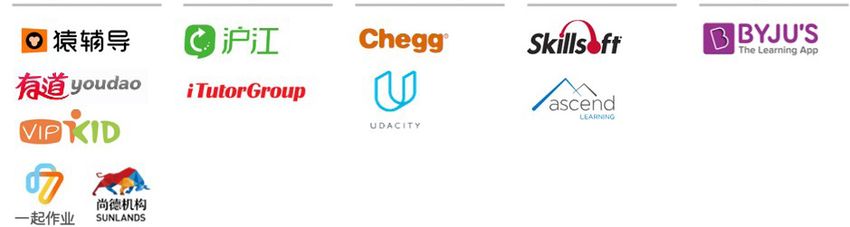
Number of EdTech companies headquartered in our 20 cities
                      Beijing                                                                  3,000

                  Shanghai                                                    1,000

                  New York                                                    1,000

                        Delhi                                           880

                  Bay Area                                            800

                 Bangalore                                      670

                    London                                520

                 Singapore                       300

                        Paris                    300

                     Boston                    240

                    Toronto                  200

                    Tel Aviv               160

                Stockholm                 150

                    Sydney               130

                     Nairobi           100

                       Berlin         90

                       Tokyo          80

                 Sao Paulo           62

               Cape Town             60

            Kuala Lumpur            50

EdTech companies valued at over US$1b in our 20 cities1
      Beijing                       Shanghai                    Bay Area              Boston   Bangalore

1. At last fundraise, or May 1, 2018 if publicly listed

                                                                                                           9
FUNDING
     The Funding dimension of the EdTech index represents EdTech capital
     availability and investor coverage

     Which cities attract funding?                                                            funding, the largest US EdTech companies are
                                                                                              more geographically distributed. US companies
     Funding was our most concentrated metric. The five                                       attracted four of the ten largest global EdTech
     US and Chinese cities evaluated received 86% of                                          investments in 2017, but only one (Chegg) is based
     all funding between 2015 and 2017. Beijing led the                                       in a traditional center for US EdTech (profiled in this
     way, with US$2.2b of funding received, followed by                                       report), and the remaining three are headquartered
     the Bay Area (US$1.9b), Shanghai (US$1.4b), and New                                      in Washington and Miami.
     York (US$0.9b). The proportion of funding received by
     each of our 20 cities is shown below:                                                    The absence of funding is the major barrier that
                                                                                              non US-Sino cities have to overcome to develop
                        Toronto                                                               competitive EdTech environments. For example,
                       Tel Aviv
                        Berlin                                                                although Bangalore and Delhi NCR are home
                                        Other Cities
                  Boston 2%
                                                                                              to 16% of the EdTech companies identified,
                 London                 3%                                                    they attracted just 5% of total funding over the
          Bangalore         3%                                   Beijing                      review period. The absence of material liquidity
                                                        29%
                          4%                                                                  events in these cities creates further barriers to
                                                                                              investment, and only increases the disparity in
     New York       12%        Funding received                                               capital allocation.
                                  (2015-17)
                                                                                              Despite the lower levels of funding deployed
                                                                                              outside of the top cities, EdTech companies are
                                                                                              finding it easier to raise funds. Generalist investors
                            18%                       24%                                     are increasingly entering the sector, while a
              Shanghai                                       Bay Area                         range of strategic and social-impact investors are
                                                                                              prioritizing EdTech (i.e. Naspers and Google in
     Other notable cities included Bangalore (US$344m),                                       Africa).
     London (US$263m), Boston ($190m), Berlin (US$119m),
     Tel Aviv (US$90m) and Toronto (US$70m), with the                                         Who are the main investors?
     remaining 11 cities each receiving less than 1% of                                       While the US is home to several specialist
     total funding. Tokyo deserves a special mention, as                                      EdTech investors (New Schools, Learn, Rethink,
     although Tokyo headquartered companies received                                          University Ventures etc.), they are rare in other
     less than $20m of funding between 2015 and 2017,                                         cities, with Brighteye Ventures (Paris), Educapital
     several Tokyo based investors have deployed                                              (Paris), Emerge Education (London) and Blue
     material funds in Asia and beyond.                                                       Elephant (Beijing) notable exceptions.

     It is notoriously difficult to obtain accurate data on                                   In China, the strategic investment arms of the
     the level of funding deployed into Chinese EdTech                                        major education companies (such as TAL and
     companies,1 but one thing is clear – Beijing and                                         New Oriental) have played a critical funding role in
     Shanghai companies are attracting serious money.                                         Beijing and Shanghai over the past three years. On
                                                                                              the other hand, only a few industry-agnostic funds
     Between 2015 and 2017, four of the top five EdTech
                                                                                              (such as ZhenFund, IDG Capital, ShunWei Capital
     investments across our profiled cities went to
                                                                                              and Sequoia) have actively invested in EdTech.
     companies headquartered in Beijing and Shanghai
     (iTutorGroup, VIPKID, Gaosi Education Group and                                          New Schools, 500 Startups, Learn Capital,
     Hujiang). While Beijing and Shanghai companies                                           Techstars and Y Combinator were the most
     consistently attract the majority of Chinese EdTech                                      active investors across our 20 cities, investing

     1. Despite our analysis and Metaari's January 2018 report, 'The 2017 Global Learning Technology Investment Patterns' indicating that Chinese EdTech funding has declined
     between 2015 and 2017, JMDedu (which is likely to have the broadest Chinese EdTech dataset) has shown an increase in Chinese EdTech funding over the period.
10
in 219 EdTech companies between 2015 and for 57% of all EdTech company exits identified
2017. They lead a long tail of predominantly US- across our 20 cities over the review period. This
headquartered generalist investors, showing the undoubtedly showcases current limitations in non-
extraordinary breadth of funding sources available US data but also reveals a key factor contributing
to US headquartered EdTech companies. The lack to the resistance of generalist investors from
of investor breadth is a significant challenge for the participating in the sector.
rest of the world, with the three US cities profiled
benefiting from 1.5 times as many active investors Other Cities
as the remaining 17 cities combined.1 Some of these (11-20)
Stockholm 2%
cities continue to punch above their weight, however. 9%
Toronto 3% Bay Area
Within identified funding rounds, Shanghai has the 26%
Beijing
largest average deal size, followed by Beijing, the 4%
Bay Area, New York, Berlin and Bangalore. Paris
4%
EdTech company
Which stages attract funding? Bangalore 5%
exits (2015-17)
We identified over 1000 funding rounds of EdTech 7%
Delhi NCR
companies headquartered in our 20 cities between 18%
2015 and 2017. More than half of all capital was 9% New York
directed into late stage (Series C+)2 rounds, despite London 14%
these only accounting for 7% of the total deals. 82%
of these large rounds (Series C+) involved companies Boston
headquartered in five cities (Beijing, the Bay Area,
Three quarters of the cities evaluated experienced
Shanghai, New York and Bangalore).
less than three exits a year between 2015 and
EdTech funding across 20 cities by investment 2017, which is surprising considering the growth
stage (2015-17) in $US millions in capital flowing into the sector. This could
TOTAL FUNDING % TOTAL
indicate that many EdTech companies are still in a
growth phase, with developing market founders in
SEED 5 particular continuing to raise private money to fund
390
expansion.
SERIES A 1,184 15 Beijing and Shanghai were responsible for the only
EdTech IPOs over the period, with 51 Talk (Beijing),
SERIES B 1,764 23 Juesheng.com (Beijing) and Retech Technology
(Shanghai) listing on the markets to fund their next
wave of expansion. 51 Talk and Retech Technology
SERIES C+ 4,153 54
listed on the NYSE and ASX respectively,
highlighting a preference to list internationally
OTHER
222 3 and avoid the investor restrictions placed on
domestic stock exchanges. When looking at the
wider education sector, six of the 20 largest listed
Interviews consistently identified a shortage of
education companies in the world are Chinese.
early stage funding, with only 5% of total EdTech
capital deployed in Seed rounds. With many EdTech Although the average number of EdTech exits
investors only looking to participate from Series A, across our 20 cities remained relatively constant
accelerators and angel investors continue to play a over the period, emerging EdTech cities saw
key role in funding early stage EdTech companies in successful exits for the first time in 2017. For
each of the cities we evaluated. example, the acquisition of GetSmarter by 2U
for $103m demonstrated the potential of African
Where have we seen exits? businesses and provided a benchmark for African
New York, the Bay Area and Boston accounted EdTech founders looking to exit in the future.
1. Although we recognize limitations in our non-US investor data, this conclusion was reinforced by numerous interviews; 2. Series C+ includes private equity rounds.
11Number of EdTech deals (2015-17) and investors present in 20 cities
Number of deals
250
Bay Area
200 Beijing
150 Other Cities
(11 – 20)
New York
Bangalore
100
London Bubble size
Boston indicative of total
funding received
(in US$m)
50
Shanghai
Tel Aviv
500
Berlin
Toronto
0
0 25 50 75 100 125 150 175 200
Investor coverage1
Top five EdTech company investments across 20 cities (2015-17)
City Year US$m Investor/s Company
1 Bay Area 2015 230
2 Shanghai 2015 200
3 Beijing 2017 200
4 Beijing 2017 199
5 Shanghai 2015 157
Top five EdTech company exits across 20 cities (2015-17)
City Year US$m Acquirer/s Company
1 Boston 2017 2000+
2 New York 2015 575 (Scholastic’s Education Technology
and Services Business Unit)
3 Cape Town 2017 103
4 Beijing 2015 80
5 Bay Area 2016 72
1. Investor coverage refers to the number of investors who have invested in two or more EdTech deals in the city.
12“India’s EdTech ecosystem shows massive potential, but
faces weak investor sentiment, especially at the Seed
and US$1-2 million pre-series A stages.”
Madan Padaki,
Co-Founder, Sylvant Advisors
“London is Europe’s EdTech capital, and home to an
abundance of angel investors pursuing quality EdTech
companies. This angel network is a major reason why
EdTech founders from across Europe choose London
as their headquarters.”
Jan Matern,
Co-Founder and CEO, Emerge Education
“Africa has seen a recent surge in big money interest in
EdTech (from the likes of Elon Musk) that means early
stage investors will have new funding sources and exit
opportunities. However, the continent will benefit from
more early-stage investment to enable the immense
entrepreneurial breakthroughs that we are seeing.”
Jamie Martin,
Founder, Injini
13COMMUNITY
The Community dimension of the EdTech index represents the frequency
and maturity of EdTech activity in the city
Which cities have the strongest Boston
EdTech communities? Boston’s community is equally impressive. Eight
We found the most active, connected communities angel investment groups and a number of functional
within the vibrant cities of New York, Boston, London, and industry agnostic accelerators fund the
and Beijing. Each community offers comprehensive development of EdTech businesses in one of the
opportunities for sector participants to interact, a world’s leading centers of learning.
range of accelerator / incubator options and an LearnLaunch plays a critical role in binding the
internationally recognized events schedule. A further Boston EdTech ecosystem together, with its three-
five cities – Paris, Bangalore, Cape Town, Sao Paulo tiered approach – made up of a co-working space,
and Sydney – offer EdTech-specific accelerator/ accelerator and institute – providing leadership,
incubator programs, while EdTech meet-up groups investment and talent development. Boston is home
and event schedules have emerged across the to a full events schedule, including LearnLaunch’s
majority of the cities profiled. Paris is one of the annual Across Boundaries conference, the EdTech
fastest-maturing communities, with Learnspace, Teacher Summer Institute, the MassCue Technology
EdTech Observatoire and EdTech France supporting conference, and a host of other meet-ups, pitch
the development of a rapidly growing EdTech contests, demo days and hackathons.
ecosystem in the city.
London
New York London is the most mature European EdTech
While the Bay Area remains the center for EdTech community. Emerge Education operates a
deals in the US, New York has been cultivating dedicated EdTech accelerator and has facilitated
one of the world’s leading communities for EdTech over 50 early stage EdTech investments since 2014.
startups. On the events schedule, EdTechX Europe, London
EdTech Week, and BETT are globally recognized,
EdTech success stories like General Assembly, while the inaugural EdTech Podcast Festival and
Noodle, Knewton, Codecademy, and Schoology all Learnit Summit will debut in September 2018 and
have roots in New York City and credit the sheer scale January 2019 respectively.
of the city for much of their success.
A growing number of accelerators, co-working
spaces, business groups, events, and government Beijing
initiatives are popping up around the city to
support EdTech entrepreneurs. The NYU Steinhardt Beijing stands heads and shoulders above the
accelerator, powered by StartEd, offers a full suite of other Asian cities we profiled. Zhongguancun in
programs dedicated to education entrepreneurship Beijing's Haidian district is China’s version of Silicon
while the New York City Economic Development Valley and at its heart is the MOOC Times Building,
Corporation provides a range of services to help home to over 60 EdTech companies that provide
companies relocate and become established in the educational content and services as part of China’s
city. If New York is the city that never sleeps, it is also online education economy. BlueElephant Capital,
the city that never stops networking. Active meet-up Imagine K12, Innovation Works, New Oriental and
groups keep the events calendar full, culminating TAL (through the EdStars program) drive EdTech
in New York EdTech Week that attracts over 1000 acceleration in Beijing. JMDedu provides media
people to the city every year. coverage while the annual GET Summit and
GSV+TAL conference are the flagship events.
14Organisations driving EdTech intensity
EdTech Events Accelerators Other Champions
Bangalore
Bay Area
Beijing (JMDedu)
Berlin
Boston
Cape Town
Delhi NCR
Kuala Lumpur
London
Nairobi
New York
Paris
Sao Paulo
Shanghai
Singapore
Stockholm
Sydney
Tel Aviv
Tokyo
Toronto
15EDTECH EVENTS
Locate your next EdTech event in a city near you
JUN Israel EdTech Summit,
Tel Aviv - June 6-7
18 EduTech Australia, JAN LEARNIT,
Sydney - June 7-8 London - January 20-22
EdTechX Europe, 19 BETT,
London - June 18-22 London - January 23-26
Next Generation Student L2 Europe,
Success Symposium, Zurich - January 25-27
Barcelona - June 19-21 Learning Technologies,
ISTE Conference, France - January 30-31
Chicago - June 24-27 LearnLaunch Conference,
Boston - Jan 31 - Feb 1
JUL GET China,
Beijing - July 16 DEC OEB,
November Learning Conference, Berlin - December 5-7
18
Boston - July 25-27 NY EdTech Week,
18
EdTech Asia Summit, New York*
Hong Kong - July 26-27
ICDEET,
Beijing - July 28 NOV GET China,
NYC Schools Tech Summit, Beijing - November 13-15
New York - July 31 BETT Asia,
18
Kuala Lumpur - November 15-16
International Schools China,
AUG AFR HE Summit,
Shanghai - November 20-22
Melbourne - August 28-29
Reimagine Education,
18 San Francisco - November 29-30
SEP Education Innovation Conference, OCT EdSurge Fusion,
Bangalore - September 4-5 San Francisco - October 2-4
18 EdTechX Africa, 18 EdTech Sweden,
Cape Town - September 11 Stockholm - October 15-16
BMO Back to School, Education Expo,
New York - September 13 Beijing / Shanghai - October
20-28
EdTech Podcast Festival,
London - September 22 National Future Work Summit,
Sydney - October 30
Edupreneur,
Melbourne - September 26 EdTechX Asia,
Singapore - Oct 31 - Nov 1
Oslo Innovation Week EdTech Day,
Oslo - September 26 GES (GSV+TAL),
Beijing*
*Dates yet to be confirmed.; Key EdTech events outside of our 20 cities (such as ASU+GSV, Edupreneur, etc.) have been included.
16FEB EdTech Review Summit,
Gurgaon, India -
February 2-3
19
MAR 21st Century Learning,
Hong Kong - March 6-9
19 SXSW Edu,
Austin - March 8-17
Global Education and Skills
Forum,
Dubai - March 22-24
HE Tech. Conference,
Bangalore*
APAIE,
Kuala Lumpur*
Geduc,
Sao Paulo*
APR ASU+GSV,
San Diego - April 8-10
SETT,
“EdTech conferences are key
19
Stockholm - April 9-11 to connecting local ecosystems
Connect 2019,
Toronto* to the international community.
ASU+GSV, EdTech Asia and
MAY ICDEL, EdTechX give entrepreneurs
Shanghai - May 24-27
New Schools Summit,
the ability to showcase their
19
California* products to the world through
BETT Educar,
Sao Paulo*
different lenses. Founders
EDIX, should select the conference
Tokyo*
that best suits the stage and
Solve MIT,
Boston* needs of their company.”
MindCET EdTech Venture Day,
Tel Aviv*
So-Young Kang,
Founder & CEO, Gnowbe
17SUPPORT
The Support dimension of the EdTech index represents the support
available to EdTech entrepreneurs from government and the traditional
education sector
Where does the education sector
“Singapore is the most supportive
play an active role?
environment for EdTech companies
A range of cities show impressive interconnectivity in Southeast Asia. The education
with their local education sectors. Toronto, Boston,
system is willing to embrace EdTech,
the Bay Area and New York all show strong links with
internationally regarded university teaching colleges and the amount of government
and affiliated incubators / accelerators. The US cities support is impressive - for instance,
also benefit from the Obama-era Digital Promise the SkillsFuture program that
initiative, which has launched a range of programs to subsidizes learning online.”
support closer integration between EdTech companies
and the education sector. Initiatives like the League of
Innovative Schools and EdClusters have been integral Mike Michalec,
in increasing EdTech access, and the first steps are
being taken to export this best practice internationally.
Founder/MD, EdTech Asia
In London, University College London (UCL) plays
a lead role connecting EdTech organisations with support, with the Exist program fully funding the
researchers to improve the efficacy of their products employee and office costs of final-year university
and services through the Educate program, while students if they establish startups, followed by
ResearchEd is playing a similar role in K-12. Within another year’s salary and subsidized health
Asia, Singapore and Beijing, universities have built insurance. This generous support has encouraged
close ties with their local EdTech sectors, supporting many German researchers to spin off their
research into EdTech development and spinning off a intellectual property into EdTech startups.
number of startups.
In Stockholm, the Swedish State Authority of
Innovation hands out grants to companies across
Where has government directly industries, and in the last three years has called
supported EdTech? for EdTech companies to apply (It is estimated
that 50-60 EdTech companies have received
The level of direct government support for grants). Stockholm EdTech companies are further
EdTech development varied significantly across supported by the Nordic EdTech Alliance, a
the evaluated cities, with independent not-for- partnership of public and private players from
profits often playing a more active role in sector Norway, Sweden, Finland, Denmark and Iceland.
development. By leveraging the strong Nordic reputation in
education, the alliance aims to build bridges to
Singapore is one of the few examples of a
international markets and attract funders and
holistic, government-led response. The city offers
investors to the region.
an impressive level of government support for
entrepreneurs including specialist visa classes Equally, the Israeli Government plays a key role in
and financial support, while SG Innovate is actively the development of EdTech in Tel Aviv, including
supporting the development of the startup government loans of up to half a million dollars
ecosystems in multiple sectors – including EdTech. and state-backed incubators that can invest up to
$750,000 over a one-year program.
Berlin also benefits from best-practice government
18Export agencies like the UK Department of Trade also noted that China has recently tightened
and Industry and Austrade have played a key regulation around international schools, placing
role in helping London and Sydney based EdTech more requirements on the curriculum and regulatory
companies access international opportunities. hurdles for school operators to overcome.
Equally, US development agencies (particularly
in New York) play an important role in stimulating
attractive local conditions for international EdTech
Which cities have the greatest
companies seeking a US headquarters. innovation potential?
A city’s ability to drive innovation and
Where has Government activity commercialization is another important enabler of
restricted EdTech? EdTech development. The 2017 Global Innovation
Index's evaluation of patent volume and knowledge
Government actions can also hold back EdTech and technology outputs provides a consistent way
development. South African intellectual property and to measure this key dimension across our 20 cities.
foreign exchange control regulations make it hard
for EdTech companies to be based in Cape Town, As shown below, Tokyo is the world's largest
leading a number of African-focused businesses to patent generator, publishing almost three times the
base their headquarters in London or Mauritius. number of patents as our second-placed city (the
Bay Area), which was recognized as being the most
Despite its generally supportive environment, the collaborative cluster. For knowledge and technology
Info-communications Media Development Authority outputs, the most effective commercializer of
of Singapore (IMDA) control over the products and innovations and inventions was Sweden (Stockholm),
services that enter the K-12 public school system, followed closely by the Chinese and US cities.
has created a barrier to EdTech adoption. It was
Inventive activity clusters: Number of patents (in thousands) published
94 under the Patent Cooperation Treaty (PCT) System (2011-15)
34
15 14 13 12
7 7 6 5 4 3 2 2 2 1
Bay Area
Boston2
Stockholm
Toronto
Beijing
London
Tel Aviv
Shanghai
Singapore
Bangalore
Tokyo1
New York
Paris
Kuala Lumpur
Sydney
Berlin
Data Source: The Global Innovation Index 2017, excludes Nairobi, Cape Town, Delhi NCR and Sao Paulo (data unavailable)
1. Includes Yokohama; 2. Includes Cambridge
19TEST BED
The Test Bed dimension of the EdTech index represents the breadth, quality
and accessibility of the local education sector
Which education systems are practice and education technologies than their
Beijing counterparts. Delhi NCR is the next largest
recognized for their quality? city, and home to over 5500 K-12 schools, although
A high-quality education system creates the the city school system is noted as being rigid and
foundations for high-quality EdTech companies. conservative with regard to the adoption of EdTech
In the 2017 World Economic Forum (WEF) Global solutions. Despite only having half the number of
Competitiveness Report, Singapore's education schools, Bangalore is viewed as having the more
system ranked at the top of our 20 profiled cities, open and accessible school system across our two
followed by the US cities, Toronto and Berlin. Indian cities.
Companies headquartered in these cities benefit Across developed markets, New York has the
from exposure to education best practice that can largest public school and community college
support the development of best-in-class solutions systems in the US, while Greater London and the
with widespread global applications. Although outside Paris region also offer extensive school systems.
the scope of this report, Helsinki is another good However, while New York and London have
example of a city that is leveraging an internationally well-established programs to increase EdTech
regarded education system to develop best-in- adoption across the K-12 sector, Paris suffers from
class solutions. Finnish EdTech companies heavily centralized procurement and a lack of funding for
leverage the “made in Finland” brand globally and EdTech products – restricting adoption to date.
are highly regarded for the quality and innovation of
their products, in particular around the educational Which cities offer attractive Higher
deployment of gamification. Education test beds?
Although cities like Cape Town and Kuala Lumpur Unlike K-12 which broadly follows population
have less well-developed education systems, they distribution, quality Higher Education institutions
have become innovative test beds for emerging frequently cluster to create internationally
technologies and offer viable markets for export- recognized centers of learning.
minded companies headquartered in developed
market cities (London and Sydney respectively). The map on the next page demonstrates the
clustering of highly-ranked universities in cities
Which cities offer high-potential such as the Bay Area (home to Stanford University
and University of California, Berkeley), Boston
K-12 test beds? (home to Harvard University and Massachusetts
K-12 EdTech companies benefit from cities with a Institute of Technology) and London (home to
high concentration of schools that are willing to Imperial and University College). These cities are
innovate around education delivery. Our interviews home to a high concentration of higher education-
helped to identify which cities provide the largest K-12 focused EdTech companies, in part due to EdTech
test beds that are actively helping EdTech companies founders and companies emerging from the
to scale and benefit from network effects. leading academic research at these universities.
These quality universities also represent easily
City population drives K-12 student numbers, and the
recognizable early adopters making it easier for
megacities of Shanghai and Beijing have the largest
Higher Education-focused EdTech companies to
K-12 populations globally. Shanghai is often given the
build their brands.
privilege of experimenting with education reforms
before they are rolled out across the rest of China,
which has led Shanghai schools to be regarded as
more open to the adoption of innovative classroom
20Distribution of ranked universities across the world (2018)
20 30 40 50 60 70 80 90
20 SCORE
OVERALL 30 40 50 60 70 80 90
Source: Times Higher Education, 2018
OVERALL SCORE
Source: Times Higher Education, 2018
Where can you find leading relatively poorly, ranking 29th-30th out of 30 OECD
countries for university-industry collaborations on
university-industry collaborations? innovation. As a result, improving links between
The capacity and tendency for universities to Higher Education and industry has been identified
develop and commercialize industry innovation as a priority by the Australian Government.
is a strong indicator of test bed support. WEF’s
University-Industry Collaboration in R&D index
highlights that the US and Israel are global leaders. “New York is home to America’s largest
Government-supported university-industry research K-12 district and community college
centers have been established in the US to foster system, as well as its most prestigious
such relationships and increase the country’s private schools and teachers colleges –
industrial competitiveness. Similarly, the Israel not to mention the most headquarters of
Innovation Authority offers incentive programs
corporate learning companies.”
to promote university-industry collaboration.
Products based on Hebrew University’s tech
transfer developments are reported to generate an
astounding US$2 billion in annual sales. Ash Kaluarachchi,
Across developed markets, Australia performs Co-Founder, StartEd
21Navigating the
CITY PROFILES
CITY SUMMARY
At the top you will find an EdTech
city summary, the city’s EdTech Index
(a weighted percentage score of the
five underlying EdTech dimensions)
and a quote from a local contributor.
COMPANIES
This section provides an overview
of the EdTech companies
headquartered in the city (by stage
in the learning lifecycle)1, EdTech
companies that have received more
than $1m funding (over their lifetime)
and EdTech companies valued at
over US$1b (May 1 2018 or valuation
at last funding round).
FUNDING
This section examines a city’s
EdTech deal volume and value by
year, deal volume and average value
by series, investor coverage (no. of
investors that have invested in more
than two EdTech companies in that
city), number of successful EdTech
company exits and example EdTech
investors who are based in that city.
All data covers 2015-2017. SUPPORT TEST BED
A city’s level of support for A city’s EdTech test bed
EdTech entrepreneurs is a score is influenced by the
COMMUNITY function of the education quality of the education
Our analysis of a city’s EdTech system and government system (World Economic
community includes the intensity of support for EdTech, the Forum rating), university-
EdTech activity, number and size of innovation potential of industry collaborations
key EdTech events, presence and the city (Global Innovation in R&D (World Economic
strength of EdTech accelerators Index rating) and the Forum rating), the size
(both dedicated and generalist commercial potential of the and quality of the Higher
that support EdTech), and the level country (Global Innovation Education institutions,
of global interaction with other Index rating). and number of K-12
EdTech ecosystems. students in the city.
1. For more information about the learning lifecycle please refer to Navitas Ventures' Project Landscape 3.0 report
22EDTECH ECOSYSTEM CITY PROFILE
EDTECH
Bangalore
INDEX
“Bangalore is home to
58% some of India’s largest
EdTech startups, including
BYJU’s and Simplilearn.”
Bangalore is India’s pre-eminent technology city and has developed into
Sandeep Aneja
one of its leading EdTech hubs. The sector has grown significantly in the
past three years, and consists of mostly small companies with a lack of
Managing
material liquidity events (Byju and Simplilearn are notable exceptions). Partner, Kaizen
Most of the sector investors and accelerators are generalists. Private Equity
COMPANIES
EXAMPLE COMPANIES:
670 EDTECH
COMPANIES 28 WITH $1m+
FUNDING 1 WITH $1b+
VALUATION
CREATE MANAGE DISCOVER CONNECT EXPERIENCE LEARN CREDENTIAL ADVANCE
Avagmah Cuemath Simplilearn BYJU’S
Online program management Mathematics learning centres Online training for technical Test preparation and educational
Funding received: US$5.2m Funding received: US$19m professionals resources
Funding received: US$34m Funding received: US$244m
FUNDING
# DEALS AVERAGE RAISED (US$m)1 INVESTOR EXAMPLE
(2015-17) COVERAGE INVESTORS
# DEALS: 19 37 21
FUNDING 47 SEED 0.6
(US$m): 32
15 SERIES A
2.7
3 SERIES B
17.2 # EXITS
8 SERIES C+ 33.0
58 173 113 8
4 OTHER 2.2
2015 2016 2017
COMMUNITY SUPPORT TEST BED
EDTECH SUPPORT FROM LOCAL QUALITY OF
INTENSITY EDUCATION SYSTEM EDUCATION (WEF)
EDTECH SUPPORT FROM LOCAL / UNI / INDUSTRY
EVENTS NATIONAL GOVERNMENT COLLABORATIONS (WEF)
ACCELERATORS INNOVATION HE ENVIRONMENT
POTENTIAL (GII)
EDTECH INTERACTION COMMERCIAL K-12 ENVIRONMENT
WITH OTHER CITIES POTENTIAL (GII)
Sources: Tracxn, Pitchbook, World Economic Forum (WEF), Global Innovation Index (GII), Expert Interviews ; 1. Average raised (in US$m) for all 2015-17 deals where funding amount was disclosed.
23EDTECH ECOSYSTEM CITY PROFILE
EDTECH
Bay Area
INDEX “The Bay Area has a
86% world-class startup
ecosystem, and leading
universities in the area
create a fertile breeding
ground for EdTech
The Bay Area is one of the Big Three EdTech cities, and home to some innovators.”
of the world’s leading EdTech companies including Coursera, Chegg and
Udacity. The Bay Area saw 225 deals recorded between 2015 and 2017 Nikhil Sinha
and has the world’s widest variety of investors active in the city. Despite CEO,
this breadth of activity, EdTech community support remains small, with GSVLabs
Edsurge playing a leading coordination role.
COMPANIES
EXAMPLE COMPANIES:
800 EDTECH
COMPANIES 178 WITH $1m+
FUNDING 2 WITH $1b+
VALUATION
CREATE MANAGE DISCOVER CONNECT EXPERIENCE LEARN CREDENTIAL ADVANCE
BrightBytes Grammarly Coursera CodeFights
Data analytics for education Online spell checker MOOC provider Assessing coding candidates
Funding received: US$52m Funding received: US$110m Funding received: US$210m Funding received: US$13m
FUNDING
# DEALS AVERAGE RAISED (US$m)1 INVESTOR EXAMPLE
(2015-17) COVERAGE INVESTORS
# DEALS: 103 79 43
FUNDING
104 SEED 1.3
(US$m): 196
52 SERIES A
6.0
22 SERIES B
17.5 # EXITS
19 SERIES C+
867 487 531
55.5
45
28 OTHER 6.5
2015 2016 2017
COMMUNITY SUPPORT TEST BED
EDTECH SUPPORT FROM LOCAL QUALITY OF
INTENSITY EDUCATION SYSTEM EDUCATION (WEF)
EDTECH SUPPORT FROM LOCAL / UNI / INDUSTRY
EVENTS NATIONAL GOVERNMENT COLLABORATIONS (WEF)
ACCELERATORS INNOVATION HE ENVIRONMENT
POTENTIAL (GII)
EDTECH INTERACTION COMMERCIAL K-12 ENVIRONMENT
WITH OTHER CITIES POTENTIAL (GII)
Sources: Tracxn, Pitchbook, World Economic Forum (WEF), Global Innovation Index (GII), Expert Interviews ; 1. Average raised (in US$m) for all 2015-17 deals where funding amount was disclosed.
24EDTECH ECOSYSTEM CITY PROFILE
EDTECH
Beijing
INDEX “Beijing is the centre of
88% technology, investment,
and education in China.
The government and
traditional education
Beijing has the broadest EdTech community in the world with around 3000 system are very supportive
of EdTech startups.”
companies headquartered there. The city is focused on serving the domestic
Chinese market, with companies concentrated in a small number of verticals Sophie Chen
(i.e. K-12 tutoring, homework), although the larger companies are increasingly Partner,
internationally focused. Strategic investors like TAL and New Oriental play a JMDedu
key role in helping EdTech companies scale.
COMPANIES
EXAMPLE COMPANIES:
3000 EDTECH
COMPANIES 109 WITH $1m+
FUNDING 5 WITH $1b+
VALUATION1
CREATE MANAGE DISCOVER CONNECT EXPERIENCE LEARN CREDENTIAL ADVANCE
ShareWithU Zuoyebang XuetangX Yuanfundao
Resources for overseas education Mentoring and homework Q&A MOOC platform Online tutoring for K-12
Funding received: US$17m Funding received: US$214m Funding received: US$33m Funding received: US$244m
FUNDING
# DEALS AVERAGE RAISED (US$m)2 INVESTOR EXAMPLE
(2015-17) COVERAGE INVESTORS
# DEALS: 94 75 33
FUNDING 85 SEED 1.5
(US$m): 50
71 SERIES A
8.1
26 SERIES B 26.3 # EXITS
19 SERIES C+
878 510 849 70.6
6
1 OTHER -
2015 2016 2017
COMMUNITY SUPPORT TEST BED
EDTECH SUPPORT FROM LOCAL QUALITY OF
INTENSITY EDUCATION SYSTEM EDUCATION (WEF)
EDTECH SUPPORT FROM LOCAL / UNI / INDUSTRY
EVENTS NATIONAL GOVERNMENT COLLABORATIONS (WEF)
ACCELERATORS INNOVATION HE ENVIRONMENT
POTENTIAL (GII)
EDTECH INTERACTION COMMERCIAL K-12 ENVIRONMENT
WITH OTHER CITIES POTENTIAL (GII)
Notes: 1. Our $1b+ analysis excludes TAL and New Oriental. Sources: Tracxn, Pitchbook, World Economic Forum (WEF), Global Innovation Index (GII), Expert Interviews ; 2. Average raised (in US$m)
for all 2015-17 deals where funding amount was disclosed.
25EDTECH ECOSYSTEM CITY PROFILE
EDTECH
Berlin
INDEX
“It’s great to start up in
53% Berlin. Visas are easy to
acquire and most startups
operate in English. It is
also very cost-efficient.”
Berlin is an emerging EdTech city, with a low volume of companies but fast
Beth Havinga
growth and a vibrant startup environment. Its nascent ecosystem is led by
EduVation with support from Connect EdTech, and is backed by generalist Founder &
investors and accelerators. OEB and, elsewhere in Germany, the Didacta Fair Managing Director,
and LearnTec are large educational events that cover all learning levels and Connect EdTech
have an increasing digital and international focus.
COMPANIES
EXAMPLE COMPANIES:
90 EDTECH
COMPANIES 14 WITH $1m+
FUNDING 0 WITH $1b+
VALUATION
CREATE MANAGE DISCOVER CONNECT EXPERIENCE LEARN CREDENTIAL ADVANCE
BetterMarks Memorado Babbel Sofatutor
Adaptive learning technology Brain training games Language learning software Test prep and educational resources
Funding received: US$34m Funding received: US$4.6m Funding received: US$34m Funding received: US$8.4m
FUNDING
# DEALS AVERAGE RAISED (US$m)1 INVESTOR EXAMPLE
(2015-17) COVERAGE INVESTORS
# DEALS: 14 8 2
FUNDING 11 SEED 1.1
(US$m): 17
10 SERIES A
5.4
1 SERIES B - # EXITS
2 SERIES C+ 37.3
8 2
92 19 0 OTHER -
2015 2016 2017
COMMUNITY SUPPORT TEST BED
EDTECH SUPPORT FROM LOCAL QUALITY OF
INTENSITY EDUCATION SYSTEM EDUCATION (WEF)
EDTECH SUPPORT FROM LOCAL / UNI / INDUSTRY
EVENTS NATIONAL GOVERNMENT COLLABORATIONS (WEF)
ACCELERATORS INNOVATION HE ENVIRONMENT
POTENTIAL (GII)
EDTECH INTERACTION COMMERCIAL K-12 ENVIRONMENT
WITH OTHER CITIES POTENTIAL (GII)
Sources: Tracxn, Pitchbook, World Economic Forum (WEF), Global Innovation Index (GII), Expert Interviews ; 1. Average raised (in US$m) for all 2015-17 deals where funding amount was disclosed.
26EDTECH ECOSYSTEM CITY PROFILE
EDTECH
Boston
INDEX “Boston has a full spectrum
76% of ecosystem players,
from leading startups
to supportive investors,
angel groups, education-
focused accelerators and
Boston is one of the few cities in the world with the potential to challenge universities.”
the Big Three. A globally recognised center for learning, Boston benefits
from a well organised EdTech Ecosystem coordinated by MassCUE and Jean Hammond
LearnLaunch, integration with some of the world’s leading universities, and Partner,
support from established players such as Cengage. The success of edX, Learn Launch
founded by Harvard and MIT, exemplifies the city’s strengths.
COMPANIES
EXAMPLE COMPANIES:
240 EDTECH
COMPANIES 45 WITH $1m+
FUNDING 2 WITH $1b+
VALUATION1
CREATE MANAGE DISCOVER CONNECT EXPERIENCE LEARN CREDENTIAL ADVANCE
Curriculum Associates Ascend Learning EdX Ready4
Adaptive and blended learning Diversified EdTech provider Non-profit MOOC platform Test prep solutions
materials provider Acquired by Blackstone and founded by Harvard and MIT Funding received: US$8.4m
Funding received: Undisclosed CPPIB for over US$2b Funding received: N/A
FUNDING2
# DEALS AVERAGE RAISED (US$m)3 INVESTOR EXAMPLE
(2015-17) COVERAGE INVESTORS
# DEALS: 43 26 14
FUNDING 44 SEED 0.9
(US$m): 39
14 SERIES A
5.0
8 SERIES B
7.1 # EXITS
6 SERIES C+ 6.7
82 43 65 23
11 OTHER 1.2
2015 2016 2017
COMMUNITY SUPPORT TEST BED
EDTECH SUPPORT FROM LOCAL QUALITY OF
INTENSITY EDUCATION SYSTEM EDUCATION (WEF)
EDTECH SUPPORT FROM LOCAL / UNI / INDUSTRY
EVENTS NATIONAL GOVERNMENT COLLABORATIONS (WEF)
ACCELERATORS INNOVATION HE ENVIRONMENT
POTENTIAL (GII)
EDTECH INTERACTION COMMERCIAL K-12 ENVIRONMENT
WITH OTHER CITIES POTENTIAL (GII)
Notes: 1. Our $1b+ analysis excludes Cengage and Houghton Mifflin Harcourt.; 2. Excludes $150m debt raised by Skillsoft in 2015. Sources: Tracxn, Pitchbook, World Economic Forum (WEF),
Global Innovation Index (GII), Expert Interviews ; 3. Average raised (in US$m) for all 2015-17 deals where funding amount was disclosed.
27EDTECH ECOSYSTEM CITY PROFILE
EDTECH
Cape Town
INDEX
“The platform is laid
35% for Africa to see an
explosion of education
innovation over the
Cape Town is an emerging EdTech city, focused on serving the whole next decade.”
of Africa. It is home to Injini, the first dedicated EdTech incubator on
the continent, which supported eight startups from five countries in its Jamie Martin
first intake in October 2017 (a second cohort will begin in July 2018). Founder & CEO,
Cape Town has a small community, with the standout company being Injini
GetSmarter, an OPM provider that was acquired by 2U in 2017.
COMPANIES
EXAMPLE COMPANIES:
60 EDTECH
COMPANIES 2 WITH $1m+
FUNDING 0 WITH $1b+
VALUATION1
CREATE MANAGE DISCOVER CONNECT EXPERIENCE LEARN CREDENTIAL ADVANCE
GetSmarter Siyavula Explore Data Mintor
Online program management for Maths and science practice re- Science Academy Student and graduate jobs
short courses sources Data skills bootcamp provider Funding received:EDTECH ECOSYSTEM CITY PROFILE
EDTECH
Delhi NCR
INDEX
“Lack of access to education
51% with strong learning outcomes
opens opportunities for
EdTech startups. There is also
growing demand for in-school
Delhi NCR is a large EdTech city predominantly focused on serving the and after-school programs.”
domestic Indian market. As with Bangalore, it has a large number of mostly Deepak Menon
small companies but growth has suffered from a relative lack of investor Regional Director,
coverage and funding. The EdTech Review coordinates EdTech events across Emerging Markets,
Delhi NCR (and the rest of India), but the majority of sector participants are Village Capital
generalists with an emerging interest in EdTech.
COMPANIES
EXAMPLE COMPANIES:
880 EDTECH
COMPANIES 19 WITH $1m+
FUNDING 0 WITH $1b+
VALUATION
CREATE MANAGE DISCOVER CONNECT EXPERIENCE LEARN CREDENTIAL ADVANCE
Knimbus Careers360 Classteacher MeritNation
Electronic academic library Higher Ed discovery Classroom management soft- Online tutoring and test prep
Funding received: US$0.5m Funding received: US$5.3m ware and pre-loaded tablets Funding received: US$24m
Funding received: US$15m
FUNDING
# DEALS AVERAGE RAISED (US$m)1 INVESTOR EXAMPLE
(2015-17) COVERAGE INVESTORS
# DEALS: 30 30 16
FUNDING 60 SEED 0.5
(US$m):
SERIES A
5
10 1.9
2 SERIES B 4.9 # EXITS
22 1 SERIES C+ -
13 8
12
3 OTHER 0.1
2015 2016 2017
COMMUNITY SUPPORT TEST BED
EDTECH SUPPORT FROM LOCAL QUALITY OF
INTENSITY EDUCATION SYSTEM EDUCATION (WEF)
EDTECH SUPPORT FROM LOCAL / UNI / INDUSTRY
EVENTS NATIONAL GOVERNMENT COLLABORATIONS (WEF)
ACCELERATORS INNOVATION HE ENVIRONMENT
POTENTIAL (GII)
EDTECH INTERACTION COMMERCIAL K-12 ENVIRONMENT
WITH OTHER CITIES POTENTIAL (GII)
Sources: Tracxn, Pitchbook, World Economic Forum (WEF), Global Innovation Index (GII), Expert Interviews ; 1. Average raised (in US$m) for all 2015-17 deals where funding amount was disclosed.
29EDTECH ECOSYSTEM CITY PROFILE
Kuala Lumpur
“Malaysia’s desire to
become the regional hub
for premium international
Higher Ed will create
additional opportunities
Kuala Lumpur is an emerging EdTech city with a notable EDTECH in ancillary education
INDEX services, including online.”
concentration of education discovery portal companies.
While local EdTech funding is nascent, the broader ecosystem 37% Mike Michalec
benefits from government backing for technology-enabled Founder & MD
education such as MOOCs, as well as support from generalist EdTech Asia
organisations such as MaGIC.
COMPANIES
EXAMPLE COMPANIES:
50 EDTECH
COMPANIES 0 WITH $1m+
FUNDING 0 WITH $1b+
VALUATION
CREATE MANAGE DISCOVER CONNECT EXPERIENCE LEARN CREDENTIAL ADVANCE
EasyUni Sync EduNation Internsheeps
Discovery portal for HE Parent-school Free educational videos for school Internship listings
Funding received: US$0.3m communications app and teacher PD Funding received: Bootstrapped
Funding received: US$0.3m Funding received: N/A
FUNDING
# DEALS AVERAGE RAISED (US$m)1 INVESTOR EXAMPLE
(2015-17) COVERAGE INVESTORS
# DEALS: 6 0 0
FUNDING 4 SEED 0.1
(US$m): 3
0 SERIES A -
1 SERIES B - # EXITS
0
404 385
SERIES C+ -You can also read


