COVID-19: Care Home Guidance for use of Lateral Flow Device testing - Orient Gene 7s designated visitors, enhanced staff testing, outbreak ...
←
→
Page content transcription
If your browser does not render page correctly, please read the page content below
CareHome

COVID-19: Care
Home Guidance for
use of Lateral Flow
Device testing –
Orient Gene 7s
(designated visitors,
enhanced staff
testing, outbreak
management)
                                   16 August 2021
   Lateral Flow Device Testing (LFD) – Orient Gene 7s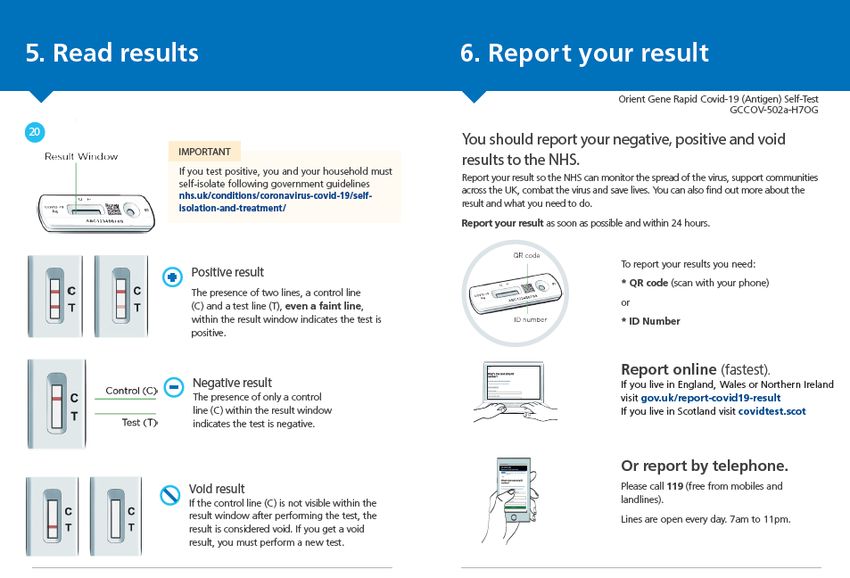
Document updates

Version Date      Update
                  First version of the guidance for Orient Gene 7s
V1.0    16 Aug
        2021

This guidance is for all care homes who are receiving Lateral Flow Device
(LFD) Orient Gene 7s testing kits. The guidance focuses on information
about preparing your care home for testing and how to use the new kits to
test for coronavirus (COVID-19).

Kits
The guidance on lateral flow devices is broadly consistent across the
four countries but has been adapted for use in care homes. Orient Gene
7s may be used in the care home or at home – at the discretion of the
care home. If used at home this should only be once per week with the
second test taken at the care home.

The manufacturer’s Instructions for Use (IfU) are included in the box and
are very detailed. You should follow the instructions in the box and
ensure you use the Scottish Covid Testing Portal to record results.

You must deplete any existing stock of Innova 25s before using the
Orient Gene 7s.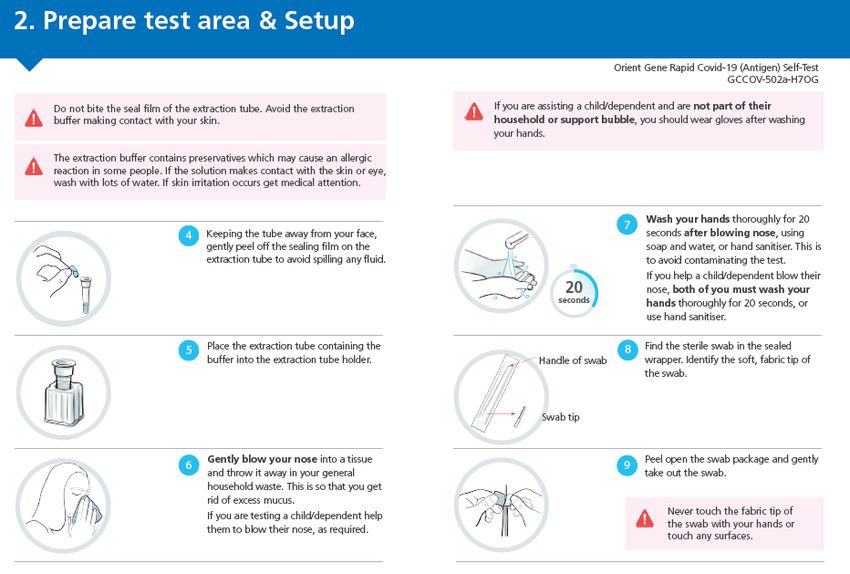
Before you do any testing
 • Read this guidance in its entirety

 • Complete the testing training and checklist

 • Make sure you have received all parts of your order

 • Ensure that your staff and visitors are fully prepared for testing
Contents

       Introduction ......................................................... 1

       Lateral flow device testing Overview ................... 5

       Overview ............................................................. 8

       Preparing your visitor ........................................ 10

       Preparing the test area ...................................... 13

       Prepare the check-in area .................................... 6

       Visitor arrival ....................................................... 7

       Your step-by-step guide ...................................... 7

       Results guidance ................................................. 8

       Enhanced Care Home Staff Testing ..................... 9

       Additional LFD Testing to support Outbreak
       Management ...................................................... 12

       Recording and reporting results ........................ 14

            Processing and Managing Visitor Consent
              information................................................. 16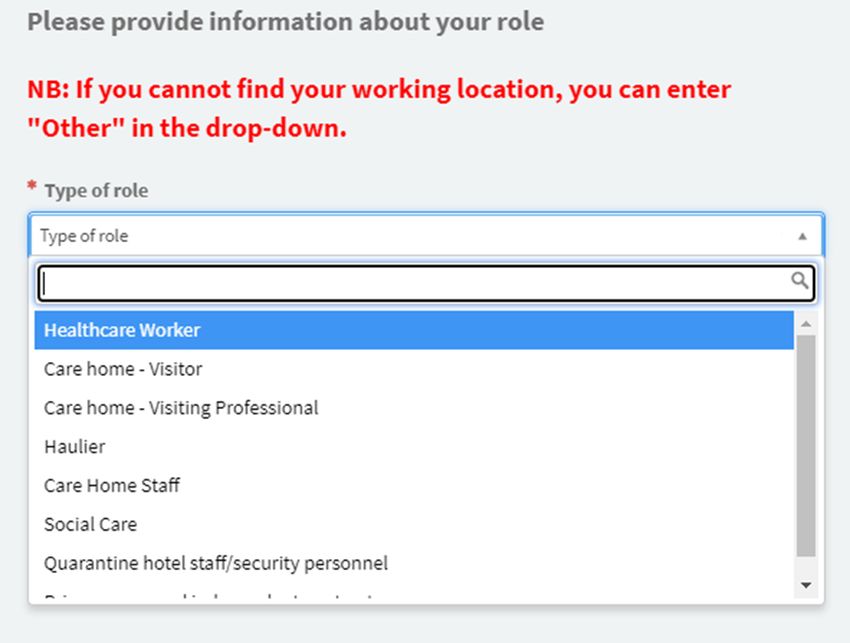
Data Pathway ................................................ 18

Testing Quality and Governance ....................... 20

 Waste Management ......................................... 20

 Questions and Feedback ................................ 21

 Annex A: Testing Process............................... 21
Introduction
This document provides guidance to care homes and residential settings on how to
prepare and manage lateral flow device (LFD) testing for designated / essential
visitors (referred to as visitors throughout). The document also includes guidance for
LFD testing for care home visiting professionals (not covered by employers through
wider pathways) and care home staff (twice weekly enhanced testing) and in
outbreak management situations. This follows the additional preventative measures
including expansion of testing in care homes announced at the end of 2020 following
SAGE advice. A letter sent to care homes on 24 December set out plans for LFD
testing of care home staff, visiting professionals and outbreak management testing.
See: https://www.gov.scot/publications/coronavirus-covid-19-adult-care-home-visitor-
testing-guidance/
In summary the recommendation was that from the 4 January the following groups in
care homes should be tested using lateral flow devices:
designated family/friend indoor visitors see latest visiting guidance
care home staff twice weekly alongside PCR testing at work (enhanced
testing) (from 4 January)
visiting professionals to care homes (through their employer where relevant.
For those who are not tested via their employer they can be tested at the care
home eg private podiatrists, essential maintenance staff).
outbreak management staff testing at work if advised by local health
protection teams (from 4 January)
This guidance covers LFD testing in care homes for above groups.
Visiting professionals
The following groups should be tested using LFDs in advance of attending care
homes organised through their employer and are covered by separate guidance:
Health staff, such as district and community nurses and allied health
professionals employed by the NHS; see
https://www.gov.scot/publications/coronavirus-covid-19-healthcare-worker-
testing/
Social care staff, social workers, other non-NHS Allied Health Professionals,
care inspectors see: https://www.gov.scot/publications/coronavirus-covid-19-
adult-care-home-testing-guidance-for-visiting-professionals/
Visiting health and social care professionals should not be refused entry
to a care home if they do not have proof of a test.
Verbal confirmation of a negative LFD test within the last 72 hours from health
and social care professionals who participate in testing through their employer
should be accepted by the care home. The absence of testing is not a barrier
to providing necessary clinical care in person - as long as PPE and
appropriate Infection Prevention and Control procedures are observed.
Other visiting professionals, such as maintenance staff, private podiatrists,
hairdressers etc. who are not offered testing through their employers are
1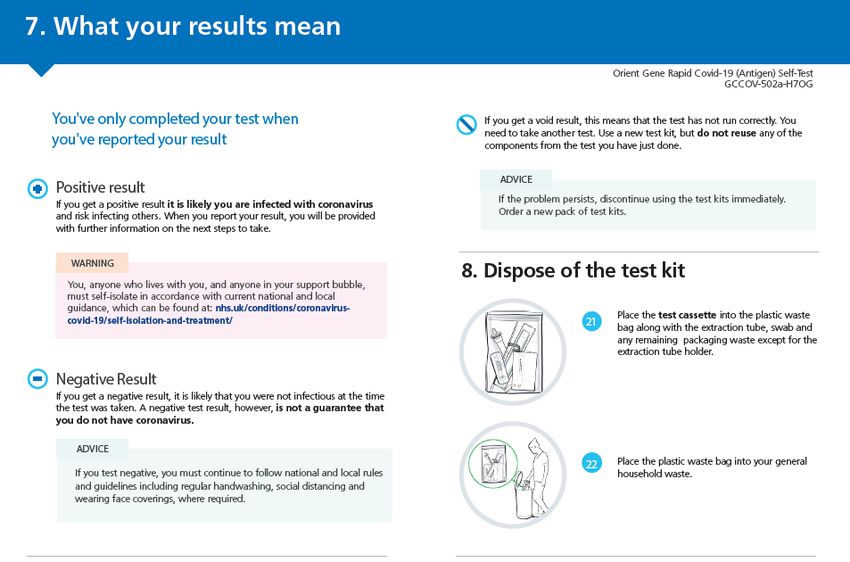
encouraged to undertake an LFD test at the care home. Some visit several
care homes - it is recommended that they test twice weekly; they do not need
to be tested in each care home.
Where visiting professionals, e.g. maintenance staff, are working over several
days in the home, they should be tested on arrival on their first day and then
later in the week.
Funeral Directors
Based on the nature of their work within care homes, it is considered that
funeral directors do not need access to testing to carry out their work safely.
Their role is distinct with no interaction with residents and minimal time in the
home so testing would not help reduce the risk of transmission in this setting.
Testing is therefore not recommended - the work of funeral directors in care
homes can be safely supported by physical distancing, the use of PPE, and
appropriate cleaning and hygiene measures.
It is important to always remember that, while testing can reduce the risk of
transmission, it does not completely remove the risk of infection. When used
alongside robust Infection Prevention and Control (IPC) measures such as PPE,
testing can support care homes to safely maintain a balance between infection
control and the vital benefits of visiting to the health and wellbeing of residents.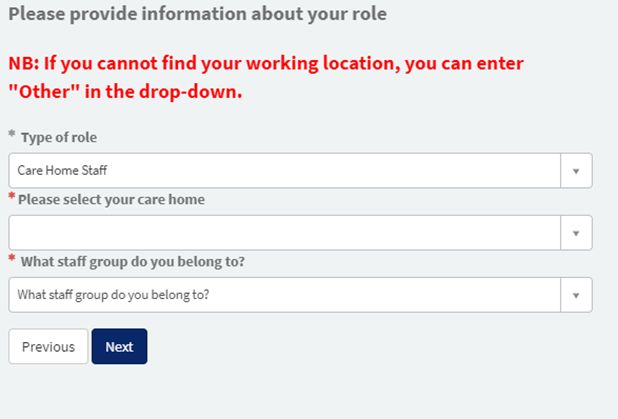
Testing Expansion –Care home staff and visitors – Orient Gene 7s
The table below summarises the start and review dates of different testing regimes for people coming into care homes. It also
outlines the recommended timing and technique for testing of different types of visitors.

 Type of care home visitor          LFD testing Start   Review     Recommended          Recommended test              Recommended
                                    date                date       frequency            delivery                      technique
 Designated visitor                 From 14th           Dec 2021   Each visit or a      By trained staff. From July   Throat and nasal
                                    December.                      minimum of twice     care home discretion to       swab – if using
                                                                   week for regular     allow home testing            community testing
                                                                   visitors             community testing route       route. Double
                                                                                                                      nasal if being
                                                                                                                      tested at care
                                                                                                                      home
 Visiting professionals:            From 4th January
 i) NHS professional visitors       See NHS             Dec 2021   Twice Weekly         NHS delivery                  See NHS
                                    guidance                                                                          guidance
 ii) Care Inspectorate visiting     Separate            Dec 2021   Twice Weekly         Self-testing overseen by      Double nasal
 professionals                      Guidance self-                                      employer
                                    testing
 ii) Social care professional       Separate            Dec 2021   Twice Weekly         Self-testing overseen by      Double nasal
 visitors                           Guidance self                                       employer
                                    testing
 iv) other visiting professionals   From 4th January    Dec 2021   Twice Weekly         Supervised especially for     Double nasal
 not covered by employer eg,                                                            non healthcare on arrival
 optometrists, essential                                                                at care home
 maintenance staff
 Enhanced Care Home Staff           From 4th January    Dec 2021   Weekly PCR plus      By trained care home staff    Double nasal for
 Testing                                                           Twice weekly LFD     or self test if trained.      LFD. Throat and
                                                                   testing (first one   At work. 2nd LFD test at      nasal for PCR.
                                                                   same time as PCR)    home once approved (at
                                                                                        discretion of care home)
Additional Outbreak From 4th January Aug 2021 7 consecutive days By trained care home staff. Double nasal
Management (if advised by staff testing (or to At work
public health) end of outbreak if
advised by local
HPTs)Lateral flow device testing Overview
What to expect What to do
Preparations Stock for twice weekly
Start planning in advance so that you are
and supply staff and visitor LFD
of LFD kits testing is sent to care ready to begin testing:
homes. Arrangements Communicate the testing approach to all
are in place to order staff
emergency supplies
(see below) Read this guidance and take the online
training available at and conform that you
have done so.
Plan out your testing area and workflow
Ensure you have enough appropriate PPE
for staff and visitors
Prepare Along with preparing
Tailor the visitor’s letter, privacy notice and
visitors (for your staff and home,
care home schedule visits as usual consent forms to your care home and
share with visitors in order to gain formal
designated and inform visitors of
visitors) testing guidance and consent for testing and collecting/using
preparations. personal information. If the visitor has
already completed a consent form, you
can reconfirm consent verbally (as long as
you continue to hold their completed
consent form).
Communicate testing arrangements to
visitors including the supplied Visitor
Guidance Leaflet.
Make sure visitors have appropriate
guidance on PPE
Prepare On the day(s) of testing, Key considerations for the testing area:
testing area set up the testing area in
Make sure there is a separate area for
your care home,
visitors: to enter and don PPE, to carry out
including a check-in
the test, and to await results without
area, a place to conduct
testing and await results. entering other parts of the home
Make sure the visitor can enter and
support them to immediately put on PPE
appropriately
If possible, the testing area should have a
separate entrance away from the main
entrance to the care home.
Follow other key considerations include
social distancing, disability access, and fire
safety regulations
3Do the Deliver testing as per For EACH day of testing:
testing staff guidance and Provide visitors with PPE upon entrance
training
The Lot number on the outer foil pack should
be recorded, plus the individual code on the
test (below the QR code) as required by the
system (this may change as system being
refined).
Prepare kits following the Instructions for Use
(IFU) in the box
Analyse test The testing care home
Following the test instructions to prepare,
samples staff member analyses
and interprets results collect and record sample result
Record results into will be recorded through
the NHS Scotland Covid Testing and
Registration System.
Dispose of the result in line with supplied
waste disposal instructions outlined below.
Results – Commu nicate the
If an LFD test result is positive:
Next Steps result to each visitor
(care home and ensure that the Take care to communicate this result to the
designated test result is recorded visitor sensitively, particularly if they are from
visitors) a more vulnerable or high risk group to Covid.
Ask the visitor to log into NHS Scotland Covid
Testing and Registration Portal to record their
results, you may need to help them with this.
The visitor will need the Test Lot and Serial
Numbers to do this. Care home staff should
support people to enter details online if
needed for any reason (or use the Excel
sheet to record details if there is an issue with
internet access).
The visitor also needs to register for a
confirmatory PCR test (details below), then
isolate immediately in line with guidance.
The visit cannot go ahead if a positive result is
recorded.
If the LFD test result is negative:
Let the visitor know of their result
Support the visit to go ahead with PPE and
wider (existing) safety measures in place.
Ask the visitor to log into NHS Scotland Covid
Testing and Registration Portal to enable
recording of the results – provide help as
necessary. They will need the Test Lot and
Serial Numbers to do this. Care home staff
should support people to enter details online if
needed for any reason (or use the Excel
sheet to record details if there is an issue with
internet access)
3Visitors Commu nicate and
testing in check with the visitor At the care home’s discretion, visitors may
their own they may meet your test in their own homes immediately prior to a
home requireme nts visit.
The visitor will require to order their own LFD
kits, information available at -
https://www.gov.scot/publications/coronavirus-
covid-19-getting-tested/pages/no-covid-
symptoms/ and report the result at
https://nhsnsstest.service-
now.com/covidtesting?id=test_home
The test should take place on the same day
as the visit to the home and the care home
may ask for proof of a negative test e.g.
screen shot. Regular visitors can test at a
minimum twice weekly.
Visiting LFD testing on arrival
From 4 January. For non-healthcare staff it is
professionals at the care home
recommend that care home staff carry out
(not covered
by wider test. For health professionals self-swabbing.
As for care home visitors results should be
pathways
recorded on: NHS Scotland Covid Testing
through their
employer) and Registration
If the LFD test is positive the member of staff
should self-isolate and arrange for a
confirmatory PCR test themselves.
Care home Arrange twice weekly
staff LFD LFD testing of all care From 4 January staff to twice weekly LFD
testing home staff tests, to be used alongside the existing
Discuss the result with weekly PCR test.
the staff member and The test can be carried out by either the care
ensure that the test home testing lead or the individual staff
result is recorded member at the discretion of each site.
At the care home’s discretion, the second
LFD test may be carried out in the member of
staff’s own home.
The first LFD test should be done on the
same day as the PCR (both of these tests
should be carried out in the care home) and if
the result is positive the member of staff
should self-isolate and await the PCR result to
confirm.
If this PCR test is negative they can return to
work. If it is positive they must remain
isolated. The second LFD test can be done
later in the week (when staff on shift). If this
later test is positive staff should self-isolate
and have a confirmatory PCR.
3 As for care home visitors, the LFD results
should be recorded on NHS Scotland Covid
Testing and Registration Portal
NHS Scotland Covid Testing and Registration
Care home staff who cannot carry out a
double nasal LFD test are advised to obtain a
throat and nasal Innova 7s test from the
community testing route. Order coronavirus
(COVID-19) rapid lateral flow tests - GOV.UK
(www.gov.uk)
Outbreak In the event where a
In the event of a resident or staff member
management resident or staff
testing positive for COVID via LFD, the local
member tests positive
HPT should conduct a public health risk
for COVID LFD can
assessment to decide if whole home testing
be used
(WHT) is appropriate. Local HPTs may
instigate WHT after one positive LFD in an
asymptomatic staff member depending on the
risk assessment unless there is a very clear
reason not to do so. HPTs will advise if WHT
should use PCR or LFD tests and will oversee
the process. If LFDs are recommended, Care
homes can utilise the home’s stocks of LFDs
to do simultaneous testing of all staff in
addition to PCR. This may not be as suitable
for residents who should have, as a minimum,
PCR testing, though LFD may be useful for a
first suspected case pending PCR
confirmation.
Any staff immediately identified as positive for
COVID by LFD test must self-isolate pending
the PCR result. Any residents identified as
positive must be isolated and managed in line
with the relevant guidance. Staff who initially
test negative should continue to be tested
daily for at least 7 consecutive days (and
ideally for the remainder of the outbreak if
local HPT advise), after the identification of a
single case of COVID within a home. In
addition all previously negative residents
should be tested on day 4/5 with PCR. This is
in line with SAGE guidance . This guidance
is subject to change and up-to-date self-
isolation guidance can be found at
Coronavirus (COVID-19) – exemption of
fully vaccinated social care staff from
isolation: information for providers -
gov.scot (www.gov.scot)
3Overview
Lateral Flow Antigen testing involves processing a nasal swab sample
with an extraction fluid and a lateral flow device.
The test detects a COVID-19 antigen that is produced when a person is
infectious with COVID-19. If this antigen is present, then a coloured strip
on the Lateral Flow Device (LFD) will appear to show a positive result
within 15 minutes.
We will be providing you with Orient Gene Rapid Covid-19 (Antigen) Self-Test
GCCOV-502a-H7OG. LFDs find at least half of the cases that PCR testing
detects and about three-quarters of those who have very high amounts of
virus present when an individual is tested. They are helpful in detecting
cases that would not be detected by other testing strategies in use
routinely. Like with other testing processes, LFD testing is not a fool-proof
solution: it should be seen as an addition to PPE and other IPC measures
and must not be seen as a way of relaxing their use.
Safety Considerations
It is important that visitor testing is not conducted without
considering other safety and risk management protocols.
Visitors don PPE during testing and visit, and comply with
existing care home guidance on infection prevention and control
measures.
Separate the visitor testing from other parts of the home.
Clean the testing area between tests and follow de-
contamination protocol.
Use clean and dirty entrances for the testing area, wherever
the layout of the care homes allows
Assurance:
The ongoing evaluation process will be part of the overall testing evaluation process.
This may include the following elements:
1. Plans for future dual swabbing at a selection of sites. This will be enacted for the
purpose of ongoing evaluation once testing at care homes with LFDs is fully
established. This will explore process and implementation issues.
2. Ongoing quantitative analysis of results from routine data e.g. positives, negatives,
and void LFD tests.
3. Care homes are responsible for their own internal quality assurance. These might
include measuring:
Visitor numbers
Staff training completion records Monitoring the stock of LFD test kits used by the care home as a whole and
by staff if second LFD test is undertaken at home.
Asking for proof of negative tests from visitors
Monitoring compliance with self-testing at home.
Survey of visitor feedback and complaints
Operational challenges such as challenges with test kits, staff availability to
support testing etc.
Training:
All staff who will conduct LFD testing should complete the online training resources.
Each home will receive access to training materials which are also included as part
of the care home visitor testing information, available online by following:
Coronavirus (COVID-19): adult care home visitor testing guidance - gov.scot
(www.gov.scot)
Each care home manager or designated care home lead needs to ensure that staff
performing the tests have access to training and supervision.
All staff members performing testing are required to watch the training video and
read the staff guidance. This is also available on TURAS.
Visitor LFD testing
Assisting care home visitors to test for COVID-19 using a Lateral Flow Device (LFD)
| Turas | Learn (nhs.scot)
Staff LFD testing
Assisting care home staff self-testing for COVID-19 using a Lateral Flow Device
(LFD) | Turas | Learn (nhs.scot)
The Scottish Government webpage will be updated regularly so please continue to
check the it for up to date information and guidance.
Storage:
Close the kit box and secure its contents when not in use.
• The kit can be stored at room temperature or refrigerated 2-30°C.
• Do not freeze any of the test kit components.
• Do not use the test device and buffer after expiration date. The expiration
information is printed on the pouch and kit-box after the “USE BY EXP”.
• Discard a test cassette that has been outside the sealed pouch for more than
30 minutes.
• Ensure your test is at room temperature 15-30°C prior to testing.
• Keep out of reach of children. The test contains small parts that may
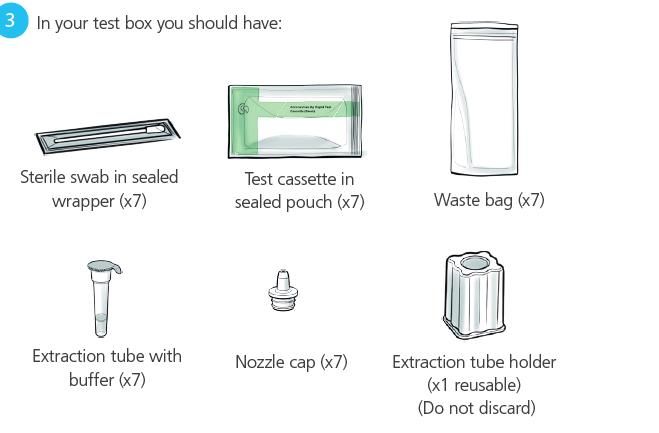
present a choking hazard.LFD kits need to be stored and separated from universal kits for confirmatory PCR tests and used only for designated purposes as described here. Ordering more kits and PPE Stock for twice weekly staff and visitor LFD testing is sent to care homes. If you have any queries about your stock/ supply, please call the dedicated helpline 0800 008 6587 which is open daily 09.00 to 17.00. If you have urgent requests for further test supply to support with outbreaks ( i.e you have a positive test on your premises, have contacted local Health Protection who have advised you to test all staff for the next 7 days), please use the nss.covid19testorderrequests@nhs.scot mailbox, notify them of the situation and request additional kit. When making these necessary urgent requests, please include the following in your email request: • Care Home Service Number (CS200XXXXXXX) • Number of staff • The nature of the urgent request (e.g. outbreak, stock depleted due to a specific reason) If you are experiencing an outbreak, please add OUTBREAK in the email subject line and confirm you have been in touch with local Health Protection who have advised you to test all staff for 7 days. • Current remaining number of Lateral Flow devices for staff twice weekly testing. Ordering PPE - Please continue to access your local PPE Hubs for support with additional PPE, including provision for visitors, should your normal supply routes be unsuccessful. On boarding of new care homes For newly registered care homes which need to arrange testing, you should contact your HSCP and the Care Inspectorate in the first instance. They will then contact the Scottish Government via CareHomesCovidSupport@gov.scot. Preparing your visitor These kits are available for testing visitors prior to every visit. Who is a visitor? A designated visitor is defined as any relative or friend wishing to visit a resident, nominated by the resident (or their authorised representative). Designated visitors should be offered tested every time that they visit. Essential visitors who often need to see their relative urgently do not need to be tested unless the individual wishes to be tested. Essential visits should be supported to proceed at all stages of the pandemic, because they are just that – essential. LFD tests for routine (or non-urgent) visits from spiritual and faith representatives to
people in the care home can be offered.
Visitor expectations – for visitors testing at the care home
On arranging their visit, we recommend you prepare visitors for testing. There are
information materials to support you to do this. Visitors will need to prepare to:
Consent to testing and processing test results
Register their own kits online, or consent to sharing personal information if
you support them with registration
Agree to care home staff delivering a double nasal swab (recommended) or
alternatively to self-complete a double swab
Wait 15 minutes for a result before visiting
Wear PPE during testing and visit
Follow all other existing visiting infection control protocols and safety
requirements during their visit
Complete a confirmatory PCR test if LFD test is positive
Visitor prep check list
Share visitor’s letter, leaflet, privacy statement and consent forms visitors in
advance of their visit
Prepare consent forms to receive written consent to testing and processing
personal information (if you support them with registration)
Schedule visits according to time it will take to test each visitor (approx 45 min
- 1 hour)
Ensure you have enough PPE and can support visitors with putting on and
taking off
Provide visitors with web devices or direct support with registering results
What happens with a positive result?
If a visitor tests positive, the visit cannot occur. A confirmatory test is required for a
person who received a positive result, they will be advised to go home to isolate and
arrange a PCR test. Tests can be accessed from Get a free NHS test to check if you
have coronavirus - GOV.UK (www.gov.uk)
or 0300 303 2713 telephony route if individual does not have internet access . For
more information on booking a test see Coronavirus (COVID-19): Testing in Scotland |
NHS inform.
The visitor should then immediately return home, avoiding public transport andwearing a face covering. If the visitor's confirmatory PCR is positive, their household/
bubble will also need to self-isolate and NHS Test and Protect will be in touch with
them to contact trace.
PPE Requirements
Up-to-date PPE guidance is available at Coronavirus (COVID-19): adult care home
lateral flow device testing - gov.scot (www.gov.scot) . Visitors may need appropriate PPE
upon entry into the care home and during the visit, including:
Disposable gloves Disposable plastic apron Surgical, fluid
resistant facemask
PPE should be worn during testing and throughout the visit. Visitors should not take
off their PPE. They can continue to wear the same PPE for the duration of their visit
unless it is contaminated, in which case they should change their PPE.
Registration of kits
Visitors should register their test individually at NHS Scotland’s
https://nhsnsstest.service-now.com/covidtesting?id=test_home. You may need to
support people to do this or to provide a web-enabled device if a visitor does not have
a suitable one themselves.
If there are issues accessing the Testing and Registration Portal then we are asking
care homes also to record tests using the Care Home Visitor Test Results recording
sheet (Excel file) at the point of testing.
Make sure the device is kept clean between each use and that IPC measures are
carefully followed. If a member of staff or visitor has to use the device in the middle
of the testing process, the device should be cleaned and PPE should be replaced
appropriately.
Visitors can complete registration before or after swabbing, depending on what
workflow works best for your home.
What the visitor will need for registration: The Care Home name
The serial number of the test (beside the QR code on the test)
Test Lot number, on the test packet
Date and time that their test was taken
Contact information
Personal details including DOB
The visitor’s current address details, if they are staying somewhere other than
home
Preparing the test
area
Before you start
Prepare for day of testing and make sure:
There is a separate area for visitors to complete a self-assisted swab and wait
on results, maintaining social distancing.
You have your visiting schedule planned accordingly to take into account time
for testing.
You have prepared written consent forms for all visitors to be tested in line
with your normal policies and procedures.
Devices are set up for registration and your home's unique organisation
number (UON) is visible for visitors to register online.
Devices are set up to use the Log Results app.
You are prepared to have a clear record of which barcode matches which
result.
You have a mirror, timer, permanent markers, hand sanitiser, and clear bags
(or equivalent. See waste section) in the testing area.
Testing process check list
Visitor checks in and note made of
1 test Lot and serial numbers
2 Take swab sample (double nasal)
Process the sample and apply it to
3 the rapid test
4 Record resultsPrepare the check-in area
Prepare the testing area with the following:
PPE for visitors Devices for registration support (if visitors cannot use mobile
phones)Visitor arrival
1. Check visitor in
As each visitor enters they are provided with PPE,
checked in against the visitor list, asked to complete
consent to testing and confirm they do not have
symptoms
Note the lot and test serial numbers. The lot number is
on the outer foil package of the device and the test serial
number is found on the device underneath the QR code.
2. Visitor moves to swabbing area
The visitor can now move to the testing area.
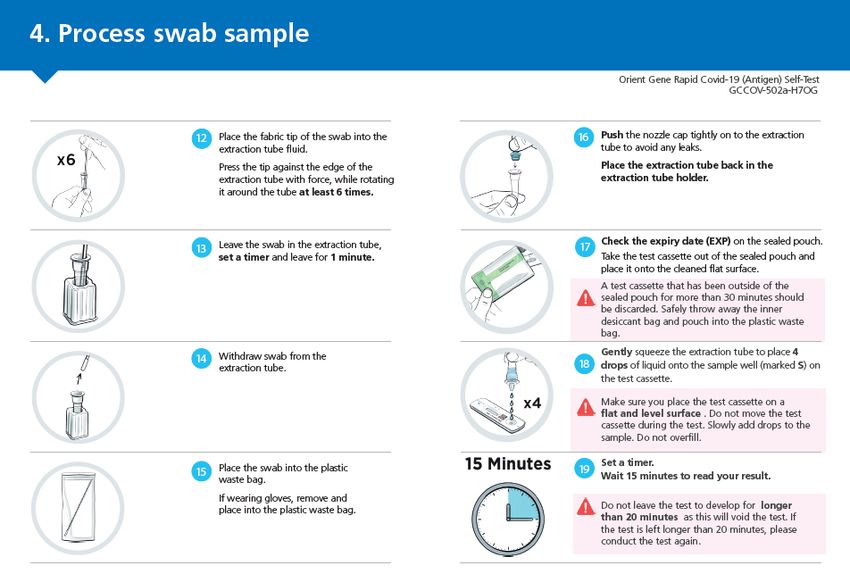
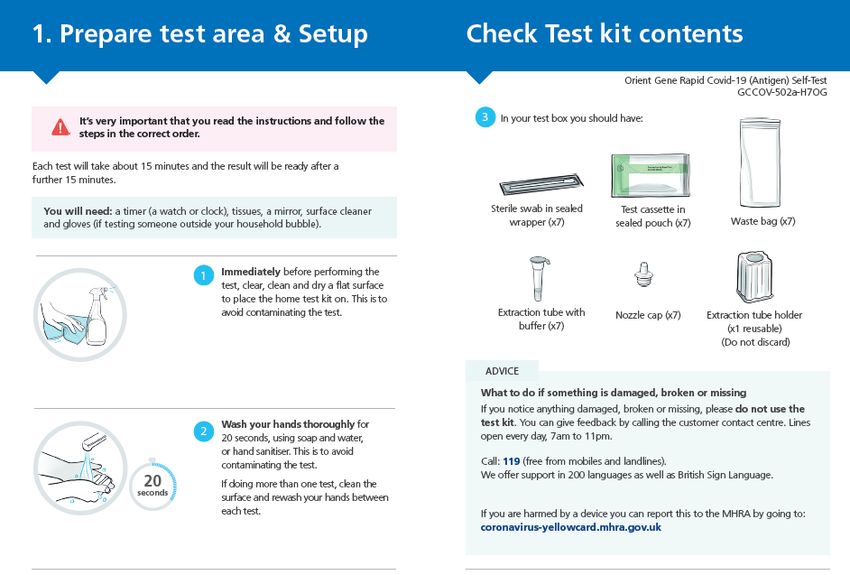
Your step-by-step guide
The link below includes the following step-by-step information:
Prepare your test area and check your test kit
Set up your test
Take your swab sample
Process the swab sample
Read your result
Report your result – Please record the LOT number from the box (not id number)
What your results mean
Safely dispose of your test kit
Performance characteristics
Orient Gene Self
Test EUA IFU final.pdfThe visitor can move into the waiting area after they have the sample or handed over the swab if
self-swabbing.
Results guidance
Once the result is logged, you can notify the visitor and follow the associated
guidance on their visit.
Negative result
The visitor can proceed with the visit if other IPC measures are
adhered to.
The visitor should only enter designated parts of the care home and
must wear appropriate PPE including a face mask, gloves, apron
Negative
and follow IPC measures in line with the care home and national
policy. IPC measures remain important because the test is not
100% sensitive. If these measures are followed, the visitor is
allowed a more meaningful visit including hand-holding or entering
the resident’s room.
Invalid or void result
Re-test using a spare LFD kit to receive a conclusive result.
If the retest comes back as invalid, we recommend that you discuss
Invalid or Void with the visitor the potential risks, but allow the visitor to complete
the visit ensuring that IPC measures, including social distancing
and PPE, are followed.
Positive result
The visitor can no longer proceed with the visit, should return
home immediately – avoiding public transport if possible and
to arrange a confirmatory PCR test.
Provide the visitor with details on how to arrange a PCR test and
sensitively explain what an LFD positive test means and give
information for the visitor to explore.Visitors testing out with the care home Visitors will now, subject to care home discretion, be able to undertake an LFD test in their own home immediately prior to coming to visit by accessing LFD tests via community testing routes. Visitor testing at home is not a mandatory requirement; decisions should take into account the circumstances of your care home and your visitors. Not all visitors will be comfortable or able to test themselves, so you may wish to continue to support visitor testing at the care home for some or all of your visitors. For those visiting regularly eg multiple times/ daily we recommend that a visitor tests a minimum of twice weekly. However, individual care homes have the discretion to decide whether or not that needs to be done each time. If you are happy for the visitor to test in their own home, they will need access to a device such as a smartphone or tablet to register their result online at https://nhsnss.service-now.com/covidtesting . There are three ways of visitors accessing testing kits and information on how to do this is available at the following link - https://www.gov.scot/publications/coronavirus-covid-19-getting- tested/pages/no-covid-symptoms/. Visitors may ring 119 or order online for home delivery or tests can be collected from the COVID-19 testing centres or picked up from local pharmacies https://maps.test-and-trace.nhs.uk/. The latter is a new service which commenced on the 9th May and has over 1000 pharmacies taking part. The test should take place on the same day as the visit to the home. You may wish to ask for proof of a negative test, confirming date of test, to be shown prior to the visit, such as a screenshot from Welcome - COVID Testing Portal (service-now.com) showing the uploaded result. If visitors do not have access to a smartphone/ tablet, or are not able to produce confirmation of negative test result, you may wish to ask them to take the test at the care home. Please note that the instructions in the LFD test kits supplied by the community route recommend recording results on the UK Government Department of Health and Social Care portal. These instructions will be updated in time to reflect reporting on the Scottish Portal. In the meantime, please advise visitors to use: https://nhsnss.service-now.com/covidtesting. Please be aware that in the event of a decrease in testing and/or a rise in care home infections, care homes may be advised by local oversight teams to reintroduce on-site testing. Enhanced Care Home Staff Testing Staff should be tested using LFD tests twice weekly alongside existing weekly PCR testing. This is in line with the SAGE recommendations. It is recommended that this is carried out in the workplace. However care homes will have discretion to allow staff to undertake the second LFD test (Orient Gene 7s) at home. This is not a requirement - it is up to you as the employer whether you allow staff to undertake LFD testing at home. The test can be carried out by either the care home testing lead or the individual staff member at the discretion of each site. Please note that research shows that sensitivity decreases slightly
when an individual is responsible for the end to end self-testing process and recording of results
but not in a way that increases the risk substantially.

The first LFD test should be done on the same day as the PCR and if the LFD result comes back
positive the member of staff should self-isolate and await the PCR result to confirm. If this PCR
test is negative they can return to work. If it is positive they must remain isolated.

The second LFD test can be used later in the week to best fit with shift patterns (or it can be done
at home at the discretion of the care home once LFD self-test kits approved for home use become
available). If this later test is positive staff should self-isolate and seek a confirmatory PCR.

In the event of a positive result, the staff member must self-isolate immediately (along with
their household) in line with government guidance, inform their manager and occupational
health department, and arrange to have an urgent confirmatory PCR test performed; swabs
will be taken in accordance with their organisational protocols and sent to their local
designated COVID-19 laboratory for testing.

Until the PCR result is confirmed, the staff member must self-isolate in line with government
guidance. At the point the confirmatory PCR test result is known, and this is positive, test
results will, as normal, be referred to Test and Protect so that full contact tracing can
commence. If the PCR result is negative, the staff member would be able to attend
immediately for duties.

If symptoms develop subsequently, then the staff member must restart their period of
isolation for the full 10 days from start of symptom onset. Staff must continue to isolate until
they have the results of the PCR test.

In line with existing government guidance, the symptomatic staff member must remain in
isolation until 10 days from symptom onset, or longer if certain symptoms persist. The rest
of their household must also remain in isolation for 10 days from symptom onset in the
symptomatic person, even if they don’t have symptoms themselves.

A staff member who has tested positive via PCR should not commence/recommence regular
COVID testing until 90 days after their positive test was taken. However, as above, if the staff
member develops COVID-19 symptoms during that 90 day period, they must self-isolate in
line with government guidance and arrange a PCR test.

Staff who are negative on LFD testing must not regard themselves as free from infection –
the test could be a false negative – they may also go on to acquire the virus in the period
before the next test. They should remain vigilant to the development of symptoms that could
be due to COVID-19 and existing IPC measures - including the use of PPE, the extended use
of face masks, physical distancing, increased environmental cleaning, and good hand and
respiratory hygiene – all remain critical to minimise the risk of transmission of COVID-19.
Staff should not be at work if they have symptoms of COVID 19. If staff have coronavirus
(COVID-19) symptoms they must self-isolate as per Government advice and book a PCR test
as per usual symptomatic testing channels.

The LFD testing programme, and ongoing need for other IPC and PPE measures, also
applies to staff who are participating in the vaccination programme. Staff who have been
vaccinated should still partake in twice weekly LFD testing and adhere to existing IPC
measures. The need for testing will be in place until we better understand the degree of
protection, and duration, that the vaccination provides, including importantly whether it is
possible to still transmit the virus if you’ve been vaccinated. The vaccination will not impact
the LFD test result.
Reporting of results and PCR testing
The results from the LFD test will be documented by the individual digitally via
https://nhsnsstest.service-now.com/covidtesting?id=test_home. Data from these devices will
flow to NHS Scotland for use in reporting and any required systems integration. As with the
visitor testing the portal is on a web link so that anyone can use their own device or a
workplace device to record the results. Bar code scanners have been made available to care
homes to scan the bar code on both PCR and LFDs to remove the need to key the number in
manually. More guidance is available at Coronavirus (COVID-19): uploading LFD testing
results and bar code scanners - gov.scot (www.gov.scot)
The results from the device must be recorded digitally by the staff member after 30 minutes
has passed via the online portal. The timing is critical, as leaving the test for longer than 30
minutes can lead to false positive results and the test will need to be repeated. Results must
be recorded in line with the following:
Negative: The presence of only the control line (C) and no test line (T) within the
result window indicating a negative result.
Positive: The presence of the test line (T) and the control line (C) within the result
window, regardless of which line appears first, indicating a positive result. The
presence of any test line (T), no matter how faint, indicates a positive result.
Invalid result: If the control line (C) is not visible within the result window after
performing the test, the result is considered invalid.
When an invalid result is observed, the test should be repeated with a new test kit. If this
issue persists and an individual continue to get invalid results, they should seek advice and
support from their manager and the Board point of contact for LFD testing.
Location of Test
Orient Gene 7s LFD test kits are approved for self-testing at home. Care Home should deplete
existing Innova LFD kits of 25 tests before using Orient Gene 7s.
When you receive the boxes of Orient Gene LFD 7s, which are approved for self-test at
home, you will have the discretion to allow your staff to undertake their second LFD test in
their own home. This is not a requirement - it is up to you as the employer whether you allow
staff to undertake LFD testing at home.
If you are satisfied that staff are fully trained to complete and record their LFD tests without
supervision in their own homes, the following arrangements apply:
Staff should undertake one LFD test on the same day as their weekly PCR test on site
at the care home. Undertaking both the PCR and the LFD test will help to provide quality
assurance checking.
Staff can complete the second LFD test midweek between PCR tests in their own
homes.
If a member of staff is undertaking the second LFD test at home on the same day as a shift,
they should do the test before travelling to work and ideally in good time to allow for cover
arrangements to be made should they test positive. This will help reduce the burden of
testing on care home capacity and help avoid further transmission of anyone who may test
positive.
If staff take testing kits home, these should be stored safely at room temperature.
It is essential that all results (negative/positive/inconclusive) are recorded on the National
Services Scotland testing portal: https://nhsnss.service-
now.com/covidtesting?id=test_home either by the care home or by the individual staffmember. Staff can register for an account with NHS NSS and record themselves as “care
home staff” and the care home that they work at. This means it will be quicker each time
someone uploads their results as they will not need to enter personal details multiple times.
If the test is inconclusive, the member of staff should re-test. The care home should ensure
that staff know how the test result is to be recorded. Recording of all tests is critical for our
understanding of prevalence within the workforce and for informing the future testing
strategy.
It remains the care home manager’s responsibility to monitor testing compliance and
maintain records of the kits that are distributed to staff, including the LOT number.
It is also important to remind staff that regular testing is vital even when they have been
fully vaccinated as people can still catch and transmit Covid when vaccinated.
Please be aware that testing uptake and recording will continued to be monitored locally by
your oversight team and nationally. In the event of a decrease in testing and/or a rise in
care home infections, you may be advised to reintroduce on-site testing for both LFD tests.
Additional LFD Testing to support Outbreak
Management
New advice for the use of LFD testing to support the immediate Care Home response to a
suspected outbreak was documented in letter to care homes on 24 December. However, use of
LFD testing in outbreak situations should only be done following advice from local health
protection teams who will undertake a risk assessment alongside a full PPE and IPC
review. Using LFDs in outbreaks situations may support early and immediate action to support the
health and wellbeing needs of both their residents and staff. The procedure is as follows:
In the event of a single resident or staff member testing positive for COVID via PCR a
whole home outbreak management process involving staff testing should be
triggered immediately by Public Health Teams.
This outbreak management process will be supervised by local Health Protection Team.
An assessment will be undertaken by health protection teams to determine whether the
outbreak testing will involve LFD or PCR testing
If a one person tests a positive from an LFD test, the local HPT will conduct a public health
risk assessment to decide if whole home testing (WHT) is appropriate. Local HPTs may
instigate WHT after one positive LFD in an asymptomatic staff member depending on the
risk assessment unless there is a very clear reason not to do so. HPTs will advise if WHT
should use PCR or LFD tests.
If using LFDs in outbreak situations, the focus should be on staff LFD testing as it may not
be as suitable for residents who should have, as a minimum, PCR testing, though LFD may
be useful for a first suspected case pending PCR confirmation.
Public Health teams should take LFD swabs, and process and read within 30 minutes,
along with a PCR swabs for both staff and residents. Care Home staff can support the
reading of test where they have completed the competency training.
The care home’s stock of LFDs can be used to do simultaneous testing of all staff in
addition to PCR if advised by local health protection. If you need to order stock urgently for
outbreak purposes please email nss.covid19testorderrequests@nhs.scot, providing the
details as set out above. Any staff immediately identified as positive for COVID by LFD must self-isolate pending the
PCR result.
Any residents identified as positive must be isolated and managed in line with the relevant
guidance.
Staff members who initially test negative may continue to be tested daily using LFD testing, for at
least 7 consecutive days (and ideally for the remainder of the outbreak if local HPT advise ), after
the identification of a single case of COVID within a home. Confirmatory PCR will be required for
a positive LFD result where the staff member immediately self-isolates until the PCR result is
received. If the PCR result is negative the staff can immediately return work.
In addition, all previously negative residents should be tested on day 4/5 with PCR. This is in line
with SAGE guidance.Recording and reporting results All results for LFD tests carried out in Scotland will be recorded through the NHS Scotland Covid Testing and Registration System, which is completed by the visitor getting the test, unless they need help to do this in which case the Care Home should complete. Care Homes should access the web platform by following the link below: Welcome - COVID Testing Portal (service-now.com) More information about the portal may be found at: Coronavirus (COVID-19): uploading LFD testing results and bar code scanners - gov.scot (www.gov.scot). Please record the LOT number from the box (not id number). Bulk uploading will initially be unavailable for Orient Gene 7s. There are two routes for recording tests – one for individuals with an account with NSS and one for individuals without an account with NSS. It is recommended that you register for an account with NSS as it will save time as there will be no need for you to add personal details m ultiple times. If staff are allowed to test at home they should register for an account and ensure that they record themselves as “care home staff” and the care home that they work at. This means the tests and results can be linked to the care home and monitored. If you have not registered for an account with NSS, please follow these steps: 1. Select “Rapid Testing (LFD)” 2. Select “Individual LFT Registration” 3. Complete this form:
4. When selecting the most relevant reason for the test, please select “Care Home Staff” or “Care Home
Visitor”:

If you have registered for an account with NSS, please follow these steps:

1. When selecting the most relevant reason for the test, please select “Care Home Staff” or “Care Home
Visitor”:
2. You will then have the option to specify care home and staff group. If you are a care home visitor then
please enter the care home you visited.

Processing and Managing Visitor Consent
  information
Each care home provider is a data controller in its own right for the data collected during the testing
process. It is responsible for the secure handling of data in line with existing protocols, and for
uploading data onto the COVID Testing Portal.

Information in the COVID Testing Portal is the responsibility of the Scottish Government, and NHS
Boards (National Services Scotland, plus local Health Boards.
Care homes are responsible for communicating the purpose of the testing to develop an
understanding of the service. Participation by visitors is voluntary and consent is sought from the
visitor to take the test. Visitor information letter and consent form templates have been prepared
for care homes to do this. Additionally Coronavirus (COVID-19) testing for visitors: Information for
people visiting care homes in Scotland – Leaflet for visitors has also been created by NHS
National Education Scotland (NES). Consent forms will need to be recorded and kept for a
relevant period, suggested as one year, at which point a review will take place with continued
secure storage or secure destruction, if visiting is no longer taking place.

As a data controller care homes must issue a privacy notice that informs visitors of how their data
will be used. If the visitor wishes to take a test, having now received this information, the visitor
should indicate their consent by reading and completing the consent form. Care Homes must
securely store a copy of visitors’ consent (see below). Repeat visits by the same designated visitor
do not require consent forms to be completed each time, if consent is securely stored by the care
home. Instead, confirmation of consent can be taken by the care home verbally for tests after the
first, unless the visitor indicates they wish to do otherwise.

Privacy notices have been prepared to support informed consent by visitors and supplied to Care
Homes. This outlines the purposes for which their personal data will be used, the data controllers
and processors involved. It also includes a link to Scottish Government’s Covid-19 privacy statement
for information in relation to the various tools and applications to help respond to the pandemic, and
how people’s data may be used by these (see: COVID-19 Privacy Statement | Information
Governance (scot.nhs.uk)).

The care home must ensure that any personal data it collects is processed and managed in line with
data protection requirements. Personal data (e.g. consent and results recording forms) that the care
home collects from visitors should be kept securely by the care home for the period that the
designated visitor wishes to continue visiting weeks. After this, it should be permanently and
securely destroyed by the care home.

The following data elements are captured by the NHS Scotland Covid Testing and Registration
System (or the Excel file, if using this when the Covid Testing and Registration portal is unavailable .
These fields may change in the weeks Dec-Jan 2021 and content will be updated to reflect any
changes:
   1. CHI Number (if known)
   2. Last name
   3. First name
   4. DOB
   5. Sex
   6. Home address (inc p/code)
   7. At least one contact method: telephone, mobile phone or email
   8. Do you currently stay at your residential address? (y/n)
   9. Select most relevant reason for taking test (healthcare worker; visiting professional to Care
       Home; visitor to Care Home)
   10. Serial number from test kit
   11. Date test was taken
   12. Time test taken (Hour/Min)
   13. Result: positive/negative/ inconclusive.
Data Pathway The following diagram outlines the interim data pathway and timescales for review:
Interim Lateral Flow Device Testing Data Pathway Note – Subject to change (Jan 2021) -
1. Care Home visitors 2. Staff Scottish Government working to
streamline and automate where
possible.
1. Designated visitor to care home 45 mins before
appointment(unless permitted to test at home prior to visit).
Remains in testing and/or waiting area
Privacy notice supplied The LFD web platform reports
Consent form and Health Screening questionnaire completed and securely stored positives to Test & Protect system.
Care homes are not required to
provide information.
2. Staff testing Test done and Test and Protect follow up initiated,
results analysed including support to confirmatory
PCR test and contact tracing as
appropriate.
We are working to put in place
same day data transfer to enable
Negative test result Positive Test Result local health protection teams to
take quick action.
1. Visitor LFD testing - visitor (or care home) completes NHS Scotland Covid Testing Where NHS Scotland Covid Testing
and Registration web form if testing in the care home and Registration form cannot be
2. Staff LFD testing – individual staff member (or testing lead) complete NHS Scotland used
Covid Testing and Registration web form Result recorded, per individual, on
‘Care Home Visitor Test Results
recording sheet (Excel)’.
As soon as feasible, Care home
manager enters data from ‘Care
Home Visitor Test Results recording
sheet (Excel file)’ onto the NHS
Scotland NHS Scotland Covid
Testing and Registration web form
If a positive results is received,
support the visitor to register for a
confirmatory PCR testTesting Quality and Governance
Each care home should designate a member of the team to act as a quality and governance lead.
In most cases this is likely to be the care home manager who will ensure that they:
Implement appropriate local quality assurance including stock control and audit processes
Concerns and safety and quality issues need to be escalated to the local public health team
where COVID related.
Support the care home testing staff with maintaining a site risk register, and develop and
implement mitigation plans
Report to local clinical oversight teams on quality assurance concerns, incidents, risks and
mitigations.
Agree with local clinical oversight and HSCP appropriate local arrangements for implementing
and monitoring training, if required
This guidance is the main guidance document for rolling out designated visitor testing in your
care home. It is aimed mainly at care home managers and the designated quality and
governance lead who should ensure that all staff delivering testing do so in line with this
guidance. Supporting materials by NES and the competency form are focussed on the testing
process itself in the main.
Document staff training and supervision and review staff testing performance
Ensure the promotion of good quality practice
Undertake quality audits.
Waste Management
Updated Guidance on Management of Waste from LFD testing - 30 March 2021
SEPA have updated their guidance on how to manage waste from LFD testing and it is available
at: SEPA Section heading. These updates follow additional public health advice on the risks of
managing waste from lateral flow device testing. A document containing answers from Public
Health Scotland and SEPA to commonly asked questions regarding the management of waste
arising LFD testing for asymptomatic cases of COVID-19 is available at: Coronavirus (COVID-19):
Disposal of waste from Lateral Flow Device Testing in Scotland - FAQs - gov.scot (www.gov.scot)
The SEPA guidance notes that:
in community and workplace settings, where testing is on a small scale (such as at care
homes), waste from LFD tests can be placed in the residual waste “black bag” waste stream;
you should agree this with your waste collector before changing current practices;
the external packaging of LFD testing kits should, in agreement with your waste contractor, be
recycled.
the LFD test itself (swab, cartridge/device) is not recyclable and should be disposed of in your
residual (‘black bag’) waste bin.
any waste produced should not be disposed of in the clinical waste (orange bag) stream. any disposable equipment such as face coverings, gloves, or aprons worn during the LFD
testing process, either by those undertaking the test or those supervising others taking LFD
tests, should also be disposed of in your residual (‘black bag’) waste bins.
Adverse Incidents
The following form can be used to report adverse incidents and near misses involving medical
devices, social care, estates and facilities equipment used in Scotland’s health and social care
services. It is recommended to use this form (not the MHRA Yellow Card link as indicated in the
IFU).
IRIC Adverse incident report form | National Services Scotland (nhs.scot)
Questions and Feedback
A free helpline is available to provide advice on testing. Tel: 0800 008 6587 available 09:00 to
17:00 every day
If you have an urgent request relating to 1. Outbreaks 2. Insufficient stock to test your staff twice
weekly, please email nss.covid19testorderrequests@nhs.scot mailbox
When making these necessary urgent requests, it is helpful to confirm the following in the email
you send to clarify your requirements :-
· Care Home Service Number ( CS200XXXXXXX)
· Number of staff
· The nature of the urgent request ( e.g Outbreak, stock depleted due to a specific
reason) If you are experiencing an outbreak, please add OUTBREAK in the email
subject line.
· Number of Lateral Flow devices you have remaining for staff twice weekly testing.
Annex A: Testing ProcessYou can also read


