Data Quality and Cost-effectiveness Analyses of Electronic and Paper-Based Interviewer-Administered Public Health Surveys: Systematic Review
←
→
Page content transcription
If your browser does not render page correctly, please read the page content below
JOURNAL OF MEDICAL INTERNET RESEARCH                                                                                                       Zeleke et al

     Review

     Data Quality and Cost-effectiveness Analyses of Electronic and
     Paper-Based Interviewer-Administered Public Health Surveys:
     Systematic Review

     Atinkut Alamirrew Zeleke1,2, PhD; Tolga Naziyok2, MSc; Fleur Fritz3, PhD; Lara Christianson4, MLS; Rainer Röhrig2,5,
     MD
     1
      Medical Informatics, Institute for Community Medicine, University Medicine Greifswald, Greifswald, Germany
     2
      Division of Medical Informatics, Carl von Ossitetzky University Oldenburg, Oldenburg, Germany
     3
      Institute of Medical Informatics, University of Münster, Münster, Germany
     4
      Leibniz Institute for Prevention Research and Epidemiology - BIPS, Bremen, Germany
     5
      Institute for Medical Informatics, Medical Faculty of RWTH University Aachen, Aachen, Germany

     Corresponding Author:
     Atinkut Alamirrew Zeleke, PhD
     Medical Informatics
     Institute for Community Medicine
     University Medicine Greifswald
     Ellernholzstraße 1-2
     Greifswald, D-17487
     Germany
     Phone: 49 3834 86 7548
     Email: atinkut.zeleke@uni-greifswald.de

     Abstract
     Background: A population-level survey (PLS) is an essential and standard method used in public health research that supports
     the quantification of sociodemographic events, public health policy development, and intervention designs. Data collection
     mechanisms in PLS seem to be a significant determinant in avoiding mistakes. Using electronic devices such as smartphones and
     tablet computers improves the quality and cost-effectiveness of public health surveys. However, there is a lack of systematic
     evidence to show the potential impact of electronic data collection tools on data quality and cost reduction in
     interviewer-administered surveys compared with the standard paper-based data collection system.
     Objective: This systematic review aims to evaluate the impact of the interviewer-administered electronic data collection methods
     on data quality and cost reduction in PLS compared with traditional methods.
     Methods: We conducted a systematic search of MEDLINE, CINAHL, PsycINFO, the Web of Science, EconLit, Cochrane
     CENTRAL, and CDSR to identify relevant studies from 2008 to 2018. We included randomized and nonrandomized studies that
     examined data quality and cost reduction outcomes, as well as usability, user experience, and usage parameters. In total, 2
     independent authors screened the title and abstract, and extracted data from selected papers. A third author mediated any
     disagreements. The review authors used EndNote for deduplication and Rayyan for screening.
     Results: Our search produced 3817 papers. After deduplication, we screened 2533 papers, and 14 fulfilled the inclusion criteria.
     None of the studies were randomized controlled trials; most had a quasi-experimental design, for example, comparative experimental
     evaluation studies nested on other ongoing cross-sectional surveys. A total of 4 comparative evaluations, 2 pre-post intervention
     comparative evaluations, 2 retrospective comparative evaluations, and 4 one-arm noncomparative studies were included.
     Meta-analysis was not possible because of the heterogeneity in study designs, types, study settings, and level of outcome
     measurements. Individual paper synthesis showed that electronic data collection systems provided good quality data and delivered
     faster compared with paper-based data collection systems. Only 2 studies linked cost and data quality outcomes to describe the
     cost-effectiveness of electronic data collection systems. Field data collectors reported that an electronic data collection system
     was a feasible, acceptable, and preferable tool for their work. Onsite data error prevention, fast data submission, and easy-to-handle
     devices were the comparative advantages offered by electronic data collection systems. Challenges during implementation included
     technical difficulties, accidental data loss, device theft, security concerns, power surges, and internet connection problems.

     http://www.jmir.org/2021/1/e21382/                                                                 J Med Internet Res 2021 | vol. 23 | iss. 1 | e21382 | p. 1
                                                                                                                      (page number not for citation purposes)
XSL• FO
RenderX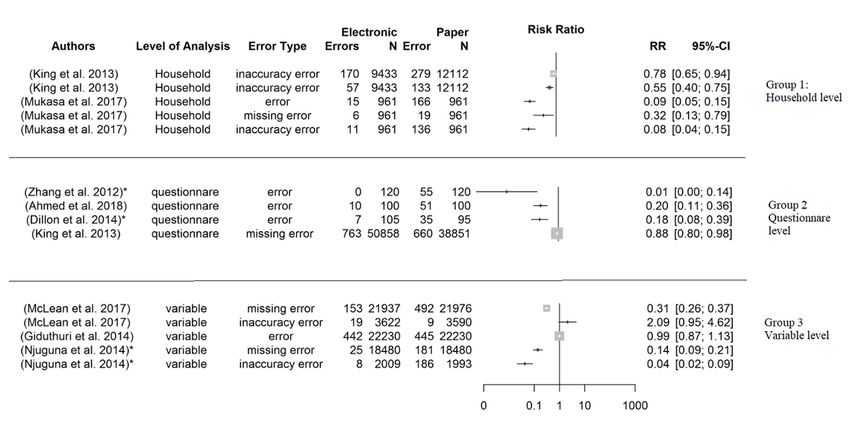
JOURNAL OF MEDICAL INTERNET RESEARCH                                                                                                   Zeleke et al

     Conclusions: Although evidence exists of the comparative advantages of electronic data collection compared with paper-based
     methods, the included studies were not methodologically rigorous enough to combine. More rigorous studies are needed to
     compare paper and electronic data collection systems in public health surveys considering data quality, work efficiency, and cost
     reduction.
     International Registered Report Identifier (IRRID): RR2-10.2196/10678

     (J Med Internet Res 2021;23(1):e21382) doi: 10.2196/21382

     KEYWORDS
     electronic data collection; demographic and health survey; tablet computer; smartphone; mobile phone

                                                                           health surveys to mitigate challenges encountered in paper-based
     Introduction                                                          data collection [13,14]. Compared with face-to-face interviews,
     Until well-established civil and vital statistics systems are in      a self-administering mode of electronic data collection tools
     place in low- and middle-income countries (LMIC), monitoring          could potentially increase the response rate among stigmatized
     sociodemographic events using data on vital societal statistics       groups. These tools have been tested in the contexts of drug
     will remain dependent on alternative data sources. Public health      abuse [15] and sexual health or HIV [16-18] in public health.
     surveys—such as censuses, demographic and health surveys              The findings conclude that respondents prefer electronic data
     (DHS), and health and demographic surveillance—serve as a             collection tools as a solution for reporting sensitive information.
     data lifeline for these countries [1,2]. Mortality and morbidity      Considering data collection in clinical trials, electronic clinical
     indicators, service utilization, and population-level program         report forms (eCRF) show a potential advantage over
     impact evaluations are usually calculated from household-level        paper-based clinical case report forms (CRF) [19-22]. Studies
     data. Further analysis of these population-level epidemiologic        have identified the relative advantages of electronic data
     indicators is helpful in identifying the determinants of mortality    capturing tools in terms of data quality, timeliness, and
     and morbidity. Data collection and management is the first step       implementation cost.
     in the process of evidence generation from household surveys,
     in which data quality errors could be introduced or prevented.        A handful of experience reports are available on the use of
     Avoiding errors at this stage is the first-line choice to avoid       electronic data collection methods in health and demographic
     inherited errors in further data management processes [1,3,4].        surveillance systems (HDSS) in the International Network for
                                                                           the Demographic Evaluation of Populations and Their Health
     The current classical data collection and management processes        (INDEPTH) network. The HDSS site in Malawi used an
     in LMIC are heavily dependent on paper-based manual methods           OpenHDS data system as a means of GPS data collection [23].
     [4,5]. Paper-based data collection requires extensive human and       One surveillance site in Kenya also reported the adoption of
     material resources, especially for large-scale surveys. It also       technological innovation using OpenHDS to manage a
     incurs high printing and data entry costs and requires extra data     large-scale malaria survey in western Kenya. The findings
     quality assurance steps during and after data collection.             asserted that electronic data collection (EDC) enabled the
     Moreover, it takes a long time for an error-free data set to be       collection of demographic and malaria data quickly and
     ready for analysis [6,7]. The intrinsic mode of paper-based data      effectively. Moreover, the possibility of real-time data quality
     collection affects the data quality, timeliness, and cost of survey   controls using the system led to an efficient workflow and
     implementation, among other factors [8-10].                           subsequent cost savings [24]. The Kombewa HDSS in Kenya
     The rapid development of the global telecommunications                also collected data electronically using PDAs and computer
     infrastructure provides an opportunity for mobile and wireless        notebooks [25,26]. Since 2010, the Magu HDSS site in Tanzania
     technologies (mobile health [mHealth]) to support health              has used EDC to enable enumerators to record household
     services and research. Harnessing this technology’s potential,        information directly in the PDA [27]. The Dabat HDSS site in
     particularly in LMIC where the disease burden is highest, is          northwest Ethiopia also reported the use of PDAs as a means
     becoming a popular strategy led by relevant activities in World       of data collection [6,28]. Most HDSS and DHS still use a
     Health Organization member countries [11]. There are diverse          paper-based data collection system, and those sites with EDC
     mHealth solutions broadly categorized as a tool to support            implementation experience have rarely published their
     communication between health service institutions and                 experience or the comparative impact of EDC and paper-based
     individuals. These include health call centers; reminders to          data collections. Despite the individual implementation
     attend appointments; providing access to information and              experiences that suggest that EDC tools can improve data quality
     education for health care professionals, for example, access to       and work efficiency and reduce overall survey costs, systematic
     electronic health care databases and clinical decision support        reviews of the available evidence are limited. The focus of the
     systems; and supporting health monitoring and surveillance (eg,       available systematic reviews is primarily on the mixed potential
     data collection and reporting in health surveys, surveillance,        of mHealth, not specifically on the impact of mobile devices
     and patient monitoring) [12].                                         on improving the data collection and management processes in
                                                                           surveys [13,29,30]. Therefore, the impacts of EDC tools in
     The implementation of tablet- or smartphone-based data                surveys need to be separately analyzed and reported. The
     collection tools is becoming increasingly popular in public           available Cochrane systematic review on the impact of data

     http://www.jmir.org/2021/1/e21382/                                                             J Med Internet Res 2021 | vol. 23 | iss. 1 | e21382 | p. 2
                                                                                                                  (page number not for citation purposes)
XSL• FO
RenderX
JOURNAL OF MEDICAL INTERNET RESEARCH Zeleke et al
quality parameters focuses on self-administered EDC tools and apps with technologies that directly support the data collection
excludes interviewer-administered methods [14]. In the case of process by enabling data collectors and interviewers to collect
face-to-face interviews, the data collection process involves and send data as well as enabling supervisors and data managers
interaction between the questionnaire, respondent, and to monitor the data collection process. The study participants
interviewer. The difference in the mode of questionnaire included in our review are defined as data collection tool users
administration can have serious effects on data quality [9]. who use a method of data collection.
Moreover, conducting face-to-face surveys has more
Studies with the following characteristics were included:
organizational costs involved than self-administered surveys.
• The study compared either data quality or cost-effectiveness
Therefore, a systematic review that considers
or both as primary outcomes and reported these in the paper.
interviewer-administered data collection may complement this
• The intervention consisted of mobile information and
evidence. We found no systematic review that analyzed the data
communication technology devices along with mobile apps,
quality and cost-effectiveness of electronic and paper-based
which include PDAs, cellphones, smartphones, and tablet
interview-administered public health surveys. The objective of
computers—devices used specifically for data collection
this systematic review is to synthesize the evidence on the effect
and reporting processes during surveys.
of using EDC systems on data quality and cost reduction in
• The control and intervention groups were compared in
public health surveys, with a focus on studies reporting
face-to-face interview-administered surveys conducted at
comparative impacts of paper-based data collection and EDC.
the household level.
• Demographic surveillance sites were based on clinical
Methods settings and not mandated for standard clinical trials (eg,
We registered a detailed protocol with PROSPERO, an CRF vs eCRF).
international database of prospectively registered systematic • The paper was published between January 2008 and
reviews, with the registration number CRD42018092259. December 2018.
PRISMA (Preferred Reporting Items for Systematic Review Search Information Source and Search Strategies
and Meta-Analysis) guidelines were used to report our
Studies were identified through systematic searching in the
systematic review [31,32]. The protocol of this study has been
following electronic databases: MEDLINE via Ovid, CINAHL
published [33].
via EBSCO, PsycINFO via Ovid, EconLit via EBSCO, the
Inclusion Criteria Social Science Citation Index, the Science Citation Index via
We assessed studies that investigated the effect of EDC methods the Web of Science and CENTRAL, and the Cochrane Library
on improving the data quality and cost-effectiveness in public (Table 1). In addition, the reference lists of all the included
health surveys or surveillance, compared with traditional citations were screened. We also searched clinical trial registries
paper-based data collection methods. We included all mobile for unpublished and in-progress studies.
Table 1. Subject term translations for individual databases
MEDLINE and Cochrane PsycINFO CINAHL
Mobile applications Not available Mobile applications
Computers, handheld Mobile devices, computer peripheral devices Computers, handheld
Electronic health records Not available Electronic health records
Cell phone Cellular phones Cell phone
Surveys and questionnaires Surveys; questionnaires Data collection methods
Interviews as topic Interviews Included in data collection methods
Costs and cost analysis Costs and cost analysis Costs and cost analysis
Data accuracy Not available Not available
The search strategy reported in the protocol was refined and OR and the categories with the operator AND. Textbox 1
updated in collaboration with a research librarian. This strategy presents the search strategy in MEDLINE via Ovid. Appropriate
considered 3 categories: the technology or intervention used modifications to control for vocabulary and syntax were made
(eg, mobile device, mobile phone, mHealth, or EDC), area of to the search strategy for each database (Textbox 1). Additional
application (eg, data collection, demographic and health survey, search strategies for PsycINFO, CINAHL, Web of Science, and
or large-scale survey), and the outcome of interest (eg, data Cochrane databases are presented in the supplementary file
quality, missing data, and cost-effectiveness). We linked (Multimedia Appendix 1). All searches were conducted in
synonyms and controlled vocabulary with Boolean operators January 2019.
http://www.jmir.org/2021/1/e21382/ J Med Internet Res 2021 | vol. 23 | iss. 1 | e21382 | p. 3
(page number not for citation purposes)
XSL• FO
RenderXJOURNAL OF MEDICAL INTERNET RESEARCH Zeleke et al
Textbox 1. Search strategy in MEDLINE via Ovid.
MEDLINE(R) and Epub Ahead of Print, via Ovid
1. (((tablet or handheld or hand held or electronic) adj2 (device* or computer*)) or ((electronic or digital) adj2 (form? or data capture* or survey* or
case report form? or data collection?)) or Open Data Kit or ODK or EDC or eCRF or eHealth or mHealth or digital health or Android or tablet? or
PDA? or personal digital assistant? or app? or (mobile adj2 (technolog* or application? or app?)) or ((mobile or cell* or smart) adj2 phone*) or
smartphone* or cellphone*).ti,ab.
2. exp “mobile applications”/
3. exp ”computers, handheld”/
4. exp “electronic health records”/
5. exp “cell phone”/
6. or/2-5
7. 1 or 6
8. (field work or fieldwork or HDSS or CAPI or computer assisted personal interviewing or questionnaire* or survey* or interview* or (population
adj2 surveillance) or DHS or EDC or (data adj2 (gather* or captur*)) or (health and demographic surveillance system?)).ti,ab.
9. exp “surveys and questionnaires”/
10. exp “interviews as topic”/
11. or/9-10
12. 8 or 11
13. ((cost? adj2 (analy?s or comparison* or saving? or measure? or effectiv* or reduction? or reduce? or reduction or reducing or decrease? or
decreasing)) or (cost benefit adj2 (analy?s or comparison* or measure?)) or (cost utility adj2 (analy?s or comparison* or measure?)) or economic
evaluation? or quality control? or (data adj2 (quality or accuracy or accurate* or error? or error rate? or incomplete* or complete* or inaccurate* or
inaccuracy or valid*))).ti,ab.
14. exp “costs and cost analysis”/
15. exp “data accuracy”/
16. or/14-15
17. 13 or 16
18. 7 and 12 and 17
19. Limit 18 to yr=“2008 -Current”
• Characteristics of the intervention (eg, hardware, software,
Study Selection and networking).
We imported all citations from all databases to EndNote for • Study methods (design, setting, participants, and sample
deduplication management and further screening. Although we size).
planned to use the Covidence web-based screening tool to • Assessed outcomes (data quality, cost-effectiveness, and
manage the title and abstract screening process, we finally chose others).
the Rayyan QCRI (Qatar Computing Research Institute) • Quantitative or qualitative summary of the main findings,
screening tool because it is freely available and provides including descriptive frequencies and statistical tests.
sufficient screening functionalities. Two authors (AZ, MPH in
Health Informatics, and TN, MSc in Informatics) independently The full description of the data extraction items can be accessed
screened the titles, abstracts, and full text, based on the inclusion in the published protocol [33].
criteria. Disagreements and uncertainty on the screening results Risk of Bias or Quality Assessment
were first resolved through discussion among the reviewers,
Randomized controlled trials are suitable for evaluating whether
followed by consultation with the third (FF, Postdoc in Medical
drugs are effective; however, for interventions that involve
Informatics) and fifth authors (RR, Professor in Medical
health care delivery modes, it may not be appropriate or possible
Informatics). We used a pretested and standardized (through
to conduct a randomized controlled trial. We aimed to assess
calibration exercise) Microsoft Excel sheet for data extraction
the quality of the data in the included studies using parameters
based on the inclusion criteria and the objectives of the review.
such as random sequence generation, allocation concealment,
Data Management and Extraction Process blinding of participants and personnel, blinding of outcome
Two reviewers extracted the following information from the assessment, incomplete outcome data, selective reporting, and
papers: other biases. However, the included studies were neither
randomized controlled trials nor nonrandomized trials with
• Bibliographic information (authors, titles, journals, and clinical outcomes; they were mainly prospective comparative
year of publication). experimental studies, cross-sectional studies, or historical
http://www.jmir.org/2021/1/e21382/ J Med Internet Res 2021 | vol. 23 | iss. 1 | e21382 | p. 4
(page number not for citation purposes)
XSL• FO
RenderXJOURNAL OF MEDICAL INTERNET RESEARCH Zeleke et al
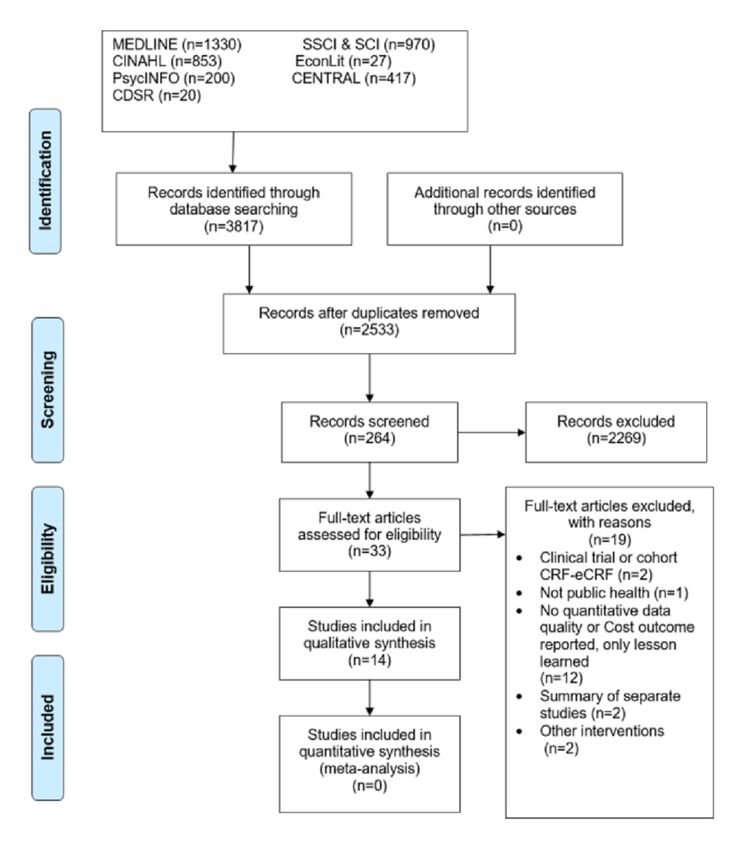
secondary data record comparisons. The remaining studies were Rayyan QCRI screening tool (Figure 1). Of these, 2500 papers
a one-time feasibility study or experience reports from the were discarded after title and abstract screening, as these papers
implementation or use of an EDC tool in public health practice. clearly did not meet our criteria. Of the 33 full-text papers
included, only 14 met the amended inclusion criteria. The
Data Synthesis original protocol was aimed at including comparative studies
There was substantial heterogeneity among the studies that addressed paper-based and electronic tools in the same
concerning the intervention (mobile electronic data capturing study, conducted household-level data collection in a community
tools such as PDA, smartphone, or tablet computer and the app field setting, and reported primary outcomes (data quality or
they used), outcome types (error rate and missing or inaccurate cost-effectiveness) of both data collection tools in the same
data), and level of outcome measurements (sample level, paper. Only 7 studies (that are heterogeneous) fulfilled these
household level, and variable level) of the mHealth interventions criteria. Due to the limited evidence, we extended our inclusion
and study outcomes. criteria to cover studies that use the tools in demographic
The studies were found to be noncombinable, and combining surveys or surveillance systems in a clinical or hospital setting.
these studies would not have been methodologically sound. We also included one-sided study design papers that only
Consequently, we performed a narrative synthesis of the studies. reported primary outcomes (cost or data quality) and EDC
methods, without formal comparison with paper-based data
Results collection methods. This widening of the scope provided an
additional 7 papers (3 comparative and 4 noncomparative EDC
Study Selection and Characteristics papers) to bring the total to 14: 10 comparative and 4
noncomparative single-arm studies were included for final
The search performed in the included databases yielded 3817
full-text extraction (Figure 1).
results. After deduplication, 2533 results were exported to the
http://www.jmir.org/2021/1/e21382/ J Med Internet Res 2021 | vol. 23 | iss. 1 | e21382 | p. 5
(page number not for citation purposes)
XSL• FO
RenderXJOURNAL OF MEDICAL INTERNET RESEARCH Zeleke et al
Figure 1. Screening process based on the PRISMA (Preferred Reporting Items for Systematic Review and Meta-Analysis) flowchart template.
assessed the outcomes using paper-based data collection and
Study Characteristics EDC in the same analysis. Furthermore, 4 papers [43-46]
The final systematic synthesis analysis included 14 studies reported either data quality or cost-related outcomes or both in
conducted in 12 LMIC. Of these 14, 10 [7,34-42] comparatively a study conducted using an EDC tool (Table 2).
http://www.jmir.org/2021/1/e21382/ J Med Internet Res 2021 | vol. 23 | iss. 1 | e21382 | p. 6
(page number not for citation purposes)
XSL• FO
RenderXJOURNAL OF MEDICAL INTERNET RESEARCH Zeleke et al
Table 2. Study and content characteristics of the included papers
Category Studies, n References
Country (n=14)
Kenya 2 [36,45]
Ethiopia 1 [7]
China 2 [42,43]
Malawi 1 [39]
India 1 [37]
Philippines/Bangladesh 1 [34]
Sudan 1 [35]
Burkina Faso 2 [40,44]
Tanzania 1 [38]
South Africa 1 [41]
Nigeria 1 [46]
Study setting (n=10)
Household community setting 7 [7,34,35,37-40]
Clinical/hospital setting 3 [36,41,42]
Comparison of paper-based and electronic data collection (n=10)
Both from the same study 8 [34,35,37-42]
Compared from 2 studies conducted at different times 2 [7,36]
Purpose of the study design (n=7)
Primarily designed to evaluate paper-based and electronic tools 5 [35,37,39,41,42]
Secondary byproduct of another primary survey 2 [7,36]
Types of outcomes (n=10)
Only data quality outcomes 1 [35]
Only cost outcomes 2 [34,40]
Both cost and data quality outcomes 7 [7,36-39,41,42]
Level of data quality outcome assessment (n=8)
Household level 2 [7,38]
Questionnaire level 4 [7,35,41,42]
Variable level 3 [36,37,39]
Type of data quality outcome comparison (n=8)
Missing 4 [7,36,38,39]
Inaccurate 4 [7,36,38,39]
Mixed (identified as error) 5 [35,37,38,41,42]
Economic evaluation type (n=11)
Complete input cost 3 [36,38,40]
Partial (differential) cost 8 [7,37,39,41-43,45,46]
Usability/user preference evaluation (n=14)
Reported after formal evaluation 6 [7,34,37-39,42]
Reported with informal discussion 1 [36]
No user evaluation information 7 [35,40,41,43-46]
Study, intervention, or evaluation year (n=10)
2008-2012 5 [36,38,41,42,44]
http://www.jmir.org/2021/1/e21382/ J Med Internet Res 2021 | vol. 23 | iss. 1 | e21382 | p. 7
(page number not for citation purposes)
XSL• FO
RenderXJOURNAL OF MEDICAL INTERNET RESEARCH Zeleke et al
Category Studies, n References
2013-2018 5 [34,35,37,43,46]
Publication year (n=14)
2008-2012 2 [42,46]
2013-2018 12 [7,34-41,43,45,46]
Furthermore, 5 studies [35,37,39,41,42] were primarily intended Types of Outcomes
to evaluate and compare data quality and cost-related outcomes
from a prospective study design using paper-based and Data Quality Outcomes
electronic tools. The remaining 5 papers [7,34,36,38,40] reported Data quality outcomes, as defined in the methods section,
the outcomes from previous technology utilization experiences. comprise the frequency of errors (incomplete, missing, or
The reported outcomes were not primarily intended to evaluate inaccurate items) on 3 levels, based on the reported outcomes
the tools; rather, data quality and cost-related outcomes were at the household, questionnaire, and variable levels. At the
extracted from surveys at different times. household level, the incidence of 1 or more errors among the
total number of households included in the surveys and data
Regarding the settings, 7 studies [7,34,35,37-40] in the
analysis were reported in 2 papers [7,38]. Similarly, the
comparative group included data from a household-level survey,
frequency of 1 or more errors per complete questionnaire,
and 3 studies [36,41,42] conducted surveys in clinical settings
regarded as a questionnaire-level error, was reported in 4 studies
or research centers.
[7,35,41,42]. At a variable level, a count of the errors in a
complete set of questions or variables in questionnaires
measured as a variable error were mentioned in 3 papers (Figure
2) [36,37,39].
Figure 2. Forest plot comparison of heterogeneity characteristics of the data quality outcomes.
The cost of implementing electronic and paper-based data databases [39,41], none attempted to link the data quality
collection processes was estimated by most studies (12 out of outcome measures to the cost inputs.
14). The majority of these estimated the partial or differential
costs unique to that study and its EDC [7,37,39,41-43,45,46].
Effect on Data Quality: Missing Data and Inaccuracy
Only 3 papers listed the full implementation cost [36,38,40] for Errors
both the study and the EDC. Except 2 studies that compared Errors are reported in terms of missing and inaccurate data in
costs per correctly entered data observation or error-free 4 studies [7,36,38,39], while a combination of both errors as a
single error indicator is reported in 4 others [35,37,38,42] (Table
3).
http://www.jmir.org/2021/1/e21382/ J Med Internet Res 2021 | vol. 23 | iss. 1 | e21382 | p. 8
(page number not for citation purposes)
XSL• FO
RenderXJOURNAL OF MEDICAL INTERNET RESEARCH Zeleke et al
Table 3. Extracted data quality outcomes.
Study and Type of compari- Study population Interven- Methods of paper- Outcome measurement Result Biases (selec-
country son, study design, and sample unit tion: de- based and electron- characteristicsb tion, informa-
and settinga vice or app ic tool administra- tion, or con-
tion founding)
Ahmed et B: Exploratory pi- • Sample unit: EDC: Daily sample ran- • A: Data quality er- • PPDC: 51 er- Selection
al [35], Su- lot study nested respondents Smart- domization for rors, questions rors from 100 and informa-
dan and experimented • Sample size: phone EDC or PPDC. 1 with no answers, question- tion
in cross-sectional 100 for each ODKe app respondent simulta- or wrong use of naires
household surveys c
(PPDC and neously inter- the skip pattern • EDC: 10 er-
viewed by 2 inter- • B: After data entry rors from 100
EDCd)
viewers with differ- • C: Errors mea- electronic
ent tools (PPDC sured at the ques- forms
and EDC) tionnaire level • 83% errors in
• D: Used similar PPDC
questionnaires
• (BOLDf survey
core question-
naire)
King et al A: Pre- and postde- Sample units: EDC: For Paper and electron- • A: Data quality, • PPDC: Miss- Selection, in-
[7], sign in full EDC • Households example, ic surveys at differ- percentage of indi- ing rate at the formation,
Ethiopia implementation • PPDC: 9433 tablet com- ent places and viduals enumerat- questionnaire and con-
evaluation in cross- • EDC: puter or times, 1 data collec- ed with at least 1 level is 1.7% founding
sectional house- 12,112 self-devel- tor at a time blank field in the • EDC: Miss-
hold surveys • Individuals oped An- census record ing 1.5% at
enumerated droid app • Percentage of P=.01
in PPDC: households with • PPDC: Miss-
38,851 and incorrect unique ing rate in
in EDC: identifying num- GPS data
50,858 ber (inaccuracy at 0.6%
• Individuals the household lev- (N=9263)
examined in el) • EDC: Miss-
PPDC: • GPS with blank ing rate in
33,800 and entries (missing at GPS 1.1%
in EDC: the household lev- (N=12,064;
38,652 el) PJOURNAL OF MEDICAL INTERNET RESEARCH Zeleke et al
Study and Type of compari- Study population Interven- Methods of paper- Outcome measurement Result Biases (selec-
country son, study design, and sample unit tion: de- based and electron- characteristicsb tion, informa-
and settinga vice or app ic tool administra- tion, or con-
tion founding)
McLean et A: Prospective • PPDC: 426 EDC: Independent paral- • A: Missing data • PPDC: Miss- Selection
al [39], evaluation nested respondents Tablet lel EDC or PPDC, defined as not ing 492 and informa-
Malawi and experimented • EDC: 558 computer 1 data collector at asked (blank; dis- (2.2%) of tion
in cross-sectional respondents and smart- a time counting not appli- 21,976 fields
household surveys • Time: 3 phone, cable blank ques- • EDC: Miss-
at HDSSg sites weeks ODK app tions) or as blank ing 153
and entered as un- (0.7%) of
known combined, 21,937 fields
Internal validity: (RRh 3.2,
defined as a field 95% CI 2.7-
with an impossible 3.8)
or inconsistent • PPDC: Inter-
value and time for nal inconsis-
submission tencies in 19
• B: Not clear (0.5%) of
• C: Variable-level 3590 fields
error count • EDC: Internal
• D: Used different inconsisten-
questionnaires cies in 9
(0.2%) of
3622 fields
(RR 0.5, 95%
CI 0.2-1.1)
• Time from in-
terview to da-
ta availability
on the
database
• PPDC: mean
3.4 days
(range 3.0-
3.7)
• EDC: mean
2.1 days
(range 2.0-
2.3)
Giduthuri A: Prospective ex- • 98 inter- EDC: A respondent simul- • A: Discrepancies • PPDC: Mean Selection, in-
et al [37], perimental compar- views in Tablet taneously inter- with reference to number of pa- formation,
India ative study de- EDC and comput- viewed by 2 inter- device-attributable per-at- and con-
signed for house- PPDC er/ODK viewers with differ- errors tributable er- founding
holds selected ran- app ent tools (PPDC • Paper entries incor- rors 4.68
domly and EDC) rect or missing (445/22,230,
and tablet entries 2.01%)
missing because • EDC: Mean
paper interviewer number of
(lead) did not fol- tablet-at-
low the skip logic tributable er-
• Tablet entries in- rors 4.65
correct or missing, (442/22,230,
paper entries miss- 1.99%)
ing because tablet
interviewer’s
(lead) skip logic
was considered an
error of EDC
• B: During data en-
try
• C: Variable-level
error count
• D: Used the same
questionnaire
http://www.jmir.org/2021/1/e21382/ J Med Internet Res 2021 | vol. 23 | iss. 1 | e21382 | p. 10
(page number not for citation purposes)
XSL• FO
RenderXJOURNAL OF MEDICAL INTERNET RESEARCH Zeleke et al
Study and Type of compari- Study population Interven- Methods of paper- Outcome measurement Result Biases (selec-
country son, study design, and sample unit tion: de- based and electron- characteristicsb tion, informa-
and settinga vice or app ic tool administra- tion, or con-
tion founding)
Mukasa et A: Retrospective • 961 house- EDC or Repeated survey, • A: Error category • Households Selection, in-
al [38], record review of holds for PDA PPDC first, fol- from the database: with errors formation,
Tanzania household survey EDC and BlackBerry lowed by EDC, 1 accuracy, logic, • PPDC: 166 and con-
data PPDC customized data collector at a and consistency; (17%) founding
HRSi time range; and com- • EDC: 15
pleteness and (2%)
missing values • PPDC more
• B: After data entry likely with ac-
from database curacy errors
• C: Error identified (79%; 95%
at the household CI 72%-
level 86%); EDC:
• D: Used the same (58%; 95%
questionnaire CI 29%-87%)
• Errors in
EDC more
likely to be
related to
completeness
(32%; 95%
CI 12%-56%)
than in PPDC
(11%; 95%
CI 7%-17%)
Zhang et al B: Prospective • 60 mothers EDC: A respondent simul- • A: Data quality er- • Households Selection, in-
[42], China comparison study for each tool smart- taneously inter- rors; missing con- with errors formation,
conducted in a (EDC and phones, viewed by 2 inter- firmation of de- • • PPDC: and con-
clinic PPDC) leased soft- viewers with same fault option, sur- 55/120 founding
ware tools (PPDC or vey date, missed • EDC: 0
EDC). Random questions, 2 op-
assignation of re- tions circled, • Questionnaire
spondents to one of wrong options pairs with no
the tools chosen, date, ID; recording
database comple- variations
tion (data entry, • • EDC:
checking, and data 15/60
cleaning) • PPDC:
20/60
• B: Before and af-
ter data entry • EDC: 134 of
• C: Questionnaire- 186 variables
level error count (72.0%) did
• D: Used the same not have any
questionnaire recording
variation
• PPDC: 126 of
184 variables
(68.5%) did
not have any
recording
variation
• In data entry:
65.0%
(78/120) of
the PPDC
records did
not match
database com-
pletion time
• PPDC: 16
hours; EDC:
30 min
http://www.jmir.org/2021/1/e21382/ J Med Internet Res 2021 | vol. 23 | iss. 1 | e21382 | p. 11
(page number not for citation purposes)
XSL• FO
RenderXJOURNAL OF MEDICAL INTERNET RESEARCH Zeleke et al
Study and Type of compari- Study population Interven- Methods of paper- Outcome measurement Result Biases (selec-
country son, study design, and sample unit tion: de- based and electron- characteristicsb tion, informa-
and settinga vice or app ic tool administra- tion, or con-
tion founding)
Njuguna et A: Pre- and • EDC: 880 EDC: Paper and electron- • A: Incomplete • Missing error: Selection, in-
al [36], postimplementa- question- smart- ic surveys at the records or vari- • • EDC: formation,
Kenya tion evaluation in naires (May phones, same place but dif- ables in selected 25/18,480 and con-
hospital-based 2011-June FASTj app ferent times, 1 data questions in a • PPDC: founding
surveillance data 2012) collector at a time questionnaire; 181/18,299
collection • PPDC: 880 questions requir-
question- ing responses with • Inaccuracy er-
naires (Jan- or without pro- ror:
uary 2010- grammed checks • • EDC:
June 2011) on the smartphone 8/2009
version; percent- • PPDC:
age of erroneous 186/1807
and inconsistent
responses in the
questionnaires
• B: Error count
from original re-
sponses in the pa-
per
• C: Variable-level
error count
• D: Used the same
questionnaire
Dillon et al B: Prospective data • EDC: 105 EDC: One data collector • A: Data collection • Overall num- Selection, in-
[14], South collection in case respondents tablet com- interviewed all re- errors defined as ber of errors formation,
Africa control study in a • PPDC: 95 puter, self- spondents either nonsensical or im- per 100 ques- and con-
hospital setting respondents developed with paper or with possible inputs, tions founding
app electronic tools in missing data, or • EDC: 0.17 er-
a random order inputs inconsistent rors; PPDC:
or incompatible 0.73 errors
with previous re- • PJOURNAL OF MEDICAL INTERNET RESEARCH Zeleke et al
separately. In the paper-based data collection, 51 of the 100 (0.5%) of 3590 fields collected by PPDC compared to 9 (0.2%)
questions had one or more errors, compared with 10 errors in of 3622 fields for EDC (RR 0.5, 95% CI 0.2-1.1) [39].
the electronically submitted forms [35]. Moreover, the mean data availability duration in databases was
3.4 days (95% CI 3.0-3.7) in PPDC compared with 2.1 days
A study in India by Giduthuri et al [37] also compared error
(95% CI 2.0-2.3) for EDC. The mean number of interviews per
rates between paper-based and electronically collected data
day was similar for both groups at 10.7 (95% CI 8.7-12.6) for
from a comparative prospective experimental study. The data
PPDC and 11.8 (95% CI 8.1-15.5) for EDC [39].
collectors were randomly assigned to use either pen and paper
or EDC tools while interviewing each respondent A tablet computer-based data collection system was
simultaneously. Audio-recorded data during the survey were implemented in a large-scale study of trachoma impact
used as a reference to compare discrepancies and assessment surveys in Ethiopia [7]. Data quality outcomes were
device-attributable errors. According to the reference, paper compared with a similar paper-based survey conducted 7 months
errors indicate when a paper entry was incorrect and when a earlier in a different part of the country. The sampling units
tablet entry was missing because the paper-based tool were households (PPDC: 9433 vs EDC: 12,112), and the study
interviewer (lead) did not follow the skip logic. Furthermore, enumerated 38,851 individuals in the PPDC survey and 50,858
tablet entries were incorrect or missing and paper entries were in the EDC survey. Individuals enumerated with at least 1 blank
missing because of the electronic tool interviewer’s (lead) skip field in a single respondent response were defined as missing
logic was considered an error of the electronic data collection data (1.7% for PPDC vs 1.5% for EDC; P=.01). Missing data
tool. The mean number of paper-attributable errors was 4.68 at the household level for GPS with blank entries was also
(445/22,230, 2.01%), while the mean number of reported (EDC: 1.1% vs PPDC: 0.6%; PJOURNAL OF MEDICAL INTERNET RESEARCH Zeleke et al
Table 4. Extracted cost information (based on Consolidated Health Economic Evaluation Reporting Standards evaluation template)
Study and Analytic Interventions Time horizon, Included cost inputs and Data quality Cost range of inter- Conclusions and remark
country method or studied or popula- discount rate, assumptions (1=PPDC; outcome link vention (1=PPDC;
model tion per group currency (base 2=EDC) with input 2=EDC)
a year) cost
(1=PPDC ;
2=EDCb)
King et al Input cost • 9433 • NRc • Printing and data Not linked 1. US $13,883 • Costs of the equip-
[7], analysis • 12,112 • NR entry costs 2. US $10,320 ment in EDC ap-
Ethiopia • US $ • Tablet and acces- proximately the
(2011) sories Single-use same as with data
cost entry cost, recur-
rent use of EDC
may save costs.
Use of person day
for comparison of
personnel costs
McLean Input cost • 426 • 1 year • Printing and entry Not linked 1. £18,895 • In total, the esti-
et al [39], analysis • 558 • NR cost and paper 2. £11,427 mated costs for the
Malawi Differential • British archival stages unique to
cost Pound • EDC development the paper-based
(2016) and configuration, process is 65%
device cost, data of- higher per annum
ficer cost than the unique
costs for the EDC
system
Giduthuri Differential • 98 inter- • NR • Printing and data Not linked For 96 interviews, • The initial invest-
et al [37], input cost views for • NR entry expenses the cost is ment in tablet-
India analysis both, and • US $ • Cost of tablet com- 1. US $2598 based interviews
extrapolated (2013) puters and server 2. US $2648 was higher com-
for larger charges pared to paper,
samples while the recurring
1000 costs per interview
were lower with
the use of tablets
• EDC is less expen-
sive for larger sur-
veys
Mukasa Cost and • 1000 house- • NR (used • All fixed costs and Error rate For 1000 house- • For error-free data
et al [38], cost-effec- holds for deflator running costs holds, error-free sets, surveys using
Tanzania tiveness both values) • To estimate the data set: electronic tools,
• NR (used costs for 2015, the 1. US $1161 compared with pa-
the num- formula for expendi- 2. US $9380 per-based tools,
ber of ture in 2016 = Ex- were less expen-
house- penditure in 2008 × Crude data set: sive by 28% for
holds) Deflator 2016, defla- 1. US $993 recurrent and 19%
• US $ tor 2008 2. US $891 for total costs
(2008) • Deflator values of
209.5 for 2008 and
233.6 for 2016
http://www.jmir.org/2021/1/e21382/ J Med Internet Res 2021 | vol. 23 | iss. 1 | e21382 | p. 14
(page number not for citation purposes)
XSL• FO
RenderXJOURNAL OF MEDICAL INTERNET RESEARCH Zeleke et al
Study and Analytic Interventions Time horizon, Included cost inputs and Data quality Cost range of inter- Conclusions and remark
country method or studied or popula- discount rate, assumptions (1=PPDC; outcome link vention (1=PPDC;
model tion per group currency (base 2=EDC) with input 2=EDC)
(1=PPDCa; year) cost
2=EDCb)
Zhang et Input cost • 60 • NR • Both EDC and Not linked Sample size: 60 • The mean costs
al [42], analysis • 60 • NR (used PPDC: Items for each per questionnaire
China • Extrapolat- projected preparation, train- 1. US $1500 were higher for
ed to samples) ing, fieldwork and 2. US $2700 the smartphone
• 1200 • US $ data collection, and questionnaire
Sample size: 1200
• 1600 (2012) logistics • No linked analysis
1. US $41,570
• Only printing and for data quality
transporting the 2. Cost per sam- and cost
questionnaire, sta- ple, US
tionery, and data $23.77
entry Sample size: 1600
• Only renting the 1. US $28,520
smartphone and the 2. Cost per sam-
software ple, US
• Assumptions for the $25.98
extrapolation are
not known
Njuguna Input cost • Both 880 • NR • First- and second- Not linked First year: • For establishment
et al [36], analysis • Extrapolat- • 2 years year costs of start- 1. US $15,999 cost, EDC 9.4%
Kenya ed for the • US $ ing up and operating 2. US $17,500 more than PPDC;
first year’s (2011, based on payroll in- in 2 years, EDC
establishing 2012) formation Second year: costs reduced 7%
and second 1. US $54,001 compared to
year’s oper- 2. US $50,200 PPDC
ating cost • No linked analysis
for data quality
and cost
Dillon et Input and • 95 • British • Salary per correctly Error rate Salary cost per • EDC salary cost
al [41], economic • 105 pound entered question month: per correctly en-
South analysis (2012) • Technology costs 1. £1000 tered question is
Africa and tablet computer 2. £915 0.5 times that of
and additional over- PPDC
head costs (storage Equipment cost: • Initial technology
space for paper hard 1. £420 costs for the EDC
copies; office space 2. £1036 is 2.47 times that
for data entry clerk, of PPDC
and for EDC, hard- • Cost per question
ware maintenance • • EDC: £0.18
and upkeep) • PPDC: £0.20
• Formulas presented
by Walther et al • EDC saved
[19]. £101.20 per month
• Assumed minimum • EDC cost recoup
staffing: time 6 months
• 1 field worker, 1 da-
ta entry clerk, and 1
data supervisor
• 1 field worker and 1
data manager
(EDC)
• Calculation based
on 46 questions in a
questionnaire, 5 in-
terviews per day, 22
working days per
month, 110 inter-
views per month,
and 5060 questions
per month
http://www.jmir.org/2021/1/e21382/ J Med Internet Res 2021 | vol. 23 | iss. 1 | e21382 | p. 15
(page number not for citation purposes)
XSL• FO
RenderXJOURNAL OF MEDICAL INTERNET RESEARCH Zeleke et al
Study and Analytic Interventions Time horizon, Included cost inputs and Data quality Cost range of inter- Conclusions and remark
country method or studied or popula- discount rate, assumptions (1=PPDC; outcome link vention (1=PPDC;
model tion per group currency (base 2=EDC) with input 2=EDC)
(1=PPDCa; year) cost
2=EDCb)
Flexman Input data • 5398 • 2013 ver- • Differential cost es- Not linked • Printing cost • For small-scale
et al [34], analysis • 516 bal autop- timation formula per paper surveys, the up-
Bangladesh sies’ data excluding similar questionnaire front costs of pur-
and collec- cost for EDC and US $0.246 chasing electronic
Philip- tion in PPDC, for example, (Bangladesh) tablets was the pri-
pines demo- data collector cost and US mary cost, and it
graphic (see the full paper $0.774 had a higher total
and mentioned on page (Philippines) cost. For large-
surveil- 4) • Cost of a sin- scale surveys, the
lance • The cost for data gle electronic costs associated
sites entry for a single tablet US with data entry ex-
enterer is the one- $393.78 ceeded the cost of
time cost of a com- (Bangladesh) the tablets, so
puter plus the and US • EDC provides a
monthly salary mul- $365.76 cheaper method of
tiplied by the num- (Philippines) data collection
ber of months re- • Cost of a • Historical cost da-
quired computer for ta from 2 coun-
data entry US tries. For projects
$984.49 that require fewer
(Bangladesh) than 150 tablets
and US and collect over
$1000.00 10,000 surveys,
(Philippines) the upfront cost of
• Monthly the tablets will
salary of data likely be substan-
enterer US tially less than the
$384.62 cost of data entry
(Bangladesh)
and US
$326.00
(Philippines)
• Average num-
ber of sam-
ples per per-
son per month
107.8
(Bangladesh)
and 145.7
(Philippines)
Lietz et al Compara- • 10,000 • HDSSd • Fixed costs: person- Not assessed Cost per household • Cost analysis esti-
[40], tive input households and nel (team lead), of- visit mated that the
Burkina cost analy- for both fice, and housekeep- CDA survey
HMSe 1. HMS +
Faso sis ing HDSS would reduce the
2010 and
• Variable costs: data (PPDC): US annual costs of
inflated
collectors, supervi- $251,641 survey implemen-
to 2014
sors, consumables, 2. CDA (EDC): tation by about US
values
transportation, and US $206,937 $45,000
• CDAf ac- training (full text in • No link with the
tual Textbox 1) Cost per (10,000 data quality out-
pretest- • Fixed and variable HDSS) come
ing ex- costs Financial costs 1. EDC: US $21
penditure of the standalone 2. PPDC: US
in 2014 (HDSS and HMS) $25
and integrated
(CDA) survey ap-
proaches were esti-
mated from the per-
spective of the im-
plementing agency
http://www.jmir.org/2021/1/e21382/ J Med Internet Res 2021 | vol. 23 | iss. 1 | e21382 | p. 16
(page number not for citation purposes)
XSL• FO
RenderXJOURNAL OF MEDICAL INTERNET RESEARCH Zeleke et al
a
PPDC: pen and paper data collection.
b
EDC: electronic data collection.
c
NR: not reported
d
HDSS: health and demographic surveillance systems.
e
HMS: Household Morbidity Survey.
f
CDA: Comprehensive Disease Assessment.
Studies from Ethiopia [7], Malawi [39], India [37], and planned. The EDC salary cost per correctly entered question
Bangladesh and Philippines [34] reported a differential input was 0.5 times that of PPDC. Overall, the cost per question was
cost unique to paper-based or electronic tools. For paper-based £0.18 for EDC and £0.20 for PPDC. The equipment cost for
data collection, these were printing and data entry costs, and PPDC was £420, compared with £1036 for EDC. EDC saved
for EDC systems, the cost of electronic devices’ hardware, £101.20 per month, and the EDC cost recoup time was reported
software, and accessories. The general assumption was that all as 6 months.
other costs, such as personnel costs, were the same for both
Lingani et al [40] in Burkina Faso and Njuguna et al [36] in
tools. Another cost assumption was that of the cost of
Kenya reported a detailed financial cost comparison for the
small-scale, short-duration surveys. Such kinds of small costs
establishment of PPDC and EDC at HDSS and a hospital-based
were extrapolated to large-scale surveys with no clear
surveillance system, respectively. The Kenyan report indicated
information about the model or the cost assumptions followed
that during establishment, the cost of EDC was 9.4% higher
to reach the large-scale costs. The studies concluded that EDC
than that of PPDC. However, after 2 years, EDC costs decreased
was expensive for small-scale surveys, as the initial investment
by 7%, compared with PPDC (see Table 4 for detailed cost
in hardware and software outweighs the paper-based printing
information).
and data entry costs. However, large-scale surveys showed a
significant decrease in cost for EDC surveys; for example, the Technology Characteristics, User Preference, and
paper-based survey cost was up to 65% higher per annum than Acceptance
the unique costs for the EDC system [39]. None of these studies
The mobile devices used for data collection included PDAs,
linked the input cost with data quality errors.
smartphones, tablet computers, and notebooks (Table 5). The
Detailed cost information and the link between cost and data included studies (6/12, 50%) also reported the use of open source
quality were reported in a retrospective data analysis in Android apps called open data kit apps to customize the software
Tanzania. However, the base year for the cost was 2008, and according to their needs. Microsoft Windows and BlackBerry
deflator values of 209.5 for 2008 and 233.6 for 2016 were used operating systems were installed on mobile devices.
to report the costs. For 1000 households, the cost per error-free
Data transfer from mobile devices to the central server was
data set was US $11,610 for PPDC and US $9380 for EDC. For
conducted using one of the following methods:
error-free data sets, surveys using electronic tools—compared
with paper-based tools—were 28% less expensive in recurrent • Direct transfer from the data collection site to the server
costs and 19% less expensive in total costs [38]. using a mobile data network [34-36] and secure virtual
private network [45].
A study in South Africa also reported cost inputs linked to data
• Direct transfer using Wi-Fi connection only [37,39].
quality outcomes [41]. The formula presented by Walther et al
• Transfer using secure digital memory card [7,38].
[19] was used with minimum staffing: for PPDC, 1 field worker,
• Transfer using USB cable [41].
1 data entry clerk, and 1 data supervisor, and for EDC, 1 field
worker and 1 data manager. In addition, 46 questions in a Data transfer to a server located in a foreign country using a
questionnaire, 5 interviews per day, 22 working days per month, mobile network was not considered appropriate in some studies
110 interviews per month, and 5060 questions per month were due to data ownership or security concerns [7,43].
http://www.jmir.org/2021/1/e21382/ J Med Internet Res 2021 | vol. 23 | iss. 1 | e21382 | p. 17
(page number not for citation purposes)
XSL• FO
RenderXJOURNAL OF MEDICAL INTERNET RESEARCH Zeleke et al
Table 5. Extracted intervention or technology characteristics
Study and Analytic method or Interventions Time horizon, discount Included cost inputs and assumptions Data quality outcome link
country model studied or rate, currency (base year) (1=PPDC; 2=EDC) with input cost
population
per group
(1=PPDCa;
2=EDCb)
Njuguna • HTC smartphone Direct to • Programmed checks • Limited or poor internet network Data saved in the smart-
et al [36], • Software: FAST a server with and restrictions • Occasional server communication phone’s memory and later
Ethiopia kit: Microsoft mobile net- • Error message notifi- breakdowns uploaded on to the server
• Purchased work cation for inaccurate • Delayed data submission from convenient places
data entry
Ahmed et • Samsung smart- Mobile inter- • ODK functionalities • Limited or poor internet network in Used ODK offline and
al [35], phone net network certain areas submitted the data after
Sudan • Customized ODKb • Unexpected software closure or restarting the smartphone
• Open source freeze
• Accessibility of the aggregate web-
site in Sudan was challenging
• Using Arabic language in the ODK
was challenging for form develop-
ment and data retrieval
King et al • Samsung tablet SDc card • ODK functionali- • Limited or poor internet network in Data stored first on the su-
[7], computer with pass- ties+ User-defined certain areas pervisor laptop and then
Ethiopia • Swift Insights Mo- word-protect- survey preferences, uploaded to the local serv-
bile 1.1 ed download- generation of er to maintain the
• Barcode scanner ing to the su- unique record identi- sovereignty and security of
4.3.1 Open source pervisor’s fication (Textbox 1) the data set
developed laptop
Flexman • Samsung tablets Direct to • ODK functionalities • Sufficiently strong internet network Purchase memory cards for
et al [34], • ODK server with (no explicit descrip- the tablets to back up data
Bangladesh • Customized in mobile net- tion) locally
and ODK work
Philip-
pines
Giduthuri • Samsung Note ex- Encrypted Not described • Required highly trained interview- Not described
et al [37], ternal recorder and upload- ers
India • Enhanced ODK ed over a • Data loss by the interviewer due to
development Wi-Fi con- accidentally pressing the delete
nection to a button
central serv-
er after re-
turning to
the office
Musaka • PDA BlackBerry Micro SD • Skip function • Device stopped functioning during Not described
et al [38], • HRSd software card interview or submission
Tanzania •
BlackBerry OSe
• Customized in
HRS software
McLean • Toshiba tablets Secured • ODK functionalities • The existing wireless network was A dedicated, secured de-
et al [39], and Samsung wireless net- sufficiently strong to upload the vice charging area
Malawi smartphones work (not re- data
• ODK layed on • Adequate battery life for a day
• Contractual pay- phone net- • Lack of internal staff for form devel-
ment for form de- work) opment
velopment • Required outsourcing cost
• 11 of 92 tablets broke in 4 years and
had to be replaced
• Only 1 functioning tablet and 1
smartphone went missing over the
4-year period
http://www.jmir.org/2021/1/e21382/ J Med Internet Res 2021 | vol. 23 | iss. 1 | e21382 | p. 18
(page number not for citation purposes)
XSL• FO
RenderXJOURNAL OF MEDICAL INTERNET RESEARCH Zeleke et al
Study and Analytic method or Interventions Time horizon, discount Included cost inputs and assumptions Data quality outcome link
country model studied or rate, currency (base year) (1=PPDC; 2=EDC) with input cost
population
per group
(1=PPDCa;
2=EDCb)
Dillon et • Tablet, PC, and Data transfer • Facilitate data • A well-run staff training program Data transfer through USB
al [41], mobile phone through USB checks and early de- • Staff was already technically
South • Self-developed a connections, tection and correc- trained
Africa C#-based program avoiding the tion of faulty proce- • Lack of reliable internet connection
with XML need for a dures and data man-
constant in- agement
ternet con-
nection
Jing et al • Smartphone Stored safely • ODK functionalities • Interviewers do not have direct ac- Building a server in China
[43], Chi- • ODK and import- on the smart- cess to submit the data to the server that can be easily accessed
na ing and extraction phone and in Washington, forcing them to would facilitate improved
software uploaded to store the data on the smartphones data security and immedi-
• ODK Briefcase v a computer for a short period ate assignment of cause of
1.4 Production secured by a • Loss of data due to smartphone death on smartphones at
password. damage the time of interview
Compiled • Uploading data was a challenge for
data sent to older smartphone users
the country
coordinator
Byass et • PDA Data copied • GPS, time stamp • Use several available mobile- Saving data from the
al [44], • Pendragon 4 soft- for PDAs’ charging arrangements in vehicles PDAs’ internal volatile
Burkina ware programmed memory or solar panels memory to nonvolatile
Faso cards • Temporary system clock changes memory cards. Protective
in a few PDAs plastic cover for the safety
• Some incomplete GPS data strings of PDA was important
• 48/151 PDA encountered technical
errors
Maduga • Mobile phone Trained to • ODK functionalities • Limited network connection The extra 2 phones served
et al [46], • ODK upload com- • Fluctuation of power and internet as backup in the event of
Nigeria • Android pleted forms connection malfunction or challenges
• Locally cus- onto a secure with the global system for
tomized server, with mobile communication
back-end ac- mobile and data networks.
cess provid- Multiple SIM cards were
ed to only provided in an attempt to
the research mitigate the problem
team lead
a
FAST: Field Adapted Survey Toolkit.
b
ODK: Open Data Kit.
c
SD: Secure Digital.
d
HRS: Household Registration System.
e
OS: operating system.
Preference, Acceptability, and Feelings
Technical Challenges in Electronic Data Collection
A total of 6 papers [7,34,37-39,42] reported that user
Limited or poor internet connectivity, occasional server
preferences, acceptance, and opinions were assessed using
communication interruptions, language challenges, the need for
formal evaluation methods, such as individual or focus groups
highly trained data collectors, device stack or freezing, device
or qualitative interviews. Detailed comparative advantages and
loss and breakdowns, and limited battery or power sources are
disadvantages of paper and electronics tools are reported in
among the technological challenges faced in the implementation
thematic-based tables in [7,38,39].
of EDC systems (Table 5). The solutions include offline storage
and transfer as soon as the data collectors obtain reliable internet The use of smartphones to collect data was faster, easier to
connection (store and forward methods), transferring data using follow, and more convenient, as the data collectors did not have
USB cables or secure digital cards, purchasing backup mobile to carry cumbersome paper questionnaires and less space was
devices or batteries, and using paper questionnaires at times of needed to store their data collection tools. Additional
device malfunction. functionalities—such as automatic retrieval of respondents and
http://www.jmir.org/2021/1/e21382/ J Med Internet Res 2021 | vol. 23 | iss. 1 | e21382 | p. 19
(page number not for citation purposes)
XSL• FO
RenderXYou can also read


