Degree Statue (Part 1) of the Bachelor degree course Chemistry - Han
←
→
Page content transcription
If your browser does not render page correctly, please read the page content below
Degree Statue (Part 1) of the Bachelor degree course

Chemistry
Institute of Applied Biosciences & Chemistry
Academic year 2019-2020

 Date of last adoption by faculty board        24-06-2019
 Date of last adoption by faculty council      24-06-2019
 Date of last adoption by degree committee     20-06-2019
 Date of adoption of amendment 1               dd-mm-yyyy
Table of contents

1 About the Degree Statute ................................................................................................................ 1
   1.1 Which degree course does this Degree Statute apply to? ........................................................ 1
   1.2 How do you read this Degree Statute? .................................................................................... 1
   1.3 How long is the Degree Statute valid for? ................................................................................ 2
   1.4 How are the DS and EER compiled? ....................................................................................... 2

2 Education at HAN ............................................................................................................................ 3
   2.1 Mission .................................................................................................................................... 3
   2.2 Vision ...................................................................................................................................... 3
   2.3 Quality culture ......................................................................................................................... 4
       2.3.1 Highly qualified staff ...................................................................................................... 4
       2.3.2 Stimulating growth and an attitude of learning ................................................................ 5
       2.3.3 Responsible for quality .................................................................................................. 5
       2.3.4 Inspiring and interactive environment ............................................................................. 5

3 Information about your degree course .......................................................................................... 6
    3.1 Mission and vision of your degree course ................................................................................ 6
    3.2 Content and organisation of your degree course ...................................................................... 7
    3.3 How we educate and supervise ............................................................................................... 8
    3.4 Work placements ................................................................................................................... 10
    3.5 How the professional field is involved .................................................................................... 10
    3.6 Research groups ................................................................................................................... 15
    3.7 Options in your degree course ............................................................................................... 15
    3.8 Quality assurance of the degree course ................................................................................. 16
    3.9 Costs ..................................................................................................................................... 16

4 The exit qualifications for your degree course and professional requirements ........................                                             17
   4.1 The professional field ............................................................................................................          17
   4.2 Professional requirements .....................................................................................................              18
   4.3 Graduation specialisation ......................................................................................................             18
   4.4 Exit qualifications and professional requirements ...................................................................                        19

5 Structure of a Bachelors course at a university of applied sciences .........................................                                     22
   5.1 Scope ....................................................................................................................................   22
   5.2 Major and minor ....................................................................................................................         22
   5.3 Propaedeutic and post-propaedeutic phase ...........................................................................                         22
   5.4 Degree course overview ........................................................................................................              23

6 Academic calendar ........................................................................................................................ 24
   6.1 Lecture days and lecture times .............................................................................................. 24
   6.2 Holidays and lecture-free weeks ............................................................................................ 24

7 HAN organisation .......................................................................................................................... 26
   7.1 Faculties and institutes .......................................................................................................... 26
   7.2 Management and organisation at faculty and institute levels .................................................. 26
       7.2.1 Board of examiners and examiners .............................................................................. 26
7.2.2 Participation and consultation ...................................................................................... 27
7.3 Student facilities .................................................................................................................... 28
7.3.1 Support ........................................................................................................................ 28
7.3.2 Information facilities ..................................................................................................... 29
7.3.3 Other facilities and services ......................................................................................... 30Date: July 17, 2019
Page: 1 of 31
1 About the Degree Statute
The WHW (Higher Education and Research Act, hereafter referred to as “the Act”) stipulates in article
7.59 that an institute such as HAN University of Applied Sciences is obliged to adopt and publish a
Student Charter.
At HAN, the part of the charter which applies to all students, i.e. the institution-specific part, is called the
Student Charter. You can find the Student Charter and all its accompanying regulations on the HAN
website: http://studentenstatuut.han.nl.
At HAN, the degree-specific part is called the Degree Statute.
The Degree Statute consists of five parts:
Part 1: General part (Degree Statute)
Part 2: The Education and Examination Regulations (EER), which defines the education, final
assessments and examinations of your degree course
Part 3: Regulations of the Board of Examiners
Part 4: Regulations of the Exams Office
Part 5: Regulations of the Degree Committees
Note Part 1 is purely informative. No rights can be derived from it. Rights and obligations are derived from
the other parts; these are legally applicable regulations.
1.1 Which degree course does this Degree Statute apply to?
This is the Degree Statute for the following degree programme at HAN University of Applied Sciences
(BRIN number: 25KB: The Basisregistratie Instellingen (BRIN) is a database for educational institutions
that is published by the Dutch Ministry of Education, Culture and Science. It contains all schools and
related institutions. Each educational institution is identified in the database with a number, the so-called
BRIN number.)
Name Academy CROHO Title after the programme
B Chemistry Institute of Applied Biosciences & Chemistry 34396 Bachelor of Science
This Degree Statute contains information on the structure, organisation and execution of the degree
course, the student facilities, counselling and personal tutoring, the EER and the course-specific
regulations that describe student rights and responsibilities.
1.2 How do you read this Degree Statute?
1. We use regular UK spelling rules.
2. When we refer to ‘you’, we mainly mean you as an internal or external student enrolled in these
degree courses at HAN University of Applied Sciences. We also refer to others, such as
prospective students.
B ChemistryDate: July 17, 2019 Page: 2 of 31 1.3 How long is the Degree Statute valid for? Each academic year the course departments at HAN University of Applied Sciences make a new Degree Statute (DS) and a new Education and Examination Regulations (EER). The DS-EER for a certain academic year applies to everyone who is enrolled in that degree course for that academic year. It does not matter which phase of your degree course you are in, whether you are an internal or external student, or when you started. You can find your DS-EER here: https://www.han.nl/opleidingen/bachelor/en/chemistry/vt/course-overview/ and on #OnderwijsOnline - general information. This DS applies to the 2019-2020 academic year: from 1 September 2019 to 31 August 2020. For students starting their degree course on 1 February 2020, two different DS-EERs apply consecutively during their first “year”: the current one and that of the next academic year (but the differences are mostly small). Did you enrol in a previous academic year for the propaedeutic or post-propaedeutic phase of the degree course? And is the degree course working with a renewed curriculum or modified EER regulations? Then some DS-EER regulations will often also apply from an earlier DS-EER. 1.4 How are the DS and EER compiled? The Degree Statute for the degree course is adopted by the faculty board each year. They base this on the Model DS/EER: a model that applies for the entire HAN. The model is always based on the Model DS and the Model EER of the current academic year. The faculty council exercises the participation rights on the EER and DS, but only in so far as the HAN Participation Council has not already exercised these rights through the Model EER and in so far as these rights have not been conferred to the degree committee. How this exactly works is set out in the Regulations of the HAN Participation Council and the Regulations of the Degree Committee. The advice of the degree course’s board of examiners is requested in advance. The relevant HAN organisational bodies strive to publish the new DS and the new EER before 1 June. B Chemistry
Date: July 17, 2019
Page: 3 of 31

2 Education at HAN
Your degree course is part of the educational offerings of HAN University of Applied Sciences. HAN has
an overarching vision on higher education. Your degree course embodies this vision in its own way. This
chapter describes the HAN mission, vision and culture.

2.1 Mission

At HAN we educate you in such a way that you are optimally prepared for your future profession. But that
is not our only goal. We also want you to develop your social awareness through the degree course. Also,
later in your career, we want you to be able to continue contributing to innovations in a complex, dynamic
and international society:
       We want to give you a good Qualification for your future profession.
       As a professional, you never work alone, but always in collaboration with others. We call that
       educating you as a Network Professional. As a result, you learn to work well with others and
       across borders. You also learn how you as a professional relate to the historical context of your
       field. This gives you insight into what is expected of you now and in the future.
       We want to contribute to your Personal Development, so that you grow as a professional and
       pursue lifelong learning. After all, your knowledge and skills are the basis of your profession, but
       who you are, your qualities and your approach, make the difference.
       We want you to learn a sense of social responsibility, ethics and citizenship for your profession; to
       learn that you have to mean something for other people in your profession. This is often indicated
       with the term Bildung.

2.2 Vision

We achieve these four goals together. How? Read about it here:

B Chemistry
Date: July 17, 2019
Page: 4 of 31
You learn in context. You get experience in practice. That helps you to understand the complexity
of your future work. Learning is not something you do on your own. Your lecturers stimulate
learning with and from each other.
You learn in the triangle of education-research-professional practice. You conduct research,
for example on the quality of work in a professional field you choose yourself, or on the possibilities
for innovation. This allows you to contribute to the development of your profession. Also, in the case
of new developments, you can quickly adapt to what is needed to perform your work optimally.
HAN University of Applied Sciences has a large number of research groups. These groups
account for the research at universities of applied sciences. They also do a great deal for the
degree courses. Students, for example, can get research experience within a research group in
collaboration with the professional field. You can find all the research groups on our website:
www.han.nl/onderzoek/kennismaken/lectoraten.
Personal tutoring and the student as partner. You are assigned a study coach for the full
duration of your studies. At HAN we want you as a student to feel acknowledged, seen and heard.
We also involve you in the degree course organisation. This is what we call ‘student as partner’.
Each department has the freedom to organise its education in such a way that it suits you as a
student and the degree course. You can read more about this in part 1 chapter 3 and part 2 chapter
7.
Education with options. Besides the regular study programme of your degree course, we also
give you various options to choose from. We offer minors such as BioRefinery, Bio-Nanotechnology
and a Palette of scientific research. In addition to these, you can select one of the graduation
specialisations: Analytical Chemistry and Organic and Polymer Chemistry to give a particular focus
to your degree certificate. The options depend on your degree course. You can read more about
these options in the EER. In addition, we stimulate you to get research experience at the research
groups of HAN University of Applied Sciences, for example in an innovation lab or at a workplace
learning location. For advice on your choices, go to your lecturers and other HAN advisors.
Internationalisation @home or abroad. During their studies, all HAN students get to experience
the international context of their field. Read more about this in Chapter 3, Section 5 of Part 1.
2.3 Quality culture
HAN University of Applied Sciences fosters a culture of quality. A culture in which everyone in some way
contributes to high-quality education and a smooth running organisation. Below you can read how.
2.3.1 Highly qualified staff
Our lecturers are highly educated. Many of them have worked in the professional field for which they are
educating students. Others have research experience relevant to this field. Over 99% of the lecturers you
encounter during your studies have a Masters degree and some of these have their PhD. Two of our
practical teachers (HAN Instructor/practical teacher) have a master degree (8%).
The lecturers also have sufficient teaching skills, which they have acquired through training. This means
they know how to guide you properly in your learning. The examiners also have the necessary
qualifications. All our support staff are also properly trained in their fields. For example, staff at the
secretarial office, the internship office and the timetable office. They all perform high-quality work.
Because our course departments collaborate with our research groups, researchers and professors are
also involved in education. This helps you to further develop your own inquiring attitude, for example. The
research group also allows you to discover the latest research results and innovations in your
professional field.
B ChemistryDate: July 17, 2019 Page: 5 of 31 2.3.2 Stimulating growth and an attitude of learning We want you to grow so that you can successfully complete your studies. This is not something we achieve just by supervising you. We also challenge you to get the most out of yourself and we train you to become ever more independent in your studies. We stimulate you to be proactive in your degree course and we help you to develop a professional work attitude. You can expect your lecturers to be available and respond to your questions quickly and clearly. You can also ask for support when you are falling behind or when you are willing and able to do more. Read more about this in the EER. 2.3.3 Responsible for quality Each degree course has a quality plan. This plan, but also the EER, describes how students evaluate the education and indicate what needs to be improved. It also outlines how students, lecturers and other staff can be directly and actively involved in improving their degree course. After all, student involvement and participation are important. It is equally important that staff members, students and professionals from the field, each in their own way, are involved in or take responsibility for the degree course and the institution. For example, for the quality of lectures, timetables, the curriculum, work placement supervision, examination and other forms of renewal and improvement. We invite you, as a student, to play an active role in this. This attitude will also be important when you start working. So we also regularly ask you for your opinion on the degree course. We do this by means of (digital) questionnaires and an annual national student survey. And through oral evaluations in the lesson at the end of each period. We also invite you to actively collaborate on renewal and quality improvement. For example, by improving the course content and exams or improving logistical or organisational points: together with lecturers and/or support staff. We also reflect on how we organise education and research, on who we do it for and why we do it in the way we do. We check our conclusions regularly with all involved parties. This means you, but also lecturers, researchers and professionals from the field. Every 6 years each degree course is officially monitored by the NVAO (Accreditation organisation of the Netherlands and Flanders). 2.3.4 Inspiring and interactive environment We want you to be inspired by your degree course. For example, by getting the latest information on developments in your field. And we always try to create an open, interactive, safe and familiar learning environment. We encourage everyone to give each other honest feedback. B Chemistry
Date: July 17, 2019
Page: 6 of 31

3 Information about your degree course

3.1 Mission and vision of your degree course

The Institute of Applied Biosciences and Chemistry offers educational programs that educate students to
become entry-level professional practitioners who are able to give shape to their own development.
The institute follows in broad lines the constructivist learning theory that assumes that acquiring
knowledge and skills is not so much the result of a direct transfer of knowledge by the teacher, but rather
the result of an active role of students in the processing of information and acquiring knowledge and skills.
Professional practitioners must not only have specialised knowledge and specialist skills, but also make
use of this effectively and efficiently in new, unknown and partly unanticipated situations. The
occupational field has a need for competent professional practitioners that can devise solutions for novel
problems, in contrary to those having simply learned methods.
The Institute of Applied Biosciences and Chemistry therefore applies the following educational principles:
       The initial situation of the student is taken as a starting point and the existing knowledge and skills
       are built upon this foundation (constructivist learning theory).
       Realistic, complex professional tasks are the starting point for the design of the course. Course
       units have been derived from these professional tasks.
       The student learns how to learn. The fast changes in the occupational field make it necessary that
       the professional practitioner continuously adapts, extends and/or relocates his expertise.
       The student is increasingly able to manage his own learning process. There is a situation of an
       increasing ability to work independently and own responsibility with regard to the learning process
       (independent learning).
       Students are challenged to reflect on their own behaviour, put this up for discussion and where
       necessary to adjust this behaviour where necessary (reflective learning).
       Students learn from each other (interactive learning). Example operation (‘how did you approach it?
       ’), social control, feedback and mutual help are seen as important elements of group work.
       Because the Degree puts the profession and the required competences for it in a central position,
       there is close contact with the field of work at all levels of the course. Professional practitioners from
       the field of work also contribute to the assessment of students.
Principles of education at HAN
Each degree course at HAN trains you to become an entry-level professional. But you learn more than
this during your course. You not only acquire knowledge, you also reflect on it in view of the opinions of
others. In this way you learn to make your own decisions and to form a perspective on your field. That
gives you the possibility to apply specialised knowledge and professional skill in new, unknown and partly
unanticipated situations. Society needs people who can devise solutions for new problems. We equip you
with the knowledge and skills that will help you to continue working on your professional development.
Good professional education is geared to developments in society and in the professional field. The study
programme is constantly being geared to what is required of graduates. Both the form and content of the
course is under constant development so you are optimally prepared for the labour market.
Learning through professional tasks
An important core value at HAN is the central role of professional practice in the curriculum. It is our task
to educate you to the standard of an entry-level professional. A key aspect is therefore learning through
professional tasks. Professional tasks are 'whole' tasks carried out in real-life settings by professionals.
'Whole' means that these tasks are not split into their various components, but need to be mastered in

B Chemistry
Date: July 17, 2019
Page: 7 of 31
their full complexity. Most professional tasks call on several different competences.
Self-management
As a HAN student, you learn to independently carry out professional tasks, to improve your professional
performance and to work on developing your career. It is not only about the successful completion of your
degree, but also about ongoing successful performance in the professional field. For you it will come
down to a gradual progression towards self-management and fewer instructions from lecturers.
Enhancing flexibility
Flexibility is an important guiding principle. You have 30 ECTs with which you have the freedom to
broaden or further specialise your degree. We call this the minor. The minor gives you the chance to
focus on specific needs of the job market and develop your own unique skills profile.
Examination and assessment
Whether you do a full-time, part-time or work-study course, you are assessed on the same professional
tasks and competences. We aim to maximise the validity and reliability. An exam is valid if it measures
what it is intended to measure. With reliability, we examine the comparability of the results.
Units of study
Course units are based on professional tasks. The standard value of a course unit is at least 2.5 credits.
They are scheduled to take place within the four periods of the HAN academic calendar.
3.2 Content and organisation of your degree course
Domains
The HAN has grouped related degrees into domains, that have been generally organised into institutes.
The degrees within a domain focus on the same area of the labour market. There are five technically
oriented domains within the Faculty of Engineering, namely Built Environment, Applied Sciences,
Engineering, Automotive Institute and Information and Communication.
The competences that students develop within the courses of a domain are comparable and can even be
(partly) the same. Each domain possesses a set of domain competences. Together those form a sort of
summary of the professional profiles for which courses in a domain train. They are fairly general and
abstract and furthermore formulated from a wider professional context (for example the paramedical
professional context or the professional context of engineering). The domain competences display both
the cohesion within a domain and the distinction with other domains. Domain competences have been
made concrete in competences per course and linked to concrete professional tasks. Many domains have
been also organised within a department or institute. The institutes within the HAN are however
organisational units and may not all coincide with the domains.
The degree courses in the domain
The degree courses which belong to the domain Applied Science (= the domain of the scientific research
and the application of natural science knowledge on practical issues and problems) of the HAN University
of Applied Sciences are:
Biology and Medical laboratory research/Life Science
Chemistry
Bioinformatics
Biology and Medical Laboratory and Chemistry degree courses are also offered in English, as an
international variant called Life Sciences and Chemistry, respectively. All courses lead to the degree
Bachelor of Science.
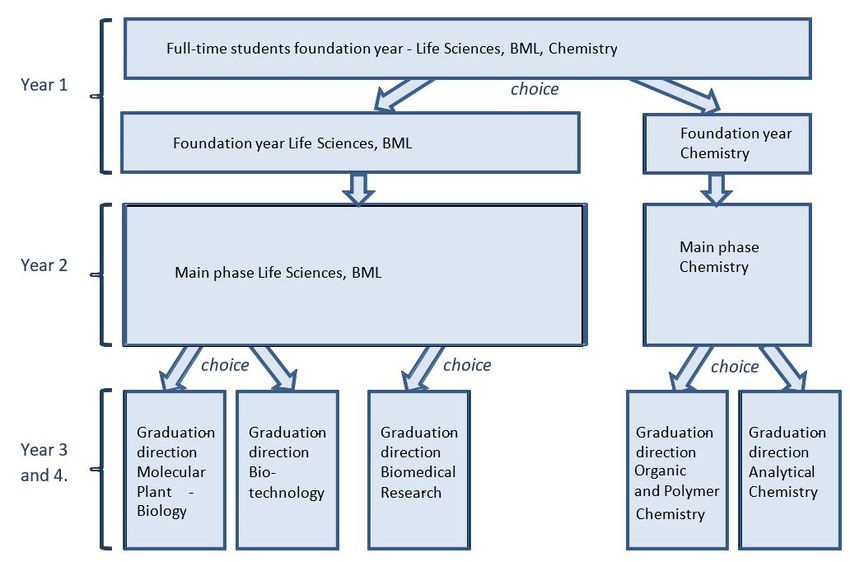
B ChemistryDate: July 17, 2019 Page: 8 of 31 Chemistry In the Chemistry degree programme you will learn about scientific research in different contexts of chemical lab research. You will gain knowledge and skills and learn how to apply these to answer research questions. With regard to a present research request (fundamental or applied) the relevant literature is studied. The research request is translated into a researchable question for which a research plan is drawn up. You perform experiments, analyse results and based on the results, design follow up experments. Students follow a Major of the respective course of 210 study credits and a minor of 30 study credits. Per block (period of approximately 10 weeks) one or two course units are followed. Some course units have a longer duration. One professional task occupies a central place in each course unit, where different competences are worked on. The Chemistry and BML/LS degree courses begin with a common programme. After half a year, they differentiate into their own curricula. Within the degree courses, students have in the second and third year options for fields of study and majors. The construction of the Life Sciences, BML and Chemistry degree courses and the options within it is shown in the diagram below. 3.3 How we educate and supervise Study coaching At the start of your degree programme, you will be assigned a study coach. This teacher guides you through one or more academic years. The study coaching takes place in individual and in group meetings. B Chemistry
Date: July 17, 2019
Page: 9 of 31

Tasks of the study coach
The study coach functions as a link between the educational question of the student and the content of
the degree programme (exam program, course units). The study coach assists the student with making
choices regarding the curriculum.
The study coach has different tasks:
- familiarise the student with the profession/professions for which the study prepares for and the
professional tasks that belong to it;
- accompanies and coaches the student in the study development of the competencies;
- play an important role in: the supervision and discussion of the study progress and delivering the
evidence thereof;
- the supervision of the participation in preliminary examinations; stimulates independent learning and the
philosophy of ‘learning to learn’.
Students who seek advice on their study, the minor or internship consult their study coach as a first step.
This is also applies for students who consider leaving the study.
If a student has complex questions, the study coach can refer the student to the study supervisor or the
student counsellor (Liesbeth Diemel, Peter Hoekstra or Astrid Sluis) or to one of the programme, minor or
internship coordinators.

Study coaching

Study coaching involves:
- support in the orientation, profession and required professional competencies
- supervision in the learning process and ‘learning to learn’ process
- linking supply and demand: supervising the decision making and choices of learning pathways
- guiding individual students, group student guidance discussion of study progress, the February advice
and binding recommendation.
- signalling in situations when study progress is influenced by factors where extra supervision or referral is
necessary.

Here the following guidelines have been formulated:
- the institute is responsible for guaranteeing the continuity of the supervision
- there are group meetings and individual meetings
- the study coaching is intensive both in the foundation year and in the main phase. The study coaching in
general decreases in intensity during the years of the degree programme.
- result-oriented study coaching: Monitoring study coaching on the basis of the study coach progress
reports.
Source: Study coaching. Significance for the student, 2010

The study coaching programme is based on the principles mentioned above. This is described in
programme-specific guides, manuals or policy plans.

Instruments
To mentor students during their learning pathway a number of instruments have been developed:

Digital Portfolio
The digital portfolio is a repository of files/documents with which the student can show his or her own
individual development (learning process) and can demonstrate the obtained level. The portfolio fulfils
different functions, such as:
1. Development-focussed function: the products in the portfolio demonstrate the development of the

B Chemistry
Date: July 17, 2019
Page: 10 of 31

student.
2. Assessment instrument. The products in the portfolio are submitted for assessment to an assessor.
This is the case for internship; graduation project and minor portfolios
3. Demonstrate what the student is capable of. In support of the job application meetings for internship
and graduation the student can bring a portfolio. With this portfolio, the student can show what they are
capable of.
Compiling and keeping a digital portfolio is a compulsory part of the degree programma. Students need to
have updated the portfolio for a performance review when a study coach asks for this, and/or when the
student wants to discuss their performance with the study coach. If a student has not updated the portfolio
at a performance review, the study coach will not sign off the interview in Alluris. A portfolio is therefore
prerequisite for a positive conclusion of the performance interview with the study coach.
In the degree programme, the portfolio is used in the graduation phase as an assessment instrument.
This applies for internship and graduation projects. The portfolio is submitted to an examiner that
assesses the portfolio. The portfolio can be used to showcase the qualities of the student when applying
for an internship or graduation project.
More information on assembling a portfolio can be found in the document ‘Study career guide’.

Personal Development Plan (PDP) and reflection
In the Personal Development Plan (POP) a student describes his learning aims and the way in which he
wants to work on this. This takes place on the basis of reflection on his own results and own function,
directed at the competences that must be developed for the relevant course. The PDP is a component of
the portfolio.
The reflection and the personal learning objective are discussed in the operation-based discussions.
The frequency, periods and concrete completion of these meetings are stated in the Study Career Guide.
Central to the performance review is a reflection on the past period (study results). The student tells what
has gone well, what he has learned and what can be improved. In the study coaching it involves the
reflection on all components of the course and the profession. An important subject in each performance
review is the choice of the learning pathway for which the student will, or has, enrolled for and the
functioning in the project group.

More information on the PDP and reflection can be found in the document ‘Study Career Guide’.

3.4 Work placements

The degree programme has an internship (30 credits) and an graduation project (30 credits).
Further information can be found in chapter 9 of the EER (Part 2) and on #OnderwijsOnline under the
section ITBC internship and graduation.

3.5 How the professional field is involved

The Chemistry Degree programme is described further in relation to the professional context.
The course units in the Chemistry Degree are designed so that the graduation specialisations analytical
chemistry and organic chemistry are covered in detail. In addition to this, there are two courses where
polymer chemistry is a central focus. A course unit of 7.5 study credits is dedicated solely to laboratory
automation because this is an important area for all specialisations. For the different course units,
relevant context areas are chosen, depending on the subject that is offered in the course unit. In selecting
these, the most common areas where our graduates come to find work are considered and represented in

B Chemistry
Date: July 17, 2019
Page: 11 of 31

the context areas of the course units.
An overview of the relationship between the different contexts of the chemical industry with the Chemistry
Degree and in which course units they are featured is shown in the table below.
Table: Relationship of the context areas of the field of work of the Bachelor of Chemistry, graduation
specialisation Organic and Polymer Chemistry and Analytical Chemisty with the chosen specialisations in
the course and the course units in which they feature.

 Context area                         Specialisation                 Course unit
 Nutrition                            Analytical chemistry           CH2
                                      (Organic chemistry)            CH4*
                                                                     C7
                                                                     C11*
                                                                     C12*
 Pharma                               Organic chemistry              CH3
                                                                     C7
                                                                     C9*
                                                                     C10*
 Synthesis                            Organic chemistry              CH4*
                                                                     C6
                                                                     C9*
                                                                     C10*
 New materials                        (Biobased)                     CH3
 and nanotechnology                   Polymerchemistry               C8
                                                                     C9*
                                                                     C10*
 Environment                          Analytical chemistry           CH4*
                                                                     C5
                                                                     C11*
                                                                     C12*

* Various context areas are used in different project and assignments.
In designing the curriculum and selecting subjects, the Chemistry Degree study is mainly guided by
national and/or international trends and developments. The ITBC has developed strong relationships with
a wide range of companies and research institutes. A large number of the students follow a substantial
part of the education in the form of internships and graduation projects there, and later often find
employment there as well.
Companies such as OCE, MercaChem and PheroBank have had a tangible influence on the education,
especially in the practicals and projects. The integration of realistic practical examples and situations,
using the external expertise that is available to us, are aspects that that will be further developed in the
coming years.
The following table shows how the occupational field has been involved in the specific units of study of
the Chemistry Degree.
Table: Involvement of the professional field in the course units of the Bachelor of Chemistry Degree.

 Course unit          Involvement of the professional    Lecturers
                      field
 CHLS                 -                                  -

B Chemistry
Date: July 17, 2019
Page: 12 of 31
CHLS2 - -
CH3 -
CH4 One-day work experience -
Second year: excursions to MercaChem, MSD, Synthon, OCE etc
C5 - -
C6 - -
C7 Information session about Guest lecturer from Merachem for the
professional life by an MSD practical
employee
C8 Excursion to nanolab RUN -
In the third study year: excursions to various companies, e.g. Merachem,
Synthon, OCE and Interscience, determined on a year-by-year basis
C9 - -
C10 - -
C11 Project with KILO -
Visit to NMR, RU Nijmegen
C12 Projects in collaboration with Guest lecturer Chemometrics 2
OCE, Rikilt, Interscience en
BioCentre.
C13 Providing an internship location, Lecturers visit the internship location
Internship internship supervision, and co-
assessor of the internship
period.
C14 Providing a graduation project Lecturers visit the internship location and
Graduation location, supervision and assess the research
project function a co-assessor.
Internationalisation
Internationalisation is one of the focus themes of the Institute of Applied Biosciences and Chemistry. This
equips the bachelor degrees to meet the needs of the professional field and the growing need for
professionals with an international mindset and good English language skills. Many organisations where
our graduates find employment function at an international level, with an international workforce and with
international branches and collaborators. The language of communication is also often English. In the
table below is an overview of the activities carried out in the framework of internationalisation within the
course. The first level is realised in the 2016-2017 academic year, the second and third levels will be
implemented in the 2017-2018 and 2018-2019 respectively.
The number of students choosing an internship or graduate research abroad is growing. This illustrates
the international character of research and development and indicates that outside the on-campus
curriculum, students are able to disperse far outside the region (naturally also within The Netherlands).
Table: Overview of the international and intercultural indicators described at three levels that are placed
within the competences ‘Design of experimental setup', 'Reporting and presenting' and ‘Teamwork’,
‘Professional development' and where they are handled in the different course units
B ChemistryDate: July 17, 2019
Page: 13 of 31
Competence Level and learning Semester 1 activities Semester 2 activities
objectives
Design of Level 1: Internationally relevant tekst books. Protcols in
research plan Understands and applies English; internationally relevant protocols; simple
simple English literature research plans; knowledge and theme tests.
relevant to the given
context
Level 2: The same as level I + The same as level 1
Understands and applies international research + analysis of
moderately complex publications, shot international
English literature literature studies, literature for research
relevant to the given research plan including plan, research report
context. internationally-relevant and oral
methods, knowledge and presentation.
theme test
Level 3: Same as level 2 + Same as level 2 +
Understands and applies literature review and use of internationally
complex English research report published papers
literature relevant to the and protocols
given context. (internship/
graduation project).
Rapporting Level 1: Lab journaals,
and Presenting Is familiar with the vergaderproducten;
international conventions geschreven opdrachten
of scientific and volgens academische
academic writing. opmaak.
In English: Can Lab regels,
communicate in simple spreekvaardigheid
and routine tasks opdrachten.
requiring a simple and
direct exchange of
information on familiar
and routine matters
Level 2: Lab journals, meeting
Is familiar with and products, written
applies the international assignments in academic
conventions of scientific style.
and academic writing. Literature research;
In English, uses written literature report; research
assignments relevant to plan; research report;
the professional practice advice report; poster;
to communicate such as email; job application.
defined by CEFR Lab activities discussed in
Cambridge B1 (written) the tutor meetings
level.
In English: can carry out
a work discussion
regarding a work-related
subject
B ChemistryDate: July 17, 2019
Page: 14 of 31
Level 3: Products written in Products written in
Same as level 2 + English; B2 written exam English (internship).
In English, uses written in English. Work meetings in
assignments relevant to In English: Research English (internship).
the professional practice presentations, meetings,
to communicate such as workshop, B2 speaking
defined by CEFR exam.
Cambridge B2 level.
In English: can interact
with a degree of fluency
as defined by CEFR
Cambridge B2 level.
Cooperation Level 1: Internationalization in
Is aware of the tutor assignments; Mini-
international character of internship (inventory of
the profession. the international aspects
of the job).
Level 2: Mixed classes (meetings International
Is aware of intercultural + study coaching + collaboration
differences in the professional learning (internship).
profession environment).
Professional Level 1: SLB activities about
development Is aware of international plagiarism and APA rules.
agreements relating to Mini-internship (inventory
fundamental and applied of the international
research. aspects of the job).
Is aware of the global
market of the profession
Level 2: Ethic workshop about International
Is aware of the internationally relevant collaboration
internationally accepted subject. (internship).
scientific code of conduct
Writing curriculum
Currently, a particular focus of the degree programmes of the Institute of Applied Biosciences and
Chemistry is developing the scientific writing skills. This is in response to feedback from the professional
field; employers that have indicated that a higher level of writing skills is desired.
To better prepare students for these demands, a writing curriculum has been developed. Within this
curriculum, writing complex scientific documents is practised in the different educational units, each with
the focus on a particular aspect of the whole. In the final phase of the degree, students will be prepared to
write a scientific report almost independently and parts of a scientific document in English. The latter is
important considering the international orientation of the biotechnology and biomedical sector, in which
English is often the operational language. An overview of the aspects of the writing curriculum and in
which educational unit this is practiced and assessed, can be found at OnderwijsOnline – General
information.
B ChemistryDate: July 17, 2019
Page: 15 of 31
3.6 Research groups
The bachelor and master programmes at the Institute of Applied Biosciences and Chemistry are
closely intertwined with the research of the HAN BioCentre/Industrial Microbiology Research
Group by sharing staff and facilities, and by the involvement of students in the research. This is
through research cases being integrated into the curriculum, or by involving students through a
minor, internship or graduation in actual research projects.
Education and research within the Institute Applied Sciences are carried out in the context of Biodiscovery
in a Biobased Economy.
Biodiscovery represents the production of biomolecules: the entire chain of discovery, purification,
analysis. This can lead to solving (social) issues and in the context of Biodiscovery, the research
contributes to the development of knowledge and products used in the biobased economy for the benefit
of agriculture and horticulture, nutrition and health.
HAN BioCentre/Industrial Microbiology Research Group performs research in the framework of
Biodiscovery. The research is based on issues from society and is carried out in close cooperation with
the business community and knowledge institutions (universities). Through this research, the HAN
BioCentre/Industrial Microbiology Research Group builds bridges between fundamental knowledge and
applications in society.
Many of the curriculum themes of the Institute of Applied Biosciences and Chemistry bachelor degree
programmes also have a place in the Biodiscovery context. They focus on discovering, analyzing, and/or
producing (bio) molecules for various applications (see Figure 3). In addition, students are introduced to
the principles of a Biobased Economy.
Image: Schematic diagram of the Biodisovery chain. Research and education at the Institute of Applied
Biosciences and Chemistry are closely intertwined and placed in a framework of the biodiscovery chain in
a biobased economy.
3.7 Options in your degree course
Second-year students choose at the end of the second year for a specialisation direction and/or the
choice of learning pathway ‘minor or ‘internship’. Third-year students will make a choice to enroll in a
specific minor, internship or graduation project.
Step-by-step instructions for enrolling can be found on HAN Insite.
The following table shows when a student can enroll for a learning pathway
Study year Period of enrollment Choice of learning pathway
2nd year April Minor
Graduation specialisation Organic and Polymer
Chemistry
B ChemistryDate: July 17, 2019
Page: 16 of 31
3rd year October Minor
Internship
Graduation specialisation Analytical Chemistry
April Minor
Internship
Graduation project
4th year October Minor
Graduation project
The exact dates for enrolling in Alluris is sent by email and listed on the information screens in the
building. Registration for the course units above is compulsory. A student that has not enrolled for a
learning pathway may not participate in the educational activities. Before a student enrolls he should
check whether he complies with the admission requirements of the learning pathway. Often this means:
the student complies with the admission requirements of the course units associated with the learning
pathway or the student complies with the admission requirements internship and/or graduation internship.
The student’s study coach is able to approve or reject the request in Alluris.
More information about internship/graduation can be found on OnderwijsOnline under the sections
Internship ITBC and Graduation ITBC.
3.8 Quality assurance of the degree course
HAN continually works on improving the quality of its degree courses through an integrated quality
assurance system. Through systematic evaluation we collect data on the quality of all aspects of
education:
aim and profile of the course;
programme with educational offerings, exam programme and study coaching;
staff deploymnent;
facilities;
internal quality assurance; results.
We actively involve all interest groups in our quality assurance system: staff, students, the professional
field and graduates. To monitor the quality of the course we also consult experts from the professional
fields. They meet a number of times per year.
In addition to these internal quality improvements, all HAN degree courses are assessed every six years
by an external panel of the Dutch Flemish Accreditation Organisation (NVAO). This accreditation is a
national seal of quality and is a condition for legal recognition of the certificate of this course at national
and international level (see also Chapter 10 EER).
3.9 Costs
Not applicable
B ChemistryDate: July 17, 2019
Page: 17 of 31
4 The exit qualifications for your degree course and
professional requirements
The activities of a Bachelor of Sciences Chemistry Graduate comprises of solving problems or issues
independently or in a team in the field of chemistry usually through experimental research. The use of
technology and often automated equipment is ever increasing and increasing in importance, as is the use
of information technology. The use of advanced software to simulate and optimise chemical processes is
also becoming more commonplace. Analytical, abstracting and service-minded attitudes are
characteristics of an Applied Science graduate. Being able to function well in multi-disciplinary teams is
also important. In the professional practise, the graduate works with consideration for the risks to health
and environment and makes decisions that are in line or guided with the ethical philosophy of the KNCV.
He works within the legal regulations that apply to his profession and strives for sustainability in all
solutions. He works according to the guidelines of a prescribed quality system or GLP.
4.1 The professional field
The graduate Bachelor of Sciences in Chemistry is suited for employment in the following sectors:
Commercial: Chemical and pharmaceutical industry (e.g. DSM, GEP, Shell, Akzo), engineering and
consultants in quality control.
Governmental or semi-governmental institutions, universities and research institutions (e.g. RIVM,
TNO, Food and Goods Authority, Alterra).
Service laboratories: Environment protection, quality control, organic chemistry, analytical
chemistry.
Within these sectors they can carry out activities in the following themes:
1. Research & Development, R&D
In a chemistry research and development, the Chemistry graduate is involved in the development of new
or improvement of existing products, methods and processes. Research is done in many different areas
such as analytical chemistry and chemometrics, organic and polymer chemistry, biochemistry, etc. To this
end, separate basic subjects, such as chemistry, statistics, physics and mathematics, are bundled
together and focus on the aforementioned areas. In both governmental and commercial research and
development laboratories, academic graduates are usually in supervising positions. They are also
responsible for the theoretical justification of the work carried out. The Chemistry graduate is responsible
for the practical execution of the research. He develops, sets up and executes an experiment, interprets
results and uses advanced software and internet. He draws conclusions from the research results and
gives advice. In smaller laboratories (small to medium enterprises) mostly applied research is carried out.
In this type of laboratory, an experienced Chemistry graduate can be responsible for managing the
research. This also applies in the development department of larger companies.
2. Commerce, Service & Facilities management
In commerce (trade) the graduate is especially active as a product specialist. He works as consultant or in
sales, or he purchases products, systems, services and equipment. He can also work in the field of
marketing. In all these cases his activities have a relationship with chemistry. In the service-providing
sphere he works is involved in knowledge transfer, for example in (vocational, applied or academic
education), e.g. in a laboratory. He can be active within institutions or businesses in the field of quality
care or management, safety (safety official, workplace health and safety management), environment
B ChemistryDate: July 17, 2019 Page: 18 of 31 (environmental adviser). 3. Application and Production In this professional field, the Chemistry graduate is often involved in environmental laboratories for quality control, production in organic, biochemical and analytical chemistry, for example. This involves especially the implementation of complex experiments where the practical and also analytical skills of the graduate are called upon. In synthesis laboratories, where the safety aspect is one of the most important aspects, there is a special emphasis on the knowledge and insight of the graduate. The wide variety of experiments demands a broad skill set of the graduate and an ability to apply techniques, equipment, automation, quality control, health and safety and environmental care. The sustainability of solutions chosen should be prioritised. The nature of the work requires good communicative abilities, a strong sense of responsibility and service. Also the ability to work in a team is an important aspect of the profession. He is also able to work reliably, critically and efficiently, in urgent situations and/or under pressure. 4.2 Professional requirements Not applicable 4.3 Graduation specialisation The Chemistry degree of the HAN has chosen to offer Analytical and Organic and Polymer Chemistry as separate graduation specialisations in order to offer the sufficient depth that the profession requires. Graduation Specialisation Analytical Chemistry Graduates of Analytical Chemistry are predominantly employed in industry, such as pharmaceutical and food industry and (service) laboratories that carry out chemical analyses for external clients. The applied and service-providing character of analytical-chemical research, as is done in the field, is expressed in the assignments, projects and practicals that are offered in the course. The whole chain of sampling, sample preparation, analysis and data processing is exhaustively practiced during the study with a wide range of materials and analysis techniques. Graduation Specialisation Organic and Polymer Chemistry Graduates of Organic and Polymer Chemistry are predominantly employed in research and development laboratories of pharmaceutical companies, and companies that are involved with new materials and contract research. The explorative character of this type of research is enphasised during the course of the study and is apparent in many assignments, projects, and practicals. Since organic-polymer chemists will have to deal with (multi-step) synthesis as well as with the optimization of certain specific reactions, both aspects will receive the necessary attention, as well as new developments, for example in the area of Pd chemistry and parallel synthesis. Polymers are increasingly being used in new and inventive materials for electronics, for example. Both the synthesis and characterisation of such polymers are presented in the curriculum. The focus on organic polymer-chemistry research is growing especially within the context of the biobased economy, where an emphasis lies on recycling, naturally occurring raw materials and biodegradation. The profession of the graduates The Chemistry Applied Science graduate is able to specialise within a particular field of research, fundamental or applied research, or research and development in laboratory techniques. With a few years of work experience, he can grow into supervising roles such as project leader or department head, or B Chemistry
Date: July 17, 2019
Page: 19 of 31

other roles such as quality controller, equipment manager, instructor/supervisor, data manager etc.
Positions in service industry such as in education as lecturer or supervisor or in commercial enterprises
are also possible. Some graduates also choose to go on to further study such as a masters degree at a
university

4.4 Exit qualifications and professional requirements

This section describes your exit qualifications at the end of the degree course. These exit qualifications
are formally defined in the EER and correspond with the professional requirements described in section
4.2.
The Degree Competences
In the degree programme the student develops the competences to be able to carry out professional
tasks. These are elaborated as criteria and indicators in the ‘BML/Chemistry Competency Profile’. This
competency profile is derived from the nationally validated competency profile ‘Bachelor of Applied
Science, a competence-based profile description’. ITBC has chosen to rename a number of competences
or to split them up so that the central theme of the degree- conducting research- clearly emerges.
To prevent a situation where confusion is arises between the competency ‘research’ and the professional
task ‘performing research’ a choice was made to split up the national domain competence ‘research’ in a
number of competences, namely:
       Design;
       Results analysis;
       Reporting and presenting;
       Planning and project-based working;
       Team work.
The final qualification however remains the same. The following example illustrates this. One of the
indicators of the competency ‘research’ that is described in the national competence profile is ‘the student
shows that he can select and obtain independently scientific literature to study the problem in greater
depth, with that he can estimate the reliability of the different sources of information correctly’. The
institute has adopted this handlings indicator, this is part of the competence ‘designing’.
The description of the domain competence ‘management and co-ordination’ indicates that it is expected
that the graduate Bachelor of Science is aimed strongly at coordinating and managing data management
systems that complies with quality norms and standards and values of the organisation. It is expected that
the Bachelor of Science can carry out these actions after 5 years work experience. The Institute of
Applied Biosciences and Chemistry is of the opinion that a student during the study, must be able to
manage her/his own administration (e.g. lab journal), lab bench and the use of materials and must be able
to act according to the rules of quality control. Therefore the institute has chosen to split up this domain
competence into two competences with recognizable names for students: ‘management and
administration’ and ‘quality control’.
The domain competence ‘advise/purchasing and selling’ describes that the Bachelor of Science must be
able to advise on products (equipment), processes and methods, set up marketing plans and make use of
negotiation techniques when buying and selling. It relates to handling indicators that a graduate should be
able to demonstrate after 5 years work experience. The Institute of Applied Biosciences and Chemistry is
of the opinion that during the study, the emphasis must lie on the ability to give an advice for follow-up
research and recommendations on suitable methods and materials, both orally and in writing. Therefore
the Institute of Applied Biosciences and Chemistry has chosen to use the more manageable competence
name ‘Advising’. Students who want to qualify further in for example buying and selling techniques can
choose a entrepreneurship minor for example.

B Chemistry
You can also read


