Developing Partnerships - 2008 Corporate Responsibility Report
←
→
Page content transcription
If your browser does not render page correctly, please read the page content below

Developing
Partnerships
2008 Corporate Responsibility Report
Welcome
Corporate responsibility is a journey. Its path is marked with challenges and opportunities
that through dialogue and partnership can be leveraged for common benefit and greater
understanding. Through this report, we hope to convey to you how conducting our business
responsibly, delivering energy and creating sustainable partnerships are at the core of
Chevron’s values.

Energy is the foundation of global growth and prosperity. For billions of people, access to
energy is the first and vital step out of poverty. To help meet current and future demand, we
strive to find and produce energy safely and with respect for the environment. While billions
of people do not have access to energy, millions of people could use energy more efficiently.
This year, we engaged the American public on an issue of utmost importance to our com-
pany — energy efficiency. For years, we have been improving our own efficiency — 28 percent
since 1992. This year, we asked U.S. energy consumers to say “I Will” to taking concrete
actions to reduce their energy consumption. We also do our part. Chevron’s Action Plan on
Climate Change has guided our emissions reduction projects, efficiency improvements and
research investments.

Chevron does more than provide energy. Our partnerships touch millions of lives and set the
stage for human advancement by addressing basic human needs, education and economic
development. Our approach to community development in the Niger Delta gradually shifts the
ownership of community development programs we fund to the communities themselves. As
the first Corporate Champion of The Global Fund to Fight AIDS, Tuberculosis and Malaria, we are
working to help control and eradicate these diseases in six countries with high incidence rates.

In 2008, we expanded and deepened our engagement with governments, nongovernmental
organizations, thought leaders, stockholders and multilateral institutions. On topics spanning
human rights, economic development, governance and climate change, we shared our views
and listened to many stakeholders and experts.

For Chevron, corporate responsibility is more than just an objective. Built on The Chevron Way,
it is central to everything we are and is embedded in everything we do. Thank you for joining
us on this journey.

                                                                       Nigeria

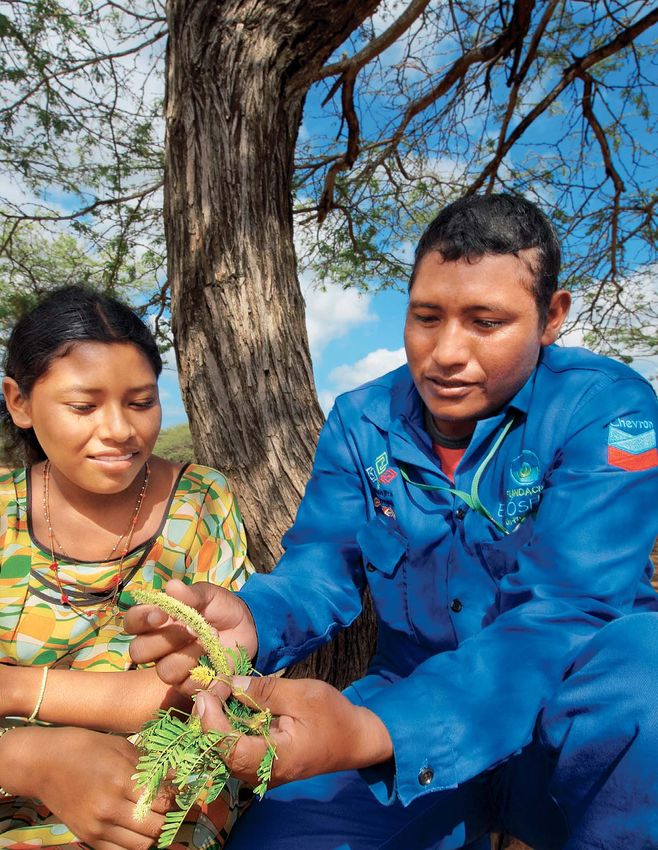
Partnering for Education

At Chevron, we believe that education opens minds, creates opportunities
and provides the skills required to compete in a global economy. Chevron and
the Discovery Channel Global Education Partnership collaborated to form
55 Learning Centers in four countries, including Nigeria, where J.O. Balogun
(on the cover) and her students study plant growth at the Ikota Primary School
in Lagos. The schools in Nigeria all experienced increased enrollment, and
parents report that student enthusiasm grew, which is demonstrated in their
group reading exercises in the photo at right.

     Meet some of the students:
     Chevron.com/LearningCenters
In This Report        Introduction                          Socioeconomic
                  2   A Message From Our CEO           26   Introduction
                  3   The Chevron Way                  28   Community Engagement
                  4   Chevron at a Glance              34   Workforce
                  5   Governance and Ethics            39   Supply Chain
                  6   Priorities, Progress and Plans   41   Human Rights
                  8   Stakeholder Engagement
                 11   Executive Interview                 Resources
                                                       43 GRI and API/IPIECA Index
                      Energy and Environment           44 About This Report
                 12   Introduction                        Assurance Statement
                 14   Climate Change                      Glossary
                 19   Renewable Energy
                 22   Environmental Management
A Message From Our CEO
Results the Right Way

                                                                                            Dave O’Reilly, Chairman of the Board and Chief Executive Officer

The world is changing, but our values            increased our community investments in                last year, we opened a polytechnic
are not.                                         2008 and plan on sustaining that level                institute in tsunami-ravaged Banda
                                                 in 2009.                                              Aceh through our partnership with
Around the globe, economies are searching                                                              government, nongovernmental organiza-
for solid ground, and people are reevaluat-      We focus our community partnerships                   tions and the United States Agency for
ing their faith in institutions. Against these   in three areas because we believe these               International Development. Along with
currents, The Chevron Way is our anchor.         are the most likely avenues for creating              our Riau polytechnic, which we opened
                                                 lasting benefits. These areas are basic               in 2001, these institutes provide job
Through good times and bad, The Chevron          human needs, education and economic                   training and livelihoods to thousands.
Way principles guide what we do and how          development.
we do it. Ask one of our nearly 62,000                                                              • NovoBanco: In 2004, Chevron and
employees to summarize The Chevron Way           Examples are many — here are some of                 partners launched this microlending
in a sentence, and he or she will likely say,    our proudest.                                        bank to spur entrepreneurship among
“It’s about getting results the right way.”                                                           Angola’s low-income households. The
                                                 • Global Fund: We’re the first Corporate             bank has been extremely successful: it
Principles are put to the test in tough times.     Champion of The Global Fund to Fight               has expanded to three branches, with
As the economic downturn grips communi-            AIDS, Tuberculosis and Malaria — a                 plans for 11 more; serves more than
ties where we operate, we will be steadfast.       public-private partnership created by              31,000 customers; and, last year, made
We plan to continue investing in those com-        the United Nations to eradicate these              more than $10 million in loans.
munities to help create jobs, support local        diseases. Our $30 million commitment
suppliers and strengthen economies — all           funds programs in six countries belea-           Inside Chevron, getting results the right
things the world needs now.                        guered by these diseases, and our more           way means never sacrificing safety. To
                                                   than 700 health care staff support               reach our aspiration of zero accidents,
We make these community investments                in-country implementation.                       we’re creating a behavior-based safety
through partnerships — one of our core                                                              culture that’s crowned by this tenet: when
strengths. Our partnerships bring together       • Education: Since 2003, we have part-             a behavior looks unsafe, employees and
business, community groups, government             nered with the Discovery Channel Global          contractors alike know they have stop-
and nongovernmental organizations with             Education Partnership to support 55              work authority. This basic tenet helped
one common goal: to produce sustainable            Learning Centers in Angola, Venezuela,           make 2008 the safest year in our history
results. To fund these partnerships, we            South Africa and Nigeria. In Indonesia           and one of the best in our industry.

2
Getting results the right way also means
responding to other challenges — from natural
disasters, to economic and social instability,       The Chevron Way
to global climate change.
                                                     At the heart of The Chevron Way is our vision . . . to be the global
Responding to climate change is a long-term          energy company most admired for its people, partnership and
process. Seven years ago, we implemented our         performance. Our values are integrity, trust, diversity, ingenuity,
comprehensive Action Plan on Climate Change,         partnership, protecting people and the environment, and high
which focuses on reducing emissions, improv-         performance. To read more about The Chevron Way, please visit
ing efficiency, investing in research, pursuing      Chevron.com/ChevronWay.
business opportunities, and promoting flexible
and economically sound policies that protect
the environment. As part of the action plan,
we set annual greenhouse gas emissions goals.
I am pleased to report we have met those
goals every year since 2004.                         Our Approach to
                                                     Corporate Responsibility
I’m also pleased that we’re ranked No. 1 among
U.S.-based oil and gas companies, and No. 2          Corporate responsibility at Chevron is the application of The
worldwide, in the 2008 Carbon Disclosure             Chevron Way across environmental, social and governance issues
Leadership Index. Compiled by the Carbon             and priorities. We implement our corporate responsibility priorities
Disclosure Project, the index highlights compa-      through existing management systems, processes and policies
nies taking “best in class” actions to measure       as part of our commitment to operate responsibly and ethically.
and report carbon emissions. It is the third         We aim to continuously improve our performance and practices
time in four years that we have been included.       throughout the corporation.

These are priorities we work on every day. At        Corporate responsibility is built on our values, which guide our
the same time, we keep our eyes on the horizon.      actions. We conduct our business in a socially responsible and
That’s where long-term needs reside. That’s          ethical manner. We respect the law, support universal human
where growth will take hold. And when it does,       rights, protect the environment and benefit the communities
the world will need all the energy it can get.       where we work.

Finding and producing that energy requires
large capital investments. Most of our 2009
capital budget of $22.8 billion — equal to what
we spent in 2008 — funds the development
of large energy projects. These projects are         How We Chose What to
designed to increase energy supplies, effi-
ciency and reliability for decades to come.
                                                     Include in This Report

That’s money well spent, because energy is a         Chevron’s seventh annual Corporate Responsibility Report provides
prerequisite for economic growth. By invest-         descriptions, data and perspectives on our socioeconomic and
ing in future supplies, we’re investing in future    environmental performance for 2008. The report reflects our efforts
prosperity.                                          toward conducting our business in a safe, socially responsible and
                                                     ethical manner.
This year, Chevron celebrates its 130th year
in operation. That’s a rare achievement. It          The content included in our report was selected because of
has been accomplished by generations of              its significance to our business values and objectives and its
Chevron people, focusing their considerable          importance to our stakeholders. Our ongoing engagement with
talents as much on skilled performance as on         employees and external stakeholders — including communities,
sustained partnership.                               nongovernmental organizations and investors — helped define
                                                     the issues and priorities for the report.
That’s 130 years of getting results the right way.

Dave O’Reilly
May 2009

                                                                                                                            3
Chevron at a Glance

  Chevron is one of the world’s leading              results in the right way by behaving in         We conduct business to the highest
  integrated energy companies, with sub-             accordance with our values. More than           ethical standards and in compliance with
  sidiaries that conduct business around             2,400 employees completed Operational           the letter and spirit of all applicable laws
  the world. We explore for, produce and             Excellence (OE) training and certification      in the countries where we operate. Our
  transport crude oil and natural gas; refine,       in 2008, bringing the year-end total to         Business Conduct and Ethics Code (BC&E
  market and distribute transportation fuels         11,700. Also by year-end, 16,500 employees      Code) communicates to our employees
  and other energy products; manufacture             had completed the OE Leadership Roles           the values that guide our actions and
  and sell petrochemical products; generate          and Behaviors session. In 2008, Chevron         decision making worldwide.
  power and produce geothermal energy;               received attestation from Lloyd’s Register
  provide energy efficiency solutions; and           Quality Assurance that OEMS meets               We require that employees read and
  develop and commercialize the energy               all requirements of the International           abide by the BC&E Code. In 2008, an
  resources of the future, including biofuels        Standards Organization’s 14001 environ-         updated BC&E Code, which included
  and other renewables.                              mental management system standard               Chevron’s Human Rights Statement, was
                                                     and the Occupational Health and Safety          deployed in 14 languages. All employees
  Our Operational Excellence Management              Assessment Series management specifica-         are required to acknowledge reading
  System (OEMS) integrates safety, health,           tion 18001 and that OEMS is implemented         the code and completing the computer-
  environmental, reliability and efficiency          throughout the corporation. These stand-        based training.
  objectives throughout the corporation.             ards are international benchmarks and
  Operational Excellence holds company               demonstrate Chevron’s commitment to
  leaders accountable for achieving                  world-class performance.

  Performance Recognition
  A sampling of 2008 awards and recognition

  Social Responsibility                              The Environment                                 • Women’s Business Enterprise National
• World Petroleum Council Excellence Award         • Carbon Disclosure Project’s Leadership Index.     Council’s Top Corporations, for the sixth
  for Social Responsibility.                                                                           consecutive year (U.S.).
                                                   • Indonesian Ministry of the Environment’s
• Dow Jones Sustainability Index for North           PROPER Green Award for environmental            • Mississippi Governor’s Cup Top Big Business
  America, for the fourth consecutive year.          performance, for the third consecutive year.      2008 Award for community involvement and
                                                                                                       economic impact in the state (U.S.).
• Woodrow Wilson Award for Corporate Citizen-      • Collaborative for High Performance Schools’
  ship to Chairman and CEO Dave O’Reilly.            Green Apple Award in the Climate Change
• El Salvador Department of Transport’s Award        category (U.S.).                                  Photo: Chevron’s Richmond, California,
  for Road Safety.                                                                                     refinery improved its overall energy efficiency
                                                     Economic Development                              in 2008. As part of the 100-Day Energy
• Kazakhstan Ministry of Education and                                                                 Blitz, employees identified ways to reduce
  Science’s Gold Medal for Patron of Education.    • Indonesian Ministry of Energy and
                                                     Mineral Resources’ Padma Community                fired steam demand by 17 percent compared
• Thailand Ministry of Culture’s Khon Dee,           Development Award.                                with 2007, avoiding 90,000 metric tons of
  Kid Dee, Sangkom Dee Award for outstanding                                                           greenhouse gas emissions and achieving its
  social programs.                                 • CWC Group’s NOG (Nigeria Oil and Gas              best-ever Energy Intensity Index rating.
                                                     Conference) Excellence in Nigerian
• Human Rights Campaign Foundation                   Content Award.
  Corporate Equality Index’s 100 percent rating,
  for the fourth consecutive year.                 • The government of Kazakhstan’s Foreign
                                                     Investors’ Council Award for Best Investor
• GovernanceMetrics International’s highest          in two categories: Long-Term and Stable
  global rating of 10.0, the top 1 percent,          Investment, and Contribution to Kazakhstan’s
  for “‘best in class’ corporate governance          Investment Image Enhancement.
  standards.”
                                                   • Kazakhstan’s Altyn Zhurek (Golden Heart)
• Philippines Quill Award for Excellence for         Award for local business development.
  Chevron’s Community Impact Review process.
• InterAction (American Council for
  Voluntary International Action) Certificate
  of Appreciation for Chevron’s contribution
  to fighting global poverty through innovative
  partnerships.

  4
Governance and Ethics
Conducting Business the Chevron Way

Corporate Governance                                                                          expanding and diversifying the country’s
                                                                                              energy portfolio. To view “Strengthening
We believe that good corporate governance is a cornerstone                                    America’s Energy Pillar: Recommendations
of strong business performance.                                                               for President-Elect Obama,” please visit
                                                                                              Chevron.com/ObamaLetter.

Chevron’s commitment to good governance         to discuss our presence in Myanmar and        Business Ethics
is demonstrated in many ways. All of our        Nigeria, our record of support for inter-     Chevron takes seriously the conduct of
directors stand for election each year, 13      national human rights, our environmental      its employees and requires question-
of 15 are nonemployees and independent,         record and commitment to alternative          able conduct to be reported. This may
and we have a lead independent director.        energy sources, our board structure and       include, for example, violations of com-
Since 2004, we have elected seven new           processes, and our director and executive     pany policy or of the Chevron Business
directors. Stockholders have the right to       compensation practices.                       Conduct and Ethics Code. One reporting
call for special meetings and recommend                                                       method is the Chevron Hotline, which is
director candidates to the board. The board     Stockholders can submit inquiries to the      operated offsite by Global Compliance
will reconsider any stockholder proposal        Board of Directors and proposals for inclu-   Services (AlertLine®), an independent
that receives a majority of votes cast at the   sion in our proxy statement. In the past      agent. In 2008, AlertLine® received 555
annual meeting. And we adopted a policy         five years, we worked with proponents of      reports, compared with 391 in 2007 and
of obtaining stockholder approval of any        51 stockholder proposals submitted for        262 in 2006. The largest percentage of
stockholder rights plan.                        inclusion in our proxy statement, result-     reports applied to two categories: people-
                                                ing in the agreed-upon withdrawal of 11 of    management issues (63 percent) and
Chevron strives to be transparent with and      those proposals. During the 2009 proxy        financial and internal controls (17 percent).
responsive to our stockholders while man-       season, we received eight stockholder
aging the company for long-term success.        proposals covering a range of topics,         On Chevron.com, you can find additional
We communicate with our stockholders            including greenhouse gas emissions, coun-     information about avenues in which
through reports, press releases and other       try selection guidelines and human rights.    employees report misconduct and a
formats. We meet frequently with stock-         One of these proposals was withdrawn          description of how we administer over-
holders to discuss governance, financial,       after dialogue with the proponents. More      sight of our compliance program.
environmental, social and policy issues. For    information can be found at Chevron.com/
example, in 2008 we met with stockholders       Investors/CorporateGovernance.                Political Contributions
                                                                                              Chevron has strict policies and internal
                                                Lobbying                                      approval processes so that decision making
Below: The Chevron-operated Northwest           Chevron has a right and responsibility to     and reporting on political contributions
Swan, which transports liquefied natural        advocate positions on proposed policies       comply with the letter and spirit of all
gas from Western Australia, uses gas from       that will have an impact on the company’s     applicable laws. Contributions in 2008
its own cargo as its primary fuel. Chevron      ability to meet growing demand for energy.    were $4,358,256 to support candidates
Shipping Co. improved its reliability in        We lobby ethically, constructively and in a   and political organizations that foster eco-
2008 over the previous year, demonstrated       bipartisan manner through direct com-         nomic development, free enterprise and
by fleet availability of 99.54 percent.         munication with public officials. We also     good governance. Totals include contribu-
                                                encourage our employees, stockholders         tions to support our views on local and
                                                and others to communicate with officials      state ballot measures.
                                                where permitted by law. Chevron complies
                                                with all registration and reporting regula-   Chevron employees, through the Chevron
                                                tions related to our lobbying activities.     Employees Political Action Committee
                                                                                              (CEPAC), contributed $711,270 in the
                                                Chevron is actively engaging the admin-       2007–2008 election cycle to the election
                                                istration of U.S. President Obama and the     of candidates from both parties for U.S.
                                                U.S. Congress to provide perspective on       federal office, as well as to local and state
                                                the complexity of energy issues affecting     candidates in certain U.S. jurisdictions.
                                                the United States and the world. In 2008,     By policy, CEPAC does not contribute to
                                                our outreach to the president included        presidential candidates or national politi-
                                                recommendations on policy matters             cal parties.
                                                regarding the economy, energy, climate
                                                change, international issues, education,      A list of federal contributions made by
                                                and research and development. The goal is     CEPAC is on the U.S. Federal Election
                                                to help shape an effective and responsible    Commission Web site. Corporate political
                                                U.S. energy policy. The recommendations       contributions made during the previous
                                                include promoting energy efficiency and       year are on Chevron.com.

                                                                                                                                         5
Priorities, Progress and Plans

    Page   Priority Area                  What We Said We Would Do in 2008

           Continuous Integration        • Continue with Operational Excellence Management System (OEMS)
     4     of Corporate Responsibility
                                           implementation across the company.
                                         • Deploy corporate standard Compliance Assurance process.
                                         • Sustain rollout of Environmental, Social and Health Impact Assessment (ESHIA)
           Into Our Business               for new projects, including stakeholder and community engagement components.
                                         • Roll out updated Business Conduct and Ethics (BC&E) Code to our employees.

           Stakeholder                   • Continue to engage the public in discussion on energy issues.
     8     Engagement
                                         • Undertake stakeholder engagement activities to progress corporate responsibility
                                           (CR) approach and reporting.
                                         • Engage Lloyd’s Register Quality Assurance for ongoing third-party verification
                                           (page 44).

           Climate Change,               • Continue operational activities to reduce greenhouse gas (GHG) emissions and
    14     Renewables and
                                           increase energy efficiency.
                                         • Continue to pursue strategic research alliances on renewable energy
                                           technologies, including development of cellulosic ethanol.
           Energy Efficiency             • Extend engagement with state, federal and international officials on policies and
                                           regulations related to GHG emissions reduction mandates.

           Environmental                 • Deploy global audit program and continue training to implement corporate
    22     Management
                                           Third-Party Waste Stewardship process.
                                         • Continue to implement ESHIA process and include biodiversity assessments in
                                           new projects.
                                         • Continue collection and analysis of environmental data to evaluate performance.
                                         • Continue OEMS alignment with leading industry standards and integrate OEMS
                                           environmental performance objectives and guidance into operations.

           Community                     • Increase support and resources devoted to capacity building and economic
    28     Engagement
                                           development.
                                         • Continue working with Regional Development Councils (RDCs) in the Niger Delta
                                           to execute development plans.
                                         • Move forward on second phase of Angola Partnership Initiative with funds
                                           committed through 2012.
                                         • Leverage partnerships and invest $30 million over three years to assist The
                                           Global Fund to Fight AIDS, Tuberculosis and Malaria.

           Global Strategic              • Continue to provide new employment across our operations.
    34     Workforce Development,
                                         • Continue to implement global partnership programs to attract and hire talented
                                           people.
                                         • Further implement our retention strategies and develop our employees’
           Including Health and            capabilities.
           Safety                        • Maintain our focus on structured leadership development programs for our
                                           supervisors, managers and senior leaders.
                                         • Sustain commitment to reduce all incidents to zero.
                                         • Continue implementing global HIV/AIDS policy and collaborating with stakeholders
                                           on health initiatives for HIV/AIDS, tuberculosis and malaria.
                                         • Continue to address road safety.
                                         • Host sixth annual Operational Excellence (OE) Forum.
                                         • Expand implementation of cardiovascular program companywide over the next
                                           three years.
                                         • Deploy corporate standard Occupational Hygiene process.

           Human Rights                  • Deploy updated BC&E Code and continue training on Human Rights Statement.
    41

6
What We Did in 2008                                                                                                        What We Plan to Do Next

• Received attestation from Lloyd’s Register Quality Assurance that OEMS meets all requirements of ISO 14001                  • Implement ESHIA for all major upstream
  and OHSAS 18001 and is implemented throughout Chevron. ▲                                                                      capital projects worldwide.
• Applied ESHIA to more than 450 capital projects worldwide. ▲                                                                • Deploy best-practices guide for using
• Deployed the updated BC&E Code in 14 languages to all employees. ▲                                                            local suppliers.
• Spent approximately $2.9 billion on goods and services provided by small businesses in the United States,
  $515 million with minority-owned businesses and $450 million with women-owned businesses. ◆

• Provided in-depth recommendations to then President-elect Obama and the U.S. Congress on energy,                            • Promote the recommendations made
  the environment and the economy. ▲                                                                                            to then President-elect Obama and the
• Unveiled the “I Will” advertising campaign on energy conservation and efficiency. ▲                                           U.S. Congress on energy, the environment
• Served as a member of the Philippines Renewable Energy Coalition and partner in America’s Energy Coast initiative.      ▲     and the economy.
• Senior executives discussed energy issues with experts from think tanks, multilateral institutions and                      • Continue to promote consumer energy
  nongovernmental organizations. ▲                                                                                              efficiency at WillYouJoinUs.com and
• Participated in the Voluntary Principles on Security and Human Rights, Extractive Industries Transparency Initiative,         educate and engage people on global
  and International Petroleum Industry Environmental Conservation Association working groups. ◆                                 energy issues.
• Shared Chevron’s approach to community development with The World Bank Institute, the International Finance                 • Improve collaboration with stakeholder
  Corp., the Business Civic Leadership Center and the Japan Institute for International Cooperation. ▲                          groups in areas key to Chevron’s business
• Engaged Lloyd’s Register Quality Assurance for verification of data reporting processes. ◆                                    objectives.

• Performed better than our 2008 goal in GHG emissions. ▲                                                                     • Continue to reduce flaring and venting
• Reduced GHG emissions from flaring and venting from 14.6 million to 13.6 million metric tons. ▲                               in our operations where feasible.
• Decreased our own energy consumption per unit of output 28 percent since 1992. ▲                                            • Advance the “I Will” campaign to continue
• Completed our first LEED (Leadership in Energy and Environmental Design) Gold-certified green building project in             to reinforce energy conservation and
  Covington, Louisiana. ▲                                                                                                       efficiency.
• Partnered with universities and research institutions on different projects related to energy efficiency, GHG emissions     • Work to LEED-certify some facilities in
  reduction, carbon capture, geologic sequestration strategies and applications, and cellulosic (nonfood-crop) biofuels. ◆      Texas and California.
• Formed Catchlight Energy LLC, Chevron’s joint venture with Weyerhaeuser Co., on a demonstration-scale,
  advanced cellulosic biofuel production process. ▲
• Engaged with state, federal and international officials on GHG emissions policies. ◆

• Met all goals in “What We Said We Would Do in 2008.” ▲                                                                      • Begin reporting total waste metrics.
• Implemented ESHIA in Lawachara, Bangladesh, to ensure that wildlife and vegetation were not adversely affected              • Develop a reporting protocol, to roll out
  by preliminary exploration activities. ▲                                                                                      in 2010, for total water use.
• Increased volume of petroleum spills to the environment. ▼                                                                  • Continue OEMS alignment with industry
• Began assessing water consumption and potential water treatment and reuse technologies at all of our refineries.    ▲         standards to achieve performance
• Expanded the number of environmental metrics reported corporatewide. ▲                                                        objectives and improve operations.
• Benchmarked OEMS against International Finance Corporation standards. ◆

• Invested $160 million in community engagement initiatives, with most targeted to basic needs, education and training,       • Develop programs, working with local
  and the support of small to medium-size businesses. ▲                                                                         communities, to promote human progress
• Launched the Chevron Humankind employee community involvement and contributions program for U.S.-based                        and economic development.
  employees and retirees. ▲                                                                                                   • Continue negotiating successor
• Expanded Discovery Channel Global Education Partnership to South Africa, Nigeria and Brazil. ▲                                agreements with RDCs in the Niger Delta.
• Welcomed the inaugural class of the Chevron-supported Politeknik Aceh in Indonesia. ▲                                       • Launch Global Fund partnership
• Contributed to disaster relief efforts in Myanmar, China, the Caribbean, Central America, and on the U.S. Gulf Coast. ▲       programs in Nigeria, Indonesia, Angola
• Completed assessments and development plans with RDCs in the Niger Delta. Conducted an evaluation of the                      and Thailand.
  Global Memoranda of Understanding program. ▲
• Commenced second phase of the Angola Partnership Initiative. ◆
• Provided initial investment as part of $30 million for Global Fund grants in Indonesia, Thailand, Angola, South Africa,
  Nigeria and the Philippines, and launched programs in South Africa and the Philippines. ▲

• Met all goals in “What We Said We Would Do in 2008.” ▲                                                                      • Roll out cardiovascular health benefits
• Increased slightly, from 24.5 to 24.8, the percentage of women and non-Caucasian men at the senior executive                  program companywide.
  level worldwide. ◆                                                                                                          • Sustain commitment to reduce all
• Increased percentage of women at midlevel positions and above worldwide from 10.6 percent in 2007 to                          incidents to zero.
  11.5 percent. ▲                                                                                                             • Develop and pilot a computer-based
• Hired 53.5 percent of employees from outside the United States compared with 30 percent in 1999. ▲                            and instructor-led employee training
• Launched Pathways career development program to expand employees’ technical and professional skills. ▲                        on tuberculosis.
• While we remained committed to zero incidents, with five fatalities in 2008, we did not meet our goal of zero               • Strengthen our commitment to
  workforce fatalities. ▼                                                                                                       Operational Discipline (“every task done
• Had our lowest recorded Days Away From Work Rate of 0.05 per 200,000 hours. ▲                                                 the right way every time”).
• Conducted programs to improve road safety, conducted a motor vehicle incident study, established Chevron Global
  Road Safety Week, and created Arrive Alive programs in El Salvador and Bangladesh. ▲
• Adding in 4,592 people in 2008, a total of 23,467 people, including 8,116 managers and supervisors, have completed
  HIV/AIDS policy training since its launch. ▲
• Implemented employee cardiovascular health pilot programs in Nigeria, the Philippines and the United States. ◆

• Updated BC&E Code to incorporate our Human Rights Statement. ▲                                                              • Continue global promotion of the
• Released the Company Guidelines on the Voluntary Principles on Security and Human Rights. ▲                                   Voluntary Principles.
• Conducted workshop for our Global Security advisors, with sessions on emerging security and human rights issues.        ▲   • Continue to deploy internally the
• Submitted an annual report on our implementation of the Voluntary Principles to the Secretariat. ◆                            Company Guidelines on the Voluntary
• Participated as a member of a Voluntary Principles subcommittee for drafting reporting guidelines. ◆                          Principles.

▲   Area of performance improvement      ◆ Unchanged or no significant improvement or decline       ▼   Area of performance decline
                                                                                                                                                                        7
Stakeholder Engagement
Striving to Be the Partner of Choice

Community engagement, Bangladesh                           Workforce development, Angola                  Teacher training, United States

At Chevron, we understand that the most important challenges                                     Engaging With Stockholders
                                                                                              We communicate with our stockholders
facing the global community today are complex and that the best                               through Chevron.com, reports, meetings
hope of finding lasting solutions is through dialogue, collabora-                             and press releases. In 2008, we met with
tion and partnership. When these challenges touch our business,                               stockholders and investment advisory
                                                                                              firms to discuss climate change; envi-
we act to share our insights based on decades of on-the-ground                                ronmental performance; human rights;
experience, and we openly inform our stakeholders of our views                                societal issues in Myanmar, Nigeria and
                                                                                              Ecuador; and other topics. We met with
and the actions we are taking to address these challenges.
                                                                                              investors from, among others, TIAA-CREF,
                                                                                              F&C Asset Management plc, the California
We value outreach and dialogue as a           In the United States, Chevron provided          State Teachers’ Retirement System and
means to understand stakeholder views         expert advice to regulatory agencies to sup-    FTSE4Good Index Series, and with insti-
and concerns, gain insight into emerging      port implementation of California’s Global      tutional investors from the Netherlands,
trends, improve our policies and processes,   Warming Solutions Act and the Low-Carbon        Norway and Sweden.
and foster collaborative relationships on     Fuel Standard, as these climate change
issues of mutual concern. In 2008, we         measures could have wide-ranging effects           Engaging With Communities
increased and deepened our engagement         on the state’s economy and businesses that      Chevron’s Environmental, Social and Health
with a wide range of stakeholders on          contribute to economic growth. Chevron          Impact Assessment (ESHIA) establishes
socioeconomic and environmental issues.       also is a member of industry coalitions and     a process for conducting stakeholder
We intend to increase the regularity of       has ongoing dialogue with environmental         engagement in a focused, comprehensive
stakeholder engagement activities and         groups in California and other jurisdictions.   and participatory manner. By the end of
further formalize our feedback efforts                                                        2008, ESHIA was being applied to more
during 2009.                                  In the Philippines, Chevron is a leading        than 450 capital projects worldwide. The
                                              member of the Renewable Energy Coalition,       goal of ESHIA is to establish and maintain
   Engaging With Governments                  a multisectoral partnership comprising          dialogue with stakeholders throughout
Chevron technical experts continue to         government agencies, local and foreign          the lifetime of a project, to solicit views
participate in the processes of the Inter-    companies, and nongovernmental organiza-        and ideas to improve benefits or mitigate
governmental Panel on Climate Change,         tions, including Greenpeace and the World       potential adverse impacts, and to consider
which has begun work on a two-year            Wildlife Fund. The coalition supports public    stakeholder input in our assessments
program to assess the status of renew-        policies that encourage the development         and planning.
able energy resources worldwide and their     of indigenous sources of energy, such as
projected impact on global climate change.    geothermal, to make the country more            For example, using the ESHIA process, the
Members of our staff have also been           energy self-sufficient. Through the coali-      Angola LNG (liquefied natural gas) project
appointed to participate on the National      tion’s efforts, the Renewable Energy Bill       engaged with stakeholders through all
Academy of Sciences’ steering commit-         was enacted by the president at the end of      phases of development. Between 2004
tee and in reviews of the nation’s research   2008. The new law will accelerate invest-       and 2007, Angola LNG held more than
programs in the atmospheric sciences          ment in and development of renewable            100 consultations and workshops with
and climate change.                           energy resources in the Philippines.            a wide range of stakeholders to provide

8
Planting mangroves,
Songkhla Lake, Thailand
Some of the Stakeholder Stories in This Report
project information and seek the views of Governments Australia, Canada, Philippines, United States
community representatives on issues and Stockholders Netherlands, Norway, Sweden, United Kingdom, United States
potential solutions. Stakeholder meet-
Communities Angola, Australia, Bangladesh, Brazil, China, Colombia, Dominican Republic, Haiti, India,
ings were held to discuss ongoing work Indonesia, Jamaica, Kazakhstan, Myanmar, Nigeria, Philippines, South Africa, Swaziland,
activities, and a straightforward griev- Thailand, Turks and Caicos Islands, United Kingdom, United States, Venezuela
ance process was implemented for people Employees Australia, China, Indonesia, Kazakhstan, Nigeria, Philippines, Tanzania, United States, Venezuela
living and working in the surrounding Customers European Union, Indonesia, Philippines, United States
communities. A radio program (both in
Suppliers Indonesia, Kazakhstan, Nigeria, United States
Portuguese and Kisorongo, a local dialect)
Civil Society Australia, Bangladesh, El Salvador, Guatemala, Nigeria, South Africa, Uganda, United States
and an information center in Soyo facilitate
ongoing communication by providing ways
for people to obtain information about the teleconference with our chairman and This includes energy efficiency and con-
Angola LNG project. other company leaders. servation — the easiest, cheapest and most
reliable forms of “new” energy available.
At our refinery in El Segundo, California, In Venezuela, Chevron employees held a Energy efficiency also helps to moderate
we created the Community Advisory Panel, town hall meeting as part of an educational demand for carbon-intensive fuels, reduce
which enables residents and community campaign to commemorate Global Road energy costs and preserve finite natural
leaders to understand the operations of Safety Week. Speakers reinforced the resources. At WillYouJoinUs.com, we invite
the refinery and provides a venue for importance of being alert and responsible discussion and provide practical tools to pro-
citizens to share their concerns. The 15- to while driving. mote energy literacy and encourage action.
20-member panel meets regularly, hold-
ing information forums led by company Our newest employee network, Boola Engaging With Suppliers
members or community experts on such Moort, represents Australia’s indigenous In early October 2008, more than 80 local
concerns as the environment, safety and people. The network’s name, in the local and international suppliers attended a two-
emergency preparedness. Panel members Nyoongar language, means “many people.” day forum in Atyrau, Kazakhstan, hosted
serve as refinery liaisons in their neigh- The network’s vision and objectives include by Tengizchevroil LLP, in which Chevron is
borhoods, sharing information with the attracting, developing and retaining indig- a 50 percent partner, and Karachaganak
community and advising the refinery on enous talent and supporting our Australasia Petroleum Operating B.V., in which Chevron
ways to improve communication. Our Cape business unit’s constructive relationship has a 20 percent nonoperating interest.
Town, South Africa, and Pembroke, United with the indigenous communities near The forum was designed to develop and
Kingdom, refineries have similar groups. its operations. improve the quality of Kazakhstan’s oil
and gas–related goods and services. At the
Engaging With Employees Engaging With Customers forum, new suppliers met with interna-
Enterprisewide, we use a diverse range In September 2008, we launched a new tional counterparts to learn about business
of methods to engage with employees phase of our Human Energy™ campaign in opportunities, bidding and the standards
globally, including employee networks, the United States. Called “I Will,” the cam- that our suppliers are expected to meet.
regular town hall meetings, email and paign focuses on energy conservation and Tengizchevroil spent more than $2.5 billion
intranet communications, and publications. efficiency. We believe the key to our energy on Kazakhstani goods and services in the
Each year, we hold a global employee future is to develop all forms of energy. past two years.
9In 2008, Chevron Nigeria Ltd. entered a
second three-year partnership with the Longtime Partner in California
Lagos Business School to provide courses
in supply contract management that target
local entrepreneurs. The program develops
the skills and competencies of Nigerian Since our founding in California in 1879 Chevron has major business centers in
contractors to enable them to capture new as the Pacific Coast Oil Co., we have been the San Francisco Bay Area, San Joaquin
business opportunities. committed to building a stronger future Valley and Los Angeles Basin. We are the
here. Today, as an integrated, global, high- largest producer of crude oil in California.
Engaging With Nongovernmental tech energy company headquartered in Through innovation and partnerships, we
Organizations (NGOs) San Ramon, we have a significant posi- promote energy literacy, energy efficiency
Chevron is a partner in the America’s tive impact on the state’s economy and and the use of all forms of energy to create
Energy Coast initiative, which draws on its people. A study sponsored by Chevron a more secure energy future.
expertise from industry, environmental and conducted by the Milken Institute,
NGOs, academia, and policymakers to a publicly supported, nonpartisan think With the University of California at Davis
make recommendations on ensuring the tank, shows Chevron’s importance as an (UC Davis), we are working on advanced
sustainability of coastal communities in the economic contributor to the state. Accord- research aimed at converting nonfood
Gulf Coast region. Top priorities for action ing to “Energizing California: Mapping resources of biomass into transportation
include recommended policies and prac- Chevron’s Economic Impacts in the Golden fuels. Also, we endowed the Chevron
tices that address critical economic, social State,” Chevron in 2007 employed nearly Chair in Energy Efficiency to lead the
and environmental issues and promote 10,000 workers and indirectly supported UC Davis Energy Efficiency Center, which
responsible development of U.S. oil and gas nearly 59,000 jobs statewide, or almost 1 in is studying the commercialization of
energy while affording protection to this 250 jobs in California. The company contrib- new energy technologies.
critical coastal area. For more information, uted $4.5 billion directly and an additional
visit AmericasEnergyCoast.org. $4.7 billion indirectly in economic activity, In 2008, several Chevron initiatives in
for a total of $9.2 billion in total economic California focused on education. For
In June, we organized an external-insights output. Overall, Chevron is responsible for example, we participated in a STEM
meeting at Chevron’s headquarters about 20 percent of the oil and natural gas (science, technology, engineering and
with representatives from Business for industry–sector output in the state. math) Roundtable with the Bill & Melinda
Social Responsibility, Harvard University, Gates Foundation.
International Finance Corp. and other The report states that “Chevron is a pillar
thought leaders in corporate social of California’s economy, with an outsized To read the Milken Institute study, see
responsibility. The meeting provided us impact on job, wealth and output creation MilkenInstitute.org/Publications.
with a candid view of emerging social well beyond the energy industry.”
issues, trends, and drivers germane to our
operations. Our leadership was informed
of external trends related to corporate
responsibility as well as opportunities to
improve our engagement on social issues.
We worked with industry and NGO partners
in the creation of an online database of
biodiversity information. Launched in the
fall of 2008, the Integrated Biodiversity
Assessment Tool was developed to help
businesses be proactive about address-
ing biodiversity concerns from the outset
of project planning. Chevron, industry
and NGO partners — including Conserva-
tion International, the U.N. Environment
Programme’s World Conservation Moni-
toring Centre, the International Union
for Conservation of Nature, and BirdLife
International — collaborated on developing
an interface that allows seamless access
to their combined data, as if the data were
from a single repository. For more informa- The front cover of a 1959 Standard Chevron magazine features
tion, visit BiodiversityInfo.org/ibat. a modern Standard service station in Vacaville, California.
10Executive Interview
The Energy Efficiency Business Model
Jim Davis
President
Chevron Energy Solutions Co.
Why does an oil and gas company
sell energy efficiency?
Meeting the growth in global energy
demand requires all forms of energy,
including efficiency. The good news is that
the potential for efficiency is great. The
International Energy Agency estimates
that globally, using measures feasible
today, we could improve the energy effi-
ciency of buildings by 50 percent. At
Chevron, we recognize that we have a
significant role to play in meeting the
world’s energy needs in a sustainable,
environmentally beneficial way. This is
one of the world’s greatest challenges, efficiency measures and onsite generation In Pennsylvania, we helped the Central
and to meet it, we need to maximize at little or no upfront cost to the client and Dauphin School District upgrade four build-
energy conservation — the cheapest and guarantees a certain level of energy sav- ings comprising more than half a million
most plentiful source of new energy. ings. The actual cost savings from reduced square feet (46,500 sq m) with lighting
utility bills are credited against the project and mechanical retrofits, an emergency
Chevron Energy Solutions Co. (CES) makes costs over time, and at the end of the generator and water conservation improve-
Chevron unique among international oil contract term, the client retains all of the ments. We worked closely with the district
companies. CES is an expert at combining cost savings. In other words, our projects not only on the design and construction
energy efficiency with renewable supply provide an economic, low-risk way for our but on operator training, monitoring and
solutions. Being a part of Chevron provides clients to improve their energy efficiency verification. Over our 15-year performance
a synergy: while Chevron invests in emerg- while reducing their costs and impact on contract with the district, we are guar-
ing energy technologies, CES can apply the the environment. anteeing more than $275,000 in annual
proven technologies that our clients will energy and operational savings.
benefit from for decades. As new technolo- In addition to avoided utility costs, our
gies become proven, we will deploy them products offer price certainty and energy What do you see for CES in 2009?
to our customers. security, which are important to public We believe there is huge potential for our
institutions. By providing energy cost business and the economic and environ-
How does CES make money? predictability, lowering energy demand and mental benefits it provides. Our projects
CES has been a profitable business developing onsite generation, we are help- and partnerships with our clients are
since 2003 and is growing by more ing our clients plan for their energy needs long term. While maintaining our current
than 20 percent annually. We have about for many years into the future. relationships, we will work hard to earn
400 employees right now and are bringing new business and continue our growth
onboard roughly 50 employees per year. Who are your customers? trajectory. In December, we were awarded
Our staff primarily consists of mechani- Our largest customer is Chevron, where we a master Energy Saving Performance
cal, electrical and architectural engineers, work with refineries, offices and oil field Contract from the U.S. Department of
project managers, and construction operations to deploy efficiency measures Energy to work with federal agencies to
managers. and onsite generation, including solar reduce energy and water consumption and
power and fuel cells. increase the use of renewable energy at
In the public sector, we look at opportuni- agency facilities. This contract provides a
ties to reduce our clients’ energy demand For the U.S. federal government, we significant opportunity for us to expand
first, then consider onsite energy supplies develop and build central utility plants our efficiency work with federal agencies
such as solar power. It makes no sense to and introduce renewable energy and in 2009 and beyond.
install solar panels on a building that is not efficiency solutions. In the public sec-
using energy efficiently. tor, we work with city, county and state Editor’s note: Fast Company included
governments, improving administration, Chevron Energy Solutions in its Top
Our projects generally start with an energy wastewater treatment and correctional 50 list of “the world’s most innovative
audit. We then work with our clients to facilities. And we help schools, colleges and companies” (March 2009). According to
implement the recommendations from the universities take advantage of government the magazine, the 50 companies illustrate
audits. Often this involves a performance funding available for onsite generation “the power and potential of innovative
contract, by which Chevron implements the and efficiency. ideas and creative execution.”
11Energy and Environment
Building a Sustainable Energy Future
Growing and diversifying our sources of energy
are essential to helping meet the world’s demand
in a sustainable, environmentally sound way.
The section that follows details our efforts to
develop energy with respect for the environment
through partnerships, integration of world-class
environmental practices throughout our operations,
and investments in innovation and technology
development.
United States
Growing New Sources of Energy
Catchlight Energy LLC, Chevron’s joint venture with Weyerhaeuser Co., is a
research and development partnership to transform cellulosic biomass into
biofuels, with a focus on commercial-scale production. Cellulosic biomass is
made from renewable sources of forest and agricultural residuals instead
of from such crops as corn, sugar cane and soybeans. Weyerhaeuser senior
research forester Wilson Edwards, in the photo at right, is pursuing ways to
grow this nonfood biomass in the spaces between trees on Weyerhaeuser’s
managed forestlands in the United States.
12In This Section 14 Climate Change
19 Renewable Energy
22 Environmental ManagementClimate Change
More Energy, Smaller Footprint
The global demand for energy will increase in the coming
decades, and this rising demand presents significant oppor- Climate Engagement
tunities for our industry. As demand increases, however, the
complexities of global climate change also pose serious In 2008, principal advisor Arthur Lee
became a Chevron Fellow, one of
questions for the energy industry and the broader society. 25 technical professionals considered
At Chevron, we are working to reduce greenhouse gas (GHG) experts in their field. Lee is an expert
emissions and expand our energy supply portfolio to meet in carbon capture and storage and has
participated in industry workshops and
the demands of customers for affordable, reliable and lower- the Intergovernmental Panel on Climate
impact supplies of energy. Change’s (IPCC) Fourth Assessment
Report. He also served as a review edi-
tor of IPCC’s Special Report on Carbon
Our multifaceted response to climate Our Action Plan on Climate Change Dioxide Capture and Storage.
change involves seeking ways to reduce Now in its seventh year of implementa-
GHGs from the use of fossil fuels, expanding tion, Chevron’s Action Plan on Climate
the use of alternative fuels and renewables, Change continues to guide our activities,
and improving energy efficiency. including emissions reduction, efficiency
improvements, research investments,
Climate Change and Chevron’s Response business opportunities and advocacy
The Intergovernmental Panel on Climate positions. While we continued to grow
Change states in its Fourth Assessment our business, our total GHG emissions
Report that most of the observed increase remained relatively flat due to the efforts
in global average temperatures since the that follow.
mid-20th century is very likely due to man-
made GHGs. Chevron is working to be part In 2008, our total emissions were 59.6 mil-
of the solution to the energy and climate lion metric tons, which is better than our
challenge facing the world. Near-term miti- goal of 62.5 million metric tons.1 Our pre-
gation actions, development of advanced liminary goal for 2009 is 60.5 million
energy technologies for the long term, metric tons, slightly higher than 2008’s Arthur Lee
and adaptation to the potential impacts actual emissions. This goal accounts Principal Advisor for Climate Change
of climate change are needed to meet for emissions growth from new major Chevron Corporation
the challenge. capital projects and emissions reductions
Learn about carbon capture:
from anticipated declining production
Chevron.com/ClimateChange
from maturing fields, continued energy
Below: Chevron’s Richmond Refinery in efficiency in our operations, and contin-
California is the most energy efficient of all ued reduction in flaring and venting. We total corporate GHG emissions. We remain
Chevron-operated refineries. estimate that combustion of our products committed in our efforts to reduce routine
resulted in emissions of approximately flaring and venting in our operations. Since
382 million metric tons of carbon dioxide 2003, we have reduced emissions from
in 20082 — about 5 percent less than the flaring and venting by about 15 percent on
404 million metric tons in 2007. When an equity basis, and we continue to work
compared with the International Energy aggressively to reduce routine flaring and
Agency’s Key World Energy Statistics (2008 venting in our operations wherever techni-
edition), these emissions represent approxi- cally and commercially feasible.
mately 1.4 percent of global CO2 emissions
from fossil fuels. Our GHG emissions inten- Chevron’s flaring reduction standard is
sity in 2008 was approximately 37 metric aligned with the World Bank–led Global
tons of CO2 equivalent per 1,000 barrels Gas Flaring Reduction voluntary initia-
of net oil-equivalent production from our tive, a public-private partnership that is
upstream operations and 36 metric tons of active in several developing countries
CO2 equivalent per 1,000 barrels of crude where we operate. While we have made
oil that was input into our refineries. significant progress in reducing routine
flaring and venting from our operations,
Reducing Emissions we face many challenges, including local
Flaring Routine flaring and venting of security, approval delays, partner fund-
the natural gas associated with crude oil ing, competing government investment
extraction are a significant source of our priorities, materials availability and the lack
14GHG Emissions by Source 1 GHG Emissions by Sector 1
Millions of metric tons of CO2 equivalent Millions of metric tons of CO2 equivalent
Combustion Flaring and venting Other Upstream Downstream Other
)''/ +(%) )''/ *+%.
(*%- )*%,
+%/ (%+
)''. +(%' )''. *-%'
(+%- ))%/
+%/ (%,
)''- *0%/ )''- *.%(
(-%+ )*%)
,%* (%*
)'', *.%0 )'', *,%-
(+%0 ))%(
-%' (%)
)''+ */%( )''+ *+%-
(,%( )*%)
-%( (%-
Total GHG Emissions by Type 1 Energy Efficiency Performance
Millions of metric tons of CO2 equivalent Percentage improvement since 1992 baseline
Grid )''/ )/
Direct3 Indirect3 Credits3 Net
)''. ).
2008 63.0 —2.2 —1.2 59.6
2007 63.8 —2.9 —0.5 60.4 )''- ).
2006 65.4 —3.0 —0.9 61.5 )'', )+
2005 62.3 —2.7 —0.7 58.8
)''+ )+
2004 62.2 —2.4 —0.5 59.4
(00) '
See pages 16 and 17 for more information.
1 Chevron’s net decrease of approximately 0.8 million metric tons of CO2- GHG inventory: Chevron Phillips Chemical Co., the Caspian Pipeline Consor-
equivalent emissions from 2007 to 2008 can be attributed primarily to tium, the Azerbaijan International Operating Co., the Chad/Cameroon pipeline
reduced flaring accounting for 1 million metric tons at the Cabinda (Angola) joint venture, Caltex Australia Ltd.’s Lytton and Kurnell refineries, and other
and Nigeria operations. Flare reductions in Nigeria are attributed to the refineries in which Chevron has an equity interest of 16 percent or less. These
Escravos Gas Plant facility and shutdowns caused by sabotage to pipelines. are entities over which Chevron does not have full operational control or
Continuing energy efficiency improvements also helped to minimize growth which do not generally follow Chevron’s corporate GHG inventory protocol or
in emissions. Additional significant reduction of GHG emissions is attributed a compatible protocol.
to decreased production in the U.S. Gulf of Mexico and California. Chevron
Due to rounding, individual numbers may not sum to the total numbers.
Shipping Co. also lowered its emissions. Decreases were offset by emissions
from a new deepwater operation in Nigeria; increased GHG emissions from 2 Product emissions are calculated based on total 2008 upstream liquids,
Chevron’s share of the Yeosu Refinery in South Korea, which saw a new gas and coal production figures from Chevron’s 2008 Annual Report.
heavy oil unit come onstream; increased throughput at Chevron’s Richmond The emissions factors used are from the American Petroleum Institute’s
Refinery; and increased production from Chevron’s U.S. midcontinent Compendium of Greenhouse Gas Emissions Estimations Methodologies for
upstream operations. the Oil and Gas Industry, published in 2004.
Chevron’s 2007 emissions have been restated to 60.4 million metric tons 3 Direct emissions come from sources within a facility. Indirect emissions come
of CO2 equivalent from 60.7 million metric tons due to a correction in data from electricity and steam Chevron imports, less the emissions credits from
primarily from two business units. electricity and steam Chevron exports. Grid credits account for the electricity
Chevron exports that is produced more efficiently than electricity from the
Chevron’s 2008 GHG emissions data are reported on an equity basis for all
regional or national grid.
businesses in which Chevron has an interest except where noted as follows.
The following entities are not currently included in the Chevron corporate
15You can also read


