DIGITALHEALTHEUROPE REQUEST FOR TWINNING TENDERS 2020
←
→
Page content transcription
If your browser does not render page correctly, please read the page content below
This project has received funding from the European Union’s Horizon 2020
    research and innovation programme under the Grant Agreement No. 826353.

                         HORIZON 2020
        The Framework Programme for Research and Innovation

           DigitalHealthEurope
Request for Twinning Tenders 2020

                DigitalHealthEurope is supported by:

                             February 2020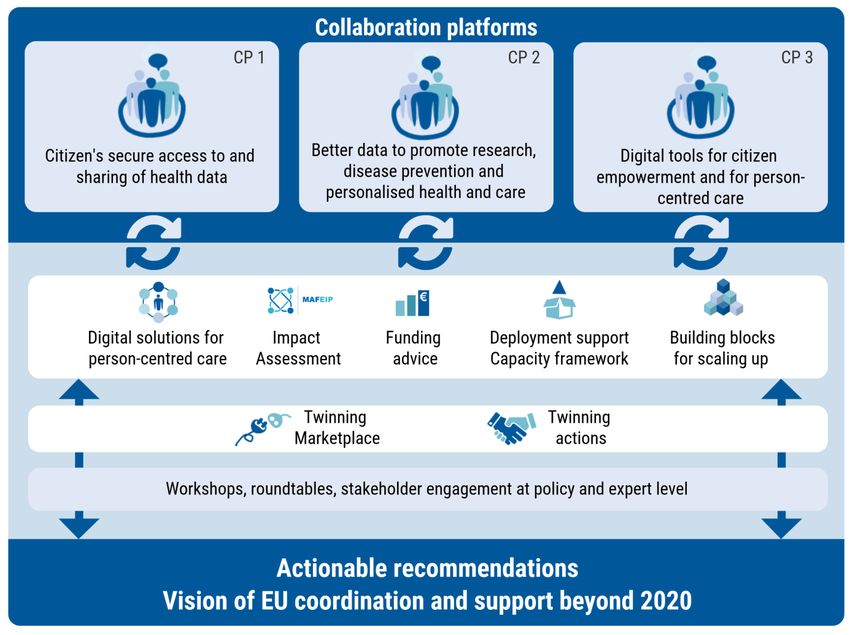
DigitalHealthEurope– Request for Twinning Tenders 2020

                                                             TABLE OF CONTENTS
1      Introduction and purpose of Twinnings .......................................................................................................... 3
    1.1    The European Commission’s Communication on enabling the digital transformation of health
    and care ..................................................................................................................................................................... 3
    1.2          DigitalHealthEurope’s role in supporting the objectives of the Communication ......................... 4
    1.3          The DigitalHealthEurope Twinning Programme ................................................................................. 5
    1.4          Collaboration with the 2020 edition of the EIP on AHA twinning scheme .................................. 6
    1.5          Expected Digital Solutions to be covered by Twinnings ................................................................... 7
    1.6          Twinning Types .......................................................................................................................................... 9
    1.7          Twinning marketplace .............................................................................................................................. 9
    1.8          Funding budget and budget distribution .............................................................................................. 9
    1.9          Twinning calendar ................................................................................................................................... 10
    1.10         Twinning outputs..................................................................................................................................... 11
2      Information on tendering ................................................................................................................................. 13
    2.1          General information and objectives .................................................................................................... 13
    2.2          Contractual conditions ........................................................................................................................... 13
    2.3          Content of the tender and submission process ................................................................................ 14
    2.4          Other tender conditions ......................................................................................................................... 16
3      Evaluation and award ....................................................................................................................................... 17
    3.1          Exclusion, selection and compliance criteria ...................................................................................... 17
    3.2          Award criteria ........................................................................................................................................... 20
    3.3          Ranking of twinning tenders ................................................................................................................. 21
    3.4          Evaluation process .................................................................................................................................. 21
4      Glossary ............................................................................................................................................................... 23

                                                                   LIST OF FIGURES
Figure 1. EC infographic on the transformation of health care in the Digital Single Market ....................... 4
Figure 2. Overview of DigitalHealthEurope activities .......................................................................................... 5
Figure 3. Overview of DigitalHealthEurope twinning concepts ........................................................................ 6
Figure 4. Twinning Types in DigitalHealthEurope ................................................................................................ 9

                                                                     LIST OF TABLES
Table 1. DigitalHealthEurope Call for Twinning Tenders funding framework .............................................. 10
Table 2. Twinning calendar ...................................................................................................................................... 10
Table 3. Twinning outputs expected per twinning type .................................................................................... 11
Table 4. Overview of exclusion, selection and compliance criteria ................................................................. 17
Table 5. Twinning award criteria ............................................................................................................................ 20
Table 6. Award criteria points system ................................................................................................................... 21

                                                                               Page 2 of 23
DigitalHealthEurope– Request for Twinning Tenders 2020
1 Introduction and purpose of Twinnings
1.1 The European Commission’s Communication on enabling
the digital transformation of health and care
The Digital Single Market (DSM) Strategy of the European Commission1, backed up by its mid-
term review in May 20172, recognised the beneficial role of digital technologies in transforming
today’s world, especially in several key policy areas, including health and care3.
In line with the DSM Strategy, the Council of the European Union adopted a set of conclusions
on digital health4 in December 2017, inviting Member States and the Commission to work
together to seize the potential offered by digital technologies in health and care. In response,
the European Commission also published a Communication on “enabling the digital
transformation of health and care in the Digital Single Market; empowering citizens and building
a healthier society”5 (referred to hereafter as the Communication). The vision outlined in the
Communication is to promote health, prevent and control disease, help address patients' unmet
needs and make it easier for citizens to have equal access to high quality care through the meaningful
use of digital innovations. It will also strengthen the resilience and sustainability of Europe’s health
and care systems. The Communication also lays out European Union (EU) actions in three
priority areas (from here on called “priorities”) to be followed in the coming years:
► citizens’ secure access to and sharing of health data across borders - enabling citizens to
access their health data across the EU;
► better data to advance research, disease prevention and personalised health and care -
allowing researchers and other professionals to pool resources (data, expertise, computing
processing and storage capacities) across the EU;
► digital tools for citizen empowerment and person-centred care - using digital tools to
empower people to look after their health, stimulate prevention and enable feedback and
interaction between users and healthcare providers.
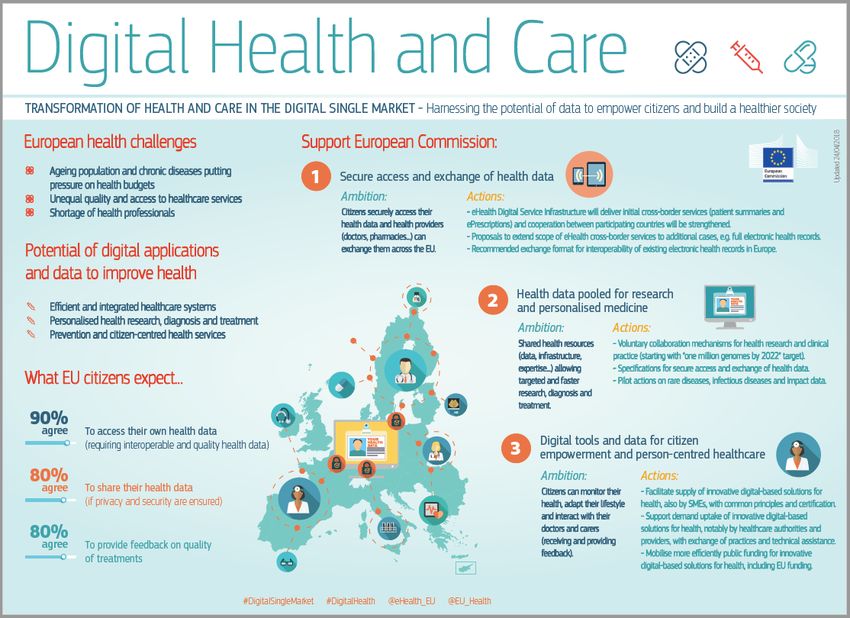
The main purposes of this important policy document and its three key priorities are outlined
in Figure 1. Various key initiatives have already started to take concrete action and address
different aspects of these priorities, but these key initiatives do need to work together in order
to boost the envisioned digital transformation of health and care (DTHC). This includes joining
up their efforts on research and innovation (in line with activities supported by Horizon2020
(H2020)) as well as political coordination, stakeholder mobilisation, deployment and uptake of
digital solutions for health and care. Sections 1.2 and 1.3 briefly outline the role of the
DigitalHealthEurope project and its Twinning programme in addressing these challenges and
supporting the objectives and priorities outlined above.
1
COM(2015) 192 final, Brussels, 6.5.2015
http://europa.eu/rapid/attachment/IP-15-4919/en/DSM_communication.pdf
2
COM(2017) 228 final, Brussels, 10.5.2017
https://ec.europa.eu/transparency/regdoc/rep/1/2017/EN/COM-2017-228-F1-EN-MAIN-PART-1.PDF
3
Transformation of Health and Care in the Digital Single Market:
https://ec.europa.eu/digital-single-market/en/policies/ehealth
4
14078/17 SAN 399 TELECOM 272 DATAPROTECT 177, Brussels, 28.11.2017
http://data.consilium.europa.eu/doc/document/ST-14078-2017-INIT/en/pdf
5
COM(2018) 233 final, Brussels, 25.04.2018
https://ec.europa.eu/health/sites/health/files/ehealth/docs/com2018_233_en.pdf
Page 3 of 23DigitalHealthEurope– Request for Twinning Tenders 2020
Figure 1. EC infographic on the transformation of health care in the Digital Single Market
1.2 DigitalHealthEurope’s role in supporting the objectives of
the Communication
DigitalHealthEurope is a Coordination and Support Action funded by the European Commission
(EC) under the H2020 programme, with Grant Agreement No. 826353. The project is
coordinated by empirica Technology Research and comprises 17 partners from across Europe.
It runs from January 2019 to December 2020.
DigitalHealthEurope provides comprehensive, integrated and centralised support to initiatives
on digital health and care innovation in the context of the DSM Strategy. The project's approach
involves actions that will boost innovation and advance the Communication’s three overall
priorities for the digital transformation of health and care, as described in the previous section.
To achieve these three priorities, the project work plan offers two forms of support:
Support to large scale deployment of digital solutions for person-centred care
DigitalHealthEurope's main objective is to facilitate the deployment of digital solutions for
person-centred care. Assessment tools will be used to identify, analyse and select successful
initiatives which are highly impactful and replicable, can be easily adapted to different contexts,
and which can benefit from further support, such as providing structured advice on EU funding
instruments and financing sources.
The selected initiatives will have the opportunity to pursue replication and scaling-up. This will
be done with the aid of instruments such as twinning matchmaking via a marketplace and the
Twinning Programme presented in this document.
Page 4 of 23DigitalHealthEurope– Request for Twinning Tenders 2020
Insights from the initiatives and from the twinning actions will contribute to a centralised
deployment support service which will include guidelines, checklists and documented
successful approaches.
These results will contribute to capacity building of Twinning Adopter(s) and elaboration of
useful resources (“building blocks”) for the scaling-up of innovative practices - new resources
that will be available to the various stakeholders engaged in scaling up digital tools for person-
centred care. The aim is to encourage even wider uptake of twinned digital innovation and
assimilate lessons learned.
Support to DTHC innovation through collaboration with key stakeholders
DigitalHealthEurope will also facilitate the creation of a collaboration platform that directly
addresses the three priorities for the digital transformation of health and care. It can be
considered as a multi-stakeholder community.
The outcomes will include collaboration agreements, the drafting of a common agenda and
actionable recommendations that guide and inform decisions pursued at the policy level.
Figure 2. Overview of DigitalHealthEurope activities
1.3 The DigitalHealthEurope Twinning Programme
In DigitalHealthEurope, the twinning programme is a support mechanism for scaling up
innovative digital solutions. Twinnings are used as a mechanism for accelerating fulfilment of
the Communication’s priorities, by enabling the transfer of innovative solutions from one
European region or country to another. An overview of the twinning concepts is outlined in
Figure 3.
Page 5 of 23DigitalHealthEurope– Request for Twinning Tenders 2020
The approach has been successfully applied in a number of EU projects and studies, including
the ScaleAHA study6, which funded 20 twinnings. The region/country with the innovative
practice is called a Twinning Originator, and the implementing region/country is referred to as
a Twinning Adopter. There can be more than one Twinning Adopter per twinning. In some
cases, third parties may be involved, e.g. as an external facilitator or as tenderer/Twinning
Contractor. Every Twinning Adopter must be in the European Union.
Interested organisations and individuals will first exchange ideas on twinning solutions which
they can offer or would like to adopt. A twinning marketplace has been set up by
DigitalHealthEurope to facilitate the matchmaking process. Potential Twinning Originators can
post information about their available twinning solutions, and those wishing to be Twinning
Adopters can specify their solution requirements.
The outputs of the twinning are expected to inform key work areas of DigitalHealthEurope,
such as elaboration of policy recommendations and development of useful resources (“building
blocks” for scaling up innovative solutions). These are a crucial part of the capacity building of
European health and care institutions.
DigitalHealthEurope
Facilitator
€
Funding
advice
Twinning candidates Deployment
Building blocks Support
for scaling up
Adopter(s) Originator
Marketplace Capacity building
digitalhealtheurope.eu
DigitalHealthEurope Twinnings
Figure 3. Overview of DigitalHealthEurope twinning concepts
Twinning Activities may include, for example, hosting meetings, organising technical groups,
travelling, acquiring licenses, paying fees for professional services. Twinnings typically last up
to ten months, depending on complexity and Twinning Type.
A first twinning scheme was launched by DigitalHealthEurope in summer 2019, the results of
which can be found here: https://digitalhealtheurope.eu/twinnings/digitalhealtheurope-call-
for-twinnings-june-august-2019.html
1.4 Collaboration with the 2020 edition of the EIP on AHA
twinning scheme
Building on the ScaleAHA twinnings, the European Innovation Partnership on Active and
Healthy Ageing (EIP on AHA) launched a first twinning scheme in 2019 concretely focusing on
supporting the Communication objectives in the domain of active and healthy ageing.
6
http://www.scale-aha.eu/home.html
Page 6 of 23DigitalHealthEurope– Request for Twinning Tenders 2020
The EIP on AHA 2020 twinning scheme edition has teamed up with DigitalHealthEurope to
amplify the synergies of the two initiatives and provide a joint twinning scheme, focusing on an
EIP on AHA twinning strand part of this Request for Twinning Tenders.
This strand targets EIP on AHA Reference Sites - regional organisations that are engaged in the
works of the EIP on AHA by means of “Individual Commitments” or "Collaborative
Commitments" and holding Reference Site status as a result of the 2019 call. Twinnings in
DigitalHealthEurope and EIP on AHA
This section outlines what types of digital solutions might be expected to be covered by the
tenders for twinnings; what types of twinnings exist; the twinning marketplace and its role; the
overall funding budget and distribution; and the twinning outputs.
1.5 Expected Digital Solutions to be covered by Twinnings
The innovative digital solutions whose adoption in a new region can be supported through
DigitalHealthEurope twinnings must be related to one or more of the three priorities defined
in the Communication, namely:
► citizens’ secure access to and sharing of health data across borders
► better data to advance research, disease prevention and personalised health and care
► digital tools for citizen empowerment and person-centred care.
A tender for twinning (i.e., an application made by a tenderer) must specify the twinning
solution(s) to be addressed and how it relates to one or more of the overall priorities.
Twinning Solutions are the digital know-how which is transferred through the twinning activities
to the Twinning Adopter. They may be products, services, processes, methodologies, strategies
and/or business models. The topics must be based on digital technologies. They must be
innovative7 and should not have been used in the adopting region(s) before the twinning takes
place.
The following three non-exhaustive lists relate to each of the three priorities stated in the
Communication. They serve to provide guidance to tenderers on what topics the proposed
twinnings are expected to address. The lists name between 7-20 different digital solutions. The
lists do not preclude submission of proposed twinnings relating to other topics linked to the
three priorities.
Note: the three priorities are numbered for ease of reference. No prioritisation of the importance
of the digital solutions listed is implied within or across the three priorities.
Priority 1: Citizens' secure access to and sharing of health data across borders
► Citizens' secure access to their health data - e.g., via secure online portal, citizen’ access to
an Electronic Health Record (EHR), a Personal Health Record (PHR) incl. telemonitoring data
and shared with health professionals
► Interoperable electronic health records deployed at national and regional level enabling
citizens' secure access to and sharing of health data; General Data Protection Regulation
(GDPR) compliant, secure health data exchange
► Citizen-enabled sharing of health data across borders: patient summary and/or
ePrescription, discharge letter, medical images, lab results
► Citizen-controlled data governance, health data cooperatives, health data donation
7
Innovation here is used to refer to a product, service, process, methodology, strategy, business model as described in
https://ec.europa.eu/growth/industry/innovation_en. For the novelty aspect of innovations, please refer to the definition
here: https://ec.europa.eu/eurostat/statistics-explained/index.php/Glossary:Innovation
Page 7 of 23DigitalHealthEurope– Request for Twinning Tenders 2020
► Other: please specify
Priority 2: Better data to promote research, disease prevention and
personalised health and care
► Digital infrastructure for personalised medicine, -omics databanks, biomedical
infrastructures
► Good practice in digital genomics, incl. whole genome sequencing
► Use of real-world data (RWD), data quality assessment and improvement
► Health data analytics (Artificial Intelligence, algorithm development and calibration, machine
learning, risk stratification tools, etc.)
► Big data analysis, particularly for preventive medicine and treatment
► Health data donation, public preference models on data use for research
► Interoperability of disease registries including for rare diseases, data aggregation and sharing
across borders, incl. at EU level
► Digital tools for public health, epidemiology, pharmacovigilance, clinical research, incl. reuse
of EHRs for clinical research
► Other: please specify
Priority 3: Digital tools for citizen empowerment and for person-centred care
Citizen/patient-focused solutions:
► Digital tools to support health education (health literacy), digital health literacy
► mHealth systems, wearable devices for monitoring and prevention, alerts, reminders
► Digital tools to support patient feedback and reporting of outcomes and experiences
► Digital tools to support proactive prevention, self-management, homecare, telemonitoring
► Tele-mentoring/coaching, virtual consultations, virtual coach, personal assistant
► ICT supporting adherence to medication and care plans
► Robotics (e.g., companion robots)
► Tools and services supporting independent living, ambient assisted living technologies,
telecare
► Other: please specify
Care practitioners’ solutions
► Advanced digital tools to support Integrated Care, including integration of health and social
care services
► Interoperable digital solutions to support person-centred and integrated care
► Regional and national Electronic Health Record (EHR) systems and ePrescription solutions
enabling person-centred care
► Regional, national and local Electronic Integrated Care Record (EICR) systems, integration of
EHR and social care records
► Digital shared care plan (e.g., support to multi-disciplinary team(s))
► Decision support for multi-morbidity and polypharmacy management
► ICT support for management of frailty
► ICT support for falls prevention
► eLearning to support workforce development for person-centred integrated care
► Other: please specify
Page 8 of 23DigitalHealthEurope– Request for Twinning Tenders 2020
1.6 Twinning Types
Twinnings can be grouped into three types. They range from knowledge exchange to adoption
(whether partial or full) of the transferred solution. The different twinning types require
different forms of funding, have different deployment time frames and need different experts.
► Knowledge exchange and training: This type of twinning mainly targets local authorities
which do not have much experience with EU networking but are eager to learn from
experiences in other parts of Europe. The twinning is seen as a first step to discuss a concrete
solution (product, service, methodology) and how it can be transferred to the adopting
region(s). The capacity needed is built during the twinnings. This includes identification of
appropriate staff, setting up a process roadmap, defining expected outcomes, etc.
► Partial adoption: Twinnings that undertake partial adoption of a digital solution will have to
provide concrete evidence on impact of the adoption, as well as the reasons why a full
adoption is not possible (e.g. different healthcare systems, organisational differences,
reimbursement issues, etc.).
► Full adoption: This type of twinning mainly targets local authorities with well established
relations with other authorities in Europe (e.g. through memorandums of understanding,
past EU project partnerships, etc.), that have already planned collaboration on a specific
topic/solution and have made first steps, such as adaptation. The twinning aims to achieve
a full adoption of the solution in the adopting region(s) using local infrastructure (including
adaptation) or the Twinning Originator’s infrastructure.
Knowledge
exchange & training,
Focus on knowledge (know-how) exchange and training,
digital skills a central aspect of the innovation are the required staff
skills
Partial adoption Elements or aspects of the innovation (product, service,
methodology, strategy) are being implemented using
locally available infrastructure
Full adoption The innovation (product, service, methodology,
strategy) is being implemented in its full scope by using
the originator’s or local infrastructure i.e. the innovation
is transferred and managed fully by the adopter
Figure 4. Twinning Types in DigitalHealthEurope
1.7 Twinning marketplace
To facilitate the forming of twinnings, DigitalHealthEurope offers an online twinning
marketplace. On it, Twinning Originators can post information about their available Twinning
Solutions, and Twinning Adopters can specify their requirements, enabling matchmaking and
preparation of a twinning tender.
The twinning marketplace can be accessed via https://digitalhealtheurope.eu/twinnings.html.
Participation in the marketplace is not a prerequisite for participation in this call. Nevertheless,
potential twinning tenderers are encouraged to use the service so as to ensure the greatest
possible transparency and openness about twinning availability throughout Europe.
1.8 Funding budget and budget distribution
The total budget for all twinnings to be funded in this call is €399,000.
Page 9 of 23DigitalHealthEurope– Request for Twinning Tenders 2020
Twinning contracts will be awarded based on the available budget, i.e. contracts will be awarded
until the remaining budget is insufficient to fund the next best twinning tender that has passed
the evaluation threshold. The exact number of twinnings finally awarded will thus depend on
the prices offered and the number of twinning tenders that pass the evaluation.
The maximum allowed budgets for each twinning type are specified in Table 1, which outlines
the distribution of the budget across the three types of twinnings.
Note that the maximum allowed for Twinning Subcontracting is not additional: it should be
included in the maximum cost of one twinning.
Table 1. DigitalHealthEurope Call for Twinning Tenders funding framework
Maximum cost Maximum for the
Expected
of one twinning category of
Twinning type no. of
for all three Twinning
twinnings
cost categories Subcontracting
Knowledge exchange & training, digital skills 13 €5,000 0
Partial adoption 7 €17,000 €12,000
Full adoption 5 €43,000 €22,500
In addition to the DigitalHealthEurope Call for Twinnings, the EIP on AHA twinnings call is
expected to fund up to 5 twinnings with up to €5,000. The EIP on AHA twinning call follows
different requirements and deadlines, documented in a dedicated call available at
https://ec.europa.eu/eip/ageing/news/eip-aha-twinnings-2020-receive-%E2%82%AC-5000-
facilitate-deployment-large-scale-innovative-digitally_en.
1.9 Twinning calendar
Table 2 presents the planned twinning calendar. If for any reason changes to dates or activities
are required, the call documents will be updated at digitalhealtheurope.eu.
Table 2. Twinning calendar
Date Activity
26.02.2020 Publication of the Call for Twinning Tenders documents on digitalhealtheurope.eu
12.03.2020 Webinar 1 for tenderers (expected date)
08.04.2020 Webinar 2 for tenderers (expected date)
10.04.2020 Deadline for questions by tenderers
04.05.2020 Deadline for submission of twinning tenders
22.05.2020 Award decision and notification
June 2020 Twinning Contracting
01.07.2020 Start of twinning activities for all twinning types (= M1)
31.12.2020 End of twinning activities for “Knowledge exchange and training”
28.02.2021 End of twinning activities for “Partial adoption”
Page 10 of 23DigitalHealthEurope– Request for Twinning Tenders 2020
30.04.2021 End of twinning activities for “Full adoption”
Note: All work related to a twinning shall be completed at the latest one month before end of the
DigitalHealthEurope Grant Agreement.
During the twinning, twinning participants will be expected to attend two webinars organised
by DigitalHealthEurope focusing on capacity building.
Questions about the Request for Twinning Tenders can be submitted in English to
twinnings@digitalhealtheurope.eu within the deadlines specified in the time schedule.
The summary of all questions and answers posed will be presented in an anonymised question
and answer (Q&A) document that will be published on the www.digitalhealtheurope.eu portal
in the English language or sent to the persons who have downloaded the tender documents.
Unless otherwise instructed, do not use any other contact email address or contact any other
persons in connection with this Request for Twinning Tenders.
1.10 Twinning outputs
Table 3 describes the objectives of the twinnings, their associated output and the tasks to be
carried out (i.e., milestones and deliverables) for each twinning type.
Table 3. Twinning outputs expected per twinning type
Knowledge exchange & training, digital skills
To pursue knowledge exchange and training activities in which the Twinning
Originator shares relevant knowledge and skills with Twinning Adopter(s) on a
Objectives Twinning Solution new to the Adopter(s), leading to improved capacity of the
Twinning Adopter(s) to address the topic in a better, more informed way in their
respective region(s).
The Twinning Adopter(s) is/are enabled to address the twinning topic in its/their
region(s), including developing and applying a concrete plan of action informed by
Output
the twinning experiences on how the acquired knowledge is used to tackle the topic
during and beyond the twinning duration.
Milestones and deliverables By when? How? Output
Updated workplan taking
Sent by email to
D1.1 Twinning inception report M2 into account any evaluation
Acting Procurer
comments
Twinning interim report
Sent by email to Report template provided by
D1.2 and publishable interim M4
Acting Procurer Acting Procurer is completed
summary
Twinning final report and Sent by email to Report template provided by
D1.3 M6
final publishable summary Acting Procurer Acting Procurer is completed
Partial adoption
To implement a mature innovation owned by the Twinning Originator by taking
innovative elements or aspects of it and using them to develop new or improve
Objectives
existing local solutions (product, service, process, methodology, strategy, business
model) enabling the innovation to be used in the Twinning Adopter regions(s).
The Twinning Adopter(s) is/are enabled to implement innovative elements or
aspects of the Twinning Originator’s innovation into new or existing local solutions,
Output
with the latter being actively used by their intended audiences at the end of the
twinning.
Page 11 of 23DigitalHealthEurope– Request for Twinning Tenders 2020
Milestones and deliverables By when? How? Output
Updated workplan taking
Sent by email to
D1.1 Twinning inception report M2 into account any evaluation
Acting Procurer
comments
Twinning interim report
Sent by email to Report template provided by
D1.2 and publishable interim M5
Acting Procurer Acting Procurer is completed
summary
Twinning final report and Sent by email to Report template provided by
D1.3 M8
final publishable summary Acting Procurer Acting Procurer is completed
Full adoption
To implement a mature innovation owned by the Twinning Originator in its full scope
Objectives in a new or existing solution, enabling the innovation to be used in the Twinning
Adopter regions(s).
The Twinning Adopter(s) is/are enabled to implement in full the Twinning
Output Originator’s innovation into new or existing local solutions, with the latter being
actively used by their intended audiences at the end of the twinning.
Milestones and deliverables By when? How? Output
Updated workplan taking
Sent by email to
D1.1 Twinning inception report M2 into account any evaluation
Acting Procurer
comments
Twinning interim report
Sent by email to Report template provided by
D1.2 and publishable interim M6
Acting Procurer Acting Procurer is completed
summary
Twinning final report and Sent by email to Report template provided by
D1.3 M10
final publishable summary Acting Procurer Acting Procurer is completed
Shared with
Video showcasing the
Acting Procurer
D1.4 Promotional video M10 adopted solution (max. 5
via suitable cloud
minutes in length)
application
Page 12 of 23DigitalHealthEurope– Request for Twinning Tenders 2020
2 Information on tendering
This section includes general information on the objectives of the tendering process and
tenderer conditions.
2.1 General information and objectives
The focus of twinning is on local, regional and national health and care providers in Europe that
wish to adopt innovative solutions which are available for transfer from another local, regional
and national health and care provider in Europe.
Twinning activities must involve the transfer of digital know-how to at least one Twinning
Adopter region from another region or organisation (Twinning Originator). Twinning Originator
and Twinning Adopter(s) must be from different countries.
An organisation may participate in more than one twinning tender, so long as the twinning
solutions and the twinning activities are both significantly different.
2.2 Contractual conditions
A twinning tender must be submitted by a single organisation willing to become Twinning
Contractor. A Twinning Contractor can be a Twinning Originator, a Twinning Adopter region or
a Third Party. Successful tenderers will be offered a Twinning Contract by the Acting Procurer8.
To conform to Commission rules on the size of overall subcontracting in the
DigitalHealthEurope project, support to twinning activities is provided in three categories of
cost, associated with different contractual and payment procedures. In particular, support can
be requested for those costs which can be invoiced directly to the Acting Procurer and which
conform to the H2020 eligibility rules for the categories entitled "personnel" and "other direct
costs". These cost categories are referred to as Twinning Personnel and Twinning Direct Costs
respectively. The details of each contractual condition are outlined below.
Twinning Personnel
For Twinning Personnel, the Twinning Contractor must provide, in the tender application, the
details of individuals foreseen to contribute to its twinning activities and be able to conclude a
contract directly with the Acting Procurer9. Contracts with Twinning Personnel, see the details
of TD5 outlined in section 3.3, are designed to conform to the Horizon 2020 eligibility rules for
personnel of the Acting Procurer. The qualifications and experience of each proposed individual
must be given in the tender along with the proposed day rate. Day rates must be accepted by
the Commission as eligible for personnel directly contracted by the Acting Procurer. Day rates
of up to € 800 for qualified and experienced personnel may be acceptable. If individuals cannot
be named as they have not yet been identified, sufficient details must be provided to show an
individual’s role and contribution along with a description of how and when the individual is to
be recruited.
Twinning Direct Costs
For Twinning Direct Costs, tenderers may request funds to meet costs such as travel costs and
other costs which can be invoiced to the Acting Procurer, conforming to Horizon 2020 eligibility
rules for the Acting Procurer's use of this cost category in financial submissions.
8
Acting Procurer is empirica Gesellschaft für Kommunikations- und Technologieforschung mbH, co-ordinator of the
DigitalHealthEurope project with Grant Agreement Nr. 826353
9
A direct contract between each individual concerned and the Acting Procurer must be put in place. The contract cannot be
with an organisation.
Page 13 of 23DigitalHealthEurope– Request for Twinning Tenders 2020
Many service contracts and contracts for software development may not qualify as Twinning
Direct Costs. Capital expenditure is not possible, the leasing of capital equipment may be an
option if the cost of leasing is less than or equal to the depreciation of the capital cost.
Twinning Subcontracting
Twinning Contracts can be used directly to cover payment for the third category, for items in
the cost category "Twinning Subcontracting". Twinning Subcontracting is a fixed sum due on
completion of the twinning activities and acceptance of the invoice for funding by the
Commission. Twinning Subcontracting can cover not only subcontracting taking place for the
twinning itself, but also other costs incurred by Originator and Adopter(s) which cannot be
invoiced directly to the Acting Procurer either as Twinning Personnel or Twinning Direct Costs.
Twinning Subcontracts will contain appropriate verification of these costs and a payment plan
will be aligned to the acceptance of twinning deliverables by the project and invoices by the
Commission. An outline contract is provided as TD4.
Proper implementation of Twinning Contracts will be monitored periodically and reviewed
against the expected outcomes (deliverables, milestones, output or results). Each Twinning
Contractor will be assigned a main contact person and supervisor from among the
DigitalHealthEurope partners.
2.3 Content of the tender and submission process
Twinning tenderers shall submit twinning tenders electronically no later than the dates
specified in the twinning calendar. They should take full account of all the tender documents
which must be downloaded from the project website https://digitalhealtheurope.eu/ after
completion of a short online identification form.
List of tender documents:
► TD0 – Request for Twinning Tenders (this document)
► TD1 – Tender application template – Administrative section
► TD2 - Tender application template – Technical section
► TD3 - Tender application template – Financial section
► TD4 –Twinning Contract (draft subcontracting agreement with Acting Procurer)
► TD5 –Twinning Personnel Contract (draft contract with Acting Procurer)
Note: TD4 and TD5 may need to be further adapted to Horizon 2020 eligibility rules.
The following documents must be submitted as part of the tender: TD1, TD2, TD3.
An email must be sent to twinnings@digitalhealtheurope.eu by the deadline specified in the
time schedule. The email must contain three searchable PDF attachments, clearly named (e.g.
DHE_TD1_NameOfTwinning.pdf)
Any questions on the request for tender, tender documents or tendering process must be sent
to twinnings@digitalhealtheurope.eu before the deadline set in the timeline in this document.
Tenders that do not comply with the formal requirements described in this section will be
rejected.
Tender templates
The tender application templates must be used when preparing the tender.
Administrative section
1. The legal entity form must be provided by the Twinning Contractor. Example forms are
available at https://ec.europa.eu/info/publications/legal-entities_en.
Page 14 of 23DigitalHealthEurope– Request for Twinning Tenders 2020
The Twinning Originator and at least one Twinning Adopter must also provide a completed
legal entity form.
2. Exclusion criteria apply. The exemption of the tenderer to any of the exclusion grounds
contained in section 4.1 of this document shall be proven by means of the types of evidence
referred to in that section.
3. The fulfilment of the tenderer of the selection criteria contained in section 4.1 of this
document shall be proven by means of the types of evidence referred to in that section.
4. The fulfilment of the tenderer to the compliance criteria contained in section 4.1 of this
document shall be proven by means of the types of evidence referred to in that section.
5. The documentation to be included in the administrative section must be submitted in the
English language.
Tenderers may be requested to provide additional information and/or evidence.
Technical section
The twinning tender must include a detailed technical offer which describes the three
categories of excellence, impact and implementation of the proposed twinning. The technical
section has a page limit according to Twinning Type.
Further details are available in the Technical tender template.
Financial section
The twinning tender must include a detailed financial offer broken down into binding prices
according to the categories: Twinning Personnel, Twinning Direct Costs and Twinning
Subcontracting. The total of the three categories of cost may not exceed the maximum for the
proposed Twinning Type, and the total of the Twinning Subcontracting category may not
exceed the maximum set - see Table 1.
► Twinning Personnel
For Twinning Personnel, details of each individual foreseen to contribute to twinning
activities and able to conclude a contract directly with the Acting Procurer must be provided.
The qualifications and experience of each proposed individual must be given along with the
number of person-hours due to be worked and the fee per hour. For individuals who cannot
be named, sufficient details must be provided.
► Twinning Direct Costs
For Twinning Direct Costs, details of each item or type of item, each set of travel plans etc.
and other costs which can be invoiced to the Acting Procurer and conform to Horizon
eligibility rules.
► Twinning Subcontracting
Any work to be subcontracted must be clearly described, as must each item of other cost
for which funding is requested. Costs which meet the criteria for Twinning Personnel or
Twinning Direct Costs may not be included in this category. The maximum identified for
subcontracting in Table 1 may not be exceeded.
Page 15 of 23DigitalHealthEurope– Request for Twinning Tenders 2020
2.4 Other tender conditions
Confidentiality
Tenderers must keep confidential any information obtained in the context of the tender
procedure (including EU-classified information10).
Language
Tenders, as well as outcomes in the form of deliverables must be submitted in English.
The twinning language is English and the twinning contract must be signed in its English version.
Communication (relating to either the tender procedure or the implementation of the twinning
contract) must be carried out in English.
With the submission of their tender applications, twinning tenderers accept these
requirements.
Cancellation of the tender procedure
The Acting Procurer may, at any moment, cease to proceed with the tender procedure and
cancel it. The Acting Procurer reserves the right not to award any contracts at the end of the
tender procedure. The Acting Procurer is not liable for any expense or loss the twinning
tenderers may have incurred in preparing their application.
10
Commission Decision 2015/444/EC, Euratom of 13 March 2015 on the security rules for protecting EU-classified
information
Page 16 of 23DigitalHealthEurope– Request for Twinning Tenders 2020
3 Evaluation and award
This section outlines the various exclusion criteria pertinent to a tender; the award criteria and
their maximum thresholds; the ranking of twinning tenders; and the selection process
3.1 Exclusion, selection and compliance criteria
Table 4. Overview of exclusion, selection and compliance criteria
Criteria type Definition Evidence
A) Conflict of interest
Exclusion B) Exclusion grounds as defined in Directive 2014/24/EU of
the European Parliament and of the Council of 26 February
2014
Selection C) Ability to perform the twinning activities Administrative
section
D) Compliance with the scope of the twinning call, including
conformance with the definition of twinning solutions as
defined in section 2.1
Compliance
E) Compatibility with other public financing
F) Compliance with ethics and security requirements
A) Conflict of Interest
A tenderer who is subject to a conflict of interest may be excluded. If there is a potential conflict
of interest, a tenderer must immediately notify the Acting Procurer in writing.
A conflict of interest is any situation where the impartial and objective implementation of the
evaluation of tenders and/or implementation of the Twinning Contract is compromised for
reasons relating to economic interests, political or national affinity, family, personal life (e.g.
family of emotional ties) or any other shared interest.
Note: If an actual or potential conflict of interest arises at a later stage (i.e. during the
implementation of the Twinning Contract), the contractor must contact the Acting Procurer, who
will notify the EC and take steps to rectify the situation. The EC may verify the measures taken
and require additional information to be provided and/or further measures to be taken.
B) Exclusion grounds as defined in Directive 2014/24/EU of the European
Parliament and of the Council of 26 February 2014
Grounds relating to criminal convictions
A tenderer will be excluded if it has been the subject of a conviction by final judgement for one
of the following reasons:
► Participation in a criminal organisation, as defined in Article 2 of Council Framework
Decision 2008/841/JHA;
► Corruption, as defined in Article 3 of the Convention on the fight against corruption
involving officials of the European Communities or officials of Member States of the
European Union and Article 2 of Council Framework Decision 2003/568/JHA (34), as
well as corruption as defined in the national law of the lead procurer or the economic
operator;
Page 17 of 23DigitalHealthEurope– Request for Twinning Tenders 2020
► Fraud within the meaning of Article 1 of the Convention on the protection of the
European Communities' financial interests;
► Terrorist offences or offences linked to terrorist activities, as defined in Articles 1 and 3
of Council Framework Decision 2002/475/JHA, respectively, or inciting or aiding or
abetting or attempting to commit an offence, as referred to in Article 4 of the aforesaid
Framework Decision;
► Money laundering or terrorist financing, as defined in Article 1 of Directive 2005/60/EC
of the European Parliament and of the Council;
► Child labour and other forms of trafficking in human beings as defined in Article 2 of
Directive 2011/36/EU of the European Parliament and of the Council.
The obligation to exclude a tenderer shall also apply where the person convicted by final
judgement is a member of the administrative, management or supervisory body of that tenderer
or has powers of representation, decision or control therein.
Grounds relating to the payment of taxes or social security contributions
A tenderer shall be excluded from participation in the twinning where the Acting Procurer is
aware that the tenderer is in breach of its obligations relating to the payment of taxes or social
security contributions, and where this has been established by a judicial or administrative
decision having final and binding effect in accordance with the legal provisions of the country
in which it is established or with those of the country of the Acting Procurer.
Furthermore, the Acting Procurer may exclude from participation a tenderer where the Acting
Procurer can demonstrate by any appropriate means that the tenderer is in breach of its
obligations relating to the payment of taxes or social security contributions.
This paragraph shall no longer apply when the tenderer has fulfilled its obligations by paying or
entering into a binding arrangement with a view to paying the taxes or social security
contributions due, including, where applicable, any interest accrued or fines.
Grounds of insolvency or professional misconduct
The Acting Procurer may exclude a tenderer in any of the following situations:
► Where the tenderer is bankrupt or is the subject of insolvency or winding-up proceedings,
where its assets are being administered by a liquidator or by the court, where it is in an
arrangement with creditors, where its business activities are suspended or it is in any
analogous situation arising from a similar procedure under national laws and regulations;
► Where the Acting Procurer can demonstrate by appropriate means that the tenderer is guilty
of grave professional misconduct, which renders its integrity questionable;
► Where the Acting Procurer has sufficiently plausible indications to conclude that the
tenderer has entered into agreements with other economic operators with the intention of
distorting competition;
► Where a conflict of interest cannot be effectively remedied by other less intrusive measures;
► Where a distortion of competition from the prior involvement of the tenderer in the
preparation of this twinning procedure cannot be remedied by other, less intrusive
measures;
► Where the tenderer has shown significant or persistent deficiencies in the performance of a
substantive requirement under a prior public contract, a prior contract with a contracting
entity or a prior concession contract which led to early termination of that prior contract,
damages or other comparable sanctions;
► Where the tenderer has been guilty of serious misrepresentation in supplying the
information required for the verification of the absence of grounds for exclusion or the
fulfilment of the selection criteria.
Page 18 of 23DigitalHealthEurope– Request for Twinning Tenders 2020
Where the tenderer has undertaken to unduly influence the decision-making process of the
Acting Procurer, to obtain confidential information that may confer upon it undue advantages
in the procurement procedure, or to negligently provide misleading information that may have
a material influence on decisions concerning exclusion, selection or award.
C) Ability to perform the Twinning Activities
This criterion is evaluated on a pass/fail basis. “Fail” means that the evidence given does not
provide sufficient indication of the tenderer’s expertise, ability and/or equipment to meet
twinning objectives. Any tender that cannot meet the selection criteria requirements will not
be selected.
To measure this criterion, tenderers are asked to provide the following information (as part of
the twinning tender):
► Brief description of relevant references and /or previous projects
► Demonstrate the expertise and working experience required to carry out the twinning by
providing short curriculum vitae (CVs) of key personnel and competences necessary to
complete the twinning
Note: Tenders may be requested to provide additional information.
D) Compliance with the scope of the twinning call
Tenderers must confirm that the tender complies with the scope of twinnings as laid out in this
document, more specifically in sections 1.3, 2.1, 2.2, 2.6 and 3.1.
E) Compatibility with other public financing
Tenderers that receive public funding from other sources will be excluded if this leads to double
public financing at the time of the twinning’s implementation, or an accumulation of different
types of public financing that is not permitted by EU legislation, including EU state aid rules.
F) Compliance with ethics and security requirements
Tenders will be excluded if they:
► Do not comply with ethical principles (including the highest standards of research integrity,
notably as set out in the European Code of Conduct for Research Integrity11, and, in
particular, avoiding fabrication, falsification, plagiarism and other research misconduct
► Include plans to carry out activities that are prohibited in all Member States.
If the tender involves activities that raise ethical concerns, the tenderer must submit an ethics
self-assessment that:
► Describes how the tender meets the legal and ethical requirements of the Member State(s)
where the tasks raising ethical issues are to be carried out
► Explains in detail how the tenderer intends to address the ethical issues identified, in
particular as regards:
► Objectives (e.g. dealing with vulnerable populations and dual-use goods12)
► Methodology (e.g. involvement of children and related consent procedure and
protection of data collected)
11
The European Code of Conduct for Research Integrity of ALLEA (All European Academies) and ESF (European Science
Foundation) of March 2011.
12
See Article 2(1) EU export control Regulation No 428/2009.
Page 19 of 23DigitalHealthEurope– Request for Twinning Tenders 2020
► The potential impact (e.g. issues relating to the dual use of goods, environmental
damage, stigmatisation of particular social groups, political or financial retaliation,
benefit-sharing and malevolent use of results).
For information on ethics issues, see the guidance for EU grant beneficiaries How to complete
your ethics self-assessment.
3.2 Award criteria
A twinning tender will be evaluated against the award criteria set out here only if the tenderer
is not excluded through application of the exclusion criteria, and only if the requirements are
met in terms of the selection criteria, the compliance criteria, and the administrative instructions
are met.
Table 5 specifies maximum points and thresholds for each of the award criteria.
Table 5. Twinning award criteria
Award criteria Maximum points Threshold
Excellence of the proposed twinning
Extent to which the proposed twinning fits with the twinning
definition, scope, expected outputs and relation to the 15 10
Communication
Innovativeness from the perspective of the Adopter(s) 5 2
Maturity of solution of the Twinning Originator 5 2
Adequacy of the scale of adoption of the twinning solution
and size of the group to which knowledge is to be 15 8
transferred
Total for excellence 40 22
Impact of the proposed twinning
Value of benefits for patients 10 5
Value of benefits for the Adopter(s’) healthcare system(s) 10 5
Feasibility of scaling up 10 5
Sustainability and business case 10 5
Total for impact 40 20
Implementation of the proposed twinning
Quality and completeness of the work-plan, detail of task
and result descriptions, clarity of the description of use of
10 5
Twinning Personnel, Twinning Direct Costs and Twinning
Subcontracting (including fixed costs).
Feasibility of plan and resources to meet the objectives
10 5
specified
Total for implementation 20 10
Overall total score for twinning tender 100 52
Points will be given for each criterion, based on the following assessment table:
Page 20 of 23DigitalHealthEurope– Request for Twinning Tenders 2020
Table 6. Award criteria points system
Assessment
5-point 10-point 15-point Description
criteria criteria criteria
Insufficient (fails to address the criterion under examination or
0 0 0 the criterion cannot be judged due to missing or incomplete
information)
Poor (the criterion is addressed in an inadequate manner, or
1 2 3
there are serious inherent weaknesses)
Fair (while the criterion is broadly addressed, there are some
2 4 6
weaknesses to it)
Good (the criterion is addressed well, although improvements
3 6 9
would have been highly desirable)
Very good (the criterion is addressed well, although certain
4 8 12
improvements are still possible)
Excellent (all relevant aspects of the criterion are successfully
5 10 15
addressed; any shortcomings are minor)
3.3 Ranking of twinning tenders
Twinning tenders must score above the thresholds given, for each threshold. Tenders that do
not reach the minimum quality thresholds (individual and totals) will be rejected.
The contract will be awarded to the most economically advantageous tender, i.e. the tender
scoring above all thresholds and offering the best value for money determined in accordance
with the formula below. A weight of 70/30 is given to quality and price, respectively.
Cheapest price Total quality score Quality
Price
Score for / (out of 100) for all criteria
= * 100 * weighting + *
tender X price of tender award criteria of weighting
(30%)
X tender x (70%)
The tender ranked first after applying the formula will be offered a Twinning Contract. Twinning
Contracts will then be awarded until the remaining budget is insufficient to fund the next best
ranked twinning tender.
Should there be any doubt as to the application of any of these criteria to a tender, tenderers
may be requested to provide additional information.
3.4 Evaluation process
This section offers details about how the transparency of the evaluation process will be
maintained, how tenders will be opened, and the general process.
Ensuring transparent evaluation
Tenders will be evaluated in a non-discriminatory manner in accordance with the legal
requirements provided for in relevant provisions under European regulations.
The Acting Procurer will appoint a Twinning Evaluation Committee (TEC) consisting of experts
in the fields related to the twinning topics defined in the request for tenders. In order to ensure
fairness and transparency, the appointment of the members of the TEC and its establishment
shall take place in good time to meet the deadlines set out for the evaluation of tenders. TEC
members will be hired by the Acting Procurer. A Declaration of an absence of conflict of interest
Page 21 of 23DigitalHealthEurope– Request for Twinning Tenders 2020
and protection of confidentiality will be signed with each nominated expert. The Acting
Procurer will refuse to involve a TEC member for a given tender evaluation if a conflict of
interest is identified.
Members of the TEC are appointed in their personal capacity. When carrying out their tasks,
they shall not seek or take instructions from the Acting Procurer or from any other body.
Opening of twinning tenders and requests for clarification
The Acting Procurer will open the twinning tender files submitted by email before the deadline
and register them. The tender documents are then made available to the TEC members in an
online repository. The TEC may request clarifications about the tender documents or additional
evidence if needed, in which case the twinning tenderer concerned will be notified by the
Acting Procurer by email. The tenderer will have five calendar days (from the day of receipt of
the notification) to send the clarifications and / or evidence requested. After this deadline, if no
response is received from the tenderer, the offer will be rejected and will be excluded from the
tender evaluation. The tenderer will be informed by the Acting Procurer by email.
Evaluation of twinning tenders
The TEC will carry out the selection of twinning tenders; apply the exclusion, compliance and
selection criteria; and evaluate tenders that are eligible for evaluation on the basis of the award
criteria. Only tenders that satisfy the criteria provided, that are not excluded on the basis of the
exclusion criteria, and that meet the selection criteria, are admissible for evaluation under the
award criteria. Tenders that do not comply with the formal requirements will be excluded from
the tender evaluation.
The TEC will issue its reports on the evaluation. The TEC will reach its decision on final scoring
of the tenders by a simple majority vote.
The twinning tenderers will receive a written report via email on the result of the evaluation,
including the scoring and their rank.
Page 22 of 23You can also read


