Increased Incidence of Dysmenorrhea in Women Exposed to Higher Concentrations of NO, NO2, NOx, CO, and PM2.5: A Nationwide Population-Based Study ...
←
→
Page content transcription
If your browser does not render page correctly, please read the page content below
ORIGINAL RESEARCH
                                                                                                                                                  published: 17 June 2021
                                                                                                                                         doi: 10.3389/fpubh.2021.682341

                                              Increased Incidence of
                                              Dysmenorrhea in Women Exposed to
                                              Higher Concentrations of NO, NO2,
                                              NOx, CO, and PM2.5: A Nationwide
                                              Population-Based Study
                                              Shih-Yi Lin 1,2 , Yu-Cih Yang 3,4 , Cheng-Chieh Lin 1,5 , Cherry Yin-Yi Chang 1,6 , Wu-Huei Hsu 1,7 ,
                                              I-Kuan Wang 1,2 , Chia-Der Lin 1,8,9 , Chung-Y. Hsu 1 and Chia-Hung Kao 1,10,11,12*
                                              1
                                               Graduate Institute of Biomedical Sciences and School of Medicine, College of Medicine, China Medical University, Taichung,
                                              Taiwan, 2 Division of Nephrology and Kidney Institute, China Medical University Hospital, Taichung, Taiwan, 3 Management
                                              Office for Health Data, China Medical University Hospital, Taichung, Taiwan, 4 College of Medicine, China Medical University,
                                              Taichung, Taiwan, 5 Department of Family Medicine, China Medical University Hospital, Taichung, Taiwan, 6 Department of
                                              Gynecology, China Medical University Hospital, Taichung, Taiwan, 7 Department of Chest Medicine, China Medical University
                                              Hospital, Taichung, Taiwan, 8 Department Teaching, China Medical University Hospital, Taichung, Taiwan, 9 Department
                                              Otolaryngology, China Medical University Hospital, Taichung, Taiwan, 10 Department of Nuclear Medicine and PET Center,
                            Edited by:        China Medical University Hospital, Taichung, Taiwan, 11 Department of Bioinformatics and Medical Engineering, Asia
                Dimirios Nikolopoulos,        University, Taichung, Taiwan, 12 Center of Augmented Intelligence in Healthcare, China Medical University Hospital, Taichung,
     University of West Attica, Greece        Taiwan

                       Reviewed by:
            Konstantinos P. Moustris,         Background: Air pollution is speculated to affect the reproductive health of women.
     University of West Attica, Greece
                                              However, a longitudinal association between exposure to air pollution and dysmenorrhea
                      Ermioni Petraki,
     University of West Attica, Greece        has not been identified, which this study aimed to examine this point.
                  *Correspondence:            Methods: Two nationwide databases, namely the Taiwan Air Quality Monitoring
                      Chia-Hung Kao
           d10040@mail.cmuh.org.tw;
                                              database and the Taiwan National Health Research Institutes database were linked.
           dr.kaochiahung@gmail.com           Women with a history of dysmenorrhea (International Classification of Disease, Ninth
                                              Revision, Clinical Modification code 625.3) before 2000 were excluded. All participants
                   Specialty section:
                                              were followed from January 1, 2000 until the diagnosis of dysmenorrhea, withdrawal
         This article was submitted to
 Environmental health and Exposome,           from National Health Insurance, or December 31, 2013. Furthermore, air pollutants were
               a section of the journal       categorized into quartiles with three cut-off points (25th, 50th, and 75th percentiles). The
             Frontiers in Public Health
                                              Cox regression model was used to calculate the hazard ratios of dysmenorrhea.
           Received: 18 March 2021
            Accepted: 25 May 2021             Results: This study enrolled 296,078 women. The mean concentrations of yearly
           Published: 17 June 2021            air pollutants were 28.2 (±12.6) ppb for nitric oxides (NOx ), 8.91 (±7.93) ppb for
                              Citation:       nitric oxide (NO), 19.3 (±5.49) ppb for nitrogen dioxide (NO2 ), 0.54 (±0.18) ppm for
    Lin S-Y, Yang Y-C, Lin C-C, Chang
  CY-Y, Hsu W-H, Wang I-K, Lin C-D,           carbon monoxide (CO), and 31.8 (±6.80) µg/m3 for PM2.5 . In total, 12,514 individuals
          Hsu C-Y and Kao C-H (2021)          developed dysmenorrhea during the 12-year follow-up. Relative to women exposed to
Increased Incidence of Dysmenorrhea
          in Women Exposed to Higher
                                              Q1 concentrations of NOx , women exposed to Q4 concentrations exhibited a significantly
Concentrations of NO, NO2 , NOx , CO,         higher dysmenorrhea risk [adjusted hazard ratio (aHR)= 27.9, 95% confidence interval
              and PM2.5 : A Nationwide        (CI) = 21.6–31.3]; similarly higher risk was found for exposure to NO (aHR = 16.7, 95%
              Population-Based Study.
        Front. Public Health 9:682341.        CI = 15.4–18.4) and NO2 (aHR = 33.1, 95% CI = 30.9–37.4). For CO, the relative
     doi: 10.3389/fpubh.2021.682341           dysmenorrhea risk in women with Q4 level exposure was 28.7 (95% CI = 25.4–33.6).

Frontiers in Public Health | www.frontiersin.org                                     1                                              June 2021 | Volume 9 | Article 682341
Lin et al. Dysmenorrhea and Air Pollution
For PM2.5 , women at the Q4 exposure level were 27.6 times (95% CI = 23.1–29.1) more
likely to develop dysmenorrhea than those at the Q1 exposure level.
Conclusion: Our results showed that women would have higher dysmenorrhea
incidences while exposure to high concentrations of NO, NO2 , NOx , CO, and PM2.5 .
Keywords: air pollution, dysmenorrhea, Taiwan air quality monitoring database, national health insurance research
database, NOX, CO, PM2.5
INTRODUCTION METHODS
Dysmenorrhea, characterized by painful cramps of the uterus Data Source
during menstruation, affects 45–95% of menstruating women. To clarify dysmenorrhea risk in participants exposed to air
Dysmenorrhea is the leading morbidity among gynecological pollutants, we used the Longitudinal Health Insurance Database
disorders and the leading cause of pelvic pain (1), thus 2000 (LHID 2000) from the Taiwan National Health Insurance
representing the greatest burden for menstruating women (2, Research Database (NHIRD), which includes ∼99% of the
3). Moreover, dysmenorrhea is related to negative performance population in Taiwan. The LHID 2000 consists of 1 million
in school and social and sports activities as well as short- patients who were randomly selected from NHIRD in 2000.
term school absenteeism among adolescents (4). Furthermore, LHID 2000 contains comprehensive deidentified health care
dysmenorrhea affects the economy insofar as it impairs work information regarding patient demographics, outpatient visits,
productivity (5), and almost 600 million working hours are inpatient care, prescription drugs, and medical procedures from
lost yearly due to dysmenorrhea (6). It is classified as either 1996 to 2013. The National Health Research Institutes confirmed
primary dysmenorrhea, which does not involve a related that no significant differences were evident in the distribution
organic disease, or secondary dysmenorrhea, which is related of age, sex, or health care costs between the population in
to attributable causes such as endometriosis (7). Although the the LHID 2000 and that in the NHIRD. This study used the
actual causes of primary dysmenorrhea are unclear, the most International Classification of Disease, Ninth Revision, Clinical
well-known pathogenesis is prostaglandin overproduction in the Modification (ICD-9-CM) to categorize disease diagnoses based
uterus, particularly overproduction of PGF2a and PGF2 (8). on inpatient data.
Therefore, the mechanism of primary dysmenorrhea involves Taiwan Environmental Protection Administration (EPA) have
arachidonic acid (AA) and inflammation (9), and thus, the set up 76 air quality observation stations nationwide for the
effective treatment for primary dysmenorrhea is non-steroidal Air Quality Observation and Forecast Network at the end
anti-inflammatory drugs and cyclooxygenase (COX) inhibitors of 2006 (17) (Supplementary Figure 1) According to different
(10, 11). pollution characteristics, weather conditions, and observational
Mahalingaiah et al. (12) and Carré et al. (13) observed purposes of EPA, the air quality observation stations were
that all size fractions of particulate matter (PM) exposure distributed reasonably in cities and countries and divided into
and traffic-related air pollution are associated with seven main island regions and three outlying islands regions
incidence of infertility and adverse reproductive health (18) (Supplementary Figure 1). Geographic information system
(14). Merklinger-Gruchala et al. (15) and Mahalingaiah (GIS) (ArcGIS version 10; ESRI, Redlands, CA, USA) was used
et al. (16) showed that the mean concentrations of the air to identify and manage the locations of the monitoring stations
pollutants particles 10 microns and below(PM10 ), Sulfur and air pollution sources. The monitoring data were integrated
dioxide(SO2 ), Nitrogen Oxides (NOx ), and Carbon monoxide into yearly point data and interpolated to pollutant surfaces using
(CO) were associated with shortening of the luteal phase, inverse distance weighting method (IDW) (19).
an irregular menstrual cycle, menstrual disorders and We obtained air pollution data [nitric oxides (NOx ), nitric
menstrual irregularity, respectively. The above evidence oxide (NO), nitrogen dioxide (NO2 ), carbon monoxide (CO),
suggested that although infertility and irregular menstrual and PM2.5 . from the Taiwan Air Quality Monitoring Database
cycle had many different anatomic or hormonal causes, (TAQMD). The TAQMD provides daily air pollution data from
they would be affected by air pollutants. Therefore, air community-based monitoring sites that are available in real-
pollutants might have effect on menstruation. However, to time on the organizations’ website. We downloaded data for the
the best of our knowledge, no epidemiological study has pollutants NOx , NO, NO2 , CO, and PM2.5 and calculated their
investigated the association between primary dysmenorrhea and annual mean levels from January 2000 to December 2012. To
air pollutants. define average exposure duration of women to these pollutants is
Therefore, we used nationwide medical records really an issue. If exposure duration to air pollutants was defined
and nationwide air pollution monitoring databases too shorter (e.g.,Lin et al. Dysmenorrhea and Air Pollution
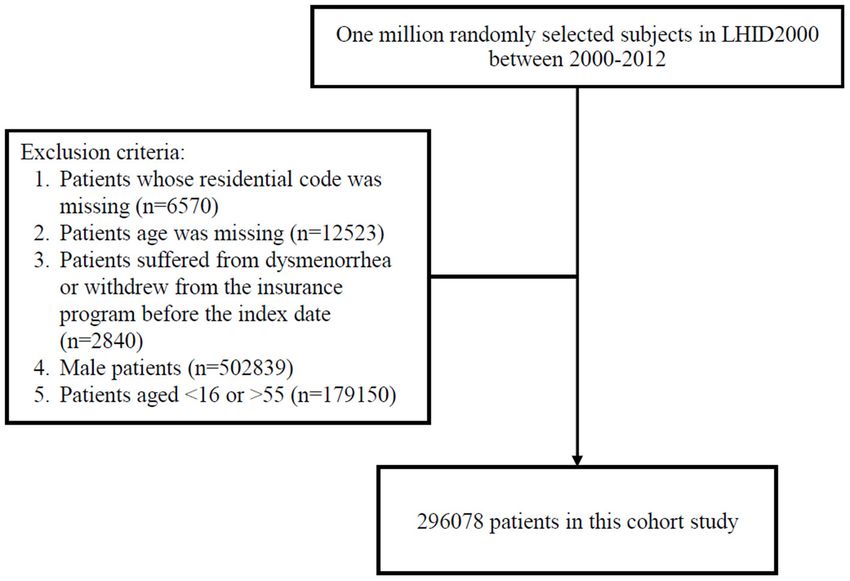
FIGURE 1 | Flow chart of this study.
and uncontrolled bias (i.e., body weight change, take hormone, 183.0), inflammatory bowel disease (ICD-9-CM 555 and 556),
change of residence, or pregnancy, etc) would be too much and intramural fibroids or intracavitary fibroids (ICD-9-CM
to make the results convincing. To avoid and minimize such 218). The National Health Research Institutes has stratified all
bias, we defined duration of average exposure levels of women city districts and townships in Taiwan into seven urbanization
to these pollutants as 2 years. Then, we computed the average levels on the basis of population density (people/km2 ); the
exposure levels of women to these pollutants for 2 years before proportion of residents with higher education, and who work
the diagnosis of dysmenorrhea or end of the study period for in agriculture; and the number of physicians per 100,000 people
each individual. in each area. Level 1 represents areas with a high population
density and socioeconomic status, and level 7 represents areas
Sample Participants with the lowest socioeconomic status. Because few people live
Women residing in areas with air quality monitoring stations in the rural areas classified as levels 4–7, our study grouped
were the focus of this study, which representative of exposure. these areas into level 4. Monthly income was classified into 3
However, women with a history of dysmenorrhea (ICD-9-CM groups: NT$30,000.
code 625.3) (http://www.icd9data.com/2012/Volume1/580- Occupational class was divided into three classes: white collar,
629/617-629/625/625.3.htm) before 2000 were excluded. All blue collar, and other class. White-collar occupations involve
participants were 16–55 years-old and were followed from working in an office and doing work that requires mental rather
January 1, 2000 until dysmenorrhea diagnosis (ICD-9-CM than physical effort. Blue-collar workers, such as farmers or
code 625.3), withdrawal from National Health Insurance, fishermen, do work that requires strength or physical skill.
or December 31, 2013 (Figure 1). The confounding factors The other class includes unemployed people, soldiers, and
were age, sex, urbanization level of residence, monthly religious people.
income, occupational class (20, 21), and comorbidities such
as hypertension (ICD-9-CM 401–405), diabetes mellitus (ICD- Outcome and Exposure Measurement
9-CM 250), hyperlipidemia (ICD-9-CM 272), heart disease The study endpoint was the diagnosis of dysmenorrhea (ICD-
(ICD-9-CM 410–414), Chronic obstructive pulmonary disease 9-CM code 625.3). We integrated daily concentrations of air
(COPD) (ICD-9-CM 490–496), chronic kidney disease (ICD- pollutants corresponding to residential zip codes to calculate
9-CM 580–589), stroke (ICD-9-CM 430–438), depression 2-year average exposure before the diagnosis of dysmenorrhea
(ICD-9-CM 296.2, 296.3, 296.82, 300.4, 309.0, 309.1, 309.28, and the year of diagnosis of dysmenorrhea from 2000 to
and 311), chronic liver disease, and cirrhosis (ICD-9-CM 070.6, 2012.To estimate the effect of air pollutants on dysmenorrhea,
070.9, 570, 571, 573.3, 573.4, 573.8, 573.9, and V42.7). Causes we investigated the daily concentrations of NOx , NO, NO2 ,
of secondary dysmenorrhea were also considered as covariates CO, and PM2.5 by using the inverse distance weighting (IDW)
included endometriosis (ICD-9-CM 617), pelvic inflammatory method. IDW is a common and simple spatial interpolation
disease (ICD-9-CM 614 and 615), ovarian cancer (ICD-9-CM method. It predicts values of unknown points on the basis of the
Frontiers in Public Health | www.frontiersin.org 3 June 2021 | Volume 9 | Article 682341Lin et al. Dysmenorrhea and Air Pollution similarity of two objects in terms of distance (22). Its principle is data are usually non-linear, which limits the application of GLM, to use distance measurement to perform the weighted analysis so it can be solved through GAM (30). The aim of this study of the interpolation. When the unknown point is estimated was to use GAM to evaluate the relation between air pollution to be closer to the known point, the weighted value of the and dysmenorrheal by using data from the NHIR database and unknown point will be higher. Hence, when the distribution of TAQM database (296,078 participants of whom 12,514 died the known measuring point is balanced, the value estimated using during 11.7 years follow-up). Using GAM, we found that strong the IDW method will be more accurate (Supplementary Table 1; positive association between air pollution and dysmenorrhea, the Supplementary Figure 1) (23, 24). In this study, the generalized association also appeared in low concentrations of air pollution additive model (GAM) was used to quantitatively evaluate the (Supplementary Figure 2). acute effects of air pollution including NOx, NO, NO2, PM2.5 , and CO concentrations and interquartile range on the incidence of dysmenorrhea in Taiwan. We found that the plots of the RESULTS generalized additive model for interquartile range more linear than the plots of generalized additive model for air pollution There were total 296,078 participants in this study, and there concentrations. In this study, the air pollutant exposure levels were 12,514 participants had diagnosis of dysmenorrhea. Table 1 were scaled to the interquartile range (IQR). Furthermore, Air demonstrates the baseline characteristics and air pollutant pollutants were also categorized into quartiles with three cut- exposure of the study cohort. Among the 296,078 female subjects, off point (25th, 50th and 75th percentiles) for NOx (Quartile 1, insured persons in 30–44 years of age (41.7%), living in north 34.6 ppb), NO (Quartile 1,
Lin et al.                                                                                                                                   Dysmenorrhea and Air Pollution

TABLE 1 | Baseline demographics and exposure of air pollutants in Taiwan.             TABLE 1 | Continued

N = 296,078                                    n                        %             N = 296,078                                      n                              %

Age, years                                                                            NO level (daily average, ppb)
                                                                                                   †
Lin et al. Dysmenorrhea and Air Pollution
TABLE 2 | Difference in dysmenorrhea incidences and associated HRs in participant exposed to various daily average concentration of air pollutants.
Pollutant levels N Dysmenorrhea PY IR Crude HR Adjusted HR
event (95% CI) (95% CI)
NOx (daily average)
Q1 78,548 1,386 966,921 1.43 1 (reference) 1 (reference)
Q2 71,830 2,379 850,647 2.8 1.89 (1.77–2.02)*** 2.45 (2.23–2.89)***
Q3 73,111 3,714 855,434 4.34 2.93 (2.76–3.12)*** 7.53 (7.13–8.67)***
Q4 72,589 5,035 838,164 6.01 4.06 (3.83–4.31)** 27.9 (21.6–31.3)***
NO (daily average)
Q1 79,248 1,629 943,949 1.73 1 (reference) 1 (reference)
Q2 71,936 1,892 854,517 2.21 1.28 (1.20–1.37)*** 1.58 (1.45–2.01)***
Q3 64,187 4,285 744,069 5.76 3.34 (3.15–3.53)*** 7.13 (6.54–8.81)***
Q4 80,707 4,708 938,631 5.02 2.90 (2.74–3.07)*** 16.7 (15.4–18.4)***
NO2 (daily average)
Q1 78,568 1,589 936,256 1.7 1 (reference) 1 (reference)
Q2 68,096 2,197 806,817 2.72 1.60 (1.50–1.71)*** 1.57 (1.46–2.17)***
Q3 77,089 2,753 910,337 3.02 1.78 (1.67–1.89)*** 5.33 (4.19–6.58)***
Q4 72,325 5,975 827,756 7.22 4.25 (4.02–4.50)*** 33.1 (30.9–37.4)***
PM2.5 (daily average)
Q1 78,978 2,228 932,916 2.39 1 (reference) 1 (reference)
Q2 70,207 3,018 828,248 3.64 1.52 (1.44–1.61)*** 1.19 (1.06–1.45)***
Q3 74,411 1,575 886,486 1.78 0.74 (0.49–0.79)*** 1.17 (1.01–1.64)***
Q4 72,482 5,693 833,516 6.83 2.83 (2.72–3.00)*** 27.6 (23.1–29.1)***
CO (daily average)
Q1 75,223 1,232 898,940 1.37 1 (reference) 1 (reference)
Q2 69,275 1,570 825,979 1.9 1.38 (1.28–1.49)*** 1.78 (1.46–2.13)***
Q3 75,707 2,528 895,579 2.82 2.06 (1.92–2.20)*** 7.31 (6.58–8.29)***
Q4 75,873 7,184 860,668 8.35 6.09 (5.74–6.47)*** 28.7 (25.4–33.6)***
Q1, first quartile; Q2, second quartile; Q3, third quartile; Q4, fourth quartile; PY, person-years; IR, incidence rate, per 1,000 person-years; HR, hazard ratio; CI, confidence interval.
HR adjusted for age, monthly income, urbanization level, occupational class, and comorbidities. **P < 0.01; ***P < 0.001.Lin et al. Dysmenorrhea and Air Pollution
TABLE 3 | Incidence rate and hazard ratio of dysmenorrhea between various daily average concentrations of NOx, NO, NO2 , PM2.5 , CO stratified by gender, age, and
comorbidities.
Adjusted HR (95%CI)
Air pollutants NOx NO NO2 PM2.5 CO
IQR Quartile1 Quartile 4 Quartile 4 Quartile 4 Quartile 4 (highest) Quartile 4
(lowest) (highest) (highest) (highest) (highest)
Age, yearsLin et al. Dysmenorrhea and Air Pollution
TABLE 5 | Cox proportional hazard regression analysis for the interactive effects of PM2.5 with NOx, NO, NO2 , and CO on the risk of dysmenorrhea association.
Variables of air pollutions N Dysmenorrhea Crude HR (95%CI) Adjusted HR P for
event (95%CI) interaction
PM2.5 NOx 0.13
Low Low 63,263 1,416 1 (Reference) 1 (Reference)
Low High 84,145 3,612 1.94 (1.82–2.06)*** 4.05 (3.75–4.38)***
High Low 114,345 3,718 1.46 (1.37–1.55)*** 1.30 (1.21–1.39)***
High High 34,325 3,768 5.19 (4.88–5.51)*** 10.8 (10.0–11.7)
PM2.5 NO 0.56
Low Low 70,312 1,664 1 (Reference) 1 (Reference)
Low High 77,096 3,364 1.87 (1.76–1.98)*** 2.64 (2.46–2.84)***
High Low 122,375 5,020 1.75 (1.65–1.85)*** 1.25 (1.17–1.34)***
High High 26,295 2,466 4.14 (3.89–4.41)*** 6.46 (6.01–6.94)***
PM2.5 NO2 0.27
Low Low 60,952 1,307 1 (Reference) 1 (Reference)
Low High 86,456 3,721 2.03 (1.91–2.17)*** 3.75 (3.48–4.05)***
High Low 94,266 2,737 1.36 (1.27–1.45)*** 1.43 (1.33–1.53)***
High High 54,404 4,749 4.24 (3.99–4.51)*** 9.77 (9.06–10.5)
PM2.5 CO 0.68
Low Low 70,684 1,371 1 (Reference) 1 (Reference)
Low High 76,724 3,657 2.50 (2.35–2.66)*** 5.03 (4.67–5.42)***
High Low 99,304 2,410 1.25 (1.17–1.33)*** 1.15 (1.07–1.23)***
High High 49,366 5,076 5.60 (5.28–5.94)*** 13.0 (12.1–13.9)***
cHR, crude hazard ratio; aHR, adjusted hazard ratio of a multivariate analysis, after adjustment for age, monthly income, urbanization level, occupation class, and comorbidities; Low,
concentrations of air pollutant less than median value; High, concentrations of air pollutant more than median value. ***P < 0.001.
9.06–10.5) for NO2 , and 13.0-fold adjusted risk of dysmenorrhea We proposed several possible mechanisms accounting for
(95% CI = 12.1–13.9) for CO. our research findings: (1) increased prostaglandin synthesis (35,
36); (2) increased oxidative stress as well as myeloperoxidase
activation (37–42); (3)irregular menstrual cycle (15, 16); and (4)
DISCUSSION increased emotional stress in those patients exposed to higher
concentrations of air pollutions (43).
Our results demonstrated that women exposed to relatively high First, increased levels of 8-epi-PGF2α have been detected in
concentrations of NO, NO2 , NOx , CO, and PM2.5 had relatively exhaled breath and urine after exposure to air pollution PM2.5
high incidences of dysmenorrhea. This was the first cohort study (44–48). Furthermore, Schneider et al. and Samet et al. found
to identify the association between dysmenorrhea and exposure that air pollution could activate macrophages, leading to the
to certain air pollutants. production of prostaglandin E2 and induce induce prostaglandin
Since no previous studies have reported association H synthase 2 (35, 49). Yan et al. found that NO2 inhalation
between air pollution and dysmenorrhea, there was no could promote COX-2 elevation-mediated prostaglandin E2
available direct information to be cited scientifically for production (36). Sang et al. showed that sulfur dioxide
our findings. However, in recent years, air pollution has (SO2 ) could induce cyclooxygenases-2-derived prostaglandin E2
been reported to be associated with many diseases, which production and its downstream signaling pathway in neurons
resulting from direct injures to lung as well as provoking (50). Therefore, exposing to air pollution NOx, NO2, and PM2.5
systematic inflammation (31, 32). Pope et al. reported could cause increasing levels of prostaglandin E2 production
that exposure to PM2.5 was associated with endothelial within body. Since increasing levels of prostaglandin E2 had been
injury and systemic inflammation, which involves increased related with dysmenorrhea (51, 52), we supposed that it would be
thrombotic propensity, loss of apoptosis of endothelial cells, one possible explanation pathway for our findings.
and changes in cytokines (33). Chen et al. showed that Second, myeloperoxidase activation plays a role in the
exposure to fine-particle air pollutants was associated with association between air pollution and increased incidence of
increased urinary metabolites, namely AA, which is indicative dysmenorrhea. Kaplan et al. summarized that myeloperoxidase
of the inflammatory property of air pollution (34). Therefore, as well as oxidative stress and calcium ion levels are involved
systematic inflammation and associated increasing oxidative in the pathogenesis of primary dysmenorrhea (53). Also,
stress would be plausible pathway for association between air oxidative stress and increased serum levels of the cytokines
pollution and dysmenorrhea. malondialdehyde and interleukin-6 are associated with
Frontiers in Public Health | www.frontiersin.org 8 June 2021 | Volume 9 | Article 682341Lin et al. Dysmenorrhea and Air Pollution
dysmenorrhea (54). Constantin showed that SO2 and NO2 menarche (younger than 12 years), nulliparity, heavy menses
induce oxidative burst and myeloperoxidase activation (37). or irregular menses, smoking, obesity, dietary habits, life stress,
Moreover, several studies have shown an association between air use of oral contraceptives, and social network support (20, 66).
pollution and oxidative stress in humans (38–42). Szmidt et al. Second, although National Health Insurance covers up to 99%
have systematic reviewed that oxidative stress was associated of the population, patients with dysmenorrhea might take over-
with development of dysmenorrhea (55). Results of Szmidt et al. the-counter medications instead of visiting a doctor. Therefore,
indicated an elevated level of oxidative stress, especially of lipid the incidences of dysmenorrhea would be underdiagnosed in
peroxidation existed among dysmenorrhea women (55). Yang all quartiles of air pollutants. Therefore, it should be cautious
et al. have found that exposure to PM2.5 will cause dysregulation in interpreting results of this study. Third, although we have
of lipid metabolism and oxidation (56). Therefore, women considered pelvic inflammatory disease, cervical stenosis and
exposure to NO2, NOX, as well as PM2.5 might lead to increasing polyps, functional ovarian cysts, malignant ovarian tumors, and
oxidative stress, therefore had higher risks of dysmenorrhea. inflammatory bowel disease, we did not consider adenomyosis,
Third, an irregular menstrual cycle is also associated with inflammation and scarring of uterus, intracavity or intramural
dysmenorrhea in women exposed to high concentrations of the fibroids, functional ovarian cysts, and intrauterine devices,
air pollutants SO2 and NOx . Merklinger-Gruchala et al. (15) and which are also associated with dysmenorrhea (67). Forth,
Mahalingaiah et al. (16) found that the concentrations of the air although there is considerable difference between primary
pollutants were associated with shortening of the luteal phase, and secondary dysmenorrhea, information about hormone
an irregular menstrual cycle, and menstrual irregularity. An measurement, regularity of menses, distribution of body fat,
irregular menstrual cycle is also a risk factor for dysmenorrhea and signs of hirsutism were unavailable in NHIRD. Fifth,
(57), and therefore, air pollution might lead to dysmenorrhea although we have used zip codes to define individual exposure
through irregular menstruation. Additionally, Beck revealed that to air pollutants, misclassification of exposure measurement
CO intoxication is related to dysmenorrhea, menorrhagia, and should occur in this study since each participant was free
amenorrhea in women (58). Although we have adjusted for mobile. Sixth, considerations for analyzing designs inclusive
irregular menses, irregular menses might also be speculated as 1-year exposure average window, IDW methods, as well as
one plausible pathway for air pollution related dysmenorrhea GAM for categorical variables should be announced here. Since
since not all patients with irregular menses would seek for this is a retrospective study, it would be many uncontrolled
medical therapy. variables generating during this exposure window such as those
Finally, emotional stress resulting from exposure to causes of secondary dysmenorrhea. If exposure window was
air pollution may contribute to increased incidence of too long, it would be more hardly to convince the association
dysmenorrhea. Power et al. reported that exposure to fine between air pollution and dysmenorrhea even if results are of
particulate air pollution was associated with anxiety (43). statistical significance. Thus, although a 1-year exposure average
Further, extensive long-term exposure to air pollution may window seems too short for dysmenorrhea investigation, we
increase the odds of depression, antidepressant use, and mental decided 1-year as exposure average window. The association
health problems in children (59, 60). Since mental stress has been between air pollution and primary dysmenorrhea would be more
reported to be a risk factor for dysmenorrhea (61–64), therefore convincing on the basis on current design of 1-year exposure
exposure to air pollution might increase mental stress and then average window. The advantage of using IDW method is that
dysmenorrhea occurrs. IDW is assumed substantially that the rate of correlations and
Another novel interesting finding is that our results showed similarities between neighbors is proportional to the distance
synergy effects of PM2.5 and NO, NO2, NOx, CO on the risks between them that can be defined as a distance reverse function
of dysmenorrheal. The risks of dysmenorrhea appeared to be of every point from neighboring points. However, on an
highest in women exposed to high concentrations of NO, NO2, area of 36,193 square kilometers of Taiwan, the density of
NOx, CO and high PM2.5 . We supposed that it would be 78 air quality monitoring stations is not very high. Thus,
that high concentrations of PM2.5 and high concentrations of another limitation of this study would be limited numbers
acid gases could provoke the highest oxidative stress as well as of air pollution monitoring stations. The principal advantage
systemic inflammation. Further, the risk of dysmenorrhea would of GAM is its ability to model highly complex non-linear
be generally higher if women exposed to high concentrations of relationships when the number of potential predictors is large.
NO, NO2, NOx, or CO, despite women exposed to low or high The disadvantage of GAM is that like other non-parametric
concentrations of PM2.5 . This observational finding warrants methods, GAM has a high propensity for overfitting. Finally, this
attention since it implied that NO, NO2, NOx, or CO would have retrospective study was based on analysis of existing database,
more harms for risks of dysmenorrheal. We suppose that high therefore the level of internal bias of this study would be
concentrations of NO, NO2, NOx, or CO would also have effects more compared with those prospective randomized control
on epigenetic modifications (65). Further studies are required to trial studies. However, our study demonstrated real-world
explore the underlying mechanisms. observational results.
This study has several limitations. First, the NHIRD does not In conclusion, our study showed that exposure to high
provide information regarding risk factors for dysmenorrhea, concentrations of the air pollutants SO2 , NOx , NO, and NO2 was
including family history of dysmenorrhea, an early age of associated with increased incidences of dysmenorrhea. Whether
Frontiers in Public Health | www.frontiersin.org 9 June 2021 | Volume 9 | Article 682341Lin et al. Dysmenorrhea and Air Pollution
personal protection against air pollution could help lessen the risk FUNDING
of dysmenorrhea will require further investigations.
This study was supported in part by Taiwan Ministry of
DATA AVAILABILITY STATEMENT Health and Welfare Clinical Trial Center (MOHW109-TDU-
B-212-114004), China Medical University Hospital (CMU107-
The datasets presented in this article are not readily available ASIA-19); MOST Clinical Trial Consortium for Stroke (MOST
because The dataset used in this study is held by the Taiwan 108-2321-B-039-003-), Tseng-Lien Lin Foundation, Taichung,
Ministry of Health and Welfare (MOHW). The Ministry of Taiwan. The funders had no role in the study design, data
Health and Welfare must approve our application to access this collection and analysis, the decision to publish, or preparation of
data. Any researcher interested in accessing this dataset can the manuscript. No additional external funding was received for
submit an application form to the Ministry of Health and Welfare this study.
requesting access. Please contact the staff of MOHW (Email:
stcarolwu@mohw.gov.tw) for further assistance. Taiwan Ministry SUPPLEMENTARY MATERIAL
of Health and Welfare Address: No. 488, Sec. 6, Zhongxiao E.
Rd., Nangang Dist., Taipei City 115, Taiwan (R.O.C.). Phone: The Supplementary Material for this article can be found
+886-2-8590-6848. All relevant data are within the paper. online at: https://www.frontiersin.org/articles/10.3389/fpubh.
Requests to access the datasets should be directed to Please 2021.682341/full#supplementary-material
contact the staff of MOHW (Email: stcarolwu@mohw.gov.tw) for Supplementary Figure 1 | Maps of monitoring stations of air pollutants in Taiwan.
further assistance. Supplementary Figure 2 | The plots of the generalized additive models showed
great deviation from a linear relationship.
ETHICS STATEMENT Supplementary Figure 3 | Kaplan-Meier curve about NOx exposure and
dysmenorrhea risk.
This study was approved to fulfill the condition for exemption
Supplementary Figure 4 | Kaplan-Meier curve about NO exposure and
by the Institutional Review Board (IRB) of China Medical dysmenorrhea risk.
University (CMUH104-REC2-115-CR4). The IRB also
Supplementary Figure 5 | Kaplan-Meier curve about NO2 exposure and
specifically waived the consent requirement. Written
dysmenorrhea risk.
informed consent for participation was not required for
Supplementary Figure 6 | Kaplan-Meier curve about CO exposure and
this study in accordance with the national legislation and the
dysmenorrhea risk.
institutional requirements.
Supplementary Figure 7 | Kaplan-Meier curve about PM2.5 exposure and
dysmenorrhea risk.
AUTHOR CONTRIBUTIONS
Supplementary Table 1 | Description correlation matrix for air pollutants.
∗∗∗
S-YL and C-HK: conception/design and collection and/or correlation is significant at theLin et al. Dysmenorrhea and Air Pollution
13. Carr,é J, Gatimel N, Moreau J, Parinaud J, Léandri R. Does air pollution endothelial injury and systemic inflammation. Circul Res. (2016) 119:1204–
play a role in infertility?: a systematic review. Environ Health. (2017) 14. doi: 10.1161/CIRCRESAHA.116.309279
16:82. doi: 10.1186/s12940-017-0291-8 34. Chen C, Li H, Niu Y, Liu C, Lin Z, Cai J, et al. Impact of
14. Srám R. Impact of air pollution on reproductive health. Environ Health short-term exposure to fine particulate matter air pollution on urinary
Perspect. (1999) 107:A542–3. doi: 10.1289/ehp.107-1566709 metabolome: a randomized, double-blind, crossover trial. Environ Int. (2019)
15. Merklinger-Gruchala A, Jasienska G, Kapiszewska M. Effect of air pollution on 130:104878. doi: 10.1016/j.envint.2019.05.072
menstrual cycle length-a prognostic factor of women’s reproductive health. Int 35. Schneider JC, Card GL, Pfau JC, Holian A. Air pollution particulate SRM 1648
J Environ Res Public Health. (2017) 14:816. doi: 10.3390/ijerph14070816 causes oxidative stress in RAW 264.7 macrophages leading to production of
16. Mahalingaiah S, Missmer SE, Cheng JJ, Chavarro J, Laden F, Hart prostaglandin E2, a potential Th2 mediator. Inhalat Toxicol. (2005) 17:871–
JE. Perimenarchal air pollution exposure and menstrual disorders. Hum 7. doi: 10.1080/08958370500244498
Reproduct. (2018) 33:512–9. doi: 10.1093/humrep/dey005 36. Yan W, Yun Y, Ku T, Li G, Sang N. NO2 inhalation promotes
17. Environmental Protection Administration. (2018). Air Quality Observation Alzheimer’s disease-like progression: cyclooxygenase-2-derived
and Forecast Network(空氣品質監測站網). Available online at: https://www. prostaglandin E2 modulation and monoacylglycerol lipase inhibition-
epa.gov.tw/eng/72014105B1616E36 targeted medication. Sci Rep. (2016) 6:22429. doi: 10.1038/srep
18. Kuo CY, Pan RH, Chan CK, Wu CY, Phan DV, Chan CL. Application of a 22429
time-stratified case-crossover design to explore the effects of air pollution 37. Constantin D, Mehrotra K, Rahimtula A, Moldéus P, Jernström B. Stimulatory
and season on childhood asthma hospitalization in cities of differing urban effects of sulfur and nitrogen oxides on carcinogen activation in human
patterns: big data analytics of government open data. Int J Environ Res Public polymorphonuclear leukocytes. Environ Health Perspect. (1994) 102:161–
Health. (2018) 15:647. doi: 10.3390/ijerph15040647 4. doi: 10.1289/ehp.94102s4161
19. Jung CR, Lin YT, Hwang BF. Air pollution and newly diagnostic autism 38. Risom L, Møller P, Loft S. Oxidative stress-induced DNA
spectrum disorders: a population-based cohort study in Taiwan. PLoS ONE. damage by particulate air pollution. Mutat Res. (2005) 592:119–
(2013) 8:e75510. doi: 10.1371/journal.pone.0075510 37. doi: 10.1016/j.mrfmmm.2005.06.012
20. Hailemeskel S, Demissie A, Assefa N. Primary dysmenorrhea magnitude, 39. Kelly FJ. Oxidative stress: its role in air pollution and adverse health effects.
associated risk factors, and its effect on academic performance: evidence Occupat Environ Med. (2003) 60:612–6. doi: 10.1136/oem.60.8.612
from female university students in Ethiopia. Int J Womens Health. (2016) 40. Lodovici M, Bigagli E. Oxidative stress and air pollution exposure. J Toxicol.
8:489–96. doi: 10.2147/IJWH.S112768 (2011) 2011:487074. doi: 10.1155/2011/487074
21. Hu Z, Tang L, Chen L, Kaminga AC, Xu H. Prevalence and risk factors 41. Yang W, Omaye ST. Air pollutants, oxidative stress and human health. Mutat
associated with primary dysmenorrhea among Chinese female university Res. (2009) 674:45–54. doi: 10.1016/j.mrgentox.2008.10.005
students: a cross-sectional study. J Pediatr Adolesc Gynecol. (2020) 33:15– 42. Ghio AJ, Carraway MS, Madden MC. Composition of air pollution particles
22. doi: 10.1016/j.jpag.2019.09.004 and oxidative stress in cells, tissues, living systems. J Toxicol Environ Health
22. Chen FW, Liu CW. Estimation of the spatial rainfall distribution using inverse Part B. (2012) 15:1–21. doi: 10.1080/10937404.2012.632359
distance weighting (IDW) in the middle of Taiwan. Paddy Water Environ. 43. Power MC, Kioumourtzoglou MA, Hart JE, Okereke OI, Laden F,
(2012) 10:209–22. doi: 10.1007/s10333-012-0319-1 Weisskopf MG. The relation between past exposure to fine particulate air
23. Agung Setianto AS, Tamia Triandini TT. Comparison of kriging and inverse pollution and prevalent anxiety: observational cohort study. BMJ. (2015)
distance weighted (IDW) interpolation methods in lineament extraction and 350:h1111. doi: 10.1136/bmj.h1111
analysis. J Southeast Asian Appl Geol. (2013) 5:21–9. doi: 10.22146/jag.7204 44. De Prins S, Dons E, Van Poppel M, Int Panis L, Van de Mieroop E, Nelen
24. Jumaah HJ, Ameen MH, Kalantar B, Rizeei HM, Jumaah SJ. Air quality V, et al. Airway oxidative stress and inflammation markers in exhaled breath
index prediction using IDW geostatistical technique and OLS-based GIS from children are linked with exposure to black carbon. Environ Int. (2014)
technique in Kuala Lumpur, Malaysia. Geomat Nat Hazards Risk. (2019) 73:440–6. doi: 10.1016/j.envint.2014.06.017
10:2185–99. doi: 10.1080/19475705.2019.1683084 45. Rosa MJ, Yan B, Chillrud SN, Acosta LM, Divjan A, Jacobson JS, et al.
25. Fox J, Weisberg S. An R Companion to Applied Regression. 3rd ed. Thousand Domestic airborne black carbon levels and 8-isoprostane in exhaled breath
Oaks, CA: Sage (2019). condensate among children in New York city. Environ Res. (2014) 135:105–
26. Pearce JL, Beringer J, Nicholls N, Hyndman RJ, Tapper NJ. 10. doi: 10.1016/j.envres.2014.09.003
Quantifying the influence of local meteorology on air quality 46. Patel MM, Chillrud SN, Deepti K, Ross JM, Kinney PL. Traffic-
using generalized additive models. Atmosph Environ. (2011) related air pollutants and exhaled markers of airway inflammation and
45:1328–36. doi: 10.1016/j.atmosenv.2010.11.051 oxidative stress in New York city adolescents. Environ Res. (2013) 121:71–
27. Souza JB, Reisen VA, Franco GC, Ispány M, Bondon P, Santos JM. Generalized 8. doi: 10.1016/j.envres.2012.10.012
additive models with principal component analysis: an application to time 47. Huang W, Wang G, Lu SE, Kipen H, Wang Y, Hu M, et al. Inflammatory
series of respiratory disease and air pollution data. J R Stat Soc Ser C. (2018) and oxidative stress responses of healthy young adults to changes in air
67:453–80. doi: 10.1111/rssc.12239 quality during the Beijing Olympics. Am J Respir Crit Care Med. (2012)
28. Grego JM. Generalized additive models. In: El-Shaarawi AH, Piegorsch 186:1150–9. doi: 10.1164/rccm.201205-0850OC
WW, Zidek J, editors. Encyclopedia of Environmetrics (2006). 48. Nuernberg AM, Boyce PD, Cavallari JM, Fang SC, Eisen EA,
doi: 10.1002/9780470057339.vag007 Christiani DC. Urinary 8-isoprostane and 8-OHdG concentrations in
29. McLean MW, Hooker G, Staicu AM, Scheipl F, Ruppert D. Functional boilermakers with welding exposure. J Occupat Environ Med. (2008)
generalized additive models. J Comput Graph Stat. (2014) 23:249– 50:182–9. doi: 10.1097/JOM.0b013e31815cf6cc
69. doi: 10.1080/10618600.2012.729985 49. Samet JM, Reed W, Ghio AJ, Devlin RB, Carter JD, Dailey LA, et al.
30. Dominici F, McDermott A, Zeger SL, Samet JM. On the use of generalized Induction of prostaglandin H synthase 2 in human airway epithelial cells
additive models in time-series studies of air pollution and health. Am J exposed to residual oil fly ash. Toxicol Appl Pharmacol. (1996) 141:159–
Epidemiology. (2002) 156:193–203. doi: 10.1093/aje/kwf062 68. doi: 10.1016/S0041-008X(96)80021-4
31. Zhang M, Song Y, Cai X, Zhou J. Economic assessment of the health 50. Sang N, Yun Y, Yao GY, Li HY, Guo L, Li GK. SO2-induced neurotoxicity is
effects related to particulate matter pollution in 111 Chinese cities by using mediated by cyclooxygenases-2-derived prostaglandin E2 and its downstream
economic burden of disease analysis. J Environ Manage. (2008) 88:947– signaling pathway in rat hippocampal neurons. Toxicol Sci. (2011) 124:400–
54. doi: 10.1016/j.jenvman.2007.04.019 13. doi: 10.1093/toxsci/kfr224
32. Chen X, Shao S, Tian Z, Xie Z, Yin P. Impacts of air pollution and its spatial 51. Iacovides S, Avidon I, Baker FC. What we know about primary
spillover effect on public health based on China’s big data sample. J Clean dysmenorrhea today: a critical review. Hum Reproduct Update. (2015) 21:762–
Product. (2017) 142:915–25. doi: 10.1016/j.jclepro.2016.02.119 78. doi: 10.1093/humupd/dmv039
33. Pope AC III, Bhatnagar A, McCracken JP, Abplanalp W, Conlin DJ, 52. Sharghi M, Mansurkhani SM, Larky DA, Kooti W, Niksefat M,
O’Toole T. Exposure to fine particulate air pollution is associated with Firoozbakht M, et al. An update and systematic review on the
Frontiers in Public Health | www.frontiersin.org 11 June 2021 | Volume 9 | Article 682341Lin et al. Dysmenorrhea and Air Pollution
treatment of primary dysmenorrhea. JBRA Assis Reproduct. (2019) and private hospitals and health care centers in Iran (Mashhad) in
23:51. doi: 10.5935/1518-0557.20180083 the years 2010 and 2011. Iran J Nurs Midwif Res. (2013) 18:316–22.
53. Kaplan Ö, Naziroglu M, Güney M, Aykur M. Non-steroidal anti- doi: 10.22038/JMRH.2014.2792
inflammatory drug modulates oxidative stress and calcium ion levels in the 62. Bajalan Z, Moafi F, MoradiBaglooei M, Alimoradi Z. Mental health and
neutrophils of patients with primary dysmenorrhea. J Reproduct Immunol. primary dysmenorrhea: a systematic review. J Psychosom Obstetr Gynecol.
(2013) 100:87–92. doi: 10.1016/j.jri.2013.10.004 (2019) 40:185–94. doi: 10.1080/0167482X.2018.1470619
54. Yeh ML, Chen HH, So EC, Liu F. A study of serum malondialdehyde and 63. Takeda T, Tadakawa M, Koga S, Nagase S, Yaegashi N. Relationship
interleukin-6 levels in young women with dysmenorrhea in Taiwan. Life Sci. between dysmenorrhea and posttraumatic stress disorder in Japanese
(2004) 75:669–73. doi: 10.1016/j.lfs.2003.11.034 high school students 9 months after the Great East Japan Earthquake.
55. Szmidt MK, Granda D, Sicinska E, Kaluza J. Primary dysmenorrhea in relation J Pediatr Adolesc Gynecol. (2013) 26:355–7. doi: 10.1016/j.jpag.2013.
to oxidative stress and antioxidant status: a systematic review of case-control 06.020
studies. Antioxidants. (2020) 9:994. doi: 10.3390/antiox9100994 64. Wang L, Wang X, Wang W, Chen C, Ronnennberg AG, Guang W, et al. Stress
56. Yang S, Chen R, Zhang L, Sun Q, Li R, Gu W, et al. Lipid metabolic and dysmenorrhoea: a population based prospective study. Occupat Environ
adaption to long-term ambient PM2. 5 exposure in mice. Environ Pollut. Med. (2004) 61:1021–6. doi: 10.1136/oem.2003.012302
(2021) 269:116193. doi: 10.1016/j.envpol.2020.116193 65. Romieu I, Moreno-Macias H, London SJ. Gene by environment
57. Fujiwara T, Nakata R. Young Japanese college students with dysmenorrhea interaction and ambient air pollution. Proc Am Thorac Soc. (2010)
have high frequency of irregular menstruation and premenstrual 7:116–22. doi: 10.1513/pats.200909-097RM
symptoms. Open Med Informat J. (2007) 1:8. doi: 10.2174/18744311007010 66. Ju H, Jones M, Mishra G. The prevalence and risk factors of dysmenorrhea.
10008 Epidemiology Rev. (2013) 36:104–13. doi: 10.1093/epirev/mxt009
58. Beck HG. Slow carbon monoxide asphyxiation: a neglected clinical problem. 67. Coco AS. Primary dysmenorrhea. Am Family Phys. (1999) 60:489–96.
J Am Med Assoc. (1936) 107:1025–9. doi: 10.1001/jama.1936.02770390017006
59. Vert C, Sánchez-Benavides G, Martínez D, Gotsens X, Gramunt N, Cirach M, Conflict of Interest: The authors declare that the research was conducted in the
et al. Effect of long-term exposure to air pollution on anxiety and depression absence of any commercial or financial relationships that could be construed as a
in adults: a cross-sectional study. Int J Hyg Environ Health. (2017) 220:1074– potential conflict of interest.
80. doi: 10.1016/j.ijheh.2017.06.009
60. Roberts S, Arseneault L, Barratt B, Beevers S, Danese A, Odgers Copyright © 2021 Lin, Yang, Lin, Chang, Hsu, Wang, Lin, Hsu and Kao. This is an
CL, et al. Exploration of NO2 and PM2.5 air pollution and mental open-access article distributed under the terms of the Creative Commons Attribution
health problems using high-resolution data in London-based children License (CC BY). The use, distribution or reproduction in other forums is permitted,
from a UK longitudinal cohort study. Psychiatry Res. (2019) 272:8– provided the original author(s) and the copyright owner(s) are credited and that the
17. doi: 10.1016/j.psychres.2018.12.050 original publication in this journal is cited, in accordance with accepted academic
61. Kordi M, Mohamadirizi S, Shakeri MT. The relationship between practice. No use, distribution or reproduction is permitted which does not comply
occupational stress and dysmenorrhea in midwives employed at public with these terms.
Frontiers in Public Health | www.frontiersin.org 12 June 2021 | Volume 9 | Article 682341You can also read


