Dilworth Senior Campus - Year 13 Option Choices 2021 - Dilworth School
←
→
Page content transcription
If your browser does not render page correctly, please read the page content below
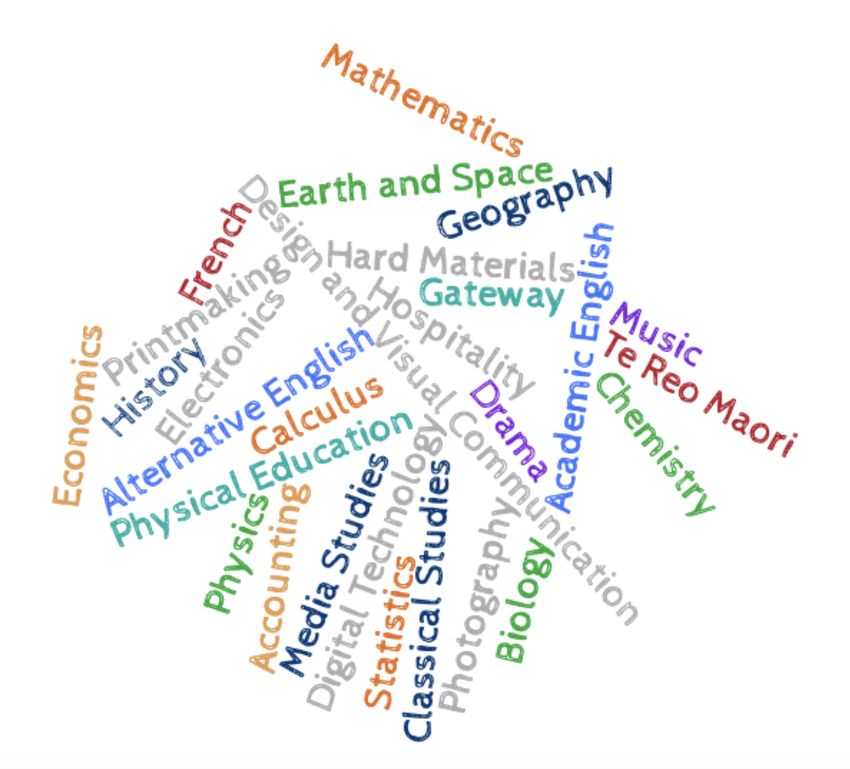
Dilworth Senior Campus

         Year 13
   Option Choices 2021
Subject Pathways
Year 10 Year 11 Year 12 Year 13
Business
Accounting ® Accounting ® Accounting
COMMERCE
Studies ® Economics ® Economics ® Economics
Academic
® English
ENGLISH English ® English ® English
Alternative
® English
LANGUAGES
French ® French ® French ® French
Te Reo Māori ® Te Reo Māori ® Te Reo Māori ® Te Reo Māori
Mathematics
Advanced ® with Calculus
® Mathematics Mathematics
MATHEMATICS Mathematics ® Mathematics ® with Statistics
® Mathematics ® Mathematics
PERFORMING Drama ® Drama ® Drama ® Drama
ARTS Music ® Music ® Music ® Music
Physical Physical Physical Physical
Education ® Education ® Education ® Education
PE & HEALTH Health
Transition Transition Gateway
Biology ® Biology
Chemistry ® Chemistry
SCIENCE Science ® Science ® Earth & Space Earth & Space
Science ® Science
Physics ® Physics
Geography ® Geography ® Geography
®
SOCIAL
Social Studies
History ® History ® History
SCIENCES Classical Studies ® Classical Studies
Media Studies ® Media Studies
Design & Visual Design & Visual Design & Visual Design & Visual
Communication ® Communication ® Communication ® Communication
Hard Materials Hard Materials Hard Materials Hard Materials
Technology ® Technology ® Technology ® Technology
Digital Design Digital Design Digital Design
Technologies ® Technologies ® Technologies
TECHNOLOGY Hospitality ® Hospitality
& ART Electronics
Technology
® Painting
® Painting
Art ® Art ® Printmaking
® Photography ® PhotographyAccounting NCEA Level 3
This course applies accounting to partnerships, companies, manufacturing businesses and covers management
decision-making. It aims to prepare students for study at tertiary level.
It requires students to think about the issues underlying accounting in today’s society and the need to interpret
financial information to make decisions.
This course is suitable for any student who would like to study at tertiary level or might want to own his own business
in the future.
Entry Requirements
Year 11 or 12 Accounting is a necessary prerequisite.
NZQF Standards
Number Title External/Internal Credits
91404 Demonstrate understanding of accounting concepts for a company External 4
91405 Demonstrate understanding of accounting for partnerships Internal 4
Demonstrate understanding of company financial statement
91406 External 5
preparation
Prepare a report for an external user that interprets the annual
91407 Internal 5
report of a New Zealand company
91409 Demonstrate understanding of a job cost subsystem for an entity Internal 4
TOTAL CREDITS 22Economics NCEA Level 3
The objectives of this course are:
§ To understand basic economic concepts, principles and simple analytical techniques and apply them to
current economic issues.
§ To inquire into and reason clearly and objectively about economic issues, using thinking, investigative and
statistical skills.
§ To develop an awareness of the inter-relationships between economic, social and political events.
Level 3 Economics combines micro and macro- economic theory to explain the behaviour of firms, the working of the
market and aggregate economic activity.
Entry Requirements
Study of Economics at Year 12 level is an advantage to students at this level. Students who have undertaken either
the Year 11 or Year 12 course must show competency in at least two of the external Achievement Standards at each
year level.
NZQF Standards
Number Title External/Internal Credits
91399 Demonstrate understanding of the efficiency of market equilibrium External 4
Demonstrate understanding of the efficiency of different market
91400 External 4
structures using marginal analysis
91401 Demonstrate understanding of micro-economic concepts Internal 5
Demonstrate understanding of government interventions where the
91402 Internal 5
market fails to deliver efficient or equitable outcomes
TOTAL CREDITS 18Academic English NCEA Level 3
This Year 13 English course has an academic focus and involves the study of a varied selection of texts including short
texts (poetry and short stories), extended texts (novel and drama), and film. The aim is to develop a love and
understanding of literature through reading and viewing a rich range of texts from a variety of authors and cultures.
Students will be given the opportunity to write in a range of styles, developing their critical essay writing skills and
producing both creative and formal writing. They will learn to respond perceptively to literary texts in both written
work and discussion.
Students will be expected to read widely and independently out of class to extend their knowledge and appreciation
of literature. They will also present an oral text to their peers.
Especially gifted students in English may be invited to work towards sitting the Scholarship English exam. This involves
extension work such as extra teacher/student tutorials and the sitting of a Scholarship Level external examination at
the end of the year, as well as the usual Level 3 examinations.
Entry Requirements
Entry to Level 3 Academic English requires students to have passed at least 12 credits at Level 2, including four credits
from an externally assessed Achievement Standard and achievement of the Level 2 Writing Portfolio. Exceptions to
this can only be made at the Head of Faculty’s discretion.
NZQF Standards
Number Title External/Internal Credits
Respond critically to specified aspects of studied written text(s),
91472 External 4
supported by evidence.
Respond critically to specified aspects of studied visual/oral text(s),
91473 External 4
supported by evidence.
Produce a selection of fluent and coherent writing which develops,
91475 Internal 6
sustains and structures ideas.
Create and deliver a fluent and coherent oral text which develops,
91476 Internal 3
sustains and structures ideas.
Respond critically to significant connections across texts, supported
91478 Internal 4
by evidence.
TOTAL CREDITS 21Alternative English NCEA Level 3
Year 13 Alternative English has an academic focus and involves the study of a varied selection of visual and written
texts including graphic novels, film and one extended text (novel or drama) OR a selection of poetry. The aim is to
develop a critical understanding of the type of visual and written texts we see every day. Students will be given the
opportunity to create effective texts in both the visual and spoken mediums. They will learn to respond critically and
perceptively to a range of texts in both written work and discussion.
Students will be expected to supplement their work in class through independent reading and study.
Entry Requirements
Entry to Level 3 Alternative English requires students to have passed at least 10 credits at Level 2, including four
credits from an externally assessed Achievement Standard. Exceptions to this can only be made at the Head of
Faculty’s discretion.
NZQF Standards
Number Title External/Internal Credits
Respond critically to specified aspects of studied written text(s),
91472 External 4
supported by evidence.
Respond critically to specified aspects of studied visual/oral text(s),
91473 External 4
supported by evidence.
Create and deliver a fluent and coherent oral text which develops,
91476 Internal 3
sustains and structures ideas.
Create a fluent and coherent visual text which develops, sustains
91477 Internal 3
and structures ideas using verbal and visual language.
Respond critically to significant connections across texts, supported
91478 Internal 4
by evidence.
Respond critically to significant aspects of visual and/or oral text(s)
91480 Internal 3
through close reading, supported by evidence.
TOTAL CREDITS 21French NCEA Level 3
Language skills and personal independence are further developed, to include presentation of arguments and
imaginative expression. Students develop the ability to use French variably and effectively, to express and justify their
own opinions and support or challenge those of others. They must be prepared to continue to support their learning
with consistent revision of vocabulary and structures.
Achievement objectives include communication about certainty and uncertainty, possibility and probability,
development of reasoned arguments, sustained interaction, production of extended text and response to selected
and adapted texts from French-speaking cultures (such as poetry, song, short story, novel and film).
Topics may include: Regions of France, Environment, Social Issues (such as Racism, the Homeless, Animal Rights,
Religion, Terrorism…) Further Education, Technology and Change, French History, Arts & Literature, Latest Trends.
At Level 3, the interact portfolio carries a heavier weighting, at six credits, while the speech drops to three. Other
standards have a similar value to those at Levels 1 & 2.
The scholarship standard is a multi-skill task, available to the very top students.
Entry Requirements
Students must have completed the Year 12 course or its equivalent and should be competent and motivated.
NZQF Standards
Number Title External/Internal Credits
Demonstrate understanding of a variety of extended spoken French
91543 External 5
texts
Give a clear spoken presentation in French that communicates a
91544 Internal 3
critical response to stimulus material
Interact clearly using spoken French to explore and justify varied
91545 Internal 6
ideas and perspectives in different situations
Demonstrate understanding of a variety of extended written and/or
91546 External 5
visual French texts
Write a variety of text types in clear French to explore and justify
91547 Internal 5
varied ideas and perspectives
TOTAL CREDITS 24Te Reo Māori NCEA Level 3
Aspects emphasised in the course are Whakarongo, Pānui, Tuhituhi and Tikanga. The course is partly internally
assessed through Tikanga studies and dialogue, written assignments, listening tasks, mini-seminars and technological
assignments. Cultural and global issues are critically analysed and assessed. Students are encouraged to kōrero Māori
inside and outside the classroom. There is a big emphasis with implementing technology in learning Te Reo Māori in
the classroom.
As it is difficult to use Te Reo Māori in a contextual setting, students wishing to take Te Reo Māori at a Level 3
standard are encouraged to participate in the Dilworth Kapa Haka Group. Students will be enriched with Māori
experiences outside of the classroom.
Entry Requirements
The suggested entry level for the Year 13 Te Reo Maori programme is at a completed Level 2 programme. Alternately,
an understanding of Te Reo equivalent to Level 7 grammar, construction and vocabulary.
NZQF Standards
Number Title External/Internal Credits
91650 Whakarongo kia mōhio ki te reo Māori o te ao whānui. Internal 4
91653 Tuhi i te reo Māori o te ao whānui. External 6
91654 Waihanga tuhinga whai take i te reo Māori o te ao whānui. Internal 6
US16136 Explain kawa and tikanga in relation to hui marena. Internal 6
US29555 Explain kawa and tikanga in relation to hui rā whānau. Internal 4
TOTAL CREDITS 26Mathematics NCEA Level 3
This course is designed for students who enjoy being challenged to think logically and systematically to solve
problems. The content of this course includes the collection and analysis of statistical data to solve real world
problems. Students will also develop their algebraic manipulation skills through solving real world problems. There is
some flexibility in this course to choose contexts for problems being investigated, so boys are encouraged to
independently research areas of interest.
Entry Requirements
More than 10 credits gained at NCEA Level 2 Mathematics.
NZQF Standards
Number Title External/Internal Credits
91574 Apply linear programming methods in solving problems Internal 3
91576 Use critical path analysis in solving problems Internal 2
91581 Investigate bivariate measurement data Internal 4
91582 Use statistical methods to make a formal inference Internal 4
91586 Apply probability distributions in solving problems External 4
91580 Investigate time series data Internal 4
TOTAL CREDITS 21Mathematics With Calculus NCEA Level 3
This course is designed for students who are confident mathematicians and who want to keep their options open for
study beyond school.
It is particularly useful for students who wish to go into fields of Engineering, Mathematics, Science, Economics and
Computing. Topics covered are shown below.
Entry Requirements
More than 12 credits gained at NCEA Level 2 Mathematics AND at least Merit grades in 91261 Algebraic Methods and
either 91262 Calculus Methods or 91257 Graphical Methods.
NZQF Standards
Not all the standards listed will be studied
Number Title External/Internal Credits
91474 Apply linear programming methods in solving problems Internal 3
91575 Apply trigonometric methods in solving problems Internal 4
91577 Apply the algebra of complex numbers (optional) External 5
91578 Apply differentiation methods in solving problems External 6
91579 Apply integration methods in solving problems External 6
91587 Apply systems of simultaneous equations in solving problems Internal 3
TOTAL CREDITS 18 - 24Mathematics With Statistics NCEA Level 3
This course is designed for students who enjoy collecting and analysing data and linking this analysis to real life
situations. Students will use actual data sets to investigate problems and suggest solutions.
Statistics at University is one of the most popular stage 1 courses as it is a requirement for students studying fields of
Humanities, Commerce, Business and some Sciences.
Entry Requirements
More than 12 credits gained at NCEA Level 2 Mathematics AND at least a Merit grade in 91267 Probability Methods
or 91265 Experiments.
NZQF Standards
Number Title External/Internal Credits
91580 Investigate time series data Internal 4
91581 Investigate bivariate measurement data Internal 4
91582 Use statistical methods to make a formal inference Internal 4
91585 Apply probability concepts in solving problems External 4
91586 Apply probability distributions in solving problems External 4
TOTAL CREDITS 20Drama NCEA Level 3
The aim of this course is:
• To develop practical knowledge in drama performance and critique.
• To initiate and develop ideas collectively and individually.
• To study one theatre form in detail; understanding the form and its purpose in historical context.
The topics for 2021 will be chosen from; Devised Theatre, Elizabethan Theatre, scenes from New Zealand plays,
performing a substantial acting role in a significant production and responding to a live performance.
A high degree of commitment to rehearsals and performances is required, which will include out-of-class time in the
final two weeks prior to an assessed performance. There is a significant writing component for 91513 – Devise and
perform a drama to realize a concept, which is a solo piece. Students who can demonstrate interest in the subject
and/or have some performance experience will be advantaged.
.
Entry Requirements
10 credits at Level Two Drama (should include 91213 and 91214) or by approval of HOD Drama or HOF Performing
Arts.
NZQF Standards
Number Title External/Internal Credits
Interpret scripted text to integrate drama techniques in
91512 Internal 4
performance
91513 Devise and perform a drama to realize a concept Internal 5
91517 Perform a substantial acting role in a significant production Internal 5
91518 Demonstrate understanding of live drama performance External 4
TOTAL CREDITS 18Music NCEA Level 3
Each individual student will have his own course made in consultation with the Head of Department. This will allow
for a greater depth of study and focus on key areas of musical knowledge, advancement, and expertise. All students
will be required to attempt the externally examined component of the course.
Entry Requirements
Students entering this course are expected to be Grade 5+ standard in performance and music theory and will have
successfully completed the NCEA Level 2 course. Students who have learned an instrument for five years or more may
be accepted for the class at the discretion of the Head of Faculty.
NZQF Standards
ALL Level 3 Music students will complete the External Assessment. They will also choose some of the Internal
Achievement Standards listed, according to their interest and ability and after discussion with the Head of Faculty.
Number Title External/Internal Credits
91416 Perform two programmes of music as a featured soloist Internal 8
Perform a programme of music as a featured soloist on a second
91417 Internal 4
instrument
Demonstrate ensemble skills by performing two substantial pieces
91418 Internal 4
of music as a member of a group
Communicate musical intention by composing three original pieces
91419 Internal 8
of music
Demonstrate understanding of harmonic and tonal conventions in a
91421 External 4
range of music scores
91424 Create two arrangements for an ensemble Internal 4
91849 Compose three original songs that express imaginative thinking Internal 8
TOTAL CREDITS 16 - 20Physical Education NCEA Level 3
This course follows on from Levels 1 & 2 Physical Education increasing the students’ knowledge and skills inherent in
our subject area. In particular, students will have the opportunity to lead training programmes, biomechanically
analyse sporting movements, critique prior physical activity experiences, analyse how issues or trends impact society,
and much more.
The exact content of each student’s course will be determined by their strengths, interests and intended career
pathway. The differentiated learning plans for each student will be created in collaboration with the teacher at the
start of the year, then revisited at the beginning of each term. There is an expectation that students will complete a
minimum of 19 credits within the year, and a maximum of 24.
The overall aim of the course is to prepare students for tertiary education and careers in the sporting, fitness,
leadership and education related fields.
Entry Requirements
Students should have attained at least 12 credits from Level 2 Physical Education to enter this course. Entry outside of
this is possible at the discretion of the Head of Physical Education, in consultation with the Deans.
NZQF Standards
Each student will have his own course designed around some of these standards, up to a maximum of 24 credits
Number Title External/Internal Credits
Evaluate physical activity experiences to devise strategies for lifelong
91498 Internal 4
well-being
91499 Analyse a physical skill performed by self or others Internal 3
Evaluate the effectiveness of a performance improvement
91500 Internal 4
programme
Demonstrate quality performance of a physical activity in an applied
91501 Internal 4
setting
Examine a current physical activity event, trend, or issue and its
91502 Internal 4
impact on New Zealand society
Evaluate the use of health promotion to influence participation in
91503 Internal 5
physical activity
Analyse issues in safety management for outdoor activity to devise
91504 Internal 3
safety management strategies
CREDITS to a
24
Maximum ofGateway NCEA Level 3
Gateway is a combination of study at school and workplace learning.
Gateway offers selected senior boys, who wish to explore career options, a chance to experience real workplace
learning, while still at school. Students will study four NCEA subjects plus Gateway, which will be timetabled as their
fifth subject. One day a week, during Terms Two and/or Three, they may go to their chosen workplace, organised in
conjunction with the Gateway Coordinator. Because the workplace experience will be over a sustained period of
time, it will give the boys a more realistic understanding than short-term work experience. The hours of work will be
as in industry, not as in a school day. Depending on the placement, some industry Unit Standards may be available,
such as the Motor Industry Training Organisation programme or the Gold Star Customer Service programme. It will be
up to boys to catch up on school work missed, due to work experience. Dilworth covers necessary equipment and
transport costs.
During classes, the boys will study a range of topics and work on transferable skills, sought by employers. They will
complete some Level 3 Unit Standards through school and some through visiting providers. Those interested in
construction and related trades may complete their Site Safe Foundation Passport for the Construction Industry.
The programmes includes:
Term 1 Who am I? - personal skills and attributes, CVs, interviews, career pathway planning
Term 2 Life beyond Dilworth - leaving school, going flatting, budgeting, youth & the law, health & safety
Term 3 Relating to others - skills I will need in the workplace, dealing with difficult people, communication skills
Term 4 What's next? - planning my future, when things go wrong, consolidation of exit plan
Entry Requirements
This is a restricted course. Please discuss with DP Curriculum before selecting this course.
NZQF Standards
Number Title External/Internal Credits
US4251 Plan a Career Pathway Internal 3
US11815 Answer customer enquiries on the phone in a wide range of contexts Internal 3
US11818 Demonstrate and apply product and/or service knowledge Internal 2
Employ customer service techniques to accommodate customer
US376 Internal 2
behavioural styles in a workplace
US30265 Apply health and safety risk assessment to a job role Internal 8
US3491 Write a report Internal 4
US2990 Read texts to research information Internal 4
CREDITS to a
26
Maximum ofBiology NCEA Level 3
The Year 13 prescription includes the following topics.
• Plant and Animal Responses to the Environment
• Human Evolution
• Genetic manipulation
• Maintenance of a human homeostatic system
Entry Requirements
At least 12 credits in Level 2 Biology is the minimum requirement to study Year 13 Biology. Entry for students not
meeting this requirement will be at the discretion of the Head of Faculty.
NZQF Standards
Number Title External/Internal Credits
Carry out a practical investigation in a biology context, with
91601 Internal 4
guidance
Demonstrate understanding of the responses of plants and
91603 External 5
animals to their external environment
Demonstrate understanding of how an animal maintains a stable
91604 Internal 3
internal environment
Demonstrate understanding of evolutionary processes leading to
91606 External 4
speciation
Demonstrate understanding of human manipulations of genetic
91607 Internal 3
transfer and its biological implications
TOTAL CREDITS 19Chemistry NCEA Level 3
Topic studies include:
• Energy Changes–particle nature of matter, inter and intra-molecular forces, heats, equilibrium
• Aqueous Solutions–properties of solutions, precipitation, acid base, buffers
• Atomic Structure–periodic table, subshells, bonding, polarity, trends (i.e. entry, etc), Radioscopes, Lewis
structures, shapes of molecules
• Organic Substances–alkanes, alkenes, alcohols, alkyl halides, amines, aldehydes, Ketones, carboxylic acids,
amino acids
• Inorganic Substances–chemistry of common ions, Group 7, transition metals
• Redox–oxidation and reduction agents, volumetric analysis in redox, electro-chemical cells, batteries.
This course extends Year 12 Chemistry and introduces a new range of more difficult and interesting topics. It is an
essential base for those advancing in scientific and technical study.
Entry Requirements
At least 12 credits in Level 2 Chemistry is the minimum requirement to study Year 13 Chemistry. Entry for students
not meeting this requirement will be at the discretion of the Head of Faculty.
NZQF Standards
Number Title External/Internal Credits
91388 Demonstrate understanding of spectroscopic data in chemistry Internal 3
Demonstrate understanding of thermochemical principles and
91390 External 5
properties of particles and substances
Demonstrate understanding of the properties of organic
91391 External 5
compounds
Demonstrate understanding of equilibrium principles in aqueous
91392 External 5
systems
91393 Demonstrate understanding of oxidation-reduction processes Internal 3
TOTAL CREDITS 21Earth & Space Science NCEA Level 3
The topics covered are:
§ Research Skills
§ Practical Investigation Skills
§ Atmospheric Cycles
§ Astronomy
§ Oceanic Cycles
This course is comprised of entirely Internal Achievement Standards and a large amount of practical work and
research.
Entry Requirements
Earth and Space Science is a stand-alone one- year course. Students are advised to have studied either General
Science or an individual science at Year 12. Other students may be considered after consultation with the HOF
Science.
NZQF Standards
Number Title External/Internal Credits
Demonstrate understanding of chemical processes in the world
91389 Internal 3
around us
Investigate a socio-scientific issue in an Earth and Space Science
91411 Internal 4
context
91412 Investigate the evidence related to dating geological event(s) Internal 4
91415 Investigate an aspect of astronomy Internal 4
Demonstrate understanding of the application of physics to a
91522 Internal 3
selected context
TOTAL CREDITS 18Physics NCEA Level 3
The course provides students with an understanding and appreciation of the world around us with an expectation
for students to be able to demonstrate an understanding of the integrated nature of Physics. It is intended to
show the application of concepts and principles to everyday situations and to encourage students to take an
interest in how this works.
The major topics taught in Year 13 include:
● Mechanics
● Modern and nuclear physics
● Waves, Sounds and Music
● Electricity and Magnetism
● Physics in the real world (Science Fiction cinema)
Entry Requirements
At least 12 credits in Level 2 Physics is the minimum requirement to study Year 13 Physics. Entry for students not
meeting this requirement will be at the discretion of the Head of Faculty.
NZQF Standards
Number Title External/Internal Credits
Demonstrate understanding of the application of physics to a
91522 Internal 3
selected context
91523 Demonstrate understanding of wave systems External 4
91524 Demonstrate understanding of mechanical systems External 6
91525 Demonstrate understanding of Modern Physics Internal 3
91526 Demonstrate understanding of electrical systems External 6
Use physics knowledge to develop an informed response to a
91527 Internal 3
Socio-Scientific issue
TOTAL CREDITS 25Geography NCEA Level 3
The course is designed to enable pupils to build upon their studies of the previous two years. The programme
involves the following topics
▪ The cultural process in the development of Tourism in Rotorua.
▪ Analysing a significant Event will look at an All Black test match at Eden Park.
▪ Research fieldwork focusing on interacting natural processes in the Muriwai Coastal Environment.
▪ The contemporary issue topic will focus on New Zealand’s Energy Production.
▪ The global scale topic looks at coral reefs.
This course offers 14 internal credits.
Entry Requirements
This course for students is suitable for students with a high level of literacy and reading comprehension. Credits in
Level 2 Geography are an advantage. Entry will be at the discretion of the Head of Faculty.
NZQF Standards
Number Title External/Internal Credits
Demonstrate understanding of how a cultural process shapes
91427 External 4
geographic environment(s).
Analyse a significant Contemporary event from a geographic
91428 Internal 3
perspective
91430 Conduct geographic research, with consultation. Internal 5
91431 Analyse aspects of contemporary geographic issues. Internal 3
91432 Analyse aspects of a geographic topic at a global scale. Internal 3
TOTAL CREDITS 18History NCEA Level 3
Year 13 History will focus on a range of useful skills and significant historical events.
The key context covered includes the Cold War, the superpower conflict between the United States and the USSR
post World War Two. Key skills are historical research, analysis of evidence, developing key historical ideas and
looking at the complexities around the causes and consequences of events.
Key areas and events looked at include:
● The Origins of the Cold War
● The Formation of Nato and the Warsaw Pact
● The Truman Doctrine and the Marshall Plan
● The Korean War
● The Berlin Airlift and the construction of the Berlin Wall
● The Cuban Missile Crisis
● The Nuclear Arms and Space Race
● The Hungarian Uprising
● The Soviet Invasion of Czechoslovakia
● Detente and Perestroika
● The Vietnam War
● Strategic Arms Limitation Treaties
● The Soviet Invasion of Afghanistan
● The Strategic Defence Initiative
● The Fall of the Berlin Wall and The Collapse of the Soviet Union
Entry Requirements
Previous study of History at earlier levels is helpful but not essential, although reasonable grades in Year 12 English
would be a requirement for newcomers. Entry is at the discretion of the Head of Faculty.
NZQF Standards
Number Title External/Internal Credits
Research an historical event or place of significance to New
91434 Internal 5
Zealanders
Analyse an historical event or place of significance to New
91435 Internal 5
Zealanders
91436 Analyse evidence related to an historical event External 4
Analyse the causes and consequences of a significant historical
91438 External 6
event
TOTAL CREDITS 20Classical Studies NCEA Level 3
The NCEA course builds on the knowledge and skills acquired in Year 12, extending the areas and depths of Greek
and Roman civilisations accordingly.
Two topics will be taught during the year and candidates will prepare these for NCEA external examinations. These
topics will be:
● Augustus
● Greek Vase Painting
Two topics will be completed as Internal Assessments. These topics will be:
● The influence of Roman Imperial propaganda on fascist Europe and Republican USA.
● The ideology of the Augustan Principate.
The course aims to interest and stimulate students of differing academic abilities while complementing existing
knowledge and appreciation of the historical importance of classical civilisation.
Students preparing for the Scholarship Examination will be expected to complete their own study of conflict during
the period Roman History, in addition to preparing for the External Standards.
Entry Requirements
Students should have a minimum of nine Level 2 credits in English, Classical Studies or History. For students who
do not meet this criterion, entry is at the Head of Department’s discretion.
NZQF Standards
Number Title External/Internal Credits
91395 Analyse the significance of a work(s) of art in the classical world. External 4
Analyse the impact of a significant historical figure on the classical
91396 External 6
world.
Demonstrate understanding of significant ideology(ies) in the
91397 Internal 6
classical world.
Demonstrate understanding of the lasting influences of the
91398 Internal 6
classical world on other cultures across time.
TOTAL CREDITS 2276
Media Studies NCEA Level 3
Media Studies:
● is about the active exploration, analysis, creation, and enjoyment of the media and its products.
● examines the dynamic role of the media in society, how the media constructs messages about individual,
communities, and cultures and how media products are produced, controlled, and distributed.
● students gain the knowledge and skill to conceive, plan, design and make media products that engage
audiences.
● students develop the skills to become informed, discriminating citizens in a constantly changing,
interconnected world. Though Media Studies, students explore career pathways in the rapidly growing
information, knowledge, entertainment, and communications industries.
Achievement standards cover these areas of study/skill acquisition:
● Completion of a short film / documentary using Adobe Premiere Pro.
● An analysis of digital/technological change in the music industry.
● An analysis of Digital Piracy as a significant development in the media.
● An analysis of the relationship between the science fiction film genre and US society
● An analysis of the representation of ethnicity in Bro’ Town.
Entry Requirements
Students who have studied Media Studies in Year 12 will be at an advantage. Entry to this course for other
students will be at the discretion of the Head of Faculty, but would require good NCEA Level 2 English grades.
Media Studies requires creativity, critical thinking skills and written and verbal fluency.
NZQF Standards
Number Title External/Internal Credits
91490 Demonstrate understanding of an aspect of a media industry. External 4
Demonstrate understanding of the media representation of an
91492 Internal 3
aspect of New Zealand culture or Society.
Demonstrate understanding of a relationship between a media
91493 External 3
genre and society
91495 Produce a media product to meet the requirements of a brief. Internal 6
Demonstrate understanding of a significant development in the
91496 Internal 3
media.
TOTAL CREDITS 19Design & Visual Communication NCEA Level 3
In Design and Visual Communication Level 3, the students will continue to develop their ability to communicate
visually and resolve design issues using a wide range of media including freehand sketching, instrumental drawing, 3D
modelling, and CAD (computer-aided design).
This course involves a portfolio submission of externally and internally achievement standards, based on work
completed during the year. All project-based work undertaken during the year occurs within the context of spatial
and product design.
The course aims to promote a higher level of inquiry and foster creativity, through continual questioning and
critiquing of the ‘status quo’ to real world design scenarios. Students will learn what it means to resolve a design
including using specific design strategies, technical knowledge and visual communication techniques. The course will
enable students to be discerning consumers and creative thinkers.
Entry Requirements
Students should have attained a minimum of 12 credits from Level 2 Design & Visual Communication. Entry outside of
this will be at the discretion of the Head of Faculty in consultation with the Dean.
NZQF Standards
Number Title External/Internal Credits
91627 Initiate design ideas through exploration External 4
Develop a visual presentation that exhibits a design outcome to an
91628 Internal 6
audience
91629 Resolve a spatial design through graphics practice Internal 6
91630 Resolve a product design through graphics practice Internal 6
TOTAL CREDITS 22Hard Materials Technology NCEA Level 3
This Unit Standard course is made up of practical and theory aspects of furniture making, building and
construction. The practical outcomes produced by the students mesh with the theory content of the course at all
times. The student outcomes are constructed in such a way as to give them the maximum number of learning
experiences of common carpentry practices.
Topics studied are:
● Stage 3 Project (i.e. laminated sun loungers, coffee tables, storage units)
● Safety
● Select and Use Hand tools, Equipment & Machines
● Project Documentation
Entry Requirements
It is suggested that the course is a continuation of Technology and will be taken in Years 11 – 13.
NZQF Standards
Number Title External/Internal Credits
29684 Undertake a Stage 3 BCATS project Internal 12
Follow safe workplace practices, and contribute to a health and
29677 Internal 2
safety culture, in a BCATS environment
Demonstrate knowledge of, select, and use materials for a Stage
29678 Internal 4
3 BCATS project
Select, use, and maintain tools, equipment and machinery for a
26982 Internal 4
Stage 3 BCATS project
TOTAL CREDITS 22Digital Design Technologies NCEA Level 3
Digital Design Technologies allows students to investigate new and emerging digital practices and trends. The nature
of this subject is very fluid and is continually being revised. Digital Design Technologies is not just for computer nerds,
hackers and geeks, but for those with an interest in how to be better equipped for an ever-changing digital world.
Every industry is being disrupted and redefined by digital technology. This course will challenge students to think
creatively about design and human-computer interaction; empowering them with the skills and techniques to make
the transition from consumer to creator.
At Level 3 you will be undertaking a three term “passion project”. This includes taking an idea from conception to
production. Students will find a need or opportunity for a digital technologies solution. The teacher takes the form of
project facilitator at this level as students research, design and prototype their project outcome.
Examples of Year 13 projects:
▪ iOS App design
▪ Website Design
▪ Virtual Reality development
▪ Designing Autonomous Boat
▪ 3D Animation and Character design
▪ Film and Animation
▪ Graphic Design and Photography
At the end of this course students would have completed a portfolio of skills and the ability to take a project from
conception to completion. There is also the opportunity to participate in Internships within the industry and to work
with start-ups.
Entry Requirements
For the best chance of success Digital Design Technologies Level 3 is taken as a continuation of the Level 2 course.
NZQF Standards
Number Title External/Internal Credits
Conduct a critical inquiry to propose a digital technologies
91608 Internal 6
outcome
91609 Undertake project management to support technological practice Internal 4
91903 Use complex techniques to develop a digital media outcome Internal 4
91907 Use complex processes to develop a digital technologies outcome Internal 6
91909 Present a reflective analysis of developing a digital outcome External 3
TOTAL CREDITS 23Hospitality NCEA Level 3
The course will offer a range of practical activities based around food preparation and service. The course will
enable students to gain industry recognised qualifications while at school and would be particularly useful to any
student considering pursuing a career in hospitality.
Credits gained will count towards NCEA Level 3, but will not count towards University Entrance or subject
endorsement.
Entry Requirements
The course will be primarily designed for students wishing to pursue a hospitality related vocational pathway upon
leaving Dilworth. Level 2 is recommended and entry to Level 3 without Level 2 requires Head of Faculty approval.
.
NZQF Standards
All credits on this course come from Unit Standards. It is not possible to get Merit or Excellence grades
Number Title External/Internal Credits
US13314 Prepare and cook egg dishes in a commercial kitchen Internal 4
US13316 Prepare and cook basic pasta dishes in a commercial kitchen Internal 3
Prepare and cook basic pastry in a commercial kitchen
US13322 Internal 4
Prepare, assemble, and present complex sandwiches for service
US13282 Internal 2
in a commercial kitchen
US18497 Demonstrate knowledge of culinary products and terms Internal 8
TOTAL CREDITS 21Digital Electronics NCEA Level 3
In this course, students will learn to prototype and build microcontroller circuits and write complex computer
programmes to control them. Students have previously developed projects such as 3D printers, Bluetooth remote
controlled cars, music synthesisers and 3D scanners, to name just a few. It is aimed at students interested in digital
electronics who may wish to pursue further training and employment in this field.
Students will do advanced study in:
▪ Microcontrollers and interfaces
▪ Programming and algorithms
▪ PCB design and construction
▪ Robotics and Artificial Intelligence
▪ Wireless, Wifi, Bluetooth
▪ Embedded Systems
▪ 3D printing and CNC
Entry Requirements
Entry at the discretion of the Head of Faculty, Science.
.
NZQF Standards
Number Title External/Internal Credits
91904 Use complex techniques to develop an electronics outcome Internal 6
Use complex programming techniques to develop a computer
91906 Internal 6
program
Implement complex procedures to make a product using a CNC
91622 Internal 4
machine
TOTAL CREDITS 16Painting, Photography or
NCEA Level 3
Printmaking
There are three options at this level: Painting, Printmaking, Photography.
Students at this level are developing an independent and individual way of working, based on an understanding of
artistic styles gained through research of contemporary artistic styles and artist models and applying technical and
pictorial conventions to their own artmaking.
Students will:
● Learn and practise ways of working from observing established art practices.
● Demonstrate their ability to use that understanding to further apply technical and pictorial conventions.
● Develop, generate and clarify ideas through the use of research, drawing and skills based applications.
● Take responsibility for their own way of regenerating ideas, in setting their own goals and evaluating their
own academic achievements.
Students may choose only one Art subject at this level, unless they have permission of the Head of Faculty and the
Dean.
Entry Requirements
All students at this level are expected to have a background of Year 11 and Year 12 Art. Students must have a sound
work ethic and good time management skills.
NZQF Standards
Number Title External/Internal Credits
91446
Use drawing to demonstrate understanding of conventions
91447 Internal 4
appropriate to painting/photography/printmaking
91448
91451
Systematically clarify ideas using drawing informed by established
91452 Internal 4
painting/photography/printmaking practice
91453
91456
Produce a systematic body of work that integrates conventions and
91457 External 14
regenerates ideas within painting/photography/printmaking practice
91458
TOTAL CREDITS 22You can also read


