Dudley Preparing for Adulthood - Strategy and Action Plan 2020 - 2025 Children and young people's alliance - Strategy and action plan ...
←
→
Page content transcription
If your browser does not render page correctly, please read the page content below
Dudley Preparing
    for Adulthood
Strategy and Action Plan • 2020 – 2025

            Children and
          young people's
                 alliance
     Unlocking our children and young people’s futures
Version Date Author Review Date
Santokh Dulai - Head of Service (Dudley Disability Services) Contributors:
Contributors:
Amanda Marshall - Dudley MBC, DDS Service Lead
Greg Barbosa - Dudley MBC, Intelligence Manager, Intelligence Team
Mark Barnett - Dudley MBC, Lead for Connexions, Integrated Youth Service, Family Solutions
Simon Hickman - Dudley MBC, SEND Programme, Children’s Services
Paul Klein - Dudley MBC, Send Improvement Programme Manager
Toni Dawodu - Dudley MBC, Head of SEND, Children’s Services
Final 10/06/2021 Sept 2023
Wendy Hilary-Patten - Dudley MBC, ~Senior Health Improvement Practitioner, Health & Wellbeing
Donna Roberts - Dudley CVS, Childrens and Communities Officer
Sarah Offley - Dudley Voices for Choice, Chief Officer
Linda Cropper - Dudley CCG, Commissioning Manager for Children, Young People and Families
Kellie Lennon - Dudley CCG, Commissioning Support Manager for Children & Young People’s Continuing Care
Sue Vincent - Dudley CCG, Designated Senior Nurse for Safeguarding Children
Lynn Glazzard - Dudley College, Assistant Principal Curriculum and Standard
Nikki Burrows - CVS, & representing Dudley Parent Carer Forum
Children and
young people's
Page 2 allianceChildren and
young people's
Page 3 allianceForeword and Introduction - Preparing for Adulthood
Dudley SEND Implementation Board Vision:
“Dudley is an inclusive borough where children, young people (and adults) with SEND thrive, are empowered to realise
their aspirations and achieved their full potential through quality support and provision where everyone aims
for excellence”.
Children and young people want to have fun, to make friends, to learn, to work, to have the opportunity to speak up and be heard and to be full participants
in their community. Their special educational needs and disabilities can mean that they experience barriers to this full engagement and achievement. Young
people (with SEND) may need extra support, sometimes significant amounts. We must create opportunities and provide appropriate support so that young
people can lead happy and fulfilled lives in line with their ambitions.
Children and Young people, who are identified as having Special Educational Needs and Disabilities (SEND) have equal aspirations, goals and ambitions, and
therefore need to be able to access appropriate opportunities to achieve these.
As a result of the SEND Reforms under the Childrens and Families Act 2014, the Care Act 2014 and the consultation and auditing of the Education, Health
and Care Plans, in co-production with the Parent /Carers Forum, young people / adults and professionals from a range of partner agencies we have
established that this is a shared vision. The priorities for Dudley are to promote and maximise independence, good heath, and wellbeing, and to support all
young people / adults with SEND to enjoy quality, meaningful lives and to offer appropriate care and support to their families and carers.
We aim to offer and develop opportunities for young people / adults to access ongoing training opportunities (0-25 Years), access to supported employment,
and to lead ordinary lives that is fully participative within their local communities including being supported to speak up and for their voices to be heard in line
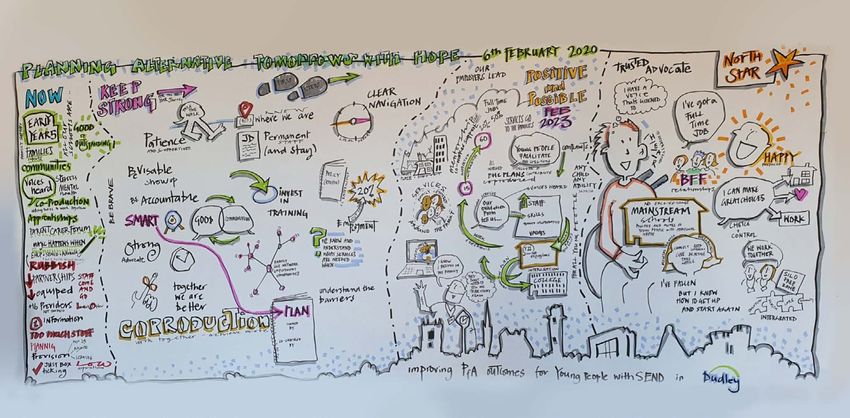
with the co-produced North Star.
Children and
young people's
Page 4 allianceIt is well recognised that young people / adults with SEND may require additional support or reasonable adjustments to be made under the Equality Act 2010
to achieve their individual aspirations. Dudley has high aspirations for all young people / adults with SEND and is working and co-producing with young people,
their parents and carers to develop opportunities and access to:
• ongoing training,
• employment opportunities
• independent living
• good healthcare across children’s and adult services
• Maximise independence/ wellbeing and active and meaningful participation within local communities.
The PFA Governance Group has been established since Feb 2020. Its purpose is to ensure that in order to develop the opportunities and access described
above, the development of the PFA task and finish groups under the following focus areas:
• Review and strategy
• Working Together to develop Operations and Processes
• Developing provision for Post 16 and Post 19
will enable the aspirational nature of the SEND reforms for young people and adults with SEND to be realised in practical and tangible ways as we work in a
person-centred planning framework.
This strategy is geared to deliver necessary changes and improvements to service provision so that Dudley can deliver the jointly identified North Star. Dudley’s
vision is to support children, young people, adults with SEND and their parents / carers starts from birth to twenty five years of age and it is the Dudley
aspiration that children with SEND as they journey through adolescence are enabled to access the right support at the right time to achieve independence and
wellbeing. It is important that all key partners from Health, Social Care and Education including early year’s providers, as well as the wider stakeholders that
include colleges, employers and their families and carers encourage these ambitions and outcomes to be achieved.
Children and
young people's
Page 5 allianceYoung people and young adults with SEND need to feel in control and supported in both their decision making and navigating systems with their Families /
carers until such time when they as young people and young adults with SEND are able to make their own decisions in line with the Mental Capacity Act 2005
please see Appendix 1 for more on the MCA
With the right support and access to appropriate information and advice, young people and adults with SEND can build their confidence and maximise their
independence to be fully participative and have control and choice in their lives. Therefore, the Local Offer and adult advocacy services will provide a range of
clear post 16 to post 19 options that families can analyse and interrogate to make sure they get the right support. It is recognised that some support will be very
individual and for other individuals with high level and complex needs it may be more related to the improvement of a person’s quality of life, autonomy and life
experiences and that of their parents / carers.
This strategy sets out the Dudley vision and intended outcomes, key priorities and indicators that will provide the framework for all services working with young
people and adults with SEND and their parents, carers and families in preparation for adulthood. The performance indicators will be measured, reviewed and
monitored by the Dudley SEND Oversight group (SOG) reporting to the Children and Young People’s Alliance Board and the Health and Wellbeing Board.
Governance and Accountability will also be provided via the Health and People Scrutiny Committee’s.
Children and
young people's
Page 6 allianceWhat is Preparing for Adulthood?
Preparing for Adulthood (PfA) is about enabling and empowering, children, young people and adults with SEND as well as their families
and or carers to prepare for a seamless transition from children’s through to adulthood. This seamless way of working will be instrumental
in underpinning the four pillars of the PfA principles of the following:
• Opportunities to access further education, employment.
• Independent living including access to supported living
• Full inclusion and active participation in local communities as an equal citizen.
• To be supported to build relationships and friendships
• To maintain health and wellbeing with reasonable adjustments in place as appropriate to support the access to mainstream health provision and services.
These principles will mean young people and young adults with SEND will need to acquire the skills and knowledge they need to access ongoing education,
pursue vocational opportunities and supported employment. In addition, they will have to develop the skills, abilities and confidence they need to maximise
/ promote their independence and wellbeing. This includes independent travel training, life skills, and management of finances, daily living skills and building
positive sustaining relationships with friends into adulthood.
This is an exciting time for children, young people and adults with SEND to become young successful active and participating citizens, being involved in
inclusive, living, contribution and participating in local communities like their non-disabled peers and finally accessing and maintaining good health and
wellbeing through better and timely accessibility to health services by utilising health passports thereby avoiding unnecessary delays to the right, type of health
support and interventions.
By working in partnership across children’s and adults, we will ensure that appropriate advice, information is made available in accessible formats for young
people and young adults with SEND and their carers.
Children and
young people's
Page 7 allianceWhat is Transition Planning?
Transition planning is about all stakeholders working in partnership with young people and adults with SEND and their families and carers
to plan and prepare from an early age to think about what it means to be an adult.
Legally, we must start the planning process from year 9 (age 14 years old). This is a key stage in a young person life and a milestone in key services being
galvanised around them, from their schools, key worker, social worker, SENCO, connexion worker, therapy service worker and any other relevant persons. This
transition phase enables much more engaging and positive experiences that builds confidence, promotes and maximises independence and allows things that
will take a long time to put in place in a timely manner (such as housing, if needed).
The work of the PfA Operational and Processes group will clearly describe how the transition phases will be outlined so that the young person and adult with
SEND will know of the expectations from year 9, who is involved and what the expected outcomes should be along that PfA pathway. We realise that the
development of every young person and adult with SEND will differ in line with their needs and aspirations and so a personalised approach is required to ensure
that plans, pathways and services are able to meet individual and very specific needs on a consistent and coherent basis following an established and agreed
operational process.
For many young people and adults with SEND, transition planning will be part of the EHCP (Education, Health and Care Plan), and will combine with other
pathway planning for either Children Looked After (CLA), as well as children with Continuing Health Care Needs. These plans should be reviewed at the same
time, to maximise the ‘tell it once’ approach and be updated on an annual basis with the young person and adult with SEND, their families, carers and other key
partners.
The SEND Code of Practice details the way in which Annual Reviews are to be conducted and the processes to be followed. As stated earlier, the EHCP is
undertaken within a person-centred framework and these reviews needs to be undertaken in an appropriate way for each individual so that they remain at the
heart of the planning process. Key to good decision making will be access to a timely and appropriate information and advice. So that independence, choice
and control are maximised. Services such as SENDIASS will ensure in line with the SEND Code of Practice that impartial information and
advice are made available to promote choices and access.
Children and
young people's
Page 8 allianceOur aim is to increase the numbers of young people/ adults (16-25) with SEND in Dudley to access employment, apprenticeships, supported employment
or training. Within this, it is key to ensure that ‘raising the age of participation’ for 16-18-year olds (the statutory requirement for all young people to stay in
education or training) is available and accessible for learners with SEND. As part of the Written Statement of Action, we will use that PfA Provisions group to gap
and map what provisions need to be developed post 19 and work alongside a range of stakeholders to increase that offer of provisions to meet differing needs.
Within legislation there is no automatic entitlement to continued support at age 19, nor an expectation that those with an EHCP should stay in education until
the age of 25. The intention of the multi-agency PFA (16-25) pathway for young people and adults with SEND will enable participation in learning (be it formal
education or vocational opportunities) until at least their 18th birthday, with a suite of possible employment-related programmes available once a young person
approaches the age of 19, for those who wish to and are able to access them.
We recognise that some young people and adults with SEND will require longer to achieve their education and training outcomes to enable them to prepare for
adulthood in a meaningful way.
The Transition Planning process should fully consider and take into account the following:
• Physical, psychological, emotional and social needs including how the young people can be best supported through the process
• Communication needs and how these will be accommodated
• Mental Capacity and any decisions that might be needed to be made in an individual’s best interest if the young person lacks capacity to make the
decision(s) in question
• Advocacy, peer support including coaching and mentoring.
• The role of Assistive and mobile technology.
• Access to the right information at the right time in the most appropriate format.
Children and
young people's
Page 9 allianceKey Statutory Responsibilities Under Legislation:
Care Act 2014
The Act recognises that transition into adult care and support comes at a time of significant change in a young person’s life and
advises on the importance of effective person- centred planning as being essential to support people to prepare and move forward into
adulthood, and to ensure that young people are supported to achieve their full potential.
The act is clear in that the transition assessment should be carried out when it is of “Significant Benefit” to the young person and recognises that this will
differ for all young people and relate to the individual circumstances at this time. The transition assessment should also be undertaken when a young person
or their carer is identified as likely to have needs for care and support under the act, when they or the person they care for moves into adult care. However,
it is recognised that good transition planning with young people should commence from year 9 (14 years old) up until they reach 18 years old. The transition
process should support young people and carers to access good advice, information and support in a timely manner to reduce anxieties, facilitating a smoother
transition from children into adult care.
The Care Act states that all transition assessments must include an assessment of:
• current needs for care and support and how these will impact on wellbeing;
• whether the child or carer is likely to have needs for care and support after the child in question becomes 18;
• If so, what those needs are likely to be, and which are likely to be eligible needs;
• The outcomes the young person or carer wishes to achieve in day-to-day life and how care and support (and other matters) can contribute to achieving
them.
Children and
young people's
Page 10 allianceTo achieve these outcomes for young people the Act places a duty on professionals from a range of agencies to co-operate and engage with families, friends
and the wider community to work together to achieve the best outcomes for young people and carers. This is aimed to achieve the meeting of individual
aspirations and empowering young people to reach their full potential.
It is envisaged that with effective transition planning that not all young people will need to access adult social care. Enabling young people and their families to
access sound advice and information to support decision making in a timely manner will give opportunities for more solution focussed interventions that aid
planning and aim to prevent, reduce or delay the development of need for care and support.
Effective and efficient transition processes commencing from year 9 will enable Dudley MBC children’s and adults services to clearly understand the needs of
the young people in Dudley, and for the effective forecasting of future demand to take place that informs local commissioning strategies and plans for young
people and their carers. This will assist in developing the marketplace and identifying appropriate resources locally and in a person–centred way. The transition
assessment relates to the assessment of care and support needs for young people, young carers and adult carers of the young person.
Children and Families Act 2014 and SEND Reforms
The Act details the need for a comprehensive birth to 25 special educational needs and disability (SEND) system, giving new rights and protections to 16-25-
year olds in further education and training – as outlined in the new DfE SEND Code of Practice. This PfA Strategy focuses on young people and adults who
have SEND within those definitions as outlined in the SEND Code of Practice. Some will have an Education, Health and Care Plan (EHCP) to support their
needs but we recognise that many young people and adult’s SEND needs can be met without the need for a formal EHCP. With regards to post 16 SEND
provision, the SEND Code of Practice states
“Local authorities (LAs) have a strategic leadership role in fulfilling their duties concerning the participation of young people in education and training. They
should work with schools, colleges and other post-16 providers, as well as other agencies, to support young people to participate in education or training and
to identify those in need of targeted support to help them make positive and well-informed choices”
Children and
young people's
Page 11 allianceSEND Code of Practice (2015), Chapter 8
Legislation states that all relevant agencies (Education, Health and Social Care (children and adults); education/training providers and voluntary sector
organisations- should work together to ensure that young people with SEND are given the same opportunities to achieve their aspirations as their non-disabled
peers. Local Authorities must have regard to:
• The view’s wishes and feelings of the child or young person, and the child’s parents/carers.
• The importance of the child or young person, and the child’s parents, participating ‘as fully as possible’ in decisions and being provided with the information
and support necessary to enable participation with those decisions.
• The need to support the child or young person and the child’s parents/carers in order to facilitate the development of the child or young person and to help
them achieve the best possible educational and other outcomes, preparing them effectively for adulthood.
Children and Families Act 2014, Section 19
The strategy focuses on how Dudley will improve outcomes for post 16 learners with SEND through access to appropriate, high quality opportunities for further
education, training and/or employment, supported by a multi-agency approach to meeting needs. It is only through this integrated approach that we can meet
Preparing for Adulthood objectives of:
• Independent/Supported Employment,
• Independent/Supported Living,
• Being an Active Member of the Local Community
• Having Good Health.
Children and
young people's
Page 12 allianceThe NHS Long Term Plan
The Long-Term Plan, also known as the Ten-Year Plan, builds on the policy platform laid out in the NHS five-year forward view (Forward View) which articulated
the need to integrate care to meet the needs of a changing population.
There is a strong focus on children and young people’s health as one of the clinical priorities, chosen for their impact on the population’s health and where
outcomes often lag those of other similar advanced health systems. Thus, in addition to the focus on maternity and neonatal services, specific commitments
are included to improve outcomes for children with cancer, increase support for children with learning disabilities and autism and improve children and young
people’s mental health services. A new children and young people’s transformation programme will oversee the delivery of the commitments relating to children
and young people.
The plan commits to a significant expansion of services for children and young people in line with the proposals outlined in the Green Paper on young people’s
mental health – for example, the creation of ‘mental health support teams’ in schools. To support these changes, the plan mandates that investment in children
and young people’s mental health provision will grow faster than the overall NHS budget and total mental health spending. These commitments will be
delivered by developing new models of care.
There are two significant commitments to developing these new models of care. The first is to create a comprehensive offer for children and young people,
from birth to age 25, with a view to tackling problems with transitions of care. The second is to redesign core community mental health services by 2023/24,
reinforcing components such as psychological therapies, physical health care and employment support, as well as introducing personalised care and restoring
substance misuse support within NHS mental health services. These commitments will be backed up by new waiting time standards covering emergency
mental health services by 2020 and children and young people’s mental health services.
There is also a strong focus on improving care for people with learning disabilities and autism. Commitments include increasing access to support for children
and young people with an autism diagnosis, developing new models of care to provide care closer to home and investing in intensive, crisis and forensic
community support. The aim is that, by 2023/24, inpatient provision for people with learning difficulties or autism will have reduced to less than half of the
2015 level.
Children and
young people's
Page 13 allianceTo enable these changes, the long-term plan calls for a ‘fundamental shift’ in the way that the NHS works alongside patients and individuals. Highlighting the
need to create genuine partnerships between professionals and patients, it commits to training staff to be able to have conversations that help people make the
decisions that are right for them. There is also a commitment to increasing support for people to manage their own health, beginning in areas such as diabetes
prevention and management. This forms part of a broader cultural change, moving towards that has been described as a ‘shared responsibility for health’.
As part of this shift, the plan focuses on personalisation. There is a commitment to rolling out the NHS comprehensive model of personalised care and referrals
to social prescribing schemes will increase, broadening the range of support available, and the roll-out of personal health budgets will be accelerated.
The plan also includes a welcome focus on supporting carers. This includes introducing quality markers for primary care, highlighting best practice in identifying
carers and providing them with appropriate support. It also encourages the national roll-out of carer’s passports, which enable staff to identify someone as a
carer and involve them in the patient’s care and promises a more proactive approach to supporting young carers.
Children, young people and their families must be involved in discussions and decisions about their individual support and local provision. The right to make
requests and decisions under the Mental Capacity Act will apply directly to disabled young people and those with SEN over compulsory school age rather than
to their parents.
Equality Act 2010:
This Act is in place to protect and prohibit against the discrimination of people with protected characteristics that are specified in section 4 of the act. Disability
is one of the defined specified and protected characteristics, so this act applies to protecting disabled people in a range of circumstances. This covers the
provisions of goods, facilities and services including access to public and community services.
Mental Capacity Act 2005
The Act covers young people /adults from the age of 16 years old and at the heart of this act are five key principles that underpin this statutory legislation.
Please see Appendix 1
Children and
young people's
Page 14 allianceKey Actions to Deliver Priorities
Below are some of the key actions/priorities to measure performance against the four key pillars of the Preparing for Adulthood
Outcomes (PfA) for young people / adults with SEND here in Dudley:
• Education and Employment: Being supported to take part in learning, training and employment
• Community Inclusion: Making a positive contribution to their community,
• Independent Living: Experiencing independence and Independent living
• Health and Wellbeing: Enjoying healthy living and lifestyle.
A more detailed action plan will be designed, agreed and will sit alongside this strategy. It will be overseen and governed by the SEND Improvement Board.
• Education and Employment: We will ensure that there is a three-year post 16 offer and one-year post 19 offer of academic learning to prepare all
SEND young people/adults for the PfA pathway. Where progression is evident and further time is needed to achieve their outcomes, then ongoing
academic learning opportunities will be agreed. In addition, we will increase the opportunities for young people / adults to access supported internships,
apprenticeships and other vocational and or training/ mentoring opportunities which can lead to employment.
In order to know how we are making an impact, we will:
• Evaluate experiences of post 16 education, training and employment and whether this has made a positive difference to their life and the lives of their families
through regular surveys and monitoring progress of destination into university of work.
• Have mechanisms in place to ensure young people/ adults with SEND have access to the right learning, training and employment opportunities through
annual provision mapping and commissioning plans.
• Increase number of Supported Internship Placements by developing the Supported Internship Programme schedule.
Children and
young people's
Page 15 alliance• Increase number of individuals with SEND accessing supported employment and volunteering opportunities.
• Increase the number of young people going into paid work in the open labour market
• Measure the number of organisations providing supported employment and volunteering opportunities, appropriately matched to meet individual skills.
• Work collaboratively with key stakeholders to develop a pool of trained job coaches.
• Promote Dudley as a borough that values a diverse work force in order to increase the numbers of employers to make adjustments to their recruitment
practices in order to offer supported internships, apprenticeships and paid jobs for SEND adults.
• Develop the commissioning framework that increases local provision with local Educational providers to meet the specific training needs of complex SEND
young people and adults with an emphasis on promoting and maximising independence in their local community.
• Support local Education providers to develop their post 16 education offer to have a clear PfA Pathway that enshrines work related activity as a core aim of
many its programmes to promote independence into adulthood
• As a council enhance our approach as a disability confident employer and promote this to other organisations.
Community Inclusion: Developing and creating opportunities for young adults to live more independently in local communities.
In order to know how we are making an impact, we will:
• Measure the uptake of the Dudley Local Offer website and individuals attending the local offer consultation / development events.
• Continue to work in with young people/adults, parents, carers and other professionals to produce accessible information via the Dudley Local Offer website
and other council websites in a range of accessible formats.
• Provide opportunities for young people/adults with SEND to develop and maintain meaningful relationships with other people into adulthood, prior to them
leaving education
• Actively work with young people to find ways to link them with community groups that are relevant to their interests and preferences
• Support young people / adults with SEND to have friends, relationships and inclusion in local communities. To be supported to lead ordinary lives,
to participate ad make a positive contribution to the local community they live in.
Children and
young people's
Page 16 allianceIndependent Living: To promote and maximise independence, by enabling, empowerment and offering appropriate support.
In order to know how we are making an impact, we will:
• Deliver Person Centred approaches to assessment and care / support planning that meet individual needs, with clearly defined aspirational outcomes.
• Develop and create opportunities for young adults to live more independently in local communities.
• Ensure access to enablement to promote and maximise skills and abilities towards independence including independent travel training.
• Develop local community resources to further develop independence and inclusion and measure their performance against the preparing for adulthood
outcomes.
Health and Wellbeing: Enable young people/adults to access mainstream health provision with reasonable adjustments in place to support the process.
Ensure that all children and young people who are eligible are accessing annual health checks. Promote the use of clear health action plans and ensure, advice,
information and support are available to promote and maximise health and wellbeing.
In order to know how we are making an impact, we will:
• Increase the numbers of learning disability health champions, trained in health coaching and prevention.
• Encourage families to ask for their child to be included in the GP’s all age learning disability register
• Encourage families to inform their GP surgery that they have caring responsibilities for a child with SEND
• Work to ensure all young people who are likely to need adult health care services owing to a long-term health condition have a health transition plan by the
time they are 16 if earlier if appropriate
Children and
young people's
Page 17 alliance• Encourage young people/adults with SEND to share their experiences to develop the confidence and talent of their peers with SEND.
• Ensure that joint commissioning arrangements are in place across Children and Adult services to support people with SEND aged 16 to 25.
• Explore opportunities for accessing personal health budgets as appropriate.
• Provide support to young people/adults with mental health issues to access appropriate mental health support to maintain their mental health and wellbeing.
• Ensure that we have learning disability champions within health services to advise health staff and hospitals in relation to accessibility and the provision of
reasonable adjustments for children and young patients, parents and carers with learning disabilities and Autism.
• Constantly review as part of the SEND improvement board progress and identify where improvement needs to be made.
• Enable Young adults to access mainstream health provision with reasonable adjustments in place to support the process. Clear health action plans in place,
timely and appropriate advice, information, and support to promote and maximise health and wellbeing in a range of formats.
Children and
young people's
Page 18 alliancePreparing for Adulthood Action Plan, Aspirational
Outcomes and Key Priorities for Young People/Adults
with SEND 14 -25 Years
The agreed outcomes within this strategy will be delivered via the Dudley PfA action plan which will be developed through collaboration
with stakeholders and overseen by the PfA Governance group. The remit of this group will be to ensure identified PfA outcomes are
delivered, embedded and monitor performance against the agreed KPI’s.
The development of an integrated performance dashboard will be central to seeking assurances from key stakeholders on performance. The overarching
objective for the PfA Governance Group for Dudley is to ensure that the collective is developing and seeking continuous improvements for the benefit of our
CYP and the delivery of stipulated PFA outcomes.
To deliver the key actions as outlined in the PfA Strategy / we will:
• Develop the preparing for adulthood strategy and approach for Dudley Borough that covers Education, Health and Social Care.
• Provide the performance data that measures progress and informs better demand / provision management. A multi-disciplinary approach will be
underpinning the strategic focus on delivering successful transitioning, be this on a whole system wide basis or individual.
• Measure the percentage of individual EHCP outcomes with evidence of progress / achievements in relation to promoting / maximising independence.
Children and
young people's
Page 19 alliance• Provide a year on year target for getting more young people with SEND into paid jobs and maintaining their employment
• Ensure that we have peer mentoring and buddying systems in place across services with evidence to measure success and effectiveness.
• Measure the numbers of young people/adults with SEND accessing appropriate housing provision.
• Identify the number of young people/adults with SEND who will require independent living and work with partners to deliver a pipeline of suitable housing
options in a timely manner
• Improve the number of leisure facilities where training has been provided and a designated champion for young people/adults with SEND is in place.
• Increase the numbers of learning disability health champions, trained in health coaching and prevention, including life coaches.
• Increase the numbers of young people/adults with SEND who have undertaken independent travel training and provide an analysis of outcomes to drive
improvement.
• Ensure transition journeys begin in line with best practice for individuals at the age of 14 that they receive a yearly review in line with their EHCP reviews.
• Measure the numbers and percentage of outcomes set at every EHCP / Transition review from year 9 onwards, that support the 4 preparing for Adulthood
outcomes. (PfA).
Children and
young people's
Page 20 allianceDudley Preparing for Adulthood Strategy 2020-2025
Outcomes and Priorities
To develop the Making a positive contribution to To ensure communication is
To increase To increase Send Vision for Dudley - their communities
Post 16 Education effective and in appropriate
the choice and access to We are committed to: formats. Communication
offer. To increase
opportunities for employment
the number of Dudley is an inclusive borough To hear the voice of Young People/ passports to be in place.
Young People/ and build
apprenticeships, where children young people Adults their parents/carers and
Adults who wish disability
internships and (and adults) with SEND thrive, challenge poor practices across
to go onto further confident
volunteering education, health and social care. To work in co-production
education. employers. are empowered to realise their
opportunities. and fully enable the voice
aspirations and achieve their
of experience, to shape/
full potential through quality To be supported to have friends,
develop future provision
support and provision where relationships, participation and
Enabled, empowered and being supported to take part in and servicesfor people with
everyone aims for excellence. inclusion in local communities.
learning, training and employment opportunities SEND.
Enabled to lead ordinary lives.
All individuals with complex health needs Healthy Living Priorities and maximise Develop peer/budding and mentoring approaches
To offer advice, have a clear health action plan/passport. independence including lifestyle coaches.
information
and guidance To ensure that Young Person centred To develop and create opportunities for Young People/
in appropriate To ensure that there are People/Adults have approach to support. Adults to live more independently within local communitites.
and accessible opportunities to develop self access to mainstream
formats esteem and confidence. To build health provision with To have access to enablement that maximise skill and abilities. To promote and maximise
including via the resilience to promote and maximise reasonable adjustments independence, inclusing access to travel and training.
Dudley website independence. in place to support this.
and the local
offer.
Children and
young people's
Page 21 alliancePFA Pathways We will: To: By: Measures:
Education and Promote a Help young people Working with education establishments, training • PCF PfA Annual Satisfaction
Employment culture in Dudley enter employment and providers and employers to: Survey
that encourages to gain greater choice, 1. Develop and increase local provision for complex • CYP Contact Satisfaction
and supports control, confidence, needs App
young people financial independence, 2. increase the number of employment opportunities • Dashboard (1-6)
with SEND stability, and role in the 3. increase the number of apprenticeships • Baseline – January 2021
to take part community. Increasing 4. increase the number traineeships/ volunteering • Current Position
in meaningful mental health and placements • Aim
learning, training, wellbeing and access to 5. increase the number Supported Internship (SI)
or employment wider social networks. programme placements
opportunities. Make sure that the three 6. Increase the number of training places available
year post 16 and one with post 16 training providers
year post 19 education 7. increase the support available to young people to
offer provides the young attract and sustain employment
people with the access
to full range of accredited
and valued qualifications.
Make the best use of the
PfA pathways for young
people with complex
needs across all partners
to enhance their life and
lifestyle
Children and
young people's
Page 22 alliancePFA Pathways We will: To: By: Measures:
Independent As partners we Make sure that young Working with young people, parents, families, and carers • PCF PFA Annual Satisfaction
Living will deliver the people with SEND can to prepare for adulthood at the earliest opportunity and Survey
Increased support and access increased range evidence their wishes and feelings throughout their life • CYP Contact Satisfaction
independent training in line of options for housing, course to maximise their chance of independent living App
living with with assessed greater choice with • PFA Housing Provision
greater choice need for each enhanced skills through Working with partners to develop robust and clear Dashboard
and control young adult an accommodation pathways for young people with SEND to access • Accommodation
with SEND to pathway. support and training, including travel, finances, managing • Travel Training
enhance their tenancy’s, relationships, and daily living tasks. • Daily Living tasks
independent Engage with young • Managing Tenancy’s
living skills, people earlier to better Working with housing services to identify suitable • Finance
confidence and understand the wishes of accommodation stock, adaptation options and • Baseline – Jan 2021
self-esteem and the individuals enabling a communicate a clear pathway for accommodation- • Current Position
endeavour to greater control over which based services • Aim
provide sufficient environment they want to
accommodation live in.
stock for
them to live
independently
where they are
able and have a
desire to do so.
Children and
young people's
Page 23 alliancePFA Pathways We will: To: By: Measures:
Community Create an Empower young people Working with community groups, activity providers • PCF PFA Annual Satisfaction
Inclusion environment with SEND to have and organisations to promote an inclusive way of Survey
where children, greater control over the delivering services and activities • CYP Contact Satisfaction
young people relationships they want Developing a culture of learning and sharing App
and adults with to maintain, develop, and amongst the partnership to invest in youth involving • NDTi Inclusion Web
SEND can get progress. with greater organisations so that they are skilled and confident
involved, take opportunities to meet to support individuals with SEND to access universal
part, and give and engage with other activity.
back to their CYP in a wider variety of Working with a range of partners to further develop
community settings to which access opportunities to get involved in ways that meet the
will be enhanced such as needs of young people to include
colleges, leisure centres,
clubs etc…, • Buddying
• Peer to Peer Mentoring
• Sharing lived experiences to influence future
service provision
• Volunteering
• Influencing decisions that affect them, their peers,
and their families
• To self-advocate
• To work in partnership with strategic decision
makers
• To socialise and have fun
Children and
young people's
Page 24 alliancePFA Pathways We will: To: By: Measures:
Health We will enable Ensure the young people All children and young people that are supported • PCF PFA Annual Satisfaction
and empower/ are involved very early by CCG commissioned services have a Care Survey
support on in their PFA journey in Management Plan. • CYP Contact Satisfaction
individuals to discussions and decision All children and young people have full participation App
achieve and making on their health in assessment and care planning (PHBs/HMP/ • Planned audit of Care
enjoy the best needs and plans. Support Plans. Management Plans
possible health Increased offer of Social Prescribing and use of • Reviewed at Contract
and wellbeing Make sure that the HERE4Youth. Review and Clinical Quality
Improved health young people and Review meetings to which a
and wellbeing families have clarity Developing integrated pathways specifically around PCF representation will be
and life chances on health pathways, LTCs, Mental health and LD. invited to.
Young people treatments, expected Ensure that all CYP with complex and multiple • Additional details to be
experience and health outcomes, who is health needs will be consistently provided with added to the Local Offer.
have access responsible for funding hospital passports which communicate their health • DIHC Clinical Advisory Group
to good health equipment, treatments, and support needs.
provision and assessments and
and have the how to access them.
necessary tools
to manage
health (health
passports,
annual health
(LD)
Children and
young people's
Page 25 alliancePFA Pathways We will: To: By: Measures:
Health Young people and families All CYP with a LD diagnosis registered with a Dudley • Transition arrangements
are more reassured that GP will have an Annual LD Health Check. are developed on and
there will be no cliff edge Explore the use of technology to support in the individualised and person-
when transitioning from increased uptake of LD health checks (post 14 centred approach to ensure
children health services years). the needs of the individual
onto adult health services. Encourage parent/carers to access the All Age LD are identified and the support
register and participate in LD health checks pre 14 required for that individual
Young people and their years. can be met
families experience • Transition arrangements will
improved positive The Dudley Integrated Care NHS Trust will ensure be developed jointly with
experiences within GP that within the clinical model and any developments the young person, family,
settings who are fully in transition arrangements within pathways will be primary care and education
aware of YP with SEND in line with NICE guideline NG43 ‘Transition from as appropriate
children’s to adults’ services for young people using • Fully involving the young
health or social care services. person to ensure they are
supported to make decisions
and choices to direct their
own care
• Involves planning, the
development of a transition
plan which is goals based
Children and
young people's
Page 26 allianceAppendices
Appendix 1: Mental Capacity Act 2005 - Key Principles.
Principle 1: A presumption of capacity.
A person must be assumed to have capacity unless it is established that he lacks capacity.
The right of all adults to make their own decisions and an assumption of capacity unless proved otherwise. This means that assumptions cannot be made in
relation to a young person’s, young carer or adult carer’s capacity based on their specific medical condition or disability.
Principle 2: Individuals being supported to make their own decisions.
A person is not to be treated as unable to make a decision unless all practicable steps to help him to do so have been taken without success.
A person must be given all practicable help before a decision is made that they are not able to make informed decisions. Every effort should be made to
support and encourage people to make their own decisions. If a person is deemed to lack capacity then they should be involved in the decision making, as far
as they are able to do so or with support.
Children and
young people's
Page 27 alliancePrinciple 3: Unwise decisions.
A person is not to be treated as unable to make a decision merely because he makes an unwise decision.
People have a right to make what may be regarded by other as unwise or eccentric decisions. Everyone has individual values, beliefs and preferences. This
does not mean that a person lacks capacity.
Principle 4: Best interests.
An act done or decision made, under this Act for or on behalf of a person who lacks capacity must be done, or made, in his best interests.
If a person is assessed as lacking mental capacity then any actions taken or any decision made for, or on behalf of that person, must be made in the individual’s
best interest.
Principle 5: Less restrictive option.
Before the Act is done, or the decision is made, regard must be had to whether the purpose for which is needed can be effectively achieved in a way that is less
restrictive of the person’s rights and freedom of action.
Decisions made on behalf of the person who lacks capacity must be the least restrictive options that interfere less with an individual’s rights and freedoms of
action or whether there is a need to make a decision or act at all. All interventions should be proportionate to the circumstances of the case and the specific
decisions to be made. All decisions and justification / rationale for decision making must be recorded.
Children and
young people's
Page 28 allianceChildren and
young people's
alliance
Unlocking our children and young people’s futuresYou can also read


