EBOLA VIRUS DISEASE Democratic Republic of the Congo - External Situation Report 31 - World Health Organization
←
→
Page content transcription
If your browser does not render page correctly, please read the page content below
EBOLA VIRUS
              DISEASE
              Democratic Republic of the Congo

                                      External Situation Report 31

Health Emergency Information and Risk Assessment   Page 1     WHO Health Emergencies Programme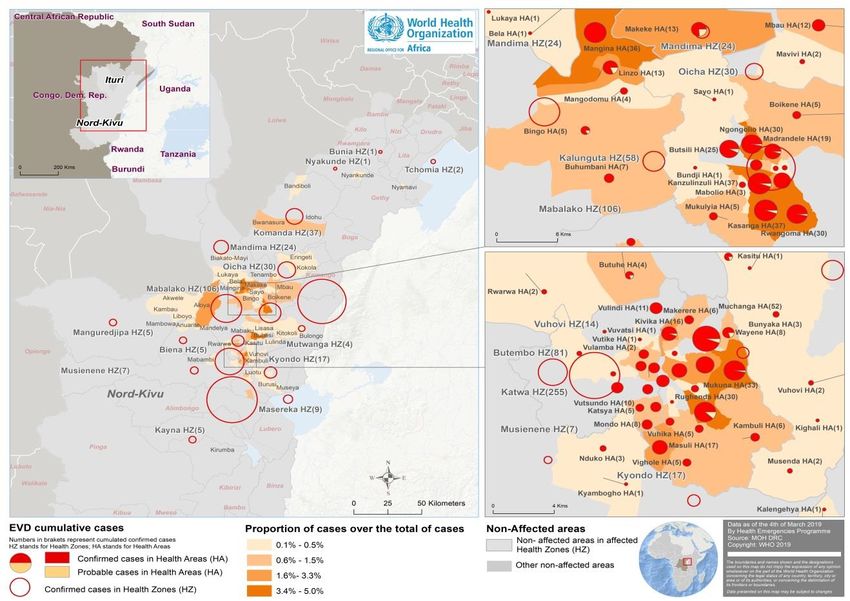
EBOLA VIRUS
                   DISEASE
                   Democratic Republic of the Congo
                            External Situation Report 31
       Date of issue: 5 March 2019
       Data as reported by: 3 March 2019
                                                                                               Cases   DeathsDeaths

     1. Situation update                                                                                 100
                                                                                               897         563

       The Ebola virus disease (EVD) outbreak in North Kivu and Ituri provinces, Democratic Republic of the Congo
       continues, as does the complex environment. Two Ebola treatment centres (ETCs) in Katwa and Butembo were
       successively attacked and burnt down during the week. These attacks, indicating a shift in insecurity, were the
       first such large-scale and organized attacks directly targeting the Ebola response. Patients from the destroyed
       ETCs have been temporarily transferred to the Katwa Transit Centre, managed by the Ministry of Health. The
       Butembo ETC was quickly rehabilitated to receive patients again.

       Since the last report on 26 February 2019, 25 new confirmed cases have been reported, with 15 additional
       deaths. As of 3 March 2019, a total of 897 EVD cases, including 832 confirmed and 65 probable cases, were
       reported from 19 health zones in the North Kivu and Ituri provinces (Table 1). Overall, cases have been
       reported from 119 of 301 health areas across 19 health zones. A total of 563 deaths were reported (overall
       case fatality ratio 63%), including 498 deaths among confirmed cases. Of confirmed and probable cases with
       reported age and sex, 57% (510/896) were female, and 30% (271/896) were children aged less than 18 years.
       Three new cases among health workers were reported during the week, bringing the number of health
       workers infected with Ebola virus to 72, with 24 deaths.

       Thirty health areas in eight of the 19 health zones affected to date have active virus transmission, reporting at
       least one confirmed case in the last 21 days (11 February to 3 March 2019) (Figure 1). Over this period, a total
       of 73 confirmed cases were reported from Katwa (44), Butembo (19), Kyondo (1), Vuhovi (1), Kalunguta (2),
       Beni (1), Mandima (4) and Rwampara (1)1. Trends in case incidence reflect that the outbreak is continuing,
       with most recent cases reported in the major urban centres of Katwa and Butembo, accounting for 86%
       (63/73) of cases reported in the last three weeks (Figure 1, Figure 2).

       The Ministry of Health (MoH), WHO and partners continue to monitor and investigate all alerts in affected
       areas, in other provinces in the Democratic Republic of the Congo and in neighbouring countries. To date, all
       reported alerts outside the outbreak affected areas have been investigated or laboratory tested to rule out
       EVD.

       1
           The case reported in Bunia on 13 February 2019 has been reclassified to Rwampara.

Health Emergency Information and Risk Assessment                              Page 2           WHO Health Emergencies Programme
Table 1: Ebola virus disease cases by classification and health zones in North Kivu and
     Ituri provinces, Democratic Republic of the Congo, as of 3 March 2019

                                                Case classification                        Deaths
                                                                                           Deaths in
                                                Confirmed Probable             Total                        Total
       Province             Health Zone                                                    confirmed
                                                cases     cases                cases                        deaths
                                                                                           cases
                            Beni                226             9              235         118              127
                            Biena               5               0              5           5                5
                            Butembo             83              0              83          43               43
                            Kalunguta           44              13             57          19               32
                            Katwa               245             11             256         181              192
                            Kayna               5               0              5           3                3
                            Kyondo              15              2              17          11               13
       North Kivu
                            Mabalako            90              16             106         54               70
                            Manguredjipa        5               0              5           4                4
                            Masereka            8               1              9           3                4
                            Musienene           6               1              7           2                3
                            Mutwanga            4               0              4           3                3
                            Oicha               31              0              31          19               19
                            Vuhovi              13              0              13          10               10
                            Komanda             27              9              36          9                18
                            Mandima             21              3              24          10               13
       Ituri                Nyakunde            1               0              1           1                1
                            Tchomia             2               0              2           2                2
                            Rwampara            1               0              1           1                1
       Total                                    832             65             897         498              563

       Note: Attributions of cases notified in recent days to a health zone are subjected to changes upon in-depth investigations

     Figure 1: Geographical distribution of confirmed and probable Ebola virus disease cases by
     health area, North Kivu and Ituri provinces, Democratic Republic of the Congo, 3 March 2019

Health Emergency Information and Risk Assessment                        Page 3                 WHO Health Emergencies Programme
Figure 2: Confirmed and probable Ebola virus disease cases by week of illness onset,
     as of 3 March 2019 (n=897)*

                             60
                                               Confirmed

                             50                Probable

                             40
           Number of cases

                             30

                             20

                             10

                             0
                                                                      25-Jun
                                                             11-Jun

                                                                               09-Jul
                                                                                        23-Jul
                                           14-May
                                                    28-May

                                                                                                                                                                                  10-Dec
                                                                                                                                                                                           24-Dec
                                                                                                                                                                                                    07-Jan
                                                                                                                                                                                                             21-Jan
                                                                                                 06-Aug
                                                                                                          20-Aug

                                                                                                                                                                                                                      04-Feb
                                                                                                                                                                                                                               18-Feb
                                  30-Apr

                                                                                                                            17-Sep
                                                                                                                   03-Sep

                                                                                                                                     01-Oct
                                                                                                                                              15-Oct
                                                                                                                                                       29-Oct
                                                                                                                                                                12-Nov
                                                                                                                                                                         26-Nov
                                                                                                                   Week of illness onset

       *Data are subject to delays in case confirmation and reporting, as well as ongoing data cleaning and
       reclassification – trends during recent weeks should be interpreted cautiously.

     2. Actions to date

        The MoH and other national authorities in the Democratic Republic of the Congo, WHO and partners are
       implementing several outbreak control interventions. Teams in the surrounding north-eastern provinces are
       taking measures to being response ready. Some of the latest activities are summarized below:

     Surveillance and Laboratory

                             Field and laboratory activities in many areas of Katwa were disrupted this week following insecurity.
                             Nevertheless, response teams remain in the place, and wherever possible, continue to intensify active
                             case finding in health facilities and communities, line listing and follow-up of contacts in health zones
                             with recently reported confirmed cases

                             Approximately 57 000 contacts have been registered to date and 5433 are currently under
                             surveillance as of 3 March 2019, of whom between 81-85% have been followed in the past seven
                             days. Additional resources are being put in place, including mobilizing local leaders, to improve the
                             coverage of daily contact monitoring and overcome the challenging security situation and community
                             non-engagement.

Health Emergency Information and Risk Assessment                                                                               Page 4                                    WHO Health Emergencies Programme
An average of 710 alerts were received per day over the past seven days, of which an average of 673
(95%) were investigated within 24 hours of reporting.
There are currently eight laboratories with Ebola virus diagnostic capacity operational in Democratic
Republic of the Congo (Mangina, Goma, Komanda, Beni, Butembo, Katwa, Bunia and Kinshasa). All the
laboratories are using automated polymerase chain reaction (Cepheid Xpert Ebola) as the primary
diagnostic tool. A new laboratory is being deployed to Kayna to serve the ETC there.
The number of tests performed per week reached 1500 during the past week. Additional GeneXpert
instruments have been shipped to Democratic Republic of the Congo to augment the number of tests
that can be performed. A stock supply of over 9000 Xpert Ebola cartridges has been established.
A laboratory with the capacity to sequence whole virus genome in eight samples/day has been
established in Katwa to support virus transmission chain analysis.
Case management
On 24 November 2018, MoH announced the launch of a randomized control trial (RCT) for Ebola
therapeutics. The RCT is now enrolling and treating patients at ETC sites in Katwa, Beni and Butembo.
This is ongoing, with all confirmed cases in ETCs receiving therapy under the compassionate use
protocol, together with supportive care. To date, 66 patients have been enrolled in the RCT and 334
patients have received therapy under the compassion use protocol.
Care was re-started at the Butembo ETC with 12 confirmed and 2 suspected cases transferred from
the Katwa Transit Centre (TC) to the Butembo ETC.
Extension work on the Katwa TC is underway, with the number of beds increased from 10 to 22.
Infection prevention and control (IPC) and Water, Sanitation and Hygiene (WASH)
A revised IPC strategy with an operational work plan for the February to May 2019 period has been
endorsed by MoH. The strategy and work plan are intended to guide the national coordination
activities of the Ebola response’s IPC Task Force, and the implementation of activities by the IPC
commissions and partners at the subnational level.
Extensive IPC activities are ongoing in affected areas, which include but are not limited to:
decontamination of households and health facilities with confirmed cases; briefings and training of
healthcare providers, including those working in private healthcare facilities and tradi-modern
facilities, and distribution of IPC kits, which include consumable items such as personal protective
equipment.
Points of Entry (PoE)
Point of Entry/Point of Control (PoE/PoC) screening continues, with 211 743 travellers screened on 3
March 2019, bringing the cumulative number of screenings to 40.4 million. A cumulative total of 499
alerts were notified, with 189 validated, among which 6 cases were laboratory confirmed.
From 25 February to 03 March 2019, 1 727 318 screenings were performed, of which 23 alerts were
notified and investigated, four subsequently validated and all the validated alerts were EVD negative
after the laboratory test.
Health Emergency Information and Risk Assessment Page 5 WHO Health Emergencies ProgrammeRoutine supervision of day to day PoE/PoC operations continued in Goma, Beni, Bunia and Butembo.
PNHF national supervision were deployed to Beni this week, to enhance supervision and continue the
training of front-line workers.
The security situation continues to deteriorate around Butembo and Katwa. The local screeners were
threatened, and screening activities disrupted by vandals on 3 March 2019. This resulted in the
interruption of screening at these PoCs. Furthermore, in Beni, there was an attack at Mavivi PoC on
25 February 2019 by armed men who destroyed the water tank.
WHO, IOM and PNHF are updating the data collection tools to streamline the revised SOPs to
integrate contact tracing at priorities PoEs and PoCs.
Frontline workers at PoC/PoEs are becoming impatient due to delay in payments, with several
workers in various territories of North Kivu and Ituri provinces going on strike from the 1 February
2019. Delay in funding under the Strategic Response Plan 3 continues to hinder PoE/PoC activities –
IOM funds were exhausted in January 2019 and current activities are being conducted using a loan.
South Sudan
IOM continues to support active screening at nine PoEs: Yei airport, Yei SSRRC, Tokori, Kaya, Okaba,
Khorijo, Pure, Bazi and Salia Musala (newly added) with approximately 11 500 screenings performed
this reporting week. There have been no alerts for EVD in the reporting period. Fever was the primary
symptom identified at screening. Travelers with fever were referred to the local health facilities for
further assessment (in many cases, malaria was diagnosed. IOM plans to support additional nine PoEs;
assessment and preliminary works are underway.
See latest sitrep from IOM South Sudan for 11-17 February 2019: https://southsudan.iom.int/media-
and-reports/other-reports/ebola-virus-disease-evd-preparedness-update-8-18-24-feb
Uganda
On the Uganda-DRC border, there was a significant drop in movements recorded at IOM Population
Flow Monitoring points between 10-12 February 2019 due to an increase in the immigration fee
required by the border authorities in Democratic Republic of the Congo, which was quickly readjusted.
Travellers coming from Beni into Uganda are mostly passing through Busunga, Madepo and Mpondwe
on the Ugandan side.
From 01-15 February 2019, most of movements observed at IOM Population Flow Monitoring points
on Uganda-South Sudan border were short term movements of one day to a week (70% of all
movements observed), mostly due to economic reasons and purchase of goods. Elegu observed high
flows of population fleeing conflict in Jonglei and Bahr el-ghazal in South Sudan. The reopening of the
school term in Uganda saw an increase in the number of young people crossing into Uganda to attend
school.
See latest sitreps from IOM Uganda for 1-15 February: http://uganda.iom.int/publication/iom-flow-
monitoring-dashboard-ugandadrc-border-1-15-february-2019 and
http://uganda.iom.int/publication/om-flow-monitoring-dashboard-ugandasouth-sudan-border-1-15-
february-2019.
Safe and Dignified Burials (SDB)
As of 4 March 2019, a total of 2860 SDB alerts have been received, of which 2302 were responded to
successfully (81%) by Red Cross, Civil Protection and CEHRBU SDB teams.
Health Emergency Information and Risk Assessment Page 6 WHO Health Emergencies ProgrammeBetween 24 February and 2 March 2019, 223 SDB alerts were received – 4% lower than the previous
week – of which 171 (77%) were responded to successfully, 7% higher than the previous week. At
least 39% (n=87) of the alerts were community deaths, 5% (12) for ETCs, and 56% (126) for non-ETC
health facilities..
Implementation of ring vaccination protocol
A total 585 community rings have been defined and vaccinated, including two targeted geographic
zones. In total, 85 341 contacts and contacts of contacts have been vaccinated (including health
workers and front-line workers). Of those who consented and were vaccinated, 21 511 are contacts
and 63 615 are contacts of contacts. The total consented and vaccinated includes 26 601 health
workers and front-line workers, while 21 135 are children between 1-17 years. In addition,
vaccination of health workers and front-line workers is ongoing in the neighbouring areas where
there is a possibility of spread. In Goma, 3896 health workers and front-line workers have been
vaccinated. In Uganda, 4852 health workers and front-line workers have been vaccinated. In South
Sudan 1138 health workers and front-line workers have been vaccinated. Vaccination is planned to
start in a week’s time in Rwanda and preparations are underway in Burundi.
Risk communication, social mobilization and community engagement
Since the recent attack on the two ETCs in Katwa and Butembo, WHO, UNICEF and partners have
been supporting the MoH in setting up platforms to directly dialogue with local politicians, key
community leaders and influencers, and pressure groups at health area levels in Katwa, Vihovi and
Kyondo health zones to better understand their needs and come up with a common understanding
and joint action towards stopping the Ebola outbreak.
Risk communication and social anthropologist teams have strengthened community engagement
activities in Katwa. Risk communication and community engagement orientation sessions were
organized for different pillars of the response to enhance capacity of RECOs and other Ebola response
personnel to address community concerns.
Risk communication and community engagement activities in other health zones, including Mangina,
Bunia, Beni, Oicha and Komanda continues, with a focus on communicating about the current
situation of the Ebola outbreak and the response.
In Oicha’s Tenambo health area, women eligible for the Ebola vaccine (as contacts or contacts of
contacts) were sensitized on the importance of vaccination. EVD awareness activities were carried out
for women in the market in Bwanasura, and for teachers from the Vutsundo health area. A visit to
Butembo ETC was organised for some community representatives to show them how patients are
being cared for in the treatment centre.
Preparedness and Operations Readiness
Operational readiness intensifies in North Kivu and Ituri provinces in the Democratic Republic of the Congo:
The coordination centre has moved from Kinshasa to Goma to be closer to the outbreak affected
areas. Operations in Beni will continue at full scale. Goma will provide a base for training of staff, and
eventually develop into a centre of excellence on Ebola.
Eight teams consisting of one WHO consultant and four MoH EVD experts each, were deployed this
week to North Kivu and Ituri (four teams in each province). The eight readiness teams will roll out a
minimum standard package of readiness activities in all 50 non-affected health zones of North Kivu
Health Emergency Information and Risk Assessment Page 7 WHO Health Emergencies Programme(18) and Ituri (32) provinces over the next six months, alongside local counterparts to transfer
capacity and harness the investment into long term development.
The one-year preparedness plan was updated with tailored plans for the high-risk non-affected
provinces for the period from February to July 2019 and is pending MoH review.
Operational readiness activities continue in countries neighbouring the Democratic Republic of the Congo:
The updated Regional Strategic Plan for Ebola Operational Readiness and Preparedness in Countries
Neighbouring the Democratic Republic of the Congo for the period from January to June 2019 was
launched on 25 January 2019. Approximately US$ 32 million has been mobilized for Ebola
preparedness since May 2018 and a budget gap of US$ 27 million remains for the next six months.
OCHA announced an early action CERF award of US$ 10 million which was allocated to Priority 1
countries for priority preparedness activities. So far funding for Burundi (US$ 2.4 million), Rwanda
(US$ 1.8 million), and South Sudan (US$ 2 million) has been approved, while Uganda (US$ 3.8 million)
is still under review.
A follow up Joint Monitoring Mission to assess progress in implementation of priority preparedness
activities in Countries Neighbouring the Democratic Republic of the Congo will be conducted in South
Sudan from 4-8 March 2019. Assessments are yet to be conducted in Angola and Zambia where there
are ongoing discussions with the MoHs to schedule the missions.
Operational partnerships
Under the overall leadership of the MoH, WHO is supporting all major pillars of the EVD preparedness
and response. WHO is working intensively with wide-ranging, multisectoral and multidisciplinary
national, regional and global partners and stakeholders for EVD response, research and preparedness.
Various international organizations and UN agencies, specialized agencies and non-governmental
organizations are involved in response and preparedness activities; the organizations and their specific
contributions have been previously reported. See this link.
WHO continues to engage the Global Outbreak Alert and Response Network (GOARN), Emerging and
Dangerous Pathogens Laboratory Network (EDPLN), Emerging Disease Clinical Assessment and
Response Network (EDCARN), and the Emergency Medical Team (EMT) initiative – as well as regional
operational partners and collaboration centres in Africa – to deploy experts and multidisciplinary
teams for the response, and to support intensive preparedness and readiness activities in
neighbouring and at-risk countries.
WHO encourages wider coverage of partner operations via this report in response to demand from our
planning teams. If you would like to see the activities of your agency or organization appears in the
report, please send an email to goarn@who.int.
SONAR-global conducted an exercise “Mapping social sciences research for the Ebola response in
Democratic Republic of the Congo and neighbouring countries”. See link - http://sonar-
global.eu/mapping-social-sciences-research-for-the-ebola-response-in-drc-and-neighboring-
countries/.
Health Emergency Information and Risk Assessment Page 8 WHO Health Emergencies ProgrammeIHR travel measures and cross border health
WHO advises against any restriction of travel and trade to the Democratic Republic of the Congo based
on the currently available information. WHO continues to closely monitor and, if necessary, verify
travel and trade measures in relation to this event.
A cross-border meeting was convened by the Ministry of Health of Uganda in Kasese from 11 to 13
February 2019 to discuss the PoE Toolkit and coordination among partners on both sides of the
border. The report will be released shortly.
3. Conclusion
The Ebola outbreak in Democratic Republic of the Congo continues with moderate transmission intensity. The
recent attacks on ETCs in Katwa and Butembo are a major setback. These events come at a time when
encouraging trends in case incidence were being observed. Indeed, as of 3 March 2019 there were no new
confirmed EVD cases detected for at least 21 days in 11 of 19 health zones, and ongoing clusters elsewhere
have remained relatively small outside of Katwa and Butembo. However, with reduced operations in several
areas, risks of further transmission, spread and potential for undetected chains of transmission in communities
remain very high. Despite these challenges, the Ministry of Health, WHO and partners will continue to sustain
proven and innovative public health responses wherever possible, while enhancing safety for responders and
patients.
Health Emergency Information and Risk Assessment Page 9 WHO Health Emergencies ProgrammeYou can also read


