Reducing health inequalities experienced by LGBTI people: what is your role as a health professional? - Health4LGBTI Training
←
→
Page content transcription
If your browser does not render page correctly, please read the page content below
Health4LGBTI Training

                       Reducing health inequalities
                       experienced by LGBTI people:
                       what is your role as a health
                       professional?

©Delpix/Shutterstock
Trans & Intersex
Health
Module 4

           © European Union, 2018
MAIN CONTENTS
1) Myths on trans and intersex people
2) Trans health
3) Intersex health

                  © European Union, 2018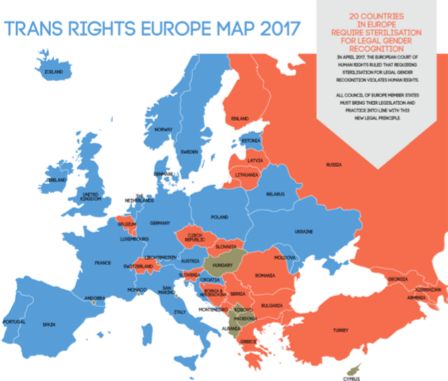
Module 4: Learning objectives
 After this module, participants will:

 ✓Have a greater awareness and improved knowledge of concepts in
  the field of gender identity and sex characteristics;
 ✓Be more familiar with the health needs of trans and intersex
  people;
 ✓Be aware of the standard of care and human rights of trans and
  intersex people.

                               © European Union, 2018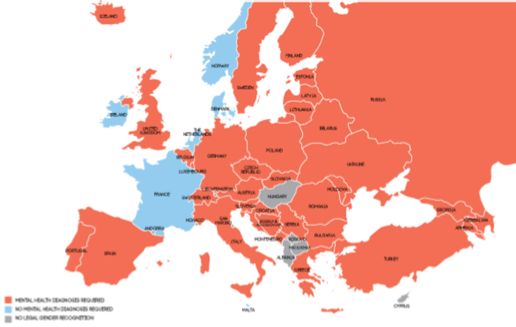
Background information
  The Assembly calls on member States to (...) provide information and training
        to education professionals, law-enforcement officers and health-service
  professionals, including psychologists, psychiatrists and general practitioners,
      with regard to the rights and specific needs of transgender people, with a
           special focus on the requirement to respect their privacy and dignity.
                               Council of Europe, Parliamentary Assembly, 2015

           National and international medical classifications which pathologise
  variations in sex characteristics should be reviewed with a view to eliminating
     obstacles to the effective enjoyment, by intersex persons, of human rights,
                 including the right to the highest attainable standard of health.
                        Council of Europe, Commissioner for Human Rights, 2015

                                © European Union, 2018
Please remember this is a
                                         confidential space!

Activity 1:
“To deconstruct myths”
20 minutes

             © European Union, 2018
“All trans people need psychiatric assessment”
What is your opinion?
Share it with the group, and
listen to other’s thoughts.
© European Union, 2018“Intersex children should undergo
cosmetic surgeries to avoid
discrimination”
What is your opinion?
Share it with the group, and
listen to other’s thoughts.
© European Union, 2018Teaching segment
Trans & Intersex health
An overview
© European Union, 2018TRANS HEALTH
Inequalities within healthcare services
• Trans people experience significant health inequalities with
healthcare services and providers
• Research reported negative interactions with health professionals
• Regardless of the setting, trans people feel they have to educate
healthcare providers
• 19% of trans people say they were discriminated against by
healthcare personnel in the last year (FRA, 2014).
© European Union, 2018TRANS HEALTH
Inequalities within healthcare services
Trans people were more likely to:
• have difficulties in gaining access to healthcare (TGEU, 2017);
• have to change a specialist on account of their negative reaction;
• receive unequal treatment when dealing with medical staff;
• forgo treatment for fear of discrimination;
• have specific needs ignored or inappropriate curiosity;
• feel pressure or being forced to undergo any medical or psychological
test (FRA, 2014).
• Increased openness to medical staff/healthcare personnel is linked to
more negative experiences and increased discrimination (FRA, 2014).
© European Union, 2018TRANS HEALTH
Inequalities within healthcare services
• Stigma, social exclusion, isolation and transphobia have a negative
impact and may cause dropouts
• Trans friendly and inclusive treatment is related to positive treatment
outcomes
• Research supports the requirement for training to educate healthcare
practitioners, to challenge prejudice in practice settings, and to
increase knowledge and competence on trans specific health needs.
(Lyons et al., 2015; FRA, 2014)
© European Union, 2018TRANS HEALTH
Well-being and mental health
• Research undertaken globally indicates considerably higher rates
of mental distress amongst trans people, related to stressors
such as discrimination, stigma, violence (Zeeman, 2017)
• Including:
– Higher rates of depression and anxiety;
– Significantly increased levels of suicidal ideation and suicide
attempts;
– Substance misuse.
• Impact of transitioning (Budge et al., 2013; Bailey et al., 2014)
© European Union, 2018Questions and comments?
© European Union, 2018TRANS HEALTH
Gatekeeping and diagnoses
Historical note
• Gatekeeping is the practice of imposing requirements which
control access to resources for trans people.
• It can be a challenge for both providers and patients (Bess & Stabb,
2009; Pinto & Moleiro, 2015)
“[Historically], the gatekeepers’ job was to sort out the “true”
transsexuals (who would be allowed to fully transition) from all
other trans people (who would be denied any medical intervention
other than psychotherapy).”
Julia Serano, 2007
© European Union, 2018TRANS HEALTH
Gatekeeping and diagnoses
Historical note
1975 “trans-
sexualism” (sic)
1980 “transsexualism”
included for the appeared in the
first time in the third edition of the
DSM
ICD
Since their first appearances, these diagnostic classifications have
changed various times, and - although the distress about one’s assigned
sex has remained the core feature of the diagnosis -, new diagnoses
were mostly used as if they were identical with the initial diagnosis of
transsexualism – which was often used as little else than a search for the
“true transsexual”. (Cohen-Kettenis & Pfafflin, 2010)
© European Union, 2018TRANS HEALTH
Gatekeeping and diagnoses
World Professional Association for Transgender Health, WPATH, 2011
• Gender nonconformity refers to the extent to which a person’s
gender identity, role, or expression differs from the cultural norms
prescribed for people of a particular sex;
• Gender dysphoria refers to discomfort or distress that is caused
by a discrepancy between a person’s gender identity and that
person’s sex assigned at birth (and the associated gender role
and/or primary and secondary sex characteristics);
© European Union, 2018TRANS HEALTH
Gatekeeping and diagnoses
“A disorder is a description of something with WPATH, 2011
which a person might struggle, not a description
of the person or the person’s identity.”
• Only some gender nonconforming people experience gender
dysphoria at some point in their lives;
• Some people experience gender dysphoria at such a level that the
distress meets criteria for a formal diagnosis that might be classified
as a mental disorder. Such a diagnosis is not a license for
stigmatization or for the deprivation of civil and human rights;
© European Union, 2018TRANS HEALTH
Gatekeeping and diagnoses
WMA, 2015
“The WMA [World Medical Association] emphasises that
everyone has the right to determine one’s own gender and
recognises the diversity of possibilities in this respect. The
WMA calls for physicians to uphold each individual’s right to
self-identification with regards to gender.”
“The WMA asserts that gender incongruence is not in itself a
mental disorder; however it can lead to discomfort or
distress, which is referred to as gender dysphoria.”
© European Union, 2018TRANS HEALTH
Gatekeeping and diagnoses
WPATH, 2011
• Treatment is available to assist people who are experiencing gender
dysphoria in exploring their gender identity and finding a gender role
that is comfortable for them;
• Treatment is individualized: What helps one person alleviate gender
dysphoria might be very different from what helps another person.
Hormones and surgery are just two of many options available to assist
people with achieving comfort with self and identity.
© European Union, 2018TRANS HEALTH
Standards of Care
World Professional Association for Transgender Health (WAPTH, 2011)
• The overall goal of the SOC is to provide clinical guidance for
health professionals to assist trans and gender nonconforming
people with safe and effective pathways to achieving lasting
personal comfort with their gendered selves, in order to
maximize their overall health, psychological well-being, and self-
fulfilment.
• This assistance may include primary care, gynaecologic and
urologic care, reproductive options, voice and communication
therapy, mental health services (e.g., assessment, counselling,
psychotherapy), and hormonal and surgical treatments.
© European Union, 2018TRANS HEALTH
Healthcare provision to trans people
Information about national context
https://www.ilga-europe.org/rainboweurope
© European Union, 2018TRANS HEALTH
Legal Situation
Sterilisation for Legal Gender Recognition (TGEU, 2017)
© European Union, 2018TRANS HEALTH
Legal Situation
Diagnosis for Legal Gender Recognition (TGEU, 2017)
© European Union, 2018Legal Gender Recognition in (insert here the name of the country
where the training is being conducted)
Information about national context
© European Union, 2018Questions and comments?
© European Union, 2018INTERSEX HEALTH
Who are intersex people?
Video:
https://ec.europa.eu/avservices/video/player.cfm?ref=I142954&lg=EN&su
blg=none
© European Union, 2018INTERSEX HEALTH
Who are intersex people?
Intersex individuals are born with physical sex characteristics that
don’t fit medical or social norms for female or male bodies. These
variations in sex characteristics may manifest themselves in
primary characteristics (such as the inner and outer genitalia, the
chromosomal and hormonal structure) and/or secondary
characteristics (such as muscle mass, hair distribution and stature).
ILGA-Europe, 2017
© European Union, 2018INTERSEX HEALTH
• Healthy intersex bodies are considered to be a ‘medical problem’ and
a “psycho-social emergency” that needs to be fixed by surgical,
hormonal, other medical and sometimes psychological means;
• In most cases, ‘normalising’ surgeries are not medically necessary and
can have extremely negative consequences on intersex children.
• In at least 21 EU Member States, sex ‘normalising’ surgery is carried
out on intersex children.
ILGA-Europe & OII Europe, 2015
© European Union, 2018INTERSEX HEALTH
“Intersex persons, in particular, have been subjected to cosmetic and
other non-medically necessary surgery in infancy, leading to sterility,
without informed consent of either the person in question or their
parents or guardians. Such practices have also been recognized as
human rights violations by international human rights bodies and
national Courts.”
World Health Organisation (WHO),
Office of the High Commissioner for Human Rights (OHCHR)
UN Women
Joint United Nations Programme on HIV/AIDS (UNAIDS)
UN Development Programme (UNDP)
UN Population Fund (UNFPA)
UN’s Children’s Fund (UNICEF)
© European Union, 2018INTERSEX HEALTH
“Human rights and intersex people”
Council of Europe Issue Paper (2015)
• Variations in sex characteristics of intersex people are currently
codified in medical classifications as pathologies or disorders,
usually referred to as ‘disorders of sex development’;
• “Normalising” interventions can result in self-harming and
suicidal behaviour;
• Although parents of intersex children are asked to provide their
proxy consent to the treatment, they are often ill-informed and
impressionable, and are not given adequate time or options
necessary to provide fully informed consent.
© European Union, 2018INTERSEX HEALTH
Access to general healthcare
• Lack of knowledge around intersex lives
• Difficulty in finding intersex-specific health services
• Critiquing widespread assumptions that intersex is an illness
which requires ‘fixing’
McGlynn et al., 2017
© European Union, 2018INTERSEX HEALTH
Access to general healthcare
• Access to general healthcare is often impaired by prejudices of
healthcare professionals and the refund policies of health
insurance companies.
• Disbelief, prejudices and disgust expressed by health care
personnel can lead intersex people to avoid seeking healthcare.
They can also lead health professionals to deny intersex people
access to health services, or to commit psychological and
physical abuse.
ILGA-Europe & OII Europe, 2015
© European Union, 2018INTERSEX HEALTH
Well-being and mental health
• There is a need for large-scale research into the psychological and emotional
wellbeing of intersex people, as well as the long-term impact of ‘normalising’
treatments for older intersex people.
• Younger intersex people report experiencing isolation due to stigma, bullying,
discrimination or rejection from family or peers. (Jones, 2016)
• Specialist long-term follow up services for intersex people should include
psychological support to address psychosexual, emotional and social wellbeing.
• Isolation may impact negatively on mental health: practitioners should advise
intersex people and their families to contact support groups/associations
© European Union, 2018Questions and comments?
© European Union, 2018Please remember this is a
confidential space!
“Role-play”
45 minutes
© European Union, 2018ROLE-PLAYING
Part 1 (15min)
In small group, discuss “Situation A” or “Situation B”, trying to answer to the following questions:
SITUATION A > ALEX
• What are the problems in both healthcare practitioners performances? Give specific examples.
• In this example, how the healthcare provision comply – or not – with international standards of
care? Give specific examples.
• How do you think Alex felt during this medical appointment?
• As a healthcare professional, what would you do differently?
SITUATION B > BIANCA
• What are the problems in both healthcare practitioners performances? Give specific examples.
• How do you think Maria and her parents felt during this conversation?
• As a healthcare professional, what would you do differently?
• Which impact do you think this approach by a healthcare professional may have on the rest of
Bianca’s life?
© European Union, 2018ROLE-PLAYING
Part 2.1
SITUATION A > ALEX
Alex is a trans man. He is 19 years old, and he socially lives according to his
identity since he was 15. Most of his colleagues and teachers at the university, and
also his friends and family, recognise him as a boy. Nevertheless, and although his
gender expression is noticeably “masculine”, he didn’t undergo any gender
confirmation treatment (e.g., hormones, surgeries…). Only now he is sure about the
changes in his body that he wants to accomplish. Moreover, for years he avoided to
resource to health professionals because of what he read online and heard from
other trans people, on the lack of competence and the prejudices of some
practitioners.
This is a role-play on the first appointment with a clinical psychologist,
expert in trans health, recommended to Alex by an online friend, John.
© European Union, 2018ROLE-PLAYING
Part 2.2
SITUATION B > BIANCA
Maria is 36 years old. For many years she dreamed about being a mother.
She is single, and doesn’t expect to be in a relationship soon. Maria decided to be a
single mother, with the use of medically assisted procreation techniques. Her decision
was supported by her family. The pregnancy went well, and the doctors said that she
was going to have a daughter. Bianca was the name that Maria chose to her baby.
When Bianca was born the doctors immediately noticed that the baby’s genitalia was
not common.
This is a role-play of the conversation that a doctor had with Maria on the
day Bianca was born.
© European Union, 2018Think of something that you have learned.
Think of something that you would put in
place after the training!
Share it with your neighbour.
© European Union, 2018© European Union, 2018 The reuse policy of European Commission. Reuse authorised. The reuse policy of European Commission documents is regulated by Decision 2011/833/EU (OJ L 330, 14.12.2011, p. 39). For reproduction or use of the artistic material contained therein and identified as being the property of a third-party copyright holder, permission must be sought directly from the copyright holder. The information and views set out in these slides are those of the authors (Francesco Amaddeo, Valeria Donisi, Francesco Farinella, Clizia Buniotto, Juliette Sanchez-Lambert, Nuno Pinto, Sophie Aujean, Ruth Davis, Massimo Mirandola, Lorenzo Gios, Magdalena Rosinska, Karolina Zakrzewska, Marta Niedźwiedzka-Stadnik, Michał Pawlęga, Marcin Rodzinka, Laetitia Zeeman, Nigel Sherriff, Kath Browne, Nick McGlynn, Anne Pierson) and do not necessarily reflect the official opinion of the Commission. The Commission does not guarantee the accuracy of the data included in this report. Neither the Commission nor any person acting on the Commission’s behalf may be held responsible for the use which may be made of the information contained therein.
You can also read


