ECOLOGICAL URBANIZATION AND THE INVESTIGATION OF THE ECOLOGICAL PLANNING APPROACH IN PUBLIC HOUSING: THE CASE OF ISTANBUL-BASAKSEHIR - IJEMME
←
→
Page content transcription
If your browser does not render page correctly, please read the page content below
INTERNATIONAL JOURNAL OF ELECTRONICS; MECHANICAL and
             MECHATRONICS ENGINEERING Vol.3 Num 4 pp.(661 - 672)

      ECOLOGICAL URBANIZATION AND THE
 INVESTIGATION OF THE ECOLOGICAL PLANNING
   APPROACH IN PUBLIC HOUSING: THE CASE OF
           ISTANBUL-BASAKSEHIR

                            Yıldız AKSOY 1 , Semih AD L 2
           1
             Istanbul Aydin University, Faculty of Architecture and Design, Istanbul
    2
        stanbul Metropolitan Municipality, Directorate of Urban Transformation, Istanbul

Abstract
Cities’ abilities to meet not only the needs of today but also the needs of future generations depend on
sustainable urban functions. The planning of dwellings, the basic living units of the society, should also
be done by using an ecological approach and in this way their sustainability should be maintained.
Public housing areas, which have emerged as a solution to the increasing need for housing in today’s
cities, should be planned with a sustainable and ecological approach in order to create eco-
friendly urban areas within the city. In this paper, the ecological planning approach was examined and
the reflections of this approach on the concept of housing were discussed. The necessary criteria for
sustainable ecological planning of public housing areas, based on the analyzed successful international
ecological planning and ecological public housing practices, were determined. Within the framework
of the determined criteria - the predefined ecological planning criteria, Istanbul Basaksehir Public
Housing Area was analyzed and evaluated.

Keywords: ecological planning, sustainability, ecological housing, public housing, basaksehir

1. Introduction                                          damage to nature and to transfer resources
                                                         to future generations (Therborn, 2000).
Urbanization, which gained momentum
with the industrial revolution, has brought              Today, a planning approach, which
with it a wide range of environmental                    protects the ecological balance & natural
issues. Migration from rural to urban                    resources and evaluates the natural
centers caused a growing need for housing                potential, is widely accepted. Sustainable
in cities and public housing areas were                  development can be performed only with
created to meet this need in a healthy way.              the understanding of ecological planning.
Planning that considers only the socio-                  In order to prevent the growing
economic needs and benefits to society has               environmental problems and protect our
very high negative ecological costs in long              natural resources in Turkey, an ecological
term. The relationship between human and                 planning approach needs to be adopted and
nature is shaped by the land-use decisions               implemented in all scales. Starting with
of the planning processes. Planning needs                upper-scale regional plans, urban growth
to have an ecological approach in order to               should be directed correctly by the
provide a healthy and sustainable human                  detection of areas that are ecologically
life and on the other hand to prevent                    inappropriate for settlement and with the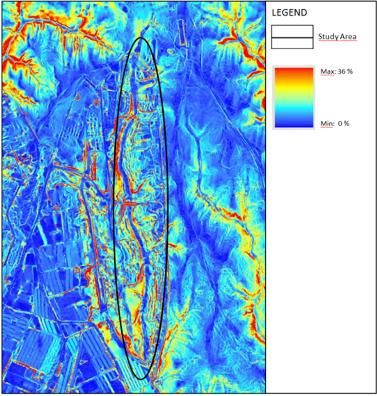
ECOLOGICAL URBANIZATION AND THE INVESTIGATION OF THE ECOLOGICAL
  PLANNING APPROACH IN PUBLIC HOUSING: THE CASE OF ISTANBUL-BASAKSEHIR
                         Yıldız AKSOY , Semih AD L

protection of natural resources. Sub-scale      order to get a better understanding to what
plans should also ensure the best of human-     extent ecological planning approach has
nature interaction in line with the upper-      been implemented in public housing areas
scale plans (Erçoşkun &Karaaslan 2009).         in the 2000s in Turkey.

It is inevitable that the planning of public    The aim of the research is to examine the
housing areas is also carried out in            ‘Basaksehir Settlement’ in the light of the
accordance with ecological criteria within      ecological planning criteria. Within the
the ecological urban planning approach.         research, the ‘Basaksehir Settlement’
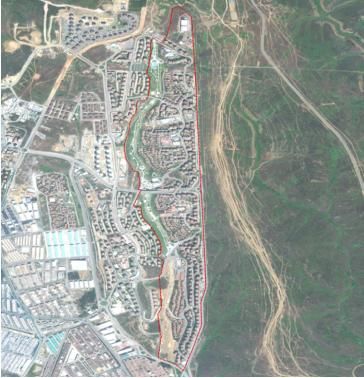
Firstly, in the stage of site-selection for     (figure 1) has been examined, necessary
public housing, an ecologic threshold           analyses of natural and built environment
analysis should be done and the correct         have been done and the area’s compliance
location should be determined, afterwards       with ecological planning criteria has been
all the planning and construction processes
should ensure compliance with ecological
criteria. Thus, healthy and sustainable
living spaces, which are consistent with the
city and the ecosystem, can be created.

Basaksehir District consists of nine
neighbourhoods and one village. The total
area of the Basaksehir District is 10433.6
ha. The industrial sector has an important
place in the economic structure of the
district. The Ikitelli Small Industrial Area,
which is one of the two organized
industrial zones of the Istanbul
                                                questioned.
Metropolitan Area, is located on the north
of the TEM highway, occupying an area of        Figure 1: Basaksehir Settlement
700 hectares. This industrial area makes
the industrial sector dominant among the
other sectors of the district. Also, located
within the boundaries of the Basaksehir         1.1.1. Material and method
District, various industrial plants are         The research, observations and analysis
continuing their activities on individual       carried out provided a lot of data related
parcels in the outskirts of Kayabası.           with the study area. The GIS analyses have
Residential areas of the Basaksehir District    been executed in two groups: natural
have been developing largely in the form        structure analyses and physical& social
of public housing.                              structure analyses.
1.1. Research objectives and scope              Basaksehir 4. Etap Public Housing
                                                Settlement has been examined on-site and
Basaksehir 4.Etap Public Housing
                                                necessary field observations have been
Settlement was chosen as the study area in
                                                made. Natural and built environment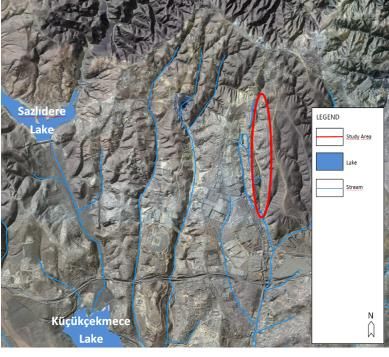
ECOLOGICAL URBANIZATION AND THE INVESTIGATION OF THE ECOLOGICAL
  PLANNING APPROACH IN PUBLIC HOUSING: THE CASE OF ISTANBUL-BASAKSEHIR
                         Yıldız AKSOY , Semih AD L

analyses have been prepared for the field        Figure 2: 1/5000 Scale Master Plan of the study
via GIS: Elevation Analysis, Slope               area.
Analysis,      Orientation      Analysis,
                                                 located near the base of the valley and
Hydrological Structure Analysis, Wind
                                                 higher density residential areas are located
Analysis, Land Suitability Analysis, Built-
                                                 on the upper elevations of the valley.
Unbuilt Analysis, Building Heights
Analysis,     Infrastructure    Analysis,        2. Natural structure analysis of the
Transportation Infrastructure Analysis,          study area
Population Density Analysis have been
prepared.                                        2.1. Height analysis
1.2. General information of the study            The study area consists of a valley on the
area                                             west and a hillside overlooking the valley.

The settlement areas in Basaksehir District      The highest elevation is 170 meters and
have been developing largely in the form
of public housing. Basaksehir 4. Etap
Public Housing Settlement has been
designed and implemented on 150 hectares
of land and in two sections. The I. Section
contains 159 blocks with 5080 flats and
358 single houses on a total of 114 hectares
of land. It is a residential area with a
population of 27,000 designed to appeal to
different income groups. The II. Section,
with an area of 36 hectares, contains 52         goes down to 20 meters on the base of the
blocks with 2142 flats and 126 single            valley, Fig.3.
houses besides social facilities and has a
population of approximately 10,000
people (Adil, 2010).

Figure 2 displays the 1/5000 Scale Master

                                                 Figure 3. The elevation analysis of the study
Plan of the study area and its environs. It is   area.
seen that low density residential areas are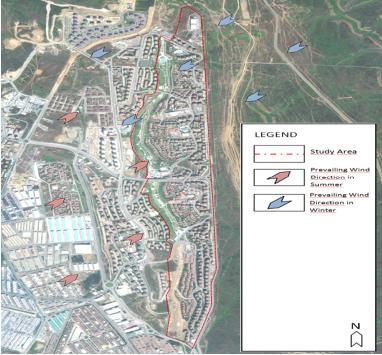
ECOLOGICAL URBANIZATION AND THE INVESTIGATION OF THE ECOLOGICAL
  PLANNING APPROACH IN PUBLIC HOUSING: THE CASE OF ISTANBUL-BASAKSEHIR
                         Yıldız AKSOY , Semih AD L

Figure 4. The slope analysis of the study area.   2.5. Wind analysis

                                                  The prevailing wind directions of the study
                                                  area are northeast and southwest. As
2.2. Slope analysis                               shown in Figure 7, in summer, winds
The study area has a hillside topography
with slope values that vary widely, fig.4.

0-10% Slope: Flat and low slope areas

11-20% Slope: Moderate slope areas

21 to 36 % Slope: High-slope areas

2.3. Orientation analysis

The study area consists mainly of a west-
oriented hillside. Water catchment areas
create some south, south-west and south-          blowing from southwest and in winter,
east oriented areas. There are also north-        winds blowing from northeast, are the
west oriented areas within the boundaries

of the study area. North-oriented areas are
                                                  prevailing winds.
very limited. There are east-oriented areas
on the west of the study area, fig 5.              Figure 6: The hydrologic analysis of the study
                                                  area.
Figure 5: The orientation analysis of the study
area.                                             Figure 7: The wind analysis of the study area.

2.4. Hydrologic structure Analysis                2.6. Land suitability analysis
A small area in the northern part of the          A large part of the study area, as shown in
study area is located within Kucukcekmece         figure 8, has a ground quality that is
Lake Watershed Boundary, fig.6. The               geologically suitable for settlement. The
Sazlıdere Dam Lake is located on the west         ground structure of the valley base is
of the study area.                                inappropriate for settlement. In addition,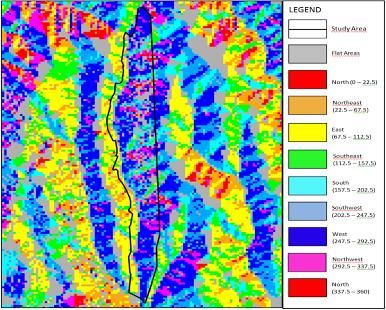
ECOLOGICAL URBANIZATION AND THE INVESTIGATION OF THE ECOLOGICAL
  PLANNING APPROACH IN PUBLIC HOUSING: THE CASE OF ISTANBUL-BASAKSEHIR
                         Yıldız AKSOY , Semih AD L

                                                 The transportation infrastructure of the
                                                 study area consists of roads and pedestrian
                                                 routes. The transfer center on the west of
                                                 the study area will link the area with the
                                                 rest of the city when the construction of the
                                                 metro lines will be finished. Currently,
                                                 public transport is provided by bus lines
                                                 reaching up into the region.

                                                 3.4. Population density analysis

                                                 The average population density of the area
                                                 used to be under 50 persons / ha. But with
on sections near the base of the valley,         the rapid construction of public housing
especially in the south of the study area,       projects, today the population density has
settlement can be established by only            reached much higher values. The average
fulfilling all precautions.                      population density of the study area is 250
                                                 people / ha.
Figure 8: The Land Suitability Analysis of the
study area.
                                                 4. Results

                                                 Basaksehir 4.Etap Public Housing
3. Physical and social structure
                                                 Settlement was chosen as the study area to
analyses of study area
                                                 be examined in order to better understand
3.1. Built-unbuilt analysis                      to what extent ecological planning
                                                 approach has been implemented in the
Buildings within the study area, which are       public housing areas during the 2000s in
mostly in the form of detached blocks, are       our country. Many data related with the
located in accordance with the topography.       study area have been obtained as a result of
The unbuilt sections of the study area           the research, observations and analyses
consist of green areas, open spaces and          which have been carried out. The analyses
parking lots.                                    are discussed in two groups: natural
                                                 structure and physical & social structure
3.2. Building heights analysis                   analyses. Basaksehir 4. Etap Public
                                                 Housing Settlement has been designed and
2-storey buildings are located in regions
                                                 implemented on 150 hectares of land and
close to the base of the valley, the heights
                                                 in two sections. A population of about
of the buildings increase on higher
                                                 37,000 people has been foreseen for the
elevations. There are different types of
                                                 region, so that a density of about 250
buildings within the study area, which vary
                                                 people/ha will be obtained. Although the
from 2 to 13 floor buildings.
                                                 study area has been planned with respect to
3.3. Transportation infrastructure               ecological values, at many points it is
analysis                                         insufficient to fulfil the requirements of the
                                                 ecological planning approach. The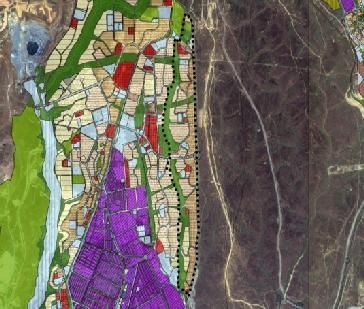
ECOLOGICAL URBANIZATION AND THE INVESTIGATION OF THE ECOLOGICAL
  PLANNING APPROACH IN PUBLIC HOUSING: THE CASE OF ISTANBUL-BASAKSEHIR
                         Yıldız AKSOY , Semih AD L

location of buildings, away from the base      consider the socio-economic needs and
of the valley on areas suitable for            ignore the ecological structure can create
settlement in accordance with the              high negative ecological costs in long term
topography and low-rise buildings near the     (Botkin & Beveridge, 1997).
base of the valley, seem to be the right
planning decisions. Taking necessary           Compensation of such losses also requires
precautions against flooding and planning      very long and costly efforts. Settlements
water catchment areas as green space, are      began to be formed, which are compatible
other correct planning decisions.              with their ecosystems, with the gradual
                                               strengthening of ecological awareness in
                                               planning (Hourihan, 2000).

But in issues such as;                         Although the initial investment costs of
                                               such type of settlements are perceived to be
• Reducing and managing waste,                 higher than others, it is clear how much
                                               these investments are required considering
• Less energy consumption,
                                               the returns to be obtained from these
• Use of renewable energy resources,           investments. Ecological planning efforts,
                                               which started in the 19th century today,
• The protection and improvement of air        began to be addressed not only on the basis
quality,                                       of projects, but also to encompass the
                                               entire city. Cities started to compete with
• Use of ecological building materials,
                                               each other also in this area, with “zero
It has been identified that the requirements   carbon" targets (Jim, 2004). For this
could not be ensured.                          purpose, measures are taken such as
                                               reducing the use of fossil fuels, making
                                               environmentally friendly improvements in
                                               transportation systems, protecting and
It was determined that open car parks were
                                               enhancing green spaces, protecting water
preferred in the entire study area.
                                               resources (Flavin, 2008).
However, by underground parking, more
open and green space could have been           Given the population pressure on cities still
provided.                                      continues today and according to a report
                                               of United Nations Department of
The absence of rain water collection and
                                               Economic and Social Affairs, urban
reuse systems within the study area is
                                               population of the world will reach 70
another lack of ecological planning
                                               percent in 2050, which is around 50%
approach.
                                               today, it is seen as inevitable that growth of
5. Discussion                                  cities will continue and many new cities
                                               will be established (International Standard
In today's increasingly competitive            Industrial Classification of All Economic
environment, economic interests often          Activities). Establishment of new public
come before social, cultural and ecological    housing sites will come up as a
interests. Planning decisions that only        consequence to meet the need for housing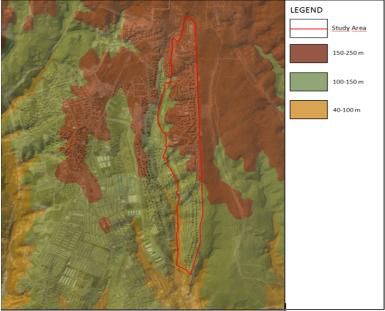
ECOLOGICAL URBANIZATION AND THE INVESTIGATION OF THE ECOLOGICAL
  PLANNING APPROACH IN PUBLIC HOUSING: THE CASE OF ISTANBUL-BASAKSEHIR
                         Yıldız AKSOY , Semih AD L

in these cities. In this case, in order to      specified by international green building
ensure a sustainable development, public        rating agencies are considered to be the
housing needs to be addressed with an           most appropriate solution.
ecological consciousness.
                                                Ecological building materials should be
 Public housing areas can be examined in        preferred. Accordance with ecological
three stages, namely:                           criteria during all phases of construction
                                                including the excavation phase must be
- The planning stage                            provided. The fertile top layer of soil, that
- Construction stage                            is suitable for life, should be evaluated in
                                                other areas. Measures should be taken to
- Stage of life and sustainability.             avoid environmental contamination caused
                                                by wastes that will arise during
An ecological housing project must meet         construction. Recyclable materials should
all the requirements in these three stages.     be preferred. By using recyclable or
No doubt that decisions made in the             reusable materials, savings of raw material
planning stage, which is the first and most     needed for the production of new
important stage, will directly affect the       construction materials will be provided
other stages. The most critical decision at     (Gao, Ariyama, Ojiyama & Meier, 2001).
this stage is the site selection decision. At
this point, in order to make a correct          All kinds of insulation measures should be
decision, an ecological threshold analysis,     taken in buildings, necessary arrangements
which thoroughly analyses the geological        must be made on issues such as natural
structure, flora and fauna and other all        ventilation and solar energy utilization
natural qualities of the site, should be        (Göksal & Özbalta, 2002). Another
made. Threshold analysis technique is a         important point of ecological planning is
method developed by Boleslaw Malisz in          open space planning and landscape
1963. Threshold analysis is actually related    planning.
with making physical environment
planning studies quantifiable (Koslowski        A landscape approach that is in line with
& Hughes, 1972).                                the region's climate and existing vegetation
                                                should be adopted. Landscaping should be
A population density, in line with the          used to help climate control. Storage and
carrying capacity of the region, must be        irrigation systems should be established to
assigned to areas suitable for settlement,      make use of rainwater for irrigation of
obtained from the analysis (Niemela,            green areas. An additional resource of
1999).                                          water will be obtained with the
                                                establishment of a rainwater collection
Factors related with buildings, which are at    system. Water collected in this way could
a later stage, must be fulfilled in             be used as drinking water, irrigation water
accordance       with      the      region's    or for various purposes.
characteristics and the ecological planning
approach. At this point, building designs to    Utilization of solar energy should be
be made in accordance with the criteria         provided in the illumination of open
ECOLOGICAL URBANIZATION AND THE INVESTIGATION OF THE ECOLOGICAL
PLANNING APPROACH IN PUBLIC HOUSING: THE CASE OF ISTANBUL-BASAKSEHIR
Yıldız AKSOY , Semih AD L
spaces. Materials which fulfil ecological study area is another lack of ecological
standards should be used in floor covering. planning approach. In Table 1, a
Materials derived from natural and comparison of an ideal ecological public
renewable sources require far less housing area with Basaksehir 4. Etap
operation during their manufacturing Public Housing Settlement is made on the
processes than artificial materials; because basis of ecological planning criteria.
of this they provide energy efficiency.
As a result, in the Basaksehir 4.Etap Public
Plant-derived materials such as wood, Housing; it has been observed that
bamboo, reed, straw, rye stalk, sunflower compliance with the ecological criteria
stalk and mushroom used as construction such as waste minimization and
materials are natural materials which are management, lower energy consumption,
obtained from rapidly renewable sources. make use of renewable energy sources,
protection and improvement of air quality,
Waste reduction and management in public use of ecological building materials have
housing are other important issues. not been achieved.
Renewable energy sources, which can be
used by all living beings of the world, are Besides these negative results, Basaksehir
accepted as inexhaustible energy sources 4.Etap Public Housing Settlement can be
(solar, wind and geothermal energy, etc.) assumed as a proper settlement area with
(Yalçınkaya, 1995). its planning criteria such as settling
generally on suitable land away from the
Household waste recycling can be valley base, locating buildings according
achieved by waste separation in every to the topography, locating low-rise
housing unit. In order to decrease energy buildings near the base of the valley,
consumption in public areas and residential planning water catchment areas as green
units, electrical systems should be set at space and having adequate green space and
most efficient level, natural and efficient recreation areas.
lighting should be preferred, efficient
kitchen and bathroom equipment to reduce
water consumption should be preferred.
Basaksehir 4. Etap Public Housing
Settlement has been examined in the light
of the identified ecological criteria. The
study area covers Basaksehir 4. Etap
Public Housing Settlement and the Valley
of Waters, which is located on the west of
the study area.4
Open car parks are preferred in the entire
study area. However, by underground
parking more open and green space could
be provided. The absence of rain water
collection and reuse systems within theECOLOGICAL URBANIZATION AND THE INVESTIGATION OF THE ECOLOGICAL
PLANNING APPROACH IN PUBLIC HOUSING: THE CASE OF ISTANBUL-BASAKSEHIR
Yıldız AKSOY , Semih AD L
Basaksehir 4.Etap
Criteria Ecological Public Housing
Public Housing
Site Selection Areas suitable for settlement shall be It is located within an
determined as a result of an area that is
ecological threshold analysis. identified as a
residential region in
upper-scale plans.
Generally areas suita
ble for settlement
have been preferred
and water
catchment areas have
been planned as gree
n space.
Orientation The buildings have the most appropriate Because the study
orientations so that they will benefit area is a west
from the sun in the most effective way, oriented hillside, the
and located on areas with proper slopes. most
South-east hillsides with a slope of 7% appropriate orientatio
are mostly preferred. ns could not be
obtained.
Orientations in
accordance with the
topography have
been obtained.
Designs are developed in accordance with Natural heating and
the climatic conditions of the cooling systems have
Building Design In region. Units are planned as a system in not been used. In
Accordance With The which, minimum-energy consuming order to
Climatic Conditions natural heating and cooling systems are reduce reflection
used, space organization is done of external temperatu
according to winter and re to the
summer conditions, optimal circulation the interior, exterior i
needs are nsulation has been
provided, infrastructure systems are done, double glazed
monitored in terms of structural biology PVC windows have
and physiological relationship been applied and
between home-garden is established. in the row houses
the physiological
home-
garden relationship
has been
successfully establish
ed, but in multi-
storey blocks the
relationship has been
tried to be established
through balconies.ECOLOGICAL URBANIZATION AND THE INVESTIGATION OF THE ECOLOGICAL
PLANNING APPROACH IN PUBLIC HOUSING: THE CASE OF ISTANBUL-BASAKSEHIR
Yıldız AKSOY , Semih AD L
Energy The main design parameters that Square and rectangular forms
Efficient affect the energy performance of the were used in building
Building building as a passive system are; designs. The buildings located
Design • Location of the building, with a 45 degree angle to the
• The distance between buildings and wind direction,
the position of the building according to reduce wind speed by
the other buildings, half. The location of buildings
• The building orientation, and the distance between them
• The building form, were planned in order to
• The physical properties related with heat minimize shades and interrupt
transfer of the shell elements that their views as little as
surround the building possible.
• The correct values of solar
control and natural ventilation systems for
energy saving are determined
Use of Ecological Local, non- toxic organic materials are Ready-mixed concrete was
Construction preferred in the design of used in buildings. The coating
Materials buildings and landscape. and paint of the facades have
an insulating feature. Local
and ecological construction
materials were not used.
Natural materials are used in
some places of the landscape
design.
Landscape Renewable landscape approach is Grass and climate-appropriate
adopted. A landscape planning which is in plant species are preferred in
accordance with the local climate and the green areas.
vegetation, and which contributes to the Necessary systems to make
natural climatizing is done. use of rainwater for irrigation
Rainwater storage and irrigation systems were not established.
necessary for irrigation are established.
Waste Heating systems which do not cause Natural gas is being used for
reduction and air pollution are preferred. Treated grey heating .
management water is provided to be used Systems required for
in toilets and for irrigation. Recycling is re-use of
provided by separation of domestic waste. grey water and recycling of
wastes are not established.
Household wastes are not
being separated.ECOLOGICAL URBANIZATION AND THE INVESTIGATION OF THE ECOLOGICAL
PLANNING APPROACH IN PUBLIC HOUSING: THE CASE OF ISTANBUL-BASAKSEHIR
Yıldız AKSOY , Semih AD L
Waste Heating systems which do not cause Natural gas is being used for
reduction and air pollution are preferred. Treated grey
heating .
management water is provided to be used Systems required for
in toilets and for irrigation. Recycling is
re-use of
provided by separation of domestic grey water and recycling of
waste. wastes are not established.
Household wastes are not
being separated.
Table 1: The comparison of Basaksehir 4.Etap public housing with an ideal ecological public housing
project.
Göksal T, Özbalta N (2002). Enerji
References Korunumunda Düşük Enerjili Bina
Tasarımları, Mühendis ve Makina Dergisi, 506,
Adil S (2010). Ecological urbanization and the Ankara.
investigation of the ecological planning
approach in public housing in the case of Hourihan K (2000). Urban planning in the
twentieth century, Urban History, 27 (3): 384-
Başakşehir 4.Etap, Bahçeşehir Unıversity 396.
Graduate School of Natural and Applied
Koslowski J, Hughes J.T (1972). Threshold
Sciences Master Thesis, stanbul. Analysis, The Architectural Pres, London.
Botkin DB, Beveridge C (1997). Cities as Niemela M (1999). Ecology and urban
environments, Urban Ecosystem, 1: 3-19. planning, Biodiversity and Conservation, 8:
119-131.
Erçoşkun Ö.Y, Karaaslan G (2009). Geleceğin
Therborn, G (2000). Globalisations:
Ekolojik ve Teknolojik Kentleri, Megaron
dimension, historical waves, regional effects,
Journal, 3 (3): 283-296.
normative governance, International
Flavin C (2008). Low- Carbon Energy: A Sociology, 15: 151–79.
Roadmap, World Wacth Report No. 178,
Washington. Yalçınkaya A (1995). Building materials and
their relationship with environment, stanbul
Jim CY (2004). Green-space preservation and Technical Unıversity Graduate School of
Natural and Applied Sciences Master Thesis,
allocation for sustainable greening of compact stanbul.
cities, Cities, 21 (4): 311-320.
Gao W, Arıyama T, Ojiyama T, Meier A
(2001). Energy Impacts of Recycling
Disassembly Material in Residential Building,
Energy and Building, 33: 553- 562.ECOLOGICAL URBANIZATION AND THE INVESTIGATION OF THE ECOLOGICAL
PLANNING APPROACH IN PUBLIC HOUSING: THE CASE OF ISTANBUL-BASAKSEHIR
Yıldız AKSOY , Semih AD LYou can also read


