Economy Profile 2015 Doing Business 2015
←
→
Page content transcription
If your browser does not render page correctly, please read the page content below
Doing Business 2015    Madagascar

                      Economy Profile 2015
                        Madagascar
Doing Business 2015                   Madagascar                                                              2

© 2014 The International Bank for Reconstruction and Development /
The World Bank
1818 H Street NW, Washington, DC 20433
Telephone: 202-473-1000; Internet: www.worldbank.org
All rights reserved.
1 2 3 4 17 16 15 14
This work is a product of the staff of The World Bank with external contributions. The findings,
interpretations, and conclusions expressed in this work do not necessarily reflect the views of The World
Bank, its Board of Executive Directors, or the governments they represent. The World Bank does not
guarantee the accuracy of the data included in this work. The boundaries, colors, denominations, and other
information shown on any map in this work do not imply any judgment on the part of The World Bank
concerning the legal status of any territory or the endorsement or acceptance of such boundaries.
Nothing herein shall constitute or be considered to be a limitation upon or waiver of the privileges and
immunities of The World Bank, all of which are specifically reserved.
                 This work is available under the Creative Commons Attribution 3.0 Unported license (CC
                 BY 3.0) http://creativecommons.org/licenses/by/3.0/igo. Under the Creative Commons
                 Attribution license, you are free to copy, distribute, transmit, and adapt this work,
including for commercial purposes, under the following conditions:
Attribution—Please cite the work as follows: World Bank. 2014. Doing Business 2015: Going Beyond
Efficiency. Washington, DC: World Bank Group. DOI: 10.1596/978-1-4648-0351-2. License: Creative
Commons Attribution CC BY 3.0 IGO
Translations—If you create a translation of this work, please add the following disclaimer along with the
attribution: This translation was not created by The World Bank and should not be considered an official
World Bank translation. The World Bank shall not be liable for any content or error in this translation.
Adaptations—If you create an adaptation of this work, please add the following disclaimer along with the
attribution: This is an adaptation of an original work by The World Bank. Views and opinions expressed in the
adaptation are the sole responsibility of the author or authors of the adaptation and are not endorsed by The
World Bank.
Third-party content—The World Bank does not necessarily own each component of the content
contained within the work. The World Bank therefore does not warrant that the use of any third-party-
owned individual component or part contained in the work will not infringe on the rights of those third
parties. The risk of claims resulting from such infringement rests solely with you. If you wish to re-use a
component of the work, it is your responsibility to determine whether permission is needed for that re-use
and to obtain permission from the copyright owner. Examples of components can include, but are not
limited to, tables, figures or images.
All queries on rights and licenses should be addressed to the Publishing and Knowledge Division, The
World Bank, 1818 H Street NW, Washington, DC 20433, USA; fax: 202-522-2625; e-mail:
pubrights@worldbank.org.
ISBN (paper): 978-1-4648-0351-2
ISBN (electronic): 978-1-4648-0352-9
DOI: 10.1596/978-1-4648-0351-2
ISSN: 1729-2638
Cover design: Corporate Visions, Inc.
Doing Business 2015 Madagascar 3 CONTENTS Introduction .................................................................................................................................. 4 The business environment .......................................................................................................... 6 Starting a business ..................................................................................................................... 16 Dealing with construction permits ........................................................................................... 23 Getting electricity ....................................................................................................................... 31 Registering property .................................................................................................................. 37 Getting credit .............................................................................................................................. 44 Protecting minority investors ................................................................................................... 51 Paying taxes ................................................................................................................................ 61 Trading across borders .............................................................................................................. 66 Enforcing contracts .................................................................................................................... 71 Resolving insolvency .................................................................................................................. 78 Labor market regulation ........................................................................................................... 81 Distance to frontier and ease of doing business ranking ...................................................... 88 Resources on the Doing Business website .............................................................................. 91
Doing Business 2015                  Madagascar                                                                    4

INTRODUCTION
Doing Business sheds light on how easy or difficult it is     1, 2014 (except for the paying taxes indicators, which
for a local entrepreneur to open and run a small to           cover the period January–December 2013).
medium-size business when complying with relevant
                                                              The Doing Business methodology has limitations. Other
regulations. It measures and tracks changes in
                                                              areas important to business—such as an economy’s
regulations affecting 11 areas in the life cycle of a
                                                              proximity to large markets, the quality of its
business: starting a business, dealing with construction
                                                              infrastructure services (other than those related to
permits, getting electricity, registering property, getting
                                                              trading across borders and getting electricity), the
credit, protecting minority investors, paying taxes,
                                                              security of property from theft and looting, the
trading across borders, enforcing contracts, resolving
                                                              transparency       of      government      procurement,
insolvency and labor market regulation.
                                                              macroeconomic conditions or the underlying strength of
In a series of annual reports Doing Business presents         institutions—are not directly studied by Doing Business.
quantitative indicators on business regulations and the       The indicators refer to a specific type of business,
protection of property rights that can be compared            generally a local limited liability company operating in
across 189 economies, from Afghanistan to Zimbabwe,           the largest business city. Because standard assumptions
over time. The data set covers 47 economies in Sub-           are used in the data collection, comparisons and
Saharan Africa, 32 in Latin America and the Caribbean, 25     benchmarks are valid across economies. The data not
in East Asia and the Pacific, 26 in Eastern Europe and        only highlight the extent of obstacles to doing business;
Central Asia, 20 in the Middle East and North Africa and      they also help identify the source of those obstacles,
8 in South Asia, as well as 31 OECD high-income               supporting policy makers in designing regulatory reform.
economies. The indicators are used to analyze economic
                                                              More information is available in the full report. Doing
outcomes and identify what reforms have worked, where
                                                              Business 2015 presents the indicators, analyzes their
and why.
                                                              relationship with economic outcomes and presents
This economy profile presents the Doing Business              business regulatory reforms. The data, along with
indicators for Madagascar. To allow useful comparison, it     information on ordering Doing Business 2015, are
also provides data for other selected economies               available on the Doing Business website at
(comparator economies) for each indicator. The data in        http://www.doingbusiness.org.
this report are current as of June
Doing Business 2015 Madagascar 5
CHANGES IN DOING BUSINESS 2015
As part of a 2-year update in methodology, Doing Finally, the name of the employing workers indicator set
Business 2015 incorporates 7 important changes. First, has been changed to labor market regulation, and the
the ease of doing business ranking as well as all topic- scope of this indicator set has also been changed. The
level rankings are now computed on the basis of indicators now focus on labor market regulation
distance to frontier scores (see the chapter on the applying to the retail sector rather than the
distance to frontier and ease of doing business ranking). manufacturing sector, and their coverage has been
Second, for the 11 economies with a population of more expanded to include regulations on labor disputes and
than 100 million, data for a second city have been added on benefits provided to workers. The labor market
to the data set and the ranking calculation. These regulation indicators continue to be excluded from the
economies are Bangladesh, Brazil, China, India, aggregate distance to frontier score and ranking on the
Indonesia, Japan, Mexico, Nigeria, Pakistan, the Russian ease of doing business.
Federation and the United States. Third, for getting
Beyond these changes there are 3 other updates in
credit, the methodology has been revised for both the
methodology. For paying taxes, the financial statement
strength of legal rights index and the depth of credit
variables have been updated to be proportional to 2012
information index. The number of points has been
income per capita; previously they were proportional to
increased in both indices, from 10 to 12 for the strength
2005 income per capita. For enforcing contracts, the
of legal rights index and from 6 to 8 for the depth of
value of the claim is now set at twice the income per
credit information index. In addition, only credit bureaus
capita or $5,000, whichever is greater. For dealing with
and registries that cover at least 5% of the adult
construction permits, the cost of construction is now set
population can receive a score on the depth of credit
at 50 times income per capita (before, the cost was
information index.
assessed by the Doing Business respondents). In addition,
Fourth, the name of the protecting investors indicator set this indicator set no longer includes the procedures for
has been changed to protecting minority investors to obtaining a landline telephone connection.
better reflect its scope—and the scope of the indicator
For more details on the changes, see the “What is
set has been expanded to include shareholders’ rights in
changing in Doing Business?” chapter starting on page
corporate governance beyond related-party transactions.
24 of the Doing Business 2015 report. For more details
Fifth, the resolving insolvency indicator set has been
on the data and methodology, please see the “Data
expanded to include an index measuring the strength of
Notes” chapter starting on page 114 of the Doing
the legal framework for insolvency. Sixth, the calculation
Business 2015 report. For more details on the distance to
of the distance to frontier score for paying taxes has
frontier metric, please see the “Distance to frontier and
been changed. The total tax rate component now enters
ease of doing business ranking” chapter in this profile.
the score in a nonlinear fashion, in an approach different
from that used for all other indicators (see the chapter
on the distance to frontier and ease of doing business
ranking).Doing Business 2015 Madagascar 6
THE BUSINESS ENVIRONMENT
For policy makers trying to improve their economy’s
regulatory environment for business, a good place to start ECONOMY OVERVIEW
is to find out how it compares with the regulatory
environment in other economies. Doing Business provides
an aggregate ranking on the ease of doing business
Region: Sub-Saharan Africa
based on indicator sets that measure and benchmark
regulations applying to domestic small to medium-size Income category: Low income
businesses through their life cycle. Economies are ranked
from 1 to 189 by the ease of doing business ranking. This Population: 22,924,851
year's report presents results for 2 aggregate measures:
the distance to frontier score and the ease of doing GNI per capita (US$): 440
business ranking. The ranking of economies is determined
by sorting the aggregate distance to frontier (DTF) scores. DB2015 rank: 163
The distance to frontier score benchmarks economies
with respect to regulatory practice, showing the absolute DB2014 rank: 157*
distance to the best performance in each Doing Business
Change in rank: -6
indicator. An economy’s distance to frontier score is
indicated on a scale from 0 to 100, where 0 represents the
DB 2015 DTF: 49.25
worst performance and 100 the frontier. (See the chapter
on the distance to frontier and ease of doing business). DB 2014 DTF: 48.91
The 10 topics included in the ranking in Doing Business
2015: starting a business, dealing with construction Change in DTF: 0.34
permits, getting electricity, registering property, getting
credit, protecting minority investors, paying taxes, trading * DB2014 ranking shown is not last year’s published
across borders, enforcing contracts and resolving ranking but a comparable ranking for DB2014 that
insolvency. The labor market regulation indicators captures the effects of such factors as data
(formerly employing workers) are not included in this corrections and the changes in methodology. See
year’s aggregate ease of doing business ranking, but the the data notes starting on page 114 of the Doing
data are presented in this year’s economy profile. Business 2015 report for sources and definitions.
The aggregate ranking on the ease of doing business
benchmarks each economy’s performance on the
indicators against that of all other economies in the Doing
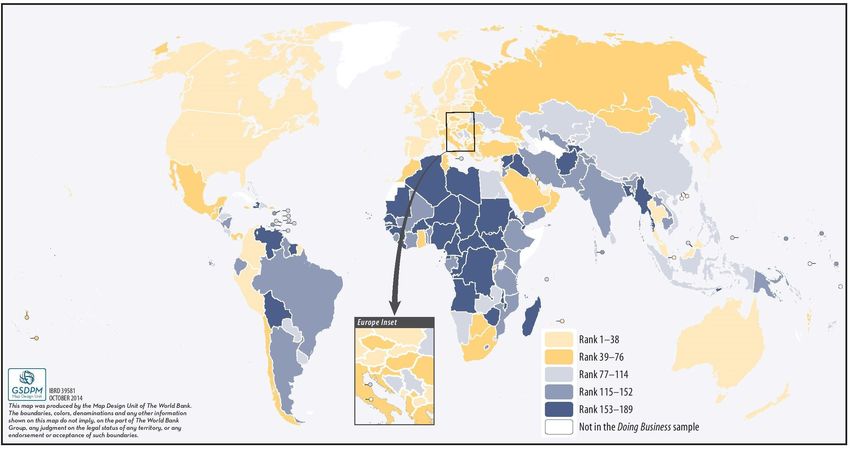
Business sample (figure 1.1). While this ranking tells much
about the business environment in an economy, it does
not tell the whole story. The ranking on the ease of doing
business, and the underlying indicators, do not measure all
aspects of the business environment that matter to firms
and investors or that affect the competitiveness of the
economy. Still, a high ranking does mean that the
government has created a regulatory environment
conducive to operating a business.Doing Business 2015 Madagascar
THE BUSINESS ENVIRONMENT
Figure 1.1 Where economies stand in the global ranking on the ease of doing business
Source: Doing Business database.Doing Business 2015 Madagascar THE BUSINESS ENVIRONMENT For policy makers, knowing where their economy regional average (figure 1.2). The economy’s rankings stands in the aggregate ranking on the ease of doing (figure 1.3) and distance to frontier scores (figure 1.4) business is useful. Also useful is to know how it ranks on the topics included in the ease of doing business relative to comparator economies and relative to the ranking provide another perspective. Figure 1.2 How Madagascar and comparator economies rank on the ease of doing business Note: The rankings are benchmarked to June 2014 and based on the average of each economy’s distance to frontier (DTF) scores for the 10 topics included in this year’s aggregate ranking. The distance to frontier score benchmarks economies with respect to regulatory practice, showing the absolute distance to the best performance in each Doing Business indicator. An economy’s distance to frontier score is indicated on a scale from 0 to 100, where 0 represents the worst performance and 100 the frontier. For the economies for which the data cover 2 cities, scores are a population-weighted average for the 2 cities. Source: Doing Business database.
Doing Business 2015                    Madagascar                                                                         9

THE BUSINESS ENVIRONMENT

Figure 1.3 Rankings on Doing Business topics - Madagascar
(Scale: Rank 189 center, Rank 1 outer edge)

Figure 1.4 Distance to frontier scores on Doing Business topics - Madagascar
(Scale: Score 0 center, Score 100 outer edge)

Note: The rankings are benchmarked to June 2014 and based on the average of each economy’s distance to frontier (DTF) scores
for the 10 topics included in this year’s aggregate ranking. The distance to frontier score benchmarks economies with respect to
regulatory practice, showing the absolute distance to the best performance in each Doing Business indicator. An economy’s
distance to frontier score is indicated on a scale from 0 to 100, where 0 represents the worst performance and 100 the frontier.
For the economies for which the data cover 2 cities, scores are a population-weighted average for the 2 cities.
Source: Doing Business database.
Doing Business 2015                    Madagascar                                                                            10

THE BUSINESS ENVIRONMENT
Just as the overall ranking on the ease of doing business tells      Doing Business introduced the distance to frontier score. This
only part of the story, so do changes in that ranking. Yearly        measure shows how far on average an economy is from the
movements in rankings can provide some indication of                 best performance achieved by any economy on each Doing
changes in an economy’s regulatory environment for firms,            Business indicator.
but they are always relative.
                                                                     Comparing the measure for an economy at 2 points in time
Moreover, year-to-year changes in the overall rankings do            allows users to assess how much the economy’s regulatory
not reflect how the business regulatory environment in an            environment as measured by Doing Business has changed
economy has changed over time—or how it has changed in               over time—how far it has moved toward (or away from) the
different areas. To aid in assessing such changes,                   most efficient practices and strongest regulations in areas
                                                                     covered by Doing Business (figure 1.5).

Figure 1.5 How far has Madagascar come in the areas measured by Doing Business?

Note: The distance to frontier score shows how far on average an economy is from the best performance achieved by any economy on
each Doing Business indicator since 2010, except for getting credit, paying taxes, protecting minority investors and resolving insolvency
which had methodology changes in 2014 and thus are only comparable to 2013. The measure is normalized to range between 0 and 100,
with 100 representing the best performance (the frontier). See the data notes starting on page 114 of the Doing Business 2015 report for
more details on the distance to frontier score.
Source: Doing Business database.
Doing Business 2015 Madagascar 11
THE BUSINESS ENVIRONMENT
The absolute values of the indicators tell another part of regulation—such as a regulatory process that can be
the story (table 1.1). The indicators, on their own or in completed with a small number of procedures in a few
comparison with the indicators of a good practice days and at a low cost. Comparison of the economy’s
economy or those of comparator economies in the indicators today with those in the previous year may
region, may reveal bottlenecks reflected in large numbers show where substantial bottlenecks persist—and where
of procedures, long delays or high costs. Or they may they are diminishing.
reveal unexpected strengths in an area of business
Table 1.1 Summary of Doing Business indicators for Madagascar
Best performer globally
Mozambique DB2015
South Africa DB2015
Madagascar DB2015
Madagascar DB2014
Mauritius DB2015
Comoros DB2015
Rwanda DB2015
Indicator
Kenya DB2015
DB2015
Starting a Business
37 33 173 143 29 107 112 61 New Zealand (1)
(rank)
Starting a Business (DTF
92.02 92.10 57.65 74.02 92.47 82.96 81.66 89.43 New Zealand (99.96)
Score)
Procedures (number) 4.0 4.0 8.0 10.0 5.0 9.0 8.0 5.0 New Zealand (1.0)*
Time (days) 8.0 8.0 15.0 30.0 6.0 13.0 6.5 19.0 New Zealand (0.5)
Cost (% of income per
13.5 12.9 114.0 42.7 2.1 17.1 52.3 0.3 Slovenia (0.0)
capita)
Paid-in min. capital (%
0.0 0.0 226.7 0.0 0.0 0.0 0.0 0.0 112 Economies (0.0)*
of income per capita)
Dealing with
Hong Kong SAR,
Construction Permits 177 175 31 95 117 84 34 32
China (1)
(rank)
Dealing with
Hong Kong SAR,
Construction Permits 46.68 44.37 81.92 71.02 67.17 73.29 81.55 81.65
China (95.53)
(DTF Score)Doing Business 2015 Madagascar 12
Best performer globally
Mozambique DB2015
South Africa DB2015
Madagascar DB2015
Madagascar DB2014
Mauritius DB2015
Comoros DB2015
Rwanda DB2015
Indicator
Kenya DB2015
DB2015
Hong Kong SAR,
Procedures (number) 13.0 12.0 11.0 8.0 13.0 11.0 10.0 16.0
China (5.0)
Time (days) 123.0 161.0 113.0 125.0 245.0 144.0 77.0 48.0 Singapore (26.0)
Cost (% of warehouse
20.8 21.9 1.0 9.3 0.7 4.4 4.1 0.9 Qatar (0.0)*
value)
Getting Electricity
189 188 81 151 41 164 62 158 Korea, Rep. (1)
(rank)
Getting Electricity (DTF
16.67 16.67 76.46 58.85 83.74 54.65 79.48 55.74 Korea, Rep. (99.83)
Score)
Procedures (number) 6.0 6.0 3.0 6.0 4.0 7.0 4.0 5.0 12 Economies (3.0)*
Time (days) 450.0 450.0 120.0 158.0 84.0 107.0 34.0 226.0 Korea, Rep. (18.0)*
Cost (% of income per
8,583.3 9,050.2 2,127.9 1,020.2 277.0 2,484.8 3,073.9 729.5 Japan (0.0)
capita)
Registering Property
153 152 105 136 98 101 15 97 Georgia (1)
(rank)
Registering Property
51.72 51.63 63.83 56.88 66.00 64.51 89.20 66.02 Georgia (99.88)
(DTF Score)
Procedures (number) 6.0 6.0 4.0 9.0 4.0 6.0 3.0 7.0 4 Economies (1.0)*
Time (days) 74.0 74.0 30.0 72.0 14.0 40.0 32.0 23.0 3 Economies (1.0)*
Cost (% of property
10.2 10.3 10.4 4.3 10.6 6.9 0.1 6.2 4 Economies (0.0)*
value)
Getting Credit (rank) 180 178 131 116 36 131 4 52 New Zealand (1)
Getting Credit (DTF
5.00 5.00 30.00 35.00 65.00 30.00 90.00 60.00 New Zealand (100)
Score)
Strength of legal rights
1 1 6 7 6 1 11 5 3 Economies (12)*
index (0-12)Doing Business 2015 Madagascar 13
Best performer globally
Mozambique DB2015
South Africa DB2015
Madagascar DB2015
Madagascar DB2014
Mauritius DB2015
Comoros DB2015
Rwanda DB2015
Indicator
Kenya DB2015
DB2015
Depth of credit
0 0 0 0 7 5 7 7 23 Economies (8)*
information index (0-8)
Credit registry coverage
0.2 0.2 0.0 0.0 71.9 5.7 2.4 0.0 Portugal (100.0)
(% of adults)
Credit bureau coverage
0.0 0.0 0.0 4.9 0.0 0.0 15.7 55.4 23 Economies (100.0)*
(% of adults)
Protecting Minority
87 84 122 122 28 94 117 17 New Zealand (1)
Investors (rank)
Protecting Minority
53.33 53.33 45.83 45.83 65.00 51.67 46.67 67.50 New Zealand (81.67)
Investors (DTF Score)
Extent of conflict of
interest regulation 5.7 5.7 4.7 4.7 7.3 6.3 6.3 8.0 Singapore (9.3)*
index (0-10)
Extent of shareholder
governance index (0- 5.0 5.0 4.5 4.5 5.7 4.0 3.0 5.5 France (7.8)*
10)
Strength of minority
investor protection 5.3 5.3 4.6 4.6 6.5 5.2 4.7 6.8 New Zealand (8.2)
index (0-10)
United Arab Emirates
Paying Taxes (rank) 65 60 167 102 13 123 27 19
(1)*
Paying Taxes (DTF United Arab Emirates
77.78 77.46 47.37 71.49 91.92 66.85 85.79 88.73
Score) (99.44)*
Payments (number per Hong Kong SAR,
23.0 23.0 33.0 30.0 8.0 37.0 17.0 7.0
year) China (3.0)*
Time (hours per year) 183.0 183.0 100.0 201.5 152.0 230.0 107.0 200.0 Luxembourg (55.0)
Trading Across Borders
109 110 144 153 17 129 164 100 Singapore (1)
(rank)
Trading Across Borders 68.98 68.17 59.33 54.49 87.74 64.76 44.67 71.05 Singapore (96.47)Doing Business 2015 Madagascar 14
Best performer globally
Mozambique DB2015
South Africa DB2015
Madagascar DB2015
Madagascar DB2014
Mauritius DB2015
Comoros DB2015
Rwanda DB2015
Indicator
Kenya DB2015
DB2015
(DTF Score)
Documents to export
5 5 9 8 4 7 7 5 Ireland (2)*
(number)
Time to export (days) 22.0 22.0 31.0 26.0 10.0 21.0 26.0 16.0 5 Economies (6.0)*
Cost to export (US$ per
1,195.0 1,195.0 1,295.0 2,255.0 675.0 1,100.0 3,245.0 1,830.0 Timor-Leste (410.0)
container)
Cost to export (deflated
1,195.0 1,303.7 1,295.0 2,255.0 675.0 1,100.0 3,245.0 1,830.0
US$ per container)
Documents to import
9 9 8 9 5 9 9 6 Ireland (2)*
(number)
Time to import (days) 21.0 21.0 24.0 26.0 9.0 25.0 27.0 21.0 Singapore (4.0)
Cost to import (US$ per
1,555.0 1,555.0 1,295.0 2,350.0 710.0 1,600.0 4,990.0 2,080.0 Singapore (440.0)
container)
Cost to import (deflated
1,555.0 1,696.5 1,295.0 2,350.0 710.0 1,600.0 4,990.0 2,080.0
US$ per container)
Enforcing Contracts
146 145 177 137 44 164 62 46 Singapore (1)
(rank)
Enforcing Contracts
45.91 45.91 33.20 48.96 66.22 39.81 63.94 66.14 Singapore (89.54)
(DTF Score)
Time (days) 871.0 871.0 506.0 465.0 519.0 760.0 230.0 600.0 Singapore (150.0)
Cost (% of claim) 42.4 42.4 89.4 47.2 25.0 119.0 82.7 33.2 Iceland (9.0)
Procedures (number) 38.0 38.0 43.0 44.0 34.0 30.0 23.0 29.0 Singapore (21.0)*
Resolving Insolvency
129 127 189 134 43 107 101 39 Finland (1)
(rank)
Resolving Insolvency
34.43 34.43 0.00 33.31 62.81 40.75 41.77 64.51 Finland (93.85)
(DTF Score)Doing Business 2015 Madagascar 15
Best performer globally
Mozambique DB2015
South Africa DB2015
Madagascar DB2015
Madagascar DB2014
Mauritius DB2015
Comoros DB2015
Rwanda DB2015
Indicator
Kenya DB2015
DB2015
no
Time (years) 2.0 2.0 4.5 1.7 5.0 2.5 2.0 Ireland (0.4)
practice
no
Cost (% of estate) 30.0 30.0 22.0 14.5 9.0 29.0 18.0 Norway (1.0)
practice
Outcome (0 as
piecemeal sale and 1 as 0 0 0 1 1 0 0 0
going concern)
Recovery rate (cents on
11.7 11.7 0.0 27.1 67.4 17.6 19.5 35.7 Japan (92.9)
the dollar)
Strength of insolvency no
9.0 9.0 6.0 8.5 10.0 10.0 14.5 5 Economies (15.0)*
framework index (0-16) practice
Note: DB2014 rankings shown are not last year’s published rankings but comparable rankings for DB2014 that capture the effects of such
factors as data corrections and changes to the methodology. Trading across borders deflated and non-deflated values are identical in
DB2015 because it is defined as the base year for the deflator. The best performer on time for paying taxes is defined as the lowest time
recorded among all economies in the DB2015 sample that levy the 3 major taxes: profit tax, labor taxes and mandatory contributions, and
VAT or sales tax. If an economy has no laws or regulations covering a specific area—for example, insolvency—it receives a “no practice”
mark. Similarly, an economy receives a “no practice” or “not possible” mark if regulation exists but is never used in practice or if a
competing regulation prohibits such practice. Either way, a “no practice” mark puts the economy at the bottom of the ranking on the
relevant indicator.
* Two or more economies share the top ranking on this indicator. A number shown in place of an economy’s name indicates the number
of economies that share the top ranking on the indicator. For a list of these economies, see the Doing Business website
(http://www.doingbusiness.org).
Source: Doing Business database.Doing Business 2015 Madagascar 16
STARTING A BUSINESS
Formal registration of companies has many WHAT THE STARTING A BUSINESS
immediate benefits for the companies and for
business owners and employees. Legal entities can INDICATORS MEASURE
outlive their founders. Resources are pooled as
several shareholders join forces to start a company. Procedures to legally start and operate a
Formally registered companies have access to company (number)
services and institutions from courts to banks as well
Preregistration (for example, name
as to new markets. And their employees can benefit
verification or reservation, notarization)
from protections provided by the law. An additional
benefit comes with limited liability companies. These Registration in the economy’s largest
limit the financial liability of company owners to their business city1
investments, so personal assets of the owners are not
Postregistration (for example, social security
put at risk. Where governments make registration
registration, company seal)
easy, more entrepreneurs start businesses in the
formal sector, creating more good jobs and Time required to complete each procedure
generating more revenue for the government. (calendar days)
What do the indicators cover? Does not include time spent gathering
information
Doing Business measures the ease of starting a
business in an economy by recording all procedures Each procedure starts on a separate day (2
officially required or commonly done in practice by procedures cannot start on the same day).
an entrepreneur to start up and formally operate an Procedures that can be fully completed
industrial or commercial business—as well as the online are recorded as ½ day.
time and cost required to complete these procedures. Procedure completed once final document is
It also records the paid-in minimum capital that received
companies must deposit before registration (or
within 3 months). The ranking of economies on the No prior contact with officials
ease of starting a business is determined by sorting Cost required to complete each procedure
their distance to frontier scores for starting a (% of income per capita)
business. These scores are the simple average of the
distance to frontier scores for each of the component Official costs only, no bribes
indicators. No professional fees unless services required
To make the data comparable across economies, by law
Doing Business uses several assumptions about the Paid-in minimum capital (% of income
business and the procedures. It assumes that all per capita)
information is readily available to the entrepreneur
and that there has been no prior contact with Deposited in a bank or with a notary before
officials. It also assumes that the entrepreneur will registration (or within 3 months)
pay no bribes. And it assumes that the business:
Is a limited liability company, located in the Has a start-up capital of 10 times income per
largest business city and is 100% domestically capita.
owned1.
Has a turnover of at least 100 times income per
Has between 10 and 50 employees. capita.
Conducts general commercial or industrial Does not qualify for any special benefits.
activities.
Does not own real estate.
1
For the 11 economies with a population of more than 100 million, data for a second city have been added.Doing Business 2015 Madagascar 17 STARTING A BUSINESS Where does the economy stand today? What does it take to start a business in Madagascar? largest business city of an economy, except for 11 According to data collected by Doing Business, starting a economies for which the data are a population-weighted business there requires 4.0 procedures, takes 8.0 days, average of the 2 largest business cities. See the chapter costs 13.5% of income per capita and requires paid-in on distance to frontier and ease of doing business minimum capital of 0.0% of income per capita (figure ranking at the end of this profile for more details. 2.1). Most indicator sets refer to a case scenario in the Figure 2.1 What it takes to start a business in Madagascar Paid-in minimum capital (% of income per capita): 0.0 Note: Time shown in the figure above may not reflect simultaneity of procedures. Online procedures account for 0.5 days in the total time calculation. For more information on the methodology of the starting a business indicators, see the Doing Business website (http://www.doingbusiness.org). For details on the procedures reflected here, see the summary at the end of this chapter. Source: Doing Business database.
Doing Business 2015                  Madagascar                                                              18

STARTING A BUSINESS
Globally, Madagascar stands at 37 in the ranking of 189      average ranking provide other useful information for
economies on the ease of starting a business (figure 2.2).   assessing how easy it is for an entrepreneur in
The rankings for comparator economies and the regional       Madagascar to start a business.

Figure 2.2 How Madagascar and comparator economies rank on the ease of starting a
business

Source: Doing Business database.
Doing Business 2015                    Madagascar                                                                     19

STARTING A BUSINESS
Economies around the world have taken steps making it             they often are part of a larger regulatory reform
easier to start a business—streamlining procedures by             program. Among the benefits have been greater firm
setting up a one-stop shop, making procedures simpler             satisfaction and savings and more registered businesses,
or faster by introducing technology and reducing or               financial resources and job opportunities.
eliminating minimum capital requirements. Many have
                                                                  What business registration reforms has Doing Business
undertaken business registration reforms in stages—and
                                                                  recorded in Madagascar (table 2.1)?

Table 2.1 How has Madagascar made starting a business easier—or not?
By Doing Business report year from DB2010 to DB2015

DB year            Reform

                    Madagascar made starting a business easier by streamlining
DB2010              procedures at the one-stop shop and eliminating the stamp
                    duty and the minimum capital requirement.
                    Madagascar eased the process of starting a business by
                    eliminating the minimum capital requirement, but also made it
DB2012
                    more difficult by introducing the requirement of obtaining a
                    tax identification number.
                    Madagascar made starting a business easier by allowing the
DB2013              one-stop shop to deal with the publication of the notice of
                    incorporation.
                    Madagascar made starting a business more difficult by
DB2014              increasing the cost to register with the National Center for
                    Statistics.
Note: For information on reforms in earlier years (back to DB2005), see the Doing Business reports
for these years, available at http://www.doingbusiness.org.
Source: Doing Business database.
Doing Business 2015 Madagascar 20
STARTING A BUSINESS
What are the details?
Underlying the indicators shown in this chapter for
STANDARDIZED COMPANY
Madagascar is a set of specific procedures—the
bureaucratic and legal steps that an entrepreneur
must complete to incorporate and register a new Legal form: Socièté a Responsabilité Limitée
firm. These are identified by Doing Business through (SARL)
collaboration with relevant local professionals and
the study of laws, regulations and publicly available Paid in minimum capital requirement: MGA 0
information on business entry in that economy. City: Antananarivo
Following is a detailed summary of those procedures,
along with the associated time and cost. These Start-up Capital: 10 times GNI per capita
procedures are those that apply to a company
matching the standard assumptions (the
“standardized company”) used by Doing Business in
collecting the data (see the section in this chapter on
what the indicators measure).
Table 2.2 Summary of time, cost and procedures for starting a business in Madagascar
Time to
No. Procedure Cost to complete
complete
Obtain a provisional fiscal identification number
Prior to registration of the company, the entrepreneur has to obtain a
provisional fiscal identification number. In order to do so, the
entrepreneur has to apply online and then submit the registration form
1 together with other documents to the EDBM fiscal. 1 day no charge
Agency: Tax registration - NIFONLINE
Deposit registered statutes, apply for license (carte
professionnelle), obtain a final fiscal identification number, and
obtain statistical identifications
The k-bis, statistical card, tax registration confirmation, commercial
registration number, and professional card (carte professionelle) can be
obtained in about 2 days. Owing to reforms, a notice of publication is
no longer needed to obtain the k-bis. Since 2007, the one stop-shop
(Guichet Unique, GUIDE) sends the company the certificate for the 4 days see comment
2
deposit of statutes (certificat de dépôt d'actes). When filing all
documents needed to obtain the k-bis, the company must provide
GUIDE with a stamped envelope. The company can continue with
subsequent procedures in the meantime.
The firm's management also needs to file forms for each employee with
the National Social Security Fund (Caisse Nationale de Prevoyance
Sociale). The required forms, the registration application (demande
d'immatriculation) and the application for workers affiliation (demande
'affiliation travailleur) must be filed along with the corporateDoing Business 2015 Madagascar 21
Time to
No. Procedure Cost to complete
complete
registration certificate and notarized copies of each employee’s
passport and birth certificate, if under age 18.
To file for health insurance, the company promoters must file two
copies of an application form (bulletin d'adhesion nouveau membre)
along with a list of names of all employees and their identity cards.
According to ""Nouvelles N°1534 du 21 mars 2009"" it is possible to
register at the one stop shop (at the EDBM) for the Caisse Nationale de
Prevoyance Sociale and the Organization Sanitaire Tananarivienne
InterEntreprise.
It takes on average 4 to 8 days to get registered with the EDBM. Then it
takes about 2 days to publish the notice of constitution.
Fee schedule:
• Commercial registration fee: MGA 15,500.
• Deed registration costs: MGA 2,000.
• K•bis: MGA 2,000.
• Institut National de la Statistique Malgache (INSTAT) (see Decree
2005-380, dated June 22, 2005): MGA 40,000.
• Registration fees: 0.5% of the share capital.
• Fee to publish a notice of constitution in a daily newspaper:
approximately MGA 23,500.
In addition, the following fees need to be paid:
• 0.2% of the lease
• Payment of the income tax (accompte de l' impot sur le revenu): MGA
320,000
Agency: EDBM
File a notice of constitution to be published in a French newspaper
Entrepreneurs must publish a legal notice of constitution in a
newspaper which can be completed within 2 days. The published
extract is also submitted together with the company’s application for 2 days no charge
3
registration at the one-stop shop (EDBM).
Agency: EDBM
Register employees with Social Security
The company must register its employees with the National Social
Security Fund (Caisse Nationale de Prevoyance Sociale), and file two
copies of an application form (bulletin d'adhesion nouveau membre)
4 along with a list of names of all employees and their identity cards to 1 day no charge
enroll for health insurance.
Agency: EDBM
* Takes place simultaneously with another procedure.
Note: Online procedures account for 0.5 days in the total time calculation.
Source: Doing Business database.Doing Business 2015 Madagascar 22
Doing Business 2015 Madagascar 23
DEALING WITH CONSTRUCTION PERMITS
Regulation of construction is critical to protect the WHAT THE DEALING WITH CONSTRUCTION
public. But it needs to be efficient, to avoid excessive
PERMITS INDICATORS MEASURE
constraints on a sector that plays an important part in
every economy. Where complying with building
regulations is excessively costly in time and money, Procedures to legally build a warehouse
many builders opt out. They may pay bribes to pass (number)
inspections or simply build illegally, leading to Submitting all relevant documents and
hazardous construction that puts public safety at risk. obtaining all necessary clearances, licenses,
Where compliance is simple, straightforward and permits and certificates
inexpensive, everyone is better off. Submitting all required notifications and
What do the indicators cover? receiving all necessary inspections
Doing Business records the procedures, time and cost Obtaining utility connections for water and
for a business in the construction industry to obtain sewerage
all the necessary approvals to build a warehouse in Registering the warehouse after its
the economy’s largest business city, connect it to completion (if required for use as collateral or
basic utilities and register the warehouse so that it for transfer of the warehouse)
can be used as collateral or transferred to another Time required to complete each procedure
entity. (calendar days)
The ranking of economies on the ease of dealing with Does not include time spent gathering
construction permits is determined by sorting their information
distance to frontier scores for dealing with
Each procedure starts on a separate day.
construction permits. These scores are the simple
Procedures that can be fully completed online
average of the distance to frontier scores for each of
are recorded as ½ day.
the component indicators.
Procedure considered completed once final
To make the data comparable across economies, document is received
Doing Business uses several assumptions about the
business and the warehouse, including the utility No prior contact with officials
connections. Cost required to complete each procedure (%
The business: of warehouse value)
Official costs only, no bribes
Is a limited liability company operating in
the construction business and located in Will have complete architectural and
the largest business city. For the 11 technical plans prepared by a licensed
economies with a population of more than architect or engineer.
100 million, data for a second city have
Will be connected to water and sewerage
been added. Is domestically owned and
(sewage system, septic tank or their
operated.
equivalent). The connection to each utility
Has 60 builders and other employees. network will be 150 meters (492 feet) long.
The warehouse: Will be used for general storage, such as of
books or stationery (not for goods requiring
Is valued at 50 times income per capita.
special conditions).
Is a new construction (there was no
Will take 30 weeks to construct (excluding all
previous construction on the land).
delays due to administrative and regulatory
requirements).Doing Business 2015 Madagascar 24 DEALING WITH CONSTRUCTION PERMITS Where does the economy stand today? What does it take to comply with the formalities to build business city of an economy, except for 11 economies for a warehouse in Madagascar? According to data collected which the data are a population-weighted average of the by Doing Business, dealing with construction permits 2 largest business cities. See the chapter on distance to there requires 13.0 procedures, takes 123.0 days and frontier and ease of doing business ranking at the end of costs 20.8% of the warehouse value (figure 3.1). Most this profile for more details. indicator sets refer to a case scenario in the largest Figure 3.1 What it takes to comply with formalities to build a warehouse in Madagascar Note: Time shown in the figure above may not reflect simultaneity of procedures. Online procedures account for 0.5 days in the total time calculation. For more information on the methodology of the dealing with construction permits indicators, see the Doing Business website (http://www.doingbusiness.org). For details on the procedures reflected here, see the summary at the end of this chapter. Source: Doing Business database.
Doing Business 2015                Madagascar                                                                   25

DEALING WITH CONSTRUCTION PERMITS
Globally, Madagascar stands at 177 in the ranking of 189   other useful information for assessing how easy it is for
economies on the ease of dealing with construction         an entrepreneur in Madagascar to legally build a
permits (figure 3.2). The rankings for comparator          warehouse.
economies and the regional average ranking provide

Figure 3.2 How Madagascar and comparator economies rank on the ease of dealing with construction permits

Source: Doing Business database.
Doing Business 2015                    Madagascar                                                                   26

DEALING WITH CONSTRUCTION PERMITS
Smart regulation ensures that standards are met while             an effort to ensure building safety while keeping
making compliance easy and accessible to all. Coherent            compliance costs reasonable, governments around the
and transparent rules, efficient processes and adequate           world have worked on consolidating permitting
allocation of resources are especially important in sectors       requirements. What construction permitting reforms has
where safety is at stake. Construction is one of them. In         Doing Business recorded in Madagascar (table 3.1)?

Table 3.1 How has Madagascar made dealing with construction permits easier—or not?
By Doing Business report year from DB2010 to DB2015

DB year            Reform

                    Madagascar made dealing with construction permits easier by
DB2015
                    reducing the time needed to obtain a building permit.
Note: For information on reforms in earlier years (back to DB2006), see the Doing Business reports
for these years, available at http://www.doingbusiness.org.
Source: Doing Business database.
Doing Business 2015 Madagascar 27
DEALING WITH CONSTRUCTION PERMITS
What are the details?
The indicators reported here for Madagascar are
BUILDING A WAREHOUSE
based on a set of specific procedures—the steps that
a company must complete to legally build a
warehouse—identified by Doing Business through Estimated cost of
information collected from experts in construction MGA 49,937,712
construction :
licensing, including architects, civil engineers,
construction lawyers, construction firms, utility
City : Antananarivo
service providers and public officials who deal with
building regulations. These procedures are those The procedures, along with the associated time and cost,
that apply to a company and structure matching the are summarized below.
standard assumptions used by Doing Business in
collecting the data (see the section in this chapter on
what the indicators cover).
Table 3.2 Summary of time, cost and procedures for dealing with construction permits in Madagascar
Time to
No. Procedure Cost to complete
complete
Obtain property registration certificates
BuildCo must obtain two copies of all the property registration
documents. 7 days MGA 4,000
1
Agency: Land Administration Department (Service des Domaines)
* Obtain official topographical plan of the plot
Five copies of the official topographical plan for the property with
coordinates are needed. The cost of each copy is MGA 1,000 5 days MGA 5,000
2
Agency: Topographical Services (Service Topographique)
* Request an alignment permit from the Commune of
Antananarivo
The alignment permit is a mandatory document to obtain a building
permit. The request for this permit is made on a standard form and is
submitted by the owner, in duplicate, to the City Council (Commune
d’Antananarivo), along with proof of ownership.
The planning officer will prepare a sketch of alignment and a report
3 (procès verbal) detailing the constraints of alignment with the road 1 day no charge
allowances of the Master Plan (delimitation of the unbuildable portion).
The file is then sent to the Régional de l’Aménagement du Territoire et
de la Ville, which verifies that the file is in conformity with the rules of
urban planning and the provisions of the Master Plan of the Commune.
The file is then returned to the Town Hall.
A receipt showing that the request was made will be given back to
BuildCo and at the same time, an appointment date will be provided for
the site visit with the owner and 2 inspectors.Doing Business 2015 Madagascar 28
Time to
No. Procedure Cost to complete
complete
Agency: Commune of Antananarivo
Receive inspection from SRAT
The inspection is carried out by the Provincial Service of Land
(Développement Aménagement du Territoire, SRAT) and the land
owner. These inspections are necessary to obtain SRAT’s approval of
the building permit. In addition to the first inspection before the start
of construction work, SRAT may carry out several other random 5 days no charge
4
inspections. Technical directives for construction work include, among
other things, a check of the center line of the street, the street
boundaries, blind walls, and openings in walls.
Agency: SRAT (Provincial Service of Land)
Obtain the alignment permit from the Commune of Antananarivo
The Urban Commune checks the design plans and supporting
documents to ensure that no documents are missing. 20 days MGA 60,000
5
Agency: Commune of Antananarivo
Request and obtain the planning requirements from SRAT
Once the alignment permit has been obtained, BuildCo must obtain the
planning requirements (presciption d’urbanisme). This planning
requirement document is obtained from the Service Regional de
l'Amenagement du Territoire (SRAT) in one week. This document is
necessary to show that the entrepreneur has the right to build on that
land. The required documents are:
6 - Official plan of the land with laborde coordinates (1 copy) 7 days no charge
- Certificate of legal status that is less than 3 months old (1 copy)
- Duly complete form to request the prescription d'urbanisme obtained
at the City Hall Analakely (1 copy)
- Alignment authorization (issued by the CUA)
- Alignment Sketch (issued by the CUA)
Agency: Service Regional de l'Amenagement du Territoire (SRAT)
Request and obtain building permit
The building permit is now completed in 3 steps:
7 (i) obtain the alignment permit 45 days MGA 7,803,000
(ii) obtain the planning permission certificate
Once these two steps are completed, BuildCo may now request the
building permit and submit all necessary documents. Only completedDoing Business 2015 Madagascar 29
Time to
No. Procedure Cost to complete
complete
applications are accepted at the Commune Urbaine d'Antananarivo
(CUA- one-stop shop).
The cost is calculated based on the volume of the building before SPAT
issues its opinion. The cost can vary from MGA 1,000.00 to MGA
2,000.00 per cubic meter.
Documents to be provided are:
- Alignment permit issued by the CUA
- Official survey plan of the land with laborde coordinates obtained
from the Topographic Service Anosy (1 copy)
- Proof of ownership that is less than 3 months old (1 copy)
- Alignment with prescription planning permission (1 copy)
Documents for the applicant:
- Technical data sheet completed and signed by architect (1 copy)
- Certified copy of the ID (carte d’identite nationale) (1 copy)
- 2 stamped and addressed envelopes
- Pictures of the land and its surroundings
- All required plans including the site plan with the septic tank location
clearly marked
Agency: Commune of Antananarivo
Receive final inspection at the end of construction by SRAT
The final inspection and approval by SRAT are required to obtain the
certificate of occupancy. 1 day no charge
8
Agency: SRAT (Provincial Service of Land)
Receive inspection by fire protection service
9 1 day no charge
Agency: Fire Service (Pompiers)
Obtain occupancy certificate
10 15 days no charge
Agency: Commission
* Apply for water connection
11 1 day no charge
Agency: JIRAMADoing Business 2015 Madagascar 30
Time to
No. Procedure Cost to complete
complete
JIRAMA inspects the building to prepare an estimate
BuildCo receives the cost estimates 2 weeks after JIRAMA inspects the
building and can pay them immediately and acquire the connection
12 one week later. 1 day no charge
Agency: JIRAMA
Obtain water connection
The fee for water connection is around MGA 2.5 million.
13 21 days MGA 2,500,000
Agency: JIRAMA
* Takes place simultaneously with another procedure.
Note: Online procedures account for 0.5 days in the total time calculation.
Source: Doing Business database.Doing Business 2015 Madagascar 31
GETTING ELECTRICITY
Access to reliable and affordable electricity is vital for WHAT THE GETTING ELECTRICITY
businesses. To counter weak electricity supply, many
firms in developing economies have to rely on self- INDICATORS MEASURE
supply, often at a prohibitively high cost. Whether
electricity is reliably available or not, the first step for Procedures to obtain an electricity
a customer is always to gain access by obtaining a connection (number)
connection.
Submitting all relevant documents and
What do the indicators cover? obtaining all necessary clearances and permits
Doing Business records all procedures required for a Completing all required notifications and
local business to obtain a permanent electricity receiving all necessary inspections
connection and supply for a standardized warehouse,
as well as the time and cost to complete them. These Obtaining external installation works and
procedures include applications and contracts with possibly purchasing material for these works
electricity utilities, clearances from other agencies Concluding any necessary supply contract and
and the external and final connection works. The obtaining final supply
ranking of economies on the ease of getting
electricity is determined by sorting their distance to Time required to complete each procedure
frontier scores for getting electricity. These scores are (calendar days)
the simple average of the distance to frontier scores Is at least 1 calendar day
for each of the component indicators. To make the
data comparable across economies, several Each procedure starts on a separate day
assumptions are used. Does not include time spent gathering
The warehouse: information
Is owned by a local entrepreneur, located Reflects the time spent in practice, with little
in the economy’s largest business city, in follow-up and no prior contact with officials
an area where other warehouses are Cost required to complete each procedure
located. For the 11 economies with a (% of income per capita)
population of more than 100 million, data
Official costs only, no bribes
for a second city have been added.
Excludes value added tax
Is not in a special economic zone where
the connection would be eligible for
subsidization or faster service. Is to either the low-voltage or the medium-
voltage distribution network and either
Is located in an area with no physical
overhead or underground, whichever is more
constraints (ie. property not near a railway).
common in the area where the warehouse is
Is a new construction being connected to located. Included only negligible length in the
electricity for the first time. customer’s private domain.
Is 2 stories, both above ground, with a total Requires crossing of a 10-meter road but all
surface of about 1,300.6 square meters the works are carried out in a public land, so
(14,000 square feet), is built on a plot of there is no crossing into other people's
929 square meters (10,000 square feet), is private property.
used for storage of refrigerated goods
Involves installing one electricity meter. The
The electricity connection: monthly electricity consumption will be
26880 kilowatt hour (kWh). The internal
Is 150 meters long and is a 3-phase, 4-wire
electrical wiring has been completed.
Y, 140-kilovolt-ampere (kVA) (subscribed
capacity) connection.Doing Business 2015 Madagascar 32
GETTING ELECTRICITY
Where does the economy stand today?
What does it take to obtain a new electricity connection Most indicator sets refer to a case scenario in the largest
in Madagascar? According to data collected by Doing business city of an economy, except for 11 economies for
Business, getting electricity there requires 6.0 procedures, which the data are a population-weighted average of the
takes 450.0 days and costs 8583.3% of income per capita 2 largest business cities. See the chapter on distance to
(figure 4.1). frontier and ease of doing business ranking at the end of
this profile for more details.
Figure 4.1 What it takes to obtain an electricity connection in Madagascar
Note: Time shown in the figure above may not reflect simultaneity of procedures. For more information on the methodology of the
getting electricity indicators, see the Doing Business website (http://www.doingbusiness.org). For details on the procedures reflected
here, see the summary at the end of this chapter.
Source: Doing Business database.Doing Business 2015 Madagascar 33 GETTING ELECTRICITY Globally, Madagascar stands at 189 in the ranking of 189 average ranking provide another perspective in assessing economies on the ease of getting electricity (figure 4.2). how easy it is for an entrepreneur in Madagascar to The rankings for comparator economies and the regional connect a warehouse to electricity. Figure 4.2 How Madagascar and comparator economies rank on the ease of getting electricity Source: Doing Business database.
Doing Business 2015                      Madagascar                                                                         34

GETTING ELECTRICITY
What are the details?
The indicators reported here for Madagascar are based
                                                                       OBTAINING AN ELECTRICITY CONNECTION
on a set of specific procedures—the steps that an
entrepreneur must complete to get a warehouse
connected to electricity by the local distribution utility—                                          Jiro sy rano malagasy
                                                                       Name of utility:
identified by Doing Business. Data are collected from the                                            (JIRAMA)
distribution utility, then completed and verified by
electricity regulatory agencies and independent                        City:                         Antananarivo
professionals such as electrical engineers, electrical
                                                                    The procedures are those that apply to a warehouse and
contractors and construction companies. The electricity             electricity connection matching the standard
distribution utility surveyed is the one serving the area           assumptions used by Doing Business in collecting the
(or areas) in which warehouses are located. If there is a           data (see the section in this chapter on what the
choice of distribution utilities, the one serving the largest       indicators cover). The procedures, along with the
number         of        customers         is       selected.       associated time and cost, are summarized below.
Table 4.2 Summary of time, cost and procedures for getting electricity in Madagascar
                                                                                           Time to
  No.    Procedure                                                                                         Cost to complete
                                                                                          complete
        The client applies for electricity connection and awaits estimate of
        connection fees from Jiro sy rano malagasy (JIRAMA)

        The application can be submitted by mail, letter, or in person at one of
        the utility’s agencies. The client will need to attach some documents to
        the application, with the client’s personal and professional details, a        15 calendar days        MGA 0
   1
        description of the works and of the electrical installation, as well as a
        notarized Signing Authority (“pouvoir de signature”).

        Agency: Jiro sy rano malagasy (JIRAMA)

        * The client obtains external inspection by Jiro sy rano malagasy
        (JIRAMA)

        When the utility has received the application, it inspects the client’s site
        to determine the specifics of the connection and prepare an estimate of         1 calendar day         MGA 0
   2
        the connection fees.

        Agency: Jiro sy rano malagasy (JIRAMA)

        The client obtains right of way from the local authority (Commune)

        The customer needs to obtain a right of way from the 'Commune' before
        paying the estimate so that the utility can carry out the external works of 50 calendar days         MGA 60,000
   3
        expanding the overhead network.

        Agency: Local authority (Commune)
You can also read


