Edge Hill University (EHU) Initial Teacher Education (ITE) Partnership Agreement 2020-2021
←
→
Page content transcription
If your browser does not render page correctly, please read the page content below
Edge Hill University (EHU) Initial Teacher
 Education (ITE) Partnership Agreement
               2020-2021

                    1
Our Vision
The Faculty enjoys the reputation of being one of the largest and longest established providers of
Education programmes in the country. We have a focus on ‘working creatively with others to enhance
life chances’. The thematic foci of ‘aspire’, ‘inspire’, ‘innovate’ and ‘transform’ capture a commitment to
creating a vibrant, outward-facing and socially-responsive academic environment for our teaching and
research.
We have a substantial track record in supporting partner schools and colleges in school improvement
initiatives. The Faculty is deeply committed to providing excellent support and training for students
who wish to enter the wider children’s workforce and offers a range of Undergraduate and master’s
level programmes designed to provide outstanding employment and career development
opportunities.
The Faculty is a major provider of professional development, advanced training and high-quality
resources for school leaders, teachers and teaching assistants each of which enhances and
embraces our strategic aims in contributing to educational improvement, educational opportunities
and pupil progress both regionally and nationally.
The Faculty has research strengths in education policy development, enactment and impact; in
educational leadership; and in inclusion and social justice.
The Faculty is focused on advancing the discipline and practice of education achieved through, and
measured by, high quality teaching and research and through its support for schools and colleges in
collaborative research and training partnerships.
We are committed to supporting and progressing research practice and scholarly output that is
recognised for its originality and impact and in providing an intellectual and physical environment that
promotes and challenges public debate on Placement and on educational policy.
For all programmes of ITE at whatever phase, generic aims are to:
• Provide a carefully crafted high quality curriculum based on coherent sequences of experiences
and activities that are tailored to support every student-teacher in meeting Teachers’ Standards;
• Equip student-teachers with the subject- and phase-specific pedagogic knowledge,
understanding and skills to enable them to effectively teach children in (Early Years, Primary,
Secondary, learners in FE);
• Support student-teachers’ development in the core areas of teaching, including - but not limited
to - behaviour management, pedagogy, curriculum, assessment and professional behaviours;
• Enable student-teachers to develop a deep critical understanding of research, legislation and
practices related to childhood and children’s learning and development in the ages …, as
socially, culturally, historically and politically constructed concepts;
• Prepare student-teachers to meet all children’s diverse needs, including their mental health and
well-being, as well as supporting children with Special Educational Needs, encompassing those
identified within the four areas of need set out in the Special Educational Needs and Disability
Code of Practice;
• Help student-teachers in building strong, positive relationships with children (as well as their
parents and carers if applicable) as a means of enabling all children to achieve their full
potential, develop their own individual identities and the confidence to assert their right to this,
and to become lifelong learners;
• Ensure that student-teachers have a clear understanding of the expectations regarding
personal and professional conduct of a teacher and the ethics of the teaching profession,
including the ways in which Fundamental British Values can be upheld in schools and the
importance of showing tolerance and respect for the rights of others.
2• Develop future teachers, who recognise and embrace their social, environmental and civic
responsibilities, such as advocating for children's rights, challenging bias and inequality,
celebrating difference and diversity, and supporting ecological justice and global sustainability;
• Inspire student-teachers to develop the commitment and enthusiasm for innovative classroom
practice, informed by their deep, research-informed analytical understanding of learning,
teaching, classroom practices and child development;
• Prepare student-teachers for employment via equipping them with transferable skills related to
drawing information from a wide range of sources, exercising critical judgements, problem-
solving, communication, time-management, organisational skills and teamwork.
• Ignite student-teachers’ commitment to life-long learning and continuing professional
development aimed at improving their Placement.
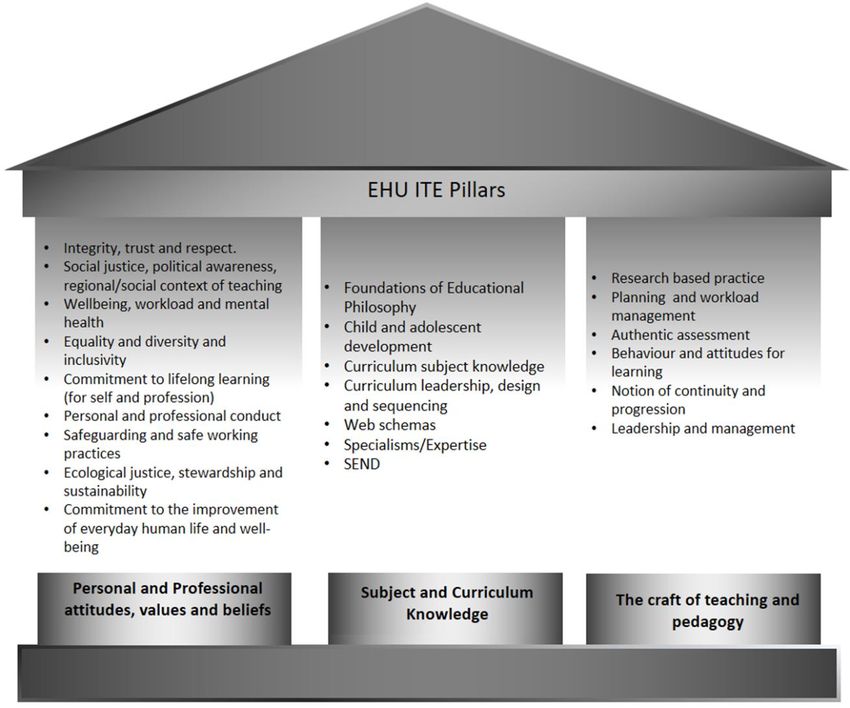
The Faculty have established three key pillars around which our ITE curriculum is designed. These
are appropriate for each age phase offered within our provision
• Personal and Professional attitudes, values and beliefs
• Subject and Curriculum Knowledge
• The Craft of teaching and pedagogy
The Edge Hill University ITE Partnership is underpinned by this overarching vision.
The Edge Hill University ITE Partnership provides Teacher Training at both Undergraduate and
Postgraduate levels in both the Primary and Secondary age ranges.
3In the year 2020-2021 the following Higher Education Institutions (HEI) programmes are offered, in
Partnership with schools:
• BA (Hons) Early Years Education with QTS (3-7 age range)
• PGCE Early Years Education with QTS (3-7 age range)
• BA (Hons) Primary Education with QTS (5-11 age range)
• PGCE Primary Education with QTS (5-11 age phase)
• PGCE Primary (Early Years) Education with QTS (3-7 age range)
• BA (Hons) Secondary Education with QTS (11-16 age range)
• PGCE Secondary Education with QTS (11-16 age range)
• PGCE Further Education and Training (post 14 age range)
Please note, this Agreement is updated regularly, for the latest version, please visit:
https://www.edgehill.ac.uk/educationpartnership/partnership-agreements/
Due to ongoing implications of COVID 19, Edge Hill University will adhere to advice and guidance
from the World Health Organisation, Public Health England and additional national and local
guidance. Partners will advise the university and students of any additional implications and guidance
within their own settings.
1) Selection of ITE Partners
Any school, college or setting that submits an offer for a Placement is agreeing to accept the terms
and conditions of this agreement and is confirming that they will adhere to the roles and
responsibilities detailed.
Any setting within the Edge Hill University ITE Partnership should be able to demonstrate:
• A recent Ofsted inspection report or equivalent that identifies the strengths necessary to be
involved in ITE.
• A commitment to work together in partnership with EHU in designing and delivering a high
quality ITE curriculum to students through the provision of mentoring and support from expert
colleagues.
• A commitment to ITE within their setting policies and procedures relating to the Placement
offers made, and a commitment to update information and to communicate with the
Partnership Development Team and academic colleagues. It is anticipated that this
commitment will be recognised within the setting’s own evaluation and development planning.
• A willingness to designate appropriately trained staff with specific responsibilities in relation to
ITE.
• A commitment to engage in on-going training and professional updating for mentors, allowing
them to work within the roles and responsibilities described in this Agreement.
• An understanding of the roles and responsibilities identified in this Agreement.
• A commitment to quality assurance and enhancement and the process of feedback,
evaluation, monitoring and the critical review of Placement and partnership activities.
2) Review, Evaluation and Feedback
The following identifies the range of mechanisms used to review, evaluate and feedback to partners:
• For every Placement a trainee and mentor complete a training evaluation (Professional
Practice Evaluative Report (PPER); this is reviewed at a Placement Review meeting
• Minuted trainee consultative meetings are reported to Programmes Boards.
• External Examiner reports are reviewed and responded to.
4• Visiting Tutors provide feedback to mentors on the quality of their training.
• Partnership Quality Officers provide feedback to the Mentor or Headteacher on the quality of
the training a school or setting is providing.
3) Organisation and Quality Assurance of the Partnership
The Partnership is overseen and managed through a collaborative committee structure which
operates at leadership and programme levels. Such committees provide collaborative forums for the
consideration of the performance of ITE programmes. The FoE Strategic Partnership Board informs
decision making relating to quality assurance, policy directives and monitors the continual
improvement and effectiveness of ITE provision.
3.1) Placement Management Structure
Faculty Board
FoE Strategic
Partnership Board
Department Programmes
Board
Departmental
Partnership
Engagement Partnership
Placement NQT/former Trainee
Groups Development
Review trainee Voice
Meetings Officer
representative (SSCF)
s
4) Placements
4.1) It is expected that Edge Hill University partners will:
• Ensure that all staff engage with and are aware of the current ITE criteria
https://www.gov.uk/government/publications/initial-teacher-training-criteria/initial-teacher-
training-itt-criteria-and-supporting-advice
• Be responsible for reviewing and updating all contact information that Edge Hill University
holds about them, ensuring it is kept up to date and that Edge Hill University is informed
of any key changes, such as Ofsted/equivalent status of the school training/department
changes.
• Provide suitable rooms, with lighting, heating and technical facilities for trainees and
ensure appropriate amenities are available for trainees to use.
• Provide access to the necessary equipment with internet connection at a level
appropriate to the number and requirements of the trainees.
• Accept responsibility for the trainee under the Health and Safety at Work Act 1974 and/or
the EU directive for Safety and Health at Work (whichever is the higher requirement).
54.2) How Placements are allocated:
The Partnership Development Team contacts schools in the summer term to discuss Placements for
the following academic year following on from the Placement Request Process.
The Partnership Development Team contact schools in a timely manner to confirm the Placements of
trainees with them, and trainees complete a Student Allocation Profile (SAP) to help Edge Hill
University match them with an appropriate school.
When allocating Placements, factors such as previous experiences, travelling distances, age phases
taught, and the current needs of the trainee are considered jointly by the Partnership Development
Team and the Programme/Course Leader.
For School Direct routes the Lead School arranges Placements with, and, if required, the support of
the University.
5) Ensuring Equality, Safeguarding and Safety
5.1) Edge Hill University Partners will:
• Ensure that, should the trainee be expected to work with machinery, equipment or substances
hazardous to health, safety precautions will first have been taken, first aid facilities will be
available and training, supervision and protective clothing will be provided.
• Will have in force Employers’ and /or Public Liability insurances and ensure that the trainee
and/or accompanying teacher is deemed an employee for the purposes of these insurance
policies.
• Ensure if insurance is not in place (eg exemption permissible under the Employers’ Liability
(Compulsory Insurance) Act 1969), they have access to funds to pay for any liability dispute
and compensation awarded and accept full responsibility in this regard.
• Provide a health and safety induction for the trainee as you would to any member of staff
working in your setting ensuring appropriate risk assessments have been carried out.
• As part of the trainee’s induction into the setting introduce the setting’s safeguarding policy
and approach to The Prevent Duty, in order that the trainee is fully briefed about their
responsibilities. Please refer to Counter-Terrorism and Security Act 2015 (the CTSA 2015).
Bodies to which the duty applies must have regard to statutory guidance issued under section
29 of the CTSA 2015 (“the Prevent duty guidance”).
• The school/college/setting will ensure that all trainee teachers are provided with the following
at the commencement of their training in each school:
o The Safeguarding policy
o The Staff Behaviour policy (sometimes called a Code of Conduct)
o Information about the role of the designated Safeguarding lead
o A copy of Keeping Children Safe in Education (or equivalent). for more information
see here: https://www.gov.uk/government/publications/keeping-children-safe-in-
education--2
o Equality and Diversity policy
o Health and Safety policy
o Special Educational Needs policy
• Will inform Edge Hill University should an issue arise under the Prevent Duty, which relates to
a trainee.
• In respect of School Direct salaried trainees and Further Education and Training in-service
trainees, the school, college/setting will ensure that all trainees have been subject to an
Enhanced Disclosure and Barring Service (DBS) criminal records check, including a check of
the children’s barred list and other relevant safeguarding checks, and keep records showing
that trainees have obtained these.
• Ensure all trainees are aware of their first point of contact in the setting and who to go to if
there are any concerns or issues that arise.
6• Allow Edge Hill University Visiting Tutors access to trainees and mentors to ensure accuracy
of assessment and that the trainee is receiving high quality training.
• Advise Edge Hill University immediately of any injury or loss involving the trainee.
5.2) Edge Hill University will:
• For trainees who are pregnant, provide an individual Risk Assessment with targets, the
school, college/setting review the targets set in the Risk Assessment on a weekly basis
• Ensure all trainees will have a DBS check, Occupational Health check and a check to ensure
they are not prohibited from teaching. They also need to make a safeguarding declaration to
confirm they are not banned from working with children.
• Trainees will not be subject to any further DBS or safeguarding checks and that the letter
confirming their suitability to train to teach is accepted as proof of their clearance to work with
children and young people in line with the DBS Code of Practice and the “Initial Teacher
Training Criteria” from DfE (see https://www.gov.uk/government/organisations/disclosure-and-
barring-service ).
• Ensure that prior to Placement, a placement-based introduction to Health and Safety,
Safeguarding, finance and the Code of Conduct and has been accessed by the trainee. In
addition, they will have been introduced to The Prevent Duty and gained an understanding of
their responsibilities about the advice given.
• Provide specific guidance to explain the requirements for each Placement and guidance on
how to support the trainee throughout their training in the setting.
• Provide trainees access to resources linked to their Placement:
https://www.edgehill.ac.uk/educationpartnership/ (see Placement paperwork within each
department)
• Provide an outline of the processes and procedures for accurate and consistent assessment
of all trainees, including moderation procedures on Placement (see relevant Placement
handbook) https://www.edgehill.ac.uk/educationpartnership/
6) Training Roles and Responsibilities within the Edge Hill University
Partnership
6.1) Edge Hill University will:
• Provide mentor training and development via a range of methods; there is a PowerPoint
online which includes all paperwork and processes. Mentor Training is delivered via Teams
before a placement commences, with regular additional webinar and ‘open’ Q and A
sessions. In addition, the team will deliver bespoke sessions to schools (virtually or
physically) requesting this. The Visiting Tutor initial visit will be part of the mentor training at
the beginning of placement, with opportunities to attend further online and face to face mentor
training events at Edge Hill Campus.
• Provide trainees with virtual/physical enhancement opportunities/Continuous Professional
Development (CPD) according to trainee need where possible and appropriate, such as,
experience of a school in challenging socio-economic circumstances.
• Consider the trainees’ workload when designing the centre and professional practice
curriculum.
6.2) Edge Hill University partners will:
• Appoint a mentor or point of contact who will liaise with Edge Hill University to ensure that all
training in the setting is of high quality, all trainees are receiving their entitlement and that the
required reports and evaluations are returned on the prescribed dates (including, interim
report forms, End of Placement report forms and evaluation forms).
7• Ensure an appropriate mentor is identified for each trainee and in the absence of the
identified one, ensure a suitable replacement is sourced immediately.
• Engage with the Edge Hill University placement management system (InPlace) to monitor the
number of placements offers and ensure mentor assigned to each trainee is correct.
• Ensure all mentors follow the assessment process and procedures outlined in the age phase
specific Edge Hill University Placement Handbooks
https://www.edgehill.ac.uk/educationpartnership/ (see each departmental section for the
relevant Handbook)
• Ensure all mentors working with trainees have a clear understanding of the most recent
Teachers’ Standards, the ITT Core Content Framework/Early Careers Framework (as
appropriate) and Edge Hill University assessment processes and procedures (see relevant
Placement handbook) https://www.edgehill.ac.uk/educationpartnership/
• Ensure mentors are aware of, and familiar with, all required report forms and documentation
that the mentor must complete for the trainee to complete the Placement and for the payment
to be released.
• Adhere to the Edge Hill University Training and Assessment Guidelines as noted in the
Placement Handbook https://www.edgehill.ac.uk/educationpartnership/and related to the
Teachers’ Standards https://www.gov.uk/government/publications/teachers-standards
• Provide trainees with enhancement opportunities/Continuous Professional Development
(CPD) according to trainee need where possible and appropriate, for example:
o SEND
o EAL
o Experience of transition from one age phase to another
• Ensure all mentors are fully aware of their roles and responsibilities, including:
o Establishing trusting relationships, modelling high standards of practice, and
understanding how to support a trainee through initial teacher training,
o Supporting trainees to develop their teaching practice in order to set high
expectations of all pupils and meet their needs,
o Setting high expectations and inducting the trainees to understand their roles and
responsibilities as a teacher,
o Continuing to develop their own professional knowledge, skills and understanding
https://www.gov.uk/government/uploads/system/
uploads/attachment_data/file/536891/Mentor_standards_report_Final.pdf
• Engage in an ITE Ofsted inspection should the University be inspected.
• Ensure all mentors can make an accurate identification and assessment of any trainee
(strengths, areas for improvement and an appropriate grade or indicative grade), including the
setting of appropriate, specific individual targets.
• Ensure all mentors have an understanding of the needs of trainees as ‘teachers in training’
and can support, develop and respond to the individual trainee’s training needs by setting
appropriate, specific individual targets.
• Support the trainees to manage their workload and provide the relevant non- contact time.
6.3) Mentors will:
• Ensure completion of trainees’ timetables in accordance with the requirements of that
Placement.
• Monitor trainee achievement and share this with Edge Hill University Placement using
appropriate paperwork for each stage of the training (paperwork accessed here:
https://www.edgehill.ac.uk/educationpartnership/)
• Ensure that all required reports and evaluations are completed and returned on the
prescribed dates (including Interim (if applicable to the programme) and End of Placement
Report forms, to ensure payment is processed.
• Provide support for each trainee to fulfil their teaching potential, ensuring that the Edge Hill
University Cause for Concern’ and intervention procedures are adhered to.
• Ensure that all trainees are able to train across appropriate key stages/age phases and
qualification levels, as appropriate, to gain the breadth and depth of experience required.
• Complete online evaluations as requested by Edge Hill University.
86.4) The Trainee will:
• Ensure that they are proactive in their own learning by playing a key role in the evaluation and
reflection of their own professional development and practice on a regular basis.
• Make initial contact with the Mentor, prior to commencement of their placement, who is
responsible for their professional development within the Placement.
• Provide a detailed copy of their teaching timetable for the Visiting Tutor
• Be pro-active in finding out about anything which they are unsure of (and should ask if in
doubt).
• Maintain professional standards from the outset.
• Adhere to the Part 2; Personal and Professional Conduct of the Teacher Standards
• Maintain full attendance, punctuality and professionalism in terms of dress, manner and
interpersonal relations.
• Complete all required activities and paperwork at the stated point in their training.
7) Quality Assurance
7.1) Edge Hill University partners will:
• Agree and adhere to Edge Hill University processes and procedures (see appropriate
Placement Handbook) https://www.edgehill.ac.uk/educationpartnership/
7.2) Edge Hill University will:
• In collaboration with partners conduct a high quality, open and transparent recruitment and
selection process.
• Ensure that the Partnership meets the current DfE Initial Teacher Training (compliance)
Criteria https://www.gov.uk/government/publications/initial-teacher-training-criteria/initial-
teacher-training-itt-criteria-and-supporting-advice and will continue to meet the criteria.
• Offer on-going training for partners including subject specific (where appropriate) and generic
mentor training for each identified mentor (see website for training opportunities,
https://www.edgehill.ac.uk/educationpartnership/ under the specific age phase).
• Ensure compliance of trainees’ timetables through Visiting Tutors.
• Ensure trainees receive Visiting Tutor entitlement.
• Ensure Partnership Quality Officers communicate with partners to ensure that quality
assurance processes have been followed and adhered to.
• Complete a review of the data and analyse trends to implement interventions, as appropriate.
• Communicate with Visiting Tutors, Mentors and trainees to gather feedback to review each
Placement.
• Collate evaluations from a range of sources including National Student Survey results (NSS),
Staff, Student Consultative Forum (SSCFS), data collection from programme teams,
Professional Practice Evaluative Reports, External Examiners, and Partnership Quality
Officers.
• The university will organise a panel of professionals to review DBS issues comprising
representatives from the partnership and the faculty, where appropriate.
7.3) Impact of an ‘Inadequate’ Ofsted judgement on a placement setting
• If a school has been judged as ‘inadequate’ by Ofsted, a Risk Assessment Quality Assurance
meeting takes place to ensure the school/year group or department are able to provide the
appropriate support for trainees.
7.4) Ending a Partnership. De-selection of schools from the ITE Partnership will take place
following a rigorous additional Quality Assurance visit.
9Edge Hill University has strong links with Partnership Schools and supports them to fulfil the
requirements and expectations of the Partnership Agreement. It would be very unusual to consider
de-selection of a Partner School and would be a rare occurrence and only if after additional support a
school is unable to fulfil their responsibilities in accordance with the Partnership Agreement or the
Partnership Handbook.
If a concern is identified at the school, the Partnership Quality Officer (PQO) will meet with key school
staff, the Edge Hill Visiting Tutor and the trainee to discuss any concerns and to identify any
necessary support or training needs to achieve a positive resolution. The PQO will liaise with the
school, the ITE lead, and the year group lead to ensure that support is in place for the school and that
the trainee receives their training entitlement.
In the case where all support mechanisms have failed and where serious issues remain unresolved,
then formal withdrawal of partnership is an option. It may be that a key stage or a department is
identified for removal from the partnership. The Head of Partnership Development will review any
decisions annually.
7.5) The External Examiner
All the university's programmes are subject to scrutiny by External Examiners who report on areas
such as:
• The general standard of the work assessed, assessment against the ITT Core Content
Framework/Teachers’ Standards and Initial Teacher Education Inspection Framework and
comparability with similar levels of work nationally;
• The overall performance of trainees in relation to their peers in other institutions and the
Teachers’ Standards;
• The overall strengths and areas for development of trainees;
• The overall quality of knowledge and skills (both general and subject-specific) demonstrated
by trainees;
• The structure, organisation, design and marking of all assessments;
• The quality of the training programme as indicated by trainee teacher performance;
Responsibilities
During their period of tenure, External Examiners will:
• Look at a sample of trainees’ written work and assessments. Samples include a range of
trainee attainments and are dependent on trainee availability and the practicalities of
arranging an itinerary;
• Review trainee documentation observe trainees teach in school and discuss the lesson
with the trainee and Mentor;
• Submit an annual report to the Faculty of Education summarising their findings and
identifying key strengths and areas for development of the programme they are
responsible for.
8) Wider partnership activity:
Working in partnership with Edge Hill University enables our partners to access a wide range of
ongoing activity for children and school staff. Children to come to campus for ‘Aspiration Visits’
which include campus tours, taster sessions across a range of subjects and opportunities to
engage with academic colleagues and students. We also have a range of CPD opportunities
including specialist subjects and engagement with research. Partners attend a Faculty Strategic
Partnership Board and Departmental Partnership Advisory Groups, which provide input into key
strategic objectives.
10Partners are involved in the design and implementation of Recruitment and Selection activity,
attending both physical and virtual interviews. Specific focus groups with partners contribute to
curriculum development. Partners are welcomed to contribute expert knowledge to teaching
sessions within a wide range of subject specialism contexts.
Partnership representatives are members of EHU DBS panels.
9) Legal Provisions
9.1) Variation of the Agreement:
Initial Teacher Education provision is subject to external requirements set by external bodies, i.e.
Ofsted, the Department for Education or any other body which may succeed them. Changes in
policy and/or requirements by those bodies may result in changes to Initial Teacher Education
provision. The University reserves the right to make amendments to the content of this agreement
which may be required as a result of changes in policy and/or requirements from Ofsted, the
Department for Education or any other body which may succeed them. Should any changes be
required to ensure that the provision remains compliant with those external requirements, the
University will forward an email to all partners informing them of the changes which have been
implemented and a revised agreement will be uploaded to the website.
https://www.edgehill.ac.uk/educationpartnership/partnership-agreements/
9.2) Inducements:
Both parties will comply with all applicable laws, statutes and regulations relating to anti-bribery
and anti-corruption including but not limited to the Bribery Act 2010.
9.3) Disagreements:
If there arises any point of disagreement between Edge Hill University and partners referring to
the terms of this Agreement every effort will be made to resolve this at a local level in the first
instance. If this is not successful, the matter shall be referred to the Head teacher or Principal of
the setting and Edge Hill University’s Head of Partnership. If no resolution is reached, the Head
teacher or Principal and the Pro Vice-Chancellor will agree to engage in independent alternative
dispute resolution procedures.
9.4) Jurisdiction:
This Agreement is governed by and shall be construed in accordance with English law. The
parties to this Agreement submit to the exclusive jurisdiction of the English Courts.
9.5) No assignment:
Partners shall not sub-let, franchise, assign or transfer the Agreement or any part, share or
interest in it to a third party.
Nothing in this Agreement is intended to, or shall be deemed to, establish any partnership or joint
venture between the Parties, constitute any Party the agent of the other Party, or authorise any
Party to make or enter into any commitments for or no behalf of any other Party.
Each Party confirms it is acting on its own behalf and not for the benefit of any other person.
9.6) Termination of the Agreement:
This Agreement may be terminated after a period of not less than 2 months’ notice by either of the
parties, without the need to give any reason, on condition that outstanding financial and personnel
commitments are honoured and that the rights of students are safeguarded.
Either of the parties may terminate this Agreement with immediate effect in the event of a breach
of any of the terms by the other party. Such termination shall not affect the rights which the party
so terminating the Agreement may have against the other party in consequence of the breach.
This includes, but is not limited to, the following circumstances:
• If at any time it is unlawful for a party to perform any of its obligations under this
Agreement; or
• If a party has appointed a liquidator, provisional liquidator, administrator or similar officer
or a like appointment is made in relation to the assets of that party; or
11• If where an application is made to a competent court for an order or an order is made, or
a meeting is convened, or a resolution is passed for the purpose of appointing a person
referred to in the preceding paragraph or for the winding up of the other party or for
implementing a scheme or arrangement or for placing the other party under
administration; or
• If a party fails to duly and punctually comply with any proper laws binding on it for the
purposes of the rights and obligations specified in this Contract; or
• If a party ceases or threatens to cease to carry on the operations customarily carried on
by it.
Termination of the Agreement is subject to the condition that each party will fulfil its respective
obligations and duties to any continuing trainees registered on provision covered by this
Agreement, with the students being enabled to complete their Placements without disadvantage.
9.7) Data Protection:
Partners agree that Edge Hill University can store and utilise information that it holds and use that
information for enhancing the training and education it provides. For further information see: Data
Protection Act (read the ‘Guide to the General Data Protection Regulation’) and Freedom of
Information Act 2000.
9.8) For content and delivery of each ITE Programme:
Please see Programme and Placement Handbooks.
https://www.edgehill.ac.uk/educationpartnership/
9.9) Further links:
The below links will be useful for those staff involved in ITE:
• Education (School Teachers’ Qualifications) (England) Regulations 2003 (SI 1662) - statutory
requirements for QTS in England
• Education (Specified Work) (England) Regulations 2012 (SI 762) - requirements that must be
satisfied by individuals who are not qualified teachers to be able to carry out specified work in
schools
• Equality Act 2010 - legislation relating to equality, discrimination and employment
10) Payments
Payments to Settings are fixed amount financial contributions, which are agreed, internally within
Edge Hill University’s, Faculty of Education, prior to the release of the Placement Request
documentation, for the following academic year.
The confirmation of a Placement allocation forms an agreement between Edge Hill University and the
partner setting. Therefore, confirmation of the Placement allocation should be made in writing by
email confirmation to each setting and should confirm the requirements and any corresponding
payment amount as a formal record and serve in the absence of a Purchase Order.
The agreed payment is subject to full completion of the Placement and the submission of the required
documentation.
10.1) Pro-rata payment for part completion
In circumstances where students do not complete their Placement in full as originally agreed, for
whatever reason, any payments will be subject to a reduction on a pro-rata basis, to fairly represent
the work undertaken.
12The table below shows the breakdown of how pro-rata calculations will be made for Placements
within the following departments:
• Department of Children Education and Communities
• Department of Early Years Education
• Department of Secondary and Further Education (but excluding Further Education and
Training Placements)
Portion of Placement completed/ attended Pro-rata payment amount
Up to and including 5 days completed/ attended £10 per day attended
(Maximum of £50)
Over 5 days and up to 25% of agreed days completed/ 25% of agreed payment amount
attended
26% - 50% of agreed days completed/ attended 50% of agreed payment amount
51% - 75% of agreed days completed/ attended 75% of agreed payment amount
76% - 100% of agreed days completed/ attended 100% of agreed payment amount
The table below shows how pro-rata calculations will be made for Further Education and Training
Placement’s only.
Cost per observation Cost per hour of solo teaching
£50 £7 per hour of solo teaching
(up to a maximum 6 observations, so a (up to a maximum 100 hours, so a maximum
maximum £300*) £700*)
For each professional practise, any additional attendance, over and above the original agreement
must first be discussed and agreed with Edge Hill University in advance of the attendance taking
place and there will not normally be any additional payment connected with this attendance. Any
voluntary attendance by a student is not subject to any payment under any circumstances.
10.2) Release of payment
Edge Hill University are unable to make any payments to settings without the auditable documented
evidence being submitted to and received by Edge Hill University, to confirm that the Placement has
taken place as agreed. This is a requirement under Edge Hill University’s Financial Regulations for
audit and monitoring purposes.
Edge Hill University do not require an invoice to initiate the release of payment and respectfully
request that school/ college/ settings do not submit invoices, as this can cause confusion and delays
in our financial processes.
Only the following documents will be accepted as auditable documented evidence:
Placement status Required document to trigger payment
Full completion of Placement End of Placement Report/ Summative Report
Part completion of Placement Early Conclusion of Placement Form
13Enhancement placement Attendance Record
10.3) Submission of documentation
It is the responsibility of partners to ensure the completion and submission of the relevant
documentation, in order to ensure payment can be made. The email addresses for the submission of
the documentation is as follows:
Full completion of Placement:
• Department of Children, Education and = DCEC@edgehill.ac.uk
• Department of Early Years Education = EarlyYearsPartnership@edgehill.ac.uk
• Department of Secondary and Further Education = SFEsupportteam@edgehill.ac.uk
Part completion of Placement:
• Partnership Development Team = educationpartnership@edgehill.ac.uk
Copies of the relevant documentation should be retained by the school/ college/ setting for future
reference.
10.4) Edge Hill University Partners will:
• Ensure that their school/ college/ setting’s Bursar/ Business Manager is aware of the
appropriate payment and that Edge Hill University do not require an invoice for Placement
payment, as the release of payment will be triggered by internal procedures upon receipt of
the appropriate documentation.
• Monitor the attendance of the trainee and ensure the trainee is completing an accurate
attendance record and that the mentor / supervisor on a regular basis review this.
• If a Placement ends before the agreed end date, inform Edge Hill University immediately in
writing and complete and submit an Early Conclusion of Placement Form to
educationpartnership@edgehill.ac.uk
• Inform the school/ college/ setting’s Bursar/ Business Manager of the early conclusion so that
they can expect a pro-rata payment.
• If the Placement completes in full, contribute to the completion of the End of Placement
Report/ Summative Report and ensure this is signed and submitted to the relevant academic
department within Edge Hill University (see email addresses above) within 2 weeks of the last
day of Placement.
• Retain copies of the appropriate documentation for submission in the event that Edge Hill
University does not receive this via other channels (e.g. trainee or Visiting Tutor).
10.5) Edge Hill University will:
• Ensure the appropriate payment is quoted on the confirmation of allocation email to initiate
the agreement between Edge Hill University and the school/ college/ setting in advance of the
Placement start date.
• Provide the school/ college/ setting with the appropriate documents (or electronic links to the
same) for completion by the school/ college/ setting.
• Ensure that the school/ college/ setting is set up as a registered supplier so that payment can
be made. This will include obtaining the school/ college/ settings BACS details, where
appropriate.
• Apply effective monitoring and tracking mechanisms for the receipt of the required
documentation to Edge Hill University to ensure payment can be made.
• Follow up on missing documentation in a timely period to reduce delays in making payment.
• Ensure the required documentation is directed to the relevant department and logged to
initiate the release of payment.
• Release the appropriate payment amount as per the agreement or above pro-rata calculation
structure in good time following the receipt of the required documentation.
• Provide remittance by email to the school/ college/ setting to confirm when payment has been
released.
1411) Summary of Roles and responsibilities:
Trainee A student who is on an Initial Teacher Education (ITE) Programme leading to Qualified
Teacher Status (QTS) or Qualified Teacher Learner and Skills (QTLS) at Edge Hill
University.
Mentor A member of staff in a school/college/setting who is a qualified teacher that is
responsible for the trainee whilst they undertake their Placement. Main duties include
observing the trainee and providing feedback, setting targets, holding weekly review
meetings, being responsible for the high-quality training that the trainee receives in the
setting and facilitating opportunities in school/college/setting for the trainee to continue
to learn and develop. Full details of this role are contained within the Edge Hill
University Placement Handbook.
School/Setting Lead/ A member of staff who has been identified as the main point of contact for the
Professional Mentor University, and co-ordinates ITE They will work with Edge Hill University to ensure the
(PM) training provided is of high quality and is consistent between all their mentors. They will
ensure that all required reports and evaluations are returned on the prescribed
Placement to ensure that any subsequent payment for placements Placement are
received. In Further Education and Training Settings, more of this role may be
undertaken by the Mentor.
Visiting Tutor (VT) The Visiting Tutor is a member of staff at Edge Hill University and provides support for
both the trainee and the mentor that they are visiting. They will conduct joint
observations with the mentor and observe feedback and discussions between the
mentor and the trainee. The Visiting Tutor will support and provide feedback on the
quality of the training and support the mentor in gaining any additional training required
either for the mentor themselves or for their trainee.
Head of Partnership A member of staff from Edge Hill University who works strategically across the
Development Partnership.
Operations Manager A member of staff from Edge Hill University who works strategically with the Head of
Partnership Partnership Development and leads the Partnership Development Administration
Development Team.
Partnership A team of staff from Edge Hill University who liaise directly with schools and trainees
Development regarding Placements.
Administration Team
Partnership Quality A member of staff from Edge Hill University (who must be a different person from the
Officer (PQO) VT for quality assurance purposes) who works with the partner lead/Professional
Mentor to quality assure the training provided partners and provides support where
needed.
Partnership A member of staff from Edge Hill University who seeks and secures offers from
Development Officer school/college/setting for Placement.
(PDO)
Programme Leader A member of staff from Edge Hill University who leads and manages the whole ITE
programme.
Course Leader/ A member of Edge Hill University staff who is responsible for the overall training and
development of trainees in their subject /year whilst on Placement and in University
Year Leader
based sessions.
15Partnership An age phase specific strategic group consisting of academic colleagues and
Development Group school/college partners working together to co-construct curriculum content and
partnership structures.
1611) ITE Partnership
• Responding to setting or
• ITE Partnership Agreement trainee concern process
• Placement
Request Request
for offers Process
– SEARCH Request• forTrainee
offers –leaves
SEARCH a
• Partnership Development
Partnership Development Officer Officer Partnershipprofessional
Development Officer early
practice
• Professional
Placement Patterns practices Patterns Placement Patterns
process and form
• Equality
Equality and and Diversity
Diversity Policy
Policy Equality• and‘Cause for Policy
Diversity Concern’
procedure
Joining the • Student support process
Issues/
EHU
Concerns
Partnership
• Mentor training events • DBS and Safeguarding procedures
• Involvement in recruitment and • Programme and Professional -
selection, design and/or delivery
– SEARCH Training Practice Handbooks
Request
•
for offers Getting Request for offers – SEARCH
Partnership Development
Partnership Development Officer and • Student Allocation Profile
Groups Involved Partnership Development
•
Officer
Placement
• DBS
Patterns Assessment Training documentation
Placement Patterns
Equality andPanels
Diversity Policy • Pregnancy
Equality Risk Assessment
and Diversity Policy
• Boards, committees, • QA Procedures
• Projects • Organisation and Management
• Conferences • External Examiner Visits
• Research • Programmes Boards
Communication across the Partnership will be at different levels depending on the nature of the communication:
• PDO with school/college/setting to build, grow and develop the Partnership
• PQO with school/college/setting and trainee to review overall quality of training and capacity of the partner
• Visiting Tutor with Mentor and trainee to ensure high quality training is provided on a day to day basis whilst a trainee is on Placement
• Programme Lead and External Examiner with Mentor and Visiting Tutor to moderate and quality assure the training
• Head of Partnership Development has strategic overview with all stakeholders
17You can also read


