Electromagnetics for Engineers I: Time-Independent Fields
←
→
Page content transcription
If your browser does not render page correctly, please read the page content below
Electromagnetics for Engineers I:
                  Time-Independent Fields
                      Dr. Cheng Yang, Prof. Dr. sc. techn. Christian Schuster
                                          Course Overview, Summer Term 2021

 Technische Universität Hamburg-Harburg              Introduction to EDC – 1   Theoretische Elektrotechnik
[Bilder: TET, TUHH]
03/21

                               What the TET is about?

        TET             = Theoretische Elektrotechnik (German)
                        = Network and electromagnetic field theory (earlier)
                        = Electromagnetic field theory (today)
                        ≈ Maxwell’s Field Theory

                  Maxwell's field theory or the corresponding equations
                    describe the behavior of electromagnetic fields
                                  at a macroscopic level.
                   The calculation, evaluation and dimensioning are the
                          tasks of electromagnetic field theory .

Hamburg University of Technology      Course Overview--Summer
                                    Vorlesungsübersicht       Semester2020
                                                        Sommersemester 2021-2
                                                                           –2   Theoretische Elektrotechnik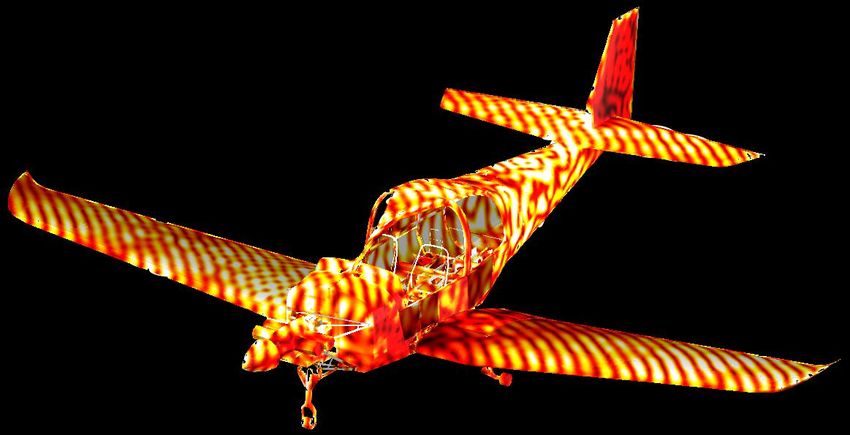
03/21

                                                     Curriculum
                                                                                              Chapter              Chapter
     Week                                               Topics
                                                                                               Script               Henke
        1                                     Good Friday (KARFREITAG)
        2                Introduction, Overview, Repetition, Vector Fields and Integrals         1.1
        3                   Maxwell-Equations (ME) in integral Form, Vector Analysis            1.1              2.1 – 2.8
                                                                                                            1.1 – 1.4, 2.9, 2.10,
        4                Coordinate Systems, ME in differential Form and Conclusions          1.3 – 1.7
                                                                                                               4.3, 7.6, 9.3
        5                            MATLAB: Introduction and Dealing with Fields
        6                    Fundamentals of Electrostatics, main Solution Methods              2.1                3.1 – 3.7
        7*                                Main Solution Methods (continued)                     2.2                    3.8
        8                          Partial Capacitance, MATLAB: Electrostatic Fields
        9                            Conformal Mappings, Separation of Variables                2.2                 6.3, 6.2
        10                  Magnetostatics, Magnetization, analogy to Electrostatics            2.3                9.1 – 9.2
        11                   Electric Current Density Fields, analogy to Electrostatics         3.1                7.1 – 7.6
        12                         MATLAB: Finite difference Method for static Fields                                  6.4
        13                         Magnetic Fields of steady Currents, Ampere's law             3.2                 8.1, 8.2
        14                   Mag. Vector Potential, Biot-Savart Law, Poynting Vector          3.2 – 3.5            8.3 – 8.6
        15                                         Exam Preparation

                                     All teaching, experimental demonstations and exercises are online.

Hamburg University of Technology                    Course Overview--Summer
                                                  Vorlesungsübersicht       Semester2020
                                                                      Sommersemester 2021-3
                                                                                         –3       Theoretische Elektrotechnik
03/21

                                   Goals of this Course
   Students can explain the fundamental formulas, relations, and methods of
   the theory of time-independent electromagnetic fields. They can explicate
   the principal behavior of electrostatic, magnetostatic, and current density
   fields with regard to respective sources. They can describe the properties of
   complex electromagnetic fields by means of superposition of solutions for
   simple fields. The students are aware of applications for the theory of time-
   independent electromagnetic fields and are able to explicate these.
   Furthermore, they are capable of applying a variety of methods that require
   solving Maxwell’s Equations in both integral and differential notations for
   more general problems. The students can assess the principal effects of
   given time-independent sources of fields and analyze these quantitatively.
   They can deduce meaningful quantities for the characterization of
   electrostatic, magnetostatic, and electrical flow fields (capacitances,
   inductances, resistances, etc.) from given fields and dimension them for
   practical applications.

Hamburg University of Technology        Course Overview--Summer
                                      Vorlesungsübersicht       Semester2020
                                                          Sommersemester 2020-4
                                                                             –4   Theoretische Elektrotechnik
03/21

                                      MATLAB-Units
  MATLAB is required for working interactively in three lectures (and possibly also
  exercises). For these units, students should be in groups of max two participants
  per one portable computer with MATLAB pre-installed.
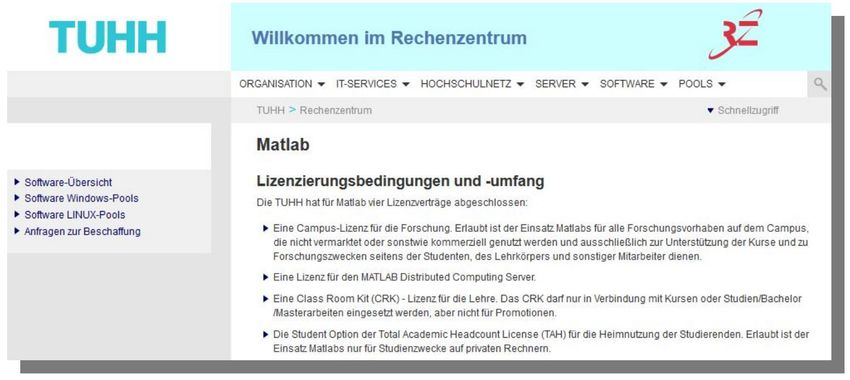
  Information about installation and license conditions at TUHH can be found at:
                             https://www.tuhh.de/rzt/software/numerik/matlab.html

Hamburg University of Technology           Course Overview--Summer
                                         Vorlesungsübersicht       Semester2020
                                                             Sommersemester 2021-5
                                                                                –5   Theoretische Elektrotechnik
03/21

                                          Exercise
      All exercises are as "presence
      exercises", i.e. students should
      work on the given problems
      /tasks independently as far as
      possible under the guidance of
      the tutor in course.
      Group discussions are
      expressly encouraged.
      Exemplary solutions are
      available on Stud.IP.

Hamburg University of Technology     Course Overview--Summer
                                   Vorlesungsübersicht       Semester2020
                                                       Sommersemester 2021-6
                                                                          –6   Theoretische Elektrotechnik
03/21
Script
Students can get a free
script from the Institute
of Electromagnetic Theory.
Scripts will be sent out by
post at the beginning of the
semester.
Details will be given in the
first lecture.
Hamburg University of Technology Course Overview--Summer
Vorlesungsübersicht Semester 2020
Sommersemester 2021-7
–7 Theoretische Elektrotechnik03/21
Literature
Close to the lecture, partially alternative textbooks:
H. Henke, "Elektromagnetische Felder: Theorie und Anwendung", Springer,
2011 (E-Book TUHH) – very close to the scripts!
M. Filtz, H. Henke, "Übungsbuch Elektromagnetische Felder", Springer (E-
Book TUHH) – good for exam preparation!
G. Lehner, "Elektromagnetische Feldtheorie für Ingenieure und Physiker",
Springer, 2010 (E-Book, TUHH) – detailed, suitable for self-learning!
For more physical application, please continue reading:
W. Nolting, "Grundkurs Theoretische Physik 3 : Elektrodynamik" Springer,
2011 (E-Book TUHH)
D. J. Griffiths, "Elektrodynamik: Eine Einführung", Pearson, 2012
J. D. Jackson, “Klassische Elektrodynamik", Gruyter (E-Book, TUHH)
Hamburg University of Technology Course Overview--Summer
Vorlesungsübersicht Semester2020
Sommersemester 2021-8
–8 Theoretische Elektrotechnik03/21
Written Exam
The written exam of Electromagnetics for Engineers usually takes
110-130 minutes and consists of two parts:
Part 1 = “Knowledge part” (10 Minutes)
Processing without any aids
Part 2 = “Application and analysis part” (remaining time)
Processing with written aids
(e.g. script, books, slide sets, etc.)
The first part would be collected before the second part is started.
Hamburg University of Technology Course Overview--Summer
Vorlesungsübersicht Semester2020
Sommersemester 2021-9
–9 Theoretische Elektrotechnik03/21
Individual Exam Calculation
In addition to the course, an individual exam calculation is offered
so that students can work on old written exams under examination
conditions. The procedure is as follows: :
Making appointment with the tutor of the exercise
Arranging individual or multiple exam tasks(without time limit but
only with the permitted aids) at the Institute of Electromagnetic
Theory on the agreed date
Correction and discussion directly with the tutor
The exam calculation has no direct influence on the grading of the
final written exam, but it is only used for the improvement of their
own abilities and their assessment.
Hamburg University of Technology Course Overview--Summer
Vorlesungsübersicht Semester 2020
Sommersemester 2021-10
– 10 Theoretische ElektrotechnikYou can also read


