EMMAUS HIGH SCHOOL 2020-2021 - PROGRAM OF STUDIES - East Penn School District
←
→
Page content transcription
If your browser does not render page correctly, please read the page content below
EMMAUS HIGH SCHOOL
    PROGRAM OF STUDIES

     2020-2021
EAST PENN SCHOOL DISTRICT
                                   MISSION STATEMENT
The East Penn School District fosters a community in which students become effective
problem solvers, collaborators, critical thinkers, and communicators.

                                    VISION STATEMENT
The East Penn School District will empower students to grow into confident, adaptable,
compassionate individuals who will become lifelong learners and contributors to a global
society.

                                    BELIEF STATEMENTS
  1. We believe education is an ever-changing lifelong process and people need to view themselves as
     lifelong learners.

  2. We believe students have a shared responsibility for their own learning.

  3. We believe all students will express themselves clearly and concisely and will understand, analyze,
     and use information communicated by others.

  4. We believe students of today will live in a different future and we must prepare them to develop
     solutions to confront new challenges.

  5. We believe the East Penn School District must continue to provide an excellent program that
     addresses the educational needs of all students in a safe and supportive environment.

  6. We believe a commitment to continuous improvement is essential to achieve the mission of the
     East Penn School District.

  7. We believe the collaboration between the home, the school district, and the community has a direct
     correlation to the quality of the educational system and the experience of each student.

  8. We believe a strong foundation of experiences leads to constructively contributing citizens who
     understand the effects of their actions.

  9. We believe that a strong and effective education system is essential to both the survival and
     prosperity of a democratic society.

  10. We believe that the East Penn School District must manage financial assets in an efficient and
      effective manner that is fiscally responsible to all members of the community.
Page | 1
A Message From The Principal
The Emmaus High School Program of Studies has been developed through a collaborative process involving your teachers and administrators. As times
change, so must the Program of Studies to reflect our current programs and procedures. Regardless of the changes, our goal remains to meet the needs of
each and every student while maintaining the organizational structure necessary for a 21st century high school. In order for us to properly identify our staffing,
curricular, and instructional needs, it is critical that you follow the procedures and timelines outlined in this program.
Please take time to review the Program of Studies with your parents or guardians. Our school counselors, teachers, and administrators will be happy to provide
you the appropriate resources and support as you reflect on your future goals and make your final course selections. Regardless of your path following
graduation, we urge you to select courses that will challenge you to learn and grow while meeting your needs and addressing your areas of interest.
When selecting courses for next school year, please keep the following in mind:
It is required that all students take a minimum of five full-year (or the equivalent) courses, in addition to wellness/fitness education (5.25 credits). Many
students elect to take six or more full-year courses in order to balance their educational experience.
Student course selections will be final as of June 26, 2020. If you wish to make a change from your initial course requests, you must submit your request in
writing to your counselor prior to this date.
Course selection can be an exciting and stressful process. Please communicate with your parents, teachers, and counselor as you finalize your selections and build
your schedule. We are committed to providing you the support you need to have a great high school experience.
Sincerely,
Dr. Kate Kieres, EHS Principal
COUNSELING SERVICES
Counseling services are intended to help students as they navigate high school
and prepare to transition to their postsecondary plans. Students are Department Chairs can be reached through the Emmaus High School
encouraged to consult with a counselor to discuss concerns about academic Main Office at 610-965-1650.
course work, career planning or social/emotional issues that may arise.
More specifically, the role of the school counselor is to: Please visit our website: www.eastpennsd.org/ehs
guide students in finding solutions to individual problems
help students transition and adjust to surroundings
aid students in identifying building and community supports BOARD OF SCHOOL DIRECTORS
provide resources for exploring post high school plans and career Dr. Ken Bacher, President
options Mr. Paul Champagne, Vice President
raise awareness of career and technical opportunities Ms. Alisa Bowman Dr. Ziad Munson
Mr. Allan Byrd Mr. Adam Smith
assist with academic course planning to meet graduation
Mr. Jeffery Jankowski Ms. Naomi Winch
requirements
Dr. Joshua Levinson
support students through the admission process for colleges, nursing
schools, junior colleges, technical schools and military enlistment. Ms. Kristen Campbell, Superintendent of Schools
Through a comprehensive school counseling program, counselors support Mr. Robert Saul, Treasurer
Ms. Janine L. Allen, Board Secretary
student success by aiming to help students achieve optimal personal
Mr. Marc S. Fisher, Esq., Solicitor Worth, Magee & Fisher, P.C.
growth, acquire positive social skills, set informed career goals and realize their
full academic potential so that they may become productive, contributing
members of the global community. HIGH SCHOOL ADMINISTRATION
Dr. Kate Kieres, Principal
FOR FURTHER INFORMATION
Contact Your School Counselor Ms. Lorie Gamble, Assistant Principal for Academic Affairs
Mrs. Lisa Shirvinski, Department Chair 610-395-8593 Ms. Tabitha Rodriguez, Assistant Principal, Class of 2020
Ms. Emily Bonney 610-965-1666 Mr. Greg Annoni, Assistant Principal, Class of 2021
Ms. Sara Burk 610-965-1664 Ms. Jessica Thacher, Assistant Principal, Class of 2022
Mrs. Colleen Demchak 610-965-1689 Mr. Jordan Fortier, Assistant Principal, Class of 2023
Mrs. Kristen Grim 610-965-1663 Ms. Rebecca George, Athletics/Activities Director
Mrs. Heather Greene 610-965-1665 Mr. Matt Spengler, Assistant Athletics/Activities Director
Mrs. Jessica LaBar 610-965-1691
Mr. Mike McInerney 610-965-1527 The East Penn School District is an equal opportunity education institution and will
Mr. Robert Pizzico 610-965-1667 not discriminate in its educational programs, activities or employment practices
Mr. Paul Wood 610-965-1687 on the basis of race, color, national, origin, sex, age, religion, ancestry, disability,
union membership or other legally protected classification. Announcement of this
DEPARTMENT CHAIRS policy is in accordance with state and federal laws, including Title VI, Title IX,
Ms. Lisa Caruso Art Section 504 and ADA.
Mr. John Dietrick Business and Computer Applications
Ms. Justine Frantzen English
Ms. Ann Breidenbach ESL For information regarding 1) civil rights, 2) grievance procedures, 3) services,
Ms. Heather Day Family and Consumer Sciences activities and facilities that are accessible to and usable by handicapped
Ms. Kim Adams Mathematics/Computer Science persons, or 4) employee or participant complaints of harassment or
Ms. Rita Cortez Music discrimination, contact Ms. Jessica Afflerbach, Compliance Officer, 800 Pine
Mr. Zach LaBar & Ms. Jenn Knight Science Street, Emmaus, PA 18049. The Federal Drug-Free Workplace Act requires
Mr. Kevin Remaly Special Education that your workplace be free of the illegal use of drugs and requires that we issue
Ms. Melissa Moxley Social Studies the following statement to you. No one is allowed to use, make, sell, distribute, or
Mr. Andrew Moxey Technology Education have in their possession any illegal drugs. Any violation of the act will lead to
Ms. Lori Miller Well/Fit/Driver Education/Health severe disciplinary action which will normally include dismissal.
Ms. Deborah Kalb World Language
Page | 2

                                                                                   TABLE OF CONTENTS
Art ................................................................... Pg 5-6   EL (English Learners) ........................................... Pg             13      Pass/Fail Option ..................................... Pg 3
Bell Schedules ............................................... Pg 39             Exempting Courses by Exam/Tutoring ................. Pg                          3-4     Science ................................................... Pg 17-21
Business and Computer Applications ........... Pg 6-8                            Family and Consumer Sciences ........................... Pg                      14      Scheduling Process ................................ Pg 2
Career Readiness .......................................... Pg 4                 Gifted Support Program ........................................ Pg               4, 14   Scheduling Worksheet............................ Back Cover
Class Transfer and Withdrawal ..................... Pg 3                         Grade Point Average (GPA) ................................. Pg                   3       Semesters, Full Terms ........................... Pg 3
College Courses ............................................ Pg 32               Graduation Requirements ..................................... Pg                 2       Six-Day Cycle ......................................... Pg 3
Computer Science ......................................... Pg 8-9                Honors and AP Sequence .................................... Pg                   3       Social Studies ......................................... Pg 21-23
Counseling Services ...................................... Pg 1                  Independent Study ................................................ Pg            32      Standardized Test Dates ........................ Pg 4
Course Descriptions ...................................... Pg 5-31               Keystone Exams ................................................... Pg            3, 4    Technology Education ............................ Pg 23-27
Course Offerings ........................................... Back Cover          Lehigh Career and Technical Institute ................. Pg                       32-38   Wellness/Fitness..................................... Pg 28
Course Selection ........................................... Pg 2                Mathematics .......................................................... Pg        14-16   World Languages.................................... Pg 28-31
Driver Education ............................................ Pg 9               Music ..................................................................... Pg   16-17
English ........................................................... Pg 9-13      Non-Discrimination Policy ..................................... Pg               1

                                                    Course Selection: A Message to Parents
Each eighth, ninth, tenth and eleventh grade student will receive a Program of Studies and can also access the Program of Studies on the EHS website. The
program is the result of meetings with teachers, counselors, department chairpersons, administrators, parents, the Superintendent and the Board of School
Directors. The Program of Studies describes each course offered in the high school. Please take some time to become familiar with our course offerings. Course
selection is regarded as an important function and should be given very serious consideration by students and parents.

In December, students will discuss next year’s course selections with their subject teachers. All teachers will use the knowledge they have gained having your child
in class to assist him/her in choosing an appropriate course for next year which best suits his/her abilities and aspirations. Students will then have the opportunity to
discuss their teachers’ recommendations with their families.

Occasionally, the teacher’s recommendation will not match your or your child’s selection. You are encouraged to contact the teacher if you have questions
regarding your child’s course recommendations for that subject area or your child’s counselor for general questions regarding course registration. Please note that
students must register for a minimum of 5.25 credits each year and fulfill the high school’s graduation requirements by the end of their senior year.

Students are encouraged to select courses with the following objectives in mind:
1. Complete all graduation requirements
2. Select courses which will prepare the student for entrance into college or the workforce. College bound students should familiarize themselves with admission
requirements for individual colleges and choose courses accordingly
3. Select courses that are taught at the highest academic level which they can handle in each subject area.

Please Note: Selecting courses should involve careful consideration by the student and his/her family and should be made on the basis of student interests,
abilities, and vocational goals. It is advisable to work closely with the school counselors in the selection of a program of studies. It is strongly recommended that a
student planning to take the second year of a continuing type course follow recommended prerequisites.

Course requests will be entered in January. Students, teachers, and families will have the opportunity to verify course requests in March. Once verifications are
completed, all the course requests are tallied. The number of sections of a particular course and teachers’ assignments are determined by the students’ course
requests. All course selection changes must be made before June 26th. A course may not be offered because an insufficient number of students selected the
course, a certified teacher is not available, or budgetary funds are not available. Although every effort is made to accommodate students’ requests, some cannot be
honored. Because of the implications a few changes can have on the entire schedule, it is very important that each student’s selections be made very carefully.

If the selections have been carefully made, changes should not be necessary, except in very unusual situations. If you would like to request a change, please send
the request in writing to your student’s counselor before June 26th, 2020. A change is much more likely to occur while the schedules are still being developed. Once
the schedules are developed, a change request is highly unlikely to be implemented. We will never be unreceptive to extenuating circumstances, but a change
merely for convenience is not in the best interest of good school organization.

                       GRADUATION REQUIREMENTS
The East Penn School District requires that all students complete a minimum
                                                                                                                                    All students are required to complete four credits of Social Studies. One of
of twenty-one (21) credits as defined in the Program of Studies between
                                                                                                                                    the courses also fulfills one of the two required credits in Arts/Humanities. As
grades 9 and 12 to graduate.
                                                                                                                                    students select courses to fulfill the four credit requirement, they must
Credits must be completed in the following areas:                                                                                   complete all of the following:
          # OF CREDITS                SUBJECT AREA                                                                                     1. American Studies (American Studies 1 and 2 OR U.S History, Advanced
              4                       English                                                                                             Placement)
              4                       Social Studies                                                                                   2. World Studies (World Studies; European History, Advanced Placement;
              3                       Science (three full years)                                                                          or World History, Advanced Placement)
              3                       Mathematics                                                                                      3. Beginning with the Class of 2022, Government (Government/Economics,
              2                       Arts/Humanities                                                                                     GP; Government, CP; U.S. Government, Advanced Placement; U.S.
              1                       Wellness/Fitness                                                                                    History, Advanced Placement; or Humanities)
              .50                     Health
              .25                     Driver Education                                                                              Students must take three full years of science, at least one of which must
              .50                     Family and Consumer Science                                                                   include Biology.
              .50                     Computer Applications
               2.25                   Elective Credits                                                                              Students transferring into the East Penn School District who are in jeopardy
Students must complete four (4) Wellness/Fitness courses (one each year).                                                           of not satisfying local graduation requirements due to differences in
One of these must be aquatics.                                                                                                      requirements between the East Penn School District and the previous
                                                                                                                                    school(s) attended and/ or students enrolled in approved differentiated
Arts/Humanities: Any course offered in the following departments may be                                                             academic programs are entitled to an adjustment in the graduation
used to satisfy the Arts/Humanities requirements:                                                                                   requirements according to procedures established by the
    Art                                                                                                                             Superintendent/Principal.
    Music (including band, orchestra and chorus when offered for credit)
    English
    Family and Consumer Science
    Social Studies
    World Language
    Technology Education
Page | 3
KEYSTONE EXAMS A mark is assigned a numerical value called the Quality Point (QP).
The Keystone Exams are end-of-course assessments designed to assess The Quality Point values for course marks are:
proficiency. Keystone exams are administered in the subject areas of
Algebra 1, Literature, and Biology. The Keystone Exams are one component Grade AP Honors Others
of Pennsylvania’s system of high school graduation requirements. 90 - 100 5 QP 4.5 QP 4 QP
80 - 89 4 QP 3.5 QP 3 QP
Keystone Exams help school districts guide students toward meeting state 70 - 79 3 QP 2.5 QP 2 QP
standards-aligned with expectations for success in college and the workplace. 60 - 69 2 QP 1.5 QP 1 QP
In order to receive a diploma, students must also meet local district graduation 0 - 59 0 QP 0.0 QP 0 QP
requirements. Detailed information about the Keystone Exams can be found M, N, P, WP and WF are not used in calculating GPA.
at:
http://www.pdesas.org/Assessment/Keystone#. Each course has an assigned credit value. A course’s credit value
is based on the number of meeting times per cycle and the length of
PREREQUISITES the course.
Students are expected to review and consider prerequisites before registering The course value for each quarter is multiplied times the Quality
for any course. Students who have not satisfied the prerequisite and/or who are Point Value of the grade earned.
not recommended by their current teacher to take the desired course may The GPA is determined by dividing the total Quality Points for all
submit a formal request to their counselor to override the recommendation. This courses by the total attempted course credits attempted for all
request will be reviewed and approved or denied by a committee based on the courses. Note: This calculation is reported once annually and
information presented. Students should see their school counselor for more additionally, at the end of a student’s seventh semester.
information regarding this procedure.
The official cumulative GPA is calculated at the end of the academic year. Quality
SEMESTERS, FULL TERMS points earned on the old grade scale prior to the 2017-2018 school year will be
The Emmaus High School year is divided into four marking or rating periods.
combined with those earned on the new grading scale beginning in the 2017-2018
Report cards are issued at the end of each of these nine-week periods.
to calculate the cumulative GPA. This sum will be divided by the total attempted
An eighteen-week course is referred to as a SEMESTER course. Other courses, credits to calculate the cumulative GPA.
which have a duration of two semesters, are referred to as FULL TERM courses.
If a course is not designated as a semester course, assume the course’s duration A cumulative GPA, which includes all completed coursework through the end of a
is a full term. student’s seventh semester, will be calculated and provided to colleges that
require a mid-year report from applicants upon student request.
SIX-DAY CYCLE
Emmaus High School operates on a six-day cycle schedule. Each day is
numbered (1-6) rather than identified by the traditional weekday name. This CLASS RANK
method aids in the scheduling of special classes such as science laboratories and The Board authorizes a system of class rank, by grade point average reported
wellness/fitness, and also provides for the continuity of days. In the past, when a as percentiles, for students in grades 9-12. All students shall be ranked
holiday fell on a weekday and this was the day a student had a particular class, together. Class rank shall be computed by the final grade in all subjects for
the student missed that part of the school program. Under the cycle schedule, which credit is awarded. It will not be printed on student report cards, transcripts
holidays or days off do not affect the program since the next regular day is or other documents. A student's class rank shall only be provided directly to a
scheduled automatically. Example: If Monday (Day 2) is a holiday, Tuesday will college, university, or other appropriate institution or agency, when required.
become Day 2 in the student’s schedule. The days within the cycle are announced
Class rank is not made available to students or their families.
each day in the EHS DAILY BULLETIN.
CLASS TRANSFER AND WITHDRAWAL HONORS AND ADVANCED PLACEMENT SEQUENCE
Students with an interest in a class transfer and/or withdrawal from a course The Honors and Advanced Placement courses are intended for students who are
must follow the process for requesting a course change. Once the first six days interested in an enriched experience in a specific subject. Enrollment in the
of the semester have passed, transfers and/or withdrawals from scheduled classes courses is open to all students, but they must have satisfied the prerequisites and
will be considered only in special circumstances. Exceptions will be made only if a have the ability and desire to handle the increased academic demands. Students
student has been scheduled for a course that he or she did not request or, in rare who complete an AP course are encouraged to take the AP examination.
cases, if an error exists on the student’s schedule. The process for requesting a
change is as follows: Any costs for courses outside of the regular high school program will be the
1. Parent and/or student contacts counselor to request a change responsibility of the student and his/her family.
2. Counselor provides Special Circumstance form to complete, if the
presented reason qualifies as a special circumstance PASS/FAIL OPTION
3. The committee comprised of counselors and administrator(s) reviews A course may be taken on a Pass/Fail basis if the below conditions are satisfied.
the request. The outcome is determined by the committee after All arrangements for Pass/Fail courses must be completed prior to the midway
analyzing the student’s record and consulting with the teacher, parents date in the first grading period of the course.
and the student involved. 1. Students must take a minimum of 5.00 credits in the academic year.
2. Students may not take graduation requirements pass/fail. This includes
A withdrawal that does not result in a transfer to another course in the same specific subject requirements and total course requirements.
academic content area will receive a W as the final grade on a student’s transcript 3. The request must be approved by the parent, teacher, counselor, and
after a marking period grade has been issued. principal or grade level assistant principal.
4. The teacher may recommend withdrawal from the course if the student
GRADE POINT AVERAGE (GPA) is not meeting the course responsibilities.
The Grade Point Average (GPA) is a system for calculating a student’s scholastic
average on a 0 to 4+ scale. EXEMPTING COURSES BY EXAM
The purpose of this exemption, whenever available, shall be to allow a student, in
Wellness/Fitness, courses that are taken pass/fail, and courses that are taken as unusual circumstances, to exempt a particular course because of an existing
an independent study are not used in calculating the GPA. knowledge base. All arrangements must be approved by the Principal or his/her
designee by the determined deadline. Exempting exams will be offered during
Beginning with the 2017-2018 academic year, the GPA calculation is based on midterm exams, final exams and during summer school session. Please
final grades earned in each course. Final grades are awarded based on quarter reference school board policy 116.1. Please contact your school counselor if
and semester exam grades. GPA is calculated and reported once annually and interested.
additionally, at the end of a student’s seventh semester. These calculations are
performed in the following manner:Page | 4
EXEMPTING COURSES BY TUTORING NCAA ELIGIBILITY
The purpose of this exemption shall be to move students ahead of the district- All student athletes interested in continuing their athletic careers at the collegiate
adopted sequence of courses in a particular academic subject through private level (Divisions I and II only, Division III is not affected) must familiarize themselves
tutoring. All arrangements must be approved by the Principal or his/her designee with NCAA Eligibility rules and requirements, as high school course selection can
by the determined deadline. Please reference school board policy 116.1. Please have an impact on future collegiate academic eligibility. Student athletes are
contact your school counselor if interested. advised to begin planning early in their high school careers in order to meet NCAA
requirements, which are found in detail here: www.eligibilitycenter.org. It is the
GIFTED SUPPORT PROGRAM student athlete’s responsibility to be aware of NCAA requirements. Please contact
Emmaus High School offers programming options for students enrolled in the your coach, the EHS Athletic Office, or your school counselor, if you have any
Gifted Support Program. EHS gifted teachers in the high school develop and questions. Courses approved by the NCAA are identified with the icon.
implement Gifted Individualized Education Plans (GIEPs). The gifted teachers
provide students with enrichment and acceleration when appropriate, and conduct
consultations and collaborations for the differentiation of instruction. Finally,
electives for ninth through twelfth grade students are also program options (see
course listings for more details).
2020-2021 STANDARDIZED TESTS
The Emmaus High School Counseling Department suggests the following KEYSTONE EXAMS
testing sequence for all students: As noted previously within graduation requirements, the Keystone Exams are
end-of-course assessments designed to assess proficiency in various subjects.
PSAT/NMSQT
This is recommended for all juniors who plan on taking the SAT and/or wish to The Keystone Exam testing windows for the 2020-2021 school year are:
compete for the National Merit Scholarship. PSAT testing occurs in October Winter Wave 1: December 1-15, 2020
each year. Winter Wave 2: January 4-15, 2021
Spring: May 17-28, 2021
SAT & SUBJECT TESTS
Emmaus High School will also offer the SAT & Subject Tests three times
ADVANCED PLACEMENT (AP) EXAMS
during the first semester of the 2020-2021 school year, as well as the SAT
Emmaus High School will offer AP exams for College Board approved
two times during the second semester. Please see www.collegboard.com for Advanced Placement courses taught at EHS. AP Exams are standardized
specific dates and to register for a test. A student with a disability, whose exams designed to measure how well a student has mastered the content and
condition substantially limits his or her ability to participate in College Board skills of a specific AP course. For more information on AP testing, please go to
tests, may be eligible for accommodations. The request for accommodations ap.collegeboard.org. Students may earn college credit for an AP course,
is initiated by completing a Student Eligibility Form. This eligibility form has depending on their AP exam score. For more information on this aspect of AP
specific deadline dates and can be obtained through the Counseling Office. testing, please visit specific college websites, as each institution has their own
AP credit policy.
CAREER READINESS
To help ensure that all students in Pennsylvania are on track for meaningful postsecondary engagement and success, the Pennsylvania Department of Education
has included a measure of students’ career exploration, preparation, and readiness as part of Pennsylvania’s state and federal accountability system through the
Future Ready PA Index and under the Every Student Succeeds Act (ESSA).
The Career Education and Work Standards are part of the State Board of Education’s regulations of required education for all students in Pennsylvania. The Career
Education and Work Standards address four areas of knowledge:
Career Awareness and Preparation
Career Acquisition (Getting a Job)
Career Retention and Advancement
Entrepreneurship
Emmaus High School students are required to submit a minimum of eight (8) artifacts showing they have met Career Readiness standards by April of their junior
year. Students receive, track, and submit this information through their respective Guidance Google Classroom. Throughout grades 9-11, EHS students have many
opportunities to fulfill this requirement, including, but not limited to: classroom activities, college/career visits, Naviance activities and reflections, and Guidance
Google Classroom activities. If students have any questions regarding the fulfillment of Career Readiness standards, they should contact their school counselor.Page | 5
COURSE DESCRIPTIONS
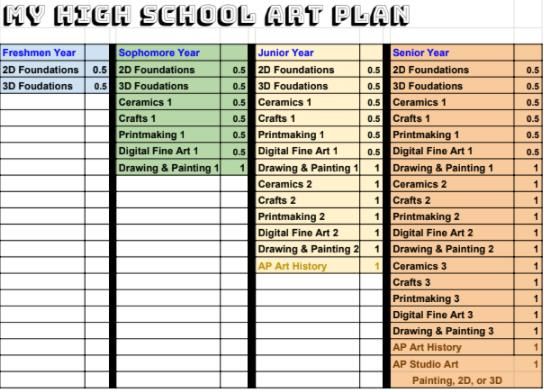
ART DEPARTMENT A708 CERAMICS 1
(Grades 10-12) Students will solve visual arts problems by using a variety of
The Art Department offers a variety of elective courses that include drawing, clay bodies and hand-building techniques. Wheel throwing experiences provide
painting, ceramics, crafts, printmaking, digital fine arts, AP Art History and AP a beginning level of proficiency. Drawing, designing and making functional and
non-functional objects, enhancing the clay surface with textures, glazes and
Art Studio. Before electing any of the aforementioned art studio courses, it is paints will give students broad-based ceramic experiences.
recommended that students take two semesters of Foundations of Art courses. Prerequisite: Recommended 75% or better in 3-D Foundations of Art
These courses are 2-D Foundations of Art and 3-D Foundations of Art. All 6 periods per cycle
courses taken in the Art Department satisfy the Humanities requirement for Semester course .50 credit
graduation.
A718/718D CERAMICS 2
All Foundation and Level 1 courses are one semester in duration with the (Grades 11-12) Students will continue to develop hand-building skills as a
exception of Drawing and Painting 1, Printmaking 1, and Digital Fine Art means of solving visual arts problems. Wheel-throwing skills will be advanced to
1. Levels 2, 3 and AP courses require a yearlong commitment. Any student an intermediate level. Refinement of drawing techniques, use of computer
wishing to test out of a prerequisite course must submit a portfolio and be software as a design tool, alternate methods of surface decoration and glazing
approved by the Art Department. provide the student with a greater number of design options. Students will
choose a theme that will guide them through production of all projects.
It is recommended that students entering ninth and tenth grade register for both Prerequisite: Recommended 80% or better in Ceramics 1
a 2-D and a 3-D Foundations course together in order to experience the breadth 6 periods per cycle 1.0 credit
of the Art Department. A718D - Students may elect to take this course for undergraduate college
credits through Lehigh Carbon Community College’s Dual Enrollment program.
A728 CERAMICS 3
(Grade 12) Students will solve visual arts problems using a variety of clay bodies
and techniques. Experiences will include drawing, wheel-throwing, hand building,
sculpting, surface decoration and glazing. Each student will elect to specialize in
one hand-building technique as well as wheel-throwing. Students will choose a
theme to become a common thread in their work during the year.
Prerequisite: Recommended 80% or better in Ceramics 2
6 periods per cycle 1.0 credit
A709 CRAFTS 1
(Grades 10-12) Students will participate in various craft techniques and their
contributions to contemporary and historical culture. Students will make
functional and sculptural objects using techniques and materials such as metal,
fibers, glass and paper. This class will focus on how to incorporate the
principles of design into creating meaningful artwork.
A700C 2-D Foundations of Art
Prerequisite: Recommended 75% or better 3-D Foundations of Art
(Grades 9 -12) Students will experience an introduction to drawing, painting,
6 periods per cycle
printmaking and digital art assignments that reflect traditional 2D techniques and
Semester course .50 credit
new computer methods in art works. A variety of media such as pencils,
pastels, markers, paint and computers will be explored to allow students the A719 CRAFTS 2
opportunity to work 2 dimensionally and to introduce students to the language of (Grades 11-12) Students will solve craft design problems that are influenced by a
art through the principles and elements of design. An awareness of historical deeply human theme of the student’s choice. Projects will be both functional and
nonfunctional artwork that will broaden the techniques and materials learned in the
and cultural art will be investigated.
prerequisite courses. Paper craft, glass, metals, plastics and fiber arts are media
that will be explored through the course. Students will take a more individual
Note: This course satisfies the prerequisite for Level 1 Drawing and Painting, approach to solving craft design problems by doing research and design in a
Digital Fine Art, and/or Printmaking. medium of their choice at times throughout the course.
6 periods per cycle Prerequisite: Recommended 80% or better in Crafts 1
Semester Course .50 credit 6 periods per cycle 1.0 credit
A729 CRAFTS 3
A701C 3-D Foundations of Art
(Grade 12) Students will explore an individual approach to craft design problems
(Grades 9 - 12) Students will participate in various introductory 3 dimensional
influenced by specific meaningful themes. Students will choose a concentration of
assignments that explore art related to crafts, ceramics and design. Both interest, develop a theme, and complete a series of pieces. Projects will be both
functional and nonfunctional forms will be developed through hand functional and sculptural. Students will propose projects throughout the year as
building/glazing of clay and use of other 3D materials such as wire, wood, glass, well as participate in teacher-designed assignments.
reed, etc. The historical/cultural importance of ceramics, crafts and 3D sculptural Prerequisite: Recommended 80% or better in Crafts 2
forms is explored. 6 periods per cycle 1.0 credit
Note: This course satisfies the prerequisite for Level 1 Crafts and Ceramics. A711 DRAWING AND PAINTING 1
6 periods per cycle (Grades 10-12) Students will recognize their creative potential in various
Semester Course .50 credit drawing and painting mediums. Drawing and Painting Level 1 teaches the
elements and principles of art and help students develop successful art
studio practices.
Prerequisite: Recommended 75% or better in 2-D Foundations of Art
6 periods per cycle 1.0 creditPage | 6
Art Dept. cont’d 762 STUDIO ART, ADVANCED PLACEMENT
A721 DRAWING AND PAINTING 2 (Grades 11-12) AP Studio Art is an intensive course that addresses advanced
(Grades 11-12) Students will recognize their creative potential in various concepts in one of the three areas of the student’s choice: drawing/painting, 2-D or 3-
drawing and painting mediums. Drawing and Painting Level 2 students D. This course has a strong emphasis on critical and analytical thinking. Students are
understand the elements and principles of art and begin to intrinsically use expected to perform at an advanced skill level and take initiative to develop their own
these traits in their work. Students learn how to practice the studio habits of personal voice. Students are expected to produce portfolios consisting of a minimum
mind. of 24 pieces that can be used in the college admissions process and for advanced
Prerequisite: Recommended 80% or better in Drawing and Painting 1 placement evaluation. Students are also required to complete summer assignments
6 periods per cycle 1.0 credit at levels that meet the art teachers’ approval. Students taking this course whose
schedule allows will be scheduled for an optional, but encouraged, studio period that
A731 DRAWING AND PAINTING 3 will allow them additional time to complete course assignments.
(Grades 12) Students promote their individual creative strengths through Prerequisite: Recommended 85% or better in any level 2 course and portfolio
drawing and painting. Drawing and Painting Level 3 students will review
demonstrate a synthesis of their own creative ability, use of elements and
6 periods per cycle 1.0 credit
principles of design and practice of studio habits of mind.
Prerequisite: Recommended 80% or better in Drawing and Painting 2
6 periods per cycle 1.0 credit 764 ART HISTORY, ADVANCED PLACEMENT
(Grades 11-12) This course has the same benefit and rigor as an introductory
A712 PRINTMAKING 1 art history course at the college level. Students will gain an understanding and
(Grades 10-12) Students will participate in various introductory printmaking knowledge of architecture, sculpting, painting and other art forms within
techniques including linoleum carving, monoprinting, engraving, and other historical and cultural context. Students will understand the formal and
methods of production. The elements of art and principles of design will be contextual meaning of major art forms from past to present. Many colleges and
emphasized, and successful studio practices will be developed. universities offer credit to students who have performed successfully on the AP
Prerequisite: Recommended 75% or better in 2D Foundations of Art Art History exam. Students should be aware that this course requires college-
6 periods per cycle level reading.
Semester Course .50 credit Prerequisite: Current enrollment in college preparatory social studies and
college preparatory English courses (recommended 75% or better in both)
A722 PRINTMAKING 2 6 periods per cycle 1.0 credit
(Grades 10-12) Students will continue to develop and refine printmaking skills,
advancing their ability to an intermediate level. New processes such as wood
carving, collagraph, and etching will be explored through historical and
BUSINESS AND COMPUTER APPLICATIONS
contemporary approaches. Students will learn to work more independently The department's mission is to prepare students for lifelong learning through the
according to a self-selected theme. use of 21st century skills in technology, business and economic concepts. The
Prerequisite: Recommended 80% or better in Printmaking 1 curriculum is designed, delivered, evaluated and updated to prepare students to
6 periods/cycle 1.0 credit enter the ever changing global economy and job market. Courses that fulfill the
A732 PRINTMAKING 3 computer graduation requirement are noted in the course descriptions.
(Grades 11-12) Students will explore an individual approach to solving visual
arts problems through printmaking. Students will choose a concentration, 601 INTRODUCTION TO BUSINESS
develop a theme, and complete a series of works that ultimately create a (Grades 9-12) This course will provide students with a broad understanding of
portfolio. Careers in printmaking will be emphasized. (Fulfills computer how businesses operate. The informed student who understands our economic
applications course requirement for graduation) system and the business world will be better prepared as a consumer,
Prerequisite: Recommended 80% or better in Printmaking 2 employee, manager, and entrepreneur. Topics discussed include basic
6 periods/cycle 1.0 credit economic concepts, owning and operating a business, and government
A713 DIGITAL FINE ART 1 influence on business.
6 periods per cycle
(Grades 10-12) Students will learn how to manipulate computer technology to
Semester course .50 credit
produce artistic images. Digital illustration and image manipulation will be taught
through the use of the Adobe Creative Suite and Wacom tablets. 3D printing
603 STUDY AND CAREER SKILLS
processes will be explored. The elements of art and principles of design will be (Grades 9-12) This course is beneficial for the student who is interested in
emphasized and successful studio practices developed. (Fulfills computer improving his or her study habits and exploring possible career paths. It is self-
applications course requirement for graduation) reflective and asks students to evaluate personal habits and interests. Study
Prerequisite: Recommended 75% or better in 2D Foundations of Art skills topics include note-taking, time management and test-taking strategies.
6 periods per cycle Students then transition into career exploration and preparation, including
Semester Course .50 credit interviewing skills and resume writing.
A723 DIGITAL FINE ART 2 6 periods per cycle
(Grades 10-12) Students will continue to refine skills with familiar and new digital Semester course .50 credit
fine art tools, including the Adobe Creative Suite, Wacom tablets, 3D printing,
604 ENTREPRENEURSHIP
and other applications. Students will learn to work more independently. Careers
(Grades 10-12) Entrepreneurial skills will be taught throughout making this class
in digital arts will be emphasized. (Fulfills computer applications course
a perfect choice for students that are natural leaders that wish to become
requirement for graduation.)
business owners and operators. This course will focus on a business that is
Prerequisite: Recommended 80% or better in Digital Fine Art 1
created by the student and prepare them to enter college or straight into the
6 periods/cycle 1.0 credit
competitive business world. This idea becomes a reality as it is developed
A733 DIGITAL FINE ART 3 further into a personalized business plan that includes a company description,
(Grades 11-12) Students will explore an individual approach to solving visual goals, marketing plans, financial statements, and a business layout, as well as
arts problems through digital fine art. Students will choose a concentration, creating a logo and slogan for the business.
develop a theme, and complete a series of works that ultimately create a 6 periods per cycle
portfolio. Careers in the digital arts will be emphasized. (Fulfills computer Semester course .50 credit
applications course requirement for graduation)
Prerequisite: Recommended 80% or better in Digital Fine Art 2
6 periods/cycle 1.0 creditPage | 7
Business & Comp. Dept. cont’d students for an ever-increasing competitive workforce. Holding a MOS
608/608D PERSONAL FINANCIAL MANAGEMENT certification can earn an entry-level business employee as much as $16,000
(Grades 10-12) In this course students will gain practical life skills and more in annual salary than uncertified peers (https://www.microsoft.com/en-
knowledge necessary to maintain the finances of a household. Topics include us/learning/certification-overview-mos.aspx). Many colleges are accepting the
paychecks, budgeting, income taxes, checking accounts, saving and investing, certification in lieu of taking a college level course.
(Fulfills computer applications course requirement for graduation)
credit, buying a car or home, and insurance.
6 periods per cycle
6 periods per cycle 1.0 credit
Semester course .50 credit
608D Students may take this course for undergraduate college credits through 627 MICROSOFT® EXCEL
Lehigh Carbon Community College’s Dual Enrollment program. (Grades 9-12) This course encompasses both core and advanced skills in
Microsoft Excel and will prepare students to take the Microsoft Office Specialist
606 ACCOUNTING 1
(MOS) test, if desired. MOS certification is the leading IT certification in the
(Grades 9-12) In this course, students are introduced to accounting principles
world. MOS enables students to become experts in the software by utilizing the
surrounding the basic accounting equation: Assets = Liabilities + Owner’s
Equity. Students will learn the steps of the accounting cycle and apply them to full features and functionality of the Microsoft Office system. In academics, MOS
both a sole proprietorship and a partnership. Key areas of study include: promotes success in the classroom, builds individual distinction and prepares
analyzing transactions, creating journal entries, maintaining subsidiary ledgers, students for an ever-increasing competitive workforce. Holding a MOS
completing bank reconciliations and preparing financial statements. Automated certification can earn an entry-level business employee as much as $16,000
accounting software will be used to complete a business simulation project at more in annual salary than uncertified peers (https://www.microsoft.com/en-
the end of the course. us/learning/certification-overview-mos.aspx). Many colleges are accepting the
6 periods per cycle 1.0 credit certification in lieu of taking a college level course.
(Fulfills computer applications course requirement for graduation)
614 BUSINESS LAW 6 periods per cycle
(Grades 10-12) This course engages students in legal issues and cases that Semester course .50 credit
involve the laws that govern business and commerce. Topics include The 628 DESKTOP PUBLISHING
Constitution and Court Systems, Torts, White-Collar Crimes, Contract Law, (Grades 9-12) This course will provide students with the knowledge required to
Consumer and Employment Law, and Property Law. Students will find this create publications using Microsoft Word and Publisher, along with Adobe
course relevant to the legal environment in which they live and better understand Photoshop CS6 and Illustrator CS6. Students will learn how to create effective
the legal methods and procedures to starting and running a and interesting documents and publications using industry standard software.
business. This course is also important as most college business curriculum (Fulfills computer applications course requirement for graduation.)
6 periods per cycle
requires two courses of Business Law. This class implements real case studies,
Semester course .50 credit
mock trials and guest speakers.
6 periods per cycle 1.0 credit 631 MICROSOFT® POWERPOINT
(Grades 9-12) This course encompasses both core and advanced skills in
616/616D ACCOUNTING 2 Microsoft PowerPoint and will prepare students to take the Microsoft Office
(Grades 10-12) In this course, students will continue their study of accounting Specialist (MOS) test, if desired. MOS certification is the leading IT certification
principles and develop a comprehensive understanding of the transactions in the world. MOS enables students to become experts in the software by
learned in Accounting 1. Key areas of study include: accounts payable, utilizing the full features and functionality of the Microsoft Office system. In
accounts receivable, inventory, plant assets, accrued/prepaid expenses, and
accrued/unearned revenue. Automated accounting software and Microsoft academics, MOS promotes success in the classroom, builds individual
Excel will be used. distinction and prepares students for an ever-increasing competitive workforce.
Prerequisite: Accounting 1 Holding a MOS certification can earn an entry-level business employee as much
6 periods per cycle 1.0 credit as $16,000 more in annual salary than uncertified peers
616D Students may take this course for undergraduate college credits through (https://www.microsoft.com/en-us/learning/certification-overview-mos.aspx).
LCCC's Dual Enrollment program. Many colleges are accepting the certification in lieu of taking a college level
course.
621 INVESTING AND CORPORATE FINANCE (Fulfills computer applications course requirement for graduation)
(Grades 10-12) This course will give students an understanding of the way 6 periods per cycle
individuals, businesses, and organizations raise, manage, invest, and use Semester course .50 credit
monetary resources over time. Students will be engaged in using fundamental
and technical analysis of company information to better understand the internal 636 WEB DESIGN
and external impact that the U.S. economy and current market trends may have (Grades 9-12) This course will provide students with the knowledge required to
on the corporation. Students will get a hands-on understanding of investing create websites using Adobe Dreamweaver and will include fundamental and
basics and learn about the corporate world of finance by trading stocks online advanced Web creation techniques. Upon successful completion of the course,
and creating a financial portfolio. students will be prepared to complete the Adobe Certification Exams Associate
6 periods per cycle Exam. In the business and education community, job applicants with these
Semester course .50 credit certifications are recognized as highly skilled users of Adobe software. (Fulfills
computer applications course requirement for graduation.)
623 MICROSOFT® OFFICE
6 periods per cycle
(Grades 9-12) This course will provide students with the knowledge required to
Semester course .50 credit
create documents using Microsoft Word, spreadsheets and databases using
Microsoft Excel and Microsoft Access, and multimedia presentations using
Microsoft PowerPoint and will include fundamental techniques. (Fulfills 638 ADOBE PHOTOSHOP/ILLUSTRATOR
computer applications course requirement for graduation.) (Grades 9-12) This course will provide students with the knowledge required to
6 periods per cycle apply design principles to the multimedia areas of graphics and illustration.
Semester course .50 credit Professional quality software titles, Adobe Photoshop and Adobe Illustrator, will
be utilized to prepare students for creating dynamic, interactive content to be
625 MICROSOFT® WORD
(Grades 9-12) This course encompasses both core and advanced skills in used in both print and web based applications. (Fulfills computer applications
Microsoft Word and will prepare students to take the Microsoft Office Specialist course requirement for graduation.)
(MOS) test, if desired. MOS certification is the leading IT certification in the 6 periods per cycle
world. MOS enables students to become experts in the software by utilizing the Semester course .50 credit
full features and functionality of the Microsoft Office system. In academics, MOS
promotes success in the classroom, builds individual distinction and preparesPage | 8
Business & Comp. Dept. cont’d COMPUTER SCIENCE DEPARTMENT
639 ADVANCED PHOTOSHOP All of the computer science courses are electives and satisfy the computer
(Grades 9-12) This advanced course will expand students’ knowledge in the applications part of the graduation requirement. They are highly recommended for
area of graphic design through broadening their understanding of basic and students pursuing STEM careers. Prerequisites are stated as recommendations for
advanced features of Adobe Photoshop. Using Adobe Photoshop will prepare success by most students. Students who wish to take advanced courses without
students for creating dynamic, interactive content to be used in both print and having satisfied the prerequisites should either exempt a course by exam or gain
online applications. Upon successful completion of the course, students will be permission from a member of the computer science department via an interview and
prepared to complete the Adobe Certification Associate Exam in Visual proof of student work.
Communications, using Adobe Photoshop. In the business and education
community, job applicants with these certifications are recognized as highly
skilled users of Adobe software. Students may also be able to receive college
credit by becoming certified. (Fulfills computer applications course requirement
for graduation.)
Prerequisite: Recommended 70% or better in Adobe Photoshop/Flash 1 or
Adobe Photoshop/Illustrator
6 periods per cycle
Semester course .50 credit
645 SCHOOL STORE 1
(Grades 9-12) This course gives students the opportunity to gain experience in
the world of retail and is designed to allow students to gain first-hand experience
in running a small business in a school setting. Students learn useful skills
associated with a retail business, including advertising, product design, inventory
control, and customer service. Business theories will be taught in conjunction
with the hands-on operation of the store. The text allows for business theory to
be taught in conjunction with the hands-on operation of the store. Not only will
this course be practical and educational, but the experience is a unique
opportunity and can serve as a reference for a potential job or career.
6 periods per cycle
Semester course .50 credit
647 SCHOOL STORE 2 321 INTRODUCTION TO COMPUTER SCIENCE
(Grades 10-12) Students of School Store 2 will run the store and will (Grades 9-12) This course is designed to introduce students to computer science
understand a managerial perspective to retail and train the students of the concepts and simple programming techniques in a hands-on
School Store 1 class. Students will be responsible for the daily operations of a
small retail store and specialize in school merchandise while incorporating environment. Projects incorporate the use of a drag-and-drop programming
entrepreneurial skills. environment to create 2-D animations in Scratch and 3-D animations in
Prerequisite: School Store 1 Alice. The course will also include computer and Internet history, the basics of
6 periods per cycle computer hardware and software, computer ethics, and careers in computer
Semester course .50 credit science. Students who have successfully completed Algebra 1 (80% or better)
should begin the Computer Science sequence with Programming I instead.
650 INTRO TO MOBILE APP DEVELOPMENT
(Fulfills computer applications course requirement for graduation.)
(Grades 9-12) This course will teach students how to create native apps across
6 periods per cycle
today’s most popular major mobile device platforms and Web apps. Students will
Semester course .50 credit
use a hands-on approach to develop 21st century skills of problem-solving,
critical-thinking, and technical programming. Though apps continue to evolve, 325 PROGRAMMING 1
having a combination of 21st century skills and fundamental app development, (Grades 9-12) This course is designed to enable all students to develop better
students will be prepared to keep up with the ever changing technological world. problem solving skills that will prepare them for many different fields of study and
(Fulfills computer applications course requirement for graduation.) future computer science courses. Utilizing the Python programming language,
6 periods per cycle students will learn to write programs that include turtle graphics, input and
Semester course .50 credit output, decisions, loops, functions, and strings. Programming assignments will
relate to a variety of real-life applications. Students interested in taking AP
670 MARKETING 1
Computer Science (Java) during the following school year should register for
(Grades 9-12) This course will introduce students to the fundamentals of
Business marketing. Topics include the role of marketing in a business, market both Programming 1 and Programming 2. (Fulfills computer applications course
research and segmentation, basic economics, developing a marketing plan, e- requirement for graduation)
commerce, products, price strategies, placement of products and distribution, Prerequisite: Recommended 80% or better in Introduction to Computer Science
and promotional aspects of businesses. It is a basic intro course that allows OR completion of Algebra 1 with an 80% or better
students to gain skills from one of the core areas of business and allows room to 6 periods per cycle
proceed to other marketing courses that are in a more specialized area. Semester course .50 credit
6 periods per cycle
Semester course .50 credit 326 PROGRAMMING 2
678 MARKETING 2 (Grades 10-12) This course is a continuation of Programming 1. Students will
(Grades 9-12) This course is designed for students to focus on three extend their knowledge of Python by writing programs that include strings, lists,
specialized areas of marketing: Sports and Entertainment, Fashion, and text input and output, searching and sorting, and recursion. Students will also
Hospitality and Tourism. Students will explore each type of business and how transition to Java programming language in preparation for the AP Computer
promotions, advertising, and pricing strategies are specifically used in these Science A (Java) course.
three concentrations. A variety of learning tools will accompany the course Prerequisite: Recommended 80% or better in Programming 1 (Fulfills computer
including field trips and guest speakers as well as career exploration in the
applications course requirement for graduation.)
three marketing areas.
Prerequisite: Successful completion of Marketing 1 6 periods per cycle
6 periods per cycle Semester course .50 credit
Semester course .50 creditPage | 9
Comp. Sci. Dept. cont’d PA DRIVER’S EXAMINATION
Emmaus High School has been certified by the Pennsylvania Department
363 ADVANCED PLACEMENT COMPUTER SCIENCE PRINCIPLES of Transportation to administer the PA Driver’s Examination. We are able to
(Grades 10-12 only) This course is designed to be equivalent to a first semester test our students and determine whether they meet the state standards for
introductory college computing course for non-Computer Science majors. driver licensing.
Students will learn the foundational concepts of computer science and explore In order for a student to take the Driver’s Examination, the following guidelines must
how computing and technology impact the world. The course will provide the be satisfied:
fundamentals of computing: including problem solving, working with data, Currently enrolled in Driver Training
understanding the Internet, cyber security, and programming. Students will also Attendance at simulation classes must be up-to-date
develop effective communication and collaboration skills, working individually Successfully completed Driver Education
and collaboratively with peers to solve problems and write about the importance Registration fee for Driver Training has been paid
of these problems and their impacts to their community, society, and the world. Regular permit (not a temporary permit)
The AP exam includes a written test and the submission of a create task Form 180C must be signed in the presence of an instructor or be
(program) to the College Board. (Fulfills computer applications course notarized
Recommended by the driving instructor
requirement for graduation)
Demonstrated the skills and maturity for a driver’s license
Prerequisite: Recommended 80% or above in any Computer Science course OR
with instructor permission.
6 periods per cycle 1.0 credit
ENGLISH DEPARTMENT
Each high school student must take and pass a ninth, a tenth, an eleventh, and
365 ADVANCED PLACEMENT COMPUTER SCIENCE A (JAVA) a twelfth grade English course to graduate. Students should choose, with the
Grades 10-12) This course will cover the entire curriculum as prescribed by the help of parents, teachers, and counselors, the program best suited to their
College Board for a one semester college course in computer science. This abilities and future plans. Each student should choose the appropriate English
includes control structures, arrays, strings, classes, interfaces, files, and course offered in a grade level. In addition to a literature survey component, all
efficiency of algorithms. Upon completion of this course, students will be non-elective English courses provide writing activities and research, vocabulary
prepared to take the AP Computer Science A level exam. Students will be study, study skills and career awareness instruction. Those who are undecided
expected to engage in rigorous problem solving activities and utilize computer
about going to college should choose college preparatory English. Note that all
resources outside of class. (Fulfills computer applications course requirement
for graduation.) elective courses will not be counted toward meeting English graduation
Prerequisite: Recommended 80% or better in Programming 1 and Programming requirements.
2. *Note* Instructor permission may be granted on an individual basis for Summer reading assignments are required for all Emmaus High School
students who have only completed Programming 1. A summer Java assignment English courses. The summer reading assignment list can be found on
will be required for these students. the Emmaus High School website.
6 periods per cycle 1.0 credit
108 NINTH GRADE ENGLISH, GENERAL PREPARATORY
368 ADVANCED TOPICS IN COMPUTER SCIENCE (AP Weight) In the 9th grade General Preparatory course, students will respond to literary
(Grades 11-12) This course will build on a solid foundation of computing works orally through inquiry-based class discussion, peer to peer discussion,
methodology to introduce students to advanced representation and processing of and informal presentation activities. Additionally, students will respond to
data. Topics will include algorithm efficiency, recursion, inheritance, and dynamic literature in writing on a regular basis, which may take the form of homework,
memory allocation. Students will learn how to process data that is stored as journaling, and informal and formal essays. Through the workshop model,
strings, arrays, stacks, queues, linked lists, sets, maps, files, and tree structures
to solve a variety of real life application problems. This course includes second students will explore the elements of brainstorming, outlining, writing, peer-
semester college-level computer science topics. Students will be expected to editing, revising and proofreading, and publishing their work. Research and
engage in rigorous problem solving activities and utilize computer resources analysis will emphasize practical aspects such as clearly articulating and
outside of class. (Fulfills computer applications course requirement for supporting an opinion with information that is accurately documented. Besides
graduation) teacher-selected titles, the study of literature will be augmented with student
Prerequisite: Recommended 84% or better in AP Computer Science A (Java) selections during independent reading time and Literature Circles. Grammar and
6 periods per cycle
vocabulary instruction will be utilized to assist students in the processes of
Semester course .50 credit
reading and writing. The literature of this course will focus on high-interest
touchstones of American, British, and World literature, including novels, plays,
DRIVER EDUCATION DEPARTMENT poems, short stories, and nonfiction. The curriculum of this course is aligned to
The Pennsylvania Department of Education and The Pennsylvania Department the PA Core Standards. Students in General Preparatory courses will focus on
of Transportation require that students must attend a minimum of thirty hours of foundational learning targets in reading, writing, and communications. The
classroom instruction in Driver Education. A student must complete the course includes a self-selected summer reading requirement.
minimum of 30 hours of instruction time, or they will be ineligible for the Drivers
6 periods per cycle 1.0 credit
Training course and license testing through EHS.
DE2 DRIVER EDUCATION 109 NINTH GRADE ENGLISH, COLLEGE PREPARATORY
(Grades 10-12 only) Driver Education is a required course usually taken in the In the 9th grade College Preparatory course, students will respond to literary
sophomore year. Driver education emphasizes personal and social problems works orally through inquiry-based class discussion, peer to peer discussion,
related to the safe and efficient movement of traffic. Major aims are to emphasize
and more formal presentation activities. Additionally, students will respond to
the desirable role of the pedestrian and driver in traffic and to develop the
knowledge and attitudes needed for safe use of traffic facilities. literature in writing on a regular basis, which may take the form of homework,
3 periods per cycle journaling, and informal and formal essays. Through the workshop model,
Semester course 0.25 credit students will explore the elements of brainstorming, outlining, writing, peer-
DRIVER TRAINING editing, revising and proofreading, and publishing their work. Research and
(Ages 16, 17, 18) Driver Training is an elective course offered to 16-year-old analysis will emphasize a scaffold approach in which students develop skills
students. Each student must have parental permission to drive a motor vehicle. such as writing a thesis, finding and evaluating secondary sources, and
A learner’s permit must be obtained by the student. Driver training consists of synthesizing primary and secondary source information. Besides teacher-
nine hours of simulation, and three hours of behind-the-wheel instruction. The
purpose of the twelve-hour course is to develop, through the use of realistic selected titles, the study of literature will be augmented with student selections
situations, the knowledge, attitudes and skills necessary for safe and efficient during independent reading time and Literature Circles. Grammar and
operation of the automobile in urban, rural and superhighway traffic. There is vocabulary instruction will be utilized to assist students in the processes of
an additional fee associated with Driver Training. Students can register for this reading and writing. The literature of this course will focus on high-interest
course on the Driver’s Training page on the EHS website. touchstones of American, British, and World literature, including novels, plays,
Prerequisite: Driver Education poems, short stories, and nonfiction. The curriculum of this course is aligned to
the PA Core Standards. Students in College Preparatory courses will focus onYou can also read


