Employment insurance Operational requirements for Indonesia - Ippei Tsuruga, International Labour Organization - Social Protection
←
→
Page content transcription
If your browser does not render page correctly, please read the page content below
Employment insurance
Operational requirements for Indonesia
Ippei Tsuruga, International Labour Organization

                                                   Supported by:

 Zoom - 22 September 2021
Operational flows

▪ In the slides, we illustrates operational flows in brief charts followed by detail tables.

▪ We try to connect current operations delivered by the existing institutions in the flow charts. In the
  meantime, we added in blue boxes key issues to be considered for improving the operations more effective.

▪ Colours in charts represent physical locations or institutions. For example, a local manpower office has units
  of industrial relations, public employment services, vocational training etc.; and therefore, these three units
  are illustrated in yellow boxes.
Hiring employees
                                                                Considerations
                                               Industrial
Employer                                       relations    The information/database
                                                  (IR)      of registered employees
           Inform about new employees                       managed by local
                                                            manpower offices and
                                                            BPJS Employment may
                                                            be shared/integrated in
                                                            order to improve
                                                            labour/social security
                                                BPJS
                                                            inspection for compliance.
            Register employees for paying EI
            contribution

    BPJS office

    Local manpower office
Hiring employees
MOM HQ / Province / District / City
Operational flows / Institutions Worker Employer BPJS
Industrial
PES Training
relations
When starting up business and hiring workers (Labour issues)
Register employers for hiring workers (only for the first
Submit Receive
time)
Inform about new employees (whenever hiring) Submit Receive
Registration of employers and collection of EI contributions
Register employers for contribution collection (only for
Submit Receive
the first time)
Register employees for paying contribution (whenever
Submit Receive
hiring)
Collect contributions from employers on behalf of
Pay Receive
employees and employerTerminating employment
Considerations
Industrial
Employer relations MOM and BPJS should
(IR) agree on a template for
Inform about termination of employment the letter of termination
including all required
information for their
operations. There is also
the issue of those who
Worker quit where IR does not
Letter of termination outlining reason for require completion of the
separation and additional monies paid letter of termination but
BPJS would definitely
on separation
need it.
Local manpower officeClaiming EI benefits
1. Registration of unemployed
3. Referrals to suitable jobs Employer
worker for employment
PES
3. Referrals to suitable training Training
2. Counselling
4. Counsellors conduct monthly interviews
for job searching activities
5. Notify any potential disqualifying conditions
Worker
6. Final decision on payment of EI benefits; Payment
of benefit or issue notice of non-entitlement
1. Letter of termination given by Considerations
worker to BPJS at the time of BPJS
applying for EI benefits
PES and BPJS operations should
be completed within the same
BPJS office
office (single window service).
Local manpower officeTerminating employment and claiming EI benefits
MOM HQ / Province / District / City
Operational flows / Institutions Worker Employer BPJS Industrial
PES Training
relations
When terminating employment and claiming EI benefits
The employer provides the unemployed worker with a
letter of termination outlining reason for separation and
Receive Submit Copy
additional monies paid on separation, while copying local
manpower offices
Registration of unemployed worker for employment at a
Register Conduct
PES office
Letter of termination given by worker to BPJS at the time
Submit Receive
of applying for benefits
Apply for EI benefits at BPJS office and complete an EI
Submit Receive
application form (frontend services)
Register EI application and set up claim docket Register
Review and assess EI application Review
Make final decision on payment of EI benefits (or issue
Approve
notice of non-entitlement)
Payment of benefit (bank or cash) Receive PayTerminating employment and claiming EI benefits
MOM HQ / Province / District / City
Operational flows / Institutions Worker Employer BPJS
Industrial
PES Training
relations
Continuation of benefit payments on a monthly basis
Conduct a mandatory monthly meeting for job searching
Attend Conduct
activities
Counsellors could conduct interviews Conduct
Provide counselling and possible referrals to suitable
Hire Refer Train
jobs and/or training
Notify BPJS of any disqualifying conditions Receive Notify9
Illustration of a generic implementation plan for Indonesia
Phase Areas of work Important Dates
Government formalizes the establishment of a new EI scheme for Indonesia October 5, 2020
Establish National Implementation Working Group
Establish Administrative Board for EI Fund
Phase One
Legal requirements
Network of Offices
IT System for collection of contributions
Manual of Procedures
Communication Strategy for collection of contributions
Phase Two
Recruitment for collection of contributions
Training for collection of contributions
Go Live Date for the collection of contributions for EI March 1, 2021 or April 1, 2021
Establish Hotline to national headquarters for local offices to address implementation issues
IT System for calculation and payment of EI benefits
Phase Three Communication Strategy for implementation and benefits
Recruitment and training for calculation and payment of benefit
Implementation Date for unemployed workers to file EI claims for benefit and receive EI benefit March 1, 2022 or April 1, 2022
Monitoring and evaluation of the implementation of the new EI scheme in first month of processing EI claims
Monthly Reports for managing the processing of EI claims for benefit
Phase Four Continuous training
Continuous communication
Full evaluation of new EI scheme 3 to 6 months after EI scheme implementation July 1, 2022 or October 1, 202210 Mandatory monthly meeting is missing Qualifying conditions other than contributions ▪ Willingness to work (Government Regulation Article 19 (2)) ▪ Being capable (Not permanent total disability, Government Regulation Article 20 (1)) ▪ Not receiving pension (Government Regulation Article 20 (1)) ▪ Not dead (Government Regulation Article 20 (1)) ▪ When finding a job, JKP payment stops (Article 40)
11

Other missing conditions

Consequences of job or training refusals

Usually, refusals lead to the suspension of UI payments
12

Public employment services and employment insurance

▪ PES assists UI recipients in returning to work as soon as possible

▪ Effective PES contributes to activating the labour market and also reducing financial expenses of
  the UI fund

▪ And more…
13

Public employment services in Korea

▪ Asian financial crisis in late 1997 => Increased the number of career counsellors from 80 (1996) to
  3,000 (2000), more than 30 times

▪ Global financial crisis 2008 => Hired additional 2,000 career counsellors

▪ COVID-19 pandemic => Hired additional 750 career counsellors
14

    Public employment services

                                                            speedy employment
                                              Staff          No of Job Placements

      Korea GoyongBokji Plus                                                                                           Well Developed
      Center                                     5,000       1.5 Million
                                                                                                                        Job Matching
                                                                                                                          Website
      Japan                                                  1.9 Million
                                               28,000                                                                   Makes PES
      Hellowork                                                                                                           Efficient
      France
                                               56,000       2.5 Million
      Pole Emploi

      Germany                                100,000        2.5 Million
      Bundesagentur fur Arbeit

      UK 56,000, USA 60,000, Netherland 15,000
Lee. ‘Public employment services and unemployment benefit schemes through digital channels in Asia’, presented at 28 July 2021
15
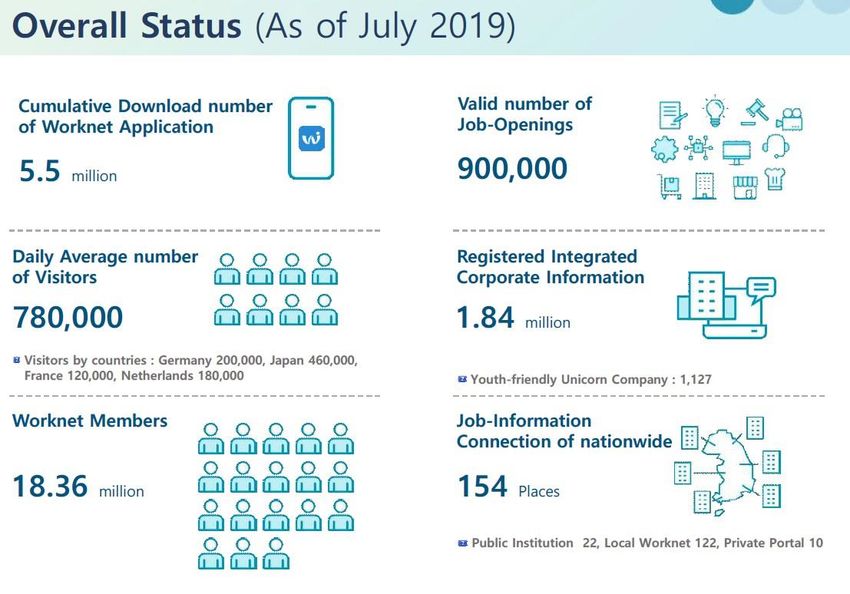
Online job centre WorkNet in Korea
Introduced web-based job matching
services WorkNet after the Asian
financial crisis
Lee. ‘Public employment services and unemployment benefit schemes through digital channels in Asia’, presented at 28 July 2021Mobile PES
▪ Introduced in 2011, 430,000 Users per Day
▪ Service available regardless of place and time
▪ Speedy job placement
Lee. ‘Public employment services and unemployment benefit schemes through digital channels in Asia’, presented at 28 July 2021Mobile PES
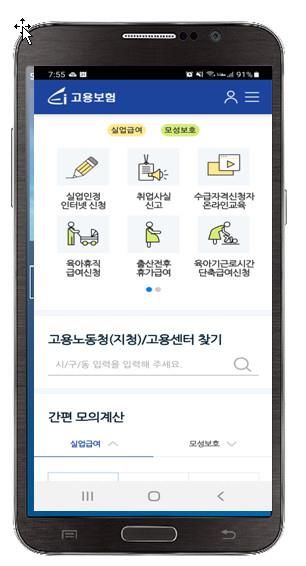
Unemployment Insurance Benefit Claim
Introduced in 2014
Lee. ‘Public employment services and unemployment benefit schemes through digital channels in Asia’, presented at 28 July 2021Achievement in Hello work 18
2016 2017 2018
Newly job seekers 5,189 4,952 4,736
Newly job vacancies 9,734 10,244 10,393
Job placement
Employment 1,627 1,558 1,465
Retirement rate within 6 months after employed - 22.5%
Unemployment
Newly qualified recipients 1,408 1,345 1,336
benefits
Note: unit is thousand people (except for specific noted)
Ushijima. ‘Employment insurance and public employment services in Japan’, presented at 3 March 2020THANK YOU
Supported by:
This note has been prepared by Ippei Tsuruga. Please contact Ippei Tsuruga (tsuruga@ilo.org) or Christianus Panjaitan (christianus@ilo.org) for more details.You can also read


