Energy: The West's Strategic Opportunity in the Eastern Mediterranean
←
→
Page content transcription
If your browser does not render page correctly, please read the page content below
DEC EMB ER 2014

Energy: The West’s
Strategic Opportunity in
the Eastern Mediterranean
B Y S ET H C RO PS E Y & E R I C B R OWN

                                           Energy: The West’s Strategic Opportunity in the Eastern Mediterranean   1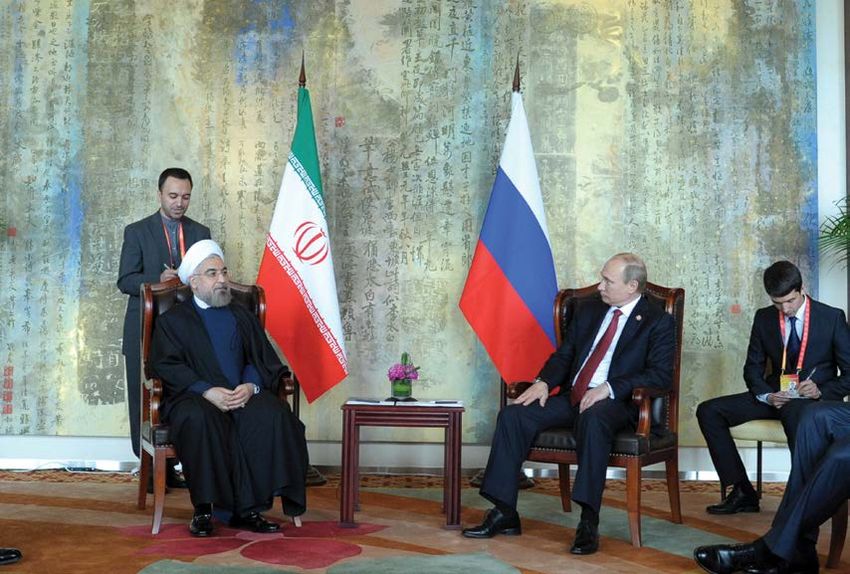
DEC EMB ER 2014

Energy: The West’s
Strategic Opportunity in
the Eastern Mediterranean
B Y S ET H C RO PS E Y & E R I C B R OWN
© 2014 Hudson Institute, Inc. All rights reserved.

For more information about obtaining additional copies of this or other Hudson Institute publications,
please visit Hudson’s website, www.hudson.org.

ABOUT HUDSON INSTITUTE

Hudson Institute is an independent research organization promoting new ideas for the advancement
of global security, prosperity, and freedom.

Founded in 1961 by strategist Herman Kahn, Hudson Institute challenges conventional thinking and
helps manage strategic transitions to the future through interdisciplinary studies in defense,
international relations, economics, health care, technology, culture, and law.

Hudson seeks to guide public policy makers and global leaders in government and business through
a vigorous program of publications, conferences, policy briefings, and recommendations.

Visit www.hudson.org for more information.

Hudson Institute
1015 15th Street, N.W.
Sixth Floor
Washington, D.C. 20005

P: 202.974.2400
info@hudson.org
www.hudson.org
TA B L E O F C O N T E N T S

Executive Summary                                                                              6

Introduction                                                                                   8

Who Will Shape the Region’s Future?                                                          11

U.S. Involvement in the East Mediterranean: What History Tells Us                            18

Turkey at a Crossroads: Implications for Peace and Stability                                 21

The Growing Problem of Russia and Iran                                                       28

American Uncertainty in the East Mediterranean                                               33

Maximizing the Positive Geopolitical Potential of East Mediterranean Energy                  36

Policy Recommendations to Advance a Political and Security Environment                       39
Favorable to Large-scale Energy Development and Commerce

Conclusion                                                                                   45

About the Authors                                                                            46

About Hudson Institute                                                                       47

                                  Energy: The West’s Strategic Opportunity in the Eastern Mediterranean   5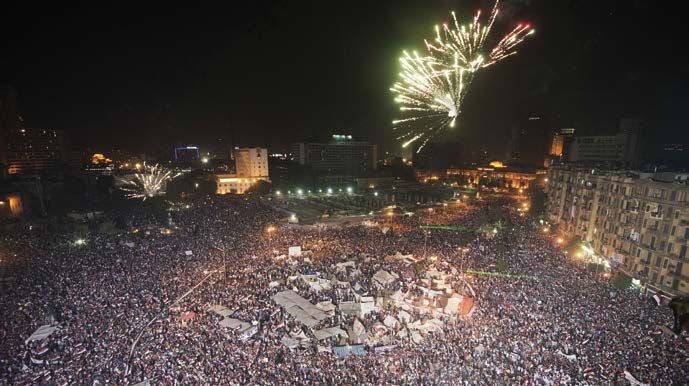
EXECUTIVE SUMMARY

A string of recent hydrocarbon discoveries in the eastern         geopolitical rivalry between the Western countries and
third of the Mediterranean Sea has demonstrated once              the emboldened revisionist powers of Russia and Iran;
again that world energy production could increasingly be          deepening instability and the weakening of the state-
shaped by democratic states that are friendly to the              based order in the Arabic-speaking Levant and across
international order and to other liberal democracies in           northern Africa; spreading Islamist militancy, which has
particular. In the near future, development of the strategic      now in the form of the Islamic State overtaken large
resources in the “East Med” will bring energy self-               swathes of territory; and a burgeoning naval arms race in
sufficiency to Israel as well as relief from painful              the Mediterranean that is already complicating the
economic constraints in EU-member Cyprus. It could                development of the East Med’s energy potential.
also enhance current diplomatic efforts to improve
                                                                  In the face of these dangers, the West has a unique
regional stability and security, including the security of an
                                                                  strategic opportunity in the Eastern Mediterranean. The
increasingly vulnerable Turkey whose political and
                                                                  United States, in particular, has the chance to work with
strategic future as a member of the Atlantic Alliance is
                                                                  each of its allies to facilitate the creation of a secure
now in doubt. Moreover, through the creation and
                                                                  regional market that could attract the large-scale
expansion of a secure energy production sector that also
                                                                  involvement of international energy developers. This
includes Greece, East Med energy could come to directly
                                                                  would anchor a budding democratic coalition in a region
supply Europe, and thereby help reduce the EU’s
                                                                  beset with war and instability and create greater
vulnerabilities to Russian coercion.
                                                                  opportunity for Western countries to shape a more secure
Unlocking the economic and geostrategic benefits of the           and more prosperous order therein. U.S. involvement
East Med’s energy potential requires something that the           would thus help to reestablish American influence where
region is sorely lacking: political stability and security. The   it has contracted in recent years—and in a consequential
East Med as a whole has entered a time of protracted              region where U.S. national security interests are likely to
conflict and insecurity. The old security and political order     grow in the future.
has broken down due to the continuing fallout of the Arab
Spring and the deterioration of relations between the
U.S.’s two most capable regional allies, Turkey and Israel.
It has been replaced by a humanitarian catastrophe and
widening sectarian warfare in Syria; an escalating

6     HUDSON INSTITUTE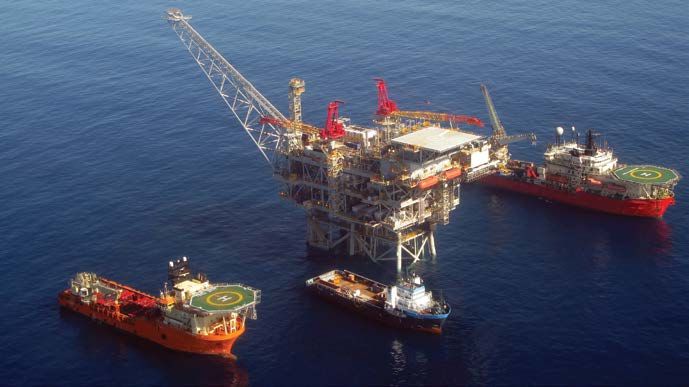
This paper offers a number of policy recommendations              • The United States should loosen its arms embargo
aimed at shaping such a favorable environment:                      on Cyprus.

   • The United States should work with its allies to             • NATO’s Partnership for Peace should accept Cyprus
     support the strategic and prudent development of a             as a member.
     regionally focused energy market as a first step to
                                                                  • NATO members France and Italy should be
     unlocking even greater potential across the East
                                                                    integrated into the regional security architecture.
     Med, including extra-regional exports.

   • The United States should seek Turkey’s improved           In the end, there is no substitute for robust U.S.
     security and inclusion as a key partner in the            leadership in crafting a geopolitical outcome
     defense and expansion of a law-based security             characterized by greater stability and prosperity in the
     order in the East Med.                                    East Med, and that will also provide the Atlantic Alliance
                                                               with the strategic depth and capabilities it needs to cope
   • The United States should reestablish a robust naval
     presence in the Mediterranean to strengthen its           with the difficult security challenges across Southwest
     regional diplomatic leverage and help secure the          Asia that lie ahead.
     regional energy market.

   • The United States and the region’s core liberal
     democracies should continue to bolster security
     cooperation to guard against a potentially
     destabilizing naval arms race and deter the
     encroachment of revisionist powers, specifically
     Russia and Iran.

                                              Energy: The West’s Strategic Opportunity in the Eastern Mediterranean         7
INTRODUCTION

In 2009, a U.S.-Israeli consortium of energy companies,                          much as 122 trillion cubic feet (tcf) of recoverable gas,
operating some 50 miles off the coast of Haifa, Israel,                          and perhaps as much as 1.7 billion barrels of oil,
sought to confirm the existence of what seismic data had                         according to a much-cited 2010 U.S. survey.1 In global
indicated was a significant reserve of natural gas buried                        context, such a quantity of unproven gas reserves,
beneath the seafloor. Drilling into the seabed 5,600 feet                        haphazardly divided up in the deep waters of several
below the water’s surface, the exploration team                                  countries, is but a splash in the bucket compared to
discovered a massive cavern filled with trillions of cubic                       Russia’s 1.6 quadrillion cubic feet of proven reserves, or
feet of pure methane gas. In addition to that initial                            the 1.2 quadrillion cubic feet estimated to be in Iran. But if
discovery, a series of major hydrocarbon strikes since                           the U.S. survey is correct, then the basin’s natural gas
then in the maritime zones of Israel and nearby Cyprus                           reserves, to say nothing of its oil, may well fetch nearly
have set off what is now widely described as an energy                           $600 billion dollars at today’s prices for everyone involved
“bonanza” and a geopolitical “game-changer.” The energy                          in harnessing it.2
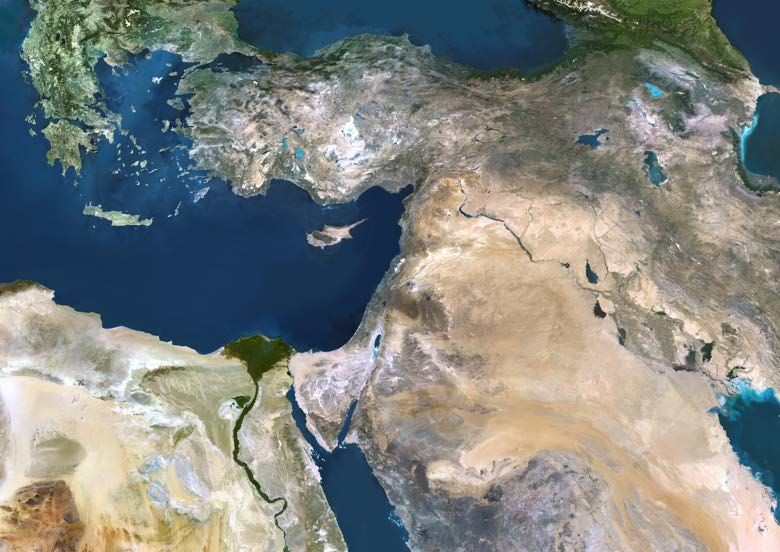
potential that lies within the easternmost third of the
                                                                                 Exactly how these resources are divided among the
Mediterranean Sea could indeed become both of these.
                                                                                 Levantine countries in whose exclusive economic zones
If, as is likely, more gas and also oil discoveries lie ahead,
                                                                                 they lie is still unclear. But in all likelihood, each one of the
then the continued extraction and monetization of these
                                                                                 countries with a claim on the Levant Basin would benefit
strategic resources will remake the economic and security
                                                                                 directly from the continued discovery, extraction, and
landscape and seascape of the Eastern Mediterranean.
                                                                                 monetization of the basin’s resources. This, in turn, could
Seismic exploration of the East Med seafloor in recent                           also have beneficial add-on effects for the wider East
years has indicated that the hydrocarbon potential there is                      Med, from Greece and Turkey all around to Egypt. So far,
huge. Attentions now are focused on the Levant Basin, a                          the major hydrocarbon strikes since 2009 have positively
bowl-like geological expanse that cups the maritime                              transformed the national fortunes of the Levant Basin’s
economic zones of Cyprus and Israel, Lebanon, Hamas-                             two liberal democracies and their 21st century strategic
ruled Gaza, and war-ravaged Syria. This basin holds as                           prospects.

1 U.S. Geological Survey, “Natural Gas Potential Assessed in Eastern Mediterranean,” April 8, 2010,
  http://www.usgs.gov/newsroom/article.asp?ID=2435#.Uwu0G_RdV1F.

2 “Israel’s Levant Basin: How Much Is It Worth?,” Oil in Israel, http://www.oilinisrael.net/tag/levant-basin.

8      HUDSON INSTITUTE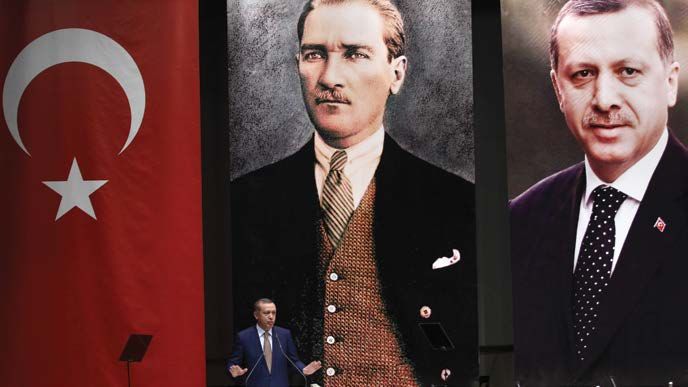
For Israel, the discovery of the Tamar field (10 tcf) in 2009
and the super-giant Leviathan field (19 tcf) in 2011 will
mean energy self-sufficiency for decades to come. This is
an historic boon to security for Israel, a country that
previously had to rely on energy imports in a tumultuous
and hostile neighborhood. What is more, Israel’s offshore
geology suggests it has much greater hydrocarbon
resources yet to be found—anywhere from 50–100 tcf
more, according to the 2011 U.S. estimate.3 Jerusalem
has decided to export at least 40 percent of Israel’s
known reserves, and the country is now set to join the
select group of net energy exporters before the start of
the 2020s.4 If this undertaking is managed well, export
revenues and the savings from large-scale energy
production at home could combine with Israel’s high-tech,
innovation-driven economy to catapult the country into an
unprecedented era of sustained national development.5                           Photo Credit: U.S. Energy Information Administration, August 2013

Meanwhile, for EU-member Cyprus, the 2010 discovery of
                                                                                desire to use the island nation’s central location in the
the Aphrodite gas field came in the midst of a protracted
                                                                                East Med to establish it as a world-class hub for gas
fiscal crisis that still threatens the country’s sovereignty. At
                                                                                production and distribution. In time, Cyprus could
about 4 tcf, Aphrodite has proved smaller than originally
                                                                                experience a near reversal of its current misfortunes and
thought, but it is still a significant find. It has also piqued
                                                                                be transformed from a problem child of the Eurozone
the interest of energy companies. In addition to Noble
                                                                                crisis into a strategic asset and leading energy-producing
Energy, the U.S. firm that has spearheaded the Israel-
                                                                                province in Europe itself.
Cyprus exploration so far, the European giants Eni and
Total have both bid for blocs to prospect in the deep                           Today, Israel and Cyprus are at the epicenter of what may
waters south of the Cypriot coast, estimated to hold as                         evolve into a much broader regional energy renaissance.
much as 60 tcf of natural gas.6 Nicosia has made clear its

3 Lior Zeno, “MIT Professor: Gas Companies Will Do Excellently with New Tax,” Ha’aretz, January 9, 2011,
  http://www.haaretz.com/business/mit-professor-gas-companies-will-do-excellently-even-with-new-tax-1.335977.

4 Chris Smith and Warren R. True, eds., “LNG UPDATE: Global LNG Supply, Demand Remain Tight,” Oil & Gas Journal, April 7, 2014,
  http://www.ogj.com/articles/print/volume-112/issue-4/special-report-lng-update/lng-update-global-lng-supply-demand-remain-tight.html.

5 The smaller Tamar field alone will infuse the Israeli economy with up to $48 billion in energy savings over the twenty-eight years that it is expected
  to be producing. See, for example, Joshua Levitt, “Tamar Natural Gas Field Worth $52 Billion to Israeli Economy – Ernst & Young,” Algemeiner
  RSS, January 8, 2014, http://www.algemeiner.com/2014/01/08/tamar-natural-gas-field-worth-52-billion-to-israeli-economy-ernst-young/.

6 Karen Ayat, “Interview with Dr. Charles Ellinas and Mr. Solon Kassinis, Cyprus National Hydrocarbons Company (KRETYK),” Natural Gas Europe,
  April 22, 2013, http://www.naturalgaseurope.com/interview-charles-ellinas-solon-kassinis-kretyk.

                                                          Energy: The West’s Strategic Opportunity in the Eastern Mediterranean                       9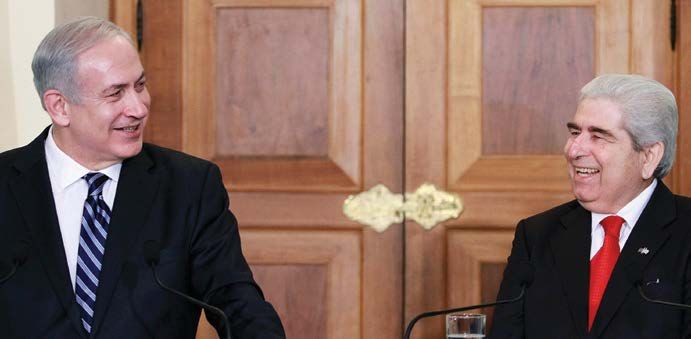
TODAY, ISRAEL AND CYPRUS ARE                                           and Cyprus combined may prove so extensive that the
                                                                            three democracies together could supply up to half of
     AT THE EPICENTER OF WHAT MAY                                           Europe’s gas needs for up to three decades.8
     EVOLVE INTO A MUCH BROADER
                                                                            All of these estimates, of course, are based on
     REGIONAL ENERGY RENAISSANCE.                                           scientifically informed guesses—some probably more
                                                                            scientific than others—but they are speculation and are
Leviathan’s discovery in Israel’s maritime zone prompted                    yet to be proved. And ultimately, it is the proof that
neighboring countries to take a fresh look at the                           matters.
geological details of their own seafloors. Lebanon’s
                                                                            Bonanzas will not materialize by themselves. Unlocking
offshore apparently looks promising, though it probably
                                                                            the East Med’s buried resources and their fullest
has somewhat less than the 96 tcf of recoverable gas that
                                                                            economic potential requires the mobilization of enormous
the energy ministry in Beirut claims. Syria believes it, too,
                                                                            sums of capital, technology, and human know-how and
has huge offshore hydrocarbon deposits, and in 2013, the
                                                                            effort. Exploratory drilling is expensive, and even with the
Damascus regime’s strategic patron in Moscow signed a
                                                                            latest seismic surveying technology, there is no guarantee
25-year deal to explore and develop it.7 Outside of the
                                                                            of success. Even if new deposits are found, in a virgin
Levant Basin, the East Med region probably contains even
                                                                            energy territory like the East Med, it will take years to
greater hidden reserves. Greece’s offshore has long been
                                                                            build up the requisite infrastructure to extract these
thought to be rich in hydrocarbons. Spurred on by their
                                                                            resources and bring them to market. For investors to
country’s bankruptcy, the Greeks initiated a new round of
                                                                            make a long-term commitment, there must be a
seismic prospecting in the northern Aegean and Ionian
                                                                            reasonable expectation of a return. This requires a
seas and discovered something staggering. Greek Prime
                                                                            situation that is favorable to commerce, and prior to this,
Minister Antonis Samaras told President Obama that his
                                                                            it requires what most of the East Med has been sorely
country’s unproven reserves could be as high as 165 tcf
                                                                            missing: political stability and security.
and thus surpass what is thought to be in the Levant
Basin. He also said that the reserves in Greece, Israel,

7 Ziad Haidar, “Syria Signs Offshore Oil and Gas Exploration Deal with Russia,” Al-Monitor, December 27, 2013,
  http://www.al-monitor.com/pulse/business/2013/12/syria-russia-sign-offshore-oil-deal.html.

8 “Vast Gas Reserves Offshore Greece,” Natural Gas Europe, August 12, 2013, http://www.naturalgaseurope.com/greece-natural-gas-reserves.

10    HUDSON INSTITUTE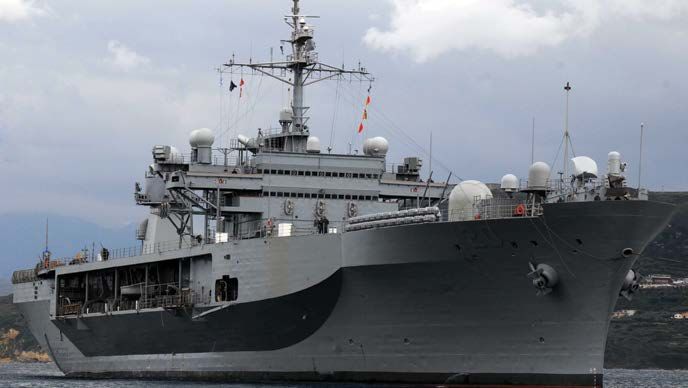
Who Will Shape the Region’s Future?

The sudden emergence of the Eastern Mediterranean as a             a now-widening strategic-sectarian conflict between Iran
potentially major energy-producing province came just as           and its regional proxies and those who oppose them,
the old regional, political, and security order collapsed.         mainly the Gulf sheikhdoms and Sunni jihadist groups.
With the swift overthrow of Tunisian dictator Zine el              The rapid and spectacular rise of the Islamic State out of
Abidine Ben Ali in 2011, the Arabic-speaking countries             this conflict was not wholly unforeseen, but the region has
that skirt the East Med embarked on a great convulsion,            little indigenous capability to deal with it. Without a robust
dubbed at the time the “Arab Spring.” Since then, the              international effort to destroy the jihadist organization and
authoritarian governments in Egypt and Libya have fallen,          empower political alternatives to it, the Islamic State will
both countries have succumbed to deepening                         likely be exporting its fanaticism to vulnerable polities
factionalism, and a popular uprising against the                   across the Middle East and North Africa for years to
Damascus-based tyranny was started and answered with               come.
brutal force. That war has since cut down the lives of at
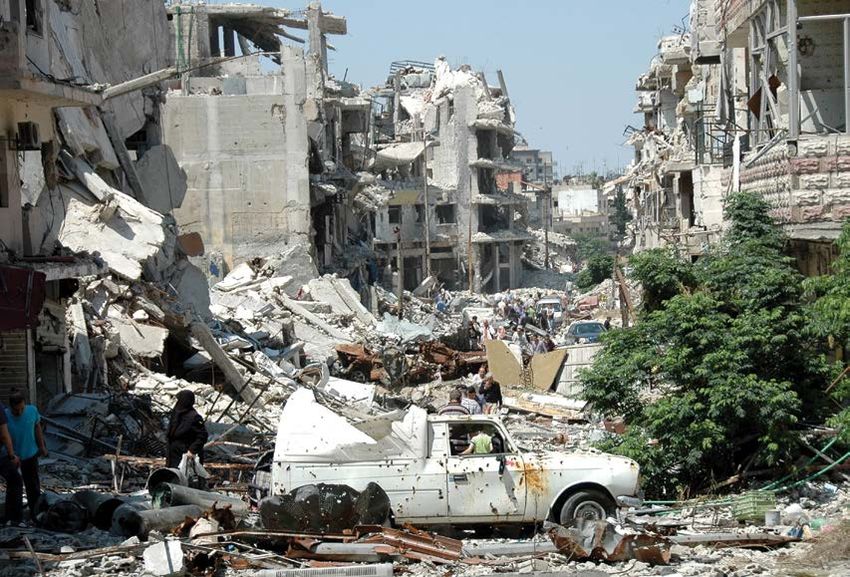
least 190,000 and displaced millions more. What began              Photo Credit: Syrians walk amid debris as they return to the
as a struggle among Syrians over their own country’s               Juret al-Shayah district of the central city of Homs, May 10,
                                                                   2014. (AFP/Getty Images)
future has since metastasized into a “new Afghanistan,”

                                                  Energy: The West’s Strategic Opportunity in the Eastern Mediterranean            11
WITHOUT A ROBUST Syria has also become the core locus of an escalating
geopolitical contest between a divided and rudderless
INTERNATIONAL EFFORT TO alliance of Western countries and a new axis of revisionist
DESTROY THE JIHADIST powers—Iran and Russia—which have an interest in
opposing the liberal order when it does not work for them
ORGANIZATION AND EMPOWER
and in pushing back U.S. influence from their doorsteps.
POLITICAL ALTERNATIVES TO IT, From its origins on the Mediterranean, this contest has
now expanded through Turkey and into Southeast Europe,
THE ISLAMIC STATE WILL LIKELY
where it now threatens what was widely considered not
BE EXPORTING ITS FANATICISM TO long ago to be a relatively secure, liberal peace.
VULNERABLE POLITIES ACROSS In the midst of such turmoil, the task of constructing the
THE MIDDLE EAST AND NORTH next order is normally eclipsed by more urgent demands.
But over the next few years, strategic decisions will be
AFRICA FOR YEARS TO COME. made by governments in and outside of the East Med
about the monetization pathways of the region’s energy
Europe has been bracing itself against the spillover from resources. These decisions about national policy will be
the wars, as has Turkey and the Kurdish Regional influenced not just by economics and commercial viability
Government in Iraq, which together have provided a assessments, but also by how politicians judge present-
safehaven for millions of refugees and internally displaced day security and political dynamics, including where these
persons. With no end in sight, it has become common to trends might be taking the region as a whole and whether
hear talk of the “end of the Sykes-Picot era” and the there may be opportunities to affect them for the better.
decomposition of the “artificial” Arab Levant nations These decisions will also have ramifications for the energy
created in the 20 century as an historic and irresistible
th
map in the East Med and the security of many nations for
process. years to come.
So far, the energy discoveries and ensuing politics over
SYRIA HAS ALSO BECOME THE
how to harness them have scrambled relations across the
CORE LOCUS OF AN ESCALATING East Med. This has spurred the formation of new
alliances, notably between Israel, Cyprus, and Greece,
GEOPOLITICAL CONTEST BETWEEN
and also exacerbated generations-old disputes over
A DIVIDED AND RUDDERLESS territory, including between Israel and her neighbors and
ALLIANCE OF WESTERN between Turkey, Greece, and a divided Cyprus. Thus, in a
region already beset with political upheaval, rivalry, and
COUNTRIES AND A NEW AXIS OF warfare, a question has hung over the hydrocarbon
REVISIONIST POWERS—IRAN AND discoveries and the resulting discussions about what their
future might hold: Will the geopolitical change brought
RUSSIA. about by these decisions be for the better or the worse?
12 HUDSON INSTITUTEPhoto Credit: Israeli Prime Minister Benjamin Netanyahu with Cypriot President Demetris Christofias during a joint press conference after a
meeting in Nicosia on February 16, 2012. (ANDREAS LAZAROU/AFP/Getty Images)
That answer depends on whose geopolitics are setting Two broad schools of thought have governed the way that
the agenda. In this, the region’s liberal democracies and the liberal democracies involved in the Levant Basin have
the Western nations more generally now have a strategic approached its development and sought strategic
opportunity. Israel and Cyprus have been sprinting ahead advantage from it.
with the development of their shares of the Levant Basin.
The first liberal strategy has looked to the East Med
Between them, the two countries now hold the largest
energy bonanza as an opportunity for national self-
“Western” energy reserves in the Greater Middle East—
strengthening, including through the formation of a new
reserves that are not controlled by Putin’s Russia, by the
strategic alliance between Israel, Cyprus, and Greece. In
Islamic Republic of Iran, or by any of the Gulf states. This
2013, for instance, Cyprus and Israel signed a
has placed Israel-Cyprus, along with their partners in the
Memorandum of Understanding that acknowledges the
U.S. and European governments and private sectors, in
desire of both countries to work together in developing
the effective driver’s seat of the East Med energy
the hydrocarbon finds, including by constructing a joint
revolution. Together these actors have an opportunity to
liquefaction plant at Vasilikos, on the southern coast of
proactively shape the regional energy market so as to
Cyprus.9 In theory, this would allow for export to a range
attract the largest possible volume of outside financial
of future liquefied natural gas (LNG) markets, perhaps to
investment and exploration and, through this, to maximize
Europe, but also to the lucrative LNG markets in Asia.
the energy revolution’s potential security-enhancing
Greece, Israel, and Cyprus have discussed other export
benefits.
9 Elias Hazou, “Noble Execs Haven’t Abandoned Onshore LNG Plant Yet,” Cyprus Mail, May 20, 2014,
http://cyprus-mail.com/2014/05/20/noble-execs-havent-abandoned-onshore-lng-plant-yet/.
Energy: The West’s Strategic Opportunity in the Eastern Mediterranean 13options, including laying a cable along the seafloor that pragmatism. This could help set the stage for diplomatic
would directly supply European markets with electricity breakthroughs and political settlements to some of the
made in East Med power plants.10 The three countries region’s disputes while reducing the opportunities for
have also begun working together on constructing a outsiders, such as Russia and Iran, to use the insecurity
common, sub-regional security architecture that will be a for their own purposes. Significantly, in 2014, Israel
crucial basis for cementing their cooperation in energy announced its first two export agreements: the first to the
commerce. Palestinian Authority, the second to Jordan.12
As new finds are made and brought online, it is not These two security strategies—the first to strengthen the
difficult to envision an East Med gas network emerging as liberal democracies, the second to use the energy
a key component of a new European security, one that bonanza to enlarge the liberal order itself—are not
could help insulate Europe from the likely shocks of incompatible, and they are likely to prove mutually
spreading instability in North Africa. This is perhaps reinforcing. Strengthening the budding coalition of East
especially true if Greece’s hydrocarbon stores prove as Med democracies can only be achieved by deepening the
enormous as Athens has predicted. If combined with new energy and security cooperation between them and,
lines of energy supply from North America, this could through this, by proactively shaping the surrounding
open the door to a 21st century transatlantic security that environment in ways conducive to their common pursuit
will reduce Europe’s vulnerabilities to Russian energy- of enlightened liberal self-interest. The development of
based coercion. energy resources will provide the economic basis for
pursuing both security strategies at once.
The second liberal strategy has seen the development of
the East Med’s energy resources as a potential vehicle or
BUT TO UNLOCK THE FULL GAME-
“political catalyst” for fostering stability in a conflict-
riddled region.11 No one has seriously argued that CHANGING POTENTIAL OF THE
infrastructure construction and the blossoming of
EAST MED—WHICH REQUIRES THE
intra-regional trade alone will generate peace. But given
the speed with which the situation in the East Med has LARGE-SCALE INVOLVEMENT OF
deteriorated, the need to fit energy policy into a
THE INTERNATIONAL PRIVATE
comprehensive strategy for restoring security to the
region is as reasonable as it is urgent. As some have SECTOR—THE LIBERAL
argued, the promise of economic benefits could establish DEMOCRACIES MUST SUCCEED IN
the requisite community of interest between some, though
likely not all, of the parties now at odds and create MAKING THE EAST MED MORE
genuine incentives for political moderation and SECURE.
10 “Enthusiasm and Commitment in Israel for the Greece-Cyprus-Israel Energy Bridge,” EuroAsia Interconnector, March 4, 2012,
http://www.euroasia-interconnector.com/News-Enthusiasm_and_commitment_in_Israel_for_the_Greece_Cyprus_Israel_energy_bridge%2C2?Se
ction=None&WebContentCode=.
11 See Christopher Coats, “The Diplomatic Potential of Eastern Mediterranean Gas,” Forbes, February 19, 2014,
http://www.forbes.com/sites/christophercoats/2014/02/19/the-diplomatic-potential-of-eastern-mediterranean-gas/.
12 John Reed, “Noble Energy Signs $500m Deal to Supply Gas from Israel to Jordan,” Financial Times, February 19, 2014,
http://www.ft.com/cms/s/0/5db74ce8-9978-11e3-91cd-00144feab7de.html#axzz33DwK4e3G.
14 HUDSON INSTITUTEBut to unlock the full game-changing potential of the East time, Turkey has been pressing territorial claims against
Med—which requires the large-scale involvement of the EU-member Cyprus, which Ankara alone does not
international private sector—the liberal democracies must recognize, arguing that the exclusive economic zone
succeed in making the East Med more secure. If they do (EEZ) agreements Nicosia has struck with its neighbors
not take advantage of the opportunities they have, then actually cut into Turkish maritime territory. The Turkish
major strategic decisions about the shape of the energy Navy has staged military drills off Cyprus to emphasize
market and the region’s future as a whole will be made for this point. In 2011, Egemen Bağiş, then Turkey’s EU affairs
them—either by others who do not share their liberal minister, warned the Cypriots against rushing ahead with
aspirations, or by the pulls of the region’s worsening hydrocarbon exploration without them: “This is what we
security situation. have the navy for. We have trained our marines for this;
we have equipped the navy for this. All options are on the
Rising Security Challenges
table; anything can be done.”13 Likewise, the Turkish
While the hydrocarbon strikes have boosted the strategic President Recep Tayyip Erdogan, whose personal
and economic prospects of Israel and Cyprus and antipathy toward Israel is clear, has also made threats as
brought them, along with Greece, closer together, the Jerusalem has maneuvered closer to Nicosia: “Israel
discoveries have also created new security challenges. cannot do whatever it wants in the Eastern
Among other things, the scramble to put down claims on Mediterranean. They will see what our decisions will be on
the Levant Basin’s riches has inflamed generations-old this subject. Our navy attack ships can be there at any
disputes over territory. Lebanon and Israel are still moment.”14 In early 2014, a Turkish warship harassed a
officially at war, and Iran’s two most capable regional Norwegian prospecting vessel in the waters off the
proxies, Syria’s Assad regime and Hezbollah, have both southern coast of Cyprus and succeeded in chasing it
accused Israel of trespassing in Lebanon’s proper away. As tensions have mounted, the AK Party
domain. The energy finds have also become a major government in Ankara has also been pressing claims
aggravating factor in the tangled and increasingly against Greece, arguing that the energy potential in the
antagonistic relations between Turkey and each one of its Aegean Sea, in an area that is widely recognized in
democratic neighbors, the “strategic triangle” of Greece, international law as Greece’s EEZ, lies instead within
divided Cyprus, and Israel. Turkish boundaries.
Ankara has sharply objected to deepening energy As a result of these disputes, some have concluded that
cooperation between Nicosia and Jerusalem, claiming, the East Med’s energy potential is at risk of remaining
among other things, that the Turkish enclave on northern “diplomatically trapped” within the seabed.15 The United
Cyprus, which Ankara alone recognizes and which is States, in a bid to salvage the situation, has dispatched
heavily fortified with Turkish troops, will be unfairly diplomats to Greece, Turkey, Cyprus, Israel, and Lebanon
deprived of its share of energy revenues. At the same to seek a breakthrough on many fronts. Washington,
13 Adam Taylor, “Turkey Threatens Naval Action against Cyprus If They Look For Oil,” Business Insider, September 6, 2011,
http://www.businessinsider.com/turkey-cyprus-oil-2011-9.
14 “Erdogan: Warships Can Be in E. Med at Any Moment,” Ynet News, September 15, 2011,
http://www.ynetnews.com/articles/0%2C7340%2CL-4122850%2C00.html.
15 Tia Goldenberg, “Israel Faces Geopolitical Tangle over Natural Gas,” Times of Israel, March 30, 2013,
http://www.timesofisrael.com/israel-faces-geopolitical-tangle-over-natural-gas/. See also the work on East Med energy development by
Simon Henderson of the Washington Institute for Near East Policy.
Energy: The West’s Strategic Opportunity in the Eastern Mediterranean 15along with the region’s liberal politicians, has seen that the Russia Today, reported in September 2013 that Moscow’s
promise of the energy bonanza could help to foster naval buildup in the Mediterranean aimed to establish “a
diplomatic settlements that might come to contribute, in constant naval presence in the eastern part of the
time, to political stability. Experts and insiders are divided Mediterranean Sea.”17 Noting amphibious ships, a large
over whether this energy diplomacy will work, but there anti-submarine warfare vessel, and reconnaissance,
has been a general assumption that an equitable escort, and missile-launching ships, Fleet Admiral Viktor
arrangement is within reach and that pragmatic leaders Chirkov said that “Russia will be building up its
on all sides are mainly interested in doing business. Mediterranean fleet until it is deemed sufficient to perform
Turkey, especially, has much more to gain from the task set.”18 What task set this is, Admiral Chirkov did
participating in the East Med bonanza than from not say. But Russian warships stationed in the region now
threatening it. give Moscow the capability to project deeper influence
over the area. Meanwhile, Russia’s strategic ally Iran has
And yet, as the historian Thucydides famously observed
also been sending warships to the East Med, just as it has
in the course of a war among the Peloponnese almost
been bolstering its position there via its proxies Hezbollah,
2,500 years ago, men will not always choose to do what
Hamas, and the Assad regime. In 2011, Iranian warships
is in their best interests—especially when their honor is at
passed into the Mediterranean Sea through the Suez
stake. Indeed, if geopolitics is an argument about the
Canal for the first time in over 30 years, and in April 2013,
future world order, then the easternmost third of the
a top official of the Islamic Revolutionary Guard Corps
Mediterranean Sea is shaping up to be a cauldron of
declared that Iran’s security “borders have stretched and
quarreling visions and interests like no other. The energy
reached the Mediterranean coasts.”19 The naval voyage
finds in the Levant Basin have rendered the East Med all
was largely symbolic, but it reflected Iran’s abiding
the more relevant to outside powers—including Russia
ambitions to become a Mediterranean power, a precedent
and Iran. At the end of 2013, Russia signed a 25-year
created in the fifth century BC by its antecedent, Persia.
prospecting deal with the Damascus regime granting it
exploration rights in Syria’s offshore territory. In addition Both Russia and Iran are clearly playing the long game in
to further bolstering Assad, the move demonstrated the the East Med. In Syria, the two countries have
Kremlin’s intent on establishing a controlling interest in the demonstrated the wherewithal to exploit the region’s
Levant Basin, one that could give it greater influence over insecurity for their own geopolitical purposes. Both
regional affairs. 16
revisionist powers have an economic and ideological
stake in opposing Western influence and liberal outcomes
Russia has been backing its diplomatic maneuvers with
in the East Med that might damage their own interests.
military commitments. The Russian government’s
Through all this, the security and political underpinnings
international television network, RT, formerly known as
of the already contested liberal order in the region, such
16 “Syrian Energy Deal puts Russia in Gas-rich Med,” United Press International, January 16, 2014,
http://www.upi.com/Business_News/Energy-Resources/2014/01/16/Syrian-energy-deal-puts-Russia-in-gas-rich-Med/UPI-32731389905770/.
17 “Russia to Expand Mediterranean Fleet to 10 Warships – Navy Chief,” RT, September 13, 2013,
http://rt.com/news/navy-warship-syria-mediterranean-800/.
18 Ibid.
19 “IRGC Official: Iran’s Borders Now Stretch to Mediterranean Coasts,” Farsnews, February 1, 2014,
http://english.farsnews.com/newstext.aspx?nn=13921112001650.
16 HUDSON INSTITUTEPhoto Credit: U.S. Sixth Fleet flagship USS Mount Whitney (LCC 20) arrives at Marathi NATO Pier, Feb. 28, 2012 (U.S. Navy photo by
Mass Communication Specialist Seaman Chelsy Alamina/Released)
as it is, have increasingly come under new pressures from missile defense-equipped destroyers based at the
forces intent on pushing them aside. western end of the inland sea. Otherwise, the U.S. naval
force in the Mediterranean consists of warships that are
The United States has a national interest in helping to
temporarily assigned—“chopped”—to the Sixth Fleet as
secure the East Med bonanza for the direct benefit of its
they transit east from Gibraltar to the Suez Canal, or as
allies and for the sake of general regional stability. And
they return home steaming in the opposite direction.
yet, the two core components of U.S. national power in
the East Med, its alliances structures and the U.S. Navy, The contraction of U.S. power in the East Med has helped
have both become attenuated. Diplomatic relations to create a vacuum, one that other powers with alternative
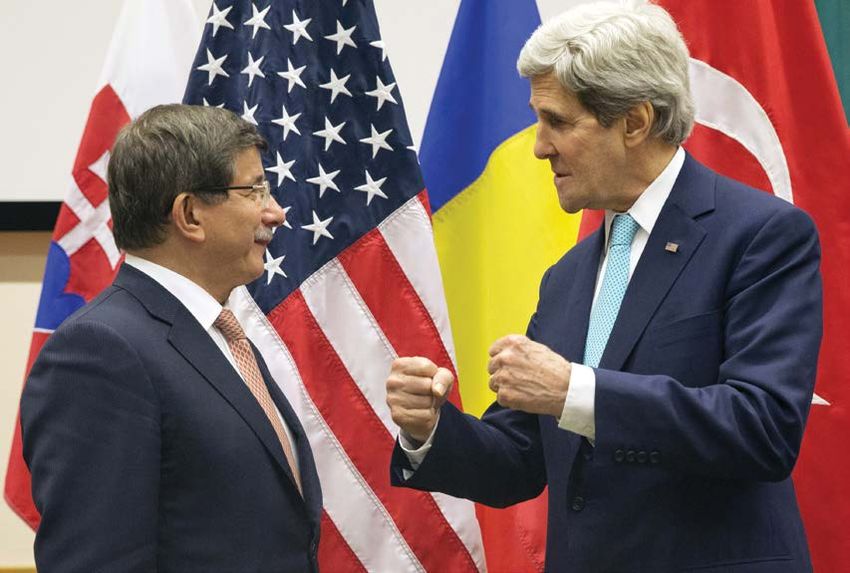
between its two most capable allies in the region—Turkey visions, and not liberal ones, have been quick to fill. There
and Israel—have deteriorated rapidly in recent years. This, is, therefore, a risk that the vigorous U.S. diplomacy on
combined with continuing fallout from the Arab Spring, behalf of liberal outcomes will be undermined without an
has weakened the security order. In the absence of direct accompanying plan to create and secure a market that
U.S. strategic involvement, revisionist powers and can attract large-scale private-sector involvement. Indeed,
growing rivalries at sea over the Levant Basin’s resources without a strategy to reconstitute the regional security
will have the chance to diminish it further. Where the U.S. architecture, the current U.S. policy is at risk of becoming
Sixth Fleet had once been preeminent, it now has only sentimental meliorism and producing nothing.
one permanently assigned ship, a command and control
flagship homeported in Italy, along with a few ballistic
Energy: The West’s Strategic Opportunity in the Eastern Mediterranean 17U.S. Involvement in the East Mediterranean:
What History Tells Us
The emergence of the United States as a Mediterranean World that would be remodeled through increasing
power began in the early 19th century when the U.S. Navy diplomatic and commercial interactions between the
was built up, in large measure, to protect seaborne littoral countries of the north and south.
American commerce from raiding pirates of the Barbary
The upheaval and intensifying geopolitical contests in
States, the vassals of the Ottoman Sultanate. By the end
today’s East Med, however, have turned the hopes of the
of the Cold War, a Mediterranean security order that was
1990s on their head. Since the start of the Arab Spring, an
generally favorable to liberal democracy and free trade
older map of the region has been revealed, which is more
rested on secure geostrategic foundations. Through
initiatives such as the 1995 Barcelona Process, a greater Photo Credit: President Harry Truman shakes hands with
“Euro-Mediterranean” community was conceivable in Secretary of State George Marshall upon Marshall’s return to
which the East Med was seen as a frontier of the Atlantic Washington on May 29, 1947 from the Big Four Minister’s
conference held in Moscow. (Photo by Hulton Archive/Getty
Images)
18 HUDSON INSTITUTEthe historic norm than the exception. The region is—to Constantine and Licinius, resulted in the transfer of the
borrow the phrase of geographer Saul Cohen—a classic imperial seat to Constantinople, the city on the Bosporus
“shatterbelt,” a congeries of different peoples and named after the victor. Centuries later, a religious schism
cultures that has smoldered in conflict and dissension between the Eastern Orthodox and Western churches
across the centuries. The East Med has also historically
20
occurred that paralleled the classical warfare and is still
been a central arena of strategic rivalry between powers relevant to its strategic affairs today. Crusaders from the
that have come both from within it and from the outside West replaced the plunderers of antiquity from the East.
with the ambition of organizing the area for their own Venice’s high command used the Fourth Crusade as an
ends. excuse to seize Constantinople, and it so drained the
Byzantine Empire that it became low-hanging fruit for
The West’s first great literary work, the Iliad, describes the
marauders from the West and the eventual conquest by
warfare between mainland Greece and Aegean tribes and
the Ottomans two and a half centuries later. Ottoman
Troy, a city located in northwest Anatolia, in what is today
predations in the southern Balkans had largely succeeded
Turkey. Approximately three centuries later, the Persian
by the time Constantinople fell. Tensions between the
Achaemenid Empire began a five-decade effort to
religions, and within them, continue to this day along the
conquer the Greek city-states. The invasion across the
fault lines that run from Southeast Europe and through the
Aegean was preceded by Persia’s subjugation of Egypt.
Levant to northern Africa.
Two centuries later, Alexander the Great crossed the
Aegean into Asia Minor en route to a successful invasion The strategic involvements of the United States in the
of Persia and then the subcontinent. In the meantime, the eastern third of the Mediterranean began in earnest
major Greek city-states of Athens and Sparta, along with during the Cold War. U.S. leaders quickly grasped the
their Greek-speaking allies, fought a three-decade war importance of the East Med for containing Soviet
that toppled Athens from her position as the Hellenic expansionism and securing Western Europe.
world’s leading city-state. Imperial ambition passed to Implementing a policy aimed at accomplishing these
Rome, whose legions extended her rule through the goals required a robust and sustained presence, which
Aegean to the Levant and northern Africa. Rome’s the United States achieved by creating a new set of
command of the central Mediterranean famously forced political and security alliances. Greece and Turkey, who
Hannibal west through Spain and over the Alps. But coexisted in the face of significant historic tension, both
Rome’s generals ultimately forced Hannibal back to joined NATO in 1952. This established a presence for the
Carthage and to defeat at the hands of those who Atlantic Alliance on the shores of the Levant and enabled
controlled the seas. Rome’s civil wars were often it to reach into the Black Sea. Strong bipartisan support in
contested in the East Med—for example, the Battle of the U.S. Congress for Israel’s security helped the tiny
Actium, in which Octavian defeated Antony and country founded in 1948 to emerge, over time, as an
Cleopatra, thus ending the republic. The resulting empire increasingly capable ally that has been separate from
was on perpetual war footing to bring the region to an NATO but has also enhanced it.
uneasy peace. One contest, between rival emperors
20 S. B. Cohen, Geopolitics of the World System (Lanham, MD: Rowman & Littlefield, 2003).
Energy: The West’s Strategic Opportunity in the Eastern Mediterranean 19But to unlock the full game-changing potential of the East time, Turkey has been pressing territorial claims against
Med—which requires the large-scale involvement of the EU-member Cyprus, which Ankara alone does not
international private sector—the liberal democracies must recognize, arguing that the exclusive economic zone
succeed in making the East Med more secure. If they do (EEZ) agreements Nicosia has struck with its neighbors
not take advantage of the opportunities they have, then actually cut into Turkish maritime territory. The Turkish
major strategic decisions about the shape of the energy Navy has staged military drills off Cyprus to emphasize
market and the region’s future as a whole will be made for this point. In 2011, Egemen Bağiş, then Turkey’s EU affairs
them—either by others who do not share their liberal minister, warned the Cypriots against rushing ahead with
aspirations, or by the pulls of the region’s worsening hydrocarbon exploration without them: “This is what we
security situation. have the navy for. We have trained our marines for this;
we have equipped the navy for this. All options are on the
Rising Security Challenges
table; anything can be done.”13 Likewise, the Turkish
While the hydrocarbon strikes have boosted the strategic President Recep Tayyip Erdogan, whose personal
and economic prospects of Israel and Cyprus and antipathy toward Israel is clear, has also made threats as
brought them, along with Greece, closer together, the Jerusalem has maneuvered closer to Nicosia: “Israel
discoveries have also created new security challenges. cannot do whatever it wants in the Eastern
Among other things, the scramble to put down claims on Mediterranean. They will see what our decisions will be on
the Levant Basin’s riches has inflamed generations-old this subject. Our navy attack ships can be there at any
disputes over territory. Lebanon and Israel are still moment.”14 In early 2014, a Turkish warship harassed a
officially at war, and Iran’s two most capable regional Norwegian prospecting vessel in the waters off the
proxies, Syria’s Assad regime and Hezbollah, have both southern coast of Cyprus and succeeded in chasing it
accused Israel of trespassing in Lebanon’s proper away. As tensions have mounted, the AK Party
domain. The energy finds have also become a major government in Ankara has also been pressing claims
aggravating factor in the tangled and increasingly against Greece, arguing that the energy potential in the
antagonistic relations between Turkey and each one of its Aegean Sea, in an area that is widely recognized in
democratic neighbors, the “strategic triangle” of Greece, international law as Greece’s EEZ, lies instead within
divided Cyprus, and Israel. Turkish boundaries.
Ankara has sharply objected to deepening energy As a result of these disputes, some have concluded that
cooperation between Nicosia and Jerusalem, claiming, the East Med’s energy potential is at risk of remaining
among other things, that the Turkish enclave on northern “diplomatically trapped” within the seabed.15 The United
Cyprus, which Ankara alone recognizes and which is States, in a bid to salvage the situation, has dispatched
heavily fortified with Turkish troops, will be unfairly diplomats to Greece, Turkey, Cyprus, Israel, and Lebanon
deprived of its share of energy revenues. At the same to seek a breakthrough on many fronts. Washington,
13 Adam Taylor, “Turkey Threatens Naval Action against Cyprus If They Look For Oil,” Business Insider, September 6, 2011,
http://www.businessinsider.com/turkey-cyprus-oil-2011-9.
14 “Erdogan: Warships Can Be in E. Med at Any Moment,” Ynet News, September 15, 2011,
http://www.ynetnews.com/articles/0%2C7340%2CL-4122850%2C00.html.
15 Tia Goldenberg, “Israel Faces Geopolitical Tangle over Natural Gas,” Times of Israel, March 30, 2013,
http://www.timesofisrael.com/israel-faces-geopolitical-tangle-over-natural-gas/. See also the work on East Med energy development by
Simon Henderson of the Washington Institute for Near East Policy.
Energy: The West’s Strategic Opportunity in the Eastern Mediterranean 15Turkey at a Crossroads:
Implications for Peace and Stability
In the Cold War, Turkey’s location made it an constituency whose driving interest has been to develop
indispensable component of the anti-Soviet containment their country and open it up for international business.
regime. After the U.S.S.R. collapsed, the Western- Through its rise, the AKP had effectively incorporated
oriented Turkish Republic continued to operate as NATO’s elements of the failed Turkish Islamist movement and then
southeast anchor and as a frontline state that contributed subordinated this ideologically motivated faction to the
real capability to the U.S.-backed security order from party’s larger pragmatic agenda of economic and political
Southeast Europe to the Persian Gulf. Today, however, the reform. It was widely believed that the party could act as
political foundation on which Turkey entered into its a vehicle for integrating Islamism into a democratizing
decades-old alliance with the Atlantic World is tottering governing arrangement. The AKP’s Turkey thus came to
and threatening to come apart. Since the rise of the be seen as a model for other Middle Eastern societies
Adalet ve Kalkınma Partisi (Justice and Development seeking productive ways to cope with political Islam.
Party, or AKP), beginning in 2002, Turkey’s rulers have
The domestic reforms the AKP launched during its first
deliberately steered their country away from the
term had impressive, even laudable, results. By opening
community of Western nations. These historic changes
up the Anatolian heartland and then the eastern provinces
within Turkey have altered the strategic construction of
to capital investments, the party succeeded in tapping
Southwest Asia, and especially the East Med, which the
and harnessing Turkey’s economic potential. It also
AKP leadership’s frequently strident rhetoric and erratic
effectively inaugurated a new process of “nation-building”
behavior has treated as an exclusive realm for its own
in Turkish Asia, a region in which the Kemalist project,
gain and, at times, as a fault-line between the Islamic
because of its own ideological underpinnings, had always
world and the Western one.
struggled. The AKP’s power has since grown and been
When the AKP came to power, there was great hope that consolidated around the newly affluent and religiously
Turkey would continue to be a pillar of regional stability. conservative middle class that its early reforms helped to
Americans, especially, wanted to see the new Turkey act create.
as a bridge to connect and mediate between the West
Turkey’s economic takeoff required it to look for energy
and an increasingly unstable Middle East. Those hopes
beyond its borders. With virtually no energy resources of
were not entirely unwarranted. The AKP, after all, has
its own, the country turned to Russia and Iran for the fuel
never been an exclusively Islamist party, nor is it now.
to drive its economy. But Ankara’s ambition was also to
Rather, it is a collection of different interest groups and
make the country into an energy corridor that would draw
ideological and cultural tendencies—some Islamist, others
on Caspian and Middle Eastern resources to meet rising
conservative and pious—with a substantial core
domestic needs and pass along any excess to Europe for
Energy: The West’s Strategic Opportunity in the Eastern Mediterranean 21Photo Credit: Turkey’s Prime Minister Recep Tayyip Erdogan addresses members of his ruling AK Party in Ankara on May 23, 2014.
(ADEM ALTAN/AFP/Getty Images)
profit. The United States and the EU actively encouraged guardian of the secularist order. The ethnic nationalism
this, as it would help the countries of East Europe reduce that was the basis of political life in the Kemalist republic
the Kremlin’s control over their supply of energy. For was also increasingly replaced with an alternative
Turkey, becoming the transit point for Caspian energy conception of citizenship rooted in the country’s Islamic
would mean a secure supply and an opportunity to heritage and culture. On this basis, the AKP initially
advance its bid for EU membership. Construction on the modified its approach toward the dispute over Cyprus,
Trans-Anatolian Gas Pipeline (TANAP), which will run from which had become an EU member in 2004. The new
Azerbaijan to Europe, is slated to begin in 2014, with a approach was less coercive than the nationalistic policies
completion date of 2018. 21
of previous Turkish governments. At the time, Ankara’s
new pragmatism toward Nicosia, combined with its
By the start of the AKP’s second term in 2007, the party
intention of joining the EU, made it easier to believe that a
was in a stronger position to push for even deeper
lasting peace was within reach.
structural and constitutional reforms, including rolling
back the political influence of the military, long the
21 Aynur Jafarova, “SOCAR Says No Delay Recorded in TANAP Construction,” AzerNews, April 11, 2014,
http://www.azernews.az/oil_and_gas/66040.html.
22 HUDSON INSTITUTEThe AKP government also pursued a new “democratic insurgents to fight against NATO troops and the people in
opening” toward the country’s minority Kurds. This has Iraq whom they were trying to protect. Iran was also
been a strategically vital policy shift: the costs of modern backing the Taliban in Afghanistan.
Turkey’s protracted struggle with Kurdish terrorism and
Westerners have been outraged and also confused by
separatism have always been significant, and because of
Turkey’s “drift,” and for many, it only confirmed what they
the Kurdish population’s burgeoning numbers, those
suspected of the AKP all along. Most immediately, the
costs can only grow in the absence of a political
shift in Ankara’s policy has sabotaged its longstanding
settlement that ends the rebellions and incorporates the
security partnership with Israel and thus enfeebled the
Kurds in an equitable governing arrangement. In principle,
existing U.S.-backed security architecture in the East
these policies reflected the political moderation that
Med. After a series of high-profile diplomatic scandals,
Turkey’s position astride Europe and Asia required. In
relations between Ankara and Jerusalem reached their
practice, however, the AKP’s operative idea of democracy
nadir in 2010 after Israeli commandos challenged a
has come to more closely resemble majoritarian rule. And
Turkish vessel that was attempting to break the blockade
as the party’s power has grown, its efforts to restructure
Jerusalem established to keep weapons out of Hamas-
the state and maintain its controlling majority by abrading
ruled Gaza. Nine Turkish citizens were killed in the
the rights of minorities who don’t agree with it and
ensuing melee. Turkey subsequently expelled Israel’s
removing the institutional checks and balances on its
ambassador, military agreements between the two
exercise of power have only deepened.
countries were suspended, and Ankara officially
As the resulting “AK party-state” consolidated its rule at designated Israel as a “threat to regional security.” The
home, it also charted a new course internationally. “Eastern Mediterranean Sea,” then-Prime Minister
Turkey’s new foreign agenda rested on the concept of Erdogan said at the time, “will see Turkish battleships with
“strategic depth.” In practice, this meant that the higher frequency.”22
country’s grand strategy would be re-centered by
The Turkey-Israel breakup is often ascribed to Erdogan’s
loosening its traditional moorings in the Atlantic Alliance
personal animosity toward the Jewish state, but its
and increasing its relations and involvements as a
sources and ramifications are much greater than that.
self-styled “Muslim power” in the Middle East—a volatile
Since the hydrocarbon strikes in the Levant Basin,
region that the security strategy of the Kemalist republic
relations between Turkey and its three democratic
strove to keep a healthy distance from. As this has taken
neighbors in the East Med have continued to worsen. If
effect, the party’s once-constrained ideological faction
current diplomatic efforts succeed, Turkey may yet
has come increasingly to the fore. In mid-2006, the AKP
become a destination market for Levant Basin gas
government made a point of embracing the terrorist group
producers. However, the prospects of an East Med gas
Hamas after its electoral victory in Gaza. Almost
economy that will be independent of Turkish control has
simultaneously, it also began to make overtures to the
dampened the AKP’s grand strategic ambition to recreate
Islamic Republic of Iran as well as to Syria, two U.S.-
Turkey as the dominant Eurasian transit corridor for
designated state sponsors of terrorism. This came at a
energy commerce.
time when Iran, with Syria’s help, was equipping
22 Ibid.
Energy: The West’s Strategic Opportunity in the Eastern Mediterranean 23Photo Credit: An Israeli Navy vessel passes by a drilling rig on May 27, 2013 off the coast of Ashdod, Israel in the Mediterranean Sea.
(Uriel Sinai/Getty Images)
Ankara has thus opposed closer cooperation between The AKP’s claims over the East Med now seem to be
Israel, Cyprus, and Greece in the development of their guiding Turkey’s unprecedented maritime-oriented
resources, arguing that the Turkish enclave on Cyprus will strategic outreach. In March 2012, the Turkish Navy’s
be deprived of its fair share of the energy revenues. senior officer, Admiral Murat Bilgel, announced that his
Ankara has also disputed the legal maritime claims of navy seeks to “operate not only in the littorals but also on
Cyprus and Greece on which their exploration and the high seas.” According to Bilgel, Turkey’s near-term
extraction of hydrocarbons depend. Those claims rest on goals in the East Med are to “enhance sea denial and
the United Nations Convention on the Law of the Sea maintain a forward presence with a limited power
(UNCLOS), to which Turkey is not a party. However, the projection capacity.”23 Late in 2013, Turkey announced
international consensus is that the provisions of the that it was procuring a massive amphibious assault ship
convention have acquired the legal force of customary that would be useful for doing just this, and also for
law, and thus, Turkey’s disputes with Cyprus and Greece conducting an opposed landing in the East Med were a
over the convention have dubious legal standing. future Turkey to ever seek to gain territory through force of
arms. The announcement of the new ship itself has
already altered diplomacy and the naval balance in the
23 Michael Tanchum, “Turkey’s New Carrier Alters Eastern Mediterranean Energy and Security Calculus,” Jerusalem Post, February 4, 2014,
http://www.jpost.com/Opinion/Op-Ed-Contributors/Turkeys-new-carrier-alters-eastern-Mediterranean-energy-and-security-calculus-340352.
24 HUDSON INSTITUTEYou can also read


