ENGLAND CANOE SLALOM TALENT
       PROGRAMME STRATEGY

                  2021-2025
←
→
Page content transcription
If your browser does not render page correctly, please read the page content below
ENGLAND CANOE SLALOM TALENT
PROGRAMME STRATEGY
2021-2025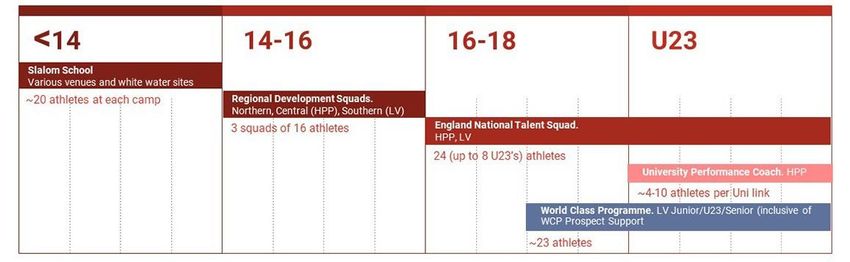
Contents
SECTION ONE     INTRODUCTION                                                            03

SECTION TWO     OUR 2021-2025 STRATEGIC PRIORITIES & AMBITIONS 04

SECTION THREE   2021 ACTION PLANS                                                       05

                3.1   Restructuring the Regional Talent Academy and replacing
                      with Slalom Schools
                3.2   Increase the funding and support to Talent Club Partnership
                      Programme
                3.3   Refocus and rename Talent Identification and Development (TID)
                      coaching roles to support athlete and club development at white
                      water venues
                3.4   Support for U23 athletes
                3.5   Retain the regional Super Regional Squad (SRS) structure and
                      England National Talent Squad (ENTS) structure
                3.6   Creation of an Athlete Development Framework

SECTION FOUR    ATHLETE PATHWAY                                                         09

SECTION FIVE    ATHLETE PATHWAY DIAGRAM                                                 10

                                        2                www.britishcanoeing.org.uk
SECTION ONE: INTRODUCTION
We are pleased to share this England Canoe Slalom Talent Programme Strategy for 2021-2025. It presents
the programme's direction and focus over the next 4 years.
Why do we need this strategy?
The England Slalom Talent Programme in its current structure was established in 2013 and has supported
countless athletes to attain personal, domestic and international success. The programme has supported
English athletes in achieving World and European Championship finals, team World and European
championship medals, a European Championship title and ECA Junior Series Cup medals. In the Tokyo
Olympic cycle the programme has transitioned a total of 11 athletes to the World Class Programme (WCP).
Our ambition is to sustain this success and continue to play a key role in establishing Great Britain as a
leading Canoe Slalom nation across all age range championships.
In order to maintain this momentum, the programme, its structure and provision, needs to adapt and
respond to external pressures within the sport (both domestically and internationally) and also wider
influences from society.
Key factors that this strategy has been developed to respond include:
• The need to better support clubs and their coaches with development opportunities and resources.
• The need to better support clubs to achieve gender and event class balance, to recruit paddlers and
coaches from all sections of society and promote the sport widely in different communities.
• The need to support communities of coaches coming together more often to share knowledge,
ideas and ways of working.
• The unknown impact that Covid-19 has had on Slalom recruitment, participation and retention at all
levels of the pathway.
• A new funding cycle presenting challenges to the continuation of investment levels that the
programme has experienced previously.
• The developing trends and patterns of slalom development within England.
• A need to better enable the sport to realise the potential of athletes at an earlier age.
• The need to maximise and ensure ongoing gated, slalom specific access at white water venues for the
benefit of the wider sport as a whole.
• The introduction of Extreme Slalom at the Paris Olympics and the possibility of further inclusion at the
LA Olympics in 2028.
Feedback from the initial draft strategy
Feedback from the consultation process on the draft Slalom Talent Strategy suggested there was broad
approval and encouragement for the general ambitions and proposed action plans, with a number of
helpful suggestions and adjustments to be carried forward or clarified within this final strategy.
We are grateful to all those that took the time to feed in and respond to the Slalom Talent Strategy, a
summary of the feedback is captured HERE.
3 www.britishcanoeing.org.ukFunding
The England Talent pathway is largely funded by Sport England and the proposals detailed within this
document are subject to the continuation of this support. Funding is in place until March 2022 and we will
be bidding for additional funds for the 2022-2025. This strategy is therefore subject to additional funding
being available beyond April 2022.
SECTION TWO: OUR 2021-2025 STRATEGIC PRIORITIES & AMBITIONS
Our strategy will focus work in 5 key priorities:
1. Increase the quality and quantity of athletes within the pathway.
2. Developing and equipping the pathway to better support athlete development.
3. Supporting the development of excellent and inclusive club infrastructures.
4. Supporting coach development at all levels.
5. Optimising a pathway for all, enhancing the psychological safety and protecting the mental health and
wellbeing for all athletes.
These 5 priorities will help us to achieve the following ambitions by 2025:
• English athletes consistently achieving GB Junior team places and reserve standards.
• English athletes consistently achieving age range World Championship finals across all Olympic classes.
• To have retained programme squad provision at LV and HPP providing for quality coaching on quality
gated white water.
• Retained regional squad provision based throughout the Northern region catering for the varied
slalom development locations in the North.
• To have retained a national junior squad, based out of LV and HPP to maximise coaching on quality
gated white water, supporting the development of those athletes that are the best in their age group,
preparing them to deliver Junior World Championship final performances.
• Provided appropriate support for U23 athletes and those dual career athletes, supporting
development opportunities for study and sporting progression beyond the junior age categories.
• Created and implemented an athlete development framework with clear technical development models
and supportive resources throughout the pathway.
• Established and better recognise clubs as the foundation and supporter of athletes at all levels within
the pathway regardless of their programme status.
• Engaged more club coaches in coach education with informal development through
national programme support and coach qualification opportunities.
• Established a network of Talent Club Partnerships (TCPs) that systematically recruited junior members
(in school years 5 and 6) and developed them in line with the athlete development framework.
• Better supported clubs recruiting paddlers from all sections of society, promoting the sport widely
in different communities.
• Achieved an increased gender and class balance in all events.
• Improved the gender balance and diversity within the coaching workforce.
4 www.britishcanoeing.org.ukSECTION THREE: THE ACTION PLANS
There are a number of key actions required of the programme in 2021 to allow the pathway to be better
able to achieve our ambitions:
3.1. Restructuring of the Regional Talent Academy and replacing it with Slalom Schools
From May 2021 the programme will begin the transition from its current Regional Talent Academy (RTA)
provision to the Slalom Schools programme.
Slalom Schools will support both athlete and coach development through inclusive training camps and events
at various white water venues. A programme of development will be provided in order to drive progression in
between camp events. This programme would be aligned to the athlete development framework detailed in
section 3.6.
There would be approximately 10 camps per year, with half term camps and a potential international camp
or appropriate race opportunities in the summer. Slalom School provision will be supported by programme
contracted coaches. Athlete attendance will incur a charge. Fees will be reinvested back into Slalom Schools
and this will help to cover costs or recruit additional coaches to reduce coaching ratios.
Eligibility criteria and event dates and locations will be released before the first race of the 2021 season.
Athletes will not need to qualify annually to Slalom Schools and may join part way through a season as they
are promoted. Access would primarily be open to Junior 12/13 athletes ranked in Div 2 or Junior 14 athletes
ranked in Div 1. There would be a level of dispensation initially in 2021 to support both the transition from
RTA to the Slalom School programme and also to take account of the potential impact of Covid-19 in 2020.
Slalom School events will be open to any active slalom coach that wished to attend.
3.2 Increase the funding and support to the Talent Club Partnership Programme
The Talent Club Partnership (TCP) is striving to build stronger clubs with more paid coaching positions
and better links across the pathway. The objective is for clubs and the England Talent Programme to
work more collaboratively to enable the sport as a whole to grow and continue to be successful on the
world stage. The first phase of the Programme comes to an end on the 31st March 2021. The aim in the
next phase is to increase the amount of funding and the breath of support available to clubs. This will
commence in April 2021 in order to maintain the support for any TCP clubs that continue from the
original phase of the TCP programme into this new phase.
Full programme details can be found HERE.
The support to clubs will be a mix of direct funding and club/coach development opportunities. The
programme has two tiers of support (Talent Club Champion and Talent Club Partner) to account for the
varying and unique needs of clubs, their scale, context and their overall ambitions.
Funding of up to £20,000 per club over four years is available for up to four clubs as Talent Club Partners
to support the cost of a part time paid coach focused on athlete recruitment and development. Club
development and progression will be supported by the Talent Club Partnership Manager, Pathway
Strength and Conditioning Coach, Talent Coach Developer and Programme Coaches. Support will be
tailored to the individual context of each club and the overall areas of focus and development will be
agreed in collaboration with each club in line with the overall outcomes of the TCP programme.
Grant funding will be primarily focused on supporting those clubs based outside of LV and HPP.
5 www.britishcanoeing.org.ukThe outcomes from the Talent Club Partnership programme will be:
• To increase the systematic recruitment and retention of junior members (those in school years 5 and 6)
active in their clubs.
• To create greater clarity and understanding of the talent pool depth by having more regular and robust
monitoring measures.
• To create paid professional coaching roles in clubs to deliver a high quality experience to its members.
• To increase the number of appropriately qualified coaches operating regularly in a club environment
and to engage with more coaches in coach development opportunities.
• To support more clubs to offer quality developmental environments for young people to flourish within.
• To assist clubs to implement a long term business plan which can underpin and maintain a paid
professional coach model.
• To improve the collaboration and engagement between clubs locally and develop greater
relationships between clubs and British Canoeing.
3.3 Refocus and rename Talent Identification and Development coaching roles to support athlete and
club development at white water venues
Talent Identification and Development (TID) coaching roles will be renamed to Regional Pathway Coaches.
These posts will be refocused to work alongside club activity, establishing sustainable community based
athlete pipelines and supporting club coach development. These roles will also target the development of
under represented Canoe classes across both genders.
The roles will support the provision of activity at white water venues. Specifically at LV the role will help
ensure the availability of water access for slalom training beyond that which is provided by the England
Talent Programme or WCP.
3.4 Support for U23 athletes
Currently the England Performance Squad (EPS) supports U23 athletes with the assistance of WCP coaches.
From May 31st 2021 this coaching provision will be restructured and repositioned in LV. Currently within
the sport the opportunity for development and the progression onto the WCP beyond the age of 20
narrows significantly. However, the ambition of the England Programme is to create a pathway that allows
for multiple, unique and varied athlete development journeys. A number of opportunities have been
explored and developed through working in partnership across various bodies.
Moving forward, support for U23 athletes will come through broadening the support of the England
National Talent Squad (ENTS). Squad capacity will be increased and the age range of support will extend
from J18 to U23. Provision will commence after the 2021 GB Junior and U23 Selection events.
Qualification will be based on 2021 U23 selection performances (a qualification criteria will be published
prior to the selection event) and there will be support for up to 4 athletes in LV and up to 4 athletes in HPP
(up to 8 total).
As with all athletes that access LV water on a weekly basis, there will be a water charge payable by athletes
in order to help contribute to the overall cost of programme water. It is recognised that one of the biggest
challenges in LV is consistent and regular access to water slots. In the long term the intent is to establish
increased club provided water access and this is one of the key drivers for the refocusing of the existing TID
post in LV (Action Plan 3.3).
6 www.britishcanoeing.org.ukHome Nation Transition Coach
As outlined in the initial draft document, conversations have been taking place for a number of months to
establish a partnership with the other Home Nations to co-fund the cost of a part time coaching role in
Nottingham for U23 athletes.
Although supportive of the ambition and aspiration to work closer together for the good of athlete provision,
collectively it was decided that investment in this role at this point wasn’t the best use of available funding. It
has been agreed to review and explore this concept at a point later in the cycle.
Other sources of U23 Support
In order to create a pathway that allows and supports multiple, unique and varied athlete development
journeys we are seeking further partnerships with universities in an effort to provide more opportunities
for U23 athletes not reliant solely on programme funding. More detail is contained below, along with the
recently launched World Class Prospect Support tier available from the World Class Programme.
University Performance Coach Provision
Partnerships with local Universities are currently being explored in order to establish part time paid
coaching roles providing support to the Universities student athletes. It is intended that the University
Performance Coach will support athlete preparation and delivery at U23 GB team selection events and
also support University performances at BUCS Slalom and Wild Water Racing events.
It is anticipated that the support available will be confirmed in May 2021 and that this will commence in
September 2021, qualification to this support will be subject to the Universities own eligibility criteria.
This provision is not exclusive to English athletes but is included within this English Slalom Talent Strategy
document to reflect the potential support available to English athletes and to recognise the investment of
the England Talent Programme in facilitating this partnership and opportunity for U23 athletes within the
pathway.
The University Performance Coach role will establish a precedent and funding model which it is hoped
could be applied at other universities local to white water venues and expand further opportunities for
athletes at this stage in the pathway.
WCP U23 Support
The World Class Programme Prospect Support provides provision at LV to a small number of talented
athletes who are close to qualifying for the WCP. The full detail can be found HERE.
3.5 Retain a regional squad structure and England National Talent Squad (ENTS) structure
The Super Regional Squad (SRS) structure is a critical part of the England Talent pathway and will be
renamed to Regional Development Squad (RDS) in order to better reflect their development focus.
The purpose and focus of these squads will remain unchanged into 2021. There will be three RDS’s, one in
the Southern Region based out of LV, one in the Central Region based out of HPP and one in the North
servicing the region as a whole. Athletes will have to achieve a qualification criteria and will be named to a
squad for a season. Each squad will aim to support the best sixteen Junior athletes, within each region and
within each class, and will focus on preparing athletes to make the step to ENTS, delivering them as a J16 in
the top half of the Premier division.
7 www.britishcanoeing.org.ukThe ENTS squad will focus on preparing Juniors and U23 athletes to qualify onto the GB teams with the
potential to achieve Junior and U23 World Championship finals. The ENTS programmes will be based out of
LV and HPP to ensure quality coaching is available consistently on quality gated white water. As outlined in
3.4, spaces on the ENTS will be increased, up to a total of twenty four in order to accommodate additional
U23 athletes. Up to eight of the places on ENTS will be available to support U23 athletes. How places are
allocated across the classes will be reflective of class strength and depth throughout the performance
pathway as a whole and the need to achieve a balanced inclusion across classes and genders
Both RDS and ENTS programmes will provide coaching during the weekdays, weekends and in school
holidays to accommodate varied athlete locations and availability.
Development in Canoe Slalom is, in part, dependent on regular and consistent access to moving water. This
becomes more critical the further the athlete progresses up the pathway, the amount of time required
accessing white water venues at each stage in the pathway increases. It is important to note that athletes
can, and have, developed from varying backgrounds and access opportunities – the commonality is that they
have all made the best of what access and opportunity is available in their individual circumstances.
3.6 Creation of an Athlete Development Framework
A critical part of providing more support for club coach development is the creation and implementation of
an athlete development framework, the What It Takes To Progress (WITTP).
WITTP will align to the senior athlete development framework (What It Takes To Win) and will identify the
key components that underpin the potential to be successful in the long term. This will provide for a
common “language” throughout the performance pathway (from Club to Senior level) and offer a reference
point for decision making (e.g. design of sessions, coaching practice and development, environmental design
etc). The framework will also align to the coaching qualification system.
8 www.britishcanoeing.org.ukSECTION FOUR: ATHLETE PATHWAY
Age and Number and
Tier level Location Purpose Provision
Clubs Beginner to Various The critical foundation of the Typically all through
Prem sport, supporting a broad volunteers.
membership, participating and
engaging in slalom in a range of
ways (competitor, official,
volunteer, committee member,
etc)
Support and provide for the
domestic competition
structure.
Slalom J12 or J13 in Various Inclusive training camps, 60 days of coaching over
Schools Div 2 or supportive exposure for the year provided by
above, J14 in athletes and club coaches at contracted coaches.
Div 1 or various white water venues. ~10 camps per year, mix
above Not named to a squad but need of weekend and half term
UNDER 14
to achieve minimum eligibility camps and 1
level for safety. international camp.
Development of white water Athlete attendance
skills and technique in athletes would be charged (~£10
and club coach education and per day) and reinvested
qualification opportunities. back into cover travel/
Expectation of ‘homework’ and coach costs/admin days
development in-between camp or recruit additional
events. coaches to reduce ratios
Athletes are club
paddlers with periodic
engagement and regular
input from the Slalom
School programme.
Regional J10 athletes ~10-20 athletes Support club development and 2 part time coaches 10
Development new to the per annum based athlete recruitment. hrs per week.
Coach sport in HPP and LV Weekday provision and 1
camp per month.
Athlete are club paddlers
with Regional
Development Coach
supporting club provision.
Regional 14 - J16 16 athletes in Supporting the best (~4) 3 full time coaches.
Development Top 50% Div each region athletes within each region Provision in HPP/LV or
Squad 1 - Prem. (N/C/S) 4 athletes within each class local white water in the
in each class Focus on preparing athletes to north.
J14–J16
make the step to ENTS, Pathway Strength &
delivering them as a J16 in top Conditioning Coach,
half of Prem tracking in line volunteer psych and
with ranking trajectory and physio (up to 2 days per
performance funnels. year). Coaching support
at international race
camps.
9 www.britishcanoeing.org.ukAge and Number and
Tier level Location Purpose Provision
England J16-U23 in Up to 24 boats, 4 - Primary focus is to 2 full time coaches.
National Top 50% 6 in each class. support athletes onto GB Provision in HPP/LV.
Talent Squad Prem or teams capable of making Junior EIS/TASS access where
J16–U23
above, best Up to 4 U23’s in and U23 Finals. appropriate/eligible.
athletes in HPP and up to 4 in Pathway Strength &
age classes. LV. Conditioning coach,
Those on volunteer psych and
Junior/U23 physio (up to 2 days per
team and on year). Coaching support
track to WCP at international race
camps
University Athletes that Between ~4-10 Support athlete preparation Weekday provision in
Performance are part of athletes and performances at BUCS HPP.
Coach the Slalom and Wild Water Racing ~10hrs per week over 30
university events as well as U23 GB team weeks per year.
U23
student body selection preparation. TASS/Uni facility access
and typically (primarily aged ~18-21) where
U23’s within appropriate/eligible.
the top 25%
in Prem.
SECTION FIVE: ATHLETE PATHWAY DIAGRAM
10 www.britishcanoeing.org.ukYou can also read


