ENVIRONMENTAL LITIGATION - Impact of Deadline Suits on EPA's Rulemaking Is Limited Report to Congressional Requesters
←
→
Page content transcription
If your browser does not render page correctly, please read the page content below
United States Government Accountability Office
                Report to Congressional Requesters

                ENVIRONMENTAL
December 2014

                LITIGATION

                Impact of Deadline
                Suits on EPA's
                Rulemaking Is Limited

GAO-15-34
December 2014

                                                ENVIRONMENTAL LITIGATION
                                                Impact of Deadline Suits on EPA's Rulemaking Is
                                                Limited
Highlights of GAO-15-34, a report to
congressional requesters

Why GAO Did This Study                          What GAO Found
Laws, such as the Clean Air Act,                GAO identified seven key environmental laws that allow citizens to file a deadline
require EPA to issue rules by specific          suit against the Environmental Protection Agency (EPA) (see table) and EPA and
deadlines. Citizens can sue EPA for             the Department of Justice (DOJ) consider several factors in determining whether
not issuing rules on time. These                or not to settle these suits. The seven key environmental laws include, among
lawsuits are sometimes known as                 others, the Clean Air Act and the Clean Water Act. EPA works with DOJ—which
deadline suits. EPA sometimes                   represents EPA in litigation —to decide whether to settle a deadline suit. EPA
negotiates a settlement to issue a rule         and DOJ officials stated that the factors they consider include (1) the cost of
by an agreed upon deadline. Some                litigation, (2) the likelihood that EPA will win the case if it goes to trial, and (3)
have expressed concern that the public
                                                whether EPA and DOJ believe they can negotiate a settlement that will provide
is not involved in the negotiations and
                                                EPA with sufficient time to complete a final rule if required to do so.
that settlements affect EPA rulemaking
priorities. GAO was asked to review             Of the total number of major rules EPA promulgated from May 31, 2008 to June
EPA settlements in deadline suits. This         1, 2013, nine were issued following seven settlements in deadline lawsuits, all
report examines (1) key environmental           under the Clean Air Act. The terms of the settlements in these deadline suits
laws that allow deadline suits and the          established a schedule to issue a statutorily required rule(s) or to issue a rule(s)
factors EPA and DOJ consider in                 unless EPA determined that doing so was not appropriate or necessary pursuant
determining whether to settle these             to the relevant statutory provision. None of the seven settlements included terms
suits, (2) the terms of settlements that        that finalized the substantive outcome of a rule. The Clean Air Act requires EPA
led EPA to issue major rules in the last
                                                to solicit public comments on drafts of settlements. The nine major rules were
5 years and the extent to which the
                                                Clean Air Act rules, and EPA solicited public comments on all of the drafts. EPA
public commented on the settlements,
and (3) the extent to which settlements         received between 1 and 19 comments on six of the settlements and no
in deadline suits have affected EPA’s           comments on one settlement. EPA determined that none of the comments
rulemaking priorities.                          disclosed facts or other considerations compelling it to withdraw or withhold
                                                consent for the settlement.
GAO identified key laws allowing
deadline suits through legal research           The effect of settlements in deadline suits on EPA’s rulemaking priorities is
and interviewed agency officials to             limited. According to EPA officials, settlements in deadline suits primarily affect a
understand the factors considered in            single office within EPA—the Office of Air Quality Planning and Standards
determining whether to settle these             (OAQPS)—because most deadline suits are based on provisions of the Clean Air
suits. EPA identified the major rules it        Act for which that office is responsible. These provisions have recurring
issued following settlements and GAO            deadlines requiring EPA to set standards and to periodically review—and revise
examined the text of those settlements.         as necessary—those standards. OAQPS sets these standards through the
GAO examined EPA documentation to               rulemaking process. OAQPS officials said that deadline suits affect the timing
determine the extent to which the               and order in which rules are issued but not which rules are issued.
public commented on the settlements.
Through data from EPA’s Office of
General Counsel and discussions with            Key Environmental Laws That Allow Citizens to File Deadline Suits
officials, GAO determined the extent to           Statute
which settlements affected EPA’s                  Comprehensive Environmental Response, Compensation, and Liability Act (42 U.S.C.
rulemaking priorities.                            §§ 9601-9675)
                                                  Clean Air Act (42 U.S.C §§ 7401-7671q)
What GAO Recommends                               Clean Water Act (33 U.S.C. §§ 1251-1388)
                                                  Emergency Planning and Community Right-to-Know Act (42 U.S.C. §§ 11001-11050)
GAO is not making any                             Safe Drinking Water Act (42 U.S.C. §§ 300f-300j-26)
recommendations in this report. DOJ               Resource Conservation and Recovery Act (42 U.S.C. §§ 6901-6992k)
and EPA concur with GAO’s findings.               Toxic Substances Control Act (15 U.S.C. §§ 2601-2697)
                                                Source: GAO. | GAO-15-34
View GAO-15-34. For more information,
contact J. Alfredo Gómez at (202) 512-3841 or
gomezj@gao.gov.

                                                                                              United States Government Accountability Office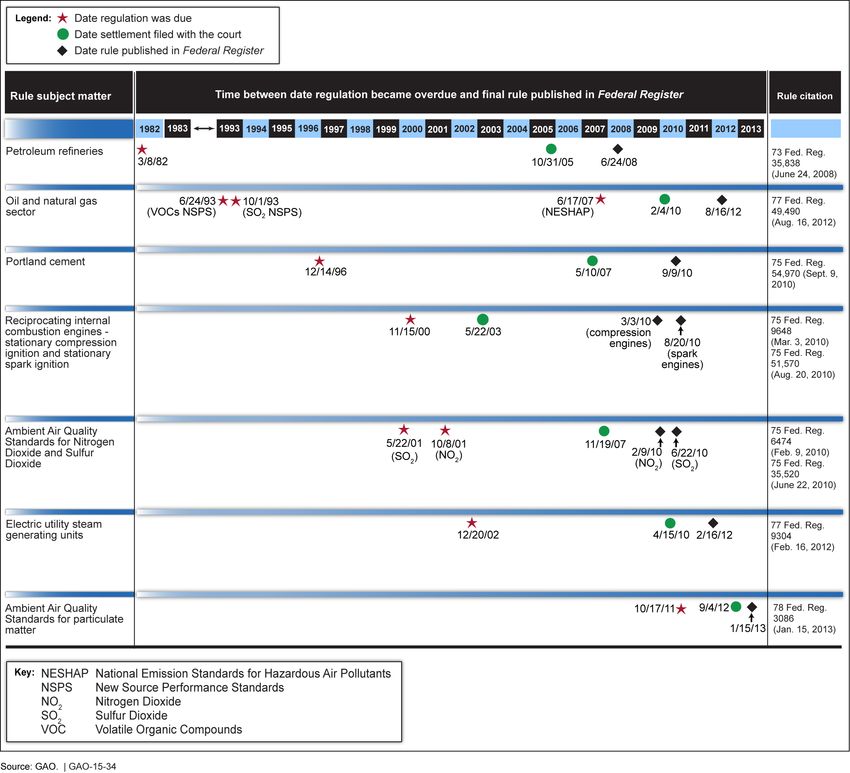
Contents

Letter                                                                                   1
               Background                                                                3
               Key Environmental Laws Allow Deadline Suits and EPA Considers
                 Several Factors in Responding to Those Suits                            5
               Settlements Resulting in Major Rules Included Rulemaking
                 Schedules, and EPA Received Public Comments on Drafts of
                 Most Settlements                                                        9
               According to EPA Officials, Settlements in Deadline Suits
                 Primarily Affect Rulemaking Priorities in a Single EPA Office          14
               Agency Comments                                                          17

Appendix I     Objectives, Scope, and Methodology                                       18

Appendix II    Major Rules Issued by EPA from May 31, 2008 to June 1, 2013              21

Appendix III   Contents of Settlements Following Deadline Suits That Compelled
               EPA to Issue 9 Rules from May 31, 2008 to June 1, 2013                   23

Appendix IV    Comments from the Environmental Protection Agency                        25

Appendix V     GAO Contact and Staff Acknowledgments                                    27

Tables
               Table 1: Key Environmental Laws That Allow Citizens to File
                       Deadline Suits                                                    6
               Table 2: The Number of Public Comments EPA Received on Draft
                       Settlements That Resulted in EPA Issuing 9 Clean Air Act
                       Major Rules from May 31, 2008 to June 1, 2013                    13
               Table 3: Major Rules Issued by EPA from May 31, 2008 to June 1,
                       201321
               Table 4: Contents of Settlements in Deadline Suits Associated
                       with 9 Major Rules EPA Issued from May 31, 2008 to
                       June 1, 2013                                                     23

               Page i                                     GAO-15-34 Environmental Litigation
Figure
Figure 1: Time Line of Key Dates Associated with 9 Major Clean
Air Act Rules EPA Issued from May 31, 2008 to June 1,
2013 11
Abbreviations
APA Administrative Procedures Act
CFR Code of Federal Regulations
CRA Congressional Review Act
DOJ Department of Justice
EPA Environmental Protection Agency
EPCRA Emergency Planning and Community Right-to-Know Act
MACT Maximum Achievable Control Technology
NAAQS National Ambient Air Quality Standards
NESHAP National Emission Standards for Hazardous Air Pollutants
NO2 Nitrogen Dioxide
NOI Notice of Intent to Sue
NSPS New Source Performance Standards
OAQPS Office of Air Quality Planning and Standards
OAR Office of Air and Radiation
RTR risk and technology review
SO2 Sulfur Dioxide
VOC Volatile Organic Compounds
This is a work of the U.S. government and is not subject to copyright protection in the
United States. The published product may be reproduced and distributed in its entirety
without further permission from GAO. However, because this work may contain
copyrighted images or other material, permission from the copyright holder may be
necessary if you wish to reproduce this material separately.
Page ii GAO-15-34 Environmental Litigation441 G St. N.W.
Washington, DC 20548
December 15, 2014
The Honorable Fred Upton
Chairman
Committee on Energy and Commerce
House of Representatives
The Honorable Ed Whitfield
Chairman
Subcommittee on Energy and Power
Committee on Energy and Commerce
House of Representatives
The Honorable Tim Murphy
Chairman
Subcommittee on Oversight and Investigations
Committee on Energy and Commerce
House of Representatives
Laws such as the Clean Air Act and the Clean Water Act require the
Environmental Protection Agency (EPA) to take certain actions, such as
issuing rules, to implement provisions of the law within certain statutorily
designated time frames. In addition, some laws have provisions that allow
any person or entity (including individuals, associations, businesses, and
state and local governments) to file lawsuits to compel EPA to take
statutorily required actions, such as issuing a rule, if it has not already
done so within a statutorily designated time frame. Such lawsuits are
sometimes referred to as deadline suits. When faced with deadline suits,
EPA and the Department of Justice (DOJ)—which represents EPA in
litigation—typically negotiate a settlement with the person or entity filing
the lawsuit.
Some members of Congress and certain sectors of the public have
expressed concern that, in settling these lawsuits, EPA is committing
itself to significant new rulemakings and that affected stakeholders, and
the public are unable to participate in the negotiating process before a
settlement is finalized. They have also expressed concern about the
impact of these settlements on EPA’s rulemaking priorities.
Under the Congressional Review Act (CRA), all rules, including those
issued by EPA, are classified as either a major rule or a nonmajor rule.
The CRA defines a “major” rule as one that has resulted in or is likely to
Page 1 GAO-15-34 Environmental Litigationresult in (1) an annual effect on the economy of $100 million or more; (2) a major increase in costs or prices for consumers, individual industries, federal, state, or local government agencies, or geographic regions; or (3) significant adverse effects on competition, employment, investment, productivity, innovation, or on the ability of U.S.-based enterprises to compete with foreign-based enterprises in domestic and export markets. 1 You asked us to review EPA’s practices involving settlements in deadline suits that may compel EPA to issue a rule. This report examines (1) key environmental laws that allow citizens to file deadline suits that may compel EPA to conduct a rulemaking and the factors EPA and DOJ consider in determining whether or not to settle these lawsuits, (2) the terms of settlements in deadline suits that led EPA to promulgate major rules in the last 5 years and the extent to which the public commented on the terms of the settlements, and (3) the extent to which settlements in deadline suits have affected EPA’s rulemaking priorities. To address the first objective, we identified through legal research key environmental laws for which EPA has primary regulatory authority and the extent to which these laws allow citizens to file lawsuits that may compel agency rulemaking. We also interviewed EPA and DOJ officials to understand the factors EPA and DOJ consider in determining whether or not to settle deadline suits. To address the second objective, we accessed a database that GAO maintains to help implement the CRA to identify the major rules EPA issued from May 31, 2008 through June 1, 2013. We determined that the data were sufficiently reliable for the purpose of identifying major rules issued by EPA. EPA officials identified which of these rules EPA issued following a settlement in a deadline suit, and we obtained those settlements. We relied on EPA because neither EPA nor DOJ maintains a database that links settlements to rules, and there is no comprehensive public source of such information. We determined the extent to which the public commented on the terms of the settlements by examining EPA documentation on the number and content 1 5 U.S.C. § 804(2). The CRA requires agencies to submit final rules, along with supporting information, to Congress and GAO for review before they can take effect. GAO’s primary role under CRA is to provide Congress with a report on each major rule containing GAO’s assessment of whether the promulgating federal agency’s submissions to GAO indicate that it has complied with the procedural steps required by various acts and executive orders governing the regulatory process. Congress then has an opportunity to review a major rule before it takes effect and to disapprove any rule to which it objects through the passage of a joint resolution with presentment to the President. 5 U.S.C. § 801. Page 2 GAO-15-34 Environmental Litigation
of the public comments. To address the third objective, we examined the
             extent to which settlements have affected EPA rulemaking priorities by
             obtaining data from EPA’s Office of General Counsel on deadline suits
             EPA settled from January 2001 through July 2014 and the EPA offices
             responsible for implementing the terms of the settlements. We
             determined that the data were sufficiently reliable for the purpose of this
             report. The data showed that one EPA office was responsible for
             promulgating most of rules following settlements in deadline suits. We
             spoke with officials from this office to determine the extent to which
             settlements in deadline suits affected the office’s rulemaking priorities.
             We also spoke with EPA budget officials knowledgeable about how EPA
             allocates resources among its offices to determine the extent to which
             deadline suits affect the resources allocated to offices not subject to
             deadline suits. Appendix I discusses our objectives, scope, and
             methodology in greater detail.

             We conducted this performance audit from September 2013 to December
             2014 in accordance with generally accepted government auditing
             standards. Those standards require that we plan and perform the audit to
             obtain sufficient, appropriate evidence to provide a reasonable basis for
             our findings and conclusions based on our audit objectives. We believe
             that the evidence obtained provides a reasonable basis for our findings
             and conclusions based on our audit objectives.

             For the purposes of this report, we use the term deadline suit to mean a
Background   lawsuit in which an individual or entity sues because EPA has allegedly
             failed to perform any nondiscretionary act or duty by a deadline
             established in law. A nondiscretionary act or duty is an act or duty
             required by law. This report examines deadline suits that seek to compel
             EPA to either (1) issue a statutorily required rule when that rule has a
             deadline in law or (2) issue a statutorily required rule or make a
             determination that issuing such a rule is not appropriate or necessary
             pursuant to the relevant statutory provision, when issuing that rule or
             making that determination has a deadline in law. For example, a deadline
             suit may involve a person suing EPA because EPA failed to issue a rule
             by a date established in statute. Similarly, a person may sue EPA
             because it missed a recurring deadline to review and revise, as

             Page 3                                        GAO-15-34 Environmental Litigation
necessary or appropriate, an existing rule. 2 In August 2011, we reported that the number of new environmental litigation cases—of all types—filed against EPA each year from fiscal year 1995 through fiscal year 2010 averaged 155 cases per year. 3 Before filing a deadline suit, a person generally must file a Notice of Intent to Sue (NOI) with EPA. 4 Among other things, a NOI generally must identify the provision(s) of the law that requires EPA to perform an act or duty and a description of the action taken or not taken by EPA that is claimed to constitute a failure to comply with the provision. 5 Sixty days after filing the NOI, the filer may initiate a deadline suit seeking a court order requiring EPA to complete the statutorily required action. 6 A settlement takes the form of either a settlement agreement or a consent decree. For purposes of this report, the term settlement refers to both settlement agreements and consent decrees. Both are negotiated agreements between EPA and the plaintiff. A settlement agreement is not subject to court approval but can result in a stay of the lawsuit. If EPA fails to meet the terms of the settlement agreement, then the plaintiff can ask the court to lift the stay in order to proceed with the lawsuit. A consent decree is entered as a court order. If EPA fails to meet the terms of a consent decree, the court can enforce or modify the consent decree, including citing EPA for contempt of court. 2 This report examines nondiscretionary duty suits in which the nondiscretionary duty is to issue a rule or make a determination not to issue a rule by a deadline in law. However, there are other types of nondiscretionary duties for which EPA can be sued. For example, in general, if a provision in law requires an agency to take an action, such as respond to a petition, but does not specify a date or set amount of time after the occurrence of an event by which the action must be taken, then a lawsuit to compel such an action is often referred to as an unreasonable delay suit. In addition to deadline and unreasonable delay suits, EPA can also be sued on other grounds. For example, a final rule issued by EPA may be challenged in court. As a result, a court may order EPA, or EPA may agree in a settlement, to issue a new rule. We did not include suits other than deadline suits in our review. GAO, Environmental Litigation: Cases Against EPA and Associated Costs over Time, 3 GAO-11-650 (Washington, D.C.: Aug. 1, 2011). See, e.g., 42 U.S.C. § 7604(b)(2). 4 5 See, e.g., 40 C.F.R. § 54.3(a). Although not statutorily required to publically post NOIs, in January 2013, EPA began to post NOIs at http://www.epa.gov/ogc/noi.html. See, e.g., 42 U.S.C. § 7604(a), (b)(2). 6 Page 4 GAO-15-34 Environmental Litigation
Unless a more specific statute governs, when EPA or any other federal
                           agency promulgates a rule, whether or not in conjunction with a deadline
                           suit, it generally follows procedures prescribed in the Administrative
                           Procedures Act (APA). 7 Among other things, the APA governs the
                           process by which federal agencies develop and issue regulations. It
                           includes requirements for publishing notices of proposed and final rules in
                           the Federal Register and for providing opportunities for the public to
                           comment on notices of proposed rulemaking. Many rules promulgated
                           under the authority of the Clean Air Act do not follow the procedures
                           prescribed in the APA, but rather follow similar but more specific
                           procedures set forth in the act. 8

                           GAO identified seven key environmental laws that allow individuals to file
Key Environmental          a deadline suit to compel EPA to issue a statutorily required rule, or
Laws Allow Deadline        perform a statutorily required review of a rule to determine whether to
                           revise the rule. EPA works with DOJ to consider several factors in
Suits and EPA              determining whether or not to settle the deadline suit and the terms of any
Considers Several          settlement.
Factors in
Responding to
Those Suits
Key Environmental Laws     GAO identified seven key environmental laws for which EPA has primary
Allow Citizens to File     regulatory authority that allow citizens to file a deadline suit. Table 1 lists
                           the seven laws.
Deadline Suits to Compel
EPA Rulemaking

                           5 U.S.C. § 553.
                           7

                           42 U.S.C. § 7607(d).
                           8

                           Page 5                                           GAO-15-34 Environmental Litigation
Table 1: Key Environmental Laws That Allow Citizens to File Deadline Suits
Statute Citizen suit provision General topic of the law
Comprehensive Environmental 42 U.S.C. § 9659 Cleanup of hazardous substance releases
Response, Compensation, and Liability
Act (42 U.S.C. §§ 9601-9675)
Clean Air Act (42 U.S.C. §§ 7401-7671q) 42 U.S.C. § 7604 Air quality
Clean Water Act (33 U.S.C. §§ 1251- 33 U.S.C. § 1365 Water quality, including dredging, and filling of waters
1388)
Emergency Planning and Community 42 U.S.C. § 11046 Reporting releases of toxic chemicals
Right-to-Know Act (42 U.S.C. §§ 11001-
11050)
Safe Drinking Water Act (42 U.S.C. §§ 42 U.S.C. § 300j-8 Water quality in public drinking water systems
300f-300j-26)
Resource Conservation and Recovery Act 42 U.S.C. § 6972 Solid and hazardous waste storage, handling, treatment, and
(42 U.S.C. §§ 6901-6992k) disposal
Toxic Substances Control Act (15 U.S.C. 15 U.S.C. § 2619 Toxic substances used in commerce
§§ 2601-2697)
Source: GAO. | GAO-15-34
With the exception of the Emergency Planning and Community Right-to-
Know Act (EPCRA), the key environmental laws allow citizens to file
deadline suits to compel EPA to perform any act or duty required by the
respective law, including issuing any required rules. For example, the
provision in the Clean Air Act states: “[A]ny person may commence a civil
action on his own behalf - … against the Administrator where there is
alleged a failure of the Administrator to perform any act or duty under this
chapter which is not discretionary with the Administrator.” 9 The provision
in EPCRA that allows citizens to file deadline suits is different from the
other key environmental laws because citizen suits may only be filed to
compel certain actions listed in the law. 10
9
42 U.S.C. § 7604(a)(2). Issuing a statutorily required rule is an example of a
nondiscretionary act.
10
See 42 U.S.C. § 11046(a)(1)(B).
Page 6 GAO-15-34 Environmental LitigationEPA and DOJ Consider Within EPA, the Office of General Counsel is responsible for handling
Several Factors in deadline suits. It works with the appropriate program offices in EPA, such
as the Office of Air and Radiation (OAR) or the Office of Water, when
Deciding Whether to
negotiating settlements for deadline suits. EPA’s Office of General
Settle Deadline Suits Counsel also coordinates with DOJ’s Environmental and Natural
Resources Division.
According to EPA and DOJ officials, when a deadline suit is filed, the
agencies work together to determine how to respond to the lawsuit,
including whether or not to negotiate a settlement with the plaintiff or
allow the lawsuit to proceed. In making this decision, EPA and DOJ
consider several factors to determine which course of action is in the best
interest of the government. According to EPA and DOJ officials, these
factors include: (1) the cost of litigation, (2) the likelihood that EPA will win
the case if it goes to trial, and (3) whether EPA and DOJ believe they can
negotiate a settlement that will provide EPA with sufficient time to
complete a final rule if required to do so. EPA and DOJ officials told us
that they often choose to settle deadline suits when EPA has failed to
fulfill a mandatory duty because it is very unlikely that the government will
win the lawsuit. In many such cases, the only dispute is over the
appropriate remedy, i.e., fixing a new date by which EPA should act.
Additionally, in such cases, officials may believe that negotiating a
settlement is the course of action most likely to create sufficient time for
EPA to complete the rulemaking if it is required to issue a rule. EPA and
DOJ have an agreement under which both must concur in the settlement
of any case in which DOJ represents EPA. 11
In negotiating the terms of settlements, EPA and DOJ are guided by,
among other things, a 1986 DOJ memorandum—referred to as the
Meese memorandum—the underlying concepts of which were codified in
the Code of Federal Regulations (CFR) in 1991. 12 The regulation provides
that any proposed settlement must be approved by the Deputy Attorney
General or Associate Attorney General, as appropriate, when the
proposed settlement converts an otherwise discretionary authority of the
agency to promulgate, revise, or rescind regulations into a mandatory
Memorandum of Understanding Between the Department of Justice and the
11
Environmental Protection Agency (June 15, 1977).
See 28 C.F.R. §§ 0.160-0.163.
12
Page 7 GAO-15-34 Environmental Litigationduty. 13 Thus, in general, this policy restricts DOJ from entering into a
settlement if it commits EPA to take an otherwise discretionary action,
such as including specific substantive content in the final rule unless an
exception to this restriction is granted by the Deputy Attorney General or
Associate Attorney General of the United States. According to EPA and
DOJ officials, to their knowledge, EPA has been granted only one
exception to the general restriction on creating mandatory duties through
settlements—a 2008 settlement in a suit related to water quality criteria
for pathogens and pathogen indicators. 14 The Meese memo also provides
that DOJ should not enter into a settlement agreement that interferes with
the agency’s authority to revise, amend, or promulgate regulations
through the procedures set forth in the APA. 15 As such, EPA officials
stated that they have not, and would not agree to settlements in a
deadline suit that finalizes the substantive outcome of the rulemaking or
declare the substance of the final rule.
13
The Meese memorandum and the regulation treat the distinction between consent
decrees and settlement agreements differently. The Meese memorandum draws a
distinction between the executive branch’s authority to enter into consent decrees, which
are negotiated agreements that are formally entered as court orders and thus enforceable
by the court, and settlement agreements, which are similar in form to consent decrees but
not entered as a court order. According to the memorandum, DOJ should not enter into a
consent decree that converts into a mandatory duty the otherwise discretionary authority
of that agency to promulgate, revise, or rescind regulations. Regarding settlement
agreements, the memorandum states that DOJ should not enter into a settlement
agreement that interferes with the agency’s authority to revise, amend, or promulgate
regulations through the procedures set forth in the Administrative Procedures Act (APA).
The related regulation does not make a distinction between consent decrees and
settlement agreements. It requires that all proposed settlements that convert into a
mandatory duty the otherwise discretionary authority of that agency to promulgate, revise,
or rescind regulations be referred to the Deputy Attorney General or the Associate
Attorney General of the United States. Finally, a 1999 DOJ memorandum—referred to as
the Moss memo—concludes that the distinction that the Meese memorandum draws
between consent decrees and settlement agreements is not of legal significance for
purposes of determining the legal limits on discretion-limiting settlements except, possibly,
in rare cases.
14
See Natural Resources Defense Council et al. vs. Johnson et al., No. CV06-04843 PSG
(JTL) (C.D.Cal. 2008). In this settlement, EPA agreed to complete two epidemiological
studies not expressly required by section 104(v) of the Clean Water Act after a court ruled
that EPA had not satisfied the requirements of that section.
15
See 5 U.S.C. § 553.
Page 8 GAO-15-34 Environmental LitigationThe terms of settlements in deadline suits that resulted in EPA issuing
Settlements Resulting major rules in the last 5 years established a schedule to either promulgate
in Major Rules a statutorily required rule or to promulgate a statutorily required rule or
make a determination that doing so is not appropriate or necessary
Included Rulemaking pursuant to the relevant statutory provision. EPA received public
Schedules, and EPA comments on all but one of the draft settlements in these suits.
Received Public
Comments on Drafts
of Most Settlements
Settlements in Deadline EPA issued 32 major rules from May 31, 2008 through June 1, 2013 (see
Suits Established a app. II). According to EPA officials, the agency issued 9 of these rules
following settlements in deadline suits. They were all Clean Air Act rules.
Schedule for Issuing Rules
The 9 rules stem from seven settlements. Two of the settlements
established a schedule to complete 1 or more rules, and five established
a schedule to complete 1 or more rules or make a determination that such
a rule was not appropriate or necessary in accordance with the relevant
statute. Some of the schedules included interim deadlines for conducting
rulemaking tasks, such as publishing a notice of proposed rulemaking in
the Federal Register. 16 Appendix III provides information on the
schedules contained in each settlement.
In addition to schedules, the seven settlements also included, among
other things, provisions that allowed deadlines to be modified (including
the deadline to issue the final rule) and specified that nothing in the
settlement can be construed to limit or modify any discretion accorded
EPA by the Clean Air Act or by general principles of administrative law.
Consistent with DOJ’s 1986 Meese memorandum, none of the
settlements we reviewed included terms that required EPA to take an
otherwise discretionary action or prescribed a specific substantive
outcome of the final rule.
The seven settlements, committing EPA to issue the 9 statutorily required
rules, were finalized between about 10 months and more than 23 years
after the applicable statutory deadlines. For each of the 9 rules, figure 1
Even where interim rulemaking steps are not expressly set forth in a settlement, EPA
16
officials stated that they go through the necessary rulemaking procedures such as notice
and comment.
Page 9 GAO-15-34 Environmental Litigationshows the date the regulation was due, the date the settlement was filed with the court, and the date the final rule was published in the Federal Register. Page 10 GAO-15-34 Environmental Litigation
Figure 1: Time Line of Key Dates Associated with 9 Major Clean Air Act Rules EPA Issued from May 31, 2008 to June 1, 2013

                                        Page 11                                            GAO-15-34 Environmental Litigation
EPA Received Public The Clean Air Act requires EPA, at least 30 days before a settlement
Comments on Drafts of under the act is final or filed with the court, to publish a notice in the
Federal Register intended to afford persons not named as parties or
Most Settlements in
interveners to the matter or action a reasonable opportunity to comment
Deadline Suits in writing. 17 EPA or DOJ, as appropriate, must then review the comments
and may withdraw or withhold consent to the proposed settlement if the
comments disclose facts or considerations that indicate consent to the
settlement is inappropriate, improper, inadequate, or inconsistent with
Clean Air Act requirements. 18 The other six key environmental laws with
provisions that allow citizens to file deadline suits do not have a notice
and comment requirement for proposed settlements. 19 According to an
EPA official, with the exception of the agency’s pesticide program, EPA
generally does not ask for public comments on defensive settlements if
the agency is not required to do so by statute. 20
The 9 major rules EPA issued from May 31, 2008 to June 1, 2013
following seven settlements in deadline suits were Clean Air Act rules.
For each settlement, EPA published a notice in the Federal Register
providing the public the opportunity to comment on a draft of the
settlement. EPA received between one and 19 public comments on six of
the draft settlements. No comments were received on one of the draft
settlements. Based on EPA summaries of the comments, the comments
concerned the reasonableness of the deadlines contained in the
settlements or supported or objected to the settlements. For example,
some comments supported the deadline or asserted that the deadlines
should be accelerated, others comments stated that EPA would have
difficulty meeting the deadlines. EPA determined that none of the
See 42 U.S.C. § 7413(g).
17
See id.
18
19
The APA and EPA regulations require notice and comment of proposed agency
rulemaking, whether or not it may have been the subject of a settlement. 5 U.S.C. §
553(b), (c); 40 C.F.R. § 25.10. This includes the right of interested persons to be given an
opportunity to participate in the rulemaking by the submission of written data, views, and
arguments. According to DOJ officials, settlements are structured to preserve public
participation in any ensuing rulemaking proceeding and to not predetermine the outcome
of that proceeding.
20
According to the EPA official, the pesticides program has a regular practice of posting on
its website proposed settlements associated with the program’s issues. The program
posts these documents because the program has a well-defined and knowledgeable
community of stakeholders that is likely to be affected by the settlements.
Page 12 GAO-15-34 Environmental Litigationcomments on any of the draft settlements disclosed facts or
considerations that indicated that consent to the settlement in question
would be inappropriate, improper, inadequate, or inconsistent with the
act. Table 2 shows the number of public comments EPA received on
each draft settlement.
Table 2: The Number of Public Comments EPA Received on Draft Settlements That Resulted in EPA Issuing 9 Clean Air Act
Major Rules from May 31, 2008 to June 1, 2013
Number of public comments
Rules issued following settlements in deadline suits received on draft settlements
Standards of Performance for Petroleum Refineries, 73 Fed. Reg. 35,838 (June 24, 2008) 1
Primary National Ambient Air Quality Standards for Nitrogen Dioxide, 75 Fed. Reg. 6474 0
(Feb. 9, 2010)
Primary National Ambient Air Quality Standard for Sulfur Dioxide, 75 Fed. Reg. 35,520 (June
22, 2010)
National Emission Standards for Hazardous Air Pollutants for Reciprocating Internal 5
Combustion Engines, 75 Fed. Reg. 9648 (Mar. 3, 2010)
National Emission Standards for Hazardous air Pollutants for Reciprocating Internal
Combustion Engines, 75 Fed. Reg. 51,570 (Aug. 20, 2010)
National Emission Standards for Hazardous Air Pollutants from the Portland Cement 1 group provided 2 comments
Manufacturing Industry and Standards of Performance for Portland Cement Plants, 75 Fed.
Reg. 54,970 (Sept. 9, 2010)
National Emission Standards for Hazardous Air Pollutants from Coal- and Oil-Fired Electric 9
Utility Steam Generating Units and Standards of Performance for Fossil-Fuel-Fired Electric
Utility, Industrial-Commercial-Institutional, and Small Industrial-Commercial-Institutional
Steam Generating Units, 77 Fed. Reg. 9304 (Feb. 16, 2012)
Oil and Natural Gas Sector: New Source Performance Standards and National Emission 1
Standards for Hazardous Air Pollutants Reviews, 77 Fed. Reg. 49,490 (Aug. 16, 2012)
National Ambient Air Quality Standards for Particulate Matter, 78 Fed. Reg. 3086 (Jan. 15, 19
2013)
Source: GAO. | GAO-15-34
Page 13 GAO-15-34 Environmental LitigationAccording to EPA officials, settlements in deadline suits primarily affect a
According to EPA single office within EPA—the Office of Air Quality Planning and Standards
Officials, Settlements (OAQPS)—because most deadline suits are based on provisions of the
Clean Air Act for which that office is responsible. 21 According to EPA’s
in Deadline Suits Office of General Counsel, provisions in the Clean Air Act that authorize
Primarily Affect the National Ambient Air Quality Standards (NAAQS) program and Air
Toxics program account for most deadline suits. These provisions have
Rulemaking Priorities recurring deadlines requiring EPA to set standards and to periodically
in a Single EPA Office review—and revise as appropriate or necessary—those standards.
OAQPS sets these standards through the rulemaking process. For
example, the Clean Air Act requires EPA to review and revise as
appropriate NAAQS standards every 5 years and to review and revise as
necessary technology standards for numerous air toxics generally every 8
years.
The effect of settlements in deadline suits on EPA’s rulemaking priorities
is limited. OAQPS officials said that deadline suits impact the timing and
order in which rules are issued by the NAAQS program and the Air Toxics
program, but not which rules are issued. The officials also noted that the
impact of deadline suits on the two programs differs because of the
different characteristics of the programs.
Regarding the NAAQS program, the Clean Air Act requires EPA to review
and revise as appropriate the NAAQS standards for six pollutants—called
criteria pollutants—at 5-year intervals. 22 NAAQS standards limit the
allowable concentrations of criteria pollutants in the ambient air. There is
more than one standard for each criteria pollutant. 23 EPA establishes the
required standards through the rulemaking process and recently
conducted seven NAAQS reviews to review the standards and revise as
appropriate. According to an OAQPS official, prior to 2003, EPA did not
review NAAQS on a regular cycle. Beginning in 2003, EPA faced four
deadline suits for failure to complete NAAQS reviews for the six criteria
pollutants. EPA settled two of these suits and was subject to a court order
OAQPS is an office within EPA’s Office of Air and Radiation.
21
42 U.S.C. § 7409(d). The six criteria pollutants are: carbon monoxide, lead, oxides of
22
nitrogen, ozone, particulate matter, and oxides of sulfur.
The Clean Air Act requires EPA to set primary standards and secondary standards for
23
each criteria pollutant. Primary standards protect public health and secondary standards
protect the public welfare. 42 U.S.C § 7409(a), (b).
Page 14 GAO-15-34 Environmental Litigationregarding the other two suits after it failed to successfully negotiate settlements with the plaintiffs. The settlements and court orders led EPA to perform the statutorily required reviews of the NAAQS standards for the six criteria pollutants and to promulgate seven rules—one for each NAAQS review. 24 The last of these seven rules was promulgated in April 2012. 25 According to officials, the deadline suits addressing the NAAQS standards did not affect which NAAQS standards were reviewed since EPA reviewed all of the standards. According to officials, the deadline suits did affect the timing and order in which EPA conducted the reviews to accommodate the time frames in the settlements and court orders. Additionally, according to officials, as a result of the experience in responding to the deadline suits, the agency is striving to maintain the 5- year statutory review cycle for criteria pollutants going forward. However, officials noted that it is difficult for EPA to complete its NAAQS reviews every 5 years. From April 2012 through September 2014, EPA has promulgated one rule following a NAAQS review after it settled a deadline suit and has missed the statutory deadline for reviewing the standards of two other criteria pollutants, one of which EPA is under court order to complete by October 2015 following a deadline suit. 26 Regarding the Air Toxics program, OAQPS officials said that the impact of deadline suits on the Air Toxics program is different from that of the impact on the NAAQS program because of the large number of rules that the Air Toxics program promulgates. For example, the Clean Air Act establishes a schedule under which EPA established 120 standards to reduce the emissions of 187 hazardous air pollutants. 27 These National 24 Because EPA decided to conduct a separate, coordinated review of the public welfare effects of oxides of sulfur and nitrogen rather than reviewing the public welfare effects of each at the same time it reviewed the respective public health effects, EPA promulgated 7 rules for the six criteria pollutants. 77 Fed. Reg. 20,218 (Apr. 3, 2012). This was not a major rule, as defined by the CRA. 25 26 EPA promulgated a rule revising standards for particulate matter in January 2013 following a court order and consent decree and is under a separate court order to complete a review of ozone by October 2015. See 78 Fed. Reg. 3086 (Jan. 15, 2013); American Lung Assoc. and National Parks Conservation Assoc. v. EPA, No. 12-cv-00243 (D.D.C. 2012); Sierra Club v. EPA, No. 4:13-cv-02809-YGR (N.D. Cal. 2012). The deadline to review the standards for lead and, if needed, promulgate a rule revising the standards was November 2013. See 73 Fed. Reg. 66,964 (Nov. 12, 2008) (revising the primary and secondary NAAQS for lead). 27 See 42 U.S.C. § 7412. For the purposes of this report, generally, we are counting each subpart of 40 C.F.R. part 63 as a NESHAP. Page 15 GAO-15-34 Environmental Litigation
Emission Standards for Hazardous Air Pollutants (NESHAP) apply to
certain categories of sources of these pollutants, such as cement
manufacturing, municipal solid waste landfills, and semiconductor
manufacturing. Generally, the act requires EPA, no less often than every
8 years, to review the standard, and revise as necessary. It makes any
necessary revisions through the rulemaking process. The review must
take into account developments in practices, processes, and control
technologies. 28 For sources subject to Maximum Achievable Control
Technology (MACT) standards promulgated pursuant to section 112(d)(2)
of the Clean Air Act, EPA must also conduct a residual risk assessment
within 8 years after the initial promulgation of the standard. 29 EPA refers
to these two reviews together as the risk and technology review (RTR).
As of October 2014, EPA has completed 28 RTRs (27 of these reviews
following deadline suits) and has not completed 57 RTRs for which the
statutory deadline has passed and 36 RTRs for which the statutory
deadline has not passed. 30 Additionally, officials report that, currently,
most of the resources available to complete RTRs are focused on a 2011
settlement. This settlement listed 27 NESHAPs for which RTRs were
overdue. OAQPS officials said that they have been unable to meet all of
the time frames contained in the 2011 settlement and, as a result, have
negotiated amendments to the settlement extending the time frames.
Officials said that they intend to complete all of the overdue RTRs but are
focused on fulfilling the terms of the 2011 settlement and several other
settlements to which EPA has entered into that address a smaller number
of reviews. Additionally, in September 2013, EPA received a NOI
concerning 43 additional NESHAPs for which a RTR is overdue. EPA
officials said that they are engaged in settlement discussions over one of
these reviews for which EPA has been sued.

 42 U.S.C. § 7412(d)(6).
28

29
  42 U.S.C. § 7412(f)(2)(A) (requiring EPA, within 8 years after promulgation of standards
for each category or subcategory of sources, to promulgate standards for such category or
subcategory if promulgation of such standards is required in order to provide an ample
margin of safety to protect public health or to prevent, taking into consideration costs,
energy, safety, and other relevant factors, an adverse environmental effect). Standards
that apply only to area sources may not need to undergo a residual risk assessment, in
which case these standards only receive a technology review every 8 years. See 42
U.S.C. § 7412(f)(5).
 These numbers do not add to the total number of standards because for one standard,
30

an RTR was conducted for some source categories but not for others. As a result, that
standard is counted both as having a completed RTR and having an overdue RTR.

Page 16                                                GAO-15-34 Environmental Litigation
Additionally, we discussed with EPA budget officials the potential impact
                  of budget allocation decisions associated with deadline suits on EPA
                  offices that are not subject to deadline suits. According to the budget
                  officials, EPA accounts for anticipated workload arising out of litigation in
                  its budgeting cycle for affected programs but does not make changes in
                  existing budget allocations specifically to address settlements in deadline
                  suits. Thus, according to the official, the resources available to EPA
                  offices not subject to these settlements are not directly impacted by the
                  settlements.

                  We provided a draft of this report to EPA and DOJ for review and
Agency Comments   comment. In written comments from EPA, reproduced in appendix IV, the
                  agency generally concurs with our analysis and states that the report
                  accurately describes EPA’s approach to deadline suit litigation brought
                  against it. EPA also provided technical comments, which we incorporated
                  as appropriate. In addition, in an e-mail received November 24, 2014, the
                  DOJ Audit Liaison stated that the DOJ concurs with our report and has no
                  additional comments.

                  As agreed with your offices, unless you publicly announce the contents of
                  this report earlier, we plan no further distribution until 30 days from the
                  report date. At that time, we will send copies to the appropriate
                  congressional committees, the Attorney General, the Administrator of the
                  EPA, and other interested parties. In addition, the report will be available
                  at no charge on the GAO website at http://www.gao.gov.

                  If you or your staff members have any questions about this report, please
                  contact me at (202) 512-3841 or gomezj@gao.gov. Contact points for our
                  Offices of Congressional Relations and Public Affairs may be found on
                  the last page of this report. GAO staff members who made major
                  contributions to this report are listed in appendix V.

                  J. Alfredo Gómez
                  Director, Natural Resources and Environment

                  Page 17                                        GAO-15-34 Environmental Litigation
Appendix I: Objectives, Scope, and
Appendix I: Objectives, Scope, and
Methodology
Methodology
The objectives of this report are to examine (1) key environmental laws
that allow citizens to file deadline suits that may compel the
Environmental Protection Agency (EPA) to conduct a rulemaking and the
factors EPA and the Department of Justice (DOJ) consider in determining
whether or not to settle these lawsuits, (2) the terms of settlements in
deadline suits that led EPA to promulgate major rules in the last 5 years
and the extent to which the public commented on the terms of the
settlements, and (3) the extent to which settlements in deadline suits
have affected EPA’s rulemaking priorities.
To examine the key environmental laws that allow citizens to file deadline
suits that may compel EPA to conduct a rulemaking, we identified through
legal research nine key environmental laws for which EPA has primary
regulatory authority. Through additional legal research, we determined
that two of these laws do not include provisions that permit citizens to file
deadline suits. These laws are the Federal Insecticide, Fungicide, and
Rodenticide Act and related provisions of the Federal Food, Drug, and
Cosmetic Act. 1 To understand the factors that EPA considers in
determining whether or not to settle deadline suits, we held discussions
with officials from EPA’s Office of General Counsel and DOJ because
both agencies are involved in making these determinations. We also
discussed the processes and procedures that EPA follows when settling
citizen deadline suits.
To examine the terms of settlements in deadline suits that led EPA to
promulgate major rules in the last 5 years, we developed a list of major
rules EPA issued from May 31, 2008 through June 1, 2013 by searching
a database that GAO maintains to help implement the Congressional
Review Act. 2 We determined that the data were sufficiently reliable for the
1
7 U.S.C. §§ 136-136y; 21 U.S.C. § 346a. The laws do not have provisions allowing
citizens to sue EPA for failure to issue a statutorily required rule within statutorily required
time frames, but the Administrative Procedures Act provides that a person suffering legal
wrong because of agency action, or adversely affected or aggrieved by agency action
within the meaning of a relevant statute, is entitled to judicial review thereof. 5 U.S.C. §
702. In such a case, the court may compel agency action unlawfully withheld or
unreasonably delayed. 5 U.S.C. § 706.
2
The act defines a “major” rule as one that has resulted in or is likely to result in (1) an
annual effect on the economy of $100 million or more; (2) a major increase in costs or
prices for consumers, individual industries, federal, state, or local government agencies, or
geographic regions; or (3) significant adverse effects on competition, employment,
investment, productivity, innovation, or on the ability of U.S.-based enterprises to compete
with foreign-based enterprises in domestic and export markets. 5 U.S.C. § 804(2).
Page 18 GAO-15-34 Environmental LitigationAppendix I: Objectives, Scope, and Methodology purpose of identifying major rules issued by EPA. EPA officials then identified which major rules EPA issued following a settlement in a deadline suit. We relied on EPA because neither EPA nor DOJ maintains a database that links settlements to rules, and there is no comprehensive public source of such information. For the purposes of this report, we use the term deadline suit to mean a lawsuit in which an individual or entity sues because EPA has allegedly failed to perform any nondiscretionary act or duty by a deadline established in law. A nondiscretionary act or duty is an act or duty required by law. This report only examines deadline suits that seek to compel EPA to either (1) issue a statutorily required rule when that rule has a deadline in law or (2) issue a statutorily required rule or make a determination that issuing such a rule is not appropriate or necessary pursuant to the relevant statutory provision, when issuing that rule or making that determination has a deadline in law. We did not review other types of suits against EPA. 3 We obtained the settlements by accessing court records through the Public Access to Court Electronic Records. We then analyzed the content of each settlement and summarized the results. To examine the extent to which the public commented on the terms of the settlements, we obtained from EPA legal memoranda summarizing the number and content of public comments EPA received on drafts of the settlements. Because each of the major rules issued following settlements in deadline suits were Clean Air Act rules, EPA solicited public comments on drafts of the settlements as required by the Clean Air Act. The act also requires EPA or DOJ to consider any public comments provided on settlements and authorizes them to withdraw or withhold consent to the proposed settlement if the comments disclose facts or considerations that indicate consent to the settlement is inappropriate, improper, inadequate, or inconsistent with the Clean Air Act requirements. EPA made these determinations and documented its decisions in legal 3 This report examines nondiscretionary duty suits in which the nondiscretionary duty is to issue a rule or make a determination not to issue a rule by a deadline in law. However, there are other types of nondiscretionary duties for which EPA can be sued. For example, in general, if a provision in law requires an agency to take an action, such as respond to a petition, but does not specify a date or set amount of time after the occurrence of an event by which the action must be taken, then a lawsuit to compel such an action is often referred to as an unreasonable delay suit. In addition to deadline and unreasonable delay suits, EPA can also be sued on other grounds. For example, a final rule issued by EPA may be challenged in court. As a result, a court may order EPA, or EPA may agree in a settlement, to issue a new rule. Page 19 GAO-15-34 Environmental Litigation
Appendix I: Objectives, Scope, and
Methodology

memoranda that it provided to us. We analyzed the contents of these
memoranda to determine the extent and nature of the public comments
EPA received on draft settlements.

To examine the extent to which settlements in deadline suits have
affected EPA’s rulemaking priorities, we obtained from EPA’s Office of
General Counsel data on deadline suits it had settled from January 2001
through July 2014 and the EPA office(s) responsible for implementing the
terms of the settlements. 4 We assessed the reliability of the data by
interviewing agency officials knowledgeable about the data. We
determined that the data were sufficiently reliable for the purposes of this
report. The data showed that one office was responsible for implementing
the terms of most of the settlements. We spoke with officials from this
office to understand the extent to which settlements in deadline suits had
affected the timing and order of the rules they promulgated, as well as
which rules they promulgated. We also spoke with EPA budget officials to
understand the extent to which settlements in deadline suits affected
budget allocation decisions for EPA offices not subject to settlements in
deadline suits.

We also interviewed individuals from academia, an environmental group,
industry, and a state official from Oklahoma, to obtain their perspectives
on deadline suits. We chose these individuals because they had
experience or knowledge related to deadline suits and could provide the
perspective of different stakeholder groups. For example, one interviewee
provided legal representation for an environmental group that filed a
deadline suit, and another interviewee authored a report critical of how
EPA responds when faced with a deadline suits. The views of these
individuals cannot be generalized to those with whom we did not speak.

We conducted this performance audit from September 2013 to December
2014 in accordance with generally accepted government auditing
standards. Those standards require that we plan and perform the audit to
obtain sufficient, appropriate evidence to provide a reasonable basis for
our findings and conclusions based on our audit objectives. We believe
that the evidence obtained provides a reasonable basis for our findings
and conclusions based on our audit objectives.

We excluded from our analysis settlements in deadline suits for which a regional office
4

was responsible for issuing the required rules because these rules are regional in scope.

Page 20                                                GAO-15-34 Environmental Litigation
Appendix II: Major Rules Issued by EPA from
                                            Appendix II: Major Rules Issued by EPA from
                                            May 31, 2008 to June 1, 2013

May 31, 2008 to June 1, 2013

                                            The Environmental Protection Agency (EPA) issued 32 major rules from
                                            May 31, 2008 to June 1, 2013. According to EPA officials, the agency
                                            issued 9 of these rules following settlements in deadline suits and issued
                                            5 of the 32 rules to comply with court orders following deadline suits in
                                            which plaintiffs and EPA were unable to reach a settlement. The
                                            remaining 18 rules, according to agency officials, were not associated
                                            with a deadline suit. Table 3 lists the 32 major rules EPA issued from May
                                            31, 2008 to June 1, 2013.

Table 3: Major Rules Issued by EPA from May 31, 2008 to June 1, 2013

Rules issued following settlements in deadline suits
Rule title                                                                                             Law
Standards of Performance for Petroleum Refineries, 73 Fed. Reg. 35,838 (June 24, 2008)                 Clean Air Act
Primary National Ambient Air Quality Standards for Nitrogen Dioxide, 75 Fed. Reg. 6474                 Clean Air Act
(Feb. 9, 2010)
National Emission Standards for Hazardous Air Pollutants for Reciprocating Internal Combustion         Clean Air Act
Engines, 75 Fed. Reg. 9648 (Mar. 3, 2010)
Primary National Ambient Air Quality Standard for Sulfur Dioxide, 75 Fed. Reg. 35,520                  Clean Air Act
(June 22, 2010)
National Emission Standards for Hazardous Air Pollutants for Reciprocating Internal Combustion         Clean Air Act
Engines, 75 Fed. Reg. 51,570 (Aug. 20, 2010)
National Emission Standards for Hazardous Air Pollutants From the Portland Cement Manufacturing Clean Air Act
Industry and Standards of Performance for Portland Cement Plants, 75 Fed. Reg. 54,970
(Sept. 9, 2010)
National Emission Standards for Hazardous Air Pollutants From Coal- and Oil-Fired Electric Utility     Clean Air Act
Steam Generating Units and Standards of Performance for Fossil-Fuel-Fired Electric Utility,
Industrial-Commercial-Institutional, and Small Industrial-Commercial-Institutional Steam Generating
Units, 77 Fed. Reg. 9304 (Feb. 16, 2012)
Oil and Natural Gas Sector: New Source Performance Standards and National Emission Standards           Clean Air Act
for Hazardous Air Pollutants Reviews, 77 Fed. Reg. 49,490 (Aug. 16, 2012)
                                                                                                 a
National Ambient Air Quality Standards for Particulate Matter, 78 Fed. Reg. 3086 (Jan. 15, 2013)       Clean Air Act
Rules issued following court orders in deadline suits
Rule title                                                                                             Law
National Ambient Air Quality Standards for Lead, 73 Fed. Reg. 66,964 (Nov. 12, 2008)                   Clean Air Act
Effluent Limitations Guidelines and Standards for the Construction and Development Point Source        Clean Water Act
Category, 74 Fed. Reg. 62,996 (Dec. 1, 2009)
National Emission Standards for Hazardous Air Pollutants for Area Sources: Industrial, Commercial, Clean Air Act
and Institutional Boilers, 76 Fed. Reg. 15,554 (Mar. 21, 2011)
National Emission Standards for Hazardous Air Pollutants for Major Sources: Industrial,                Clean Air Act
Commercial, and Institutional Boilers and Process Heaters, 76 Fed. Reg. 15,608 (Mar. 21, 2011)
Standards of Performance for New Stationary Sources and Emission Guidelines for Existing               Clean Air Act
Sources: Commercial and Industrial Solid Waste Incineration Units, 76 Fed. Reg. 15,704 (Mar. 21,
2011)

                                            Page 21                                                   GAO-15-34 Environmental Litigation
Appendix II: Major Rules Issued by EPA from
May 31, 2008 to June 1, 2013
Rules issued not associated with a deadline suit
Rule title Law
Lead; Amendment to the Opt-out and Recordkeeping Provisions in the Renovation, Repair, and Toxic Substance Control Act
Painting Program, 75 Fed. Reg. 24,802 (May 6, 2010)
Standards of Performance for Petroleum Refineries; Standards of Performance for Petroleum Clean Air Act
Refineries for Which Construction, Reconstruction, or Modification Commenced After May 14, 2007,
77 Fed. Reg. 56,422 (Sept. 12, 2012)
National Emission Standards for Hazardous Air Pollutants for Reciprocating Internal Combustion Clean Air Act
Engines; New Source Performance Standards for Stationary Internal Combustion Engines 78 Fed.
Reg. 6674 (Jan. 30, 2013)
Control of Emissions From Nonroad Spark-Ignition Engines and Equipment, 73 Fed. Reg. 59,034 Clean Air Act
(Oct. 8, 2008)
Revisions to the Definition of Solid Waste, 73 Fed. Reg. 64,668 (Oct. 30, 2008) Resource Conservation and
Recovery Act
Oil Pollution Prevention; Spill Prevention, Control, and Countermeasure Rule Requirements – Clean Water Act
Amendments, 73 Fed. Reg. 74,236 (Dec. 5, 2008)
Mandatory Reporting of Greenhouse Gases, 74 Fed. Reg. 56,260 (Oct. 30, 2009) Clean Air Act
Oil Pollution Prevention; Spill Prevention, Control, and Countermeasure Rule Requirements – Clean Water Act
Amendments, 74 Fed. Reg. 58,784 (Nov. 13, 2009)
Regulation of Fuels and Fuel Additives: Changes to Renewable Fuel Standard Program, 75 Fed. Clean Air Act
Reg. 14,670 (Mar. 26, 2010)
Light-Duty Vehicle Greenhouse Gas Emission Standards and Corporate Average Fuel Economy Clean Air Act
Standards, 75 Fed. Reg. 25,324 (May 7, 2010)
Prevention of Significant Deterioration and Title V Greenhouse Gas Tailoring Rule, 75 Fed. Reg. Clean Air Act
31,514 (June 3, 2010)
Oil Pollution Prevention: Spill Prevention, Control, and Countermeasure (SPCC) Rule - Clean Water Act
Amendments for Milk and Milk Product Containers, 76 Fed. Reg. 21,652 (Apr. 18, 2011)
Federal Implementation Plans: Interstate Transport of Fine Particulate Matter and Ozone and Clean Air Act
Correction of SIP Approvals, 76 Fed. Reg. 48,208 (Aug. 8, 2011)
Greenhouse Gas Emissions Standards and Fuel Efficiency Standards for Medium- and Heavy-Duty Clean Air Act
Engines and Vehicles, 76 Fed. Reg. 57,106 (Sept. 15, 2011)
Federal Implementation Plans for Iowa, Michigan, Missouri, Oklahoma, and Wisconsin and Clean Air Act
Determination for Kansas Regarding Interstate Transport of Ozone, 76 Fed. Reg. 80,760
(Dec. 27, 2011)
Regulation of Fuels and Fuel Additives: 2013 Biomass-Based Diesel Renewable Fuel Volume, 77 Clean Air Act
Fed. Reg. 59,458 (Sept. 27, 2012)
2017 and Later Model Year Light-Duty Vehicle Greenhouse Gas Emissions and Corporate Average Clean Air Act
Fuel Economy Standards, 77 Fed. Reg. 59,458 (Sept. 27, 2012)
National Emission Standards for Hazardous Air Pollutants for Major Sources: Industrial, Clean Air Act
Commercial, and Institutional Boilers and Process Heaters, 78 Fed. Reg. 7138 (Jan. 31, 2013)
Source: GAO. | GAO-15-34
a
This rule was issued after the court issued an order establishing a deadline to sign the notice of
proposed rulemaking, and the parties reached a settlement establishing a deadline to sign the final
rule.
Page 22 GAO-15-34 Environmental LitigationYou can also read


