European Cities INTERNATIONAL MASTER - in Urban Planning and Studies Track 2020 2021 - Ecole d ...
←
→
Page content transcription
If your browser does not render page correctly, please read the page content below
INTERNATIONAL MASTER
in Urban Planning and Studies
           Track
     European Cities
        2020 – 2021
2 
CONTENT
         Content _______________________________________________________3

         Welcome ______________________________________________________5

         Presentation of the EUP __________________________________6
         EUP Teaching Team _______________________________________________7

         EUP administrative team__________________________________________10

         Map to the EUP _________________________________________________11

         The Chair « Developing the Greater Paris » _____________________________12

         The certi cation « Greater Paris Training » _____________________________13

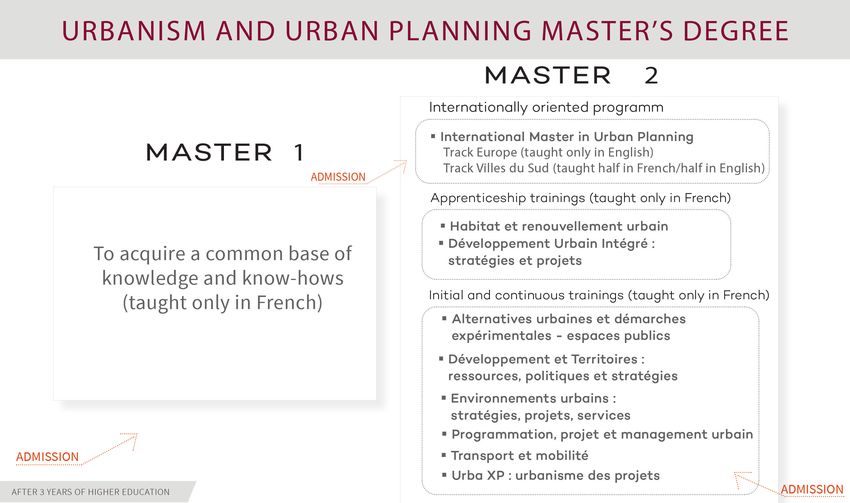
         Presentation of the Urban Planning Master’s Degree _____________15
         Overview of the program’s tracks ____________________________________16

         Professional applications and opportunities ____________________________19

         Structure of the year ____________________________________________20

         Validation of the year ____________________________________________20

         2020-2021 EUP Calendar _________________________________________21

         Common activities ______________________________________________22

         the common activities week 2020 ___________________________________23

         Research track _________________________________________________29

         Internship and professional dissertation_______________________________30

         Presentation of the International Master in Urban Planning ________32
         Presentation of the “European Cities track“ ___________________36
         Organisation of the year __________________________________________38

         International mobility ____________________________________________40

         Modules description _____________________________________________42

         Student Life __________________________________________57

                                                                                   3

    fi
4 
WELCOME
          Welcome to the EUP!

          Welcome to the Paris School of Urban Planning, one of the main urban
          planning schools in France and Europe. This booklet presents your school and
          its environment, which is an exceptionally rich one to study urban issues: the
          EUP is part of the Descartes Cluster and the “Pôle Ville” (City Hub), home to a
          school of architecture, engineering schools, and many research centers where
          cities – and more generally territories – are the main focus of study and
          analysis.

          Within this environment, the EUP offers a rich and varied curriculum covering
          many different elds that you will progressively discover, and which you will
          ultimately spend all or part of your future professional life working in. You will
          be assisted and accompanied in your studies with us by over a hundred
          research lecturers and urban-planning professionals from very highly diverse
          backgrounds and horizons in terms of their disciplines and areas of
          application. As nationally and internationally recognized specialists in their
            elds, we urge you to make the most of the academic diversity and resource
          that they represent. You will also bene t from the support of the EUP’s
          administrative team, made up of some 15 staff members, who will be happy
          to assist you throughout your time here.

          This year will be a peculiar one, considering the health crisis that we have all
          been through, and that has had most of the planet under lockdown, forcing
          us to nd new ways to inhabit the territories of our lives. This crisis has
          emphasised the transformations in the urban worlds, which forces us to
          rethink the way we design and contribute to organise them.

          This is an unprecedented occasion to make this year a learning period, but
          also a time to think and act to begin a rich and stimulating professional path.
          In order to do so, take advantage of every opportunity that the EUP has to
          offer, and at the same time adopt the attitude of future professionals in a
          spirit of respect for both the EUP as an institution and the people at its heart
          that make the institution what it is. Our teaching and administrative teams,
          together with our students, stand at the core of the collective dynamic that
          the EUP seeks to foster with a view to understanding, analysing and creating
          our future urban spaces.

                                                        Marcus Zepf and Taou k Souami
                                          Co-directors of the École d’Urbanisme de Paris

                                                                                          5
fi

     fi
                fi
                       fi
                                            fi
PRESENTATION OF THE EUP
In September 2015, the IUP (Institut d’Urbanisme de Paris – Paris Institute of
Urban Planning; part of Université Paris-Est Créteil) and the IFU (Institut
Français d’Urbanisme – French Institute of Urban Planning; part of Université
Paris-Est Marne-la-Vallée) joined forces to form the EUP – École
d’Urbanisme de Paris, or Paris School of Urban Planning – and offer a new
curriculum in urban planning and development, in new premises located in the
Bienvenüe Building on the Cité Descartes campus in Marne-la-Vallée.
Our 3 main ambitions:
• Developing and internationalizing all of its training courses and complete
them with others, especially in terms of continuous training. We also put
the emphasis on an innovating learning approach based on real-life
professional situations and individual follow-up of knowledge and know-
how acquisition.
• Playing an essential liaison role between the training and the research
programmes by developing and deepening the relations between the
research laboratories about urbanism and the Labex Futurs Urbains.
• Becoming a leading place for public debates about the great urban
challenges and the urban fabric in Ile de France, France, Europe and
throughout the world.
The Paris School of Urban Planning (École d’Urbanisme de Paris – EUP) is the
rst school of its kind in France and one of the most important ones in
Europe. It is primarily a training centre offering a unique master’s training
programme called “Urbanism and Urban Planning” with an intake capacity of
nearly 400 students in their rst and second year of master’s degree.
With over 50 teachers-researchers, in a rich environment with many
institutions and schools interested in the city and territories established in
Cité Descartes (ENPC, Architecture school, IFSTTAR, Ef cacity, Advencity,
etc.), the EUP has many assets to pursue its ambitions and thus become an
international reference school on city and the urban fabric.
6
fi

fi
fiEUP TEACHING TEAM
The EUP’s multidisciplinary teaching team is made up of professors, assistant
professors, practitioners, teaching and research assistants, and some PhD
students with teaching responsibilities.
Below are brief details about each member of the EUP teaching team and
their areas of expertise.
ADISSON Felix felix.adisson@enpc.fr
Urban development; Legal and financial instruments of urban planning and development; Real estate and public
real estate; Land rent; Comparative methods; Geographical Areas: France, Italy, Brazil
ALDHUY Julien julien.aldhuy@u-pec.fr
Economic development policies, discourse and practices (regions, territories, metropolises, major projects);
economics in urban planning and development projects; spatial strategies and urban projects of companies in the
city of flows; territorial planning and strategies; constrained mobility and spatial/urban trajectories of companies.
ARAB Nadia nadia.arab@univ-paris-est.fr
Innovation and urban planning; approaches involving the transformation of practices, professions, and methods
used for public and private collective action. Key themes: urban planning projects; building metropolises; territorial
management; design; artists and urban planners; design and urban planning; public space; tram systems and
urban planning; economic activities and urban planning.
ARIK Elvan arik.elvan@gmail.com
Urban studies of the Global South: emerging metropolises, urban policies (housing, urban renewal, poverty, access
to essential services), socio-environmental inequalities ; Urban political ecology: infrastructure and network
services (natural gas / electricity), transition and energy efficiency policies ; social conflicts linked to urban fabric
logics ; Sociology of energy: social practices (heating, electricity), vulnerability / poverty / energy injustice
ARNOULET Violette violette.arn@gmail.com
Public policy, ethnography, city policy, NGO, working class, surburbs.
ARTIOLI Francesca francesca.artioli@u-pec.fr
Urban policies and governance; urban development projects in times of austerity; urban regeneration of public
land and property; sharing economy and sharing cities (Airbnb, Uber…); international comparison.
BALLIF Florine florine.ballif@u-pec.fr
Changes in urban policies and modes of public action; security policies; urban violence; divided cities; closure of
public spaces; urban and ethnic identities; France; Ireland; Brazil.
BARON Nacima nacima.baron@enpc.fr
Links between transport and urban development on metropolitan and regional scales, with a particular focus on
stations, the European space (especially Southern Europe, France and Spain) and tourism-related mobility.
BEHAR Daniel daniel.behar@u-pec.fr
Territorial development; local powers, metropolisation; Greater Paris; territorial strategies.
BRIOT Romain romainbriot@hotmail.com
"Politique de la ville", European cohesion policy, integrated territorial development.
CHEDID Rita rita.chedid@u-pec.fr
Metropolization: territorial development, residential mobility, territorial economy, territorial strategy - Spatial
planning practices - Urban observation - Operational urban planning: local urban plans in Lebanon.
COUDROY DE LILLE Laurent coudroy@u-pec.fr
Urban history; history of urban planning; history of the urban environment; heritage; terminology and language;
urban planning operations; Spain.
CUNY Cécile cecile.cuny@univ-eiffel.fr
Urban sociology, ethnography, visual methods, worker worlds, logistical spaces, participatory urban planning
DANG VU Hélène helene.dangvu@univ-eiffel.fr
Urban Projects, Large Equipments, Mobility and Transport, Urban Professions, University Planning, Railway Station
Projects and Neighborhoods, Third Places
DE TILIERE Guillaume guillaume.detiliere@univ-eiffel.fr
Links between transport, mobility and urban development; planning and design of major transport projects;
planning of stations and transport hubs.
DELAPLACE Marie marie.delaplace@univ-eiffel.fr
Territorial development tools and policies (economic activities, transport infrastructure and services, innovation, tourism).
7
DIDIER Sophie                                                                      sophie.didier@univ-eiffel.fr
    Power; metropolitan governance; middle-range temporalities for urban dynamics and public policy design; North–
    South comparativism; international dissemination of models; emerging Africa; North America.
    DIKEC Mustafa                                                                    mustafa.dikec@univ-eiffel.fr
    Space; politics; aesthetics; spatial justice; urban revolt; urban policy; history of time; hospitality.
    DORSO Franck                                                                              franck.dorso@u-pec.fr
    Sociology and social anthropology; the informal city; heritage recognition processes; norms, transgressions and
    socio-spatial regulations.
    DOULET Jean-François                                                         jean-françois.doulet@u-pec.fr
    Metropolitan transport and mobility policies; urbanisation and urban development in emerging countries, notably
    China; methods of producing and governing the sustainable city; the future of the city and urban lifestyles.
    DRIANT Jean-Claude                                                                                  driant@u-pec.fr
    Socioeconomics and politics of housing; housing for low-income households; local housing policies and urban policy.
    GARDESSE Camille                                                                   camille.gardesse@u-pec.fr
    Commissioning of development operations; land-related action; legal, technical and financial tools of urban production.
    GENDREAU Louis                                                                           louis.gendreau@enpc.fr
    Daily mobility - Recurring congestion - Time policies - New data - Quantitative methods.
    GUELTON Sonia                                                                                     guelton@u-pec.fr
    Local development and the funding of urban planning: territorial economics and the economics of development;
    land economics; economics of pollution; funding and risk in projects; conversion of public land.
    GROUEFF Lucinda                                                                       lucinda.groueff@u-pec.fr
    Visual anthropology - Images and city stories - Practices and representations of ways of living - Sensitive and
    experimental approaches - Videography and public space - Participatory devices.
    JAGLIN Sylvy                                                                          sylvy.jaglin@univ-eiffel.fr
    Politics, management and regulation of network services; urban governance and public action in cities of the Global
    South; energy, drinking water, and waste in developing cities; neoliberal policies, poverty, and access to essential services.
    JARRIGEON Anne                                                                  anne.jarrigeon@univ-eiffel.fr
    Communication sciences; visual ethnography; perception-based approaches; uses of the city; experience of
    mobility; minorities; gender; urban images and imaginaries; NICTs.
    KHALIL Richard                                                                         richartkhalil@gmail.com
    Right to the city - Land dynamics - Urban diagnosis - Urban change - Real estate dynamics - Participatory
    methods - Public space - Urban project - Urban segregation - Affordable housing - Community town planning -
    Municipal branding - Small and medium-sized towns - Social and spatial representations - Urban exclusion -
    Revitalization - Lebanon - Arab town planning - Rural town planning.
    KORSU Emre                                                                            emre.korsu@univ-eiffel.fr
    Urban planning and urban policy; location choice; residential mobility; travel practices; housing–transport trade-
    offs; segregation/social diversity.
    LACROIX Guillaume                                                           guillaume.lacroix@univ-eiffel.fr
    Sustainable development and environnemental professional practices; Urban engineering; Project management;
    Professional jurisdiction sociology; Metropolization processes; Urban planning and design in Grand Paris context
    LARRUE Corinne                                                                          corinne.larrue@u-pec.fr
    Analysis of public policy; drafting, implementation and evaluation of environmental policy; natural resource
    management; environmental problems: pollution, flood risk, and climate change.
    LE NECHET Florent                                                             florent.lenechet@univ-eiffel.fr
    Links between urban form and daily mobility; metropolitan dynamics in Europe; geomatics applied to interactions
    between transport and development.
    LEFEVRE Christian                                                             christian.lefevre@univ-eiffel.fr
    Political science; urban governance; territorial strategies; territorial public policy; international relations of cities.
    LELEVRIER Christine                                                                christine.lelevrier@u-pec.fr
    Sociology of housing: segregation processes, ethnicity, residential trajectories and mobility, uses and experiences
    of space; urban policy and urban renewal policies in Europe: analysis of the categories, discourses, and social
    effects of public action.
    MASSOT Marie-Helene                                                         marie-helene.massot@u-pec.fr
    Socioeconomics of mobility and transport; daily and residential mobility: determining factors, practices,
    stakeholder trade-offs and their changes with time and space; co-production of the city, networks and mobility;
    potential factors in the regulation of mobility; the future of the city, lifestyles, and transport services.
    MERCIER Stéphane                                                           stephane.mercier@univ-eiffel.fr
    Landscape and urban planning, landscape and agriculture, territory diagnosis, project management, applied ecology,

                                                                                                                                 8
MIOT Yoan                                                                                      yoan.miot@univ-eiffel.fr
    Urban planning; local housing policies; urban policy; operational urban planning; shrinking cities.
    MONNET Jérôme                                                                         jerome.monnet@univ-eiffel.fr
    Urban planning and development; social, cultural and political geography of large cities; uses, practices and
    representations of space; public space, centrality, urbanity, and territoriality; mobility and pedestrian accessibility;
    systemic, qualitative and comparative approaches; the Americas.
    NAVARRE Françoise                                                                                          navarre@u-pec.fr
    Local public finances (and intermunicipal structures); economics of development; local public services; GIS as a
    tool for aiding representation, analysis, and decision-making.
    ORILLARD Clément                                                                             clement.orillard@u-pec.fr
    Culture of public and private institutional stakeholders in urban development; commercial and tertiary-sector urban
    planning; international construction of academic and professional fields in urban planning; history of urban planning.
    PASSALACQUA Arnaud                                                                   arnaud.passalacqua@m4x.org
    History of mobility, urban history, transport system transfers, contemporary issues in town planning with a long
    term perspective, energy issues, systemic approaches
    PETILLOT Anne                                                                                      a.petillot2@gmail.com
    Strategic and operational position in urban policy and planning, new urban governance ; Negotiated planning ;
    Cooperative management and professional workshop ; Economic growth and community planning ; public /
    private cooperation ; Real estate development in urban design ; Hospital conversion ; Hospital planning
    POINSOT Philippe                                                                     philippe.poinsot@univ-eiffel.fr
    Welfare economics; transport economics; economic evaluation of public policy; regional and local economic
    development; history of economic thought.
    RACHMUHL Virginie                                                                                       rachmuhl@gret.org
    Popular housing in France and the cities of the South, precarious neighbourhoods, participatory approaches and projects
    REDOUTEY Emmanuel                                                                        emmanuel.redoutey@free.fr
    Assistance to contracting authorities; urban programming; urban sociology.
    SIMON Gwendal                                                                          gwendal.simon@univ-eiffel.fr
    Sociology; urban planning; tourism and leisure in urban spaces: tourist cities, festival cities, ephemeral events
    policies, co-presence of residents and tourists, leisure and tourism practices and mobility, non-daily practices,
    long-distance mobility.
    SOUAMI Taou k                                                                         taoufik.souami@univ-eiffel.fr
    Integration of the environment and sustainable development in operational development practices; economic and
    social dimensions of sustainable development projects in Europe and the Southern Mediterranean.
    STOURDZE Laurent                                                                    laurent.stourdze@univ-eiffel.fr
    Management of urban projects; urban development; consultation and public contracts; public spaces and the
    ergonomics of urban production; project commissioning; assistance to contracting authorities; urban scheduling,
    construction management and coordination; inter-site scheduling, construction management and coordination.
    STRANSKY Vaclav                                                                                            stransky@enpc.fr
    Transport and intermodal links as tools for urban planning and territorial development: urban planning of public
    and active modes of transport, transit-oriented development, transport hubs, station neighbourhoods, air travel/
    high-speed travel; interscalar organisation of spaces and low-energy cities; analysis/diagnosis of spaces.
    TORRES Ana Cristina                                                                    ana-cristina.torres@u-pec.fr
    Urban ecology, Social-Ecological Transition and Resilience, Biological conservation, Environmental stewardship,
    Environmental justice, Participatory methods, Discourse analysis
    VANIER Martin                                                                                    martin.vanier@u-pec.fr
    Public policies and territories; spatial planning;     prospective and planning; territorial recomposition and
    governance; periurban issues; networks and reticular approaches
    VIVANT Elsa                                                                           elsa.vivant@univ-paris-est.fr
    Culture; creative cities; artists and urban planning; creativity, innovation and urban planning; work; the role of
    design offices in urban planning; self-employment.
    WENGLENSKI Sandrine                                                           sandrine.wenglenski@univ-eiffel.fr
    Socioeconomics of daily mobility; daily mobility practices in the city; the role of mobility in individual adjustments to urban
    contexts (lifestyles); links between the location of urban resources and individual mobility (urban forms, accessibility).
    ZEMBRI Pierre                                                                                   pierre.zembri@u-pem.fr
    Transport; public policy; stakeholder strategies; territorial integration of networks; performance of public transport; liberalisation.
    ZEPF Marcus                                                                                        marcus.zepf@u-pec.fr
    Evolution of urban and regional planning processes; Urban project and uncertainty; Metropolisation and
    participatory planning; Urban ecologies; Patrimonialisation versus urban renewal: conflicts and synergies; Urban
    planning: resilient planning in Lebanon.

                                                                                                                                              9

         fi
                                                             CO DIRECTORS

                                          Taoufik Souami (UGE)             Marcus Zepf (UPEC)

            FINANCE DEPARTMENT                    CO HEADS OF ADMINISTRATION                               MANAGEMENT SUPPORT
                                               Samia El Mars                  Béatrice Perruchot
                                            samia.elmars@u-pem.fr          beatrice.perruchot@u-pec.fr                   XXX

                Chantal Ferreira
                 ferreira@u-pec.fr
                                                          REGISTRAR’S OFFICE
                                                                                                          INTERNATIONAL RELATIONS
               Véronique Foucher                              Valérie Camard
             veronique.foucher@u-pec.fr          valerie.camard@univ-eiffel.fr - 01 71 40 80 90                  Aurélie Messias
                                                           M2 PROMU, M2 DUI, M2 HRU                            aurelie.messias@u-pec.fr

                                                                 Elsa Candia
                                                   elsa.candia@univ-eiffel.fr - 01 71 40 80 70
                                                                M1, M2 AUDE                                  PARTNERSHIP OFFICE
             INTERNSHIPS AND
         PROFESSIONAL INTEGRATION                            Magali de Oliveira                               Marie-Paule Rousseau
                                                  magali.de-oliveira@u-pec.fr - 01 71 40 80 35              marie-paule.rousseau@u-pem.fr
           SUPPORT OFFICE (BAIP)
                                          M2 Environnements, M2 TM, Research track, common activities
                                                  H

                                                                 Marine Tritz
               Sandrine Vazquez                     marine.tritz@u-pec.fr - 01 71 40 80 34                  CHAIR « AMÉNAGER LE
                                                                                                                                               EUP ADMINISTRATIVE TEAM

             sandrine.vazquez@u-pec.fr         M2 DETER, M2 Expertise internationale, M2 Urba XP,              GRAND PARIS »
                                                            International mobilities
                                                                                                                Guillaume Lacroix
                                                                                                            guillaume.lacroix@univ-eiffel.fr

                                                        CONTINUING EDUCATION
         COMMUNICATION DEPARTMENT
                                                      Marie-Claire Coco - coco@u-pec.fr                  « POËTE ET SELLIER » LIBRARY
                                                                    M2 MOPU
                                                                                                                  José Mayorga
                       XXX                   Véronique Foucher - veronique.foucher@u-pec.fr
                                                                                                                jose.mayorga@u-pec.fr
                                                                 DIU GP (50%)

    10
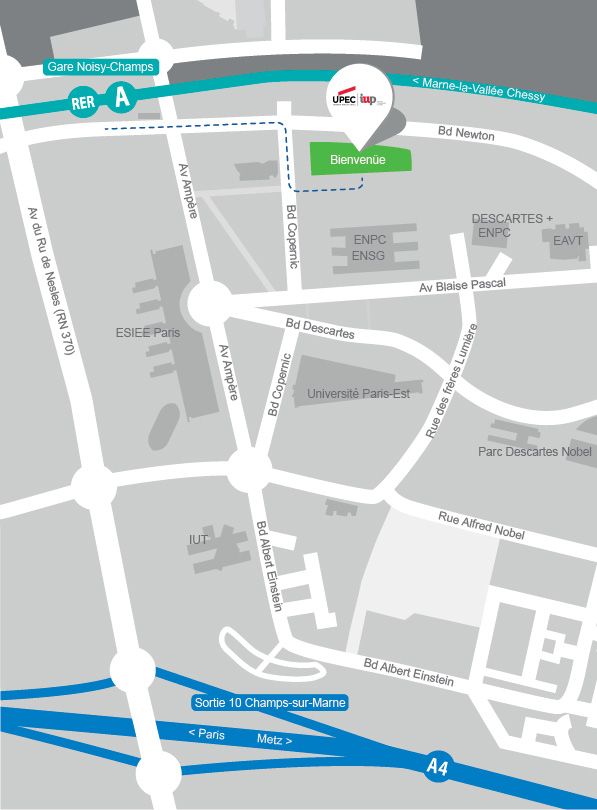
MAP TO THE EUP
École d’Urbanisme de Paris
Bâtiment Bienvenüe – Plot A
14–20 Boulevard Newton
Cité Descartes - Champs-sur-Marne
77454 MARNE-LA-VALLÉE CEDEX 2
RER (train from Paris):
• Take RER line A towards Marne-la-Vallée – Chessy – Parcs Disneyland.
• Alight at Noisy – Champs station (exit 3: Cité Descartes).
• Take Boulevard Newton towards the École des Ponts, then turn right into Avenue André-Marie Ampère.
• Turn left on to the pedestrian promenade that runs alongside the Bienvenüe Building.
• The entrance hall is on the left.
CAR (from Paris):
• Take the A4 motorway towards Metz and Nancy, and leave the motorway at exit 10 (Champs-
sur-Marne – Cité Descartes).
• At the roundabout, turn left (3rd exit) on to the N370 towards Cité Descartes. See the map of the
Cité Descartes campus.
CAR (towards Paris):
• Take the A4 motorway towards Paris, and leave the motorway at exit 10 (Champs-sur-Marne –
Cité Descartes).
• At the roundabout, turn right (1st exit) on to the N370 towards Cité Descartes. See the map of the
Cité Descartes campus.
Gare Noisy-Champs
< Marne-la
-Vallée Ch
essy
Centre de conférences
Bd Newton
Bienvenüe P
Av Am
Entrée principale Parking
Parking visiteurs
visiteurs
p
ère
Bd Copernic
Av d
DESCARTES + 14 - 20 boulevard Newton
ENPC Cité Descartes
u
ENPC EAVT
Ru d
Champs-sur-Marne
ENSG 77447 Marne-la-Vallée Cedex 2 01 81 66 80 00
e Ne
Av Blaise Pascal
sles
(RN
Bd De parking personnel : 14 bd Newton
scarte
re
ESIEE Paris s
370)
miè
accès piéton : 12 bd Copernic
Av Am
s Lu
ic
opern
ère
p
ère
Université Paris-Est
fr
Bd C
des
Rue
Parc Descartes Nobel
Rue A Accès par le RER A
lfre d Nob
Bd Alb
el
IUT
RER A - direction Marne-la-Vallée
station Noisy-Champs
ert Ein
sortie n°3 Cité Descartes
stein
bd Newton - direction Ecole des Ponts
tourner à droite sur bd Copernic
emprunter mail piéton sur la gauche pour contourner le bâtiment Bienvenüe
Bd Alb accéder au hall d’entrée sur la gauche
ert Ein
stein
Sortie 10 Champs-sur-Marne
Accès par l’autoroute A4
< Paris
Metz >
A4/E50
A4 sortie n°10 Champs-sur-Marne - Marne-la-Vallée
direction Cité Descartes
suivre enseignement supérieur
suivre ENSG/Ecole des Ponts
11
THE CHAIR « DEVELOPING THE GREATER PARIS »
    Launched in 2017, the Chair « Developing the Greater Paris » is an
    observatory and a resource center focused on changes in planning practices,
    in relation to the transformations of the Greater Paris, and more generally in
    metropolitan contexts.

    It has four main missions:
    - Research and prospective through scienti c monitoring of special planning
      transformation (stakeholders, planning instruments, scales) within the
      context of the city region.
    - Training and professional sensitization in order to create a common culture
      on the Grand Paris’ special planning, for students and professional actors.
    - Capitalization on foreign metropolitan cities’ experiences, in particular, led
      by discussions with experts.
    - Dissemination to the society through different kinds of public events.

    It carries out these missions together with:
    - academics and researchers of the three associated laboratories of Ecole
      d’Urbanisme de Paris (Lab’Urba, LATTS and LVMT);
    - the 350 students of Ecole d’Urbanisme de Paris;
    - 13 major public and private agencies of the Greater Paris:
      ‣ 5 founding members of the Chair: Caisse des Dépôts, Établissement
        Public Foncier d’Île-de-France, Grand Paris Aménagement, Groupe SNI/
        Grand Paris Habitat and Société du Grand Paris.
      ‣ 8 associated partners: Altarea Cogedim, Eiffage Aménagement,
        Française, Kaufman & Broad, Linkcity, SEMAPA, SNCF Immobilier and
        SPL AIR 217.
    - a committee of experts: Institut Paris Region (former institut
      d’Aménagement et d’Urbanisme d’Ile-de-France), Atelier Parisien
      d’Urbanisme de Paris and Direction Régionale et interdépartementale de
      l’Equipement et de l’Aménagement
    Find all the news and events of the Chair on its website:
    https://chaire-grandparis.fr/

                                                                                  12

                                     fi
THE CERTIFICATION « GREATER PARIS TRAINING »
Presentation
The certi cation “Greater Paris Training” is awarded to students who have
taken part in several activities and who have produced signi cant work
linked to urban construction in the Greater Paris.
This certi cation aims at indicating to structures targeted for an internship
or a job that the students have good rst knowledge in the eld of planning
in metropolitan areas and are familiar with urban construction in the Greater
Paris. It can be stated on the student’s curriculum vitae and a certi cate will
be issued by Ecole d’Urbanisme de Paris.
How to obtain the certi cation “Greater Paris Training”?
To get this certi cation the student must:
1/ follow at least three kinds of activities among the following:
- a course labelled by Greater Paris Training;
- a workshop labelled by Greater Paris Training;
- a common activity labelled by Greater Paris Training;
- an internship related to the topics of the Chair “Developing the Greater
Paris metropolitan areas”;
- an activity especially organized by the Chair “Developing the Greater Paris
metropolitan areas” (open debate, exhibition, etc.).
Courses and activities labelled with the Greater Paris Training are indicated in this booklet by the Chair’s logo.
2/produce at least one document among the following:
- a dissertation related to the topics of the Chair “Developing the Greater
Paris” and a 4-page summary;
- a free document related to the topics and activities of the Chair
“Developing the Greater Paris” (activities overview, conference report, etc.).
When to obtain the certi cation “Greater Paris Training”?
The student can carry out his/her Greater Paris training on one or two years
( rst and/or second year of Master’s degree) depending on his/her activities
and works choices.
It is awarded by the Chair “Developing the Greater Paris metropolitan areas”
after assessing the training of the student at the end of each academic year.
13

fi
fi
fi
fi
fi
fi
fi
fi
fi
fiTHE URBAN PLANNING
MASTER'S PROGRAM OF THE
ECOLE D'URBANISME DE PARIS
Year 2020-2021
EUP Master’s program coordinators:
Sonia GUELTON and Sandrine WENGLENSKIPRESENTATION OF THE URBAN PLANNING
MASTER’S DEGREE
Our master’s program in urban planning is based on complementary and
cross-disciplinary approaches, combined with training in both the skills and
knowledge required today in the professional elds of urban planning, urban
development and the management of territorial dynamics, as well as for
research in these areas.
This highly interdisciplinary master’s program is accessible to students from
a wide range of academic backgrounds (anthropology, architecture,
economics, engineering sciences, geography, history, law, political science,
public administration, sociology, urban development, etc.). It offers a variety
of teaching and learning methods (lectures, workshops, dissertations,
internships, eldwork, individual and group work, etc.) and demands a high
level of commitment from students to their education and training, with the
aim of fostering a professional commitment to and involvement in the eld of
urban planning.
This curriculum gives students – whether they are new to urban planning or
continuing previous studies – the means to respond in relevant and
innovative ways of changing urban issues, today and in the future. A common
core of skills and knowledge in urban planning and development is provided
in Year 1, while different tracks for in-depth professional training, along with
a research path, are offered in Year 2.
15


fi
fi
fiOVERVIEW OF THE PROGRAM’S TRACKS
The program’s different tracks aim to provide comprehensive coverage of the
various dimensions of urban planning and development (Master 2). At the same
time, they also allow students who have already completed the rst year of a
master’s program in this eld to extend their learning. It is in this respect that our
master’s degree aims to be a reference quali cation in the eld of urban planning.
While the different tracks correspond broadly to professional applications, the way
they are de ned and labelled should not obscure the fact that many skills in urban
planning and development are cross-disciplinary. Furthermore, each track draws
from university research, and is linked to the areas of expertise of the teams of
research lecturers in charge of the different modules.
Within each track, a range of teaching methods are employed, with the aim of
alternating foundational skills and applied knowledge, practical work and tutorials,
individually and in groups, along with teaching exercises: problematized personal
re ection ( nal thesis), producing a response to a professional project, scenario
simulations (controversial situations, collaborative approaches, responses to calls
for tender, etc.), and training in research methodology.
Track – Development and Territories: Resources, Policies and Strategies
This track seeks to provide a conceptual framework and operational skills for the
coordinated implementation of public and/or private action in, and in conjunction
with, territories. These territories are affected by increasingly complex and
interdependent social, economic and environmental dynamics that are subject to
internal tensions and external pressures that are often paradoxical in a context of
great uncertainty (globalization and nancialization, growing inequalities,
environmental concerns, recon guration of major global economic balances). Taking
as its starting point the understanding and analysis of territories’ social, economic
and environmental dynamics, this track provides and structures the knowledge and
techniques necessary to develop territorialized responses to these issues by
adapting them to the different dimensions present in a given case (economic,
social, cultural, tourism-related, etc.). This, in turn, makes it possible to analyse how
stakeholders use and organize the resources available to them in their areas: land
resources, associated infrastructure and services, and innovation and new forms of
territorial value creation on different scales.
Coordinators: Emre KORSU - Christian LEFEVRE
Track – Planning, Projects and Urban Management
This track trains students in activities relating to the production of the city (from
planning and scheduling to the implementation of projects) in preparation for the
public- and/or private-sector careers that are likely to include posts involving the
de nition and coordination of urban projects. This track functions on the basis of
strong ties with urban-development stakeholders and professionals, via its
teaching staff, the themes it addresses, and its professional simulation workshops
corresponding to real urban projects.
Coordinators: Helene DANG-VU - Felix ADISSON
16

fl
fi
fi
fi
fi
fi
fi
fi
fi
fiTrack – Urban Alternatives and Experimental Approaches
This track focuses on alternatives and experiments, in terms both of the themes
addressed (analysis of experimental processes and case studies) and the teaching
approaches adopted, based on collaborative work and experimentation in small
groups. The overall aim of this track is to train students in professions relating to
urban planning, and more speci cally the planning of public space, with particular
emphasis placed on the conditions that enable society to reclaim its own spaces.
Coordinators: Franck DORSO - Anne JARRIGEON
Track – Integrated Urban Development: Strategies and Projects
This track trains future professionals in the field of integrated urban development, a new
dimension of public and private urban action that presents new challenges. How should the
regeneration of urban spaces be coordinated in a context of austerity in public finances,
transformations in the issues and challenges facing cities, and changes in the relationships
between spaces and societies? This objective calls upon professionals’ ability to analyse and
understand territorial transitions and spatial changes, decompartmentalize different areas of
public action, foster new collaborations, and reflect upon problems and solutions at the
junction of multiple domains. The aim is to train professionals who are able to adapt to these
new action contexts and adopt interface roles. This requires new and revised knowledge,
approaches and skills. Accordingly, this track takes the form of a sandwich course (study +
work-based training), based on a teaching philosophy that combines university-level
knowledge and research approaches with practice-related issues and professional
experience. It places students in a proactive and reflective position with regard to their own
learning and their ability to develop new solutions.
Coordinators: Nadia ARAB - Yoan MIOT
Track – Housing and Urban Renewal
The aim of this track is to produce young urban-planning professionals specialized
in the design and implementation of public policies relating to housing and urban
renewal. The diversity of positions and professional contexts represented by the
internships on offer within companies and local authorities, combined with
university-level teaching, enables students to develop a shared culture of the eld
of housing – the most basic building blocks for the production and management of
our cities. This track is offered as an apprenticeship option only.
Coordinators: Jean-Claude DRIANT - Françoise NAVARRE
Track – Urban Environments: Strategies, Projects, Services
This track offers comprehensive training in different urban-planning roles, and more
especially those associated with the environmental challenges of intervening in urban
spaces and urbanized territories. The key aim is to enable students to develop critical
expertise with regard to environmental planning and development challenges so that
they are able to identify and understand the ecological issues linked to the way
territories function, as well as the theoretical foundations of these issues and their
impact in legislative, regulatory, operational and other terms. Students will discover
how such issues are integrated into urban-planning decision-making processes on
different scales, and become familiar – through the use of workshops in particular –
with the tools of environmental development and how they are applied.
Coordinators: Stéphane MERCIER - Ana Cristina TORRES
17

fi
fiTrack – Transport and Mobility
This track is the fruit of a collaboration between the EUP and the École Nationale des Ponts
et Chaussées engineering school, and reflects the specializations of each institution: urban
planning and development for the former, and transport, mobility and networks for the latter.
It seeks to provide students with the essential multidisciplinary knowledge required in the
fields of transport, urban development and mobility (of people and goods), on different
territorial scales, taking into consideration French, European and international contexts. Its
ambition is to train professionals and researchers who are able to adapt to new forms of
issues relating to the sustainable development of territories and associated questions of
mobility, and the way these are handled so as to reconcile their various political, economic,
social, organizational and technical dimensions. This track is open to students in their fifth
year of study (i.e. students who have completed the first year of a master’s degree, or
engineering students who have completed the equivalent of two years of classes
préparatoires and two years of a French engineering school) whose previous studies have
adequately prepared them for the fields of urban planning, development and transport. It is a
track where the engineering sciences and the human sciences are closely linked.
Coordinators: Marie-Hélène MASSOT - Philippe POINSOT
Track – International Master in Urban Planning and Studies
This track provides training in international urban planning: it seeks to prepare
students who wish to work abroad or in international organizations and structures.
More speci cally, it provides an opportunity to acquire expertise in urban issues
either in Europe or in countries of the Global South/emerging countries. Students on
this track come from all over the world, which enriches the exchanges that take
place over the course of the year. This track – much of which is taught in English –
functions on the basis of close relationships with foreign universities and
international bodies and agencies. Its objectives are to make students aware of the
changes and challenges resulting from metropolization and globalization, and to
provide them with the skills necessary to analyse and compare globalized cities.
Students will acquire essential professional skills and knowledge in the eld of
urban planning, with a particular focus on international structures, policies and
projects. This track actively encourages students to spend time abroad – in the
form of either an internship or a semester at a foreign university – and offers two
teaching options: “European cities” (taught entirely in English) and “Villes du
Sud” (“Cities of the Global South”, taught in French)
Coordinators: Francesca ARTIOLI - Sylvy JAGLIN
Track - “Urba XP”: urban planning
A demand-oriented training program: teaching method centered on practical
workshops and all other types of concrete productions from the students, de ning
the teachers’ interventions program (fundamentals) or experts’ interventions
depending on the needs that may arise throughout the activities. A track organised
around a project group consisting of some 15 students supervised by 5 to 6
teachers throughout the year with special attention to acquisition and progressive
evaluation by the skilled students in professional situations. The track trains you to
the new professional skills expected in terms of creation, implementation and
management of urban transformations.
Coordinators: Anne PETILLOT - Martin VANIER
18

fi
fi
fiPROFESSIONAL APPLICATIONS AND OPPORTUNITIES
The EUP trains students in the various professions associated with the planning,
management and implementation of urban and territorial projects undertaken by
local authorities and their public and private partners. The training we provide gives
access to four broad categories of professional opportunities.
Urban studies
These professions involve assisting and facilitating decision-making in both the
public and private sectors. Urban planners trained in this particular eld generally
work either in private or association-based structures (e.g. engineering and design
of ces; urban planning agencies; chambers of commerce and industry; economic
development agencies), or in public or quasi-public structures (e.g. local authorities;
government services and departments, in particular those responsible for territorial
development; environment and energy agencies; national housing bodies; other
public bodies).
Urban planning
These professions help plan and develop urban policies and their implementation
over time. The skills required for this focus on the ability to act as an effective
interface between political decision-makers (elected of cials, government
representatives, etc.) on the one hand, and project-management teams (planning,
coordination, implementation) on the other.
Urban design
These professions call for familiarity with the different stages of de ning and
implementing urban projects. Particular skills required in this domain are the ability
to develop and bring to fruition an urban project, and the ability to comprehend and
conceptualize different forms of spatial organization (planning, urban con guration,
urban design, etc.) based on collaborative approaches.
Urban management
These professions are based on the various activities associated with managing
and organizing the city and its different components (housing, and social housing in
particular; networks, especially transport; public space; environment; landscapes).
Local authorities, intermunicipal authorities, public bodies, social-housing
organizations, and public-transport authorities and operators are the main sources
of jobs of this kind, with professionals in these domains typically working in the
technical, urban-planning, land-management, housing, and central-services
departments (among others) of local authorities.
These broad categories of skills and knowledge cannot be reduced to speci c elds
of action (public spaces, housing, transport, environment, etc.), even if such elds
form distinct domains from an academic perspective. Indeed, just as urban planners
are frequently required to make connections between these elds, which public
action often tends to compartmentalize, they will also be required, at various times
in their careers, to call upon and combine the different types of activities and
methodologies presented above.
19

fi
fi
fi
fi
fi
fi
fi
fi
fiSTRUCTURE OF THE YEAR
The admissions procedure for the master’s program includes enrolment for a
particular track.
As the more general aspects of urban planning will have already been
covered previously, the specialization tracks will represent the bulk of
students’ activities, both in the rst semester (and up to early April) and in
the course of the internship and the second-year/ nal dissertation, which will
also be defended within the framework of the student’s chosen track.
However, several cross-disciplinary activities are attended by all second-
year “initial training” students, and indeed potentially by all students on the
master’s program: the rst week; common activities in the rst and second
semesters; and the Journée Grand Paris (“Greater Paris Day”) in January.
Students following the research path are also enrolled in a particular track,
and they will participate in most of the group activities associated with this
track. Enrolment takes place either at the start of the year or in the second
semester, the bulk of which will be dedicated to the writing of a dissertation.
Students wishing to request PhD funding are requested to enroll for the
research path as early as possible.
Tracks that take the form of sandwich courses (study + work-based training)
have a different calendar, as they involve a particularly busy schedule and a
heavy workload; dedication and commitment on the part of students is a
prerequisite. Further details can be found later in the booklet.
VALIDATION OF THE YEAR
The rst semester is validated by an oral examination before a panel. A
separate judging panel at the end of the year decides on whether to validate
the second semester and thus the master’s degree.
If the average mark obtained for a module (unité d’enseignement, or UE) is
less than 7 (out of 20), the student must resit the module. For marks between
7 and 10, students may opt to resit, but this is not compulsory. Whatever they
decide, students must inform the administration of their choice, so that the
teaching staff concerned can organize examinations.
The workshops for each track and the nal dissertation (whether a research
dissertation or a professional dissertation) cannot be repeated or
compensated for by additional credit.
20

fi
fi
fi
fi
fi
fi2020-2021 EUP CALENDAR
Sept. 19 Oct. 19 Nov. 19 Dec. 19 Jan. 20
1 M 1 J COMMON 1 D 1 M 1 V
2 M 2 V ACTIVITIES 2 L W7 M2 2 M 2 S
3 J 3 S 3 M 3 J 3 D
4 V 4 D 4 M 4 V 4 L W12 M2
5 S 5 L W1 M2 5 J 5 S 5 M
6 D 6 M 6 V 6 D 6 M
7 L 7 M 7 S 7 L W10 M2 7 J
8 M 8 J 8 D 8 M 8 V
9 M 9 V 9 L W6 M2 9 M 9 S
10 J 10 S 10 M 10 J 10 D
11 V 11 D 11 M 11 V 11 L W13 M2
12 S 12 L W2 M2 12 J 12 S 12 M
13 D 13 M 13 V 13 D 13 M JOURNÉE
GRAND PARIS
14 L 14 M 14 S 14 L W11 M2 14 J
15 M 15 J 15 D 15 M 15 V
16 M 16 V 16 L W7 M2 16 M 16 S
17 J 17 S 17 M 17 J 17 D
18 V 18 D 18 M 18 V 18 L
19 S 19 L W3 M2 19 J 19 S 19 M
20 D 20 M 20 V 20 D 20 M
21 L 21 M 21 S 21 L 21 J
22 M 22 J 22 D 22 M 22 V
23 M WELCOME DAY 23 V 23 L W8 M2 23 M 23 S
24 J 24 S 24 M 24 J 24 D
25 V 25 D 25 M 25 V 25 L W1 M2
26 S 26 L W4 M2 26 J 26 S 26 M
27 D 27 M 27 V 27 D 27 M
28 L 28 M 28 S 28 L 28 J
COMMON
29 M 29 J 29 D 29 M 29 V
ACTIVITIES
30 M 30 V 30 L W9 M2 30 M 30 S
31 S 31 J 31 D
Feb. 20 March 20 April 20 May 20 June 20
1 L W2 M2 1 L W6 M2 1 J 1 S 1 M
2 M 2 M 2 V 2 D 2 M
3 M 3 M 3 S 3 L 3 J
4 J 4 J 4 D 4 M 4 V
5 V 5 V 5 L INTERNSHIP 5 M 5 S
6 S 6 S 6 M 6 J 6 D
7 D 7 D 7 M 7 V 7 L
8 L W3 M2 8 L W7 M2 8 J 8 S 8 M
9 M 9 M 9 V 9 D 9 M
10 M 10 M 10 S 10 L 10 J
11 J 11 J 11 D 11 M 11 V
12 V 12 V 12 L 12 M 12 S
13 S 13 S 13 M 13 J 13 D
14 D 14 D 14 M 14 V 14 L
15 L W3 M2 15 L W8 M2 15 J 15 S 15 M
16 M 16 M 16 V 16 D 16 M
17 M 17 M 17 S 17 L 17 J
18 J 18 J 18 D 18 M 18 V
19 V 19 V 19 L 19 M 19 S
20 S 20 S 20 M 20 J 20 D
21 D 21 D 21 M 21 V 21 L
22 L W5 M2 22 L W9 M2 22 J 22 S 22 M
23 M 23 M 23 V 23 D 23 M
24 M 24 M 24 S 24 L 24 J
25 J 25 J 25 D 25 M 25 V
26 V 26 V 26 L 26 M 26 S
27 S 27 S 27 M 27 J 27 D
28 D 28 D 28 M 28 V 28 L
29 L W10 M2 29 J 29 S 29 M
30 M 30 V 30 D 30 M
31 M 31 L
21
COMMON ACTIVITIES
    Presentation
    The EUP’s ambition is to actively participate in the transformation of the
    urban-planning professions by offering initial and continuing training focused
    on contemporary issues and the ability to meet the challenges presented by
    cities, territories and the transformation of spaces. This means contributing
    to the debates and activities of these elds by mobilizing the skills of EUP
    members in the context of collective expert assessments, and organizing
    meetings or partnerships developed with stakeholders in this eld of action,
    in both the public and private sectors.
    With this in mind, the common activities we offer have educational
    objectives such as enabling students to acquire professional skills that go
    beyond the eld of urban planning alone. These are cross-curricular modules,
    in which students from the various tracks of the Urban Planning master’s
    program work in small groups on a project to be completed over the course of
    a week under the supervision of a tutor (the activities on offer typically
    change from year to year).
    The concentration of these activities into a single week should lead to the
    development of cross-disciplinary approaches.
    The common activities also seek to develop other skills:
    - the ability to adapt to training based on activities that foster cooperation
      and encourage students to see their peers as additional sources of
      learning and inspiration;
    - the ability to integrate atypical teaching materials by using diverse, high-
      quality knowledge-transfer tools (simulation software, scenarios, collective
      prototyping) in addition to more traditional learning methods.

    Key dates and enrolment
    Common activities will take place from September 28th to October 2nd 2020.
    The teaching team will be offering different activities – please note that you
    can only participate in one activity per semester. The activities will be
    presented on the rst day of the semester. You will be given a sign-up form to
    complete, on which you should list four choices of activity by order of
    preference.
    Students’ presence is mandatory in order to validate the Common Activities
    module, which counts towards the nal degree. This module will be assessed
    in terms of skills attained (and will not be given a mark out of 20).
                 Coordinator: Florent Le Néchet – orent.lenechet@univ-eiffel.fr

           Administration : Magali DE OLIVEIRA - magali.de-oliveira@u-pec.fr

                                                                                  22

      fi
            fi
                              fl
                                   fi
                                        fi
                                                               fi
THE COMMON ACTIVITIES WEEK 2020
SEPTEMBER 28 - OCTOBER 2, 2020
Administration : Magali DE OLIVEIRA - magali.de-oliveira@u-pec.fr
1. Cycle de conférence - Aménager le Grand Paris - Taou k SOUAMI
Organisation de conférences-débats : enjeux et
controverses au cœur de l’actualité de l’aménagement
(en lien avec la chaire du Grand Paris)
Objectifs :
• Renforcer la capacité à produire rapidement un état de la question à partir
de sources multiples et progresser dans la maîtrise des méthodes de
recherche
• Apprendre à maîtriser les débats publics, politiques et scienti ques
portant sur des objets au cœur d’une actualité changeante et complexe en
urbanisme
• Adopter une démarche professionnelle d’organisation d’événements et de
supports de communication publics et professionnels en urbanisme
notamment les outils numériques et les réseaux sociaux spécialisés
(programmation du contenu, choix des intervenants, déroulement,
logistique, communication et nancement, production de documents et
webinaires, gestion des aléas).
• Apprendre à utiliser des outils de communication didactique, synthétique
et convaincante au sein du ot des informations et de l’actualité
• Apprendre à travailler collectivement, en mode projet et de façon itérative.
2. Atelier d’écriture - L’écriture des lieux - Elsa VIVANT
Les étudiants réaliseront plusieurs exercices d'écriture de lieux, en salle et en
extérieur, selon différents protocoles. Si les conditions sanitaires le
permettent, l’atelier sera réalisé sur le site du projet urbain de l’écoquartier de
Chatenay-Malabry, en lien avec le programme de recherche-création porté
par UGE (https://e3sautregard.hypotheses.org/).
Par l’écriture, les étudiants seront amenés à repenser leurs pratiques
d’observation, à se décentrer, et à déployer leur capacité à se projeter dans
un futur imaginaire.
Le dispositif de restitution des textes sera conçu collectivement (exposition,
performance, fanzine…).
Objectifs : Cette activité contribue à l’acquisition de compétences en
matière d’observation, d’écriture et de restitution.
23

fl
fi
fi
fi3. a) Urbax - International version - Sonia GUELTON et Juan Carlos CUEVAS
Activity in english only, priority to international students - Cette activité se
déroulera uniquement en anglais, la priorité sera accordée aux étudiants du
parcours international.
«Urbax » is a pedagogical interactive simulation of urban planning and
development involving the main urban actors: Local authority, Public and
private developers, Entrepreneurs, Landowners (3 days)
Urbax: Students simulate private land development projects in a territorial
strategy implemented by selected public tools. They will play different actors
with different pédagogiques: city council, developers, social housing investor,
industrial company directors according to a computer-monitored process
regulated by the coordinators. Students will have to design an original
restitution to be presented before EUP students on Friday afternoon.
Objectives :
• Urban planning and development system: interactions, control and regulations
• Actors strategies
• Tools: Land use, planning, nancing, contracts
• Cooperation and human relationships and con ict
3. b) Atelier Urbax version « Bourg structurant » - Urbax : logiques d’acteurs,
stratégies et outils de l’aménagement urbain – simulation interactive -
Philippe POINSOT et Eric CITERNE
Urbax : simulation d’un processus de mobilisation foncière pour la mise en
œuvre d’une stratégie de développement d’une petite ville.
Il s’appuie sur une mise en situation ctive et orchestrée par des spécialistes
du foncier et de l’aménagement. Les étudiants interagissent sur le territoire
ctif proposé et analysent les résultats de leurs décisions. Une séance
introductive pose les principales références à mobiliser dans le « jeu urbain »,
les étudiants préparent leur « rôle » autour de 2 éléments clefs : les acteurs et
les outils. La simulation se déroule ensuite en continu sur une période de
deux jours et demi.
A l’issue du jeu, un point d’évaluation avec les étudiants permet de croiser les
apports, de produire une restitution collective et un rapport analytique.
Objectifs :
• Comprendre les logiques et les stratégies des acteurs de l'aménagement
urbain
• Comprendre le système de l'aménagement urbain et ses interactions sur
les plans foncier, nancier et juridique ;
• Savoir choisir et utiliser les outils et les méthodes applicables pour
l’aménagement d’un « quartier durable » ;
• Résolution de problèmes et de dé s de prise de décisions en situation
complexe.
24
fi

fi
fi
fi
fi
fl
s4. La ville des télétravailleurs : prospective d’une mutation en cours -
Mesure de l’ampleur du phénomène suite à l’événement pandémique -
Martin VANIER
• Repérage sur le secteur de Marne-la-Vallée
• Ré exions sur les conséquences en chaîne dans tous les aspects urbains
• Expressions prospectives sur quelques sujets concrets (immobilier
d’entreprise, conception des logements, vie de quartier, …)
Objectifs :
• Ré exion urbaine et sociétale sur le changement et ses imprévisions
• Production d’un support de restitution accessible en ligne.
5. Temps territoriels - Physiques et numériques, portraits artistiques d'un lieu -
La mutation urbaine comme matière critique et artistique -
Grégoire MOULIN-MORABITO
English or spanish speaking students are welcome - L’atelier est ouvert aux
étudiants anglophones et hispanophones.
A travers l'exploration d'un lieu, l'activité propose une rencontre autour de la
ville dans une dialectique art / territoire / temporalité.
Cette activité se base sur un exercice de ré exion entre deux perceptions :
• celle physique d'un paysage et de ses matières (réalité sensible)
• celle numérique d'un territoire converti en données (virtualité)
Les étudiant.e.s seront invité.e.s à transcender leur regard d'urbaniste, ils et
elles devront s'interroger sur l'évocation sensible de thématiques générées
par l'observation de l'espace urbain (matière, corps, nature, limite, mémoire…).
Objectifs :
• Mettre en perspective l'approche présente et réelle d'un lieu et l'approche
virtuelle, passée et future, permise par les outils numériques dans
l'appréhension des espaces, des paysages et de leur transformation.
• Seront privilégiés photographie, dessin, montages, cartographie, sensible,
écriture, collecte d'objets physiques et installations.
25

fl
fl
flYou can also read


