Europeana Learning Scenario - European Schoolnet
←
→
Page content transcription
If your browser does not render page correctly, please read the page content below
Europeana Learning Scenario
Title
Jobs ... From The Dusty Pages of History to Modern Times

Author
Gül Doğan

Abstract
This learning scenario aims to create awareness about the changes happening in some professions due
to technological developments and industrial reforms. It also aims to introduce how to use Europeana
resources in class especially for the high school students aged 14-18. However, this scenario can also be
adapted to different grades and ages easily. Students will be aware of some jobs which still exist and are
performed. Students will also research the jobs which are almost forgotten in their own culture. At the
end of the lesson, besides being informed about Europeana resources, students will be able to integrate
social sciences, technology and culture into English language learning.

Keywords
English, Industrial Work, Language, Technology, Child Labor

Table of summary

Table of summary
Subject                  English, Language, Cultural Heritage, History
Topic                    Creating awareness for the changes happened in some professions due to
                         technological developments and industrial reforms through Europeana
                         resources.
Age of students          15-16

Preparation time         2 hours
Teaching time            2 hours 40 minutes: 4 lessons with 40 minutes
Online teaching          https://kahoot.com
material                 https://create.kahoot.it/share/europe-at-work/963d82ee-d4b6-4d3d-8a38-
                         541c93e3a6c6
                         https://padlet.com/eylulguldogan/y0rnze3ru6z3
                         https://padlet.com/eylulguldogan/4xja45bzbmci
                         https://socrative.com
                         https://b.socrative.com/teacher/ - import-quiz/43476145
                         https://safeYouTube.net/w/gKp5
                         https://safeYouTube.net/w/CKp5
                         https://safeYouTube.net/w/PKp5
                         https://www.polleverywhere.com
                         PollEv.com/guldogan790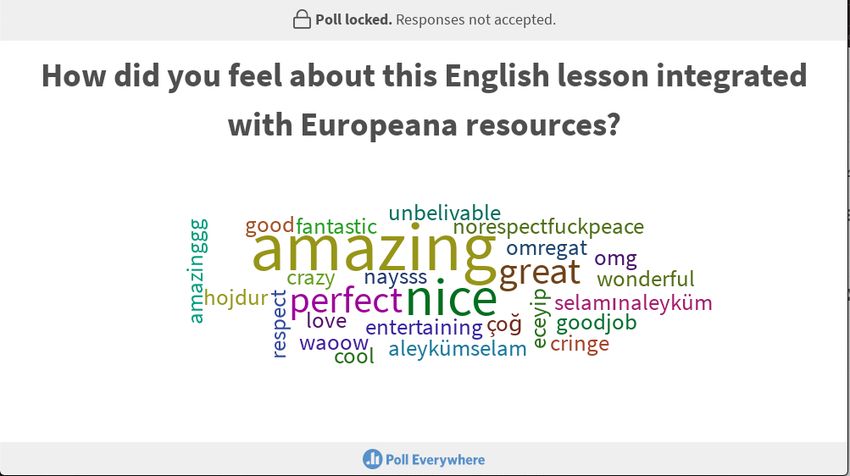
https://pollev.com/free_text_polls/eB7jmSjYdNLMqeAkhtlvP/respond
https://www.randomlists.com/team-generator
https://www.qr-code-generator.com
https://www.emaze.com
https://docs.google.com/presentation/u/0/
https://prezi.com
Offline teaching Paper, newspaper, magazine, glue for poster making
material
Europeana resources Item 1
used Item 2
Item 3
Item 4
Item 5
Licenses
Attribution CC BY. This license lets others distribute, remix, tweak, and build upon your work,
even commercially, as long as they credit you for the original creation. This is the most
accommodating of licenses offered. Recommended for maximum dissemination and use of
licensed materials.
Integration into the curriculum
This scenario is integrated with English Lesson Curriculum prepared by the Turkish Ministry of National
Education. 11th Grade Theme 3: Hard Times focusing on the past habits, events and routines, 10th
Grade Theme 4: Traditions, 9th Grade Theme 5: Inspirational People and Theme 7: World Heritage
Students can list differences and similarities between today’s and past working conditions using
Europeana resources. They can also see the changes happened during the years due to the industrial
revolution. They will get various information about men, women and children workers from the
newspapers or photos published on Europeana. As this learning scenario includes many disciplines, it
can be integrated history, social sciences, technology, and literature into the English curriculum.
Another fundamental element in this scenario is encouraging students to build their own identities and
structure their thought by doing cultural research. Thus they will help to keep the values and cultural
roots. This lesson can be integrated with cultural education.
Aim of the lesson
This lesson aims to inform students about Europe at work, Europeana resources and the professions
which are almost forgotten in their own culture integrating culture, social sciences and technology into
English language lessons.
Outcome of the lesson
Students will be able to recognize vocabulary indicating the sequence of events in a recorded text/video.
Students will be able to talk about past habits. Students will be able to talk about a personal experience
in the past. Students will be able to ask and answer simple questions in an interview about past times
and past events. Students will be able to give a short simple presentation about a profession they have
2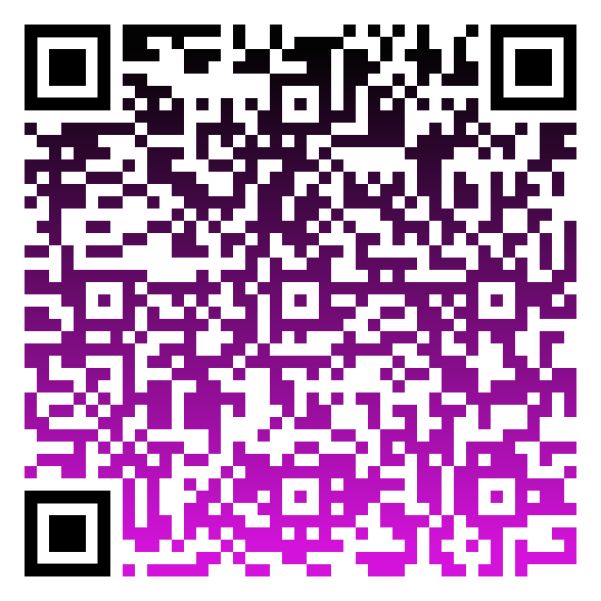
searched before. Students will be able to contrast past’s working life conditions and today’s. Students
will be able to use past tenses in a meaningful context. Students will be able to ask and answer simple
questions in an interview about past times and past events. Students will be able to answer the
questions about short texts on social, educational and technological lives of people in the past around
the world. Students will be able to identify the differences between the lifestyles and customs of people
in the past and the ones in the 21st century in a written text.

Trends
Project-based learning: Students will work in groups. They will collect stories about people at work in research trip and prepare
presentations with the materials they have collected.

Flipped Classroom: Students will get ready for the lessons before they come to the class. They will acquire basic knowledge
about the topic doing research, watching videos and doing simple tasks beforehand.

Collaborative Learning: Students will improve their English written and oral skills as well as critical thinking skills in their mother
language by working in groups.

BYOD: Bring your own device to the lesson: Students will bring their smartphones to record stories, to prepare presentations
and to assess the lesson.

Cloud-based learning: Students will have the opportunity to reach the materials they have learned by themselves, or from their
peers, or from the teacher whenever they need afterward the lessons in Google Classroom.

Social Media: Students will also share some of their results on social media with two hashtags #Europeana and #Unforgettable
Professions

21st-century skills
Communication and Collaboration: To work on authentic materials and context as a group, students need to communicate in
orally and written way with their peers. To provide a common product together they are expected to work collaboratively.

Creativity and Flexibility: This scenario encourages students to improve their creative writing skills and to be flexible while they
study and prepare their materials.

Critical Thinking: Students have to learn, interpret and analyse the sources the teacher has sent them through cloud-based
learning and flipped classroom.

Activities
   Name of                                                     Procedure                                                    Time
   activity

Brainstorming Students are introduced to the topic through Europeana’s “Europe at 15
and Survey    Work, Share your story” resources to understand the working life
              conditions of today. Students prepare a questionnaire (Annex 1) with the
              questions on the resource and ask the questions to at least their two
              family members They will share their answers on the Padlet which teacher
              has sent before the lesson through Google Classroom. Students will use
              both their native language and English to complete the task.
Flexible      Students will read one of the articles on the Europeana blog before they 15
Reading       start the lesson. There will be three texts on Google Classroom. They are
              about child labour, women’ labour history in Europe and industrial
              agriculture in rural life. Students will be grouped randomly to read the

                                                                                                                                     3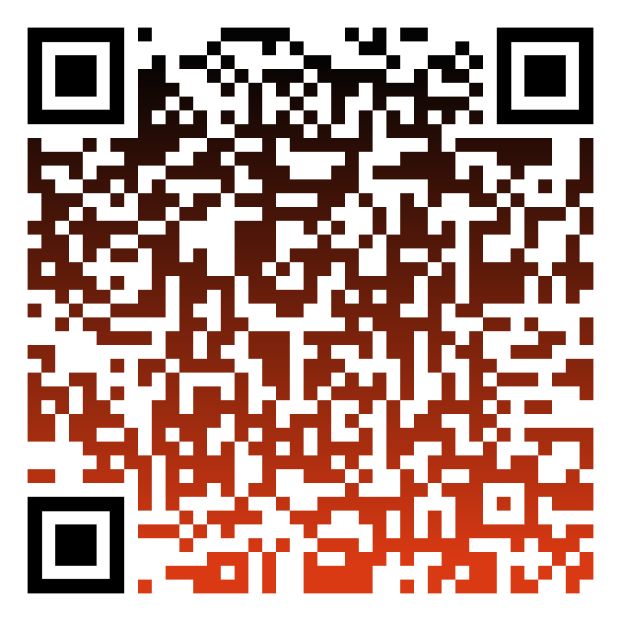
Name of                                       Procedure                                      Time
  activity

               text. They are grouped via a random list generator. Then the groups
               choose a colour out of red, pink, green. These colours show the QR code of
               the texts on Europeana. (Annex-2) Each group are expected to read one of
               the texts. They will also watch a few grammar videos to learn the language
               needed during the following four lessons.
Presentation   Teacher will introduce the main objectives, the work methodology, the          10
               web tools, the research trip, the resources and the expected outcomes.
               Teacher will provide the language needed to conduct the following
               lessons.
General        Firstly the students will discuss the texts and photos taken Europeana and     20
Discussion     listed on Padlet. They are expected to use the target language and
               language items.
Research       Group work - Research                                                          40
               Students research the professions that are almost forgotten due to
               technological developments and industry reforms. From stonemasonry to
               antiquity, tin, milling, custodianship and saddlery, nearly a hundred
               occupations are mixed with history, while others continue to resist. They
               will watch a video to get some ideas about these kinds of professions.
               Students will interview people who still do these professions and prepare
               presentations about them. They can use Emaze, Prezi or Google Slides to
               prepare their presentations.
Delivering the Students will present their presentations as a group. Other students will      40
presentations complete a peer/group evaluation form while they watch the presenters.
               (Annex-5) Students will also share some of their results on social media
               with two hashtags #Europeana and #Unforgettable Professions.
Assessment     There will be quizzes about the language, Europeana resources and the          20
               lesson itself using three different online testing tools. (Kahoot, Socrative
               and Poll-everywhere).

Assessment
Students’ knowledge will be tested through a multiple-choice questionnaire using the Socrative and
Kahoot applications. (Annex-4) Students are expected to remember or create a link between the photos
and the topic on Kahoot. They will do jigsaw reading to find answers on Socrative. The teams have to
communicate and collaborate for this test. Finally, they will evaluate the lesson and Europeana via an
online poll. Their answers are shown on the board as a word cloud. They will evaluate both themselves
and the others by asking more explanations.

******************************* AFTER IMPLEMENTATION ********************************

                                                                                                      4
Student feedback
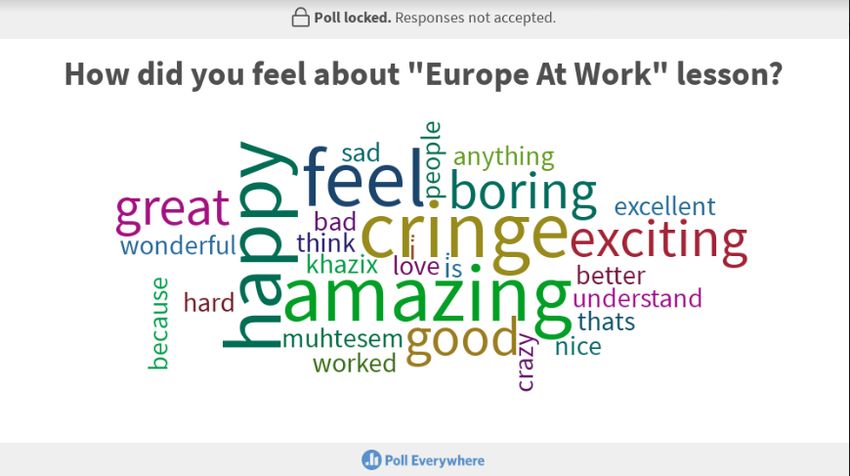
Students’ feedbacks were collected through two questions prepared on Poll-everywhere application.
Even though it was their first experience integrating other disciplines and Europeana resources into
English language lessons, the students enjoyed a lot while using the digital tools, doing research and
collecting information about their ancestors’ occupations. They were proud to take part in preserving
the cultural heritage. You can check the results at Annex 3.
Teacher’s remarks
It was my first scenario, too. Students’ oral and written feedbacks were very motivating for me, too. The
students were 10th and 11th grade in high school. The scenario aims to improve multi-skills of the
students such as English, history, ICT skills, 21st-century learning skills and to integrate all of them in
English lessons. Students evaluated both their performances through self-assessment tools and their
peers’ performances. They used Social Sciences and Technology to develop their language skills. Not
only language skills of students were improved but also their ICT skills were improved. They used their
smartphones and interactive whiteboards to get information on ‘’People at work’’ in Europeana
platform. Digital Literacy was enhanced by reliable information on Europeana. 21st learning skills of the
students such as collaboration, communication, flexibility, creativity and critical thinking skills were
improved as well. As the students had to work together to carry out the tasks, their communication and
collaboration skills were improved. The students brainstormed on the changes happened in some
professions due to technological developments, that improved students’ critical thinking skills. They
completed some online tasks with the help of some web2.0 tool. Learning English through technology
attracted them very much. They were happy during these four lessons and research trips. I also got
some positive feedback from the parents and school staff. I felt honoured to be a part of preserving
cultural heritage in my everyday teaching.
About the Europeana DSI-4 project
Europeana is Europe’s digital platform for cultural heritage, providing free online access to over 53 million digitised items drawn
from Europe’s museums, archives, libraries and galleries. The Europeana DSI-4 project continues the work of the previous three
Europeana Digital Service Infrastructures (DSIs). It is the fourth iteration with a proven record of accomplishment in creating
access, interoperability, visibility and use of European cultural heritage in the five target markets outlined: European Citizens,
Education, Research, Creative Industries and Cultural Heritage Institutions.
European Schoolnet (EUN) is the network of 34 European Ministries of Education, based in Brussels. As a not-for-profit
organisation, EUN aims to bring innovation in teaching and learning to its key stakeholders: Ministries of Education, schools,
teachers, researchers, and industry partners. European Schoolnet’s task in the Europeana DSI-4 project is to continue and
expand the Europeana Education Community.
5Annex
Annex-1: Survey Questions
Annex-2: QR Codes for Europeana Reading Blogs
67
Annex-3: Polleverywhere Results

                                  8
Annex-4: Kahoot and Socrative Results
9Annex-5: Peer Evaluation Form
10You can also read


