Evaluation and Management of Adverse Reactions to Vaccines - John M Kelso, MD Division of Allergy, Asthma and Immunology
←
→
Page content transcription
If your browser does not render page correctly, please read the page content below

Evaluation and Management of
Adverse Reactions to Vaccines
            John M Kelso, MD

    Division of Allergy, Asthma and Immunology
                    Scripps Clinic
                   San Diego CA

Clinical Professor of Pediatrics and Internal Medicine
         University of California, San Diego
                 School of Medicine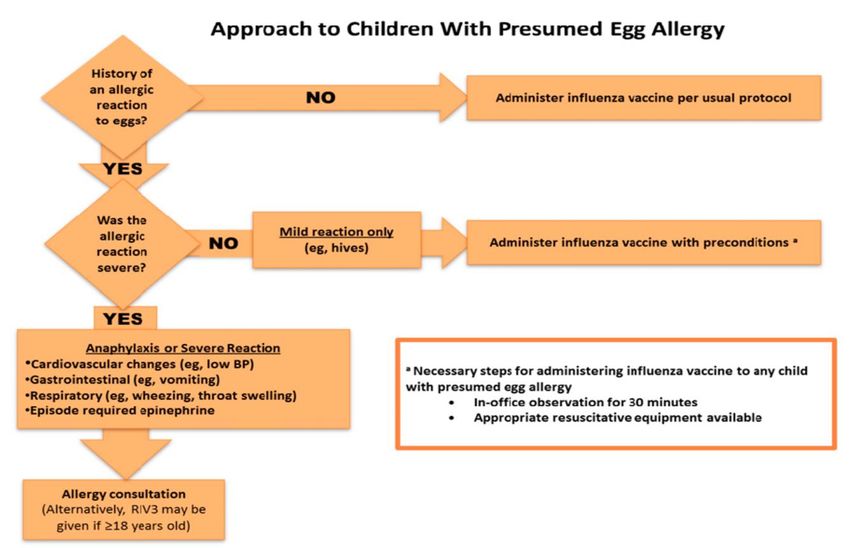
Faculty Disclosure
                   Information
• I have not had a significant financial interest or other
  relationship with the manufacturers of the products or
  providers of the services that will be discussed in my
  presentation.
• This presentation will not include discussion of
  pharmaceuticals or devices that have not been
  approved by the FDA.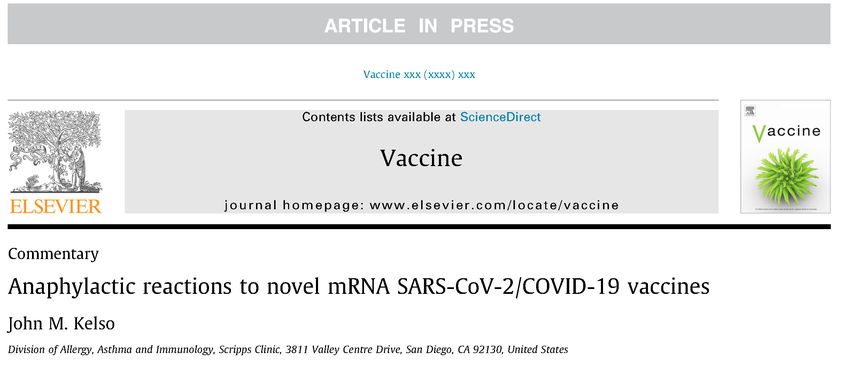
Objectives
•   Appreciate the nature of IgE-mediated and non-IgE-
    mediated adverse reactions to various vaccines.
•   Appropriately refer patients who have had adverse
    reaction to vaccines.
•   Provide advice to patients regarding the future
    administration of vaccines after an adverse reaction to
    a previously administered vaccine.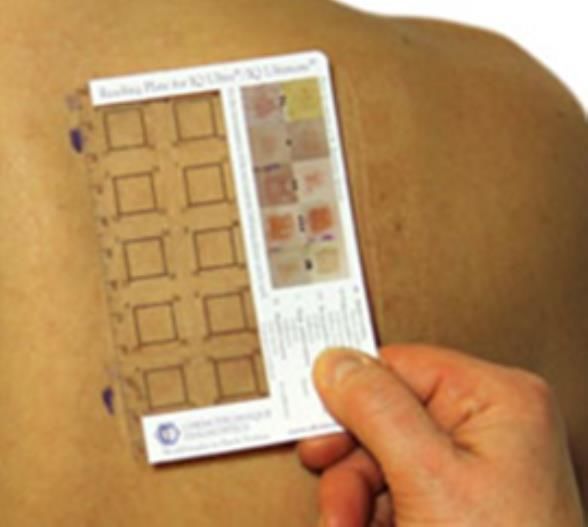
Kelso JM, Greenhawt MJ,
                Li JT, et al.
 Adverse reactions to vaccines practice
         parameter 2012 update.
J Allergy Clin Immunol 2012; 130:25-43.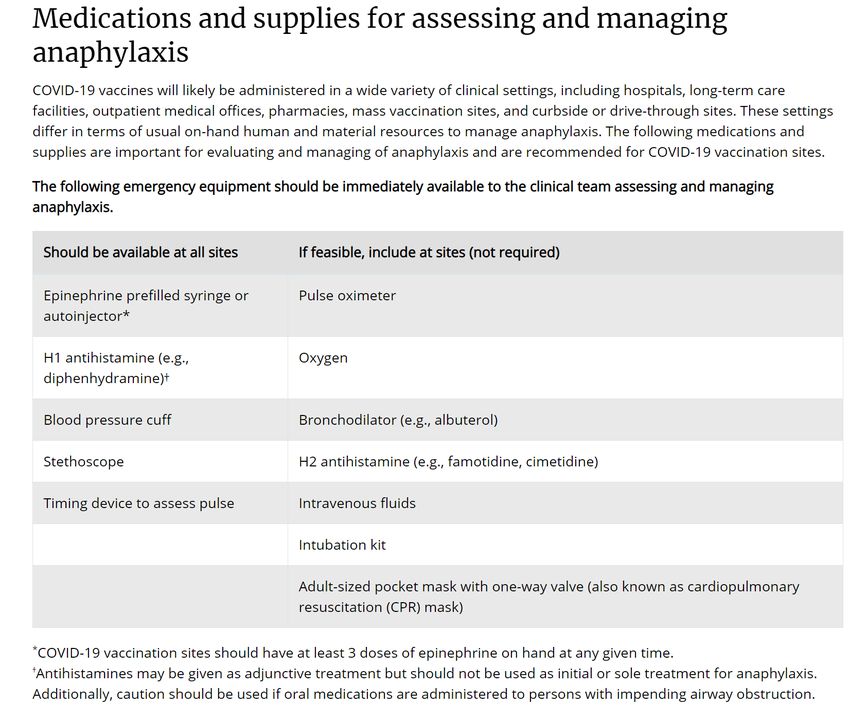
Dreskin SC, Halsey NA, Kelso JM, et al.
International Consensus (ICON): allergic
          reactions to vaccines.
       WAO Journal 2016;9:1-21.
Common Reactions
Mild local (injection site) reactions and constitutional
symptoms, such as fever, after vaccinations are
common and do not contraindicate future doses.
Delayed Type Hypersensitivity
Rarely, delayed-type hypersensitivity (DTH) to a vaccine
constituent, such as neomycin or thimerosal, may cause
a temporary injection site nodule, but DTH to these
constituents, or a history of such nodules is not a
contraindication to subsequent vaccination.
Anaphylaxis
Anaphylactic reactions to vaccines are estimated to occur
at a rate of approximately 1 per million doses.
Evaluation
All suspected anaphylactic reactions to vaccines should be
evaluated in an attempt to determine the culprit allergen.

Evaluate before labeling
• When a patient experiences an apparently IgE-mediated
  reaction after an immunization, often labeled “allergic” and
  advised against future doses
• This approach should be avoided because it may leave
  patients inadequately immunized if they unnecessarily
  avoid vaccines to which they are not allergic or if the
  vaccine could be administered safely despite their allergy.
• In addition, not knowing the constituent of a vaccine to
  which the patient is allergic may pose a risk with future
  vaccinations that contain the same ingredient.
Excipients
  IgE-mediated reactions to vaccines are more often
  caused by vaccine components such as gelatin, rather
  than the immunizing agent itself.

www.cdc.gov/vaccines/pubs/pinkbook/appendix/appdx-b.html
Egg allergy and influenza
       vaccination
Egg allergy and influenza vaccines • Most influenza vaccines contain measurable quantities of egg protein (ovalbumin) • Does this cause systemic reactions when injected into egg-allergic patients?
Egg allergy and influenza vaccines

• 27 studies involving >4100 patients with egg allergy,
  including 513 with a history of anaphylaxis after egg
  ingestion, receiving inactivated influenza vaccine (IIV)
  without any serious reactions
• Reports describe 1129 patients with egg allergy,
  including 412 with history of anaphylaxis to egg
  ingestion, given live attenuated influenza vaccine
  (LAIV) without any immediate systemic reactions
Why are there no serious reactions
                 being reported?
• Manufacturers of all influenza vaccines report the
  maximum amount of ovalbumin < 1 µg per 0.5 mL dose
• The measured amounts in independent laboratories are
  usually much lower than the claimed amounts
• Thus, the vaccine does not contain enough ovalbumin
  to cause a reaction
Recommendations for Prevention
and Control of Influenza in Children,
2020-2021
Committee on Infectious Diseases
American Academy of Pediatrics
Pediatrics 2020Egg allergy and influenza vaccine
Egg allergy and influenza vaccine

• “There is strong evidence that egg-allergic individuals
  can safely receive influenza vaccine without any
  additional precautions beyond those recommended for
  any vaccine.”
• “The presence of egg allergy in an individual is not a
  contraindication to receive IIV or LAIV.”
• “Vaccine recipients with egg allergy are at no greater
  risk for a systemic allergic reaction than those without
  egg allergy.”
Egg allergy and influenza vaccine

• So if it doesn’t matter if the patient is egg allergic, why
  do we ask?
• “It is not necessary to inquire about egg allergy before
  the administration of any influenza vaccine, including
  on screening forms.”
• “Patients who have had a previous allergic reaction to
  the influenza vaccine, should be evaluated by an
  allergist to determine whether future receipt of the
  vaccine is appropriate.”
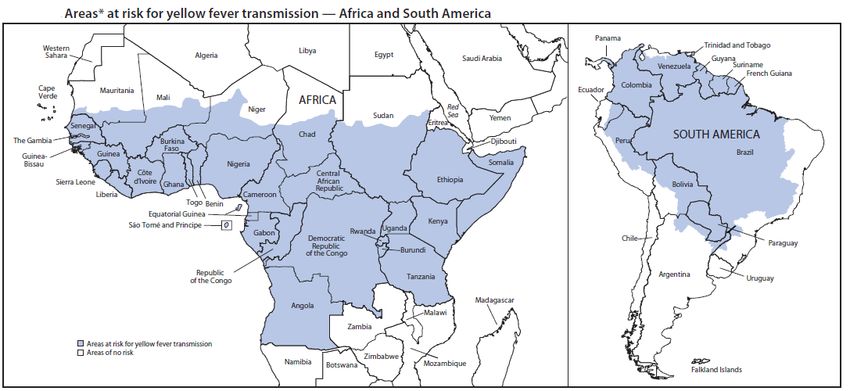
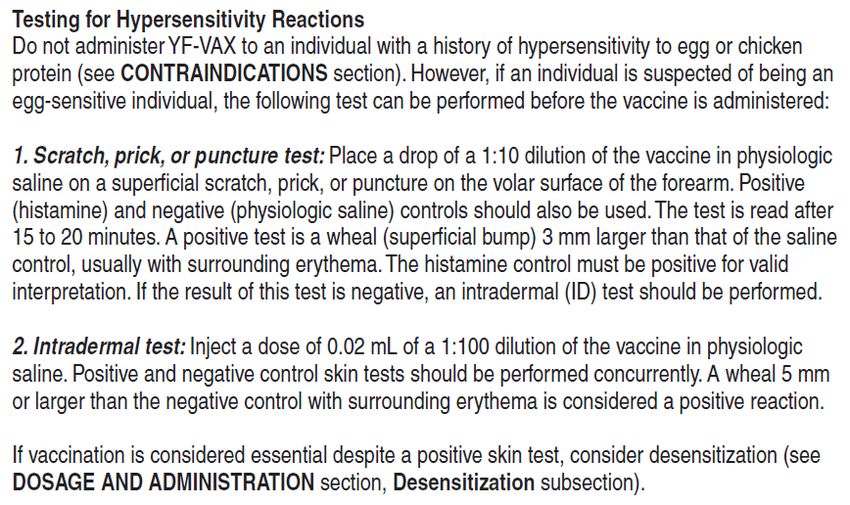
Yellow Fever Vaccine

• A history of allergy after the ingestion of egg should be
  sought prior to the administration of yellow fever vaccine
• Persons with positive histories should be skin tested with
  yellow fever vaccine prior to administration
   – If negative, give in usual manner but observe for 30
     minutes afterward.
   – If positive, give vaccine in graded doses
Yellow Fever Vaccine
Yellow Fever Vaccine
Anaphylaxis to measles,
   mumps, and rubella vaccine
    mediated by IgE to gelatin

  Kelso JM, Jones RT, Yunginger JW
Journal of Allergy & Clinical Immunology
              1993;91:867-72.
IgE-mediated systemic
reactions to gelatin included in
the varicella vaccine
Sakaguchi M, Yamanaka T, Ikeda K,
Sano Y, Fujita H, Miura T, Inouye S.
Journal of Allergy & Clinical Immunology
1997;99:263-4.None in Stamaril None in SHINGRIX
Reactions to Gelatin in Vaccines
• Persons who react to gelatin on ingestion should be
  evaluated by an allergist prior to administration of gelatin-
  containing vaccines.
• If the history is consistent with an immediate-type allergic
  reaction to gelatin confirmed by skin tests or serum
  specific IgE, skin test with vaccines prior to administration.
   – If negative, give in usual manner but observe for 30
      minutes afterward.
   – If positive, give vaccine in graded doses
Yeast • Hepatitis B vaccines are grown in Saccharomyces cerevisiae (baker’s yeast or brewer’s yeast) and contain residual yeast protein (up to 25 mg per dose) • Human papillomavirus vaccine also contains residual yeast protein (less than 7 mcg per dose) • However, allergic reactions yeast in vaccines, are rare or nonexistent
Yeast
• Yeast allergy itself is very rare but, if a patient has a
  history of clinical reactivity to Baker's or Brewer’s yeast
  and a positive skin test to Saccharomyces cerevisiae,
  skin test them with yeast-containing vaccines prior to
  administration.
   – If negative, give in usual manner but observe for 30
     minutes afterward.
   – If positive, give vaccine in graded doses
Latex • The “rubber” in vaccine vial stoppers or syringe plungers may be dry natural rubber (DNR) latex or synthetic rubber. • Those made with DNR pose a theoretical risk to the latex allergic, however reports of reactions possibly due to latex are exceedingly rare
Latex
• Patients with latex allergy can safely receive vaccines from
  vials with non-DNR stoppers.
• If the only available preparation has a latex stopper, if
  feasible, consider removal of stopper and drawing vaccine
  up directly from the vial without passing the needle through
  the stopper.
• If the only available vaccine contains latex in the packaging
  that cannot be avoided, such as in a prefilled syringe, the
  vaccine can still be administered but consider observation
  for 30 minutes after.
Latex in vaccine packaging
https://www.cdc.gov/vaccines/pubs/
pinkbook/appendix/appdx-b.html
Vaccine skin tests
• Patients who have had an apparent anaphylactic
  reaction after immunization should undergo
  immediate-type allergy skin testing to help confirm
  that the reaction was IgE-mediated and determine
  the responsible component of the vaccine.
Vaccine skin tests
• To determine whether a vaccine was responsible for an
  apparent allergic reaction, skin test with the vaccine
   – first by prick method (full-strength unless history truly
     life-threatening)
   – If negative, ID 1:100
• As with any (especially non-standardized) skin test
  reagent, false positive (irritant) and clinically irrelevant
  positive results may occur
• Likewise, false-negatives also possible
Vaccine skin tests • No formal studies to evaluate the positive and negative predictive values for vaccine skin tests • Dilutions of vaccines of 1:100 have been demonstrated to be nonirritating for intradermal testing • No reports of patients with negative intradermal skin test reacting to subsequent administration of vaccine
Component Skin Tests

• If the suspect vaccine contains gelatin, egg, latex or yeast,
  skin test for these
• Egg and yeast extracts commercially available
• In vitro assays for specific IgE antibody commercially
  available for gelatin, egg, latex and yeast
Vaccine hx +, skin tests -
If the intradermal skin test result is negative, the chance
that the patient has IgE antibody to any vaccine constituent
is negligible, and the vaccine can be administered in the
usual manner. It is prudent nonetheless, in a patient with a
history suggestive of an anaphylactic reaction, to
administer the vaccine under observation with epinephrine
and other treatment available.
Vaccine hx +, skin tests +

In patients with histories and skin test results consistent
with an IgE-mediated reaction to a vaccine, who require
additional doses of the suspect vaccine or other vaccines
with common ingredients, consideration can be given to
administering the vaccine in graded doses under
observation.
Graded Dosing
• If vaccine or vaccine component skin test results are
  positive, the vaccine may still be administered, if
  necessary, in graded doses
Already “protected”?
• Measuring levels of IgG antibody to the
  immunizing agent in a vaccine suspected of
  causing a serious adverse reaction to determine
  if they are at protective levels can help determine
  whether or not subsequent doses are required.
• However, it is not clear that , even if serology is
  positive, not receiving fewer than the usual
  number of doses leads to the same level or
  duration of protection.
Non-allergic Vaccine Reactions
Some more serious, and less common, reactions to
vaccines require evaluation, but only a few are absolute
contraindications to future doses.
Guillain-Barre´ syndrome

• “Swine flu” vaccine administered in 1976 associated
  with increased risk GBS (1 additional case per 100,000
  over background rate of 1 to 2 cases per 100,000)
• Subsequent years influenza vaccines have shown no
  consistent increased risk (If any, 1 per million)
• Specific attention was paid to the potential for GBS after
  the 2009 pandemic influenza A (H1N1) vaccine
  campaign and no increased rate was found
Guillain-Barre´ syndrome
• GBS continues to be reported in temporal association
  with influenza infection itself
• Previous GBS has risk of a recurrence
• Persons who developed GBS within 6 weeks of influenza
  vaccination should avoid subsequent immunization
• However, individuals with a history of GBS unrelated to
  influenza infection or vaccination who would benefit from
  immunization can be vaccinated
Interval between Td and Tdap
• The recommended interval between doses of Td had
  been 10 years, with shorter intervals thought to be
  associated with increased rates of Arthus reactions.
Interval between Td and Tdap

• However, two studies:
  – the rates of injection site reactions to Tdap were no
    different in those vaccinated with Td < 2 years vs
    >2 years earlier
  – no higher rates of injection site reactions whether
    Tdap was given one month after a Td or placebo
Interval between Td and Tdap • Pertussis disease burden continues to be substantial • Now recommended that Tdap be given to all adolescents and adults regardless of interval since the last Td and to pregnant women with each pregnancy • After receipt of Tdap, persons should continue to receive a dose of Td or Tdap for routine booster immunization against tetanus and diphtheria every 10 years
Yellow Fever vaccine sequelae
• YF vaccine associated with a rare, but very severe illness in
  adults, yellow fever vaccine-associated viscerotropic
  disease (YEL-AVD), resulting in fatalities from multi-system
  disease strikingly similar to yellow fever itself
• Has occurred in patients who are not known to be
  immunocompromised, but history of a thymus disorder and
  age >60 years risk factors
• Cause unknown
• Vaccine should not be given to patients unless they are
  at risk of acquiring yellow fever, typically by traveling to
  an area where the disease is endemic.
Yellow Fever vaccine: no booster
Vaccines in Pregnancy
Pregnant women should not be vaccinated with live
vaccines. However, pregnant women should be given
inactivated influenza vaccine, as well as Tdap and
hepatitis B vaccine if otherwise indicated.
Vaccines and Immunodeficiency
In general, live vaccines should not be given to
persons who are immune compromised because
of a risk of generalized infection with the
immunizing agent.
Vaccines: Long-term Consequences
Specific vaccines or vaccination in general have been
purported to have long-term consequences including
atopy, autism and multiple sclerosis. Epidemiologic
studies have not supported such associations.
Anaphylactic reactions to mRNA
      COVID vaccines
• None reported in clinical trials, but small
  number reported after authorization
• 2.5-10 per million doses
JAMA. 2021;325(11):1101-2.
• All (n = 66) were treated in health care settings; 34
(52%) ED, 32 (48%) hospitalized (including 18 in ICU)
• 7 required endotracheal intubation
– Of these 7, median time to symptom onset: 6
minutes (range,MMWR Morb Mortal Wkly Rep 2021;70:46–51.
Misdiagnosis of systemic allergic
  reactions to mRNA COVID-19 vaccines

• 4 cases characterized and treated as anaphylaxis
• 4/4 vaccine skin tests negative
• 3/4 received second doses uneventfully (1 refused due to
  fear of epinephrine to treat a reaction should one occur)
Anaphylaxis DDx
• Anaphylaxis typically involves urticaria with respiratory
  and/or cardiovascular symptoms.
• Other reactions can mimic anaphylaxis:
   – vasovagal reactions which can also cause syncope
     but are preceded by bradycardia and pallor as
     opposed to the tachycardia and flushing that would
     be typical of anaphylaxis
   – vocal cord spasm can cause stridor and dyspnea
   – panic attacks can cause a globus sensation,
     palpitations, dyspnea and other symptoms
Anaphylaxis DDx • Embarrassment can cause obvious flushing (vasodilatation) triggered only by a thought • After local anesthesia at the dentist, patients often have the distinct sensation that their lip or tongue is swollen, but looking the mirror reveals that it is not
Anaphylactic reactions to mRNA
      COVID vaccines
• IgE-mediated reactions:
   – almost all to proteins
   – require prior exposure
• mRNA COVID vaccines
   – do not contain proteins
   – reactions reported after first dose
www.cdc.gov/vaccines/covid-19/info-by- product/clinical-considerations.html
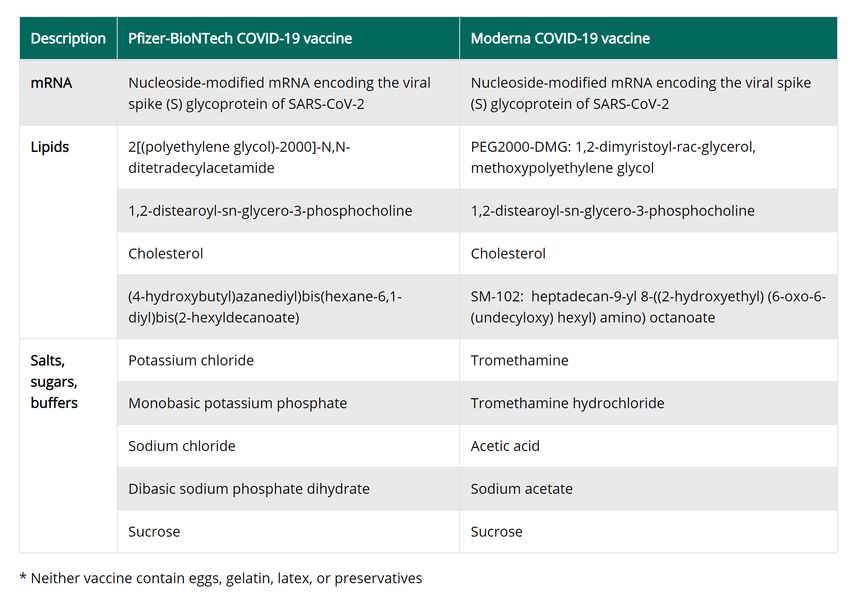
Potential culprit: polyethylene glycol
                (PEG)
Potential culprit: polyethylene glycol (PEG)
• PEG allergy is rare
• PEG widely used in medications and bowel preps,
and also in cosmetics and foods
• Not an ingredient in any non-COVID vaccine
• Such exposure could potentially explain how a
patient may be sensitized to PEG prior to COVID
vaccination but…Potential culprit: polyethylene glycol (PEG)
• The amount of PEG in injected medications associated
with potential allergic reactions is considerably higher
than that contained in the vaccine
– Methylprednisolone acetate injectable suspension
contains 29.1 mg PEG 3350 per 1 mL dose
– The Pfizer COVID vaccine contains 0.05 mg PEG
2000 per 0.3 mL dose
• To date, no confirmation of any case with positive
vaccine skin test and positive skin test or serum specific
IgE assay to PEGAnaphylactic reactions to mRNA
COVID vaccines
• Need to determine if IgE-mediated and if so,
search for culprit allergenmRNA COVID Vaccine Skin Testing • The stability of any potential allergens in vaccines is not known so skin testing should be performed using vaccine within the same six-hour timeframe from reconstitution used for vaccine administration • Some residual volume remains in multidose vials from both vaccines that can be used for skin testing, so as not to waste doses • For many other vaccines, prick full strength and intradermal diluted 1:100 have proved to be nonirritating concentrations • Prick and intradermal testing with full strength Pfizer mRNA COVID-19 vaccine has been reported to be non-irritating
SARS-CoV-2 Serology
• Alternative: assess for the presence of anti-SARS-CoV-2 IgG
  antibody as evidence of immune reactivity to the first dose
• Requires assay for IgG to spike protein specifically, not
  nucleocapsid protein
• If titers to the spike protein were positive and the risk of a
  reaction to a second dose were judged sufficiently high,
  second dose could be withheld, but no data to suggest single
  dose provides the same level or duration of protection from
  disease
mRNA COVID Vaccine Skin Testing
• Negative skin tests argue reaction not IgE-mediated
  – consider giving second dose in the usual manner
    under observation
mRNA COVID Vaccine Skin Testing
• Positive skin test results argue reaction was IgE-mediated:
– consider giving second dose in graded doses under close
observation
– perform PEG skin tests to assess PEG as a potential culprit
allergen
• Prick PEG 3350 17 gm in 17 mL saline and if negative,
• ID 1: 10 dilution of 40 mg/mL methylprednisolone acetate
suspension which contains 29.1 mg/mL PEG 3350
–More dilute concentrations if strong suspicion for PEG
allergymRNA COVID Vaccine Skin Testing • Administering second doses requires shared decision- making with the patient, weighing the risk of a vaccine reaction against the risk of remaining inadequately vaccinated against COVID-19 • Alternatively, administer second dose with another type of vaccine, e.g. Janssen (J&J) viral vector vaccine, although unknown safety and effectiveness of this approach
Ann Intern Med. [Epub ahead of print 6 April 2021]. doi:10.7326/L21-0104
www.cdc.gov/vaccines/covid-19/info-by-product/clinical-considerations.html
† People with a contraindication to one of the mRNA
COVID-19 vaccines should not receive doses of either of
the mRNA vaccines (Pfizer-BioNTech or Moderna).
* Immediate allergic reaction to a vaccine or medication is
defined as any hypersensitivity-related signs or symptoms
consistent with urticaria, angioedema, respiratory distress
(e.g., wheezing, stridor), or anaphylaxis that occur within
four hours following administration.
‡Includes people with a reaction to a vaccine or injectable
therapy that contains multiple components, one of which
is a vaccine component, but in whom it is unknown which
component elicited the immediate allergic reaction.
www.cdc.gov/vaccines/covid-19/info-by-product/clinical-considerations.html
#Polyethylene glycol (PEG) is an ingredient in both
mRNA COVID-19 vaccines, and polysorbate 80 is an
ingredient in Janssen COVID-19 vaccine. PEG and
polysorbate are structurally related, and cross-reactive
hypersensitivity between these compounds may occur.
People with a contraindication to mRNA COVID-19
vaccines (including due to a known allergy to PEG) have
a precaution to Janssen COVID-19 vaccine. Among
people who received one mRNA COVID-19 dose but for
whom the second dose is contraindicated, consideration
may be given to vaccination with Janssen COVID-19
vaccine (administered at least 28 days after the mRNA
COVID-19 dose).
People with a contraindication to Janssen COVID-19
vaccine (including due to a known allergy to polysorbate)
have a precaution to mRNA COVID-19 vaccines.
For people with these precautions, referral to an allergist-
immunologist should be considered.
In patients with these precautions, vaccination should
only be undertaken in an appropriate setting under the
supervision of a health care provider experienced in the
management of severe allergic reactions.
www.cdc.gov/vaccines/covid-19/clinical-considerations/managing-anaphylaxis.html
Changes you may wish to make in practice

• Stop asking about egg allergy prior to the
  administration of influenza vaccines
• Administer a single Tdap dose to all adolescents and
  adults regardless of interval since the last Td
• Administer injectable (inactivated) influenza vaccine
  and Tdap to pregnant patients
Changes you may wish to make in practice
• Encourage your colleagues overseeing vaccination clinics to:
  – recognize and treat anaphylaxis after vaccine administration,
    but to know there is a differential diagnosis
  – carefully record vital signs and physical exam findings
    (including skin, oropharynx and lungs), including photographs
    of skin findings if possible
  – obtain a blood sample within 4 hours of an apparent
    anaphylactic episode for mast cell tryptase
  – refer patients with histories of possible allergic reactions after
    immunization to allergy rather than simply labeling them
    “allergic”
You can also read


