Explainer: How Richard Branson will ride own rocket to space
←
→
Page content transcription
If your browser does not render page correctly, please read the page content below
Explainer: How Richard Branson will ride
own rocket to space
10 July 2021, by Marcia Dunn

                                                          BOSS ON BOARD

                                                          Just a week shy of turning 71, the London-born
                                                          founder of the Virgin Group says he's "not
                                                          apprehensive at all and it is the dream of a lifetime"
                                                          to ride into space. The longtime fitness fanatic put
                                                          in extra effort to prepare for the brief up-and-down
                                                          flight. "I'm in my 70s now so you either let yourself
                                                          go or you get fit and enjoy life." His wife, children
                                                          and grandchildren will be there as he climbs aboard
                                                          the rocket plane that's attached to a dual-fuselage
                                                          aircraft for takeoff. During the three to four minutes
                                                          of weightlessness, "I'll be looking back at our
                                                          beautiful Earth and taking it all in and realize that
                                                          only 500 other people have done this." Closer to
This Sept. 8, 2016 photo made available by Virgin         600, actually, but still a relatively small number.
Galactic shows the company's Spaceship Unity and          Upon landing, he'll celebrate with "a great, great
Mothership Eve. After reaching nearly 50,000 feet         grin on my face."
(15,000 meters), Unity will be released and drop for a
moment or two before its rocket motor ignites to send
the craft on a steep climb toward space. Credit: Virgin
Galactic via AP

Virgin Galactic will become the first rocket
company to launch the boss when Richard
Branson straps into one of his sleek, shiny space
planes this weekend.

The self-described tie-loathing adventurer and
troublemaker will join five company employees for
Sunday's test flight from New Mexico's southern
                                                      This Saturday, May 22, 2021 image provided by Virgin
desert—the company's fourth trip to the edge of
                                                      Galactic shows the release of VSS Unity from VMS Eve
space.                                                and ignition of the rocket motor over Spaceport America,
                                                      N.M. After reaching nearly 50,000 feet (15,000 meters),
Branson assigned himself to Virgin Galactic's first Unity will be released from the specially designed aircraft,
full-scale crew, jumping ahead of Blue Origin's Jeff and drop for a moment or two before its rocket motor
Bezos, an even richer rocketeer looking to launch ignites to send the craft on a steep climb toward space.
himself into space. Bezos' liftoff is set for July 20 Credit: Virgin Galactic via AP, File
from West Texas.

A brief look at Branson's ride and company:
                                                          WHO ELSE IS FLYING

                                                                                                         1/3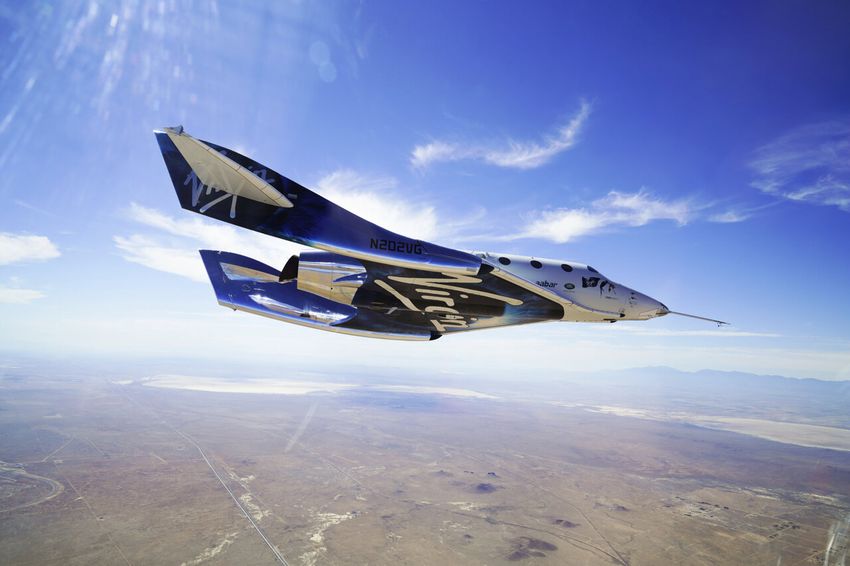
Two pilots are needed to fly the rocket plane from
the time it's released from the mothership to shoot
into space until it glides down to a runway. It will be
the third trip to space for chief pilot David Mackay,
a Scottish-born test pilot for the Royal Air Force
who went on to fly for Branson's Virgin Atlantic, and
the second for chief flight instructor Michael
Masucci. Chief astronaut instructor Beth Moses, a
former NASA engineer, is also launching for the
second time. Joining Branson as space rookies are
lead operations engineer Colin Bennett and Sirisha
Bandla, a vice president. The six will grab a lift from
mothership pilots C.J. Sturckow, a former NASA
astronaut, and Kelly Latimer.
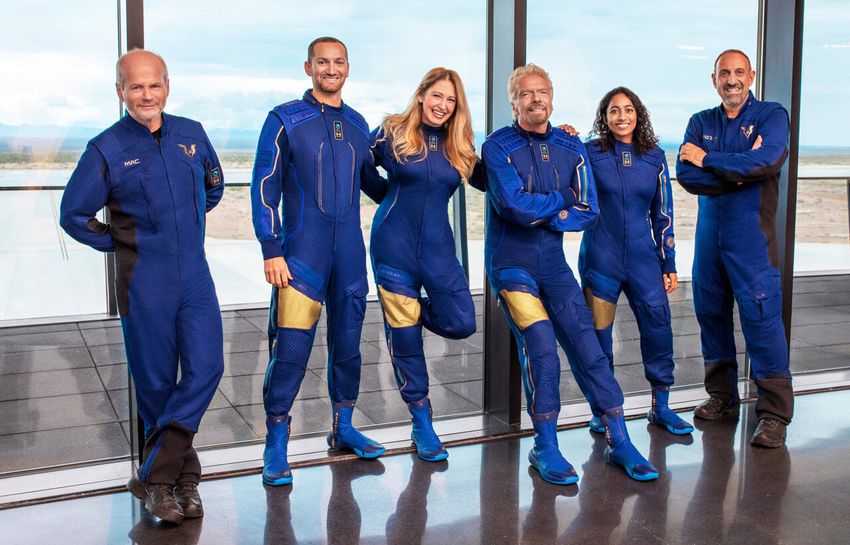
                                                      This image provided by Virgin Galactic shows, from left,
ROCKET PLANE                                          Chief Pilot Dave Mackay, Lead Operations Engineer
                                                      Colin Bennett, Chief Astronaut Instructor Beth Moses,
Virgin Galactic's space plane, Unity, will take off   Founder of Virgin Galactic Richard Branson, Vice
                                                      President of Government Affairs and Research
attached to a specially designed double aircraft
                                                      Operations Sirisha Bandla and pilot Michael Masucci.
nicknamed Eve after Branson's late mother. After
                                                      Just a week shy of turning 71, the London-born founder
reaching nearly 50,000 feet (15,000 meters), the      of the Virgin Group will become only the second
plane will be released and drop for a moment or       septuagenarian in space. Credit: Virgin Galactic via AP,
two before its rocket motor ignites to send the craft File
on a steep climb toward space, exceeding 3 G's, or
three times the force of Earth's gravity. The motor
will shut off once the craft reaches space—a
maximum altitude of about 55 miles (88 kilometers)
is anticipated—enveloping the ship in silence as
everyone but the pilots unbuckle, float and gaze out
the 17 windows at Earth and the black void of
space. After a few minutes of weightlessness, the
occupants will strap back in as the plane reorients
itself for entry—folding up its wings, then folding
them back down in unique technique known as
feathering. The rocket plane will glide back, NASA
space shuttle style, to conclude about 15 minutes
of free flight.

                                                          This May 29, 2018 photo made available by Virgin
                                                          Galactic shows the company's VSS Unity on its second
                                                          supersonic flight. After reaching nearly 50,000 feet
                                                          (15,000 meters), Unity will be released from the specially
                                                          designed aircraft Mothership Eve, and drop for a moment
                                                          or two before its rocket motor ignites to send the craft on
                                                          a steep climb toward space. Credit: Virgin Galactic via
                                                          AP

                                                                                                             2/3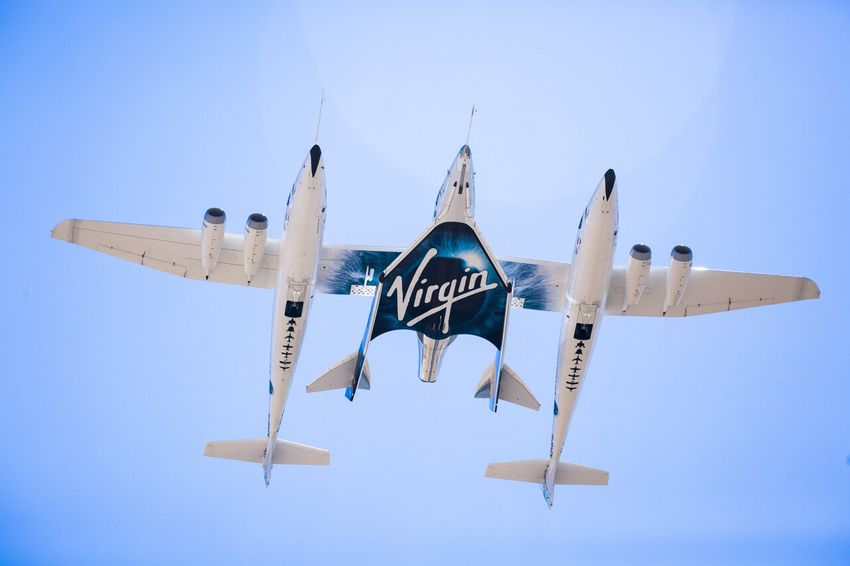
TRACK RECORD

                                   Founded in 2004, Virgin Galactic got its start when
                                   Branson teamed up with aircraft designer Burt
                                   Rutan to provide the necessary spaceship
                                   technology. A 2007 rocket motor test in California's
                                   Mojave Desert left three workers dead and three
                                   more injured. Then in 2014 the rocket plane
                                   Enterprise—named after the "Star Trek" ship—broke
                                   apart during a test flight, killing one pilot and
                                   seriously injuring the other. Unity, the replacement
                                   ship named by the late physicist Stephen Hawking,
                                   began flight tests in 2016. It made its first trip to the
                                   edge of space with two pilots in 2018 and the
                                   second in 2019, both times from Mojave. The
                                   operations moved to New Mexico's Spaceport
                                   America, with the plane soaring from there on May
                                   22 to achieve the company's third spaceflight.

                                   WHAT'S NEXT

                                   After Branson's launch, Virgin Galactic plans two
                                   more test flights this summer and fall before inviting
                                   paying customers on board. The next one will
                                   include more company employees, and the last will
                                   have Italian Air Force members conducting
                                   research. If all goes well, the first of the more than
                                   600 confirmed ticket holders will climb aboard next
                                   year. The company plans to reopen reservations
                                   once Branson soars. Initial tickets went for
                                   $250,000; no word on whether that will change.
                                   Branson promises a surprise after his ride to "give
                                   more people the chance to become an
                                   astronaut—because space belongs to us all." In the
                                   meantime, scientists are lining up for research
                                   rides, including Southwest Research Institute's Alan
                                   Stern, who was behind NASA's New Horizons
                                   mission to Pluto and beyond.

                                   © 2021 The Associated Press. All rights reserved.
                                   This material may not be published, broadcast,
                                   rewritten or redistributed without permission.
                                   APA citation: Explainer: How Richard Branson will ride own rocket to space (2021, July 10) retrieved 16
                                   October 2021 from https://phys.org/news/2021-07-richard-branson-rocket-space.html

                                   This document is subject to copyright. Apart from any fair dealing for the purpose of private study or research, no
                                   part may be reproduced without the written permission. The content is provided for information purposes only.

                                                                                                                                                3/3

Powered by TCPDF (www.tcpdf.org)
You can also read


