Forthroid on Android: A QR-code based Information Access System for Smart Phones
←
→
Page content transcription
If your browser does not render page correctly, please read the page content below
Forthroid on Android: A QR-code based
        Information Access System for Smart Phones
                          Tasos Alexandridis, Paulos Charonyktakis, Antonis Makrogiannakis,
                                  Artemis Papakonstantinou, and Maria Papadopouli
                                    Department of Computer Science, University of Crete &
                       Institute of Computer Science, Foundation for Research and Technology - Hellas

   Abstract—The Forthroid is a location-based system that “aug-     application that enables users to build interactive journals that
ments” physical objects with multimedia information and enables     associate multimedia files with locations on maps and share
users to receive information about physical objects or request      this information with other users.
services related to physical objects. It employs computer-vision
techniques and QR-codes. We have implemented a prototype on            The contribution of this paper is twofold: it presents the
Android platforms and evaluated its performance with systems        design and architecture of the system, and its performance
metrics and subjective tests. We discuss our findings and chal-     evaluation using subjective tests and system metrics, such
lenges in prototyping on Android OS. The analysis indicates that    as the delay, distance estimation error, battery consumption,
the network and the server are the main sources of delay, while     and CPU load. Moreover, it discusses some of the main
the CPU load may vary depending on the specific Forthroid
operation. The preliminary subjective test results suggest that     challenges that programmers often face, when developing
users tolerate these delays and the offered services can be         similar applications.
particularly useful.                                                   This paper is organized as follows: Section II presents
                                                                    related work, while Section III focuses on the architecture of
                      I. I NTRODUCTION                              the system. The performance of the system and the user study
   The emergence of wireless networks and their continuous          are discussed in Section IV. Finally, Section V summarizes
deployment world-wide has triggered a fast growth of location-      our main conclusions and future work plans.
aware and pervasive computing services and applications. We
designed and evaluated the Forthroid, a location-based system                            II. R ELATED W ORK
and set of services, that enables users to obtain multimedia           The community has developed several exciting location-
information about specific points of interest using their mobile    aware and mobile computing applications. For example, the
phones and provides users with services related to physical         CoolTown project [7] of the HP labs is a location-aware
objects (e.g., a printing service). The Forthroid can be easily     ubiquitous system that explores opportunities provided by
deployed and used in indoor and outdoor environments, such          the convergence of Web technology, wireless networks, and
as museums, campuses, and metropolitan areas.                       portable client devices to support “web presence” for people,
   The Forthroid uses QR-codes, which are two-dimensional           places, and things. The web technology is used in order to
barcodes that can encode various types of information. QR-          provide ad hoc access to services, based on techniques of
codes can be attached to physical objects. Already in sev-          embedding and recovering URLs in visual codes located on
eral metropolitan areas, such codes have been placed, e.g.,         objects and in places.
in stores, at the entrance of buildings to provide floorplan           Several mobile computing applications have been using
information, on walls for announcing upcoming events. An            barcodes [1]–[5]. For example, Ljungstrand et al. [3] proposed
example of usage of the Forthroid is illustrated in Figure 2.       barcode stickers, which can be attached to physical objects.
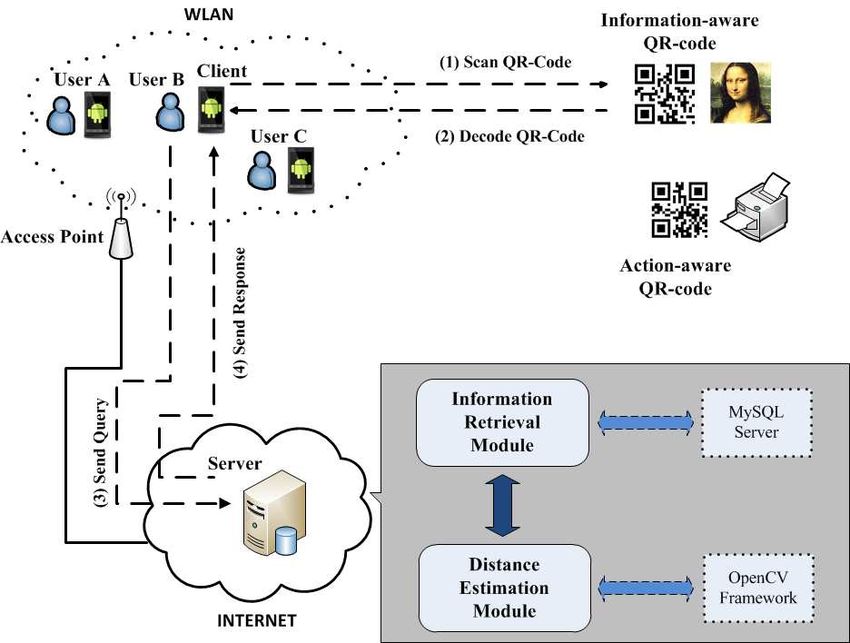
   The Forthroid architecture consists of QR-codes (associated      Barcode stickers map web pages to physical representations
with physical objects in proximity), Forthroid clients, that run    and enable users to access the web by scanning an attached
on Android smart phones, and the Forthroid multi-threaded           barcode.
server. A Forthroid client may scan QR-codes (associated               A comparative performance analysis of several vision-based
with a certain point of interest) and communicate with the          distance estimation algorithms is presented by Maidi et al.
Forthroid server via the Internet in order to retrieve multimedia   [8]. The authors developed a hybrid approach to distance
information or request services associated with that point of       estimation, that mixes an iterative and an analytical method
interest.                                                           for pose estimation. Their approach is compared to several
   Although the community has proposed similar QR-code              sophisticated vision-based algorithms. The execution time of
information access systems [1]–[5], to the best of our knowl-       their hybrid approach is 112µs for one pose estimation and
edge, there are no real-world studies that evaluate their per-      the mean distance error is 7.2mm for a distance of 1m.
formance.                                                              Several systems that use distance estimation algorithms with
   The Forthroid builds on our earlier work, the PhotoJournal       functionality similar to the Forthroid have been proposed.
[6]. The PhotoJournal is a novel location-based media sharing       Sony developed a new type of marker named CyberCode [1],
(a) (b)
Fig. 1. (a) A typical QR-code. (b) The main components of a QR-code.
Fig. 3. The Forthroid architecture.
(a) (b)
Fig. 2. (a) A user scans a QR-code in order to retrieve information The Forthroid architecture employs the client-server
about a point of interest at the Telecommunications and Networks Laboratory paradigm: it consists of the application that runs on the mobile
(FORTH). (b) A screen snapshot of the information returned to a user for a device (client) and the server. The client uses the ZXing API
specific point of Interest.
and the Barcode Scanner open-source application provided
by Google, for scanning and decoding QR-codes. The server
along with a visual tagging system with tracking capabilities. consists of two modules, namely, the information retrieval,
Ordinary mobile phones can easily recognize CyberCode tags, and the distance estimation module. To support information
enabling the estimation of the 3D position and orientation retrieval, the server deploys a MySQL database that contains
of the camera relative to the tag. TRIP [2] is a computer information regarding all points of interest, while the OpenCV
vision system which uses printable 2D circular markers for framework is used to perform the distance estimation. The
the identification and location estimation of objects. Evaluation server is multi-threaded and able to support a significant
results indicate that the recognition is successful on 98% of number of clients/requests.
the cases and the average error is less than 3cm. TRIP can Figure 3 illustrates the general architecture of the Forthroid.
identify entities within 3 meters distance. A user holding an Android smart phone points to a QR-code
Rukzio et al. [4] proposed the idea of user interaction (which is associated with a point of interest, for example a
through a mobile device with services that are related to painting). The Forthroid mobile application detects the QR-
a poster. The “interaction” between a mobile device and a code and decodes its unique identifier locally. A query for
poster uses cameras and near-field networks (e.g., WLANs, that point of interest is formed, containing the identifier of
bluetooth), or user input. Rohs et al. [5] utilized 2-dimensional the specific QR-code and the captured image. The client
visual codes, similar to QR-codes, in order to retrieve object- sends the query to the server via the Internet. The server
related information and functionality. Their recognition algo- receives the query and determines the type of the QR-code
rithm can detect multiple codes simultaneously and compute based on the enclosed identifier. If the type corresponds to
the coordinates of the target in the coordinate system induced an information-aware QR-code, the information retrieval and
by the code. However, none of these papers provide any distance estimation modules are invoked. The information
performance analysis study of their proposed system. retrieval module accesses the database to retrieve the appropri-
ate information and the distance estimation module performs
III. S YSTEM A RCHITECTURE camera calibration. The server forms a response that contains
The Forthroid utilizes QR-codes, which are entities of the the multimedia information about the point of interest and
Forthroid architecture, and their main components, namely, the the estimated distance (between the smart phone and the QR-
finder patterns, timing patterns, alignment patterns, and the code). Finally, the response is sent back to the client.
encoding region (as shown in Figure 1). A unique identifier In the case of an action-aware QR-code, action-specific
is encoded in each QR-code. The Forthroid defines and uses operations are performed by the server. Currently, we have
two QR-code types, namely, the “information-aware” and designed and evaluated the printing service: when a user scans
“action-aware” QR-codes. The information-aware QR-codes a QR-code, which is attached to a printer, a list of all the points
are attached to points of interest and associate them to specific of interest he/she has visited is displayed. The user can then
multimedia information, while the action-aware QR-codes choose an item from this list and information about this item
map the corresponding point of interest with certain services at the Forthroid server will be sent to the printer. In order to
that can be provided to users. support the printing service, the Forthroid needs to keep trackTABLE I
VARIOUS EVENT TYPES . T HE TERM Ti INDICATES THE TIME THE EVENT i first identified. Once correspondences are extracted, the camera
WAS RECORDED AT THE CORRESPONDING MONITOR matrix M can be estimated using several methods for camera
calibration, such as Least Squares Methods [10], nonlinear
Time Event description estimation methods [11], and iterative algorithms [9].
T1 client successfully decodes a QR-code
The corners of the finder patterns were used as the cali-
T2 client unicasts the query to the server
bration pattern. 36 correspondences are created where each
T3 server receives the query
correspondence reflects to a corner of a finder pattern square.
T4 server sends back the response
The upper-left corner is used to define the origin of the world
T5 client receives the response from the server
coordinate system.
T6 client displays the response to the user
We divided the camera calibration process into two parts:
TABLE II
the intrinsic parameters calibration, which is carried out only
D IFFERENT DELAY TYPES AS MEASURED BASED ON THE RECORDED once, and the extrinsic parameter estimation. The intrinsic
EVENT TYPES camera calibration was done using the MATLAB Calibration
Toolbox [12]. When a query arrives at the server, extrinsic
Delay Time
parameter calibration is performed in order to estimate the
Server T4 − T3
distance of the smart phone from the QR-code. This process
Network T5 − T4 + T3 − T2
consists of the following steps:
Android client T2 − T1 + T6 − T5
First, the image is rotated counterclockwise so that the
Total T6 − T1
position of the finder patterns in the image matches the
position of the finder patterns in the actual QR-code (lines
passing from the centers of the finder patterns form a “Γ”
of the points of interest each client visits. Each time a client shape). The angle of rotation is included in the client query.
sends a query requesting information for a point of interest, It is estimated by inspecting the position of the centers of the
the server creates a new entry in the database with the IP of finder patterns in the captured image.
the client and the identifier of the point of interest. Since IPs
Then, the corner detection procedure is carried out in order
are dynamically assigned and a new client may have the same
to create the world to image correspondences. The Harris
IP as an old one who “left” the network, these entries expire
corner detection algorithm [13] is applied in the three finder
after a certain period of time.
patterns of the QR-code. Specifically, Harris corner detector
The main operations of the Forthroid take place during two
is expected to find the twelve corners that correspond to the
distinct periods, namely, the preview, and the query period.
corners of the three squares inside each finder pattern. The
During the preview period, the Forthroid client uses the mobile
resulted correspondences are then used for extrinsic parameter
camera to continuously scan the area in order to detect and
estimation. After the extrinsic parameters are successfully
decode a QR-code. The query period includes the client-server
found, the camera center C (i.e. the 3D world coordinates of
communication and the display of the results on the screen of
the location of the camera) can be determined by [14]:
the smart phone.
The distance of the smart phone from the plane that the QR-
code is attached is estimated by camera calibration techniques. C = −R−1 t (3)
Camera calibration addresses the problem of determining
matrix M of Eq. (1), that projects a 3D point P from the world The distance of the user from the QR-code is estimated
coordinate system to a 2D point p in the image coordinate using the Euclidean distance from the camera center to the
system [9]: origin of the world coordinate system.
p = MP (1) IV. P ERFORMANCE A NALYSIS
where M is the 3x4 projective or complete camera calibration To evaluate the performance of the Forthroid, empirical-
matrix. Eq. (1) can be further decomposed into: based measurements and subjective tests were performed.
Specifically, first we measured the delay, the distance esti-
p = K[R|t]P (2)
mation error, and the battery consumption of the Forthroid
where K is the 3x3 matrix of the intrinsic parameters, which running on the Android device. Then, we performed a prelim-
are camera specific parameters and [R|t] is the 3x4 joint inary subjective study in the premises of our lab.
rotation and translation matrix, which constitutes the matrix The testbed includes an HTC Nexus One smart phone that
of the extrinsic parameters. Extrinsic parameters describe the runs Android 2.2 and a server, which is a 2.66 GHz Core 2
position of the camera in terms of orientation and translation Duo Dell Desktop with 2048 MB RAM and the Linux Ubuntu
with respect to the world coordinates. In order to estimate the Operating System. The server is connected via FastEthernet
extrinsic camera parameters, correspondences between points and the smart phone (client) is connected via IEEE802.11 to
in the world coordinate system and in the image must be the ICS-FORTH infrastructure network.1 1
0.9 0.9
0.8 0.8
0.7 0.7
0.6 Total delay 0.6
Server delay Scenario A
CDF
CDF
0.5 0.5 Scenario B
Network delay
0.4 Android delay Scenario C
0.4
0.3 0.3
0.2 0.2
0.1 0.1
0 0
0 2000 4000 6000 8000 10000 0 1 2 3 4 5 6 7 8
Delay (ms) Distcance Error (cm)
Fig. 4. Cumulative distribution function of the various types of delays Fig. 6. Cumulative distribution function of the distance estimation error.
introduced in the system.
Preview period
4
x 10 1
2 0.8
0.6
CDF
OLED
1.5 0.4 CPU
Delay (ms)
0.2
1 0
0 0.1 0.2 0.3 0.4 0.5 0.6 0.7
Energy consumption (mW/ms)
0.5 Query period
Total delay 1
Server delay
0 0.8
0 5 10 15 20 25 30 35 40 45 50 55
Number of requests 0.6 OLED
CDF
CPU
0.4 Wifi
Fig. 5. Mean delay versus the number of concurrent requests with 95%
confidence intervals. 0.2
0
0 0.1 0.2 0.3 0.4 0.5 0.6 0.7
Energy consumption (mW/ms)
A. Delay
Fig. 7. Cumulative distribution function of the battery consumption during
As it is illustrated in Tables I and II, the overall delay (i.e., the preview and query periods.
total delay) that a user experiences consists of the following
components:
1) Server delay: it corresponds to the total time elapsed sends to the Forthroid server a number of concurrent simu-
between the reception of a query by the server and the lated queries for points of interest. We varied the number of
transmission of a response. Its dominant components are concurrent requests from 5 to 50 (step of 5). Each experiment
the distance estimation and the database access parts of for a specific number of concurrent requests was repeated 10
the information retrieval. times and the total and server delay were measured (as shown
2) Network delay: it includes the network and propagation in Figure 5). A prominent increase in the delay occurs when
delay. the number of concurrent requests is 40 or more, due to the
3) Android client delay: it consists of the delay for the substantial increase of the memory required for processing all
query generation and the delay for displaying the re- the requests (reaching the available one). As a result, some
ceived data on the screen. threads may have to wait for others to finish, increasing the
Specifically, to measure these delays, the events shown server and the total delay.
in Table I were defined. When a specific event occurs, our
B. Distance estimation
software invokes a system call in order to get the current
system time in milliseconds. The various types of delays are To test the accuracy of the distance estimation module, a
then estimated according to Table II. range of distances from 40cm up to 2m was chosen. A QR-
In the first evaluation phase, a Forthroid client scans an code is scanned at every 10cm in this range. The QR-code size
information-aware QR-code. This process was repeated 30 is 11x11 cm. The distance of 40cm and 2m correspond to the
times. The resulted delay measurements are shown in Figure 4. minimum and maximum distance, respectively, for which the
The median values for the total, server, network, and android ZXing library was able to detect and decode the QR-code. The
delay are 5.68, 2.68, 1.99 and 1.01 seconds, respectively. The following scenarios were used for our measurements:
variance is relatively small (as shown in Figure 4). • Scenario A: The user is located in front of the QR-code,
To study the impact of the number of simultaneous requests holding the camera parallel to the surface that the QR-
on the server and total delay, we used a desktop PC that code is mounted.TABLE III
Q UESTIONNAIRE OF OUR PRELIMINARY SUBJECTIVE STUDY the wireless interface consumes no battery. The consumption
due to CPU is much higher during the preview period com-
Question 1 Easiness to get familiar with the Forthroid and use it pared to the query period, since during the preview period,
Question 2 Experience w.r.t. delay to obtain the information about the client device continuously tries to detect and decode a
the point of interest QR-code (which contributes to a great amount of CPU load).
Question 3 Usefulness of the application in general Note that fine level conclusions about the battery consumption
Question 4 Easiness to successfully scan QR-codes cannot be easily drawn, since the consumption due to OLED
operations depends on the specific content and color displayed
TABLE IV
P ERCENTAGE OF USERS THAT PROVIDED A SPECIFIC SCORE IN EACH
on the screen [16]. We also observed that in a few cases the
QUESTION battery consumption due to OLED operations is significantly
lower than the median value (as shown in Figure 7). In
Question 1 Question 2 those cases, at the query period, the content changes from
Trivial 66.7% Excellent 40% the specific image captured by the camera to an almost black
Very Easy 33.3% Very Good 33.3% screen, where the retrieved information is displayed. Moreover,
Satisfactory 0% Satisfactory 26.7% camera previewing is still displayed with small intensity. Such
Very Difficult 0% Not Satisfactory 0% cases occur when a user holds the mobile device in such a way
Too Difficult 0% Bad 0% that the content changes rapidly, while reading the retrieved
Question 3 Question 4 information.
Trivial 26.7% The CPU usage of the Android device during the preview
Very Useful 73.3% Very Easy 40% and the query period was also measured. To measure the
Useful 26.7 % Satisfactory 33.3% CPU usage we implemented a more lightweight version of the
Not That Useful 0% Very Difficult 0% Linux top command. Top displays a listing of the most CPU
Too Difficult 0% intensive tasks of the system. We altered the top command,
so as to measure the CPU usage on shorter intervals than
the original top tool (top measures CPU load every 1 sec).
• Scenario B: The user scans the QR-code holding the During the preview period the total CPU usage was 89.6%
camera from different angles. of the CPU power, while the one caused exclusively by the
• Scenario C: The user holds the camera with arbitrary Forthroid process was 67%. During the query period the total
rotation. As a result the QR-code is rotated in the captured CPU usage was 49.6%. During this period, our system uses
image. The user can stand either in front of the QR-code only 27.7% of the CPU, a percentage much lower than in the
or at some random angle. preview period.
Each scenario was repeated three times. Figure 6 illustrates
the error between the reported and the actual distance. The me- D. Subjective study
dian error for scenario A is 1.3 cm, while for scenarios B and We performed a preliminary user study to evaluate the user
C is 2.6 cm. Moreover, the application can report a distance experience running the Forthroid application. The user study
estimation at 94%, 84% and 87% of the cases for scenario A, was carried out in the Telecommunications and Networks
B and C, respectively. The distance estimation procedure fails Laboratory at FORTH. We attached four information-aware
when the correspondences are not correctly identified, due to QR-codes in various posters and one action-aware QR-code
blurry images caused by accidental movement of the camera next to the printer for the printing service. At first, we
when taking a picture. briefly presented the functionality of the Forthroid to the
C. Battery consumption 15 colleagues, mostly students of the Institute of Computer
Science at FORTH, who agreed to participate in our user study.
Given the energy constraints of mobile devices, a developer
We then asked them to use the system for at least 10 minutes.
should consider the efficient memory allocation and CPU
At the end, each user answered a questionnaire and evaluated
usage. The battery consumption and the CPU usage of the
his/her experience using the system. The questionnaire is
Forthroid were evaluated. The following experiment was car-
shown in Table III , while the scale/score for each question is
ried out: A user was holding the mobile device for some time
shown in Table IV. Table IV shows the percentage of users
during the preview period and then an information-aware QR-
that provided a specific score per question. Most of users found
code was scanned. The battery consumption during the two
easy to use the Forthroid and scan QR-codes and tolerated the
periods was recorded using the PowerTutor application [15].
delay.
The experiment was repeated 90 times. In each run, the battery
consumption due to the wireless interface, OLED display, and
E. Discussion
CPU was measured separately.
The median consumption of the wireless interface is 0.17 We faced several challenges while developing the Forthroid
mW/ms during the query period (as shown in Figure 7). Since on the Android platform related to the camera API, the screen,
no wireless communication occurs during the preview period, and GUI.During the preview period, the screen of the mobile device online social networking experience. The Forthroid technology
displays the area viewed by the camera. The preview resolution will be integrated with the PhotoJournal to create various
may vary from 176x144 pixels to 1280x720 pixels. This multimedia journals of the users’ visits [6]. Finally, the user
resolution differs from the picture resolution, which is the study will be extended to a larger user population, for longer
resolution to which a picture is taken by the camera. Typical period of time, and in different set of premises, in order to have
picture resolutions vary from 640x480 pixels to 2592x1952 more conclusive results about the quality of user experience.
pixels. The preview and picture resolutions depend on the
ACKNOWLEDGMENT
specific model and brand of the device. The relatively low
preview resolutions constraints the application. Camera cal- The authors would like to thank Manolis Surligas for
ibration procedures require high resolution images in order his help during the implementation of the lightweight top
to provide accurate results. We overcame this problem by command for the evaluation of the CPU usage. Thanks also
capturing two pictures, one in the preview resolution for the goes to Google for their equipment grant with Androids smart
process of QR-code decoding, and one in the picture resolution phones (Google AndroidEDU programme).
for the distance estimation. When a QR-code is detected, the R EFERENCES
application invokes the takePicture() method of the Camera
[1] J. Rekimoto and Y. Ayatsuka, “Cybercode: designing augmented reality
API in order to capture a picture with the highest resolution environments with visual tags,” in Proceedings of DARE 2000 on
available from the picture resolutions. Designing augmented reality environments, Elsinore, Denmark, April
As in the case of most portable mobile devices, Android 2000.
[2] D. Lopez de Ipina, P. R. S. Mendona, and A. Hopper, “Trip: A low-cost
smart phones have relatively small screens. Inevitably, all vision-based location system for ubiquitous computing,” Personal and
mobile application developers come across the challenge to Ubiquitous Computing, pp. 206–219, May 2002.
fit all the graphical content on such small screens. Moreover, [3] P. Ljungstrand, J. Redström, and L. E. Holmquist, “Webstickers: using
physical tokens to access, manage and share bookmarks to the web,”
the GUI should be user-friendly to be easily used without any in Proceedings of DARE 2000 on Designing augmented reality environ-
special training. We attempted to keep the GUI simple and ments, Elsinore, Denmark, 2000.
provide a Help button in the menu in order to guide users that [4] E. Rukzio, A. Schmidt, and H. Hussmann, “Physical posters as gateways
to context-aware services for mobile devices,” IEEE Workshop on Mobile
are unfamiliar with technology or similar applications. Computing Systems and Applications, pp. 10–19, December 2004.
V. C ONCLUSIONS AND F UTURE W ORK [5] M. Rohs and B. Gfeller, “Using camera-equipped mobile phones for in-
teracting with real-world objects,” in Advances in Pervasive Computing,
This work focused on the Forthroid, a location-based infor- Linz/Vienna, Austria, April 2004.
mation retrieval system, and analyzed the delay, the distance [6] N. Kotilainen and M. Papadopouli, “You’ve got photos! the design and
evaluation of a location-based media-sharing application,” in 4th Inter-
estimation error, and the battery consumption of the system. national Mobile Multimedia Communications Conference (Mobimedia),
The performance analysis indicates that the heavyweight im- Oulu, Finland, July 2008.
age processing functions result in a significant increase of the [7] T. Kindberg, J. Barton, J. Morgan, G. Becker, D. Caswell, P. Debaty,
G. Gopal, M. Frid, V. Krishnan, H. Morris, J. Schettino, B. Serra, and
total delay. Moreover, the network delay is also considerable M. Spasojevic, “People, places, things: web presence for the real world,”
due to the overheard induced in the network from transmitting Mob. Netw. Appl., pp. 365–376, October 2002.
large-sized images. On the contrary, the efficient hardware [8] M. Maidi, J. Y. Didier, F. Ababsa, and M. Mallem, “A performance
study for camera pose estimation using visual marker based tracking,”
and software of the HTC Nexus One smart phone result in Machine Vision and Applications, pp. 365–376, 2010.
relatively small processing delays. A significant amount of the [9] R. Szeliski, Computer Vision: Algorithms and Applications. Springer-
total CPU is “utilized” by the preview period. In contrast, the Verlag New York Inc, 2010.
[10] D. A. Forsyth and J. Ponce, Computer Vision: A Modern Approach.
corresponding CPU load during the query period is smaller. Prentice Hall, 2002.
However, during the query period the wireless interface and [11] J. Heikkila and O. Silven, “A four-step camera calibration procedure
the OLED are the main sources of energy spendings. with implicit image correction,” in Proceedings of Computer Vision and
Pattern Recognition, San Juan, Puerto Rico, 1997.
We also performed a preliminary subjective study to eval- [12] J. Y. Bouguet, “Camera calibration toolbox for Matlab.” [Online].
uate the user experience. The study suggests that users can Available: http://www.vision.caltech.edu/bouguetj/calib doc/
tolerate a 5.68 sec delay. Users characterized the Forthroid [13] C. Harris and M. Stephens, “A Combined Corner and Edge Detection,”
in Proceedings of The Fourth Alvey Vision Conference, Manchester,
as a useful system, encouraging us to plan a larger-scale 1988.
deployment. We plan to extend the Forthroid to support more [14] R. Hartley and A. Zisserman, Multiple View Geometry in Computer
services, e.g., enable the retrieved information to be sent via Vision. Cambridge University Press, 2003.
[15] L. Zhang, B. Tiwana, Z. Qian, Z. Wang, R. P. Dick, Z. M. Mao,
e-mail, posted it on a social networking page, or superimposed and L. Yang, “Accurate online power estimation and automatic battery
on Google Maps. Also, we will improve the scanning/decoding behavior based power model generation for smartphones,” in Pro-
of QR-codes process by providing additional (visual or audi- ceedings of the eighth IEEE/ACM/IFIP international conference on
Hardware/software codesign and system synthesis, Scottsdale, AZ, USA,
tory) “messages/clues”, taking into consideration the feedback 2010.
from the user study. [16] M. Dong, Y.-S. K. Choi, and L. Zhong, “Power-saving color transfor-
The integration of the Forthroid with Facebook and other mation of mobile graphical user interfaces on oled-based displays,” in
Proceedings of the 14th ACM/IEEE international symposium on Low
social networking applications will enable users to enrich their power electronics and design, San Fancisco, CA, USA, 2009.You can also read


