Communication Strategy - 2021 update - WHO | World Health ...
←
→
Page content transcription
If your browser does not render page correctly, please read the page content below

Communication Strategy
2021 update

Eliminate Yellow Fever Epidemics (EYE) Communication Strategy		                                                  Update 2021

Contents
Overview.......................................................................................................................3
    Background on Eliminate Yellow Fever Epidemics (EYE),
    and communication rationale..................................................................................3
    The Global EYE Strategy 2017 – 2026.......................................................................3
    The Role of the EYE Partnership...............................................................................4
Communication strategy............................................................................................6
    Overview...................................................................................................................6
    Aims and objectives of the communication strategy..............................................7
Key messaging.......................................................................................................... 10
    Key achievements of EYE to date ..........................................................................10
    EYE key messages...................................................................................................11
    Target audiences.....................................................................................................12
    Content and channels for target audiences..........................................................13
    Communication channels......................................................................................16
           2021 content calendar.....................................................................................17
           Branded materials...........................................................................................19
           Social media calendar.....................................................................................19
           Press.................................................................................................................20
    Key communication relationships.........................................................................20
           EYE governance structure...............................................................................21
           Communication contacts ...............................................................................22
    Crisis communications’ planning...........................................................................23
    Monitoring and evaluation of communications....................................................23
    Resource plan for 2021...........................................................................................24
Appendix 1 Communications survey..........................................................................25
Appendix 2 Useful links...............................................................................................29
Acknowledgements.....................................................................................................30
Cover image: Yellow fever vaccination campaign                  2
Kinshasa, Democratic Republic of the Congo, August 2016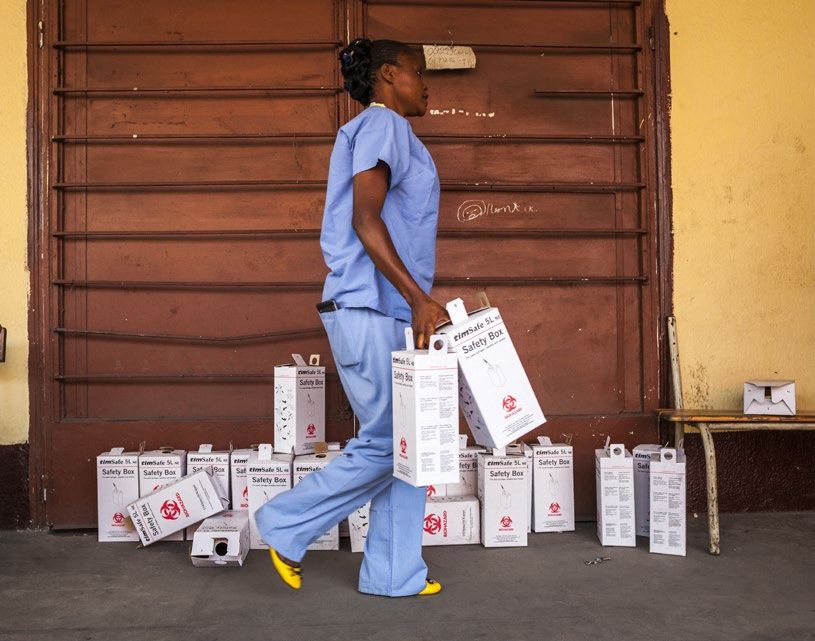
Eliminate Yellow Fever Epidemics (EYE) Communication Strategy		                      Update 2021

Overview
Background on Eliminate Yellow Fever Epidemics (EYE)
and communication rationale
The major yellow fever outbreaks in Angola and the Democratic Republic of Congo in 2016, and
resulting public health crises, created the need for a comprehensive, updated and scaled-up
strategy to eliminate yellow fever epidemics. The resurgence of the disease has been a result of a
number of factors, including:

  Populations           Urbanization      Population          Climate             Resurgence
  with low                                mobility            change              of the Aedes
  levels of                                                                       aegypti
  immunity                                                                        mosquito
  against                                                                         globally
  yellow fever

For any control strategy to succeed, it needs to be supported by a practical and holistic
communication strategy. This communication strategy addresses both the information and
advocacy needs of the EYE partnership, and public-facing communications, as expected with
major public health strategies.

When working with a number of organizations towards a common goal, it is imperative there is a
clear and unified voice. This document aims to address that important need.

Additional information on yellow fever can be accessed     here
The Global EYE Strategy 2017 – 2026
The EYE strategy has three strategic objectives:

                 Protect at-risk        Prevent                 Contain
                 populations            international           outbreaks
                                        spread                  rapidly

                                                   3
                                                                                                 Contents
Eliminate Yellow Fever Epidemics (EYE) Communication Strategy		                      Update 2021

Overview

And five competencies of success:

               Affordable               Strong political         High level
               vaccines and             commitment at            governance
               sustained                global, regional         with long-term
               vaccine market           and country              partnerships
                                        levels

                            Synergies with          Research and
                            other health            development for
                            programmes and          better tools and
                            sectors                 practices

The full EYE strategy can be read   here
The Role of the EYE Partnership
The EYE Partnership exists to provide a global oversight, whilst effectively supporting and
coordinating local efforts to detect and prevent yellow fever outbreaks.

To date, the Partnership has developed and led the EYE strategy by:

   1. Establishing a governance structure for the participating organizations, regions, and
      countries (see Governance Structure on page 21).
   2. Developing tools, protocols, and procedures for delivering the strategy, as well as for
      responding to emergencies.
   3. Updating and communicating with all stakeholders about EYE’s work and results.

The EYE communication strategy is a guide for internal and external communication activities
that support the EYE Partnership’s vision of eliminating yellow fever epidemics by 2026.

It is the role of the EYE Partnership to deliver both the EYE strategy and the communication
strategy. Some of the key organizations comprising the EYE Partnership are the World Health
Organization, Gavi, the Vaccine Alliance, UNICEF, US CDC and the Bill and Melinda Gates
Foundation.

                                                4
                                                                                                Contents
Eliminate Yellow Fever Epidemics (EYE) Communication Strategy		                      Update 2021

Overview

The communication strategy is intended for use by all EYE partners and respective
communication teams, as well as regional and country colleagues who will need to
communicate about the work of EYE. It will also be publicly available for others, such as non-
governmental organizations (NGOs) and private sector organizations, who may wish to read
or share content published about EYE.

                 Yellow fever vaccination campaign, Rio de Janeiro, Brazil, 2018

                                                5
                                                                                                 Contents
Eliminate Yellow Fever Epidemics (EYE) Communication Strategy Update 2021
Communication strategy
Overview 2020
This communication strategy has been
written following a communication survey Review of all
in 2020 to determine the information needs communication activities,
of the EYE stakeholder community, and will including annual partner
serve as a template for future years. It will be meeting,
updated annually to reflect the emergence Development and
and availability of new communication dissemination of
tools, methods and forums, as well as the communication survey,
changing global landscape of macro and Development of
micro geopolitical factors, amongst others. communication strategy.
Full details on the communication survey
can be found in Appendix 1.
The EYE strategy runs until 2026. On 2021
the right is a high-level timeline for the
communication activities through 2021. Feedback on and
finalization of
communication strategy,
Dissemination of
communication strategy,
6-month content strategy
– completed in December
2020,
Identifying dedicated
social media resource
from within EYE partner
network,
Building communication
network.
2022– 2026
To be confirmed
07 6
ContentsEliminate Yellow Fever Epidemics (EYE) Communication Strategy Update 2021
Aims and objectives of the
communication strategy
The EYE communication strategy has four main aims:
Aim 1: Increase awareness of the EYE strategy 2017 – 2026
Objective(s):
For each year of the strategy, develop a 12-month content calendar with multimedia
deliverables to include video, webinar and podcast, as well as written content, such as
newsletters and reports (see content calendar on page 17)
Specific activities that will be conducted in 2021, and may serve as a basis to plan for
activities in future years:
Select video production suppliers via formal procurement process in Democratic
Republic of Congo and Nigeria for the creation of vaccination campaign videos.
Selection process to be concluded in Quarter 2 (Q2)
Produce 3-to-5-minute video to explain the role of EYE and its strategy (Q2)
Produce 3-minute animated video to explain the role of the EYE.ops team in the
EYE strategy (Q3)
For each year of the strategy, develop a 12-month social media calendar including
key dates for public health awareness campaigns, in conjunction with partner
communication teams (see social media calendar on page 19):
For 2021, identify social media resource in Q3, to help increase number of
postings, following and reach, and to help define goals and metrics for the rest of
the year. This may need to be repeated in subsequent years of the EYE Strategy
Produce monthly newsletter (public communication) to include updates on vaccination
campaigns, outbreak information and response, international health regulations and
public health advice. To be circulated mid-month via email marketing software and
social media
Update and share the EYE social media toolkit six monthly basis with the EYE
community to increase sharing of posts and content
Schedule a minimum of 3 posts per week on Twitter, Facebook and LinkedIn to
increase following and sharing of EYE content
Monitor partner social media accounts for relevant content and updates on a weekly
basis
7
ContentsEliminate Yellow Fever Epidemics (EYE) Communication Strategy Update 2021
Aims and objectives of the communication strategy
Aim 2: Monitor and evaluate communication activities
Objective(s):
Every quarter, review analytics vs goals set for social media accounts, email marketing
software and EYE web pages
Specific activities that will be conducted in 2021, and may serve as basis to plan for
activities in future years:
Define analytics goals in Q1 for the rest of 2021
Use feedback from the 2020 communication survey to refine content calendar and
messaging, to improve open and engagement rates for email communications
Review and cleanse distribution lists in Q1 to ensure the right publications are
being sent to the correct target audience, to increase open and engagement rates
Develop standard operating procedures (SOPs) by the end of Q1, for production of
monthly communications, design and video assets, and all other EYE information
products
Aim 3: Increase commitment of time and resources from key
stakeholders through communication and advocacy activities
Objective(s):
Produce monthly leadership reports (internal communication) to include newsletter
updates (as above), as well as monitoring and evaluation of data, and progress
updates against the EYE strategy deliverables – in conjunction with Data Visualization
Consultant. To be circulated mid month
The EYE Secretariat’s communication focal person to attend working groups (WGs),
project management group (PMG), technical forum and leadership meetings,
where appropriate, to maintain contact with key stakeholders; understand specific
information needs and assist with the creation of relevant content and messaging
The EYE Secretariat’s communication focal person to oversee development of a suite
of communication channels and products to engage with key stakeholders, and to
disseminate information about the value and successes of EYE. This will be done
through webinars, roundtable discussions, podcasts, as well as newsletters and reports
8
ContentsEliminate Yellow Fever Epidemics (EYE) Communication Strategy Update 2021
Aims and objectives of the communication strategy
Aim 4: Enhance the EYE brand and design identity
Objective(s):
Specific activities that will be conducted in 2021, and may serve as basis to plan for
activities in future years:
Oversee design of new templates for the monthly newsletter, monthly leadership
report and annual highlights by the end of February; implement across all
publications in Q1
Oversee redesign of social media assets, including banners for Facebook, Twitter
and LinkedIn; implement across all publications in Q1
Review of key messages (see page 10) by end of Q3; refine existing messages, and
create new messages, if needed
Develop logo usage guidance
Yellow fever vaccination campaign, Kinshasha, Democratic Republic of Congo, 2016
9
ContentsEliminate Yellow Fever Epidemics (EYE) Communication Strategy Update 2021
Key messaging
In this section, we demonstrate the key achievements of EYE to date, and the relevant messaging
to be used in communications going forward. The messaging will be reviewed on a quarterly
basis to ensure it is accurate and relevant, and any relevant documents and web pages will be
updated to reflect any changes.
Key achievements of EYE to date
Through the strength of the partner organizations coming together with a robust strategy, as
well as consistent and continued investment in communication and advocacy, there have been
some notable achievements in the goal to eliminate yellow fever epidemics.
Close to 200 million people have been protected against yellow fever in Africa since EYE’s
inception.
In 2020, 48 million people were protected against yellow fever in Africa in 2020, despite
COVID-19, through preventive, reactive, and catch-up campaigns (Ghana, Ethiopia,
Nigeria, South Sudan, Sudan and Uganda).
Stronger laboratory capacity in Africa, with faster confirmation.
Increasing engagement with the EYE strategy at three levels (country, regional and
global) and in three regions (Africa (AFRO), Americas (PAHO), North Africa, Middle East
(EMRO)).
Development of innovations and tools for streamlined, transparent, and risk-informed
decisions (e.g., national risk analysis tool, vaccine allocation prioritization).
Increase in yellow fever vaccine supply, and confidence in production. 135 million doses
(Md) available globally in 2019 (of which 85 Md for Africa), 150 Md in 2020.
Better ways of detecting, quantifying, and managing YF outbreaks:
Improved coordination between levels to support countries to detect and
manage outbreaks
Advances in sample transport via EYE.ops
Improved reagent availability and timely replenishment
Updated ICG (International Coordinating Group on Vaccine Provision) requests to
better assess risk and define interventions
Advocating for sustained and improved routine immunization coverage to prevent yellow
fever re-emergence, such as in West Africa.
Despite the global challenges of COVID-19, the EYE Partnership was able to adapt in
effective and innovative ways, maintaining delivery of the EYE strategy throughout 2020.
10
ContentsEliminate Yellow Fever Epidemics (EYE) Communication Strategy Update 2021
Key messaging
EYE key messages
Existing key messages, as of 2021:
We aim to eliminate yellow fever epidemics by 2026.
We aim to protect almost 1 billion people from yellow fever in Africa and the Americas by
2026.
We have protected nearly 200 million people from yellow fever since the inception of EYE
in 2017.
In 2020, we protected 48 million people in Africa from yellow fever.
The COVID-19 vaccine roll-out is crucial for equitable protection and halting the
pandemic, however we need to ensure continuity of YF vaccination to prevent outbreaks.
Yellow fever cannot be eradicated, but we can eliminate yellow fever epidemics.
EYE has three strategic objectives: to protect at-risk populations from yellow fever;
prevent international spread, and contain outbreaks rapidly.
EYE offers a continuum from prevention to outbreaks, which has helped to prevent and
respond to yellow fever emergencies over the last three years.
The EYE strategy supports 40 countries and involves more than 50 partners.
Without the work of EYE and its partners, yellow fever has the potential to become an
epidemic with international spread.
Preventive mass campaigns, combined with routine immunizations and catch-up
activities, are effective ways to prevent yellow fever outbreaks.
Countries lead the efforts to prevent yellow fever outbreaks. EYE supports this by
enhancing their surveillance, laboratory and vector control capacity.
We aim to identify and protect at-risk workers from yellow fever, by engaging with the
private sector to protect unimmunized employees with sylvatic exposure.
We aim to prevent international spread by protecting at-risk workers, applying
International Health Regulations (IHR) and building resilient urban centres.
11
ContentsEliminate Yellow Fever Epidemics (EYE) Communication Strategy Update 2021
Key messaging
Target audiences
This communication strategy will focus on the following target audiences:
Financial Governance entities such At-risk countries
partners as Gavi, UNICEF & WHO (national health authorities and
affected communities in priority)
Technical experts:
Epidemiologists
Entomologists General
One health community public
International health regulation (IHR) community
Urban health community
Immunization community
Non-governmental organizations (NGOs)
Academic
and civil society organizations (CSOs),
community
such as the Pandemic Action Network
Each identified audience has varying information and communication needs. Therefore,
individual messages and communication materials will be required to address specific interests.
See page 13.
12
ContentsEliminate Yellow Fever Epidemics (EYE) Communication Strategy Update 2021
Key messaging
Content and channels for target audiences
Types of content / information /
Target audience Best channels
messaging
Governance entities Monitoring and evaluation Monthly leadership report
– Gavi, UNICEF, WHO Progress vs. strategic goals to date (formerly monthly update) with
newsletter combined
Annual workplan progress
Roundtables
Return on investment – both time
and resources Webinars
Impact of programmes LinkedIn
Programme risks Annual meeting
Campaigns Website
Cross-disease linkages Social media
Information/tools on how EYE can
support all partners to further all
aspects of the strategy
Country case studies
Process and timeline data
IHR
Clinical management
Working group updates
Current financial partners Monitoring and evaluation Monthly leadership report with
Progress vs. strategy to date newsletter combined
Annual workplan progress Roundtables
Return on investment – both time Webinars
and resources LinkedIn
Impact of programmes Annual meeting
Programme risks Website
Campaigns
Cross-disease linkages
Country case studies
Process and timeline data
IHR
Clinical management
Working group updates
13
ContentsEliminate Yellow Fever Epidemics (EYE) Communication Strategy Update 2021
Key messaging
Types of content / information /
Target audience Best channels
messaging
Potential financial Impact of programme deliverables Newsletter
partners Campaigns High-level monthly progress
updates on EYE Strategy and
Country case studies
work plans
Webinars
Website
Social media
Press / radio
Podcast
Wider partner Monitoring, evaluation and impact Monthly leadership report with
community Progress vs. strategy to date newsletter combined
Annual workplan progress Roundtables
Return on investment – both time Webinars
and resources LinkedIn
Impact of programmes Annual meeting
Programme risks Website
Campaigns Social media
Cross-disease linkages Press / radio
Information / tools on how EYE can
support all partners to further the
strategy
Country case studies
Process and timeline data
IHR
Clinical management
Working group updates
Technical experts: No specific programme of Newsletter
communications Roundtables
Epidemiologists, Consider their topics of interest Webinars
entomologists,
One Health experts, IHR LinkedIn
community, Annual meeting
urban health Website
community,
Social media
immunization
community Press / radio
14
ContentsEliminate Yellow Fever Epidemics (EYE) Communication Strategy Update 2021
Key messaging
Types of content / information /
Target audience Best channels
messaging
Regional / country level Monitoring, evaluation and impact Newsletter
Progress vs. strategy to date High level monthly progress
Annual workplan progress updates on EYE Strategy and
work plans
Return on investment – both time
and resources Roundtables
Impact of programmes Webinars
Programme risks LinkedIn
Campaigns Annual meeting
Cross-disease linkages Website
Information / tools on how EYE can Social media
support all partners to further the Press / radio
strategy Podcast
Relevant technical information to
help assess and respond to needs
Process and timeline data to
facilitate knowledge sharing
IHR
Clinical management
Working group updates
General public Campaigns Newsletter
and media Digital content (photo galleries, Press releases
video and photo stories) Website
Country case studies Social media
Yellow fever facts / information Press conferences, interviews
Public health safety and other events open to the
Travel information media
Data visualisation Press / radio
Podcast
15
ContentsEliminate Yellow Fever Epidemics (EYE) Communication Strategy Update 2021
Communication channels
Below are the existing and planned communication channels for EYE:
Existing channels:
EYE annual Partner/ Weekly epidemiological record – an
partners’ meeting country calls annual yellow fever update is provided
Working Monthly Monthly Scientific
group calls newsletter leadership journals
report
Press releases, Partner websites Social media – Scientific
and other media and social media Twitter, LinkedIn, journals
products channels YouTube,
Facebook
Quarterly Programme Management WHO website Branded
Group (PMG) updates to vaccine goods
manufacturers
Future channels:
Press conferences Podcast Webinars Op-eds
(via DG Press (to be developed (to be developed
Conference, WHO by Communication by Communication
– talking points Consultant – in post Consultant – in post
provided on a until December 2021) December 2021)
fortnightly basis)
16
ContentsEliminate Yellow Fever Epidemics (EYE) Communication Strategy Update 2021
Communication channels
2021 Content calendar
This is a high-level content plan based on the consulting resource available until the end of the
year.
More detailed information on specific content, i.e., project timelines for video production, can be
obtained from the EYE communication consultant (see page 22).
This content plan takes into account the outputs of the communication survey, feedback from
discussions with partners and communication colleagues, and seeks to meet the aims listed on
pages 7 to 9 of this strategy.
Month Content
January December newsletter + annual report
December update
Start to identify local production resources for in-country content
February January newsletter
January update
Start storyboarding of ‘What is EYE? Overview of EYE Strategy’ video
March February newsletter
February update
April March newsletter
March update
Start podcast planning – finalize speakers and topics: migration; climate
change; urban risk; reemergence of other diseases; vaccination / positive use of
vaccines; identify podcast production company
Identify podcast production resource
May April newsletter
April update
Start podcast production - 10 episodes
June DRC campaign shoot
May newsletter
May update
Webinar – EYE.ops
17
ContentsEliminate Yellow Fever Epidemics (EYE) Communication Strategy Update 2021
Communication channels
Month Content
July June newsletter
June update
Podcast series to begin
August July newsletter
July update
WER annual update
Start production of EYE.ops video
Nigeria campaign shoot
September August newsletter
August update
October September newsletter
September update
Start production of ‘What is EYE? Overview of EYE Strategy’ video
Annual meeting
November October newsletter
October update
December November newsletter
November update
Holiday message
18
ContentsEliminate Yellow Fever Epidemics (EYE) Communication Strategy Update 2021
Branded materials
Currently, there is a suite of branded materials, which includes notebooks, mugs, tote bags,
pens, lanyards, baseball caps, USB storage sticks and face masks. There is no plan to produce
anything further in 2021.
Social media calendar
The EYE social media channels were created in September 2020, and therefore, engagement
is currently minimal. These are the key objectives to increase the following, and ensure the
broadest possible reach of EYE communications:
Create new social media design assets i.e., banners, digital content (photo galleries and
short videos), social media tiles (in progress at the time of writing this document)
Develop a social media calendar in conjunction with partner communications and social
media team (in progress)
Identify resource to help write social media posts, boost metrics and provide regular
analytics reports (in progress)
*To be completed in conjunction with communications colleagues across the partnership.
2021 Key
Events
January February April
World (Neglected International Day of World Health Day (7th)
Tropical Disease) NTD Women and Girls in World Health Worker Week (7th to 11th)
Day (30th) Science World Malaria Day (25th)04
World ImmunizationWeek (24th to 30th)
01 02 04
May August October
World Health Assembly (24th May to 1st June) World Mosquito Day EYE annual partners’
(20th) – US CDC led meeting (TBC)
05 04 08 10
19
ContentsEliminate Yellow Fever Epidemics (EYE) Communication Strategy Update 2021
Press
The communication focal point maintains fortnightly contact with the WHO / WHE
communications focal point, Marie Bracquemont, who is supporting the EYE Secretariat
with the co-ordination of press releases from country and regional WHO communication
contacts.
The communication focal point is now part of the partnership communication calls,
which are bi-weekly and involve a number of agencies and organizations to co-ordinate
communication strategy and activities. Hosted by Global Health Strategies.
Develop a list of relevant press and journal contacts, by working with partner
communication peers.
Press kit to be developed once communication strategy is approved, in conjunction with
partner communication peers.
Key communication relationships
This section highlights the key EYE stakeholders with whom to maintain relationships. It also
provides information on EYE’s sources of information and content.
Nigeria Centre for Disease Control (NCDC) YF diagnostic training
workshop supported by EYE, 2021
20
ContentsEliminate Yellow Fever Epidemics (EYE) Communication Strategy Update 2021
EYE governance structure
Partner Type of information
Information on Gavi application deadlines, procedures and eligibility
Updates from UNICEF Supply Division on vaccine supplies
WHO Social Media accounts for sharing EYE content
Documentation clearance
Website update
WHO
Portal development
Communications
Departments (DCO) Country press releases and content
Emergencies press releases and content
21
ContentsEliminate Yellow Fever Epidemics (EYE) Communication Strategy Update 2021
Communication contacts
Below is a list of the communication relationships to be maintained as part of the
communications focal point’s role. Network will be broadened to include wider partners with
communication contacts, to help amplify EYE messaging and collaborate on marketing and
communication campaigns and activities.
Name Organisation Contact
Rakhee Verma EYE Partnership vermar@who.int
Marie Bracquemont WHO (WHE) bracquemontm@who.int
Priyanka Khanna (Measles /
UNICEF pkhanna@unicef.org
Rubella)
Miraj Pradhan,
UNICEF mpradhan@unicef.org
Polio Communications
Margaret Silver
US CDC uvt8@cdc.gov
(Arboviral diseases)
Oka Sakuya AFRO okas@who.int
Charity Warigon WHO Nigeria warigonc@who.int
Inas Hamam EMRO hamami@who.int
22
ContentsEliminate Yellow Fever Epidemics (EYE) Communication Strategy Update 2021
Crisis communications’ planning
A group of key stakeholders representing a cross section of the EYE community will be convened
in 2021 to do the following for crisis communications:
Brainstorm Brainstorm Identify Work with
all potential possible spokespeople communication
scenarios for responses for each colleagues in WHE
which crisis for internal scenario to understand
communications audiences and existing protocols
may be needed the media and materials on
i.e., outbreaks approach to crisis
communications
Monitoring and evaluation of
communications
One of the key objectives of this communication strategy is to devise and implement robust ways
and metrics for monitoring the effectiveness of EYE communications. By using built-in analysis
tools for the software and social media platforms we utilize, and eliciting external support where
possible and necessary.
Targets will be set in Q3 for email marketing software, social media and web analytics.
The social media accounts are new and therefore, do not currently show sufficient meaningful
data to include in this strategy. Once a social media resource is found, we will add a social media
section to this communication strategy.
23
ContentsEliminate Yellow Fever Epidemics (EYE) Communication Strategy Update 2021
Monitoring and evaluation of communications
Resource plan for 2021
To be reviewed on an annual basis
Core Team Time commitment Status
Communications consultant 4 days per week / 12 months Filled
2 days per week / 6 months
Social media executive Vacant
minimum
Communications support (WHO / WHE) 2 days per week Filled
Ad hoc support
All video projects for 2021 have Resource
Video editing
been confirmed identified
Several projects confirmed for Resource
Graphic design
first 6 months of 2021 identified
Resource
Podcast producer
identified
Refugees vaccinated as part of yellow fever vaccination campaign, Sudan, 2021
24
ContentsEliminate Yellow Fever Epidemics (EYE) Communication Strategy Update 2021
Appendix 1 Communications survey
In 2020, a communication survey was conducted to ascertain information needs from the EYE
community. There were 118 responses, obtained from a mixture of online surveys and face-to-
face interviews with key stakeholders. The survey was sent to the entire EYE network, including
core partners, which amounted to approximately 800 contacts at the time.
Survey respondents
The largest segment of respondents were EYE core partners, followed by government
officials.
There was a smaller number of responses from communication professionals across the
partnership and NGOs, which are both communities that we aim to grow over the course
of the next year for the EYE strategy to achieve its vision by 2026.
Most respondents work in a public health function, including vaccination technical
experts.
By far the largest number of respondents were based in Nigeria, followed by Switzerland
and the US, and with good representation from Brazil.
Key points of feedback
There are additional information needs for certain stakeholder groups, particularly,
financial and other partners looking for more detailed performance metrics and data.
Frequency, length and content of newsletters received positive feedback.
The virtual annual meeting was well received, but there are opportunities to reduce the
number of topics and increase discussion time for future meetings.
There is an interest in seeing information communicated in ways other than in the written
form, and outside the annual meeting, most notably a webinar programme.
Respondents were asked to prioritize the following list of topics of interest. These need to be
taken into consideration when creating content. They were ranked in the following order:
1. Surveillance and laboratory updates
2. Acute events and outbreak response
3. Immunization activity implementation updates
4. Strategic, programmatic and epidemiological risks
5. Gavi applications by countries
6. Training resources
7. Upcoming meetings and events
25
ContentsEliminate Yellow Fever Epidemics (EYE) Communication Strategy Update 2021
Appendix 1 Communications survey
Detailed feedback
Key respondent
Area of feedback / feedback points Action
group
General communications
Email is over-used as a form of Review and create protocol for use
Core EYE partner
communication. of EYE strategy email account.
Work more closely with partner
communication team, especially
More focus needed on external PR – WHE for press opportunities and
newsworthy stories; human focused Core EYE partner outreach (see page 27).
case studies. Develop relationships with video
production companies in certain
countries for grassroots content.
Webinars and roundtable discussions
were preferred additional methods of Include in the content strategy for
All
communication. Webinars being the 2021.
overwhelming winner.
People have seen a steady
improvement in communication,
Core EYE partner
between the start of EYE in 2017 and
now.
A few respondents made comparisons
to communications for other diseases, Core EYE partner
and EYE’s were considered better.
Revisit distribution lists for
Multiple responses received saying all information products /
respondents are not receiving publications.
communication updates, or they have Send mailer with subscribe
made requests to receive certain other links to each information
All
information products / publications. product / publication, with
EYE needs a plan to enable people clear descriptions and which
to request subscriptions to different audience it is for; these can
publications stating their reasons. then be vetted by core team for
suitability.
26
ContentsEliminate Yellow Fever Epidemics (EYE) Communication Strategy Update 2021
Appendix 1 Communications survey
Key respondent
Area of feedback / feedback points Action
group
Newsletter / update
EYE is largely sending the right amount
of communication from a newsletter / All
update perspective.
Content in the newsletter is deemed
succinct, and easy to read for busy Core EYE partner
people.
Many people can’t distinguish between
the newsletter and monthly update (will
Monthly leadership report will
become the Monthly Leadership Report Core EYE partner
combine the newsletter in 2021.
in 2021), and feel the information is
repeated.
Information needs
Milestone status / progress updates
against the EYE global strategy is
a major point of feedback from
the respondents. Each partner / Financial partner
stakeholder group’s needs must
be understood and met from a
communications’ standpoint.
Information needs
Understanding what hard data /
metrics our partners need, and on what
Financial partner
frequency. The outputs from the data
visualization work will help.
More collaboration across other
diseases; linkages between diseases; Build a communication peer
Core EYE partner
information about other diseases in network.
relation to YF prevention.
27
ContentsEliminate Yellow Fever Epidemics (EYE) Communication Strategy Update 2021
Appendix 1 Communications survey
Key respondent
Area of feedback / feedback points Action
group
Content
Add this as a regular point of
Programme
content in the newsletter /
A number of requests asking for managers;
update, for example, vaccine
vaccine updates as content. laboratory
allocations, impact on vaccine
experts
production / pipeline.
The vast majority of respondents Review current content, and
work for partners and governments ensure relevant information is
at country level. provided to this audience.
28
ContentsEliminate Yellow Fever Epidemics (EYE) Communication Strategy Update 2021
Appendix 2 Useful links
WHO Strategic Communications Framework for effective communications:
https://www.who.int/docs/default-source/documents/communicating-for-health/
communication-framework.pdf?sfvrsn=93aa6138_0
GAVI, the Vaccine Alliance social media toolkit:
https://www.gavi.org/sites/default/files/programmes-impact/our-impact/apr/Gavi-2019-APR-
Social-Media-Toolkit_2.pdf
EYE social media toolkit:
https://worldhealthorg.sharepoint.com/:b:/r/sites/EYESecretariat/Shared%20Documents/
General/Communications/Social%20Media%20Kits/EYE%20Social%20Media%20Toolkit%20
2020%20%26%202021.pdf?csf=1&web=1&e=oU8TeW
29
ContentsEliminate Yellow Fever Epidemics (EYE) Communication Strategy Update 2021
Acknowledgements
The EYE Secretariat would like to thank the following EYE partners for contributing to this
communication strategy:
Margaret Silver, US CDC
Marie Bracquemont, World Health Organization
Priyanka Khanna, UNICEF
Cassandra Quintanilla Angulo, Gavi, the Vaccine Alliance
Chris Gregory, UNICEF
Wambui Munge, Gavi, the Vaccine Alliance
Evan O’Connell, Gavi, the Vaccine Alliance
Elinore Count, Gavi, the Vaccine Alliance
Thank you also to the Bill and Melinda Gates Foundation.
30
ContentsYou can also read


