French regional genetic collaborative projects to improve welfare and resilience of dairy cows - ICAR
←
→
Page content transcription
If your browser does not render page correctly, please read the page content below
French regional genetic
collaborative projects to improve
 welfare and resilience of dairy
               cows

H. Leclerc, I. Croué, R. Vallée, A. Baur, A. Barbat, S. Fritz,
  M. Philippe, M. Brochard, F. Guillaume, G. Thomas,
   L. Manciaux, JB. Davière, L Voidey, N. Gaudillière

              Helene.leclerc@idele.fr – French Livestock Institute (IDELE)
Two collaborative projects
• in Holstein and Normande Breed
1st French Breed: 3rd French Breed:
1,5 millions of lact. 190 000 lact. per
per year in DHI year in DHI
• SAN in Montbéliarde Breed
3 (groups of) traits having a significant impact on
herd health, animal welfare, and profitability of herd:
2nd French Breed: Ketosis
425 000 lact. per Claw health traits
year in DHI Other health traits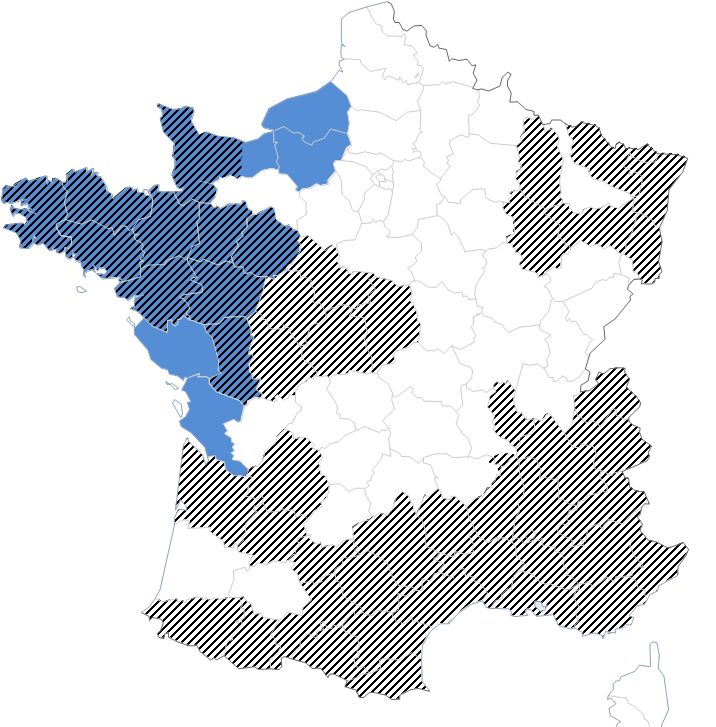
… based on regional network
                                                                  SAN
2015-2019                                             2019-2021

                                        Phenotypes available
            Genomic index available for genotyped animals + local claw health data
Collective achievements
                                                                          SAN
                          Industry partners
                          From upstream
                          - Breeding compagnies
                          - Milk recording / DHI organisations)
                          - Sanitary Defense Group (GDS)
                          To downstream
                          - Milk processing industry

                          Scientific partners                          01 - 38 - 43 - 69

                           - INRA
                                           Gathered in
                           - IDELE
                                           UMT ebis
                           - ALLICE

      Two projects bringing together stakeholders from dairy cattle sector!
3 traits to improve
by Management and
Genetic selection
1/ KetosisWhat is ketosis? How to control it? The main metabolic disease of dairy cows in early lactation What impacts? Decrease in milk production (-300 to -500 kg/lact) Impact on reproduction (cyclicity delayed and success at first service reduce up to 20%) Increased risk of retained placenta and displaced abomasum (x4 to 8) Increase in clinical mastitis (x3) How often? • Clinical ketosis: 3 to 4 % of cows • Sub-clinical ketosis: 12 to 20 % of cows Aim: Prevent and reduce the risk of ketosis in dairy herd • Management: From Cetodetect/CetoMir indicator and specific technical services • Genetic: a genetic evaluation of ketone bodies to improve genetic level of animals by selection.
Population evaluated
A large population
 • Phenotype: ketone bodies estimated from MIR analysis at monthly test-day
    • acetone
    • β-hydroxybutyrate (BHB)
 • Population: Performances since 2012 for west part of France / 2015 for east part
 • Use log-transformed concentrations for genetic evaluations
 • 1 trait for validation and interpretation of the results: Cetodetect®/CetoMIR® indicator
   determined by a decision tree from acetone and BHB concentrations (→ health status of
   animals)
Data edits
 •   Herds enrolled in official milk recording
 •   Purebred animals
 •   Lactations 1-5,
 •   Days In Milk 7 to 120                            Holstein       Normande       Montbéliarde
                             #cows with phenotypes      2 291 428         408 182        178 360
Genetic Evaluation (step 1: polygenic)
Genetic parameter estimation
• 2 traits, animal model, repeated data over lactations
Holstein Normande Montbéliarde
h² and rG
log(acet) log(BHB) log(acet) log(BHB) log(acet) log(BHB)
log(acet) 0.15 0.89 0.12 0.85 0.11 0.85
log(BHB) 0.16 0.10 0.14
Holstein Normande Montbéliarde
Repeat.
and rPE
log(acet) log(BHB) log(acet) log(BHB) log(acet) log(BHB)
log(acet) 0.22 0.26 0.20
log(BHB) 0.88 0.18 0.91 0.24 0.66 0.20
Low to moderate heritability, Acetone and BHB highly correlated but low repeatability
( each performance brings much information)
For routine evaluation : single trait, animal model with repeatabilityGenetic Evaluation (step 2: Genomic evaluation)
GBLUP Genomic Evaluation with Reference pop = males + females
Holstein Normande Montbéliarde
#genotyped cows with phenotypes 121 872 31 801 33 699
#genotyp. sires with DYD of ungenotyp. daught. 18 945 2 461 3 439
Incidence of ketosis as a fonction of female genomic index
100%
90%
80%
70%
Genomic index between -2 and -1,
8% of test-day = clinical ketosis
Test-day %
60%
50% more 25% = subclinical ketosis
40%
Genomic index between 1 and 2,
30% Less 1% = clinical ketosis
20% 8% = subclinical ketosis
10%
0%
Genomic index on KetosisKetosis - Sum up
Phenotype readily available, with limited costs
Large population (possibly all cows enrolled in official milk recording)
Be careful to have homogenous phenotypes
Polygenic/Genomic Evaluation:
Available since Aug. 2016 for Holstein
Available since Aug. 2016 for Normande
Expected in 2020 for Montbéliarde
(in a single step model)3 traits to improve
by Management and
Genetic selection
2/ Claw healthClaw health in dairy cattle Hoof and leg disorders are a major welfare problem in dairy farming, often causing pain and lameness in cows (11% of cows with lameness – Delacroix 2000) Hoof disorders are also associated with high costs and have been identified as the third most costly disease in dairy farming after mastitis and fertility trouble Multifactorial origin: Infectious traumatic, housing/hygiene, nutrional 21 claw health traits (as described in ICAR Atlas) – 11 traits mandatory Data collection 80 trimmers collecting data on tactile tab since Sprint 2014 / Autumn 2016 Severity scoring from 1 to 3 except for Digital Dermatitis (1 to 4) All trimmers have the same initial training from one single training center
Population evaluated
A limited population
  • Limited % farm using trimming service (independent trimmers do not take part)
  • non-exhaustive data - Breeders choose cows
  • Too few cows trimmed 2 times or more (14% in 2017)

Data edits
  • Herds enrolled in official milk recording, Purebred animals
  • Lactations 1-3 in Holstein, (1-5 in Normande - Montbéliarde)
  • At least 5 animals in the visit in Holstein, (4 in Normande - Montbéliarde)
  • Days In Milk 1 to 550                      Holstein       Normande      Montbéliarde
                #cows with phenotypes           118 816           17 350          14 985

Model adaptation
   To take into account preselection of cows, we included a trimming status in the model. If we
   considered not trimmed cows as healthy, the genetic correlation are biased. With a
   trimming status, they are considered present in the herd but not seen. (Croué et al., JDS 2017)
Genetic parameter Estimation
• Multiple trait, animal model
h² and Rg Holstein
contemporary non trimmed cows)
Infectious traits Non infectious traits
Based on 2017 data: 46 787
Preval. DD HHE IH WLF SU SHC SHD TRIM
trimmed cows (+ 54 090
Source : Croué et al., JDS 2017
DD 29 0,07 0,62 0,68 -0,21 -0,04 -0,23 -0,1 0,43
HHE 53 0,04 0,50 -0,05 0,36 0,15 0,02 0,55
IH 8 0,08 -0,16 -0,02 -0,01 -0,14 0,37
WLF 14 0,06 0,51 0,35 0,23 0,10
SU 7 0,05 0,86 0,26 0,36
SHC 16 0,03 0,49 0,45
SHD 43 0,02 0,12
TRIM 0,02
std h² = 0.003 à 0.009
std rG 0,05 - 0,09 0,07 - 0,09 0,05 - 0,08 0,08 - 0,09 0,08 - 0,09 0,05 - 0,11 0,10 - 0,12 0,08 - 0,12
Low heritability, highly correlated within infectious and non
infectious groups of traitsGenetic parameter Estimation (2)
Infectious traits Non infectious traits
Preval. DD HHE IH WLF SU SHC SHD TRIM
(+ 14 066 contemporary
10 782 trimmed cows
DD 32 0,10 0,86 -0,44 0,02 -0,17 0,30
non trimmed cows)
Normande
HHE 35
IH 21 0,22 -0,46 -0,08 -0,34 0,25
WLF 17 0,04 0,51 0,36 0,34
SU 11 0,08 0,70 0,21
SHC 9 0,04 0,17
SHD 29
TRIM 43 0,16
std h² = 0.012 à 0.020 except for IH 0.030
std rG 0,06 - 0,15 0,06 - 0,15 0,15 - 0,17 0,13 - 0,17 0,15 - 0,23 0,10 - 0,16
(+ 9 040contemporary non
Infectious traits Non infectious traits
10 164 trimmed cows
Preval. DD HHE IH WLF SU SHC SHD TRIM
Montbéliarde
trimmed cows)
DD 16 0,05 0,71 0,77 -0,12 0,50 -0,30 0,53
HHE 34 0,07 0,55 -0,08 0,60 -0,46 0,50
IH 9 0,08 0,15 0,51 -0,08 0,49
WLF 24 0,11 0,46 0,25 0,22
SU 8 0,08 -0,14 0,59
SHC 14
SHD 45 0,07 -0,41
TRIM 53 0,29
std h² = 0.01 à 0.02 except for TRIM 0.027
std rG 0,12 - 0,17 0,12 - 0,16 0,14 - 0,17 0,15 - 0,17 0,13 - 0,17 0,16 - 0,19 0,11 - 0,14Prevalence of claw traits in function of cow genetic index
(N=106 877 / N=12 395 / N=11 369)
Digital Dermatitis Interdigital Hyperplasia
100% 100%
80% 80%
60% 60%
40% 40%
20% 20%
0% 0%
< à -2 -2 à - -1,5 à -1 à - -0,5 à 0 à 0,5 à 1 à 1,5 à > à 2 < à -2 -2 à - -1,5 à -1 à - -0,5 à 0 à 0,5 à 1 à 1,5 à > à 2
1,5 -1 0,5 0 0,5 1 1,5 2 1,5 -1 0,5 0 0,5 1 1,5 2
Sole Ulcer White Line Fissure
100% 100%
80% 80%
60% 60%
40% 40%
20% 20%
0% 0%
< à -2 -2 à - -1,5 à -1 à - -0,5 à 0 à 0,5 à 1à 1,5 à > à 2 < à -2 -2 à - -1,5 à - -1 à - -0,5 à 0 à 0,5 0,5 à 1 1 à 1,5 1,5 à 2
1,5 -1 0,5 0 0,5 1 1,5 2 1,5 1 0,5 0Genetic Evaluation (step 2: Genomic evaluation)
GBLUP Genomic Evaluation with Reference pop = males + females
Holstein Normande Montbéliarde
#genotyped cows with phenotypes 16 982 5 618 2 078
#genotyp. sires with DYD of ungenotyp. daught. 3 183 409 662
Routine Genomic Evaluation:
Available since Nov. 2017 in Holstein
Expected in winter 2019/2020 in Normande
Expected in 2020/2021 in Montbéliarde (in a single step model)
Need to enlarge reference population in Normande and Montbéliarde in order to improve
genomic prediction equation
GWAS / QTL detection
Lot of QTL found, including 8 with logBF>10 (Croué et al., JDS 2019)Take Home Message
Management tools and Genetic Evaluation are already available (or coming soon) for
ketosis and Claw Health traits
A 3rd group of traits “Common health disorders”, registered on farm (metritis, retained
placenta, milk fever…) are currently under development in Holstein and are planned in
Normande and Montbéliarde
One main issue is to have exhaustive health data during the productive life of
the cow (3 to 5 years)
Objectives: Improve dairy cow welfare and resilience
Only possible with a efficient data pipelines from phenotypes
collection in herds to genetic evaluation and management tools for
breedersAcknowledgment
Thank
for your
attentionYou can also read


