Fundamental Rights Survey - Crime, Safety and Victims' Rights Dr. Joanna Goodey Head of Research and Data
←
→
Page content transcription
If your browser does not render page correctly, please read the page content below
Fundamental Rights
           Survey
     Crime, Safety and
        Victims’ Rights

             Dr. Joanna Goodey
     Head of Research and Data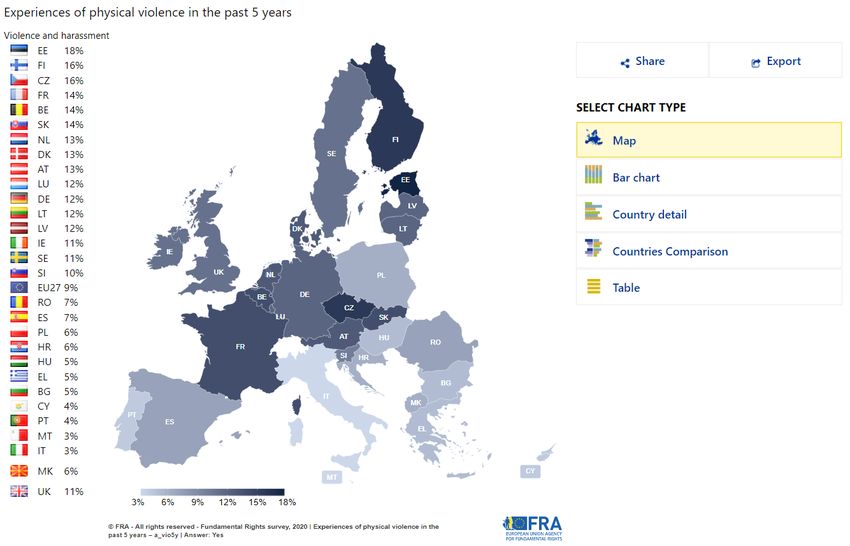
FRA surveys – data on crime victimisation
Fundamental rights survey
• 2019 data collection (publications in 2020-2021)
• 35,000 respondents, general population – random sample
• 27 European Union Member States + North Macedonia and the
United Kingdom
Violence against women survey
• 2012 data collection (publication 2014)
• 42,000 women in 28 EU Member States – random sample
• Replicated in 8 countries/territories outside the EU by the
Organization for Security and Co-operation in Europe (OSCE)
• Replicated in Japan by Ryukoku University, Kyoto
2
FRA surveys – data on crime victimisation
Immigrants and descendants of immigrants surveys
• 2008: 23,500 respondents in 27 EU MS (EU-MIDIS I) – random sample
• 2016: 25,200 respondents in 28 EU MS (EU-MIDIS II) – random sample
• 2021: new survey in progress
Roma (and Travellers) surveys
• 2008: 3,500 Roma in 7 EU MS (as a part of the EU-MIDIS I survey) –
random sample
• 2011: 14,900 Roma and Travellers and 7,300 non-Roma households in 11
EU MS – random sample
• 2016: 7,950 Roma in 9 EU MS (as a part of the EU-MIDIS II survey) –
random sample
• 2019: 4,700 Roma and Travellers in 6 EU MS – random sample
• Since 2020: new survey in progress
3
FRA surveys – data on crime victimisation
Surveys on discrimination and hate crime against Jews
• 2012: 6,000 respondents in 8 EU MS – online opt-in sample
• 2018: 16,500 respondents in 13 EU MS – online opt-in sample
LGBT(I) surveys
• 2012: 93,100 LGBT respondents in 28 EU MS – online opt-in
sample
• 2019: 140,000 LGBTI respondents in 28 EU MS + North
Macedonia and Serbia) – online opt-in sample
4
Fundamental Rights Survey – key facts
Countries     EU-27 + North Macedonia and the United Kingdom

Sample        34,948 respondents, interviewed in January-October 2019

Results       Representative of the general population

Respondents   16 years of age and older

Methods       Face-to-face (with self-completion) and online data
              collection, as appropriate in each country, following a
              feasibility study and an extensive pilot
Analysis      Results presented by country, EU-27 results by socio-
              demographic characteristics. Results available in more detail
              in the online data explorer

                                                                              5
Report on ‘Crime, Safety and Victims’ Rights’
Fundamental Rights Survey
First EU-wide survey data on crime
victimisation experiences
Experiences of physical violence and
harassment
– Covers specific acts of physical violence and
separate questions on acts of harassment
– Details concerning the perpetrators, the
setting where the incident took place,
consequences for the victim, reporting to the
police and other organisations, reasons for
not reporting
Experiences of property crimes and fraud
Willingness to take action as a witness of
crime
Worry about crime and risk avoidance
6Fundamental Rights Survey
_______________________________
Headline findings – crime victimisation
7Burglary 8
3
Experiences
8
of five Online banking or payment card fraud
3
selected Consumer fraud
16
26
crimes 41
Harassment
29
(EU-27, %)
Violence 9
6
Total - five crimes 54
39
0 10 20 30 40 50 60
5 years before the survey 12 months before the survey
8Experiences of physical violence and
harassment
Physical violence
6 % of people in the EU experienced it within 12 months (5 % of
women, 7 % of men)
Corresponds to 22 million people in the EU
Harassment
29 % of people in the EU experienced it within 12 months
Corresponds to 110 million people in the EU
9Measuring physical violence – Questions
Sometimes people can do things that physically hurt you. For the next
question please think about strangers as well as anyone you know,
including acquaintances, colleagues, family members or relatives.
In the past 5 years, how many times has somebody done each of the
following things?
a) Slapped you, thrown something at you, pushed you or pulled your
hair
b) Hit you with their fist or with something else that could hurt you
c) Kicked or dragged you, or beaten you up
d) Tried to suffocate or strangle you
For each item a) to d), answers could range from - Never, Once, Twice
through to - More than ten times, All the time.
10Experiencing physical
violence, in the 5 years
before the survey (EU-27, %)
Limitations in usual
Women 8 Employed or self-employed 10 Severely limited 17
Gender
activities
Men 11 Unemployed 12 Limited but not severely 12
Main activity
Retired 3 Not limited at all 8
16-29 23 Student, pupil 21
30-44 9 Born in the survey country 9
Country of birth
Other 8
45-54 7 Born in another EU MS 10
Age
55-64 6 Born in a non-EU country 13
Household's ability to make
With (great) difficulty 14
65+ 3
With some difficulty 9 Citizen of the survey
ends meet
9
Citizenship
country
Fairly easily 7 Not a citizen of the survey
education completed
Lower secondary or less 9 15
country
Highest level of
Upper secondary, or post (Very) easily 9
10
secondary but not tertiary
Ethnic minority
Tertiary 9 Yes 22
Salaries, self-employment,
11
Household's main
No
source of income
farming 8
Big city (incl. suburbs) 11 Pensions 4
Type of area
Unemployment benefit,
orientatio
A town or a small city 9 21 Heterosexual 9
Sexual
social benefits
n
A country village or home
8 Other 15 Not heterosexual 19
in the countryside
0 5 10 15 20 25 0 5 10 15 20 25 0 5 10 15 20 25
11Limitations in usual
Severely limited 17
activities
Not limited at all 8
Experiencing Citizen 9
physical
Citizenship
Not a citizen 15
violence, in the
five years before
orientation Ethnic background
Ethnic minority 22
the survey
(EU-27, %) Not ethnic minority 8
Heterosexual 9
Sexual
Not heterosexual 19
0 10 20 30 40 50 60
12Perpetrators of physical violence (EU-27, %)
Incidents experienced by women Incidents experienced by men
2 1
Man (or more
4 2
than one man)
15
Man (or more than one man
Both man and a
26 Both man and a woman woman
9
Woman (or more than one Woman (or more
woman
than one woman)
Not sure whether it was a man or
60 a woman
72 Not sure whether
Don't know or prefer not to say
8 man or woman
Don't know or
prefer not to say
13Incidents not of a sexual nature
37
In own home
14
Place where the In another house or apartment
10
5
most recent 7
At school or college
physical 8
11
violence At work
11
incident In a shop, café, restaurant, pub or club
5
13
happened In the street, a square, park, car park 20
or other public place 39
(EU-27, %) 5
Some other place in the country
5
3
Abroad
3
2
Don't know or prefer not to say
1
0 10 20 30 40 50 60
Women Men
14Victims of physical violence – contact with
police and other services (EU-27, %)
7
Reported to police
14
Reported to police and
contacted another service
Contacted other services
58 only
21
Not reported to police
and no services contacted
15Fundamental Rights Survey
_______________________________
Headline findings – safety
16Avoiding situations or places due to fear of
being assaulted or harassed (EU-27, %)
Any of the three situations listed in the survey
20 “This is a nice and peaceful place to
live, unless you have to go home late at
39 night. I had to learn the safe routes
home.”
(Woman, 18-29 years)
41 “In fact I have been followed several
times, but from then on I have told
myself that I will not speak to other
Often or all the time people who I do not know, especially in
Sometimes the evening.”
(Woman, 30-59 years)
Never
Don't know or prefer not to say
17Avoiding situations or places due to fear of
being assaulted or harassed (EU-27, %)
Any of the three situations listed in the survey
Women 39 44 17
16-29
Men 16 42 42
Women 24 50 27
30-44
Men 10 37 52
Women 25 48 28
45-54
Men 9 36 55
Women 25 45 30
55-64
Men 11 33 56
Women 27 38 35
65+
Men 11 33 56
0 20 40 60 80 100
Often or all the time Sometimes Never Don't know or prefer not to say
18Fundamental Rights Survey
_______________________________
Key Findings and Opinions
19Report’s key findings and opinions
Targeted measures needed to prevent physical violence:
young people, persons with disabilities, ethnic minorities and LGBTI
people . . .
Member States should:
consider specific measures to encourage and empower people to
report incidents of crime – in particular, incidents of violence and
harassment which are reported at a lower rate than some other
crimes
increase their efforts to ensure access to justice for all victims of
crime, including the most vulnerable
consider specific measures to ensure support for victims of violence
in the domestic sphere, so that they have access – in practice – to
the rights guaranteed by the Victims’ Rights Directive
20Impact of the FR survey results – examples
Survey results used to inform policy in the European Union:
– Victims’ Rights Directive – law
– First EU Strategy on Victims’ Rights – policy
– Victims’ Rights Platform – stakeholder engagement
– Security Union Strategy
– Action plan on Racism and Xenophobia
– EU Framework Decision on Racism and Xenophobia
– Disability Strategy
– EU Roma strategic framework
– LGBTI strategy
– Other areas of EU law/policy in the field of consumer protection,
online hate etc.
21Fundamental Rights Survey and the SDGs
Target 5.2 Eliminate all forms of violence against women and girls
Target 11.7 Access to safe, inclusive and accessible, green and public spaces
Target 16.1 Reduce all forms of violence
Target 16.3 Promote rule of law and ensure equal access to justice
Target 16.5 Reduce corruption and bribery
Target 16.6 Effective, accountable and transparent institutions
Target 16.7 Responsive, inclusive, participatory and representative
decision-making
Target 16.b Promote and enforce non-discriminatory laws and policies
22Available now – Data Explorer
Technical Report and
Microdata set to be
released in due course
23Thank you!
joanna.goodey@fra.europa.eu
sami.nevala@fra.europa.eu
fra.europa.euYou can also read


