Fundamentally re-thinking ALM - Todd Cutting, Aviva Investors Hans-Christof Gasser, Nomura International plc - Institute and Faculty of Actuaries
←
→
Page content transcription
If your browser does not render page correctly, please read the page content below

Fundamentally re-thinking ALM

Todd Cutting, Aviva Investors
Hans-Christof Gasser, Nomura International plc

Team Mailbox:
Who we are                                          AI_LDI@avivainvestors.com

                       Insurance              Pensions

    UK Life –
 With Profit / Non                                              ASPS
                                                                RAC
  Profit Funds                      LDI

         UK Life –
                                Aviva Group –                UKGI
       Annuity Funds
                              Treasury, Aviva Re,
                                    Mixer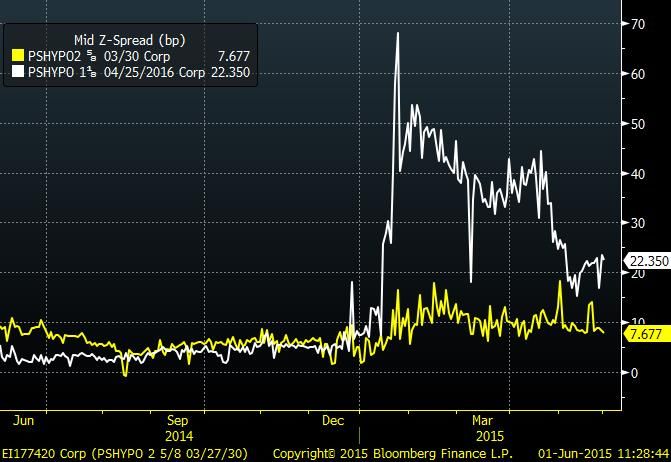
What we hear when we discuss insurance
investment…

                                         3
The ideal: Risk Based Capital
Constrained Portfolio Management
- Clear investment objective
  driving investment strategy

- Focus on economic value
  not accounting profits

- Risk appetite clearly
  expressed

- Clear governance within
  set risk limits

- Transparent view of risk
  and relevant performance

                                   4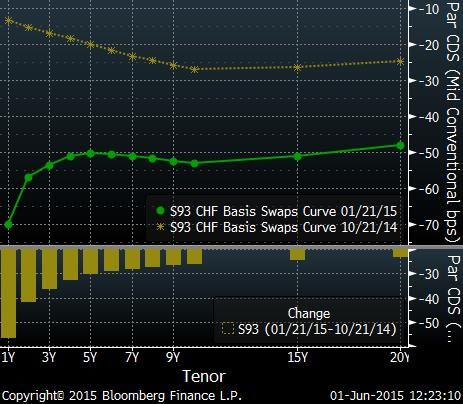
Jargon Buster
• Funding   • Liquidity                  • Capital

• RWA       • Leverage                   • Spread

             “Give me a lever long
             enough and a place to
             stand and I will move the
             entire earth”, Archimedes
                                                     5
A step back:
The competitive landscape

Pressure on banks
                                                                 Volcker rule

                                                                                             Ring-fencing
                                                                                             Liquidity coverage ratio
                                                                                             Net stable funding ratio
            MIFID
                                                                                             Central clearing
Central clearing                                                                             OTC reforms / margin
                                                                                             Short-selling

                                                                                             Basel III market risk
                                                                                             Leverage ratio
                                                                                             Net stable funding ratio
               FTT

                                                                                             Balance sheet levy

   Source: CGFS Paper No 52 “Market making and proprietary trading: industry trends, drivers and policy implications”   7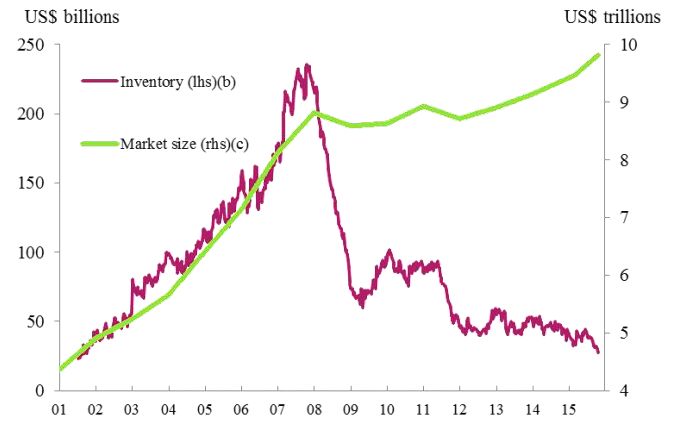
Implications
  Reduced leverage                               Falling inventory

   “Although liquidity may on average be higher, the risk that liquidity
      may not be available when it is needed most has also risen.”
Source: CGFS Paper No 52 “Market making and proprietary trading: industry trends, drivers and policy implications”   8
Bank of England Deputy Governor speech, Dealing with change: Liquidity in evolving market structures, Oct 2015
Knock-on effect for hedge-funds

                               IRR 10%
     Strategy
      return                6 * leverage

       L+150                  Cost L+25

                             IRR 5.5%
     Strategy
      Return                6 * leverage

       L+150                 Cost L+100

Source: Barclays, “Evolution of the Hedge Fund Financing Model”, September 2012
http://www.risk.net/risk-magazine/feature/2349066/hedge-funds-to-be-hit-by-prime-broker-charges-under-basel-iii   9
http://www.risk.net/risk-magazine/feature/2361104/no-arbitrage-new-rules-make-markets-less-efficient
Private equity – loan-on-loan finance

  Purchased at                                            Equity                      IRR = 15%
 large discount                                           (35%)                       (L+1350)
                                    Non-
        Returns                  performing
        through                    loans                Loan-on-
                                                          loan                        5 year loan vs. longer
restructure and                   L+[700]
                                                          65%                         dated loans
   onward sale
                                                         L+350                        Refinancing risk

  Source: Cushman and Wakefield “European Real Estate Lending Market” February 2015                      10
So who can fill the gap
less sensitive to changes in liquidity conditions. Liability
profile
ongoing accounting and regulatory changes Solvency II
higher risk
charges may disincentivise allocations to corporate bonds.
Exposure to
volatility
Source: CGFS Paper No 52 “Market making and proprietary trading: industry trends, drivers and policy implications” 11The opportunity for insurers
Allocating the cost of funding

                  “Risk-free” – X     Liquidity needs
   Insurance
                   Underwriting        and duration
    liabilities
                       profit             profile

   Liability      Risk-free rate
                                       Basis risk vs.
  benchmark
                                    liability discounting
   portfolio       Libor - CRA

                  “Risk-free” +
  Investment                           Return vs.
                    spread /
    portfolio                        marginal capital
                  excess return

                                                        13
Insurance vs. market risk
Excess return (spread)
25 bpa
Return on marginal capital
Stand-alone Diversified
Insurance Risk RBC
5.0% 13.6%
11.8%
10%
15% correlation
5%
14But what about the Volatility Adjustment? Source: “Damp Squid, the English Language laid bare”, Jeremy Butterfield 15
But what about the Matching Adjustment?

                                      16
Examples …
“Float”
Funding @ 2.2%
(T-bills - 3%)
Leverage
1.6-1
1965-2014
Berkshire Hath. Berkshire Hath. S&P 500
Information ratio Book value Market value Total return
0.66 19.4% p.a. 21.6% p.a. 9.9% p.a.
751,113% 1,826,163% 11,196%
Source: Berkshire Hathaway Inc. Shareholder Letter 2014, 17
Buffett’s Alpha by Frazzini, Kabiller, and Pedersen (2013), NBER Working PaperExamples …
“Attractive cost of funding Return on equity illustration
allows us to be patient, Assets $1,500
disciplined and opportunistic Reserves $1,400
in our investment philosophy –
Capital [7%] (14 * leverage) $100
our asset
allocation is driven by market Liabilities $1,500
opportunity… Income statement
Investment income [6%] $90
… capturing incremental (Cost of reserves [3.5%]) ($49)
spread by assuming
Spread income $41
incremental
liquidity and complexity risk Overheads & taxes [1.5%] ($21)
rather than credit risk” Operating income $20
Return on equity 20%
Source: Athene Holdings, High‐Level Business Model Overview – Investor Presentation, 2013 18
and Investor Day October 2015Examples … Source: Fosun International 2014 Annual Results Presentation 19
Risk Based Capital Constrained
Portfolio Management
Where structural premiums originate
             •   Not all investors are in an equal position!

             •   Rationale for structural investor specific advantages are:
                  1. Illiquidity - It is difficult to trade out of the positions during life
                     of the transaction.
                  2. Complexity - Trades require significant structuring expertise
                     and due diligence, which must be compensated.
Background

                  3. Cost of funding - Funding cost of participants active in the
                     market may be larger than for insurer
                  4. Regulatory - Regulatory constraints can increase cost of
                     consuming risk for aggregate participant, often via
                     mismatches between economic and regulatory capital
                     requirements
                  5. Size – Some illiquid trades come in large sizes and are
                     typically accessible only to large institutional investors

                                                                                               21
How liabilities enter the picture
Liability cashflows x (swap implied) discount factors
45
40
35
30
25
Cashflows
20
15
10
5
0
1 2 3 4 5 6 7 8 9 10
• The present value of a liability is the projected
cashflows discounted at the relevant discount
rate
• For the economic basis this discount rate is
implied from the interest rate swap market
• Therefore there is market risk embedded in
liabilities as changes in swap rates result in
changes in liability
22How we manage liability risk
• Liability value is calibrated to market instruments (IRS + potentially others)
• Can construct a portfolio of swaps that offsets any change in market value
of the liabilities due to market movements
• Will need to receive the fixed rate on the swaps to match the fixed liability
payments
– leaves us with a floating rate payment
• Floating rate is 6 month LIBOR
– this is the effective liability funding rate
• The market risk exposure of the liabilities have been matched by a
portfolio of assets and we have to make regular LIBOR-linked payments
IR sensitivity from liabs
Insurance
6 month LIBOR
Company
IR sensitivity from
swaps
23What that means for the assets
• Investment objective is to invest in assets to meet the liability funding rate
of LIBOR
• Return in excess of this will add to the surplus
• Need to be aware of and able to manage the risk taken to earn this target
• Effectively a risk constrained absolute return investment objective
Insurance Company
Assets Liabilities
Risk Constrained Liability
Absolute Return Exposure Liabilities
Assets Matching Swaps
24Risk Constrained Assets
Focusing on the risk/required capital constrained assets.
The investment objective becomes one of allocating risk/capital budget
to assets that are expected to offer excess returns for their given risk
Property
Dependent on liquidity surplus
Risk Multi-strategy diversified growth funds
Constrained Low volatility return generation
Absolute
Return
.....
Portfolio
Fixed Income
This is what we will focus on for the rest of the presentation
25Analysing Fixed Income Returns
Spread is excess return over the Illiquidity is common explanation but is
liability valuation rate but need to misleading for excess spread. Mostly
hold RBC for risk of this widening compensation for spread volatility
Bond yield can be
decomposed into
Interest Rate Excess risk that
and Spread Spread can be Spread spread
Spread further broken down widens
Yield Default
Default
Rates Rates
Allocate risk capital to assets that you judge to
IR matches against the IR
offer good excess returns for given Risk Based
exposure embedded in liability
valuation via valuation rate Capital you will be required to provision
26Economic Capital for Spread Risk
• Credit spread volatility curve is
downward sloping
• Viewed in market value terms
the RBC required increases
with longer maturity and lower
credit rating
27Using Derivatives
• Derivatives are a useful tool for risk management
• Fixed income securities contain various risks:
o credit risk
o interest rate risk
o exchange rate risk (if denominated in a foreign currency)
o inflation risk (if payments are linked to inflation)
• Derivatives allow you to manage these risks and isolate the credit risk.
This is where we want to spend our risk based capital, allowing us to take the risks we
want to with the aim of earning returns in excess of our target rate.
Bond Bond + Derivatives
Interest Rate
Credit Risk Credit Risk
Risk
FX Risk Inflation Risk
28Break-even target asset return
• We have shown that the liability value grows at LIBOR (less CRA)
o Leaving LIBOR as the asset target return to keep up with the liabilities
• We also need to consider the market risk of the assets
o And the RBC we need to provision for this risk
o This capital that has been provisioned needs to be remunerated
• This leads to target return over a time horizon to meet the liabilities and remunerate
the capital provisioned for market risk
Breakeven return = LIBOR + RBC x CoC x diversification
Capital
Required return Liab rate
Remuneration
Returns in excess of this breakeven rate add economic value as it delivers asset value
gains over and above what is required to meet the liability and the cost of capital for the
risk taken
29How does MA affect the framework
• Liabilities are valued relative to invested portfolio of liability cashflow replicating assets
o allowing for defaults
• Risk Based Capital is dampened
o as some of widening in credit spread shock scenario is matched by higher liability
valuation rate, and
o the matching adjustment allows expected spread income to be capitalised
• The hold to maturity requirement of the assets drives an equivalent time horizon on
balance sheet impact
Breakeven return = LIBOR + Exp Def +(RBC x dampener – MA) x CoC x diversification
= LIBOR + Exp Def + [RBC x dampener – dur x (spread – FS)] x CoC x diversification
Reduces
Dampened
MA benefit required
RBC
return
30Impact on break-even target
3.0%
2.5%
2.0%
1.5%
1.0%
0.5%
0.0%
0 5 10 15 20 25 30
BE non-MA AA BE non-MA A BE non-MA BBB
BE MA Fin AA BE MA Fin A BE MA Fin BBB
31Considerations - Portfolio Composition
Given the investment objective to maximise return relative to economic risk
(or return for an amount of Risk Based Capital) what needs to be
considered when composing a portfolio?
Some caveats:
- Actual returns are retrospective
- Expected returns are prospective and subjective
- Neither are the same thing as yields or spreads
- But yields/spreads are useful for illustration
purposes as it is transparent, objective and
simple. Avoids the subjectivity from overlaying
investment views
32Governance and Discretion
• Liability exposures to be matched Liability exposures
can be communicated in terms of communicated by client
interest rate, inflation and liquidity
• Risk appetite made explicit in
terms of company aligned metrics
such as RBC, counterparty limits, Liability exposures matched by
liquidity, etc. manager
• This leaves the manager free to
utilise risk budget for opportunities
that provide good excess returns
Risk limits explicitly set out in
• Discretion gives ability take investment mandate
advantage of and benefit from
dislocations in the market and
relative value opportunities
Manager has discretion to
• Transparent risk and performance
reporting utilise risk budget
33Example 1 – UK Government Bonds
Nominal Spot Yield Curves Nominal Spread Govt-Swap
%
3.0 bps
Nominal Spread Govt-Swap
150 1Y Forward Govt-Swap
2.5
100
2.0
50
1.5
Swap
-
1.0
Gilt
0.5 (50)
- (100)
0 5 10 15 20 25 30 35 40 45 50 0 5 10 15 20 25 30 35 40 45 50
Years Years
- Risk Based Capital increases with credit duration
- The spread curves flatten off at the long (high RBC) end
- Want to position such that we can maximise return vs risk
- Forward credit spread exposures can be more efficient than plain long only
34Example 2 – Swiss AAA Covered Bonds
EUR/CHF FX rate SNB Target Rate
• The Swiss National Bank applied a currency floor of the EUR CHF exchange rate to
stop the CHF strengthening
• In Jan 2015 the Swiss National Bank abandoned the peg and cut its target interest
rate to -0.75%
• This unexpected and abrupt move caused market dislocations
Source: Bloomberg 35Example 2 – Swiss AAA Covered Bonds
CHF Cross Currency Basis Curve
as at 21/10/2014 and at 21/01/2015
• The white curve shows the spread of a short dated AAA Swiss covered bond
• The yellow curve shows the spread of a longer-dated 15 year bond from the same issuer
• As shown in the graph, the spread of the short-dated bond widened whereas the long-dated bond did
not move as much ⇒ its not a credit quality related spread move
• At the same time the cross currency basis widened significantly
Source: Bloomberg 36Example 3 – XCCY Relative Value
Corporates issue bonds in multiple currencies
• Facilitates currency specific funding needs
• Increases and diversifies the investor base
• Relative funding value
Valuations across currencies 80
Issuer spread in different currencies
vary as local investor sentiment 70
and local liquidity conditions 60
amongst other factors change. 50
40
Spread
30
The underlying credit risk 20
remains the same 10
0
0 2 4 6 8 USD 10
This provides opportunities to -10
Maturity non USD
buy in another currency swapped -20
back to liability currency
37Recap
• Investment objective is to target economic value when investing
• Target excess returns compared to liability funding rate
• Need to provision (and remunerate) capital for market risk taken
• Clear risk aligned investment mandates delineates overlapping issues
• Matching market exposures of the liabilities
with a portfolio of derivatives, we are left
with a risk constrained absolute return
asset portfolio
• Target is to meet liabilities and pay for the
capital provisioned (which is itself a
function of the assets held)
• A bond is a package of risks. Derivatives
can isolate these risks and allow better
investment outcomes
• Insurers have a structural investment
advantage in some markets
38Questions Comments
The views expressed in this [publication/presentation] are those of invited contributors and not necessarily those of the
IFoA. The IFoA do not endorse any of the views stated, nor any claims or representations made in this
[publication/presentation] and accept no responsibility or liability to any person for loss or damage suffered as a
consequence of their placing reliance upon any view, claim or representation made in this [publication/presentation].
The information and expressions of opinion contained in this publication are not intended to be a comprehensive study,
nor to provide actuarial advice or advice of any nature and should not be treated as a substitute for specific advice
concerning individual situations. On no account may any part of this [publication/presentation] be reproduced without the
written permission of the IFoA [or authors, in the case of non-IFoA research].
39You can also read


