School Board's Adopted - FY 2019-28 Capital Improvement Plan
←
→
Page content transcription
If your browser does not render page correctly, please read the page content below
School Board’s Adopted
      FY 2019-28
Capital Improvement Plan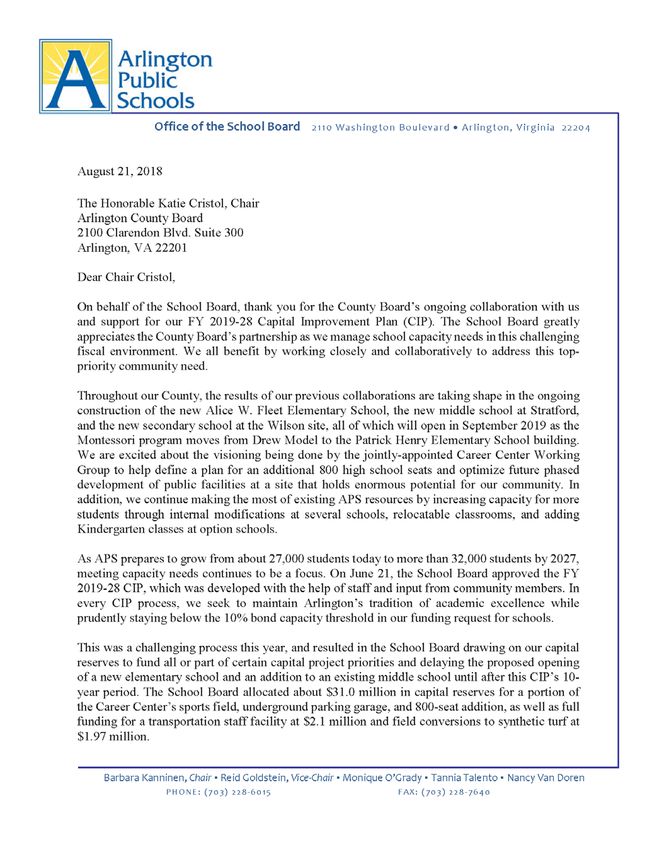
School Board’s Adopted
  FY 2019-28 Capital Improvement Plan

                 School Board Members

                Barbara Kanninen, Chair
               Reid Goldstein, Vice Chair
               Monique O’Grady, Member
                Tannia Talento, Member
               Nancy Van Doren, Member

                 Patrick K. Murphy, Ed.D.
                     Superintendent

                        Lisa Stengle
        Executive Director, Planning and Evaluation

                      John Chadwick
    Assistant Superintendent, Facilities and Operations

                      Leslie Peterson
Assistant Superintendent, Finance and Management Services

                      Benjamin Burgin
        Assistant Director of Design & Construction

                  Tameka Lovett-Miller
                Director, Office of Finance

                       Robert Ruiz,
        Principal Planner, Planning and Evaluation

                                                            Page 2 of 32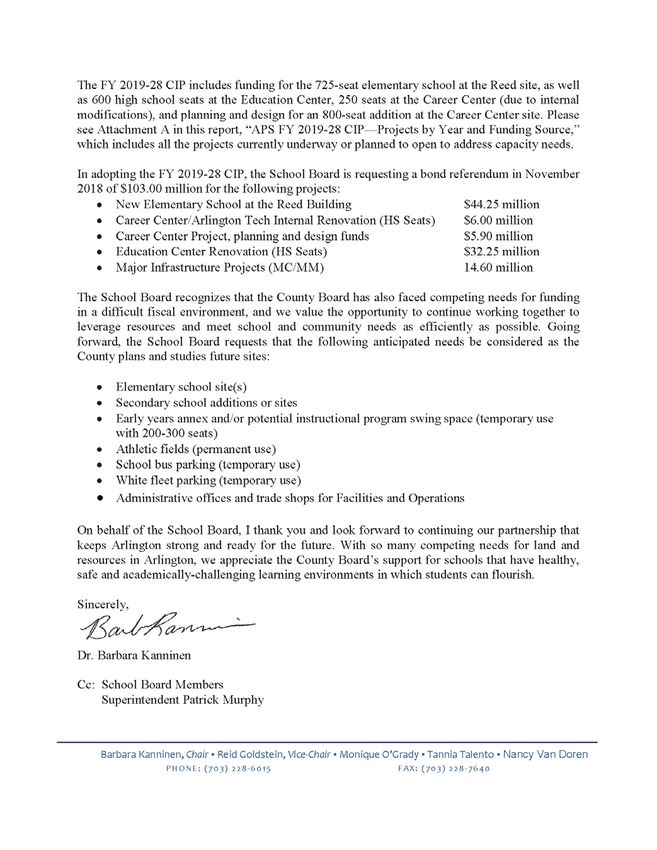
FY 2019-28 CIP Report Table of Contents
School Board Message .................................................................................................................................. 5
Executive Summary....................................................................................................................................... 7
Attachment A: School Board’s Adopted CIP ................................................................................................. 9
Arlington Public Schools Map ..................................................................................................................... 10
CIP Overview ............................................................................................................................................... 11
   Capital Improvement Plan ...................................................................................................................... 11
   Enrollment Growth ................................................................................................................................. 12
   Process .................................................................................................................................................... 15
   Engagement ............................................................................................................................................ 18
Capital Investments .................................................................................................................................... 20
   CIP Funding ............................................................................................................................................. 22
   Estimated Project Costs .......................................................................................................................... 23
   Publications that Informed the CIP ......................................................................................................... 23
       Arlington Facilities and Student Accommodation Plan (AFSAP) ......................................................... 23
       2018-24 Strategic Plan ........................................................................................................................ 23
       Facilities Optimization Study, SY 2017-18........................................................................................... 24
   Committees that Informed the CIP ......................................................................................................... 24
       Advisory Council on School Facilities and Capital Programs (FAC) ..................................................... 24
       Building Level Planning Committees (BLPC) ....................................................................................... 24
       Public Facilities Review Committees (PFRC) ....................................................................................... 24
Appendix A – Motion for Adoption of FY 2019-28 CIP: June 21, 2018 ....................................................... 25
Appendix B – Total Project Cost Estimates ................................................................................................. 28
Appendix C – Glossary of Terms ................................................................................................................. 31

                                                                                                                                              Page 3 of 32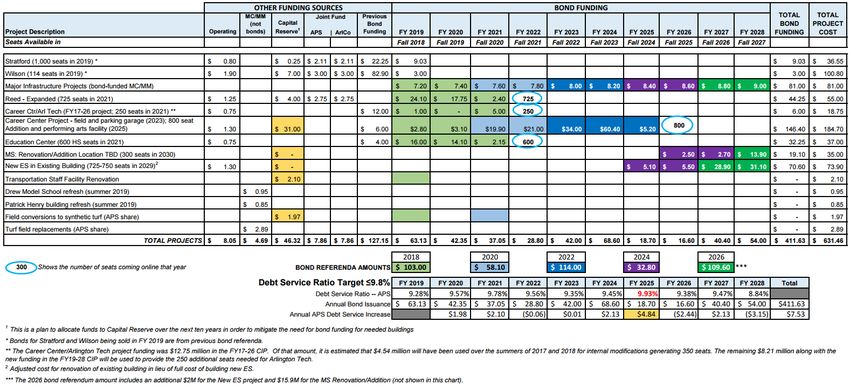
Page 4 of 32
School Board Message

                       Page 5 of 32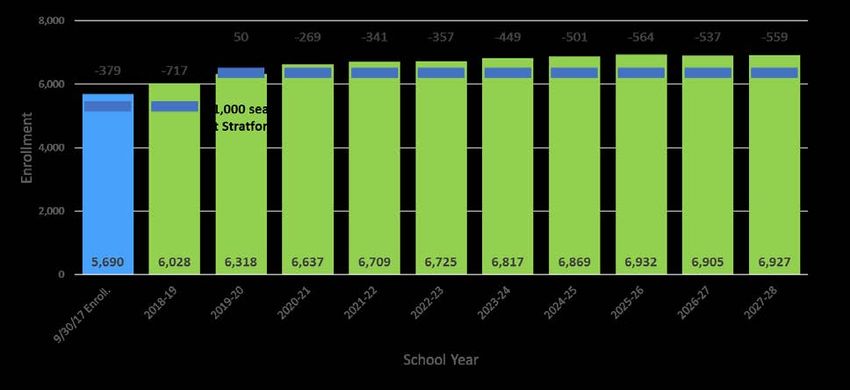
Page 6 of 32
Executive Summary
Arlington County continues to be a desirable place to live and raise families, as evidenced by the growth
in our public school student population. With that growth comes the responsibility to manage our
Arlington Public Schools (APS) facilities to accommodate present and future students and provide high
quality learning environments. Every two years, the Capital Improvement Plan (CIP) process allows APS
to examine how school facilities need to change to respond to expected future enrollment and the
infrastructure investments required for the upkeep of our schools and operations.

The 2019-28 CIP process was defined by a number of challenges including:
    • Limitations on bonding capacity available to address the need for new schools
    • Growing enrollment
    • School infrastructure upkeep and improvements

The FY 2019-28 CIP required evaluating trade-offs for the potential number of future seats by school
level and their timing. The School Board and APS staff weighed the merits of eight scenarios that
provided various combinations of school seats and opening dates. Each scenario was studied to
understand how it would affect the balance between projected enrollment and the number and timing
of seats provided in relation to the availability of bond funding and relocatable classrooms.

With the eighth and final scenario in the FY 2019-28 CIP process, the School Board committed $411.6
million in bond funding for 4,236 school seats by Fall 2027. In addition, the School Board dedicated
monies for the Career Center site to include a field and parking garage by 2023 and a performing arts
facility by 2025; a transportation staff facility renovation by 2019; Minor Construction/Major
Maintenance (MC/MM) projects throughout the 10-year CIP period; and field conversions to synthetic
turf. Not all funds dedicated to these CIP priorities came from bond funding; over $35.0 million in capital
reserves were allotted to partially or fully fund certain priorities, such as a transportation staff facility.
This was done to keep the associated FY 2019-28 CIP bond issuances within acceptable financial
thresholds.

In keeping with the School Board commitment to keep the community informed of the CIP process, a
dedicated “Engage with APS” webpage was created to update county residents on the process timeline;
raise awareness on opportunities for open office hours and venues to get answers to CIP-related
questions and community information sessions; provide answers to School Board questions on the CIP;
and allow for community input on CIP priorities included in the Superintendent’s Proposed CIP.

APS sought input from various stakeholders, including the Advisory Council on School Facilities and
Capital Programs (FAC), which assisted in assessing periods of time when it would be ideal to add seats
by grade level. FAC’s recommendations were based on identifying future school years when it is
expected that the difference between seats and projected enrollment will exceed the current balance in
seats and students.

In addition, community input on the CIP was considered and incorporated into the evolving CIP
scenarios. As the process evolved, the School Board directed staff to produce CIP scenarios that
constructed high school seats earlier than the Superintendent’s Proposed CIP and added an

                                                                                                 Page 7 of 32
underground garage with an at-grade field, which was absent in the Proposed CIP. By the time the final
CIP scenario was developed, the School Board dedicated $146.4 million in new bond funding and $31.0
million in capital reserves for the field and parking to be constructed by Fall 2023, and an 800-seat
addition and performing arts facility by Fall 2025. The list below identifies projects that will be included
in the November 2018 bond referendum.
• Reed (725 elementary school seats) ........................................................................... $44.25 million
• Career Center/Arlington Tech (250 high school seats), $6.0 million
• Planning and design funds for field, parking garage, and 800 high school seats at the Career
Center ........................................................................................................................... $5.90 million
• Education Center (600 high school seats)................................................................... $32.25 million
• Major Infrastructure Projects (MC/MM) .................................................................... $14.60 million
Page 8 of 32Attachment A: School Board’s Adopted CIP
Note
• On online copy of the above table is available at https://www.apsva.us/wp-content/uploads/2018/06/F-1-Scenario-A2.pdf
• Bond financing is generated through the sale of general obligation bonds by Arlington County as authorized by County voters through bond referenda. Bond referenda are scheduled
for even-numbered calendar years, with the next bond referendum in November 2018.
• APS’s bonding capacity is framed by the County Board-adopted financial and debt management policies. These policies provide the parameters for the amounts and timing of bond-
financed projects to be included in the County’s CIP, ensuring that the CIP is financially sustainable and that it supports the County’s triple, triple-A bond ratings.
• Within the 10-year CIP period, net tax-supported debt service payments should not exceed 10% of general expenditures, not including the Capital Projects Fund. This percentage is
known as the debt service ratio.
• A high debt service increase reflects an increase of $3 million or more over the previous fiscal year.
• The MC/MM identifies major maintenance investment needs for APS facilities, such as the repair and/or replacement of HVAC, roofing, and building envelope systems.
• The color coding in the “Bond Funding” area of the chart pertains to the bond referendum year in which these project amounts will be included (see the “Bond Referenda Amounts”
line just below the main chart). The color coding in the “Other Funding Sources” area of the chart shows additional Capital Reserve amounts from a previous version of the chart.
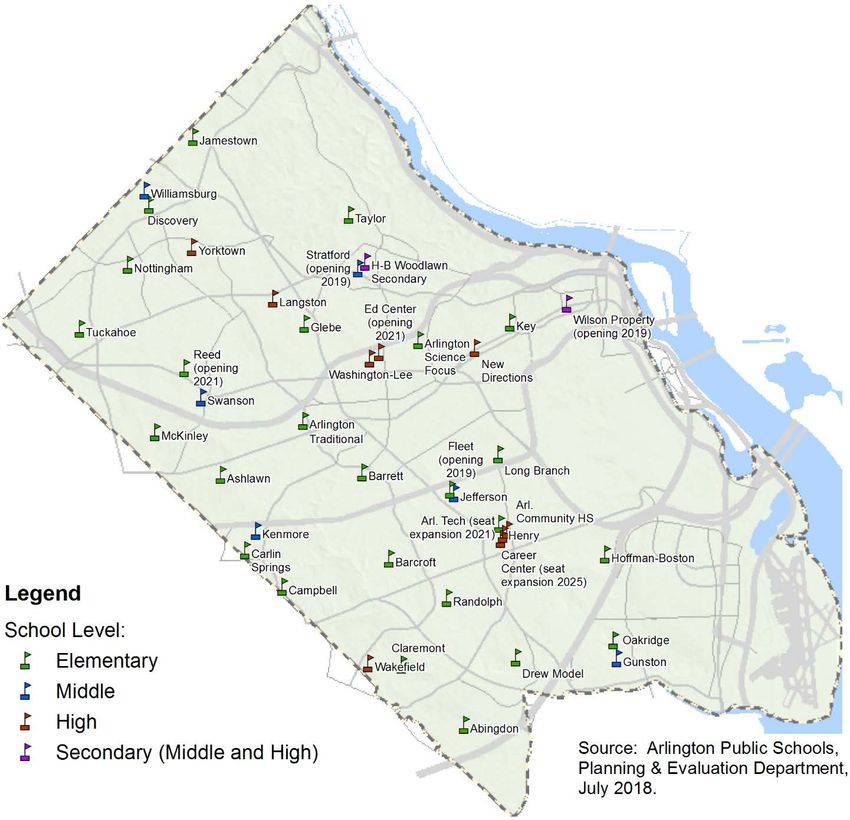
Page 9 of 32Arlington Public Schools Map
Page 10 of 32CIP Overview
Capital Improvement Plan
Managing enrollment growth and maintaining the quality of facilities are critical to the success
of any school division. Constructing, renovating, and adding to existing school buildings are all
lengthy processes. Typically, from the time the School Board makes a commitment, it takes five
years to open a school. It begins by identifying the needs of the school division and is followed
by obtaining bond authority from the citizens, after which construction may follow.
APS develops a 10-year CIP every two years. Each plan re-evaluates and/or confirms the
previous plan to reflect changes in enrollment projections, changes to various conditions
informing the plan, and changes in School Board priorities. Every CIP includes two broad
categories of projects: The Major Construction projects, and a second category known as Minor
Construction/Major Maintenance (MC/MM).
Major Construction projects include new buildings, additions and renovations. MC/MM projects
primarily include HVAC, roofing, and infrastructure improvements. Regardless of the category,
all CIP projects have a useful life of 20 years or more. Most CIP projects are funded by general
obligation bonds, but they may also be funded with supplemental funding or current revenues
set aside in the Capital Reserve.
Page 11 of 32Enrollment Growth
Underscoring the need to manage enrollment growth, Figure 1(below) shows historical
enrollment trends. Since 2006, PreK-12 enrollment has increased by just over 8,500 students
through 2017. In this period, enrollment growth has averaged about 3% year-over-year.
Figure 1. Total K-12 and PreK-12 Enrollment (September 30th), 1961-2017
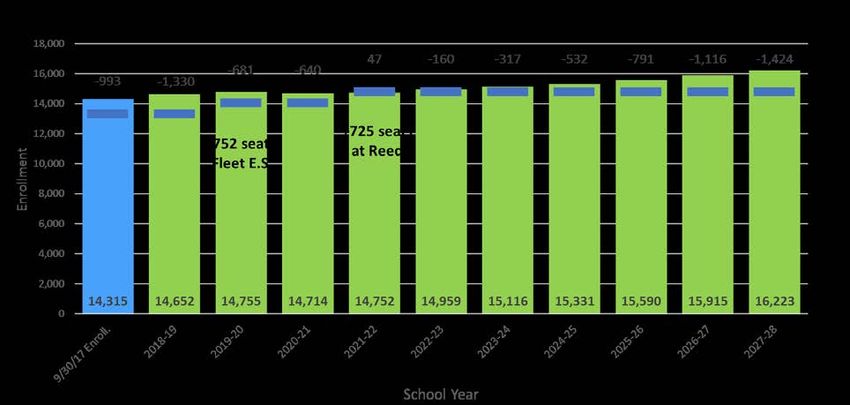
APS produces projections 1 that extend 10-years, the same period considered by the CIP. When the
projected enrollment, by grade level, is compared to the estimated number of future permanent seats 2
produced by prior CIP funding, it helps illustrate periods of time when there are more students than
seats. Figure 2 (next page) shows that after the 725 elementary seats are added at Reed in school year
2021-22—a 2017-26 CIP priority—there are likely to be about 160 more projected students than seats
by the following school year. This difference grows to about 1,420 more students than seats by school
year 2027-28. Similar to the CIP which is reevaluated every two years, projections are reviewed annually
to assess changes in enrollment growth and monitor enrollment levels at each school to ensure
balanced enrollment across schools.
1 To learn more about how projections are used in the CIP process, see the March 2018
“Arlington Facilities and Student Accommodation Plan” (AFSAP) report for more information at
https://www.apsva.us/wp-content/uploads/2018/03/AFSAP-Decision-Points-FINAL-03-06-
19.pdf
2 Permanent seats are associated with a current or future school structure. Permanent seats do
not include relocatable classrooms.
Page 12 of 32Figure 2. Projected Enrollment and Seats from Prior CIP, PreK to Grade 5
Likewise, Figure 3 shows the effect on the balance between seats and projected enrollment
when 1,000 middle school seats are added at Stratford—a 2015-24 CIP project—in school year
2019-20. In that school year, there is a temporary surplus of seats, but by the following school
year, there are about 160 more projected students than seats. This difference grows to about
560 more students than permanent seats by 2027-28.
Figure 3. Projected Enrollment and Seats from Prior CIP, Grades 6 to 8
The same is true at the high school level. Even when 600 seats are provided through
repurposing of the Education Center and 250 seats are added to Arlington Tech through
internal modifications, by the following school year in 2022-23 there are expected to be about
Page 13 of 3275 more students than seats at the high school level, due to enrollment growth; see Figure 4.
This difference grows to about 700 more students than seats by 2027-28.
Figure 4. Projected Enrollment and Seats from Prior CIP, Grades 9 to 12
Because the seat capacity from prior CIP projects which have either started construction or will
start near-term construction is outpaced by enrollment growth, the School Board must re-
evaluate prior CIP projects that have not started and contemplate new capital projects. APS
staff and the School Board were assisted in assessing periods of time when it would be ideal to
add seats by grade level by the Advisory Council on School Facilities and Capital Programs (FAC).
FAC’s recommendations were based on identifying future school years when it is expected that
the difference between seats and projected enrollment will exceed the current balance in seats
and students. The current balance is used as a criterion because APS is currently managing such
differences between students and seats. Figure 5 (next page) identifies those periods of time—
shown circled—when FAC assessed it would be ideal to add seats.
Page 14 of 32Figure 5. Periods Identified as Ideal for Adding Seats by Grade Level for FY 2019-28 CIP.
Note
• The numbers represent the difference between seats and students, with the red figures representing a deficit of seats and
black figures representing a surplus of seats.
• The 250 seats at Arlington Tech are the remaining seats needed to complete the FY 2017-26 CIP project for planned growth
at Arlington Tech to 600 students. The FY 2017-26 CIP project seats were to be delivered by September 2018. This timeline
has shifted to allow a comprehensive phased development planning effort to occur through the Career Center Working
Group (CCWG) prior to beginning any capital expansion project.
Process
The process to shape the priorities of the FY 2019-28 CIP began in Fall 2017 with the drafting of
the Arlington Facilities Student Accommodation Plan (AFSAP) and its publication in March 2018.
The AFSAP provides an overview of projected enrollment by school level and the implications
for future seat capacity.
With the publication of the AFSAP, preparations for the FY 2019-28 CIP started in early March
2018. Using the AFSAP for context, APS staff and the FAC identified periods of time when it
would be ideal to add permanent seats to manage growth by school level.
By late April, APS Design and Construction Services received cost estimates for an array of
capital projects that might be considered in the FY 2019-28 CIP from two different professional
cost estimators engaged for this purpose, see Appendix B. Similarly, APS Finance and
Management Services worked to determine an estimate of bonding capacity 3 so staff could
perform cash flow analyses on a combination of potential capital projects. All three topics were
covered at the School Board’s Work Session #1.
At the start of this process, the necessary information—impact of projected enrollment, cost of
potential projections, and bonding capacity—was assembled. Then CIP scenarios were
developed with the goal to manage growth through capital projects that addressed different
3
APS’s bonding capacity is framed by the County Board-adopted financial and debt
management policies. The policies provide the parameters for the amounts and timing of bond-
financed projects to be included in the County’s CIP, ensuring that the CIP is financially
sustainable and that it supports the County’s triple, triple-A bond ratings.
Page 15 of 32school levels and needs, as well as the timing of projects, within the financing constraints. The
first scenario developed for Work Session #1 was for information purposes and demonstrated
the impact of funding all the school facilities that met the timing for projected seat needs, as
identified by FAC and APS staff (see Figure 5). This first scenario illustrated the trade-offs
implicit with each CIP, since providing all school seats when needed led to going over the two
key funding thresholds for several fiscal years: the (1) Debt Service Ratio, which cannot exceed
10% per the County Government’s policy, and an (2) annual debt service increase which is
preferred to be kept below $3.0 million.
The second scenario was the Superintendent’s Proposed FY 2019-28 CIP that provided all the
seats by school level as recommended by FAC, while shifting some of the timing so that every
project’s funding fit within the bonding capacity. This CIP scenario added seats at the
elementary, middle, and high school levels, including 800 seats at the Career Center by 2026
with no field or additional parking.
After the Superintendent’s Proposed CIP was released, the School Board held a series of work
sessions that developed scenarios to add 800 seats at the Career Center site earlier than 2026
and provide additional parking and/or field. At each work session, the School Board discussed
the implications of each scenario to bond capacity, relocatable classrooms, and balance
between projected enrollment and proposed seats. Figure 6 (next page) summarizes the
different scenarios that were developed across the process, and Figure 7 details key dates in
the CIP development calendar.
Page 16 of 32Figure 6. CIP Scenario Iterations with School Board Direction and Dates
Page 17 of 32Figure 7. FY 2019-28 CIP Development Calendar
Engagement
Throughout the FY 2019-28 CIP process, APS endeavored to keep the community informed
about progress on the CIP and to answer questions regarding the evolving scenarios. For this
purpose, APS offered in-person, social media, and online avenues for community engagement
for the CIP.
Beginning in April 2018, Planning and Evaluation staff developed the FY 2019-28 CIP website,
https://www.apsva.us/engage/cip_fy19-28/, with explanatory text on the CIP process, a
schedule of School Board meetings and work sessions relevant to the CIP, and links to all
content related to the CIP as it became available, such as copies of presentations or answers to
School Board members’ CIP questions. The webpage also included a dedicated
communications page with summaries of select School Board work sessions and links to news
stories on the CIP, podcasts that explain the CIP process, and news releases on CIP-related
milestones. This information was distributed to stakeholders via School Talk messages and
weekly updates to APS Ambassadors; in addition, the APS Twitter account tweeted about CIP
updates and the APS Facebook page featured posts about CIP activities.
Besides informing the community about the CIP process through online and social media
channels, staff conducted in-person outreach. In April, staff held Open Office Hours at
Page 18 of 32Wakefield High School, the Education Center, and Kenmore Middle School to answer questions
on the CIP process.
Community input was also gathered through other engagement processes including the 1,300
New High School Seats, Education Center instructional focus, Reed BLPC, and Career Center
Working Group.
By May 2018, when the CIP process was further along and the School Board was weighing the
merits of competing CIP scenarios, additional community outreach was organized to answer
questions on the CIP scenarios and status. To this end, three Community Information Sessions
were organized at Washington-Lee High School, Swanson Middle School, and Patrick Henry
Elementary School. All these sessions were held in the evening and sites were selected to
address questions from parents of students attending all three grade levels. In attendance were
staff with different areas of expertise, including finance, enrollment projections, and the future
projects at the Career Center, Education Center, and the Reed School site, so they could answer
a variety of questions.
The FY 2019-28 CIP process also included an opportunity for community input on the
Superintendent’s Proposed CIP through an online questionnaire that asked the following:
In reviewing the Superintendent’s proposed Fiscal Year 2019-28 Capital Improvement
Plan (CIP), please share your thoughts on the major capital projects and infrastructure
needs of APS, and how this CIP addresses these needs and our community’s priorities.
This questionnaire resulted in seventy-nine (79) responses. All responses-- with any personal
information removed, were posted online for the public’s review and were shared with APS
staff and the School Board so they could assesss the range of answers to the questionnaire as
they deliberated the merits of various CIP scenarios.
Page 19 of 32Capital Investments
The CIP funds two types of capital projects: Major Construction and Minor Construction/Major
Maintenance (MC/MM) projects. For these capital projects to be funded with proceeds from
bond sales, their total costs must be more than $500,000 and have a useful life of 20 years or
more. In addition, a project’s useful life must be equal to or longer than the repayment
schedule for the bonds issued for it.
Major Construction projects include new facilities, additions, and renovations:
• New Facilities: a new school built on a new or existing site with play fields, common spaces,
and attendance boundaries (or attendance policies in the case of option schools)
• Additions: space added to an existing school to create new classrooms and other spaces as
well as site work and other infrastructure required to support the new space
• Renovation: replacement of selected finishes or systems and reconfiguration of spaces as
necessary to bring the facility up to code and/or current standards
Figure 8 shows ongoing major construction projects funded through prior CIP rounds, new
major construction projects funded through the FY 2019-28 CIP, and other priorities funded
through capital reserves.
Page 20 of 32Figure 8. 10-Year CIP, New and Ongoing Major Construction Projects (from Bond Funds)
MC/MM projects primarily include HVAC, roofing, and infrastructure improvements. Priorities
for these projects come from a ten-year plan developed by staff that runs concurrently with the
CIP and is based on a series of annual inspections and condition reports. Schools and
departments are also invited to participate directly in the MC/MM process by submitting
requests for projects at individual buildings. Figure 9 (next page) lists two projects in the FY
2019-28 CIP which use MC/MM funds.
Figure 9. 10-Year CIP, MC/MM Projects Not Funded by Bond Funds
Page 21 of 32Each fall, the MC/MM committee—comprising staff from the Facilities and Finance
departments, representatives from each principals’ group, and a member of the FAC—
convenes for a series of meetings to review and prioritize projects from the 10-year plan and
the new requests submitted according to the following criteria:
• Mandates
• Health and safety
• Immediate instructional needs
• Essential building repairs
• General instructional enhancements
• General building enhancements
CIP Funding
Major Construction and MC/MM projects may be funded through bond financing, current
revenues, reserves, County funds on joint-use projects, and, in some cases, through a
combination of all four sources. Bond financing is generated through the sale of general
obligation bonds by Arlington County as authorized by County voters through bond referenda.
Arlington County schedules bond referenda for even-numbered calendar years, which
correspond to odd-numbered fiscal years; for example, the next bond referendum is scheduled
for November 2018 (FY 2019). In the past, Arlington County voters have approved school bonds
by a large majority. As proposed for some projects in this CIP, APS has often funded the design
of a Major Construction project in one bond referendum year and then construction of the
project in the next bond referendum year. The practice of funding design and construction of
projects in separate bond referenda years allows the project to be well underway prior to the
second bond referendum year, at which time estimates of construction and total project costs
will have been refined to reflect input from the school and community and more detailed
development of the design.
Projects with total costs of more than $500,000 and useful lives of 20 years or more are
typically funded with proceeds from bond sales, although, in the FY 2019-28 CIP, certain
facilities are partially or wholly paid with capital reserves. To keep the current CIP’s Debt
Service Ratio 4 below 10%, about $31.00 million in capital reserves were allocated to the
construction of the Career Center Project’s classroom seats, field, parking garage, and
performing arts facility. For the same reason, renovation of a Transportation staff facility and
field conversions to synthetic turf are completely funded with capital reserves, with about
$2.10 and $1.97 million allocated respectively. If a project is financed with bonds, it must have a
useful life equal to or longer than the repayment schedule of the bonds issued for it.
4
Within the 10-year CIP period, net tax-supported debt service payments should not exceed 10% of general
expenditures, not including the Capital Projects Fund. This percentage is known as the debt service ratio.
Page 22 of 32Estimated Project Costs
Estimated costs included in the CIP for Major Construction projects represent total project costs. Total
project costs comprise construction costs; soft costs and contingencies calculated based on current
costs; plus an allowance for escalation, or potential cost increase, through the midpoint of construction.
For each project under consideration, a preliminary scope of work was developed by
Architecture/Engineering (A/E) consultants with input from Design and Construction Services staff. Two
independent estimates were prepared for each project based on the preliminary scope of work; one by
a cost estimator on the A/E team, and another by a Construction Manager. The two estimates were
reconciled with one another to ensure that that each was based on the same assumptions and scope of
work. This process ensured that APS obtained two separate professional opinions of probable cost for
each project. Staff selected the higher of the two numbers to use in the total costs for the projects
included in the FY 2019-28 CIP.
The total project cost estimates were initially based on 2019 dollars; see Appendix B for a list of all
project costs considered in the FY 2019-28 CIP. To plan for projects that would be completed after 2019,
4% compounded annual escalation was added to account for increasing costs of labor and materials
through the anticipated mid-point of construction for each project. Anticipated escalation causes the
total cost of a project to vary according to the year in which it is scheduled for completion.
Because of the conceptual nature of the estimates, several design, construction, and soft cost
contingencies are included in all CIP project estimates. Design cost contingency is an estimated cost that
is added to total project cost for development of the design drawings. This contingency’s estimated cost
typically goes down as a facility’s design becomes better defined and more details during the process
from conceptual design through bid documents. Construction contingencies are included to cover
unanticipated costs arising during construction and soft cost contingencies are included because many
of APS’s direct costs are unclear at this early stage of a project.
Publications that Informed the CIP
Arlington Facilities and Student Accommodation Plan (AFSAP)
The AFSAP is generally produced every other calendar year to provide a comprehensive look at
student enrollment and building capacity; it is used to inform the CIP. A copy of the March 6,
2018, AFSAP can be found at https://www.apsva.us/wp-content/uploads/2018/03/AFSAP-
Decision-Points-FINAL-03-06-19.pdf.
2018-24 Strategic Plan
The Strategic Plan is a six-year plan that charts a course for students, staff and APS overall. The
Strategic Plan addresses the needs and aspirations of students, parents, citizens, teachers,
administrators and staff, while mapping out the school system’s core activities. On June 7,
2018, the School Board adopted the 2018-24 Strategic Plan. In September 2018, the
Superintendent will propose final strategies and performance objectives of the Strategic Plan
for School Board approval. A copy of the Strategic Plan can be found at
Page 23 of 32https://www.apsva.us/wp-content/uploads/2018/06/SB-Adopted-APS-2018-2024-Strategic-
Plan-DRAFT-removed.pdf
Facilities Optimization Study, SY 2017-18
The APS Facilities Optimization Study provides the number of relocatable classrooms that may
be deployed at each APS school. The study was developed by APS staff. It provides data with
which to make informed decisions about adding capacity to APS schools through the use of
relocatable classrooms.
Committees that Informed the CIP
Advisory Council on School Facilities and Capital Programs (FAC)
The FAC, comprising parents and citizens, reports directly to the School Board. The FAC assists the
School Board in the continuous, systematic review of school facilities and the annual and long-range
Capital Improvement Program (CIP). FAC offers recommendations and suggestions to the School Board
on the AFSAP, which includes the 10-year CIP, and for future funding for school facilities.
Building Level Planning Committees (BLPC)
Following a decision to proceed with a capital project, the School Board appoints a BLPC. The
BLPC members include two representatives of the civic association within which the school is
located, one representative from each civic association within the school attendance zone,
parents, County, APS and school staff, and other significant stakeholders. The BLPC works with
the architect appointed by the School Board to determine the best way to meet the goals and
objectives for the project as approved in the CIP. The BLPC assists in developing the concept
design and creating the schematic design that is recommended to the School Board for
approval.
Public Facilities Review Committees (PFRC)
The PFRC was formed by the County Board to ensure that the highest quality of land use
planning and the Principles of Civic Design in Arlington are applied to all County and APS capital
projects. The PFRC is a standing committee comprising representatives of each County
Commission to which are added representatives from affected civic associations for each
specific project under review. The PFRC focuses on the placement of the building or additions
on the site, site layout and amenities, and the overall relationship to and impact of the project
on the neighborhood in which it is to be located. On APS projects, the PFRC works in concert
with the BLPC during concept and schematic design and makes recommendations to the County
Board.
Page 24 of 32Appendix A – Motion for Adoption of FY 2019-28 CIP: June 21, 2018
The School Board is tasked by the Code of Virginia to oversee the delivery of public education in the
county. This includes making decisions on providing and/or managing school facilities and properties,
such as establishing a CIP. The Board conducts their business in accordance with Robert’s Rules of
Order, consequently all their official actions are made by voting on motions. Below is the June 21, 2018,
motion approving the APS FY 2019-28 CIP:
Motion for Adoption of FY 2019-28 CIP: June 21, 2018
Every two years, the School Board adopts a Capital Improvement Plan (CIP) addressing capital needs
over the next ten years. This approach to capital planning anticipates needs for the next decade, while
providing flexibility to adjust to changing circumstances.
During the development of the FY 2019-FY 2028 CIP, the School Board focused on providing seats for
students in the areas of most critical need in light of the continued, sustained growth in student
enrollment. The development process that began in the fall of 2017 culminates in this CIP and will be
detailed in a report to be completed by the end of July 2018.
The School Board concluded that, to meet its Strategic Plan goal of operational excellence, and focusing
on the areas of greatest need, capital improvements for this CIP would focus on elementary seats, high
school seats and continued investment in maintenance of our facilities.
The School Board recognizes that its first priority in this CIP is identifying the funding needed for the
2018 bond, in order to begin work on the areas of most critical need. The School Board further
recognizes that additional community input and further collaboration with the Arlington County Board
and staff will be necessary moving forward.
Consistent with these goals, I move that the School Board adopt the FY 2019-FY 2028 Capital
Improvement Plan.
Elementary School Capacity
Reed – Expanded
• Estimated New Seats: 725
• Projected Completion: start of school, September 2021
• Maximum Estimated Project Cost: $55,000,000
• 2018 Bond Funding: $44,250,000 (Project funding also includes $4.0 million from reserves, $5.5
million from joint funding, and $1.25 million in other funds)
Elementary Seats to be Determined
• Estimated New Seats: 725 -750
• Projected Completion: start of school, September 2029
• Maximum Estimated Project Cost: $73,900,000
Page 25 of 32• 2018 Bond Funding: $0 (Project funding also includes $70.6 million in future bonds, and $1.3 million
in other funds)
Middle School Capacity
Middle School Renovation/Addition Location to be Determined
• Estimated New Seats: 300
• Projected Completion: start of school, September 2030
• Maximum Estimated Project Cost: $35,000,000
• 2018 Bond Funding: $0 (Project funding also includes $35.0 million in future bonds)
High School Capacity
Career Center/Arlington Tech
• Estimated New Seats: 250
• Projected Completion: start of school, September 2021
• Maximum Estimated Project Cost: $18,750,000
• 2018 Bond Funding: $6,000,000 (Project funding also includes $12.0 million in previous bonds, and
$0.75 million in other funds)
Career Center Project
• Estimated New Seats: 800
• Projected Completion: start of school, September 2025
• Maximum Estimated Project Cost: $184,700,000
• 2018 Bond Funding: $5,900,000 (Project funding also includes $6.0 million in previous bonds, $140.5
million in future bonds, and $31.0 million from reserves funding, and $1.3 million in other funds)
Education Center
• Estimated New Seats: 600
• Projected Completion: start of school, September 2021
• Maximum Estimated Project Cost: $37,000,000
• 2018 Bond Funding: $32,250,000 (Project funding also includes $4.0 million in previous bonds, and
$0.75 million in other funds)
Infrastructure
Major Infrastructure Projects (bond-funded MC/MM)
• Maximum Estimated Total Project Costs: $81,000,000 over the 10 years of the CIP
• 2018 Bond Funding: $14,600,000 (Includes $66.4 million future bonds)
Transportation Staff Facility Renovations
• Maximum Estimated Project Cost: $2,100,000
• 2018 Bond Funding: $0.0 (Project funding also includes $2.1 million from reserves)
Page 26 of 32Field Conversions to Synthetic Turf & Turf Field Replacements (APS Share)
• Maximum Estimated Total Project Costs
o $1,970,000 Field Conversions
o $2,890,000 Turf Field Replacements
• 2018 Bond Funding: $0.0 (Project funding includes $1.97 million from reserves, $2.89 million from
MC/MM funds)
Building refreshes
• Maximum Estimated Total Project Costs
o $950,000 Drew Model
o $850,000 Patrick Henry
• 2018 Bond Funding: $0.0 (Project funding includes $1.8 million from MC/MM funds)
MOTION
WHEREAS, Section 15.2-2640 of the Code of Virginia of 1950, as amended (the “Code”), requires that
the School Board of Arlington County (“School Board”) request, by resolution, that the County Board of
Arlington County (“County Board”) adopt a resolution regarding the contracting of a debt and the
issuance of general obligation bonds of Arlington County for school purposes;
NOW, THEREFORE, BE IT RESOLVED, that the School Board, as required by Section 15.2- 2640 of the
Code, does hereby request that the County Board adopt a resolution setting forth the maximum amount
of its general obligation bonds to be issued for capital projects for school purposes and requesting that
the Circuit Court of Arlington County order an election on the question of contracting a debt and issuing
the general obligation bonds of Arlington County in an amount not to exceed $103,000,000 for the
purpose of paying the costs of capital projects for school purposes. This resolution shall take effect
immediately.
Page 27 of 32Appendix B – Total Project Cost Estimates
A list of all capital projects considered in the FY 2019-28 CIP and their cost is below and can also be
found at https://www.apsva.us/wp-content/uploads/2018/04/Capital-Projects-Considered-for-FY-2019-
28-CIP-as-of-April-24-2018.pdf and https://www.apsva.us/wp-content/uploads/2018/05/FY-2019-28-
CIP-Work-Session-Presentation-May-7-2018.pdf.
Capital Projects Considered for FY 2019-28 CIP
Elementary School
Total project cost Sequencing of
Potential capital
Description Seats 2019 Dollars (millions) construction Included in the 2017-26 CIP Web Link
projects
Low estimateHigh estimate phasing
Reed building
renovation/expansion to https://www.apsva.u
New elementary create 110,000 sq. ft. building s/design-and-
school at the Reed with surface parking 725-750 N/A $55.00 N/A Yes - 725 seats by 2021, $49.00 million construction/new-
site elementary-school-at-
Note: Project is currently in reed-building/
the schematic design phase.
Additional seats for
elementary school Buck property building renovati 250+/- $14.00 $14.70 TBD No -
use
Yes - 400 to 725 seats to be completed by
with surface parking 725-750 $51.90 $61.00 N/A -
Options for future 2025, $68.92 million
new 110,000 sq. ft. Yes - 400 to 725 seats to be completed by
with parking below an adjacent 725-750 $59.80 $70.40 N/A -
elementary school, 2025, $68.92 million
site TBD Yes - 400 to 725 seats to be completed by
with parking below the school 725-750 $54.60 $64.30 N/A -
2025, $68.92 million
Middle School
Total project cost Sequencing of
Potential capital
Description Seats 2019 Dollars (millions) construction Included in the 2017-26 CIP Web Link
projects
Low estimateHigh estimate phasing
Gunston
- 42,000 sq. ft. addition for
general classrooms 300 $19.60 $23.10 TBD No -
- 14,700 sq. ft. light
renovation to existing building
Options for future Kenmore
Renovation/ - 42,000 sq. ft. addition for
additions general classrooms 300 $19.50 $22.90 TBD No -
- 14,700 sq. ft. light
renovation to existing building
Williamsburg
- 42,000 sq. ft. addition for
general classrooms 300 $16.50 $19.40 TBD No -
- 8,400 sq. ft. light renovation
to existing building
Future middle
school, with surface parking at a site
1,000 $86.90 $102.10 TBD No -
new bldg. TBD
180,000 sq. ft.
Notes
(1) All amounts are in 2019 dollars – 4% per year compounded escalation must be added based on planned project completion date to arrive at final estimated cost.
(2) Total project cost includes costs for construction, design/project management/other professional services fees, commissioning, utility services, permitting, furniture, equipment (including technology),
moving, legal expenses, project contingencies, and APS staff.
(3) The 250 seats at Arlington Tech are the remaining seats needed to complete the FY 2017-26 CIP project for planned growth at Arlington Tech to 600 students. The FY 2017-26 CIP project seats were to be
delivered by September 2018. This timeline has shifted to allow a comprehensive phased development planning effort to occur through the Career Center Working Group (CCWG) prior to beginning any capital
expansion project.
(4) Projects highlighted in yellow represent components of the 1,300 secondary seats from the FY 2017-26 CIP.
Source
APS, Facilities & Operations Department. Data is as of April 24, 2018
Page 28 of 32Capital Projects Considered for FY 2019-28 CIP (Continued)
High School
Total project cost Sequencing of
Potential capital
Description Seats 2019 Dollars (millions) construction Included in the 2017-26 CIP Web Link
projects
Low estimateHigh estimate phasing
Yes: 1,300 secondary seats to be
completed in three phases for start of
https://www.apsva.u
school in 2022, 2024 and 2026 locations
Renovation of Education Center Education Center s/instruction/new-
TBD, $146.71 million.
existing facility for will be fully high-school/
500-600 $30.40 $34.20
high school seats, Note: part of the 1,300 seats vacated by June https://www.apsva.u
June 2017: School Board action to locate
55,000 sq. ft. included in the FY 2017-26 CIP 30, 2018 s/engage/education-
700-800 of the 1,300 seats at the Career
center/
Center and 500-600 at the Education
Center.
Career Center/Arlington Tech
- addition for general
classrooms on roof of existing
Additional seats building with new stair and
Initial phase of Yes: 300 + seats for Arlington Tech, to be https://www.apsva.u
for high school use, elevator access
250 $14.00 $16.90 Career Center delivered by September 2018, $12.75 s/career-center/ccwg-
30,000-35,000 sq. - includes no additional
expansion million follow-journey/
ft. parking
- offsite leased parking will be
required
Phase 1
Yes: 1,300 secondary seats to be
- add 172,000 sq. ft., including
completed in three phases for start of
general classrooms, specialty
school in 2022, 2024 and 2026 locations
shops and multi-purpose
TBD, $146.71 million.
gymnasium/assembly/perfor https://www.apsva.u
mance space 800 $102.50 $105.10 N/A s/career-center/ccwg-
June 2017: School Board action to locate
- 50,000 sq. ft. renovation of follow-journey/
700-800 of the 1,300 seats at the Career
existing building
Center and 500-600 at the Education
Center.
Note: part of the 1,300 seats
included in the FY 2017-26 CIP
Phase 2
- add 82,500 sq. ft. for general Follows
https://www.apsva.u
classrooms and completion of
500 $60.90 $72.70 No s/career-center/ccwg-
theater/performance/assembl Career Center
follow-journey/
y space Phase 1
- 50,000 sq. ft. renovation of
Phase 3
Follows
- add 82,500 GSF addition for https://www.apsva.u
Options for future completion of
general classrooms 500 $60.90 $72.70 No s/career-center/ccwg-
high school, Career Center
- 50,000 sq. ft. renovation of follow-journey/
Career Center Phase 2
existing building
Follows
Phase 4 https://www.apsva.u
completion of
- add 82,500 sq. ft. for general 500 $42.40 $50.80 No s/career-center/ccwg-
Career Center
classrooms follow-journey/
Phase 3
Field/Parking Garage Required
New multi-use field above 500 concurrent with
structured parking spaces or before https://www.apsva.u
below grade 0 $31.80 $35.00 completion of Anticipated in FY 2015-24 CIP. s/career-center/ccwg-
Career Center follow-journey/
(required concurrent with or Phase 2 unless
before completion of Career Henry building is
Performing arts facility
0 $7.40 $8.50 No
addition
Swimming pool addition 0 $24.30 $27.90 No
Demolition of Henry and
Cannot occur
construction of multi-use field
before https://www.apsva.u
(468) $5.80 $6.80 replacement No s/career-center/ccwg-
(cannot occur before
elementary seats follow-journey/
replacement elementary seats
are available.
are available)
Notes
(1) All amounts are in 2019 dollars – 4% per year compounded escalation must be added based on planned project completion date to arrive at final estimated cost.
(2) Total project cost includes costs for construction, design/project management/other professional services fees, commissioning, utility services, permitting, furniture, equipment (including technology),
moving, legal expenses, project contingencies, and APS staff.
(3) The 250 seats at Arlington Tech are the remaining seats needed to complete the FY 2017-26 CIP project for planned growth at Arlington Tech to 600 students. The FY 2017-26 CIP project seats were to be
delivered by September 2018. This timeline has shifted to allow a comprehensive phased development planning effort to occur through the Career Center Working Group (CCWG) prior to beginning any capital
expansion project.
(4) Projects highlighted in yellow represent components of the 1,300 secondary seats from the FY 2017-26 CIP.
Source
APS, Facilities & Operations Department. Data is as of April 24, 2018
Page 29 of 32Capital Projects Considered for FY 2019-28 CIP (Continued)
Other Projects
Total project cost Sequencing of
Potential capital
Description Seats 2019 Dollars (millions) construction Included in the 2017-26 CIP Web Link
projects
Low estimate High estimate phasing
Driver/attendant break room and
Transportation staff restrooms expansion required due to
facility, increasing number of drivers and 0 $1.90 $2.00 N/A No -
renovate 8,500 sq. ft. attendants required to meet growing
enrollment
Notes
(1) All amounts are in 2019 dollars – 4% per year compounded escalation must be added based on planned project completion date to arrive at final estimated cost.
(2) Total project cost includes costs for construction, design/project management/other professional services fees, commissioning, utility services, permitting, furniture, equipment (including technology),
moving, legal expenses, project contingencies, and APS staff.
(3) The 250 seats at Arlington Tech are the remaining seats needed to complete the FY 2017-26 CIP project for planned growth at Arlington Tech to 600 students. The FY 2017-26 CIP project seats were to be
delivered by September 2018. This timeline has shifted to allow a comprehensive phased development planning effort to occur through the Career Center Working Group (CCWG) prior to beginning any capital
expansion project.
(4) Projects highlighted in yellow represent components of the 1,300 secondary seats from the FY 2017-26 CIP.
Source
APS, Facilities & Operations Department. Data is as of April 24, 2018
Page 30 of 32Appendix C – Glossary of Terms
Bonding Capacity -The amount of bonds that can be issued in a given year that meets the debt service
ratio. APS’s bonding capacity is framed by the County Board-adopted financial and debt management
policies. These policies provide the parameters for the amounts and timing of bond-financed projects to
be included in the County’s CIP, ensuring that the CIP is financially sustainable and that it supports the
County’s triple, triple-A bond ratings.
Bond Financing – Funds generated through the sale of general obligation bonds by Arlington County as
authorized by County voters through bond referenda. Bond referenda are scheduled for even-numbered
calendar years, with the next bond referendum in November 2018.
Capital Improvement Plan (CIP) - Every two years, the School Board adopts a CIP that addresses APS
capital needs—investments needed to improve or enhance the infrastructure of our schools—over the
next ten years. The CIP includes major capital projects, such as new schools and school additions, as well
as major maintenance and minor construction projects. See CIP Overview for more information.
Construction Contingency – An estimated value added to total project cost to cover unanticipated
expenses that come up during construction.
Debt Service Ratio - Within the 10-year CIP period, net tax-supported debt service payments should not
exceed 10% of general expenditures, not including the Capital Projects Fund. This percentage is known
as the debt service ratio.
Debt Service Increase – In the APS CIP process, it reflects a debt service increase of $3 million or more
over the previous fiscal year.
Design Cost Contingency – An estimated cost added to total project cost to account for development of
the design drawings. This contingency’s estimated cost is typically reduced as a facility’s design
becomes increasingly well-defined from conceptual design through bid documents.
Escalation Cost - To plan for projects that would be completed after 2019, a 4% compounded annual
increase, or escalation, was added to account for increasing costs of labor and materials through the
anticipated mid-point of construction for each project. Anticipated escalation causes the total cost of a
project to vary according to the year in which it is scheduled for completion.
Major Construction and Minor Construction/Major Maintenance (MC/MM) - major maintenance
investment needs for APS facilities, such as the repair and/or replacement of HVAC, roofing, and
building envelope systems.
Permanent Seat – school seats associated with a current or future school structure. Permanent seats do
not include relocatable classrooms.
Soft Costs - Include architecture/engineering design fees, construction management, third-party testing
and commissioning fees, permitting fees, moving and legal costs, furniture, fixtures, and equipment
costs, and other miscellaneous costs needed to provide a complete project. Soft costs can vary greatly
depending on the size, scope, and complexity of the project.
Page 31 of 32Total Project Cost - Includes construction costs; soft costs and contingencies calculated based on
current costs; plus an allowance for escalation, or potential cost increase, through the midpoint of
construction.
Page 32 of 32You can also read


