Otepoti ki Te Raki - Community of Learning - Kāhui Ako North Dunedin 1 - Ministry of Education
←
→
Page content transcription
If your browser does not render page correctly, please read the page content below
Otepoti ki Te Raki

Community of Learning – Kāhui Ako
        North Dunedin

                1
PREAMBLE

 Who are we?
 The North Dunedin education community is made up of a wide range of learning
 environments, from early childhood providers through to New Zealand’s most successful
 polytechnic and New Zealand’s oldest university.

 The general community too is varied – whilst there are pockets of real deprivation in our
 district, where poverty is as bad as anywhere else in the country, the presence of the
 tertiary institutions and the history of the city combine to place high expectations on the
 educators.

 https://www.health.govt.nz/publication/nzdep2013-index-deprivation

 The experience and wisdom found amongst this group is vast – many of the education
 leaders are leaders in local and national organisations. Most have worked in this part of the
 city for most of their careers.

 The outstanding feature of educational leadership in our community is that the educators
 know their learners. They understand the power of making the connections with the learner
 and the learner’s whānau.

 https://www.education.govt.nz/assets/Documents/Ministry/Strategies-and-policies/Ka-
 Hikitia/KaHikitiaSummary.pdf

 So, these leaders bring to this community of learning

        Successful teaching experience
        Successful leadership
        Rich connections with the learner and their whānau

                                               2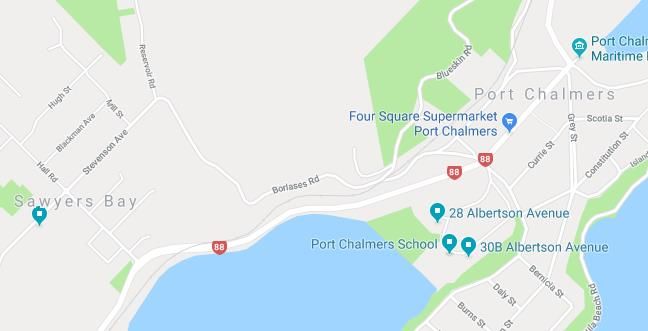
What are some of these successes?
The Valley Project is an example of what can happen when a group of committed and
forward-thinking educators get together to make a difference for their learners.

This initiative started around 2007 when primary, intermediate and early childhood leaders
working in and around North East Valley got together with a few other influential locals to
better engage families in education.

The original premise was that by making the Valley a better place to live, children and young
people would better engage at school; better engagement would hopefully lead to better
learner outcomes.

So over ten years later the Project is a well-established community development
programme, hosted by North East Valley Normal School. Last year the Project was
nominated and shortlisted for New Zealander of the Year.

The schools and early childhood centres in North East Valley and beyond have indeed
benefitted from this work – overflowing school rolls, decline in transience and absenteeism
and a greater sense of community involvement in schooling.

Strengthening wairua in schools (SWiS) is a collaborative approach across some North
Dunedin schools and ECE sites to bolster teacher efficacy in the area of inclusive education.
Started by local school leaders, this initiative brings teachers and support staff together
once a term to discuss an issue around inclusion. Invited panellists include a local
educational psychologist, ICT specialists and local teachers who demonstrate effective
practice in their classrooms and centres.

Protocols for taking excluded children were established among North Dunedin schools
some years ago. The local principals made a handshake agreement with each other that
they would take excluded children from North Dunedin schools thereby keeping the child
close to their home and own environment.

You can see that these experienced and innovative leaders and teachers are already
working collaboratively to better engage children and young people in the learning process
by reaching out to whānau and community.

We are currently in the process of refining a teacher led research initiative (TLIF) around
the notion of universal design for learning (UDL).

                                              3
And what do we want to do?
We want to build on this work.
We want to immerse ourselves in the community.
We want to work with groups such as the:
Otago Port Authority
Ravensdown Fertiliser Company
Dunedin City Council
Highlanders Rugby franchise
Otago University and Polytechnic.
Anyone and everyone in and around North Dunedin who will work with us to make North
Dunedin a better place to live, especially for children and young people and especially those
who need our help the most.
We want to explore every learner’s potential and work towards them reaching their goals.
And what does achievement mean for us?
Our definition of achievement is that all learners will reach their potential.
We will achieve this by the strategies outlined in this document.
We will measure this by a number of factors, as stated in the document, but mostly by using
our collective understanding of what achievement is and judging whether our learners are
reaching their potential. This measure will be made by us all – the village!
4
INQUIRY

 Why have we chosen the following challenges?
 The challenges are about creating an environment in which learning can flourish for all. We
 need competent teachers, engaged learners, healthy whānau and a networked community
 to ensure the optimal learning environment for our children and young people. Learning
 does not happen in isolation and we will use our influence to improve the context of the
 learners’ lives so they are better able to learn.

 How will we make progress for each challenge?
 The levers for change already exist in our schools and centres, we just need to strengthen
 and extend them. We will use tools such as universal design for learning (UDL) to inquire
 about our practice in each of these spheres – teacher practice, student and whānau voice
 and connected community - to begin our inquiry. Our within-school and across-school
 teachers will take the lead, guide the Kāhui ako through a deep reflection of our practice in
 each of these domains, and help our teachers and leaders plan ways to strengthen the
 practices.

 How will we measure progress against each challenge?
 Each challenge has a measure that will help us gauge success. The most effective measure
 will be watching the progress of our children through the pathway from early childhood
 through to post high school training. This is a long game of course and some of the results
 will take years to see fully.

 How do these challenges relate to the New Zealand Curriculum?
 The front part of the curriculum is about principles, values, and competencies. Our focus is
 on these aspirational goals - we want all leaners to be lifelong learners, who display our
 common values and show competence and agency in the learning process. We want them
 to be great people, valuable and valued citizens who lead happy and fulfilling lives.

 Will curriculum levels indicate success for this work?
 We would expect to see some lift in achievement for the target groups especially and will
 use school achievement data to track this goal. To measure this lift we will focus on oral
 language in the early childhood settings, reading progress in primary schools and reading
 PAT results beyond primary.

                                               5
INTRODUCTION

 What is our compelling collective vision?
 Bringing everyone into the learning journey.

 Our compelling collective vision is that across all levels of schooling, from early childhood
 through to tertiary, we can identify and make a difference for all learners, but particularly
 for priority learners.

 Priority learners are those at risk of not meeting their potential – whether this potential lies
 at, above or below curriculum levels.

 Priority learners may include Māori, Pasifika learners, and those from low socio-economic
 backgrounds, and learners with learning support needs.

 http://nzcurriculum.tki.org.nz/Priority-learners

 The community of learning gives us the exciting ability to compare our work with priority
 learners in very different contexts, across curriculum areas and age groups, with a view to
 establishing commonalities and best practice in the identification and management of those
 learners needing support and extension.

 All learners will get a good deal. We will achieve this through our focus on the learner being
 part of a community – a community of the school, the whānau, the wider community.

 We are a subset of community.
 North Dunedin is our village.

 We want our Kāhui ako to be seen as the learning subset of that village – we are the
 educators, those who teach, who manage and who are charged with the learning that
 happens within this community.

 So we will work with all in this village.

 Our community of learning will work inside our wider community to make our community
 stronger and better connected.

 All learners will benefit from this work, especially those most in need.

                                                6
GOALS
We will:
create a more cohesive network of learning specialists within the wider
community of North Dunedin.
expand our influence as educators in the wider community.
use our influence and networks to enhance achievement for all learners
but particularly those most in need.
Focus:
We will focus on strengthening our learning community
We will strengthen our networks with the wider North Dunedin community
We will focus on those learners greatest in need, the priority learners:
o Those with special needs
o Those with behavioural needs
o Those with giftedness
o Those who are disengaged
7
INDICATORS OF SUCCESS
We will know we are successful when;
we become a learning community that knows itself, communicates
effectively with its players, transitions learners well and works together.
strong educators and their organisations are seen as integral to the life
and health of the community; where the wider community organisations
and businesses talk with us, consult and engage with us, to maximise
learners’ potential.
learners with the greatest need are more successful, healthier, happier
and hopeful.
Annual Hui to evaluate
We will meet as a community – educators, learner representatives, whānau
and wider community members – annually to evaluate our progress and to
report to the community about our achievements.
8
WHO WILL HELP US?
Who will help us achieve our challenges?
The iwi, the businesses, the many community organisations, the helping
agencies, the local and national government service providers, all in the
community of North Dunedin will be pressed into action to help us strengthen
our community, both the learning community and the wider North Dunedin
community. Also we will rely on:
Our children and young people
Whānau
Hapu
Vibrant community organisations in North Dunedin like The North East
Valley Project https://www.northeastvalley.org/
Agencies like the Otago Youth Wellness Trust
Otago University
Not for Profits
Otago Polytechnic
The Port of Otago
Ravensdown
Forsyth Barr Stadium and the Institute of Sport
The Dunedin City Council
The Dunedin Study
Government agencies and ministries
9
EDUCATION
SITES INFORMATION
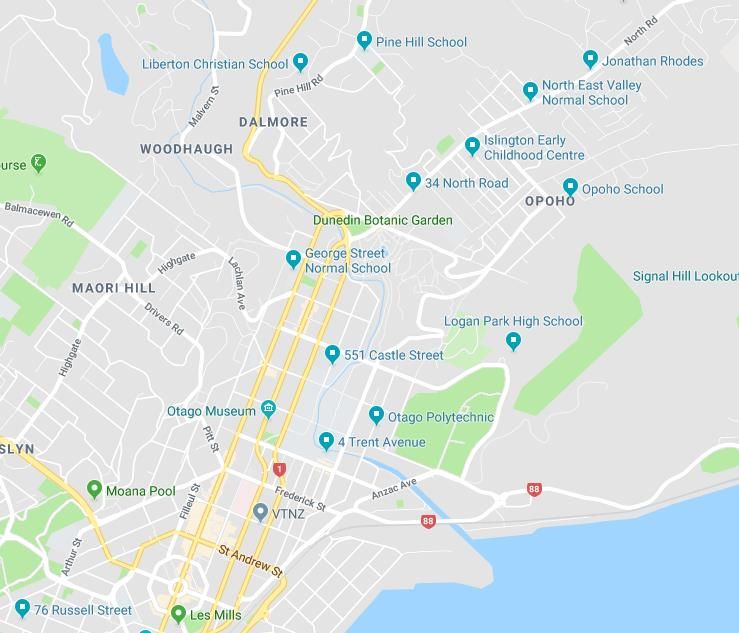
THIS MAP INDICATES
THE APPROXIMATE
LOCATION OF THE
COMMUNITY OF
LEARNING EDUCATION
SITES
10OUR SITES
Dunedin Kindergartens
Vision: Providing excellence in early childhood education for all
children.
Phone: 455 8892
Website: www.dunedinkindergartens.org.nz
Email: dk@dk.org.nz
CoL liaison: Lee Blackie, lee@dk.org.nz
Dunedin North Intermediate
Vision: Kia Māia – be courageous and independent
Dream Big – promote creative, curious, happy learners
Act with Integrity – we value manaakitaka, kaitiakitaka and
kotahitaka
MoE#: 3731
Phone: 473 9027
Website: www.dni.school.nz
Email: office@dni.school.nz
CoL liaison: Heidi Hayward, Principal heidih@dni.school.nz
George Street Normal School
Vision: Every child active, positive and proud
Motto: Lighting the future
MoE#: 3740
Phone: 474 0825
Website: www.georgestreet.school.nz
Email: office@georgestreet.school.nz
CoL liaison: Rod Galloway, Principal
rod@georgestreet.school.nz
11Islington ECC
Vision: We provide high quality education and care in
partnership with families and the community, supporting
children to become competent, confident learners and
communicators.
Motto: Learning for Life
MoE#: 83006
Phone: 473 7490
Email: Islington.ecc@gmail.com
CoL liaison: Shirley Perry, Head Teacher
islington.ecc@gmail.com
Jonathan Rhodes Kindergarten
Vision: Providing excellence in early childhood for all children
MoE#: 5498
Phone: 473 9107
Website: www.dunedinkindergartens.org.nz
Email: jonathanrhodes@dk.org.nz
CoL liaison: Joy Hawley, Head Teacher
jonathanrhodes@dk.org.nz
Kelsey Yaralla Kindergarten
Vision: Providing excellence in early childhood for all children
MoE#: 5500
Phone: 477 6674
Website: www.dunedinkindergartens.org.nz
Email: kelseyyaralla@dk.org.nz
CoL liaison: Denise Schofield, Head Teacher
kelseyyaralla@dk.org.nz
12Liberton Christian School
Vision: Our children, as part of the Christian community,
learning with enthusiasm, growing in knowledge,
developing their abilities, and desiring to serve God.
Motto: In Christ are hid all the treasures of wisdom and
knowledge
MoE#: 4117
Phone: 473 7599
Website: www.libertonchristian.school.nz
Email: admin@libertonchristian.school.nz
CoL liaison: Fiona Sizemore, Principal
principal@libertonchristian.school.nz
Logan Park High School
Vision: Logan Park High School dedicates itself to the holistic
nurturing of its young people. In growing good people, we focus
on extending the academic, sporting, cultural, emotional and
physical experiences of our learners in preparation for the diverse
pathways our learners embark on as leavers. With our emphasis
on the importance of relationships and interpersonal
connections, we are proud of our co-educational environment.
Our emphasis is firmly on achievement for the individual,
measured against their own aspirations and abilities.
Motto: Respect, Motivation, Inclusion
MoE#: 376
Phone: 477 3586
Website: www.lphs.school.nz
Email: office@lphs.school.nz
CoL liaison: Peter Hills, Co-Principal
peter.hills@lphs.school.nz
13North East Valley Normal School
Vision: We are caring, respectful, knowledgeable, confident
and competent: we are prepared for life and grounded in
the greater good and in community.
He aha te mea nui o te ao?
He tangata, he tangata, he tangata.
Motto: We teach children and train teachers
MoE #: 3783
Phone: 473 8246
Website: www.nevn.school.nz
Email: office@nevn.school.nz
CoL liaison: John McKenzie, Principal john@nevn.school.nz
Opoho School
Vision: To develop confident lifelong learners and be at the heart
of the community.
Values: Be kind, be responsible and be the best you can be.
MoE#: 3790
Phone: 03 4738019
Website: www.opoho.school.nz
Email: office@opoho.school.nz
CoL liaison: Jenny Clarke, Principal
principal@opoho.school.nz
Otago Polytechnic
Vision: Our people make a better world. Kia tū ki te tahi
Motto: Build capability, realise potential
MoE#: 6013
Phone: 477 3014
Website: www.op.ac.nz
Email: andyk@op.ac.nz
CoL liaison: Andy Kilsby, Director Employability
027 572 7382
14Otago University Childcare Association
Vision: A Community of Excellence in Early Learning
MoE#: Te Pā (Te Maioha, Te Pārekereke o Te Kī, Te Uru, Te Puna)
#83022
College of Education centre # 83065
Phone: 471 4412
Website: www.otago.ac.nz/childcare
Email: ouca.director@otago.ac.nz
CoL liaison: Karen Hurst, Director
ouca.director@otago.ac.nz
Pine Hill School
Vision: Our vision is for Pine Hill School to be a place where all
learners, parents, staff and other members of our school
community view themselves as learners and actively participate in
their own learning.
Motto: A community of learners
MoE#: 3801
Phone: 473 9148
Website: www.pinehilldunedin.school.nz
Email: office@pinehilldunedin.school.nz
CoL liaison: Melissa Ward, Principal
principal@pinehilldunedin.school.nz
Pioneers
Vision: To provide accessible, affordable and flexible quality
education and care for families of Dunedin.
MoE#: Pioneers Russell Street #83008, Pioneers Koputai #80016
Phone: 563 213
Website: www.pioneers.co.nz
Email: info@pioneers.co.nz
CoL liaison: Penel Pask, Director penel.pask@pioneers.co.nz
15Port Chalmers Kindergarten
Vision: Providing excellence in early childhood for all children
MoE#: 5502
Phone: 472 8696
Website: www.dunedinkindergartens.org.nz
Email: portchalmers@dk.org.nz
CoL liaison: Sapph Prentice, Head Teacher
portchalmers@dk.org.nz
Port Chalmers School
Vision: In partnership with our community, Port Chalmers School
will provide a happy and healthy centre of learning where every
child receives equal opportunity and encouragement to develop
his/her potential.
Motto: Port Kids are Alive (Active, Life-long, Imaginative, Visual,
Enthusiastic) learners becoming leaders
MoE#: 3803
Phone: 472 8685
Website www.portchalmers.school.nz
Email: office@portchalmers.school.nz
CoL liaison: Vicki Nicolson, Principal vicki@portchalmers.school.nz
Puketeraki Marae
Motto: Whaea koe te iti kahurangi. Mehemea kia tuohu koe, me
he mauka teitei. Seek to follow your dreams. If you should bow
your head, let it be to a lofty mountain.
Phone: 465 7793
Website: www.puketeraki.nz
Email: principal@waitati.school.nz
CoL liaison: Stacey Honeywill, principal@waitati.school.nz
16Ravensbourne School
Mission: To equip and inspire our learners to be the very best
version of themselves. Our school values are Hauora, Excellence,
Aroha, Respect-Resilience-Responsibility & Teamwork (H.E.A.R.T)
Motto: Kia kaha, Kia maia, Kia manawanui. Be brave, Be strong, Be
willing
MoE#: 3808
Phone: 471 0410
Website: www.ravensbourneschool.com
Email: office@ravensbourne.school.nz
CoL liaison: Adele Lidgard principal@ravensbourne.school.nz
Sawyers Bay School
Vision: Sawyers Bay School is a place where teaching and learning
engages, challenges and supports our learners, empowering all to
become confident and capable lifelong learners.
Motto: A safe harbour for learning, growing and making a
difference
MoE#: 3817
Phone: 472 8981
Website: www.sawyersbay.school.nz
Email: office@sawyersbay.school.nz
CoL liaison: Gareth Swete, Principal
gareth@sawyersbay.school.nz
St. Leonard’s School
Vision: To do our best to meet the individual needs of all children,
and to promote learning that prepares children for life’s
experiences, builds their self-esteem, resilience and
encourages them to care for others.
Motto: Learning for life
MoE#: 3829
Phone: 471 0501
Website: www.stleonardsdn.school.nz
Email: office@stleonardsdn.school.nz
CoL liaison: Jo Wilson, Principal jo@stleonardsdn.school.nz
17The Valley Project
Vision: A strongly connected, healthy, sustainable community. No
matter who we are or where we are from, together we have
voice, make action and create hope.
Phone: 473 8614
Website: www.northeastvalley.org
Email: tess@northeastvalley.org
CoL liaison: Tess Trotter, tess@northeastvalley.org
18THE FOUR LEVERS OF CHANGE
Four levers of change have been identified as most likely to impact positively on learning
outcomes for learners, which is what we aim to develop and strengthen in our Kāhui Ako.
Challenge A A teacher’s belief in
their own ability to
positively affect Challenge B
learners. Learners
communication
skills will improve
leading to greater
student agency
Ko tā te kaiako kōkiri ako Mana ākonga
- -
Teacher Efficacy Communication
A shared Taking care of
Challenge D
responsibility the whole
Challenge C focusing on building person
success for every
learner
Hauora
-
Whakawhānaungatanga Health & Well-
- being
Family, Whānau, Iwi &
Community Partnerships
19WHY CHANGE IS NEEDED
“Our teachers are
suffering a drop in
confidence to deal with
Challenge A the kids with autism and
anger issues and so many
other challenges. We need
Challenge B “We want to
to find solutions with and
empower kids from
for them.”
day one and give
Sam, RTLB
them skills to carry
North Dunedin
Ko tā te kaiako them through their
lives.”
kōkiri ako Mana ākonga Joy, Head Teacher,
- -
Jonathan Rhodes
Kindergarten
Teacher Efficacy Communication
“We know the families
most at need in North
Dunedin – there are
about 120 of them. Lets
Challenge C work together to break
the cycle.”
Peter Hills, Co-Principal “We are family, ko
Logan Park au, ko koe, ko koe,
High School ko au. Biz bir aileyiz.”
North East Valley
Challenge D Project
Whakawhānaungatanga
-
Family, Whānau, Iwi & Hauora
Community Partnerships -
Health & Well-
being
20Challenge A A teacher’s
belief in their
Challenge A
own ability to
positively
affect learners.
Ko tā te kaiako
Strong teachers kōkiri ako
-
Teacher
Efficacy
Target: To improve teacher confidence (see survey results 2019) by an average of 5% by the end of 2020 -
ECE from 65% to 70 %, primary 61% - 66%, intermediate 69% - 74% and secondary 60% - 65% and another
5% by the end of 2021.
Use the teacher confidence data (TCD survey) collected 2019 as the baseline
Develop and administer a number of quantifiable qualitative measures for gauging
success
Analyse data from the TCD survey to enable a targeted support plan to be formed and
implemented
CRITICAL SUCCESS FIRST STEP ACTIONS OUTCOMES 2020 OUTCOMES
FACTORS 2021-2022
Staff meetings Priority children Teachers and
identifying children identified and IEP ECE/school managers
TEACHERS & LEADERS AS to target type plans share a greater
INQUIRERS Identify gaps in established understanding of
teacher capabilities Teachers confidence how to better teach
for these children grows as measured target children
by the TCD survey
Measure both Survey data will be Teacher and
teacher and student analysed and next ECE/school managers
EVIDENCE-BASED capabilities via step actions track teacher
DECISION MAKING observations and identified capability and
surveys student progress
CoL wide and smaller Teacher capability Teacher and
cluster hui to lift and confidence will ECE/school
BUILDING BELIEF teacher confidence be increased through management
targeted PLD develop useful
support networks for
themselves
21Challenge B Challenge B
Learners
Strong Voices Mana ākonga communication
skills will improve
-
leading to greater
Communication student agency
Target: To improve reading scores - using the Ready to Read scheme which ranges across the community
from 25% at Level 14 after one year at school to 79% of children after one year of schooling by an average
of 5% by the end of 2020 and another 5% by the end of 2021.
Collate and analyse Reading data after one year at school.
Use the NZCER student agency survey gathered mid-2019 as a baseline.
Develop and administer a number of quantifiable qualitative measures for gauging Literacy success, for
students at the end of Year 6 and Year 10, by the end of 2019.
CRITICAL SUCCESS FIRST STEP ACTIONS OUTCOMES 2020 OUTCOMES
FACTORS 2021-2022
IEPs have specific Learners show Teachers share a
goals around student evidence of self- greater
LEARNERS TAKE CHARGE agency directed learning as understanding of
OF THEIR LEARNING Learners observed seen by observations how to better teach
and consulted about and discussions target children
their aspirations
Identify learners who Once identified, Priority learners will
require additional direct resources and be better able to use
LEARNERS’ LITERACY support in reading professional their voice to
WILL IMPROVE GIVING and oral and written development to advocate for their
THEM A STRONGR VOICE language teaching of literacy own learning
Undertake language
data gathering at end
of year 1,end of year
6 and end of year 10
CoL wide and smaller Learners become Learners are more
cluster hui to build more self-dependent self-dependent and
LEARNERS KNOW teacher confidence as evidenced by self-directed
WHERE TO GET SUPPORT observations and
surveys
We will seek help from professional agencies and university specialists to help us gauge our
progress in this area. Agencies such as the Otago Youth Wellness Trust, CCS Otago and the
staff of the Psychology Department at the University will all be of assistance. Student voice
will be captured throughout this process.
22Challenge C Whakawhānaungatanga
Challenge C
A shared
- responsibility
Strong connections Family, Whānau, Iwi &
Community
focusing on
building success
for every
Partnerships learner
Target: To improve inclusion in our schools and centres. We will gather baseline data using the Inclusion
Index late in 2019 and aim to increase inclusion by an average of 5% by the end of 2020 and another 5%
by the end of 2021.
Use the Inclusion Index and ‘me and my school’ community engagement survey data,
gathered mid 2019 as a baseline.
Develop and administer a number of quantifiable qualitative measures for gauging
success with each of our targets by the end of 2019.
CRITICAL SUCCESS FIRST STEP ACTIONS OUTCOMES 2020 OUTCOMES
FACTORS 2021-2022
Identified children’s Priority children Evidence of success is
CHILDREN AND IEPs are co-instructed identified and IEP shared by all involved
WHĀNAU ARE SEEN AS by whānau, relevant type plans
FULL MEMBERS OF THE and critical established
ECE/SCHOOL FAMILY ECE/school staff and
agency professionals
ECE/schools bring Survey data will be Inclusion data
community into the analysed and next tracked to measure
CHILDREN, WHĀNAU lives of targeted step actions success against
AND COMMUNITY ARE children and their identified identified targets
WELL CONNECTED whānau – sports
teams, cultural
groups, civic events
Partnerships with community groups and helping agencies such as the North East Valley
Project will be encouraged – such partnerships will allow schools and centres to tap into
community services; the community will then have a voice in the Community of Learning.
23Taking care of
the whole
Challenge D
person
Challenge D
Strong learners
Hauora
-
Health &
Well-being
St
Target: To improve student and whanau wellbeing. We will gather baseline data late 2019 and aim to
Strong
increase the results by an average of 5% by the end of 2020 and another 5% by the end of 2021.
Undertake the NZCER well-being survey in mid-2019.
Use the data collected, along with ERO’s wellbeing report to develop and administer a
number of quantifiable qualitative measures for gauging success with each of our
targets by the end of 2019.
CRITICAL SUCCESS FIRST STEP ACTIONS OUTCOMES 2020 OUTCOMES
FACTORS 2021-2022
Develop a consistent Survey data analysed On-going survey data
understanding of and used as a analysed and used as
TARGET CHILDREN ARE what these success baseline for future a baseline for future
ENGAGED, LEARNING, factors mean – actions. actions.
HEALTHY, HAPPY AND engaged, learning, Children are more Children are more
SETTLED healthy, happy and engaged, learning engaged, learning
settled. well, healthy, happy, well, healthy, happy,
Plans developed to settled settled
measure our success
We will use the various engagement and health data available to us as baseline data with
which to gauge our progress. We will work closely with the public health nurses, local
prominent psychologists and other health and well-being related providers to meet their
needs. Student wellbeing is central to successfully implementing The New Zealand
Curriculum. https://www.ero.govt.nz/publications/wellbeing-for-success-effective-
practice/schools-with-good-wellbeing-practices/#fn:1
24RELEVANT DATA
The following relevant data for Otepoti ki Te Raki Community of Learning Challenges can
accessed online.
North Dunedin COL
2018 RTLB Request for Support Referral Data
In 2018 there were 44 requests for support accepted and allocated for:
Learning: 14 requests for support
Learning & Behaviour: 11 requests for support
Behaviour: 18 requests for support
The majority of requests were for individual learners however RTLB also accepted the following
group referrals and there is a project currently being worked on.
Opoho Group Referral – Learning, 9 learners, Year 4-6
Port Chalmers Group Referral – Learning, Literacy & Numeracy, 5 learners, Year 4
Pine Hill Group Referral – Learning & Behaviour, 4 learners, Year 6
NEVN Project – Maori Medium Liaison Role – this is ongoing in 2019
Within the North Dunedin COL there are also 3 learners receiving In Class Support in 2019 – these
learners are based at Logan Park High School, Port Chalmers and North East Valley Normal School.
There are four Liaison RTLB working within the North Dunedin COL, Sam Weepers, Tania McLay,
Arran Wilkinson and Jo Cook-Bonney – other RTLB also pick up work in schools are required.
Below the year level, gender and support area of all requests for support in 2018
YEAR LEVEL AND GENDER BREAKDOWN OF
2018 DATA
YEAR LEARNING BEHAVIOUR LEARNING &
BEHAVIOUR
M F M F M F
10 1
9 1 1 1 1 1
8 1 1
7 1
6 1 1 2 2 2
5 1
4 1
3 1 1 2
2 1 2 1 1 1 1
251 1 9 3
Totals 7 7 16 2 7 4
School Specific 2018 Data
Breakdown
North Dunedin COL
North East Valley Normal
3 referrals and 1 project carried over from
2018 to 2019
Female – Behaviour, Year 2
Male – Learning, Year 1
Male – Learning & Behaviour, Year 2
Project – Maori Medium Liaison Role
2018 - 8 Referrals allocated:
Male - Learning & Behaviour, Year 6
Male - Learning, Year 5
Male - Behaviour, Year 6
Male – Learning & Behaviour, Year 1
Female – Learning, Year 6
Female – Learning & Behaviour, Year 6
Female – Learning, Year 4
Female – Learning, Year 2
Opoho
No referrals carried over to 2019
2018 - 9 Referrals Allocated:
Group Referral – Learning, Y4-6, 9
learners
Male – Behaviour, Year 2
Male – Learning, Year 3
Male – Behaviour, Year 1
Male – Learning & Behaviour, Year 2
Male – Learning & Behaviour, Year 6
Male – Learning, Year 2
Male – Learning & Behaviour, Year 1
Dunedin North Intermediate
1 Referral waiting – transition from Opoho to
DNI
2018 – 3 Referrals Allocated:
Male – Behaviour, Year 8
Male – Learning & Behaviour, Year 7
Female – Learning, Year 8
Logan Park High School
No referrals carried over from 2018 to 2019
2018 – 6 Referrals Allocated:
Male – Learning, Year 9
Male – Learning, Year 10
26 Female – Learning, Year 9
Female – Learning & Behaviour, Year 9
Female – Behaviour, Year 9
Liberton Christian School
No referrals in the last 5 or 6 years.
George Street Normal School
1 referral carried over from 2018 to 2019
Male – Behaviour, Year 2
1 referral pending:
Male – Learning & Behaviour, Year 1
2018 – 8 Referrals Allocated:
Male – Behaviour, Year 1
Male – Behaviour, Year 3
Male – Learning, Year 1
Male – Behaviour, Year 1
Male – Learning & Behaviour, Year 1
Female – Learning, Year 2
Female – Behaviour, Year 2
Female – Learning, Year 3
St Leonard’s
1 referral carried over from 2018 to 2019
Male – Learning & Behaviour, Year 4
2018 – 2 Referrals Allocated:
Male – Behaviour, Year 3
Female – Learning & Behaviour, Year 2
Sawyer’s Bay
2018 – 1 Referral Allocated:
Male – Learning, Year 6
Ravensbourne
2018 – 1 Referral Allocated:
Male – Behaviour, Year 1
Port Chalmers
2018 - 6 Referrals Allocated:
Male – Behaviour, Year 1
Male – Behaviour, Year 1
Male – Behaviour, Year 1
Male – Behaviour, Year 1
Male – Learning, Year 5
Group – Learning, Literacy &
Numeracy, 5 learners, Year 4
Pine Hill
2018 - 5 Referrals Allocated:
Male – Learning & Behaviour, Year 2
Male – Behaviour, Year 1
Male – Behaviour, Year 6
Female – Learning & Behaviour, Year 6
27Dunedin North Kāhui Ako Attendance
Dunedin North Kāhui Ako - Term Attending % Attending Grand
Two Regularly regularly Total
2015
Dunedin North Intermediate 171 67.3 254
George Street Normal School 393 83.8 469
Logan Park High School 349 58.0 602
Opoho School 112 79.4 141
Port Chalmers School 72 75.8 95
Ravensbourne School 21 63.6 33
St Leonard's School (Dunedin) 42 67.7 62
2016
Dunedin North Intermediate 184 68.1 270
George Street Normal School 362 79.6 455
Opoho School 98 71.0 138
Port Chalmers School 82 82.0 100
Ravensbourne School 26 76.5 34
Sawyers Bay School 104 80.6 129
St Leonard's School (Dunedin) 40 74.1 54
2017
Dunedin North Intermediate 168 63.6 264
George Street Normal School 373 78.7 474
Liberton Christian School 75 78.1 96
Logan Park High School 329 56.2 585
Opoho School 87 63.0 138
Pine Hill School (Dunedin) 13 59.1 22
Port Chalmers School 78 75.7 103
Ravensbourne School 18 72.0 25
Sawyers Bay School 94 69.1 136
St Leonard's School (Dunedin) 35 61.4 57
2018
Dunedin North Intermediate 139 58.9 236
George Street Normal School 398 79.8 499
Liberton Christian School 69 65.7 105
North East Valley Normal School 156 62.2 251
Opoho School 109 71.7 152
Pine Hill School (Dunedin) 24 55.8 43
Port Chalmers School 86 77.5 111
Ravensbourne School 10 55.6 18
Sawyers Bay School 96 72.7 132
Stand-downs 2015 2016 2017
Dunedin North Intermediate 5 24 48
George Street Normal School 4 4 4
Liberton Christian School 0 0 0
Logan Park High School 61 27 15
North East Valley Normal School 0 1 1
28Opoho School 0 2 0
Pine Hill School (Dunedin) 3 2 4
Port Chalmers School 1 5 5
Ravensbourne School 1 6 10
Sawyers Bay School 0 0 0
St Leonard's School (Dunedin) 0 0 0
Suspensions
Dunedin North Intermediate 1 8 5
George Street Normal School 0 1 0
Liberton Christian School 0 0 0
Logan Park High School 3 1 1
North East Valley Normal School 0 0 0
Opoho School 0 0 0
Pine Hill School (Dunedin) 0 0 1
Port Chalmers School 0 0 0
Ravensbourne School 0 0 0
Sawyers Bay School 0 0 0
St Leonard's School (Dunedin) 0 0 0
Exclusions
Dunedin North Intermediate 1 2 1
George Street Normal School 0 0 0
Liberton Christian School 0 0 0
Logan Park High School 0 1 1
North East Valley Normal School 0 0 0
Opoho School 0 0 0
Pine Hill School (Dunedin) 0 0 0
Port Chalmers School 0 0 0
Ravensbourne School 0 0 0
Sawyers Bay School 0 0 0
St Leonard's School (Dunedin) 0 0 0
Learning Support Services to North Dunedin Kahui Ako - 2018
Site ORS Communication Behaviour Other Total
DNI 5 0 0 0 5
GSNS 3 8 1 (High Health Needs) 12
Liberton 1 1
Christian
LPHS 6 0 5 0 11
NEV 3 4 1 3 (2 HHN, 1 Physical Disability) 11
Opoho 2 2 3 2 (1 Assistive Technology, 1 9
Moderate Hearing)
Pine Hill 1 0 0 0 1
29Port Chalmers 0 4 0 1 (Physical Disability) 5
Ravensbourne 0 1 1 3 (HHN) 5
Sawyers Bay 0 3 0 0 3
St Leonards 0 2 0 2 (HHN) 4
20 25 10 12 67
CoL Survey Results
The survey results were limited to 100 respondents.
Q1: Area of education that respondents teach in
Q2: How confident are you teaching children with complex learning issues?
30Q3: How confident are you teaching children with serious behavioural issues?
Q4: How confident are you that you can get help from your school/centre when dealing
with difficult children?
31Q5: How confident are you that you can get help from outside agencies when dealing with
difficult children?
Q6: How confident are you teaching children who are gifted or who have a very specific
talent?
32Q7: In your view, are you satisfied with the professional development you receive for
working with children with special needs?
Q8: In your view, are you satisfied with the professional development you receive for
working with children with serious behavioural issues?
33Q9: In your view, are you satisfied with the professional development you receive for
working with children who are gifted?
34The Importance of Literacy:
Literacy is the written and oral language people use in everyday life and work. A person’s
literacy refers to the extent of their oral and written language skills and knowledge and their
ability to apply these to meet the varied demands of their personal study and work lives
(Tertiary Education Commission, 2009, p. 58).
Our community sees literacy and, in particular reading and oral language, as a key to well-
being and our other challenges, including whānau engagement and an individual’s progress
towards their potential.
The Education Review Office in a report on reading
https://www.ero.govt.nz/publications/reading-and-writing-in-years-1-and-2/
highlights the difficulties some schools have in teaching reading effectively:
Some teachers worked in isolation without having the opportunity to share or discuss
reading achievement and teaching practices with others. A lack of collaborative discussion
about reading assessments resulted in variability in the quality of reading programmes
evident across the junior classes.
Size made it difficult for very small schools to share assessment information. In these
schools the junior teacher often worked in relative isolation. However ERO found some small
schools where assessments were reflected on and used to improve teaching. These teachers
found ways to discuss children’s reading assessments with a teacher in the senior school or
the principal release teacher to encourage more collaborative decision making.
Many of the schools in our community are small; some struggle to meet with other teachers
to discuss what works and what doesn’t work. A collaborative approach to teaching reading
will be of benefit to our teachers and the learners in our schools.
Our desire to better communicate as a community of learning with whānau would address
another barrier to reading as seen by ERO:
Although parents had many informal opportunities to find out about their child’s reading,
some did not know about their child’s achievement or progress. This will be addressed via
Challenge Three - Strong Connections.
Our challenge to develop deeper student agency will deal with their concern that: Children’s
lack of awareness about their progress, and/or how they could improve, reduced
motivation and enthusiasm for reading.
One school reports in their Statement of Variance 2018 the following about reading
progress in their early years:
Of the 66 children in the junior syndicate, 52 are reading at or above our school’s
benchmark in reading. 14 children are reading below the expected level. These children are
identified and given extra time with teacher aides, or are taken into the Reading Recovery
35Programme. Out of these 14 children, one child is ORS funded, 4 children are ESOL
students, 2 children are on the ASD spectrum and 2 children started school well after their
fifth birthday and 2 had very limited language experiences as they only started talking at the
age of 4. One child started at our school in late term 2 with major family issues and limited
schooling.
Schools across the community have varied results in reading after one year at school:
Reading at/above level 12-14
2018
North Dunedin Primary Schools
80%
70%
60%
50%
40%
30%
20%
10%
0%
#1 Decile 6 #2 Decile 6 #3 Decile #4 Decile 6 #5 Decile 9 #6 Decile 3 #7 Decile #8 Decile 7
10 10
We will collate and analyse reading levels at three critical points and aim to lift reading
scores to level 14 of the ready to read scale by the end of a child’s first year at primary
school. This improvement will aid in developing student voice.
36You can also read


