Genetic variation for resistance to the specific fly pathogen Entomophthora muscae - Nature
←
→
Page content transcription
If your browser does not render page correctly, please read the page content below
www.nature.com/scientificreports
OPEN Genetic variation for resistance
to the specific fly pathogen
Entomophthora muscae
Jonathan B. Wang1, Carolyn Elya2 & Raymond J. St. Leger1*
We found substantial variation in resistance to the fly-specific pathogen Entomophthora muscae
’Berkeley’ (Entomophthoromycota), in 20 lines from the Drosophila melanogaster Genetic Reference
Panel (DGRP). Resistance to E. muscae is positively (r = 0.55) correlated with resistance to the broad
host range ascomycete entomopathogen Metarhizium anisopliae (Ma549), indicative of generalist
(non-specific) defenses. Most of the lines showing above average resistance to Ma549 showed
cross-resistance to E. muscae. However, lines that succumbed quickly to Ma549 exhibited the full
range of resistance to E. muscae. This suggests fly populations differ in E. muscae-specific resistance
mechanisms as well as generic defences effective against both Ma549 and E. muscae. We looked for
trade-offs that could account for inter-line variation, but increases (decreases) in disease resistance to
E. muscae are not consistently associated with increases (decreases) of resistance to oxidative stress,
starvation stress and sleep indices. That these pathogens are dynamic agents of selection on hosts is
reflected in this genetic variation for resistance in lines derived from wild populations.
Considerable genetic variation in resistance and tolerance to infection can exist within populations1,2. This
variation determines the burden of disease, and represents the raw material from which populations can evolve
resistance either naturally or artificially (i.e. through selective breeding by humans)3. Insects are no exception to
this pattern, and the same population of Drosophila melanogaster can contain resistant and susceptible genotypes
to viruses, fungi and b acteria4,5.
Many arthropod pathogenic fungi belong to the phylum Entomophthoromycotina and most of the remain-
der are distantly related ascomycetes6. We previously demonstrated significant variation in the life-span of 188
Drosophila Genetic Reference Panel (DGRP) lines infected with the ascomycete fungus Metarhizium anisopliae
ARSEF 549 (Ma549)5. In addition, we found that resistance to Ma549 was correlated with resistance to the bac-
terium Pseudomonas aeruginosa (Pa14), and several previously published DGRP phenotypes including oxidative
stress sensitivity, starvation stress resistance, hemolymph glucose levels, and sleep indices. As bacteria infect per
os and fungi through the cuticle, the cross-resistance to Pa14 and Ma549 is suggestive of general (multipurpose)
humoral defense mechanisms that do not involve cuticle or gut immunocompetence. Consistent with this, a
genome-wide association study revealed a network of Pa14 and Ma549-resistance genes that are functionally
connected through many different aspects of host physiology5. These observations are in line with insertional
mutagenesis results: L u7 reported that 87% of mutated genes in more susceptible Drosophila lines are involved
in a broad spectrum of biological functions not connected with canonical immune systems. The large numbers
of pleiotropic genes involved in resistance to Ma549 and Pa14 contrasts with the small number of common
polymorphisms associated with resistance to viruses4. Interestingly, each viral resistance SNP was associated
with resistance to only one virus, which suggests that viral immunity is mediated by a suite of specific f actors4.
Most models of hosts and pathogens assume there is a tight relationship of co-evolved interactions between
species pairs8. Such hosts and parasites are thought to engage in antagonistic coevolution, where a newly evolved
parasite virulence mechanism is negated over time by a newly evolved host immune mechanism and vice versa9.
The broad host range of Metarhizium and Beauveria spp. used in several previous studies on Drosophila10–13
suggest that these pathogens have not engaged in a strict coevolutionary arms race with Drosophila14. As study
systems, these microbes will not, therefore, tell us about how specialist parasites suppress host immunity, or
about any secondary immune mechanisms hosts deploy against specialist p arasites15,16.
1
Department of Entomology, University of Maryland, College Park, MD 20742, USA. 2Department of Organismic
and Evolutionary Biology, Harvard University, Cambridge, MA 02138, USA. *email: stleger@umd.edu
Scientific Reports | (2020) 10:14284 | https://doi.org/10.1038/s41598-020-71262-w 1
Vol.:(0123456789)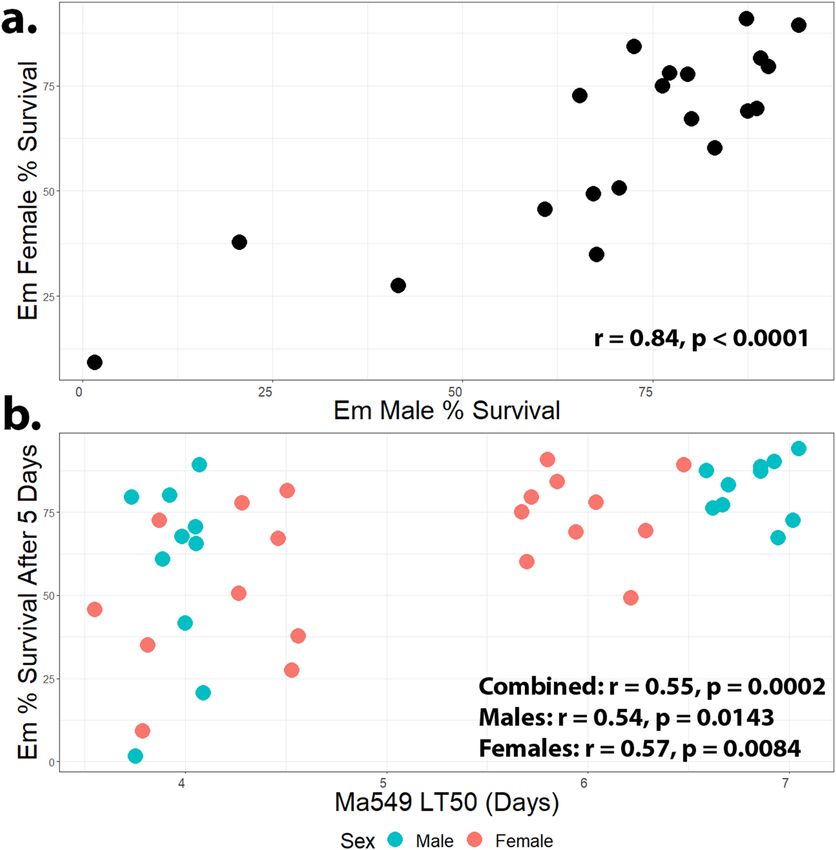
www.nature.com/scientificreports/
Given the importance of the Drosophila model system to our understanding of immunity, it is surprising that
very little is known about its natural parasites. There may be 5.5 million insect species17, and if every metazoan
species has at least one host-specific parasite as some studies s uggest18, narrow host range entomopathogenic
fungi may exist by the millions as well. However, an ecologically relevant specialist fungal pathogen of Dros-
ophila pathogen that would facilitate understanding of host pathogen evolution and identify specialized immune
mechanisms has only recently been i dentified19. Behavior-manipulating fungal pathogens in the Entomophthora
muscae (Entomophthoromycota) species complex are best known for causing epizootic outbreaks in house flies.
However, Elya et al.19 identified an epizootic in Californian Drosophila caused by a single strain of E. muscae
(E. muscae ’Berkeley’). It remains unclear if E. muscae ’Berkeley’ is a distinct lineage (or even species) from
those that infect other fly species, and how specific it may be for Drosophila spp. over other dipterans is also
unknown19. However, contrary to other fungal infections (e.g., Metarhizium), and consistent with previous E.
muscae infections described in house fl ies20, E. muscae ’Berkeley’ invaded the Drosophila’s nervous system and
caused a characteristic set of behaviors: on their final day of life, a few hours before sunset, the flies climb upward,
extend their proboscides, affixing them to a substrate, then raise their wings, clearing a path for infectious spores
to launch from their a bdomens19. This robust control of behavior by E. muscae ’Berkeley’ indicates a high level
of adaptation of the pathogen to the host. However, many aspects of this disease (e.g., the climbing behavior of
critically ill hosts), are typical for narrow host range pathogens of arthropods, and probably involve the patho-
gens taking advantage of sleep behavior in insects, as these behaviors are highly c onserved21. Many of the best
characterized and most commonly witnessed epizootics are caused by behavior-modifying entomophthoralean
species infecting flies, ants, grasshoppers, caterpillars and c icadas22,23.
In this study we bioassayed E. muscae ’Berkeley’ (hereafter referred to as E. muscae) against a subset of 20
DGRP lines selected because they represent the genotypes that are the most resistant or susceptible to Ma549
from the DGRP collection. Using this divergent subset, we show that wild-derived populations of Drosophila have
substantial differences in susceptibility to E. muscae, and that this variation correlates with resistance to Ma549,
and, to a lesser extent, with starvation resistance and sleep indices. However, lines that succumbed quickly to
Ma549 covered the whole spectrum of resistance to E. muscae from low to high. This suggests there are additional
mechanisms by which disease resistance to E. muscae can be altered, besides those effective against Ma549.
Methods
Divergent DGRP lines. DGRP Freeze 2 lines, originally derived from an out-crossed population in Raleigh,
North Carolina, by the Mackay laboratory24 were obtained from the Bloomington Stock center. To characterize
natural variation in susceptibility to E. muscae, we used a subset of the 188 DGRP lines deployed in Wang et al.5,
comprising the 10 most Ma549 resistant and 10 most Ma549 susceptible DGRP lines. Called the “divergent
subset” in Wang et al.5, they represent the most extreme disease phenotypes to Ma549 in the DGRP. Ma549 and
Pa14 LT50 data for the divergent subset was previously published in Wang et al.5.
E. muscae exposure of divergent DGRP lines. All flies were reared on cornmeal-based diet (3% weight
per volume (w/v) cornmeal, 11% w/v dextrose, 2.3% w/v yeast, 0.64% w/v agar and 0.125% w/v tegosept) at
21 °C on a 12:12 light:dark cycle. For infection, we followed a modified version of the protocol described in Elya
et al.19 using E. muscae that has been propagated in Drosophila in vivo since 2015. Briefly, 21 “exposure vials”
were prepared, each by embedding six Canton-S Drosophila cadavers freshly killed by E. muscae headfirst into
minimal media containing 5% sucrose and 1.5% agar in wide fly vials (Genesee Scientific). For each of the 20
DGRP lines and Canton-S, fifty flies (25 male and 25 female) aged < 5 days post eclosion were transferred to a
fresh vial and the plug of the vial was pushed down to confine the flies within 2 cm to improve the likelihood
that they would encounter infectious spores. Vials were housed for the first 24 h under high humidity at 21 °C
with a 12:12 light:dark cycle, at which point the plug was raised to relieve fly confinement. Flies were housed
at 21 °C with ~ 40% humidity for the remainder of the experiment. Each vial was monitored twice daily (once
before subjective sunset, once after) for deaths and subsequent sporulation, to confirm death by E. muscae. All
experiments were replicated five times, the raw data is provided in Supplemental Table S1.
Data analysis. All statistics were done using R version 3.6.1. To determine the relationship between dif-
ferent phenotypes, we performed Pearson correlations using the package Hmisc. We tested for normality using
Shapiro-Wilks test. Comparisons between sexes and Wolbachia infection statuses were done using the non-
parametric two-sided Mann–Whitney test.
Results and discussion
To characterize natural variation in pathogen resistance, we quantified susceptibility to E. muscae using the
divergent subset of the 10 most and the 10 least Ma549 resistant DGRP lines (selected out of 188 DGRP lines).
Age-matched flies from each line were exposed to E. muscae, and survival time was monitored using five repli-
cates (25 flies each), per sex per line. Elya et al.19 report that the Wolbachia-free CantonS Drosophila developed
a strong immune response one day after infection with E. muscae but by the third day the fungus had spread
throughout the body, and most flies died around four to five days following infection. Unlike Ma549 and Pa14,
E. muscae consistently kills hosts at the same zeitgeber time every day (always in the hours leading to subjective
sunset), therefore, we used the percentage surviving at five days post-exposure to E. muscae (referred to as a PS5;
daily deaths only rarely peak after this time point) as our metric to compare to Ma549 and Pa14. In contrast to
E. muscae, DGRP lines die from Ma549 or Pa14 at different rates over a broader range of day’s post-exposure,
so post-infection survival for these pathogens is better measured using L T50 values.
Scientific Reports | (2020) 10:14284 | https://doi.org/10.1038/s41598-020-71262-w 2
Vol:.(1234567890)www.nature.com/scientificreports/
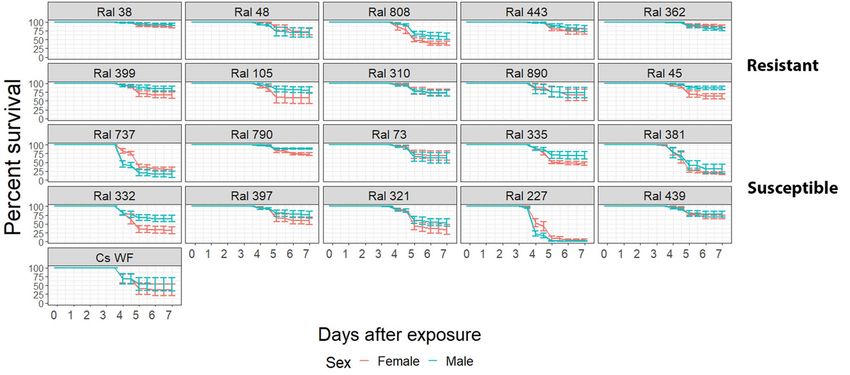
Figure 1. Percent survival of DGRP lines tested with E. muscae. Flies of the divergent subset were broken up
into two groups, those resistant to Metarhizium anisopliae (top two rows) and those susceptible to M. anisopliae
(middle two rows). Canton-S flies (CS WF) (bottom) used previously to establish that E. muscae ’Berkeley’ is a
Drosophila pathogen19 were used as a positive control. Percentages are an average of five replicates and error bars
reflect standard errors.
Using the DGRP lines, we show that wild-derived populations of Drosophila have substantial differences in
susceptibility with mortalities ranging from 1.6 to 94%, and a mean survival of males (females) of 70% (62%)
(Fig. 1). Less than 25% of flies in the most E. muscae-resistant DGRP lines had died seven days post exposure,
and most of those that succumbed did so after 4 to 5 days. At the other extreme, almost 100% of RAL 227 flies
were dead at five days post exposure. After five days the death rate plateaued off for most lines, and approached
that of uninfected flies, suggesting that the survivors had cleared the infection. Thus, variable host susceptibility
is illustrated by some DGRP lines dying more than others four to five days post infection with E. muscae.
To identify general (multipurpose) defense, the P S5 for males and females exposed to E. muscae was plotted
against average L T50 for males (females) infected with Ma549 (Fig. 2b). The data on Ma549 and Pa14 is derived
from our earlier publication which used replicates run on different days to randomize environmental variation5.
Correlations were moderate but highly significant (r = 0.54, 0.57, p = 0.0143, 0.0084 for males, females respec-
tively), consistent with Drosophila utilizing unspecific generalized defense components against E. muscae and
Ma549 (Fig. 2b). We previously reported that LT50 values for Ma549 and P. aeruginosa Pa14 were correlated
for both males (r = 0.45, n = 78) and females (r = 0.40, n = 78)5. Correlations between Ma549 and Pa14 in the
divergent subset used to assay E. muscae were greater, with r = 0.7 for males (p = 0.0024, n = 16) and r = 0.55 for
females (p = 0.0262, n = 16) (Fig S1b). Although correlations were still positive between E. muscae and P. aerugi-
nosa, they were not significant for males (r = 0.09, p = 0.7295, n = 16) or for females (r = 0.39, p = 0.138, n = 16)
(Fig S1a). Ma549 is a broad host range generalist insect pathogen, while Pa14 is a human clinical isolate, and so
represents a novel association that will have no history of coevolution. Our results suggest that the genetic basis
for resistance to a non-coevolved bacterium (Pa14) and an opportunistic broad host range fungus, share more
genetic causes than Pa14 and E. muscae.
The weak correlations indicate that Drosophila has alleles with pathogen-specific effects to E. muscae. This is
consistent with variation in the magnitude and direction of association between Ma549 and E. muscae. We found
greater variation in susceptibility to E. muscae among the lines susceptible to Ma549 (male range: 1.6–76.28%,
female range: 9.18–84.23%) compared to lines resistant to Ma549 (male range: 77.25–94.2%, female range:
60.13–90.83%) (Fig. 1). Except for RAL 808, the lines resistant to Ma549 were also resistant to E. muscae, while
lines that succumbed quickly to Ma549 covered the spectrum of resistance to E. muscae from low to high (Fig. 1).
The exception, RAL 808, is the third most resistant line to Ma549, but is moderately susceptible to E. muscae
ranking fifteenth out of the twenty lines ( PS5 ~ 50%). These results suggest that there are multiple mechanisms
by which disease resistance to E. muscae can be altered besides those effective against Ma549. The shared history
of E. muscae and D. melanogaster could have resulted in a co-evolutionary process that altered the diversity of
resistance genes compared to naïve pairs of hosts and pathogens. Similarly, host–pathogen coevolution increases
genetic variation in susceptibility to viruses25. Thus, heritable variation for host resistance was detectable for two
natural viruses of D. melanogaster, but not for two non-natural viruses4.
To identify sexual dimorphism, we measured disease resistance separately for males and females infected
with E. muscae (Fig. 2a). Cross-sex genetic correlations were high (r = 0.84, p < 0.0001, n = 20), indicating that
many of the same variants affect E. muscae resistance in males and females. Females flies died more quickly than
males when infected with Ma5495 (p = 0.00039, n = 188). This difference is not significant overall for females of
the divergent set (p = 0.37, n = 20), but females group separately from males in the most resistant DGRP lines
(Fig. 2b). Females were also slightly more susceptible than males to E. muscae though this fell short of significance
Scientific Reports | (2020) 10:14284 | https://doi.org/10.1038/s41598-020-71262-w 3
Vol.:(0123456789)www.nature.com/scientificreports/
Figure 2. Correlation graphs. Positive correlations of (a) % survival of male and female DGRP flies 5 days post-
infection with E. muscae, and (b) between flies infected with E. muscae (% survival) or M. anisopliae (Ma549
LT50 values). Ma549 LT50 values were obtained from Wang et al. 20175.
(p = 0.2, n = 20). As observed previously for M a5495, RAL 737 was exceptional, as females of this fly line were
more resistant to E. muscae than males (Fig S2).
Wolbachia pipientis is a natural intracellular symbiont of many arthropods, and Wolbachia may confer pro-
tection against the fungus Beauveria bassiana in one D. melanogaster line26. Wolbachia status in the DGRP lines
was without significant effect on susceptibility to Ma5495. Eleven of the twenty divergent lines were positive for
Wolbachia, seven of these eleven were present in the ten most susceptible lines producing no significant effect
on the susceptibility to E. muscae for males (p = 0.15, n = 20 or females p = 0.71, n = 20).
Resistance to multiple pathogens should have a selective advantage unless this general defense is traded off
against other (pathogen-independent) fitness c omponents27. In the absence of such a trade-off, directional selec-
tion would presumably lead to fixation of genotypes showing general resistance. Table S2 shows the divergent
subset, and their life cycle parameters and rankings in publicly available data from other publications, including
our data for Ma549 and Pa14. Figure S1 presents correlations between the disease resistance phenotypes in our
studies and these other traits. The small sample size (n = 20) of the divergent set reduces the discriminatory power
of correlation analysis. However, r values for the divergent set and the total population (188 lines) are similar
for many phenotypes. For example, correlations between female resistance to Ma549 and paraquat (a source of
oxidative stress) are r = 0.46, p = 0.0541 (divergent set, n = 18) and r = 0.31, p < 0.0001, n = 156 (total population),
and correlations between female resistance to Ma549 and negative geotaxis are r = 0.29, p = 0.2411 (divergent
set, n = 18) and r = 0.2, p < 0.0079, n = 171 (total population). The corresponding values for E. muscae are r = 0.25,
p = 0.325, n = 18 (paraquat resistance) and r -0.04, p = 0.861, n = 18 (negative geotaxis).
We previously reported that resistance to Ma549 among 188 DGRP lines was negatively correlated with sleep
duration at night in males (r = − 0.32, p < 0.0001, n = 156) and females (r = − 0.28, p = 0.0004, n = 156)5. Conversely,
there was a positive association between resistance and the number of sleep bouts in males (r = 0.25, p = 0.0018,
n = 156) and females (r = 0.24, p = 0.0028, n = 156)5. Compared to the total population, the resistance of the 20
divergent subset to Ma549 was even more closely associated with the number of nocturnal sleep bouts (males
r = 0.67, p = 0.0026, n = 18; females r = 0.67, p = 0.0021, n = 18) and negatively correlated with night sleep dura-
tion (males r = − 0.71., p = 0.0009, n = 18; females r = − 0.74, p = 0.0005, n = 18). Hence, compared to the general
Scientific Reports | (2020) 10:14284 | https://doi.org/10.1038/s41598-020-71262-w 4
Vol:.(1234567890)www.nature.com/scientificreports/
population, there is a stronger trend for the 10 most resistant DGRP flies to have more sleep bouts than the 10
most susceptible DGRP flies, but these bouts are shorter and total sleep time is less. This trend was retained for
E. muscae, but to a lesser degree, and falling short of significance, with the number of nocturnal sleep bouts
(males r = 0.29., p = 0.2352, n = 18; females r = 0.35, p = 0.1483, n = 18) and negatively correlated with night sleep
duration (males r = − 0.36, p = 0.1402, n = 18; females r = − 0.32, p = 0.1919, n = 18).
Looking at the data on a line-by-line basis shows why the associations are so weak. There are lines with
increased levels of resistance to E. muscae and negative geotaxis, oxidative stress or sleep duration, but there are
also resistant lines with moderate or low rankings for these indices, suggesting that there are no straightforward
associations or trade-offs. Taking starvation stress as an example, as E. muscae colonizes the host’s body it will
compete with it for r esources19, so it makes intuitive sense that genotypes better able to tolerate starvation would
have better tolerance to disease. Resistance to starvation is positively correlated with resistance to E. muscae in
both males (r = 0.21, n = 20) and females (r = 0.34, n = 20). Although these values fall short of significance (p > 0.05)
(Supplementary Fig S1p), they are higher than the correlations between resistance to Ma549 and starvation in
males of (r = 0.17, n = 20) and females (r = − 0.03, n = 20). Resistance to starvation in the total population was only
weakly correlated with the resistance of female flies to Ma549 (r = 0.16, p = 0.0335)5, indicating that E. muscae
may cause greater nutrient stress to Drosophila than Ma549. However, on a line-by-line basis, DGRP lines RAL
38, RAL 48, RAL 443 and RAL 362 (highly resistant to both Ma549 and E. muscae), ranked 159, 28, 62 and 8
out of 203 DGRP lines for resistance to starvation. RAL 808 (Ma549 resistant, E. muscae susceptible), RAL 439
(Ma549 susceptible, E. muscae resistant) and RAL 227 (susceptible to both Ma549 and E. muscae) ranked 152,
162 and 149, respectively.
Conclusion
Fungal-host interactions include both general broad host range and narrow host range pathogens. E. muscae is
a dipteran specialist that naturally causes epizooitic outbreaks in D. melanogaster. Similar to broad host range
ascomycete fungi, we identified considerable host genetic variation in resistance to E. muscae infection. However,
we found that this variation is unlike ascomycetes, which kills different host genotypes with varying rapidity,
but instead reflected considerable differences in the number of flies that died in a narrow window of time four
to five days post-exposure. This reflects the unique E. muscae behavioral trait of killing flies in the hours leading
to subjective sunset to ultimately maximize fungal dispersal. Despite differences in the co-evolutionary dynam-
ics between D. melanogaster and E. muscae, versus other fungal pathogens such as M. anisopliae, flies showed
cross-resistance to both fungi, indicative of generic anti-fungal defences. However, cross-resistance was greater
between M. anisopliae and an opportunistic bacterial pathogen, P. aeriginosa, than between M. anisopliae and
E. muscae. Also, D. melanogaster lines killed quickly by M. anisopliae Ma549 show greater variation in suscep-
tibility to E. muscae, indicating that Ma549-susceptible individuals vary in evolution or retention of narrow
anti-E. muscae mechanisms. Also, with the notable exception of starvation resistance, resistance to Ma549 and
Pa14 correlated with non-specific physiological features such as sleep indices, to a greater extent than E. muscae
infected flies, consistent with specific defenses being more important. This study demonstrates the continued
utility of Drosophila for understanding host-fungus interactions, the clear potential for Drosophila to become a
powerful in vivo comparative system to study the diversity of antifungal responses, and supports the utility of E.
muscae as a model for studying varied aspects of host–pathogen interactions in the fly.
Data availability
All data generated or analysed during this study are included in this published article (and its Supplementary
Information files).
Received: 9 April 2020; Accepted: 10 August 2020
References
1. Hill, A. V. S. Evolution, revolution and heresy in the genetics of infectious disease susceptibility. Philos. Trans. R. Soc. B Biol. Sci.
367, 840–849. https://doi.org/10.1098/rstb.2011.0275 (2012).
2. Kniskern, J. M., Barrett, L. G. & Bergelson, J. Maladaptation in wild populations of the generalist plant pathogen pseudomonas
syringae. Evolution (N. Y.) 65, 818–830. https://doi.org/10.1111/j.1558-5646.2010.01157.x (2011).
3. McGonigle, J. E. et al. Parallel and costly changes to cellular immunity underlie the evolution of parasitoid resistance in three
Drosophila species. PLoS Pathog. https://doi.org/10.1371/journal.ppat.1006683 (2017).
4. Magwire, M. M. et al. Genome-wide association studies reveal a simple genetic basis of resistance to naturally coevolving viruses
in Drosophila melanogaster. PLoS Genet. https://doi.org/10.1371/journal.pgen.1003057 (2012).
5. Wang, J. B., Lu, H.-L. & St. Leger, R. J. The genetic basis for variation in resistance to infection in the Drosophila melanogaster
genetic reference panel. PLoS Pathog. 13, e1006260 (2017).
6. Araújo, J. P. M. M. & Hughes, D. P. Diversity of Entomopathogenic Fungi. Which Groups Conquered the Insect Body? In Advances
in Genetics, Vol. 94 (eds Lovett, B. & St. Leger, R. J.) 1–39 (2016).
7. Lu, H.-L., Wang, J. B., Brown, M. A., Euerle, C. & St. Leger, R. J. Identification of Drosophila mutants affecting defense to an
entomopathogenic fungus. Sci. Rep. 5, 12350 (2015).
8. Barrett, L. G., Kniskern, J. M., Bodenhausen, N., Zhang, W. & Bergelson, J. Continua of specificity and virulence in plant host-
pathogen interactions: causes and consequences. New Phytol. 183, 513–529. https://doi.org/10.1111/j.1469-8137.2009.02927.x
(2009).
9. Dawkins, R. & Krebs, J. R. Arms races between and within species. Proc. R. Soc. Lond. Biol. Sci. 205, 489–511. https://doi.
org/10.1098/rspb.1979.0081 (1979).
10. Gottar, M. et al. Dual detection of fungal infections in Drosophila via recognition of glucans and sensing of virulence factors. Cell
127, 1425–1437. https://doi.org/10.1016/j.cell.2006.10.046 (2006).
Scientific Reports | (2020) 10:14284 | https://doi.org/10.1038/s41598-020-71262-w 5
Vol.:(0123456789)www.nature.com/scientificreports/
11. Matskevich, A. A., Quintin, J. & Ferrandon, D. The Drosophila PRR GNBP3 assembles effector complexes involved in antifungal
defenses independently of its Toll-pathway activation function. Eur. J. Immunol. 40, 1244–1254. https://doi.org/10.1002/eji.20094
0164 (2010).
12. Roxström-Lindquist, K., Terenius, O. & Faye, I. Parasite-specific immune response in adult Drosophila melanogaster: a genomic
study. EMBO Rep. 5, 207–212. https://doi.org/10.1038/sj.embor.7400073 (2004).
13. Tinsley, M. C., Blanford, S. & Jiggins, F. M. Genetic variation in Drosophila melanogaster pathogen susceptibility. Parasitology 132,
767. https://doi.org/10.1017/S0031182006009929 (2006).
14. Kawecki, T. J. Red queen meets Santa Rosalia: arms races and the evolution of host specialization in organisms with parasitic
lifestyles. Am. Nat. 152, 635–651. https://doi.org/10.1086/286195 (1998).
15. Keebaugh, E. S. & Schlenke, T. A. Insights from natural host-parasite interactions: the Drosophila model. Dev. Comp. Immunol.
42, 111–123 (2014).
16. Lu, H.-L. & St. Leger, R. J. Insect immunity to entomopathogenic fungi. in Advances in Genetics (eds Lovett, B. & St. Leger, R. J.)
(2016). https://doi.org/10.1016/bs.adgen.2015.11.002
17. Stork, N. E. How many species of insects and other terrestrial arthropods are there on earth?. Annu. Rev. Entomol. 63, 31–45. https
://doi.org/10.1146/annurev-ento-020117-043348 (2018).
18. Rohde, K. Ecology and biogeography, future perspectives: example marine parasites. Geoinform. Geostat. Overv. https://doi.
org/10.4172/2327-4581.1000140 (2016).
19. Elya, C. et al. Robust manipulation of the behavior of Drosophila melanogaster by a fungal pathogen in the laboratory. Elife https
://doi.org/10.7554/eLife.34414 (2018).
20. Brobyn, P. J. & Wilding, N. Invasive and developmental processes of Entomophthora muscae infecting houseflies (Musca domes-
tica). Trans. Br. Mycol. Soc. 80, 1–8. https://doi.org/10.1016/s0007-1536(83)80157-0 (1983).
21. Lovett, B., St. Leger, R. J. & de Fine Licht, H. H. Going gentle into that pathogen-induced goodnight. J. Invertebr. Pathol. https://
doi.org/10.1016/j.jip.2020.107398 (2020).
22. Hughes, D. P. et al. From so simple a beginning. the evolution of behavioral manipulation by fungi. Adv. Genet. https://doi.
org/10.1016/bs.adgen.2016.01.004 (2016).
23. Roy, H. E., Steinkraus, D. C., Eilenberg, J., Hajek, A. E. & Pell, J. K. Bizarre interactions and endgames: entomopathogenic Fungi
and Their Arthropod Hosts. Annu. Rev. Entomol. 51, 331–357 (2006).
24. Mackay, T. F. C. et al. The Drosophila melanogaster genetic reference panel. Nature 482, 173–178 (2012).
25. Duxbury, E. M. et al. Host-pathogen coevolution increases genetic variation in susceptibility to infection. Elife https://doi.
org/10.7554/eLife.46440 (2019).
26. Panteleev, D. I. et al. The endosymbiotic bacterium Wolbachia enhances the nonspecific resistance to insect pathogens and alters
behavior of Drosophila melanogaster. Russian J. Genet. 43, 1066–1089 (2007).
27. Mitchell-Olds, T. & Bradley, D. Genetics of Brassica rapa. 3. Costs of disease resistance to three fungal pathogens. Evolution 50,
1859–1865 (1996).
Acknowledgements
Jonathan Wang was supported by Hatch project accession no. 1015969 from the USDA National Institute of Food
and Agriculture to R.J.S. Carolyn Elya was supported by a HHMI Hanna H. Gray Fellowship. We appreciate
Benjamin de Bivort’s helpful comments and suggestions in revising this manuscript.
Author contributions
J.W. Data analysis, Methodology. C. E. Investigation, Methodology, Experimental design, Data curation. R.J.S.
Conceptualization, Data analysis, Manuscript preperation. All authors reviewed and edited the manuscript.
Competing interests
The authors declare no competing interests.
Additional information
Supplementary information is available for this paper at https://doi.org/10.1038/s41598-020-71262-w.
Correspondence and requests for materials should be addressed to R.J.S.L.
Reprints and permissions information is available at www.nature.com/reprints.
Publisher’s note Springer Nature remains neutral with regard to jurisdictional claims in published maps and
institutional affiliations.
Open Access This article is licensed under a Creative Commons Attribution 4.0 International
License, which permits use, sharing, adaptation, distribution and reproduction in any medium or
format, as long as you give appropriate credit to the original author(s) and the source, provide a link to the
Creative Commons license, and indicate if changes were made. The images or other third party material in this
article are included in the article’s Creative Commons license, unless indicated otherwise in a credit line to the
material. If material is not included in the article’s Creative Commons license and your intended use is not
permitted by statutory regulation or exceeds the permitted use, you will need to obtain permission directly from
the copyright holder. To view a copy of this license, visit http://creativecommons.org/licenses/by/4.0/.
© The Author(s) 2020
Scientific Reports | (2020) 10:14284 | https://doi.org/10.1038/s41598-020-71262-w 6
Vol:.(1234567890)You can also read


