GLPGP - Greater Accra LPG Demand Assessment - FINAL PRESENTATION MAY 24, 2014 - The ...
←
→
Page content transcription
If your browser does not render page correctly, please read the page content below
GLPGP –
Greater Accra LPG Demand
Assessment
FINAL PRESENTATION
MAY 24, 2014
GLPG – GHANA MARKET ASSESSMENT – 24 MAY 2014

WIVP Project setting

The Wharton International Volunteer Program (WIVP) is a student-run organization that sends
Wharton MBA students on consulting-like projects at resource-limited social impact organizations in
developing countries.
There is absolutely no cost to recipient organizations, except time invested by staff. In return, WIVP
asks that organizations allow students to focus on projects with high-level strategic importance and
that key stakeholders be available for meetings during the project.
Projects most often focus on fundraising, marketing, strategic and financial planning, business
development, performance evaluation, market sizing and other areas specific to the MBA skill set.
While project costs are partially subsidized by WIVP, the majority of costs for airfare, lodging and visa
are covered by students.
In this specific project, we had significant support from the Global LPG Partnership, and multiple
public and private participants from Ghana’s LPG value chain. Additionally, all statistical analysis
related to conjoint analysis was processed using Sawtooth Software. We were given an academic grant
by Sawtooth Software to use their software package in this project.

SOURCE OF PICTURES IN THE PRESENTATION: CANSTOCK.COM, INTERGAS.TRADEINDIA.COM, KRAFTINDIA.IN, MADE-IN-CHINA.COM, ALIEXPRESS.COM, STOVESER.COM,
CLKER.COM, 123RF.COM                                                                                                                                 2
GLPG – GHANA MARKET ASSESSMENT – 24 MAY 2014

Agenda

Greater Accra LPG demand assessment

Appendix

  1. LPG value chain structure

  2. Conjoint methodology

  3. Detailed interview results

                                                                         3
GLPG – GHANA MARKET ASSESSMENT – 24 MAY 2014

Agenda

Greater Accra LPG demand assessment

Appendix

  1. LPG value chain structure

  2. Conjoint methodology

  3. Detailed interview results

                                                                         4
GLPG – GHANA MARKET ASSESSMENT – 24 MAY 2014
Executive summary (1/3): Approach
Throughout this project our objective was to characterize demand for LPG in Greater
Accra, and identify barriers and solutions to the adoption of LPG
To accomplish this we studied consumers in Greater Accra (from all income levels) by
conducting: 1) 84 conjoint surveys to understand how consumers trade-off their
preferences; 2) in-depth consumer interviews to understand the underlying reasons for
consumers’ preferences; and 3) a community workshop with a local Chief in Jamestown
to identify potential barriers and test key hypothesis for solutions
In parallel we conducted seven meetings with major players along the LPG value chain
to understand the LPG value chain structure in Ghana; and to identify and test key
insights on potential barriers and solutions to adoption for LPG
5
GLPG – GHANA MARKET ASSESSMENT – 24 MAY 2014
Executive summary (2/3): Segments
Based on this research, in Greater Accra we identified two consumer segments in LPG
consumption at home (consumption for automotive not considered)
─The Access Seekers (83% of respondents)
◦ These consumers have income below ~1000GHS/month and a lower share of LPG
adoption (~57%) compared to the second segment
◦ They wish to adopt LPG and tie a significant importance to: 1) proximity to cylinder
decanting station (ideally ≤5 minutes walking distance); and 2) low upfront
adoption price for cylinder + cook stove kit
─The Convinced Users (17% of respondents)
◦ These consumers have income above ~800GHS/month and the majority use LPG as
their primary cooking fuel
◦ They wish to maintain their current access to LPG, use cook stoves, and distrust
service providers and intermediaries with refilling and maintaining their cylinders.
Because of this, they distrust the exchange model
6
GLPG – GHANA MARKET ASSESSMENT – 24 MAY 2014
Executive summary (3/3): Segment strategies
To maximize adoption, each segment should be targeted with a different strategy
─For Access Seekers, we recommend to increase adoption by 1) increasing the
availability of LPG in their communities through alternative distribution models (at 5
minutes walking distance); 2) decreasing upfront costs of adoption through
microfinance; and 3) educating consumers on the health benefits and safety of LPG
─For Convinced Users, we recommend to seek widespread acceptance of the future
exchange model by 1) providing education on the reliability of the cylinder exchange
model; and 2) ensuring that substitute cylinders include a trusted safety guarantee
(e.g., certificate, seal)
7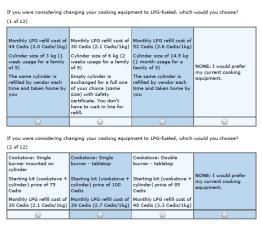
GLPG – GHANA MARKET ASSESSMENT – 24 MAY 2014
Objective: characterize demand for LPG in neighborhoods and small
towns in the outskirts of Accra and identify solutions to LPG adoption
Initial project objectives
TOR Goals Description
2.5 Characterize the Understand consumer behavior when buying and using
cooking fuel
customer profile for the
typical LPG-using Evaluate perception of key product attributes of LPG
household usage
Estimate demand curve for LPG and value of different
fuel configurations (based on consumer trade-offs)
2.8 Identification and Identify potential barriers to adoption from the
prioritization of primary consumer-end
barriers limiting the
Initial hypothesis of solutions to address these barriers
adoption and use of LPG
by households
8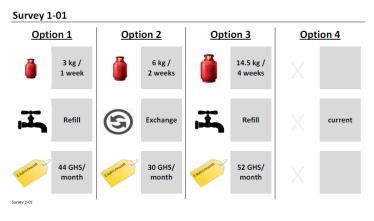
GLPG – GHANA MARKET ASSESSMENT – 24 MAY 2014
Methodological
Demand characterization focused on previously identified description
segments with a focus on the region of Greater Accra
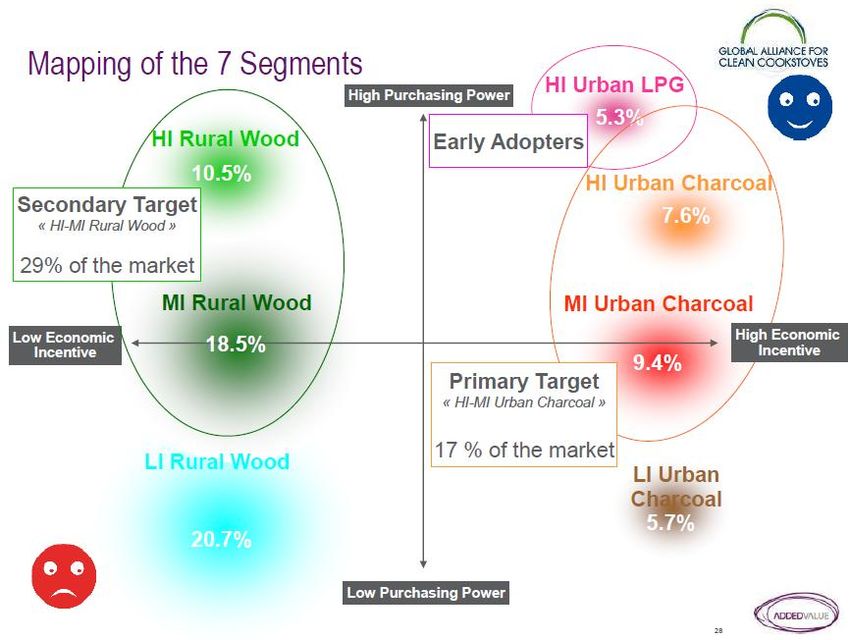
Market segmentation Focus on high economic
based on “Ghana Consumer Segmentation Study”1 incentive segments
Given Greater Accra’s higher income,
project aimed at covering all income
segments in Greater Accra (due to their
high economic incentive to adoption):
Early adopters: High income urban
consumer segment with already high
LPG adoption rate
Primary target: Middle and high
income segment in urban areas, with
charcoal as primary fuel
Low income charcoal users: low
income segment in Accra with higher
viability of adoption of LPG than the
equivalent segment in other regions
1) SOURCE: THE GLOBAL ALLIANCE FOR CLEAN COOKSTOVES - GHANA CONSUMER SEGMENTATION STUDY (APRIL 2014) 9GLPG – GHANA MARKET ASSESSMENT – 24 MAY 2014
Insights generated by collecting data using four key sources
Sources Data collection Insights
• Consumer preferences for different
Structured interview on product
next slides
Focus on
Conjoint product attribute combinations
preferences with 84 consumers in
surveys
Greater Accra region (~25min each) • Insights on usage behavior and
potential LPG adoption rate
• Comprehensive information on
Consumers
In-depth In-depth qualitative interview on LPG current LPG usage practices
customer usage behavior with 4 current
interviews consumers (~60min each) • Insights on perceptions and challen-
ges of LPG in contrast to other fuels
• Insights on barriers to adoption of
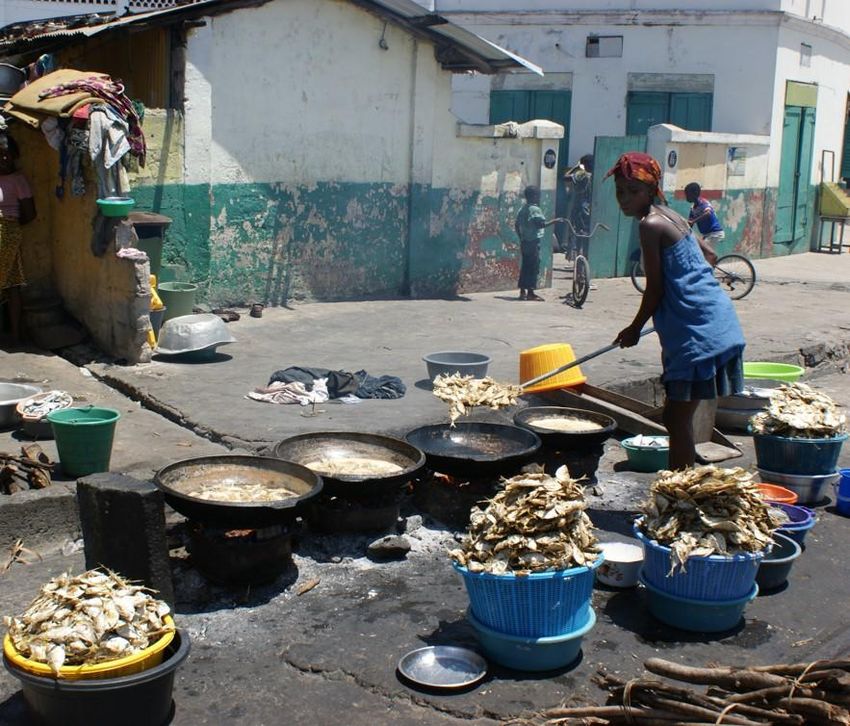
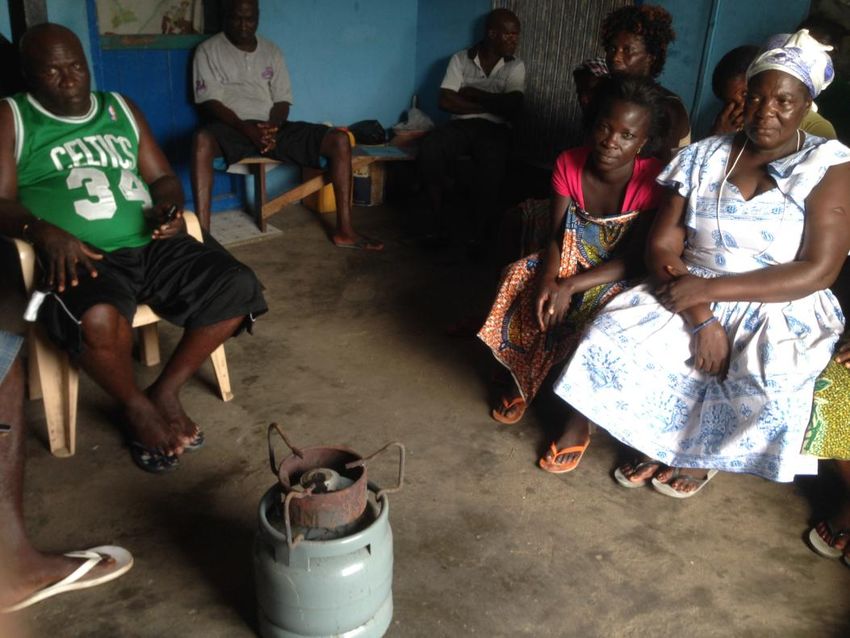
Round-table discussion with 30 fish LPG under current market conditions
Community
fryers in urban Accra neighborhood
workshop
(Jamestown) for approx. 60 minutes • Potential solutions for education and
distribution in urban communities
7 small group meetings (lasting more • Understanding of current LPG value
Suppliers
Supplier than 12 hours) with representatives of chain in Ghanaian market
meetings players in LPG value chain (e.g. cylinder • Insights on key challenges in LPG
manufacturer, retailers) market from different points of view
10GLPG – GHANA MARKET ASSESSMENT – 24 MAY 2014
Field research focused on conjoint analysis on customer preferences
• Field research mainly focused on analysis of customer preferences based on conjoint
analysis
• In conjoint analysis, customers reveal “true” preferences by selecting preferred choices
Conjoint analysis among a set of alternative combinations of product attributes
methodology
• Conjoint provides insights in relative importance of product design dimensions and
preferred product attributes
• Differences in preferences allow segmentation among customer base
• Survey taken with a randomized sample on May 19 & 20, 2014 in Accra (e.g. Korle-bu,
Jamestown, Russia) and Tema (e.g. community 5, 7)1
Conduct
• Each Wharton researcher complemented with local market research specialist
• Interview duration approx. 25 mins
• 1. Conjoint choices between four options based on 3 attributes out of 6 dimensions,
such as
– Stove type (e.g. 2 burner tabletop vs. 4 burners)
Survey design – Cylinder size (e.g. 14.5kg vs. 6.0 kg cylinders)
– Initial purchase price of starter-kit
• 2. Perception and usage of LPG gas in comparison to other fuels
• 3. Demographic information
11GLPG – GHANA MARKET ASSESSMENT – 24 MAY 2014
Randomized sample consists of 84 respondents across different
income levels, genders and age groups
Income levels Gender and age groups
40 20
Monthly household Male
31 income (in GHS) 16
14 14 Female
30 15
11
20 10 8
14
11 6
9 5 5
10 5
6 5 5 2
2 1 1 1 1
0 0
26-30
21-25
31-35
36-40
41-45
46-50
51-55
56-60
61-65
66-70
1600-1900
100
100-400
400-700
700-1000
1000-1300
1300-1600
2000-2400GLPG – GHANA MARKET ASSESSMENT – 24 MAY 2014
Research identified two segments: one focused on convenience and
upfront cost, and another on their cooking experience
Segment 1 Segment 2
Access seekers Convinced users
(low-income, 83% of respondents) (high-income, 17% of respondents)
Demo- • Household income below ~1,000 GHS/mo. • Household income above ~ 800 GHS/mo.
1
graphics • Currently lower share (57%) of LPG adoption • Majority uses LPG for daily cooking
• Primarily focused on optimizing LPG usage
• Strong preference for proximity to sales
and cooking experience (i.e. stove types with
points and large cylinder size
Customer at least 4 burners and low decanting costs)
2
preferences • Initial investment in stove and cylinder is
• Limited trust in LPG service providers and
main barrier of adoption due to lack of
intermediaries forces them to take care of
financial resources
cylinder maintenance and decanting
• Provide customers with convenient access to • Provide door-to-door cylinder exchange for a
cylinder exchange at 5 minutes walking fee
Segment distance through exchange truck system • Educate consumers on the importance and
3
strategy • Decrease upfront cost of adoption through reliability of the cylinder exchange model
microcredit solutions
• Educate consumers on the health benefits
and convenience of LPG
13GLPG – GHANA MARKET ASSESSMENT – 24 MAY 2014
1 Demographics: two segments coincident with household income
Preference segment LPG usage
Description
distribution by income levels by segment
100 100
Access seekers mainly defined by
household income of below
27.1% ~1,000 GHS/month
+42.9% • Majority of people completed
Access seekers accounts
Senior or Junior High School
for ~83% of 15.7%
• Working in low skilled profes-
respondents
sions (e.g. trader, vendor)
Convinced users customers
primarily in higher income
57.1%
segment of above ~800
GHS/month
• Mostly obtained higher edu-
cation (university, polytech)
• Mostly white collar profess-GLPG – GHANA MARKET ASSESSMENT – 24 MAY 2014
2 Preferences: Segments differ in importance of product attributes
Relative Access seekers Convinced users
importance (low income) (high income)
Access Convinced
seekers users
18 28 …Preference for multiple burners, but Stove is most important attribute and
Stove Stove …
stove type is not first priority most people opt for four burners
Strong preference for large cylinders,
Cylinder 20 23 Preference for large cylinders due to
Stove as this reduces exchange/decanting
longer lifetime
size frequency
High sensitivity to initial retail price of Preference for lower prices, but
Purchase 10 11
Stove stove and cylinder due to financial willingness to pay for appealing
price constraints stove/cylinder combinations
Proximity single most important factor Relatively unimportant as people have
Distance to 15 27
Stove due to lack of time and financial access to car or sufficient financial
point of sale resources for transportation resources for taxi ride
Prefer current decanting model and
Cylinder 4 8 Preference for exchange model with
Stove safety certified cylinders
taking care of cylinder maintenance
management themselves
Decanting / Willingness to pay more for cylinder Strong preference for lower
14 23 exchange/decanting in exchange for decanting/exchange costs due to pay-
Stove exchange off of long-term savings of LPG
additional services and lower upfront
price investment
costs
Low
Low High 15GLPG – GHANA MARKET ASSESSMENT – 24 MAY 2014
2 Preferences
Consumers prefer multiple burners for multi-tasking
Cook stove attribute preferences by segment Burners – “the more, the better”
100 88 Overall, in both segments clear preference for stove
Access seekers
types with more than one burner
Convinced users
63 Access seekers prefers multiple burners for dual appli-
50 Sub segment cations, but also sees benefit of single mounted type
interested in single • Multiple burners would substitute current usage of
mounted burners1 7 multiple charcoal stoves for dual cooking
• Single burners mounted on cylinder seen as viable
0 portable solution for a few customers
-24 -3 • Quote: “I like two burners because I can cook two
-36 dishes at the same time”
-50 -50 Convinced users not willing to accept any stove types
-46
with less than four burners
• Most customers already use LPG stoves with at
least four burners and a stove
-100 • No willingness to switch to smaller burner
Single Single Double Four • Quote: “I am used to my four burners, I can heat
mounted tabletop tabletop tabletop tea and cook at the same time”
1) SIZE OF SUB SEGMENT TO BE ESTIMATED BY FUTURE RESEARCH 16GLPG – GHANA MARKET ASSESSMENT – 24 MAY 2014
2 Preferences
14.5kg cylinder sizes favored by both segments
Cylinder size preferences by segment 14.5kg cylinder top favorite in the market
Both segments favor 14.5kg cylinder, while smaller
100 cylinders not consider viable options (especially 3kg)
Access seekers
72
Convinced users
Access seekers’ choice for cylinder size driven by
64
reduction of refill frequency and increased carrying
50 comfort
• On average, customers refill their 14.5kg cylinder
every 4-6 weeks
• Customers hate going to decanting stations
0 -4 because they are far away (walking/taxi required)
-9 and availability is uncertain
• Quote: “I have a large family and sometimes cook
-55 commercially. Anything smaller than 14.5kg would
-50 have me going back and forth to the refill station”
-68 Convinced users prefer 14.5kg cylinders size as it
optimizes convenience and refill frequency
-100
• Customers often with 14.5kg spare cylinders at
3 kg 6 kg 14.5 kg home to build reserves for potential shortages
• Refills considered less painful because customers
have car or sufficient financial resources to afford a
taxi ride
• Quote: “You never know when LPG is not available.
That’s why I have three 14.5kg cylinders.” 17GLPG – GHANA MARKET ASSESSMENT – 24 MAY 2014
2 Preferences
Initial purchase price as a barrier of adoption for access seekers
Willingness to payfor stove and cylinder by segment Starting kit purchase price – “the lower, the better”
100 While economic pricing rules apply for both, purchase
Access seekers
price seem to be show-stopper for access seekers
Convinced users
Income constraints make access seekers very
50 sensitive to upfront retail price of stove and cylinder
33
starting kit
15 14 • Anything else than low price combinations seem as
a potential barrier to adoption for access seekers
16
0 • Lack of savings and larger cash amounts make
2 -27 initial starting-kit purchase impossible
-8
• Quote: “I don’t have money for the cylinder or the
cooker”
-50 -35
Convinced users indifferent to initially spend more for
starting kit, if features are appealing
• Convinced users prioritize obtaining the desired
-100 cooker and cylinder over the upfront cost
e.g. retail price Low Medium High Very high • Quote: “I would never sacrifice my current stove.
double tabletop 100 120 140 160 It’s just too valuable to me.”
14.5 kg cylinder1
1) IN GHS, LOW, MEDIUM, HIGH AND VERY HIGH PRICES FOR START-KITS DEFINED BASED ON STOVE AND CYLINDERS COMBINATIONS (SEE TABLE IN APPENDIX) 18GLPG – GHANA MARKET ASSESSMENT – 24 MAY 2014
2 Preferences
Short distances for Access seekers, while convinced users trade-
off convenience and trust
Preferences for distances and means of Cylinder delivery as a tradeoff
transportation for decanting stations by segment between convenience and trust
99
100 Convenience of door-to-door delivery favored by
Access seekers
most; convinced users with some trust concerns
Convinced users
Access seekers strongly driven by convenience
50 35 aspects to avoid refill/exchange troubles
56
• Door-to-door delivery clearly seen as best solution
to save time and painful cylinder carrying to
15 refill/exchange station
0 -15 -21 -14 • If door-to-door is not available, 5 minute duration
is preferred; otherwise, duration of journey less
important than convenience of a bus ride
-25 -341
-281 -31 • Quote: “Door-to-door would save me a lot of time,
-50 because I am too busy to go to the refill station”
-64 Convinced users prefer door-to-door, but do not mind
travelling short distances to refill/exchange cylinder
-100 • More elastic in terms of distance/duration as most
Door- 5 15 30 30 60 customers have a car available to take cylinder to
to- decanting/exchange station
Walking Bus drive • Quote: “I don’t like door-to-door, because you
door
(in min) (in min) never know whether they return your own cylinder
1) NOT SIGNIFICANT, INTERPOLATED 2) NOT SIGNIFICANT and whether they fill it properly.” 19GLPG – GHANA MARKET ASSESSMENT – 24 MAY 2014
2 Preferences
Cylinder management model polarizes two segments
Preferences for cylinder
Safety yes – but who should take care of it?
management model by segment
100 Opposite preferences in cylinder management models
Access seekers are one of the key differences between two segments
Convinced users
Cylinder exchange with
Access seekers prefer ease of exchange transaction
50 Current evidence of
and increased safety through certified maintenance
refilling model safety/maintenance1
• Many customers “fix” potentially leaking cylinders
8 with stone on valve
23 • Exchange faster than current decanting process,
0 which takes 5-6 minutes (with queue easily
>45min)
-8
• Quote: “I would feel better if I could replace my
-23 current cylinder for a certified one”
-50
Convinced users interested in well-maintained
cylinders, but does not trust the exchange model
• Currently most customers take care of cylinder
-100 maintenance themselves
Decant Exchange • Doubt feasibility of increased safety in exchange
model, partially based on previous experience
• Quote: “I’ve seen the exchange model in action. In
Ghana it doesn’t work. I would always exchange
my good cylinder for a bad one”
1) E.G. SEALED VALVE 20GLPG – GHANA MARKET ASSESSMENT – 24 MAY 2014
2 Preferences
Convinced users optimizing for low refill/exchange costs in the
long-run
Access seekers willing
Preferences on refill/exchange prices by segments
to pay more for additional services
100 As expected, both segments show inverted
Access seekers preferences for increasing monthly refill/exchange
59 prices
Convinced users
50 Access seekers favor lower refill/exchange prices, but
33
willing to pay for additional services2 and lower
39 upfront price
41 • Many customers explicitly state willingness to pay
0 15
for certified safety or door-to-door delivery
-23 • Willing to pay higher recurring payments in order
-6 -331
-43 to balance with upfront costs due to lack of cash
Current price -27 • Quote: “We work a lot. We would pay to have
-50 2.87 GHS/kg nearby access to safe LPG”
-531
Convinced users strongly prefer lower refill/exchange
-79 prices as long-term nature of LPG investment is
-100 considered
2.1 2.4 2.7 3.0 3.3 3.6 • Low willingness to pay for transport services;
Refill/exchange price (in GHS/kg) consumers already have access to automobile
• Willing and financially equipped for higher upfront
investments to reduce recurring costs
• Quote: “Why would I pay someone to go refill my
cylinder. I don’t trust him and I already have a car”
1) SAMPLE RESULTS NOT SIGNIFCANT, INTERPOLATED 2) E.G. DOOR-TO-DOOR OR EXCHANGE MODEL 21GLPG – GHANA MARKET ASSESSMENT – 24 MAY 2014
3 Target access seekers with nearby LPG at low costs and convinced
users through education on reliability of cylinder exchange model
Access seekers Convinced users
Increase convenience of cylinder exchange, Achieve widespread acceptance of exchange
Strategic focus lower upfront costs and educate on LPG model by educating users on its reliability
health and safety
• Reduce upfront cost through microcredit • Target segment with 14.5kg cylinder and 4
Price for
• Target segment with 14.5kg cylinders and burner cook stoves (potentially with oven)
stove and cylinder
double table top cookers; provide street
configuration
vendors with single mounted burners
Distribution • Increase proximity to consumers by • Maintain current distribution channel and
a
channels exploring alternative channels (e.g., provide door-to-door exchange for a fee
exchange truck visits local communities)
• Implement exchange model with safety certified cylinders and eliminate queues
Cylinder
b • Substitute legacy cylinders by ramping up domestic production and increasing cylinder
management
imports (to be analyzed in depth in supply work stream)
• Train respected community members • Explain benefits of cylinder exchange
c Education (e.g., selected by local Chief) to explain model (i.e. safety and health aspects)
LPG safety rules and health benefits through health centers and LPG retailers
Refill/exchange price • Decrease prices by building efficiency in LPG value chain (analyze in supply work stream)
Potential increase in
d +31pp -6 to +2 pp
market share
22GLPG – GHANA MARKET ASSESSMENT – 24 MAY 2014
3 Segment strategies
A single truck could access 9k households distributing cylinders at
a
5 minutes walking distance with a positive NPV
Description Economics
Cash flow structure, GHS Assumptions
Transport cylinders Incremental Sales of 96 cylinders , of which 20% go to new
88 consumers, at margin of 5GHS/cylinder1
to each location profits
with high 2 employees loading and unloading cylinders
Total labor
concentration of 29 for ~100 minutes and driving 2 hours at
costs 4GHS/man hour
access seekers
Use 8ton trucks to Fuel costs 22 Average distance to location of 20 km, with
place cylinders at truck consuming 20L/100km at 2.7GHS/L
~5minutes walking
Maintenance Annual costs of 5% of truck value distributed
distance from 6
costs throughout 3 trips per working day
consumers
Truck should EBITDA 32 Corporate tax rate of 25%
transport ~96
cylinders weighting Depreciation tax shield based on straight line
Taxes 6 depreciation for 15 years life
14.5kg and visit 3
locations per day Annual FCF of 18kGHS (considers 3 trips per working day)
NPV of 9kGHS throughout 15 year lifetime2
FCF 26
Coverage of 9k households3
1 Each cylinder weighs 14.5kg, is priced at 2.9GHS/kg with a 4.0% margin to the retailer (current margin), and has an additional transportation fee of 0.2GHS/kg. Calculation only considers incremental market
share generated by initiative (detailed ahead).
2 Considers WACC of 19%: β of 1.1 (in line with transport industry); market premium of 6.7%; country equity risk premium of 11.8%; no debt
3 Assumes cylinders last 1 month and a half
SOURCE: DAMADORAN (NYU); KITE; NPA; BLOOMBERG; ALIBABA; CONSUMER SURVEYS; CONJOINT ANALYSIS 23GLPG – GHANA MARKET ASSESSMENT – 24 MAY 2014
3 Segment strategies
bAchieving 50% LPG adoption rate by 2020 with cylinder exchange
model demands increase of cylinder supply capacity
Cylinder demand and production (Million cylinders), 2015-2020
Supply-demand
gap of ~7.5M
7.5 cylinders likely in
2020 at current
Success of installed capacity
Current cylinders in circulation to
exchange model
be replaced or refurbished?
demands 1) To achieve target
sufficient adoption rate
cylinders to meet Ghana needs to
6.0 ramp-up current
demand from 3.7 2.2
new adopters yearly cylinder
GCMC2
and 2) trust in production by 5x
0.9 (from ~0.4M to
circulating Sigma yearly average of
cylinders 1.3 1.5 2M) or
The latter complement it
with additional
demands
imports
substitution of
unsafe cylinders Cylinder Cylinder Production Current Potential
currently demand of production gap cylinders in refurbishing
circulating new capacity circulation and
customers1 (’15-’20) production
gap
1) 2.5M NEW HH WITH 1.5 CYLINDERS IN CIRCULATION PER HH 2) GCMC PRODUCTION TO REACH CAPACITY IN 2017 SOURCE: KITE (2011); CONSUMER SURVEYS AND
INTERVIEWS 24GLPG – GHANA MARKET ASSESSMENT – 24 MAY 2014
3 Segment strategies
cFor access seekers, education should be done through community
Chiefs, and should focus on explaining that LPG is safe and healthy
Focus on education for access seekers
Consumers who believe LPG is safe and healthy (vs. Education should be spread through local
other fuels) use it more community Chiefs
% of participants that use LPG as Request that each community’s Chief select a
primary fuel for each response group of community members to educate the
Question local population on the use of LPG
69 +20pp
How safe
Educate group on each of the drivers of LPG
is LPG? 49 adoption
─ How to use LPG safely
─ How to detect and react to a leak or
Very safe Unsafe or eminent explosion
dangerous ─ What are the health benefits of LPG
+17pp Make group accountable for educating
Is LPG 62 community on the use of LPG
44
healthier
than
other Monitor group’s success with a visit to the
fuels? community (e.g., 6 months after LPG is made
Healthier Not healthier available), based on reports of accidents and
the adoption of LPG within the community
SOURCE: CONJOINT SURVEY; FISH FRYER CHIEF OF JAMESTOWN, ANDRE MAKATTAH 25GLPG – GHANA MARKET ASSESSMENT – 24 MAY 2014
3 Segment strategies
For convinced users, education should be done through respected
c
community members, and focus on reliability of exchange model
Focus on education for convinced users
Consumers don’t trust the safety of their cylinders to Education should be spread through well-
others respected community members
Consumers disliked the previous exchange model Leverage health centers (especially
because they distrusted the safety of the cylinders mothers during maternity) and local LPG
they received retailers to educate consumers
─ “I saw the old [cylinder exchange] model. It doesn’t
work in Ghana because people don’t respect each Educate these stakeholders on
other. I use to give them a well taken care of
cylinder and they’d give me a terrible one” ─ The importance of adopting LPG for
health reasons
Consumers don’t trust third party door-to-door
intermediaries because they don’t like to lose sight ─ How LPG has become safer with the new
of their cylinder exchange model that includes a safety
guarantee (e.g., certificate, seal)
─ “I never use door to door refilling. The man who
─ How to detect and react to a leak or
takes the cylinders to the station doesn’t fill it
eminent explosion
completely and doesn’t take good care of it”
Consumers don’t trust those who fix cylinders
Monitor the success of the education
─ “When I ask someone to fix a leak on my cylinder programs with a visit to the community
they usually sometimes they do it right other times (e.g., 6 months after LPG is made available),
they don’t. When this happens I ask someone else based on reports of accidents and the
to fix it. Fixing things is completely random in this adoption of LPG within the community
country.”
SOURCE: CONSUMER INTERVIEWS; KITE: LPG GHANA STUDY 26GLPG – GHANA MARKET ASSESSMENT – 24 MAY 2014
3 Segment strategies
dProposed initiatives can significantly increase LPG market share in
access seekers
Access seekers Convinced users
LPG market share Market share
increase, % Assumptions increase, % Assumptions
• Decrease distance from 30
min bus to 5 min walking by • 40% of segment uses door -to-
Decrease
adding nearby sales point door cylinder exchange
distance +8% 0.40
Stove and/or cylinder exchange +2%
to sales • 0.5 GSH/kg cost for those who
truck
point use this service
• Increased fee of 0.2 GHS/kg
• Implement cylinder • Aversion to exchange model –
exchange model with fear of losing current (well
Implement evidence of cylinder safety maintained) cylinder for a poorly
Stove exchange +12% 0.43 -8 to 0%
• Added maintenance cost of maintained one
system
0.05 GHS/kg to • Unlikely to stop using LPG. 0-8%
refill/exchange price2 share drop is worst case scenario
• 40 GHS decrease of upfront
Decrease payment for a cylinder and
Stove upfront +11% 0.57 cook stove kit3 +/- 0% • Low elasticity of initial kit
payment • Amount of discount repaid expense
over 1 year (microfinance)
Potential increase
+31pp -6 to +2 pp
in market share
1) Maximum possible refill/exchange price increase that does not decrease LPG market share below the level prior to the attribute change Marginal increase in
GHS/kg
2) Cylinder maintenance cost = 8 GHS/year (~10% of cylinder purchase price) 3) Double tabletop burner and 14.5 kg cylinder willingness to pay1 27GLPG – GHANA MARKET ASSESSMENT – 24 MAY 2014
Next steps
Characterize demand in other regions of Ghana
and understand differences vs. Accra (lower levels
of adoption may generate additional segments both
among high-income consumers and low-income
consumers)
Finalize research on LPG supply chain (including
its economics) in Ghana
Optimize and fine-tune proposed marketing
strategy initiatives based on supply side economics
(i.e., cost structure)
28GLPG – GHANA MARKET ASSESSMENT – 24 MAY 2014
Appendix
29GLPG – GHANA MARKET ASSESSMENT – 24 MAY 2014
Appendix
1. LPG market structure
2. Conjoint methodology
3. Detailed interview results
30GLPG – GHANA MARKET ASSESSMENT – 24 MAY 2014
Goals for Reference 4
Supply security, scalability, and curve assessments
REMINDER
TOR Goals Description
4.1 Characterization of Understand structure of current value chain
present LPG supply chain Describe links from production to retail
link by link, from Assess performance and economics of each link
production/importation to
retail
31GLPG – GHANA MARKET ASSESSMENT – 24 MAY 2014
Preliminary
assessment
LPG supply chain is specific and complex with many actors involved
Production/refining Bulk Bulk
Wholesale Transport Retail
+ import Storage transport/filling
1 4
Bulk Distribution Companies (BDC) Oil marketing companies (OMC)
2 5 6
TOR Transporters Independent decanters
3 BOST 7 Cylinder and valve manufacturing companies
•TOR is single dom- •Single centralized •Currently no LPG •~85 OMCs in charge •Transportation •Decanting outlets
estic refinery with public (TOR) and bulk transportation of distributing and solely on the road operated by OMCs or
capacity of only a private storage network available marketing of LPG •Limited number of under franchise
weeks consumption (Fueltrade) in TEMA •Distribution to refill- •Goil as largest OMC road tankers (BRV) •Independent decanting
•BDCs directly import •BOST with mandate ing tanks directly covers 7% of market •Direct transport stations
(Fueltrade with 90% for strategic reserve from bulk storage •Two domestic cylin- from TOR to retailer •Gas cylinders under
market share) management •Also direct ship to der manufacturer •Some OMCs own a control of customers
•Imports make 80%+ BRV discharge with spare capacity fleet of tank trucks •Standardized valves
of consumption facilities
Policy and regulation
• National Petroleum Authority (NPA): regulate, oversee and monitor activities in the deregulated petroleum downstream industry
• Overall responsibility with Energy Commission (EC), Ghana Standards Board (GSB) set safety and measurement standards
• Reduction of LPG subsidy from 50% to 0% decreased consumption in 2014 compared to 2013 by about 30%
32GLPG – GHANA MARKET ASSESSMENT – 24 MAY 2014
Preliminary
assessment
LPG price build up as of May 16, 2014 (in GHp/KG)
11.16 287.00
(3.9%) (100.0%)
4.78
-12.68 8.15 1.00
6.38
(-4.4%) (2.8%) (0.3%)
269.37 0.72
30.31
(93.9%) 5.00 10.00 (10.6%)
(3.5%)
18.40 256.69
(89.4%)
Unified Petroleum Price Fund (UPPF) levy
generates funds needed to smoothen prices
across the coastal and hinterland regions
Ex-refinery Taxes Ex-depot UPPF levy Marketers Transport Pure retailers Ex-pump
price price
2 1 4 5 6
1) INDICATIVE MAXIMUM PRICE SOURCE: NPA 33GLPG – GHANA MARKET ASSESSMENT – 24 MAY 2014
Preliminary
Drive down prices by increasing efficiency in LPG value assessment
chain (especially up to refinery section)
Comparison of international oil and Ghanaian LPG prices, USD
USD/Barrel USD/kg
130 1.3 Price of LPG to consumer is
mainly driven by its price at
1.2
120 refinery (92% of price to
1.1 consumer)
110 1.0 Until 2013, LPG price evolution
remained in tandem with that
100 0.9 of oil (with less volatility)
0.8 Post 2013, LPG prices
90 increased 50% while oil prices
0.7
decreased by 6%
80 0.6
50% increase in 0.5
70 LPG price vs. 6% Survey data suggests that
decrease in oil price 0.4
Access seekers are spending
60 0.3 on average 17% of their
LPG price Ex-pump (USD/kg)
0.2 income on cooking fuels
LPG price Ex-refinery (USD/kg)
50 (middle 50%: 4-24%), while
Europe Brent spot price FOB (USD/Barrel) 0.1 Convinced users 3% (middle
0 0.0 50%: 1-6%)
1-Jul-07 1-Oct-08 1-Jan-10 1-Apr-11 1-Jul-12 1-Oct-13 1-Jan-15
SOURCE: NPA; EIA
34GLPG – GHANA MARKET ASSESSMENT – 24 MAY 2014
1
Preliminary
assessment
BDCs: Fueltrade largest bulk distributer with ~90% market share
LPG bulk distribution market size and
Outlook
share by BDC 2010 – 2013 (in ‘000 kg)
+41,5% Challenges
• LPG shortages and insufficient cylinder
268,49
250,66 production capacity limits demand and the
214,43 ability to estimate what the true demand is
• Perceived lack of safety of LPG limits
177,19 demand for this fuel
28,8% Potential strategies proposed by fuel trade
90,2% 88,5%
91,5% • Expand bulk transportation infrastructure
(e.g., Takoradi pipeline and bulk transport
61,8%
ship)
• Potentially, integrate vertically into OMC
and eventually retail section of value chain
2010 2011 2012 2013 (accomplish this through initiatives in which
Import fuel trade has full control)
84% 83% ~95% ~81%
quota
Other Ebony Cirrus
TOR Chase Fueltrade/Bulkship
1) OTHER INCLUDES ECO, OILCHANNEL, BLUE OCEAN, DEEN, FIRSTDEEPWATER, VIHAMA 35GLPG – GHANA MARKET ASSESSMENT – 24 MAY 2014
3
Preliminary
assessment
OMCs: Three different types of marketers in Ghanaian LPG market
Pure LPG OMCs Multi-fuel OMCs Hybrids
Typical
characteristics
1 Market share ~ 57% ~ 31% ~ 11%
Almost exclusively LPG Small share in sales LPG w/ significant share in
2 LPG share/sales
(more than 90%) portfolio (less than 10%) sales mix (10-90%)
Mainly national and some
3 Geographic focus Mainly local and regional Only local and regional
regional
4 Network size Less than 10 outlets More than 15 outlets Less than 10 outlets
• Trinity Oil • Ghana Oil • Superior Oil
Examples • Manbah Gas • Agapet • Unique Oil
• Joekona • Quantum Petroleum • Lucky Oil
36GLPG – GHANA MARKET ASSESSMENT – 24 MAY 2014
3
Preliminary
assessment
1 Pure LPG marketers command 57% of LPG market in 2012
Market share by company type and geographic focus, in m litres
Total LPG sales in 2012: 228.548m litres
127 25 69
2%
Local 8%
22%
(30%)
6%
Regional
23%
(37%)
21%
6%
National
12%
(34%)
Pure LPG marketers Hybrid marketers Multi-fuel marketers
(57%) (11%) (31%)
SOURCE: NPA
37GLPG – GHANA MARKET ASSESSMENT – 24 MAY 2014
3
Preliminary
assessment
2
Top 20 OMCs account for 62% of Ghanaian LPG market
17 out of 20 top OMCs exclusively sell LPG
100%
90%
80%
70%
60%
50%
40%
Top 5 OMCs account for 25%
30% of the LPG market
LONESTAR GAS (3.4%)
20% JOEKONA (3.8%) Top 20 OMCs account for
MANBAH GAS (4.8%)
62% of the LPG market Top 40 OMCs account for
10% TRINITY OIL (4.8%)
GHANA OIL (6.9%) 83% of the LPG market
0%
0 5 10 15 20 25 30 35 40 45 50 55 60 65 70 75 80 85
Multi-fuel OMCs Pure LPG OMCs Hybrid OMCs n=83
NOTE: BASED ON LITRES SOLD IN 2012
SOURCE: OMC PERFORMANCE STATISTICS 2012 (NPA)
38GLPG – GHANA MARKET ASSESSMENT – 24 MAY 2014
3
Preliminary
3
Most pure LPG marketers with local retail network, assessment
while most Multi-fuel marketers with national retail strategies (1/2)
26 15 42 Geographic focus of outlet network
National
15.4%
(7+ regions) Majority of pure LPG OMCs focus their
40.0% outlet network on 1-2 regions (mainly
Regional 52.4% urban areas)
30.8%
(4-6 regions)
Majority of Multi-fuel OMC’s with
national retail network (more than 7
regions)
Local 60.0% 33.3% Hybrids only with local and regional
53.8% networks, no national coverage
(1-3 regions)
14.3%
Pure LPG Hybrids Multi-Fuel
OMCs OMCs
SOURCE: BASED ON NPA STATISTICS 393
3
Concentration of regions in outlet portfolio
(ranked by #outlets per region, 1-10 regions)
ANASSET
MIGHTY GAS
KAYSENS GAS
TRADE CROSS
100% of outlets
SHELLEYCO PETROLEUM
LAMBARK GAS
CENT EASTERN GAS
GO-GAS VENTURES
Local
YOKWA GAS
SHAKAINAH VENTURES
NEXTBONS GAS
LAMININBEE
PETROCELL
SOURCE: BASED ON NPA STATISTICS
THOMCOF
JOEKONA
LONESTAR GAS
ANNANDALE GHANA
ROOTSENAF GAS
BAFFOUR GAS
in same region Pure LPG marketers
TRINITY OIL
MANBAH GAS
ROYAL ROSE
OCEAN OIL
XPRESS GAS
LOUIS GAS
Regional Nat.
VIRGIN PETROLEUM
CAPSTONE OIL
RURAL ENERGY RESOURCES
MOTOHAUS OIL
LUCKY OIL
O.J.K
GLASARK OIL
Local
ASPEN PETROLEUM
CORNOIL PETROLEUM
HAK OIL
Hybrids
SONNIDOM
UNIQUE OIL
MAXX GAS
Reg.
SUPERIOR OIL
RICH OIL
AP OIL & GAS GHANA
UNITY OIL
Backup
Q8 Oil(GH)
READY OIL
Local
JUSBRO PETROLEUM
AI ENERGY
VENUS OIL
STRATEGIC ENERGIES
PACIFIC OIL GHANA
ENGEN GHANA
DUKES PETROLEUM
SPIRIT PETROLEUM
SEPHEM OIL
MODEX OIL
KINGS ENERGY
EV. OIL
Regional
UBI PETROLEUM GHANA
LILYGOLD OIL
WEST AFRICAN PETROLEUM
SO ENERGY GH
NAAGAMNI GHANA
UNION OIL GHANA
GRACE OIL PETROLEUM
CROWN PETROLEUM GH.
Most pure LPG marketers with local retail network,
FRAGA OIL GH.
CHAMPION OIL
TOTAL PETROLEUM GHANA
PETRO AFRIQUE GHANA
Multi-fuel marketers
FRIMPS OIL
GALAXY OIL
Concentration of outlets among 10 regions by OMC, each bar represents an OMC
PETROBAY OIL
TOP OIL
OANDO GHANA
EXCEL OIL
National
HAVILAH OIL GHANA LTD
SKY PETROLEUM
UNIVERSAL OIL
AGAPET
GLORY OIL
GHANA OIL
STAR OIL
QUANTUM PETROLEUM
in all 10 regions
assessment
Preliminary
Outlets distributed
while most Multi-fuel marketers with national retail strategies (2/2)
40
GLPG – GHANA MARKET ASSESSMENT – 24 MAY 2014GLPG – GHANA MARKET ASSESSMENT – 24 MAY 2014
3
Preliminary
assessment
4 Pure LPG marketers drive more sales per outlet (1/2)
Avg. sales per outlet (in ‘000 litres)
Avg. # Outlets
25 670 700
23
600
20
500
15 400
263 300
10
6 6 200
5
59 100
0 0
Pure LPG OMCs Hybrid OMCs Multi-fuel OMCs
Average number of outlets
Average sales per retailer segment (in ‘000 litres)
SOURCE: NPA 414
3
10
15
20
25
30
35
40
45
50
55
60
0
5
7
MANBAH GAS
4
ANASSET
1,559
TRADE CROSS
5 5
SOURCE: NPA
KAYSENS GAS COMPANY
7
LONESTAR GAS
5
SHELLEYCO PETROLEUM
3
GO-GAS VENTURES
7
LAMBARK GAS
8
ROOTSENAF GAS
7
NEXTBONS GAS
17
TRINITY OIL
6
SHAKAINAH VENTURES
13
VIRGIN PETROLEUM
6
CENT EASTERN GAS
3
MIGHTY GAS
11
ANNANDALE GHANA
YOKWA GAS
3 3
THOMCOF
Pure LPG retailers
# Outlets
18
JOEKONA
12
OCEAN OIL
19
LOUIS GAS
22
XPRESS GAS
2
PETROCELL
6
BAFFOUR GAS
LAMININBEE
4 4
ROYAL ROSE
6
670
Median
ASPEN PETROLEUM
3 3
RURAL ENERGY RESOURCES
6
LUCKY OIL
3
MOTOHAUS OIL
6
GLASARK OIL
8
MAXX GAS
17
SUPERIOR OIL
21
UNIQUE OIL
CAPSTONE OIL
Hybrids
SONNIDOM
13 13
8
O.J.K COMPANY
3
HAK OIL
12
RICH OIL
3
CORNOIL PETROLEUM
na
TRIGON ENERGY
6
263
Median
Avg. sales per outlet (in ‘000 litres)
3
AI ENERGY GROUP LIMITED
Backup
12
JUSBRO PETROLEUM
10
AP OIL & GAS GHANA
21
QUANTUM PETROLEUM
12
PETRO AFRIQUE GHANA
MODEX OIL
UBI PETROLEUM GHANA
23 23
21
KINGS ENERGY
27
STRATEGIC ENERGIES
14
EV. OIL
22
NAAGAMNI GHANA
225
GHANA OIL
33
FRIMPS OIL
18
GRACE OIL PETROLEUM
12
VENUS OIL
6
LILYGOLD OIL
23
PACIFIC OIL GHANA
29
ENGEN GHANA
25
DUKES PETROLEUM
39
TOP OIL
47
AGAPET
51
UNION OIL GHANA
19
WEST AFRICAN PETROLEUM
21
PETROBAY OIL
26
EXCEL OIL
Pure LPG marketers drive more sales per outlet (2/2)
13
SO ENERGY GH
15
HAVILAH OIL GHANA
Multi-fuel retailers
23
CROWN PETROLEUM GH.
37
GALAXY OIL
36
OANDO GHANA
27
UNIVERSAL OIL
55
GLORY OIL
37
FRAGA OIL GH.
Number of outlets per OMC (bar), average sales per outlet per OMC (line, in ‘000 litres)
7
READY OIL
5
Q8 Oil(GH)
53
SKY PETROLEUM
Average sales per marketer segment (in ‘000 litres)
153
STAR OIL
5
SEPHEM OIL
35
CHAMPION OIL
222
TOTAL PETROLEU
5
SPIRIT PETROLEUM
16
UNITY OIL
23
Median
assessment
Preliminary
59
0
42
100
200
300
400
500
600
700
800
900
1,000
1,100
1,200
1,300
1,400
1,500
1,600
GLPG – GHANA MARKET ASSESSMENT – 24 MAY 2014GLPG – GHANA MARKET ASSESSMENT – 24 MAY 2014
5
Preliminary
Independent decanters turned unprofitable due to 39.9% assessment
margin reduction since 2011
Significantly reduced …not sufficient to cover cost base of an
retailer margin (in % of retail price)… average LPG decanting station
33,137 Driven by delivered gas density,
6.72 (100.0%) which currently cannot be
measured/controlled sufficiently
5.63 by retail decanting station
-39.9%
19,200
4.28 (-57.9%)
4.04
3.03
2.63
7,550
(-22.8%)
5,160
(-15.6%)
5,271
(-15.9%)
Q3 Q4 Q1 Q2 Q3 Q4 Q1 Q2 Q3 Q4 Q1 Q2
-4,044
2011 2012 2013 2014 (-12.2%)
Operating Salaries Property, Utilities Taxes Profit
profit equipment & fees
and
maintenance
SOURCE:
… GHANA LPG RETAIL ASSOCIATION 43GLPG – GHANA MARKET ASSESSMENT – 24 MAY 2014
6
Preliminary
assessment
Cylinders: Domestic cylinder production inefficient & below capacity
Cylinder production overview Cylinder ownership model
Two cylinder manufacturing companies currently Currently three standard sizes in market available –
active in Ghana (GCMC and Sigma) 3.0kg, 6.0kg and 14.5kg
• 14.5kg most popular size in the market
Ghana Cylinder Manufacturing Co. Ltd. (GCMC) • More sizes up to 52.0kg available, but mostly for
officially mandated to provide market with cylinders industrial and commercial applications
(40% market share)
• Produced 130k cylinders in 2013 (140k expected in Ownership of cylinders in Ghana is vested in practice
2014), which is highest output in company history with end-users
• Positioned at price premium as quality cylinders, • Model initially based on deposit/refund and
which optimally meet standards (e.g. thicker walls) exchange system evolved to local decanting
• Cylinder production complemented with motivated by LPG shortages that led to consumer
manufacturing of LPG stoves (output 2013: 5k) desire to cross-fill, and by lack of cylinder
• Currently excess capacity of 150k cylinders due to maintenance that led to consumers exchanging
inefficiencies and shortages good-condition cylinders for bad-condition
• Expansion and new production facilities in Accra cylinders
planned to be kicked off in late 2014 • Lack of knowledge about cylinder lifespans; lack
financial resources for carrying out refurbishment
Sigma Gas Ghana Ltd. Accounts for 60% of the market,
and cylinder recertification
known to reduce material cost by pushing cylinder
• Inability to manage cylinders in circulation due to
design for lower end of standard measures
end-user cylinder control and lack of exchange
44GLPG – GHANA MARKET ASSESSMENT – 24 MAY 2014
Appendix
1. LPG market structure
2. Conjoint methodology
3. Detailed interview results
45GLPG – GHANA MARKET ASSESSMENT – 24 MAY 2014
Conjoint study methodology (1/2)
Definition of attributes • A pool of attributes (e.g., cylinder size, cleanliness, cook stove type) of a future LPG model
was defined
1 • Six most important attributes (refill/exchange price, cylinder size, distance to a
exchange/decanting station, cylinder exchange/refill model, cook stove type and price of a
set: cylinder + cook stove) were
selected to test their importance with customers
Survey design • Values for attributes were defined based on information gathered during local interviews
(e.g., cylinder sizes were set to 3 popular ones in Ghana: 3kg, 6kg and 14.5 kg)
• Specialized software (Sawtooth Software SSI Web and its additional modules)¹ was used to
2 design 8 versions of a questionnaire, 12 conjoint questions each, giving a set of 96 unique
questions
• Each question consisted of 3 combinations of attributes and a blank choice („your current
configuration”)
Fielding survey • Printed picture-based questionnaires were used to field the survey among the inhabitants of
several Accra neighborhoods (Jamestown, Chorkor, Korle-Bu, Korle-Gonno, Russia, Circle,
Mango Lane)
3 • 84 surveys were conducted; in each survey respondent was choosing their preferred
configuration of attributes out of 4 choices in 12 questions for a total of 1008 selections
being made from 4032 options
1) WWW.SAWTOOTHSOFTWARE.COM (CBC MODULE FOR SSI WEB)GLPG – GHANA MARKET ASSESSMENT – 24 MAY 2014
Conjoint study methodology (2/2)
Clustering analysis • All survey answers, together with respondents’ demographic data were imported to Sawtooth
specialized software¹
• Latent Class using logit regression was performed to identify homogenous groups of
4
respondents, based on their attribute preference
• Identified two preference-based segments were then characterized demographically (income
being the best differentiator)
Preference estimation • Individual survey data was analyzed within segments with HB regression, logit regression
and partial utilities counts to determine which attributes and attribute values are preferred by
customers
5 • The software analyzes how frequently certain attributes were chosen whenever they were
available and based on 1008 selections determines the average importance of each
parameter and a preferred value of attributes (e.g., most preferred cylinder size is 14.5 kg as
respondents were more likely to choose options with this cylinder size as compared to other
sizes)
Demand curve
approximation
• A model of a two-fuel market (charcoal and LPG) was built and market shares of each fuel
6 were estimated based on the preference scores from the previous step (explained in detail on
the following slides)
1) WWW.SAWTOOTHSOFTWARE.COM (LATENT CLASS MODULE FOR SSI WEB)GLPG – GHANA MARKET ASSESSMENT – 24 MAY 2014
This methodology produced statistically significant results for both
segments
Segment 1 Segment 2
Access seekers Convinced users
(low-income, 83% of respondents) (high-income, 17% of respondents)
Logit regression model used to calculate Logit regression model used to calculate
attribute relevance and part-worth attribute relevance and part-worth
utilities utilities
Chi-square = 828 Chi-square = 202
P-value at 26 degrees of freedom ≈ 0 P-value at 26 degrees of freedom ≈ 0
Latent class segmentation process used to find most adequate set of segments
Chi-square for a 2 segment model = 956
P-value at 26 degrees of freedom ≈ 0
48GLPG – GHANA MARKET ASSESSMENT – 24 MAY 2014
Market share and willingness to pay estimation (1/2)
Definition of two • Charcoal was defined with the use of parameters characterizing LPG: 5 min walking distance
to a store, price of 2.1 GHS/kg LPG¹, 3 kg cylinder (short-lasting supply), refill model, low
competing products initial set price, single mounted burner (one cooking space per charcoal burner)
1 • Current most common LPG configuration was described with a set of attributes. For example,
for the Access Seekers Segment these are the following: 30 min by bus to a
decanting/exchange station, price of 2.9 GHS/kg, 14.5 kg cylinder, refill model, high initial
price, double burner
Estimation of a share
• Utility of each product to individual customers was calculated based on the individual
of preference
preferences of respondents captured with the survey (with Sawtooth Software SMRT
module²)
2
• Product providing more utility was “chosen” by each individual. Percentage of choices won by
LPG is its Share of Preference, or an estimated market share (57% among Access Seekers,
equal to the value observed with the survey)
Sensitivity analysis • LPG attributes were changed one by one and the resulting changes in the Share of
(market share Preference were estimated. Below is the example of the SoP sensitivity to the initial LPG set
(cylinder + cook stove) price levels. By decreasing price from High to Low, the market share
estimation)
increased from 57% to 70.07% (increase of 13.07pp)
3
Upfront Payment Low Medium High Very high
Charcoal 38.57 43.00 45.11 46.47
Current Gas 61.43 57.00 54.89 53.53
1) MONTHLY SUPPLY OF CHARCOAL EQUIVALENT TO A 14.5 KG COSTS ~30 GHS 2) WWW.SAWTOOTHSOFTWARE.COM/PRODUCTS/MARKET-SIMULATORS/SMRTGLPG – GHANA MARKET ASSESSMENT – 24 MAY 2014
Market share and willingness to pay estimation (2/2)
Share of Preference
regression on price
• Based on the Share of Preference sensitivity against prices (step 3), regression line was
4
fitted: SoP=114.88-19.26*Price (R² of 0.95)
Estimation of a
corresponding price • Using the regression model, refill/exchange price levels were calculated to resemble Shares
level of Preference achieved by various attribute levels. For example, the Low initial set price SoP
5 of 70.07 is equal to the SoP determined by the refill/exchange price of 2.33 GHS/kg (all
other parameters fixed at the base-case level), significantly below the base-case value of 2.9
GHS/kg
Willingness to pay
calculation • The difference between the base-case scenario price and the estimated price equivalent for
various attribute levels is the willingness to pay.
6
• For example, the willingness to pay for a Low initial price of equipment is equal to 0.57
GHS/kg (2.9-2.33)GLPG – GHANA MARKET ASSESSMENT – 24 MAY 2014
Appendix
1. LPG market structure
2. Conjoint methodology
3. Detailed interview results
51GLPG – GHANA MARKET ASSESSMENT – 24 MAY 2014
Community LPG workshop Jamestown (May 22, 2014)
Meeting summary (1/2)
Date
Thursday, 5/22/2014,
3.00 pm – 4.00pm
Location
House of Chief Andre Mankattah,
Jamestown
Participants
Andre Mankattah
Somoa Hansen
Gifty Akgtoe
Sera Tegoe
Esther Ainagyei
Eunice Tetteh
Regina Amaley
Rebecca Aguatey Mervis Nee Quaye Elizabeth Cottoy Victoria Labia
Rebecca Tetteh Elizabeth Ayer Essy Ashey Sara Baah
Abigril Commey Abigril Arytey Ayshetu Ayre Rahel Ayre
Joyce Tetteh Lydia Laptey Mevis Adarku Ayre Julianna Baah
Charity Quaye Las Tagoe Georgina Okine
52GLPG – GHANA MARKET ASSESSMENT – 24 MAY 2014
Community LPG workshop Jamestown (May 22, 2014)
Meeting summary (2/2)
Current stove usage practices
Heavy usage of charcoal stoves for fish
frying (~25 GHS/day)
LPG as potential alternative
Test users clearly see advantages of
using LPG for fish frying:
• Cooking is faster
• Weather-resistant (especially rain)
• Healthier (no burning eyes)
14.5kg cylinder lasts for 2-3 days due
to heavy frying usage
Main barriers of adoption
• Refilling is too painful, as station too
far away and unavailability/shortage
• Initial outlay unaffordable
• Safety concerns (e.g. kids run around)
Strong preference for LPG
if refilling easier and cylinder available
53You can also read


