Guide to the DAX Equity Indices - Formerly known as Guide to the Equity Indices of Deutsche Börse AG - Qontigo
←
→
Page content transcription
If your browser does not render page correctly, please read the page content below
Guide to the
DAX Equity Indices

Formerly known as Guide to the Equity
Indices of Deutsche Börse AG

Version 11.1.4

Published on 18th January 2021
Effective as of 25th February 2021
STOXX Ltd.                                                                                 Version 11.1.4
                                                                                          th
                                                                                        25 February 2021

Guide to the
DAX Equity Indices                                                                                Page 2

General Information

With effect to August 2019 Deutsche Börse AG has transferred the
administration of the DAX Equity Indices formerly known as the Equity Indices
of Deutsche Börse AG to its affiliate STOXX Ltd.

STOXX Ltd. develops, creates and publishes Indices for certain uses, e.g., the
issuance of Financial Instruments. In general, an Index is any figure published
or made available to the public that is regularly determined by the application
of a formula (or any other method of calculation, or by an assessment) on the
basis of the value of one or more underlying assets or prices, including
estimated prices, actual or estimated interest rates, quotes and committed
quotes, or other values or survey.

All DAX Equity Indices are governed by the respective index methodology
applicable to the respective index or index family. Purpose of this Guide to the
DAX Equity Indices (“Guide”) is to provide for a comprehensible index
methodology in continuity of the former Guide to the Equity Indices of
Deutsche Börse AG as last amended with effect from 26 June 2019 (version
9.2.4).

In order to ensure the highest quality of each of its indices, STOXX Ltd.
exercises the greatest care when compiling and calculating equity indices on
the basis of the rules set out in this Guide.

However, STOXX Ltd. cannot guarantee that the various indices, or the various
ratios that are required for index compilation and computation purposes, as set
out in this Guide, are always calculated free of errors. STOXX Ltd. accepts no
liability for any direct or indirect losses arising from any incorrect calculation of
such indices or ratios.

The DAX Equity Indices in no way represent a recommendation for investment.
In particular, the compilation and calculation of the various indices shall not
be construed as a recommendation of STOXX Ltd. to buy or sell individual
securities, or the basket of securities underlying a given index.

                                         www.dax-indices.com
STOXX Ltd. Version 11.1.4
th
25 February 2021
Guide to the
DAX Equity Indices Page 3
Contents
1 Introduction ......................................................................................... 11
1.1 Principles for Index Calculation 11
1.2 Advisory Body 11
1.3 Discretion 11
1.3.1 Exercise of Discretion 11
1.4 Index Termination Policy 15
2 Determination of Index Parameters .......................................................... 15
2.1 Ex-Date 15
2.2 Fixed Holdings 15
2.3 Free Float 15
2.4 Free Float Market Capitalisation 17
2.5 Share Capital 17
2.6 Main Focus of Trade on FWB® Frankfurt Stock Exchange 17
2.7 Legal Headquarters 17
2.8 Operating Headquarters 17
2.9 Market Capitalisation 17
2.10 Order Book Volume 17
2.11 Sector Affiliation 18
2.12 XLM – Xetra® Liquidity Measure 18
3 General Index Information ...................................................................... 19
3.1 Selection Indices 20
3.2 All Share Indices 22
3.3 Sector Indices 23
3.4 International Indices 24
3.5 Index-Based Calculation Products 24
3.5.1 X-Indices 24
3.5.2 Late/Early Indices 25
4 Regular Index Review ............................................................................ 26
4.1 Selection Indices 26
4.1.1 DAX, MDAX, SDAX and TecDAX 26
4.1.2 General Standard Index 36
4.1.3 Scale 30 Index 36
4.1.4 DAX ex Financials Index 36
4.1.5 DAX ex Financials 30 Index 37
4.1.6 ÖkoDAX 37
4.1.7 DAX 50 ESG 38
4.2 All Share Indices 43
4.2.1 Addition 43
4.2.2 Deletion 43
4.3 Sector Indices 43
4.3.1 Addition 44
4.3.2 Deletion 44
5 Extraordinary Index Review .................................................................... 45
www.dax-indices.comSTOXX Ltd. Version 11.1.4
th
25 February 2021
Guide to the
DAX Equity Indices Page 4
5.1 Selection Indices 45
5.1.1 Insolvency of Companies 45
5.1.2 Breach of the Basic Criteria 46
5.1.3 Conversion of Preferred Shares into Ordinary Shares 47
5.1.4 Extraordinary Free Float Adjustments 48
5.1.5 Adjustments in the Case of Mergers and Acquisitions 48
5.1.6 Conversion into Tendered Shares 49
5.1.7 Breach of Severe ESG Controversy Rating 50
5.2 All Share Indices 50
5.3 International Indices 50
5.3.1 Insolvency of Companies 50
6 Calculation ........................................................................................... 50
6.1 Index Formulas 50
6.1.1 Index Formula for free-float market capitalisation weighted indices 50
6.1.2 Index Formula for Market Cap-Weighted Indices 52
6.1.3 Index Formula for Equally Weighted Indices 52
6.1.4 Specifics of Derived Indices 53
6.2 Index Formula for X-Indices 53
6.2.1 Calculation of X-DAX 53
6.2.2 Calculation of X-MDAX and X-TecDAX 53
6.3 Calculation Details 54
6.3.1 Basis of Calculation 54
6.3.2 Daily Settlement Indices 55
6.3.3 Currency Conversion 55
6.3.4 Prices Used, Calculation Frequency and Start 55
6.3.5 Computational Accuracy 56
6.3.6 Index Flags and Corrections 57
6.4 Calculation Correction 57
6.4.1 Rule-based Correction 57
6.4.2 Non-rule-based Correction 57
6.4.3 Notifications 58
7 Chaining .............................................................................................. 59
7.1 Chaining for Free Float Market Cap-Weighted Indices 59
7.1.1 Regular Chaining 59
7.1.2 Unscheduled Chaining 60
7.1.3 Adjustment during Unscheduled Chaining 61
7.2 Chaining for Market Cap-Weighted Indices 61
7.3 Chaining for Equally Weighted Indices 61
7.4 Capping 62
8 Adjustments – Corporate Actions ............................................................. 64
8.1 Distributions 64
8.1.1 Cash Dividends and Other Distributions 64
8.1.2 Stock Dividends 65
8.1.3 Distributions > 10 Percent of Market Capitalisation 65
8.2 Changes in Share Capital 66
www.dax-indices.comSTOXX Ltd. Version 11.1.4
th
25 February 2021
Guide to the
DAX Equity Indices Page 5
8.2.1 Capital Increases 66
8.2.2 Capital Reductions 66
8.3 Nominal Value Changes and Share Splits 67
8.4 Spin-offs 67
8.5 Subscription Rights on Equity 68
8.5.1 Subscription Rights on Other Share Classes 68
8.6 Subscription Rights on Fixed-Income Instruments and Instruments with
Embedded Options 69
8.6.1 Subscription Rights on Profit-Participation Certificates 69
8.6.2 Subscription Rights on Bonds 70
8.6.3 Subscription Rights on Instruments with Embedded Options 70
8.6.4 Subscription Rights on Profit-Participation Certificates with Warrants 70
8.6.5 Subscription Rights on Bonds with Warrants or Convertible Bonds 72
9 Limitations ........................................................................................... 73
10 Methodology Review.............................................................................. 74
10.1 Frequency of Review 74
10.2 Review Procedure 74
10.2.1 Initiation of Methodology Review 74
10.2.2 Decision and Escalation 75
10.3 Material Changes with Consultation 75
10.4 Non-Material Changes without Consultation 78
10.5 Publication of the methodology change 79
11 Appendix ............................................................................................. 79
11.1 Historical Data 79
11.2 Calendar of Publications 80
11.3 Sector classification 81
11.4 Reference data 84
11.5 History of Amendments to the Rules and Regulations 89
11.6 Contact 92
www.dax-indices.comSTOXX Ltd. Version 11.1.4
th
25 February 2021
Guide to the
DAX Equity Indices Page 6
History of Amendments to the Rules and Regulations
All amendments listed with effect prior to July 2019 are amendments to the Rules and
Regulations of the former Equity Indices of Deutsche Börse AG.
Amendments listed as of August 2019 are amendments to the Rules and Regulations of
STOXX Ltd in continuation of the Rules and Regulations of the former Equity Indices of
Deutsche Börse AG.
Published - Creation of Version 11.1.4
18/01/2021 - Clarification: application of requirements in section 4.1.1.1
Effective
25/02/2021
Published - Creation of Version 11.1.3
07/01/2021 - Correction: Incorrect wording in section 4.1.1.1 regarding requirements
Effective for half-yearly financial reporting
25/02/2021
Published - Creation of Version 11.1.2
30/12/2020 - Clarification: Definition of EBITDA in section 4.1.1.2
Effective
25/02/2021
Published - Creation of Version 11.1.1
22/12/2020 - Correction of Tables in chapter 4.1 Equity Index Rankings
Effective - Correction of references to chapter 11.3 Sector Classification
25/02/2021
Published - Creation of Version 11.1
16/12/2020 - Rule Change: Removal of Prime Standard requirement in sections
Effective 3.1 and 4.1
25/02/2021 - Rule Change: Introduction of Additional Basic Criteria in section
4.1.1.1
- Rule Change: Reflection of additional Basic Criteria added to
section 5.1.2
- Rule Change: Change of Review schedule for DAX and derived
indices in sections 4.1.1, 4.1.5, 4.1.4, 4.1.7
Effective - Creation of Version 10.4
24/11/2020 - Rule change: Introduction of Profitability requirement for DAX in
Section 4.1.1.2
Effective - Creation of Version 10.3.4
23/11/2020 - Introduction of Net Return versions of CDAX and Prime All Share
indices
- Clarification of determination of subscription price, Section 8.2.1
Effective - Creation of Version 10.3.3
09/11/2020 - Introduction of the DAX 50 ESG Daily Settlement index
www.dax-indices.comSTOXX Ltd. Version 11.1.4
th
25 February 2021
Guide to the
DAX Equity Indices Page 7
Effective - Creation of Version 10.3.2
09/10/2020 - Clarification: Rule 5.1.5 Determination of Deletion Price
Effective - Creation of Version 10.3.1
19/08/2020 - Rule change: Addition of Section 5.3.1 Insolvency of Companies
Effective - Creation of Version 10.3
19/08/2020 - Rule change: Section 5.1.1 Insolvency of Companies
Effective - Creation of Version 10.2.12
03/08/2020 - Decommissioning of selected DAXsupersector, DAXsector,
DAXsubsector and DAXsubsector All indices
Effective - Creation of Version 10.2.11
08/07/2020 - Clarification of Wording in Chapter 2.6
- Adjustment of Chapter 4.2.1/ 4.3.1
Effective - Creation of Version 10.2.10
26/06/2020 - Introduction of CZK variant of DAX
Effective - Creation of Version 10.2.9
20/06/2020 - Clarification of Section 5.1.1 Insolvency of Companies
Effective - Creation of Version 10.2.8
15/06/2020 - Governance update, Clarification of Sections 1.3, 1.4, 9
- Correction of Wording in chapter 4.1.7.4 “Fast Exit Rule”
Effective - Creation of Version 10.2.7
20/04/2020 - Rule Enhancement chapter 5.1.4: Adjustment for market cap-neutral
free float changes
- Rule Clarification chapter 4.1.1.2: Aggregation of turnover in case of
a merger
Effective - Creation of Version 10.2.6
20/03/2020 - Updated meeting schedule for Advisory Board
- Correction of improper translation from former German version in
section 2.11
Effective - Creation of Version 10.2.5
05/03/2020 - Clarification of section 5.1.7
Effective - Creation of Version 10.2.4
04/03/2020 - Launch of DAX® 50 ESG Index
Effective - Creation of Version 10.2.3
10/02/2020 - Correction of improper wording in sections 4.1.1.1 and 4.1.1.3
Effective - Creation of Version 10.2.2
17/01/2020 - Alignment of the usage of Xetra® and FWB® Frankfurt Stock Exchange
throughout the rulebook
Effective - Creation of Version 10.2.1:
16/10/2019 - Adjustment of the sector classification changes treatment for DAX ex
Financials and DAX ex Financials 30 (section 4.1.4 and 4.1.5)
www.dax-indices.comSTOXX Ltd. Version 11.1.4
th
25 February 2021
Guide to the
DAX Equity Indices Page 8
Effective - Creation of Version 10.2
02/10/2019 - Clarifications relating to changes in the EONIA rate determination
Effective for index - Creation of version 10.1.1
calculation as of - Clarifications relating to EU Benchmark Regulation of former version
September 2019 9.3.0 on calculation amendment to Volatility Criteria (section 5.1.3)
that cease to apply as of 23/09/2019
effective - Creation of Version 10.1
16/08/2019 - Clarifications relating to EU Benchmark Regulation of former version
9.2.4
- Changes relating to the transfer of index administration to STOXX Ltd.
- Inclusion of the ÖkoDAX into Equity Guide in Chapter 4.1.6
effective - Creation of version 9.2.4:
26/06/2019 - Adoption of chapter 8.4 Spin-offs to consider “multiple spin-offs”
- Adjustment of references concerning family ownership in chapter 2.3
Free Float due to the new Market Abuse Regulation (MAR)
effective for index - Creation of version 9.2.3:
calculation as of - Removal of 2-months Euribor from calculation of X-indices
December 2018
effective - Creation Version 9.2.2:
23/10/2018 - Change of the logic for timing of the advisory board meeting
- Include cut-off time at cut-off date for creation of the ranking list
- Rule Clarification chapter 4.1.1.2: Inclusion in the Ranking List in
the event of several share classes
- Deletion of chapter 4.1.1.4 “Transition Rule” and deletion of note
about the relevance of the Index Guide/ Transition rules
- Reintegration of the sequential production of the ranking list
- Correction of wording for X-Indices
- Clarification of chaining for equally weighted indices
effective - Creation of version 9.2.1:
24/09/2018 - Termination of calculation and dissemination of Midcap Market Index
effective - Creation of version 9.2.0:
31/08/2018 - Addition of note about the relevance of the Index Guide / transition
rules
- Addition of chapter 4.1.1.4: Transition rules
effective - Creation of version 9.1.0:
05/06/2018 - Launch of DAX Net Return CHF Index
- Chapter 9.6: Inclusion of DAX Currency Variants
effective for index - Creation of Version 9.0.0
calculation as of - Change of index methodology for MDAX, SDAX, TecDAX and derived
September indices (e.g. HDAX): Elimination of the separation between Tech and
rebalancing 2018 Classic in selection criteria for MDAX and SDAX, inclusion of specific
DAX-companies in TecDAX
www.dax-indices.comSTOXX Ltd. Version 11.1.4
th
25 February 2021
Guide to the
DAX Equity Indices Page 9
- Increase in number of components from 50 to 60 for MDAX and from
50 to 70 for SDAX
effective - Creation of version 8.6.0:
28/05/2018 - Chapter 4.1.1.3 1): Adjustment of Fast Exit Rule
effective - Creation of version 8.5.0:
16/05/2018 - Launch of DAX® ex Financials 30 Net Return Index
effective - Creation of version 8.4.0:
07/02/2018 - Launch of Scale 30 Index
effective - Creation of version 8.3.0:
29/12/2017 - Adjustment of selection criteria for ex Financials indices 4.1.3 &
4.1.5
effective - Creation of version 8.2.1:
08/05/2017 - Adaption of contact details
effective - Creation of version 8.2.0:
15/03/2017 - Discontinuation of Entry All Share Index and Entry Standard Index
- Change of index methodology for all indices that are based on the
Entry Standard Segment: Scale All Share replaces Entry All Share Index
effective - Creation of version 8.1.0:
01/03/2017 - Chapter 4.1.1.2: Introduction sequential creation of the ranking list in
order to make changes in DAX® transparent on MDAX®, SDAX®,
TecDAX® ranking lists
- Chapter 5.1.6: Adjustment: requirements for conversion into tendered
shares
effective - Creation of version 8.0.2:
30/11/2016 - Chapter 4.1.1.1: Correction of wording in chapter 4.1.1.2
- Chapter 4.1.1.1: Shifting of the basic criteria minimum reference
since first listing in 4.1.1.2
- Chapter 6.3.4: Concretion of the DAX®-opening criteria,
Introduction of net return versions for DAX®, MDAX®, SDAX®, TecDAX®
- Chapter 3.5.1: Introduction of XDAXDAX® Index
effective - Creation of version 8.0.1:
05/09/2016 - Change only applicable to English version of the Guide to the Equity
Indices of Deutsche Börse - 4.1.1.3:
- Correction of wording within Regular Exit rule
effective - Creation of version 8.0:
05/09/2016 - Chapter 4.1.1: Introduction of entirely quantitative rules for index
composition of MDAX®, SDAX® and TecDAX® after model of DAX®
effective - Creation of version 7.2:
31/05/2016 - Chapter 4.1.1.1: Correction of paragraph “Expanded basic criteria for
foreign companies”
effective - Creation of version 7.1:
26/04/2016
www.dax-indices.comSTOXX Ltd. Version 11.1.4
th
25 February 2021
Guide to the
DAX Equity Indices Page 10
- Chapter 3: Correction of typo in table ‘General Index Information’
falsely displaying the General Standard Index as FF-MCAP when it is
actually MCAP weighted
- Chapter 6.3.6: Edit of wording for the index-specific deviation
threshold from one index tick to another
effective - Chapter 6.3: Shift of the DAX® opening criterion from 9:03 a.m. to
18/01/2016 9:06 a.m.
effective - Version 7.0: Restructuring of Guidebook
15/12/2015
CDAX®, Classic All Share®, DAX®, FDAX®, HDAX®, MDAX®, ODAX®, SDAX®, TecDAX®, X-
DAX®, X-MDAX®, X-TecDAX® are registered trademarks of Qontigo Index GmbH.
Eurex®, FWB® Frankfurt Stock Exchange, Xetra® and XTF® Exchange Traded Funds are
registered trademarks of Deutsche Börse AG.
www.dax-indices.comSTOXX Ltd. Version 11.1.4
th
25 February 2021
Guide to the
DAX Equity Indices Page 11
1 Introduction
1.1 Principles for Index Calculation
The DAX Equity Indices are calculated based on the following principles wherever possible:
▪ Representative: The indices aim to best represent the performance of the target
market
▪ Tradeable: Index components are tradeable in relation to the size of the companies
and the target market
▪ Replicable: Performance of indices can be tracked by an actual portfolio
▪ Stable: High degree of index continuity
▪ Rules-based: Index calculation and changes to the index composition follow
transparent rules
▪ Predictable: Changes to index rules are publicly announced with a reasonable notice
period (generally at least 2 trading days), and are never implemented retroactively
▪ Transparent: Decisions are based on public information
1.2 Advisory Body
The Advisory Board for Equity Indices (“Arbeitskreis Aktienindizes”) provides advice on topics
related to indices administered by STOXX Ltd and referenced in this guide. It acts as an
advisory body based on the basic principles mentioned and the rules of these guidelines. The
Advisory Board does not take binding decisions on behalf of STOXX Ltd.
The Advisory Board for Equity Indices consists of employees appointed by STOXX Ltd. and
representatives of leading national and international financial institutions. The Advisory
Board's meetings usually take place not later than the sixth trading day in March and
September. Extraordinary meetings may also be convened.
1.3 Discretion
Save for the cases expressly described in this Guide, the index methodology is entirely rule-
based and automatic. Discretion only applies if expressly stated and must be exercised as
provided for in this Guide.
1.3.1 Exercise of Discretion
Discretion may only be exercised by STOXX Committee(s) (as defined hereafter) with a view
to resolve issues arising in maintaining the prevailing index methodology in response to
events, with an overarching aim to accurately and reliably measure the market or economic
realities as defined in this Guide.
Discretion shall be exercised in line with the following principles:
www.dax-indices.comSTOXX Ltd. Version 11.1.4
th
25 February 2021
Guide to the
DAX Equity Indices Page 12
▪ The body or person(s) exercising discretion must not be affected by a conflict of
interest;
▪ The body or person(s) exercising discretion must have the requisite skills, knowledge
and experience to exercise such discretion;
▪ All facts and circumstances relevant for the exercise of discretion must have been
established and properly documented prior to the exercise of discretion;
▪ The exercise of discretion must comply with all applicable laws and regulations;
▪ The body or person(s) exercising discretion must act on the basis of the relevant
facts and circumstances only, must give proper weight to the various considerations
and ignore irrelevant facts and circumstances;
▪ The body or person(s) exercising discretion must act with a view to maintain the
integrity of the market or economic reality by aiming to ensure that indices remain
representative and can be replicated, taking into account, inter alia, some, or all of
the following:
• Relevance of the event to the DAX indices
• Trading accessibility of the affected market
• Availability of alternative markets
• Ability of market participants to replicate the index or, where applicable, the
results of the index review
• Public information related to the events and their development in the
foreseeable future
▪
▪ The body or person(s) exercising discretion must act honestly, reasonably, impartially
and in good faith.
As part of the decision-making process, STOXX may consult with external stakeholders.
Discretionary Rule: Any exercise of discretion must take into account the rationale of the
index, the purpose of the rules with regard to which discretion is exercised, the objective
to preserve market integrity and reliability of the index calculation to avoid undue market
impact, the technical feasibility and economic reasonability, and the interest of licensees
or investors.
The cases in which STOXX Ltd. may exercise discretion regarding the index methodology
and its application are noted in the respective rules of this Guide.
The following bodies (hereafter each of them separately also referred to as “STOXX
Committee”) are involved in the decision-making process relevant for the indices governed
by this Guide:
▪ Product Initiation Committee (PIC),
▪ Product Approval Committee (PAC),
▪ Index Operations Committee (IOC),
▪ Index Management Committee (IMC),
▪ Index Governance Committee (IGC),
▪ Oversight Committee (OC),
www.dax-indices.comSTOXX Ltd. Version 11.1.4
th
25 February 2021
Guide to the
DAX Equity Indices Page 13
▪ Management Board (MB).
The following table summarizes the cases in which STOXX Committee(s) may exercise
discretion regarding the index methodology and its application
Case Responsible
STOXX Committee
Index Termination and Transition IGC
Sector Affiliation IGC
Exclusion from Rankings IGC
Deviation from Fast Exit/Fast Entry rules and Regular Exit/Regular Entry rules in IGC
exceptional cases
Procedure in case of a breach of the Basic Criteria IGC
Determination of expected price to new shares in case of Subscription Rights on IGC
Other Share Classes
Procedure for Subscription Rights on Instruments with Embedded Options IGC
Limitations IGC
Review and approve treatment of Calculation Errors. Non-rule-based Correction. IOC, IGC
Annual methodology review schedule IGC
Initiation of ad hoc methodology reviews IMC
Determination regarding materiality of changes to the index methodology IMC,
Deviation from standard consultation period in case of material changes of the IGC
index methodology
Deviations from notification procedure in case of non-material changes of the IMC
index methodology
Extreme or exceptional market conditions or analogous extraordinary situations to IGC
be addressed in a fast track way (e,g, Pandemic)
www.dax-indices.comSTOXX Ltd. Version 11.1.4
th
25 February 2021
Guide to the
DAX Equity Indices Page 14
Periodic review of current index methodologies (e.g. matching of underlying IGC
interest) including initiation of ad-hoc reviews of benchmarks or benchmark
families and clarification of methodologies (if required).
(Annual) Review of the control framework (including identification of operational IOC, IMC
risks and definition of measures that address operational risks).
Review and approve reports on monitoring of outsourced service providers, IGC
contributors, risks and incidents reporting (Art. 10 BMR relevant)
Consideration and follow-up on the implementation of remedial actions based on IGC
results of internal and external audits.
Monitoring of input data (including input data from contributors). IOC, IGC, OC
Review and approval of special cases identified during index review IOC, IMC, IGC
Review and approval of complex corporate actions (disagreement on treatment of IOC, IMC, IGC
corp. action or application of rules)
Decisions with respect to complaints. IGC
Review and approve periodic reporting requirements under the Periodic Review IGC
Policy.
Review and approve changes in case thresholds of significant or critical IGC
benchmarks exceeded and notify competent authority
Approval of introduction of new internal or strategic projects for new product PIC
ideas.
Responsibilities for clients requests: Decision to proceed or not or further analysis PIC
required.
Approval of launch of new products, including checks on suitability based on PAC, IGC
Positioning Paper .(including Regulatory Checklist, financial products that will be
used and confirmation that any maintenance tool will be delivered by the launch
date).
Responsibilities for clients, strategic or internal requests: PAC, IGC
-Final estimation of costs and revenues and final launch date
-Final Positioning Paper (including Regulatory Checklist, financial products that
will be used and confirmation that any maintenance tool will be delivered by the
launch date).
www.dax-indices.comSTOXX Ltd. Version 11.1.4
th
25 February 2021
Guide to the
DAX Equity Indices Page 15
1.4 Index Termination Policy
For termination of an index or an index family that underlie financial products issued on
the market, to the knowledge of STOXX Ltd., a market consultation will be conducted by
STOXX Ltd. in advance of the termination in line with STOXX Transition Policy and STOXX
Consultation Policy (publicly available on STOXX website).The length of the consultation
period will be defined in advance based on the specific issues of each proposed
termination subject to STOXX Benchmark Transition Policy (Discretionary Rule, see
Section 1.3). During the consultation period, clients and third parties will have the
chance to share their concerns regarding the termination of the index or index family.
Based on the collected feedback, STOXX Ltd. may rethink its decision to terminate an
index or an index family (Discretionary Rule, see Section 1.3). At the end of the
consultation period, STOXX Ltd. will publicly announce its final decision about the
termination. A transition period will be granted in the event of termination (Discretionary
Rule, see Section 1.3).
For termination of an index or an index family that do not underlie financial products
issued on the market, no market consultation will be conducted.
2 Determination of Index Parameters
2.1 Ex-Date
The ex-date is the date as of which securities are traded without a specific capital measure,
e.g. spin-off, or without a specific right, e.g. dividend claim or subscription right.
2.2 Fixed Holdings
The shares of a company that are not assigned to the free float are considered fixed holdings.
By definition, these shares cannot be freely traded.
2.3 Free Float
1. Free float refers to the freely tradeable shares of a company that are not held in fixed
ownership. The following rules apply to determine the free float: All shareholdings of an
owner which, on an accumulated basis, account for at least 5 percent of a company’s
share capital attributed to a class of shares are considered to be non-free float.
Shareholdings of an owner also include shareholdings
▪ held by the family of the owner as defined by section 19 of the Market Abuse
Regulation (MAR),
▪ for which a pooling has been arranged in which the owner has an interest,
www.dax-indices.comSTOXX Ltd. Version 11.1.4
th
25 February 2021
Guide to the
DAX Equity Indices Page 16
▪ managed or kept in safe custody by a third party for the account of the owner,
▪ held by a company which the owner controls as defined by section 290 (2) of the
German Commercial Code (HGB),
▪ subject to a statutory or contractual qualifying period of at least six months.
This does not include shareholdings of
▪ asset managers and trust companies,
▪ funds and pension funds,
▪ investment companies or foreign investment companies in their respective special
fund assets
insofar as they are held as part of short-term investment strategies and the size of a
shareholding does not exceed 25 percent of a company’s share capital. This does not
apply to shareholdings held by venture capital companies, government funds or
shareholdings held by their financial agencies, or supranational funds.
In this context, shares for which the acquirer has at the time of purchase clearly and
publicly stated that strategic goals are being pursued and that the intention is to
influence the company policies and ongoing business of the company in the long-term
are not considered a short-term investment. In addition, shares having been acquired
through a public purchase offer will not be considered a short-term investment.
2. Shares of an owner that are subject to a statutory or contractual qualifying period of
at least six months with regard to their disposal and shares held by the issuing
company (treasury shares) are – irrespective of the size of a shareholding – always
considered fixed holdings.
3. In case of an ongoing takeover, shares that are under the control of the overtaking
companies via derivatives will also be considered for the determination of the stock’s
free float. The derivatives need to be subject to registration and correspondingly
registered according to legislation in Securities Trading Act (WpHG) and Securities
Acquisition and Takeover Act (WpÜG).
The various criteria laid down in numbers 1 to 3 are also fully applied to classes of shares
that are subject to restrictions of ownership. For the purpose of the determination of the free
float as described above, each ISIN under which shares are traded is considered a separate
share class.
If STOXX Ltd. determines and publishes company‘s free float within the framework of a
scheduled chaining, this free float factor will only be changed or corrected at the next
scheduled chaining date. This is also the case if STOXX Ltd. learns of facts or circumstances
following the determination of the free float that would have resulted in the determination of
a different free float factor had they been known at the time of the determination.
www.dax-indices.comSTOXX Ltd. Version 11.1.4
th
25 February 2021
Guide to the
DAX Equity Indices Page 17
2.4 Free Float Market Capitalisation
Free float market capitalisation is the product of market capitalisation and the free float
factor.
2.5 Share Capital
The share capital is the number of all outstanding shares in a company.
2.6 Main Focus of Trade on FWB® Frankfurt Stock Exchange
A company’s share class focuses its trading volume on FWB® Frankfurt Stock Exchange if at
least 33% of its total turnover within the EU and the EFTA has been transacted via Xetra®
and Börse Frankfurt over the last 12 months. The total turnover includes the turnover of all
stock listings of the company’s share class that arise due to trading on regulated exchanges
and multilateral trading facilities (MTF1) inside the EU/EFTA.
2.7 Legal Headquarters
The operating centre (head office) of commercial companies is termed the legal
headquarters. It is generally specified in the articles of association.
2.8 Operating Headquarters
The operational headquarters is the location of (part of) the executive management or (part
of) the administrative management.
2.9 Market Capitalisation
The product of the number of outstanding shares of a company’s share class and the price of
the respective share class is defined as the market capitalisation of a company’s share class.
2.10 Order Book Volume
The sum of the turnover determined on Xetra® and Börse Frankfurt for the respective share
classes of a company is defined as the order book volume.
The period, over which the turnover is calculated, is stipulated individually for each index
type and will be applied pursuant to the specific provisions for the respective index type.
1 according to classification by ESMA
www.dax-indices.comSTOXX Ltd. Version 11.1.4
th
25 February 2021
Guide to the
DAX Equity Indices Page 18
2.11 Sector Affiliation
For the purpose of Sector Indices as described in Section 3.3 companies are assigned to the
sectors according to the sector classification (under Section 11.3). Sector assignment is
dependent upon the respective company’s sales focus. The sector assignment of all Prime
Standard listed companies will be assessed on a regular basis in August each year, effective
the following month in September.
The following rule shall apply for investment companies: Investment companies are initially
allocated to the Financial Services/Private Equity & Venture Capital sector. If the activities of
a company extend to several industrial areas, the company is allocated to the
“Industrial/Industrial Diversified” sector (Discretionary Rule, see Section 1.3). Investment
companies with a clear focus on a certain sector are allocated to that sector. The adjustment
of sector classifications is described in Section 4.3.
2.12 XLM – Xetra® Liquidity Measure
The Xetra® Liquidity Measure (XLM)2 is given in basis points (100 basis points = 1 percent)
and relates to the relevant market impact costs of the so-called “roundtrip” (simultaneous
purchase and sale of a position) for a given order volume. Since July 2002, the measure has
been calculated over the entire trading day for all shares in continuous trading on Xetra ®. An
XLM of 10 basis points and an order volume of €25,000, for example, mean that the market
impact costs for the purchase and sale of this share totalled €25. The lower the XLM, the
lower the market impact costs for the trading of a share and the higher the liquidity of a
share and its trading efficiency.
2 https://www.xetra.com/xetra-en/trading/market-quality/xlm-xetra-liquidity-measure
www.dax-indices.comSTOXX Ltd. Version 11.1.4
th
25 February 2021
Guide to the
DAX Equity Indices Page 19
3 General Index Information
No. Weigh 4
Calc. Cap Trading Calc.
Index compan Base date Sector Segment ting 3
Basis limit Form interval
ies
Tech & Regulate FF-
DAX® 30 1000 30.12.1987 10 % Continuous 1 Sec.
Classic d market MCap
Tech & Regulate FF-
MDAX® 60 1000 30.12.1987 10 % Continuous 1 Sec.
Classic d market MCap
Tech & Regulate FF-
SDAX® 70 1000 30.12.1987 10 % Continuous 60 Sec.
Classic d market MCap
Regulate FF-
TecDAX® 30 1000 30.12.1997 Tech 10 % Continuous 1 Sec.
d market MCap
Tech & Regulate FF-
HDAX® Variable 500 30.12.1987 10 % Continuous 60 Sec.
Classic d market MCap
ÖkoDAX Regulate FF-
10 100 21.03.2003 Tech - Continuous 60 Sec.
d market MCap
Continuous
General Standard
200 1000 21.03.2003 - General MCap - & One- 60 Sec.
Index
auction
Scale 30 30 1000 17.03.2017 - Scale MCap 10 % Continuous 60 Sec.
DAX® ex Regulate FF-
Variable 1000 02.12.2002 - - Continuous 1 Sec.
Selection indices
Financials d market MCap
DAX® ex Regulate FF-
30 1000 30.12.2003 - 10 % Continuous 1 Sec.
Financials 30 d market MCap
Tech & Regulate FF-
DAX® 50 ESG 50 1000 24.09.2012 7% Continuous 1 Sec.
Classic d market MCap
Prime, MCap
DAX® Tech &
100 1000 20.03.2008 General 15 % Continuous 60 Sec.
International 100 Classic
International
&Scale
Prime, MCap Continuous
DAX® Tech &
100 1000 20.03.2008 General 15 % & One- 60 Sec.
International Mid Classic
&Scale auction
Continuous
Tech & FF-
Prime AS Variable 1000 21.03.2003 Prime - & One- 60 Sec.
Classic MCap
auction
Continuous
Tech & Prime & FF-
All Share-Indices
CDAX® Variable 100 30.12.1987 - & One- 60 Sec.
Classic General MCap
auction
Continuous
FF-
Tech AS Variable 1000 30.12.1997 Tech Prime - & One- 60 Sec.
MCap
auction
3
As of the chaining day in September 2006 the cap limit was lowered to 10 percent.
4
DAX, MDAX and TecDAX are calculated once a second since 1 January 2006.
www.dax-indices.comSTOXX Ltd. Version 11.1.4
th
25 February 2021
Guide to the
DAX Equity Indices Page 20
No. Weigh 4
Calc. Cap Trading Calc.
Index compan Base date Sector Segment ting 3
Basis limit Form interval
ies
Continuous
FF-
Classic AS Variable 1000 21.03.2003 Classic Prime - & One- 60 Sec.
MCap
auction
Continuous
General AS Variable 1000 21.03.2003 - General MCap - & One- 60 Sec.
auction
Equal
Continuous
-
Scale AS Variable 1000 28.02.2017 - Scale - & One- 60 Sec.
weigh
auction
ted
FF- Continuous
Tech &
DAXsupersector Variable 100 21.03.2003 Prime MCap 10% & One- 60 Sec.
Classic
/ GG auction
Continuous
Tech & FF-
DAXsector Variable 100 30.12.1987 Prime - & One- 60 Sec.
Classic MCap
auction
Continuous
Tech & FF- Once a
DAXsubsector Variable 100 21.03.2003 Prime - & One-
Classic MCap day
auction
Prime, Continuous
DAXsector All Variable 100 20.03.2008 - General MCap - & One- 60 Sec.
Sector-Indices
& Scale auction
Prime, Continuous
DAXsubsector Once a
Variable 100 20.03.2008 - General MCap - & One-
All day
& Scale auction
3.1 Selection Indices
The Selection Indices represent the largest companies with the highest turnover on the
Regulated Market of Frankfurt Stock Exchange that fulfil certain minimum quality
requirements.
DAX®
The DAX® Index includes the 30 largest companies with the highest turnover on the
Regulated Market of FWB® Frankfurt Stock Exchange that fulfil certain minimum quality and
profitability requirements. In contrast to the other selection indices MDAX, SDAX and
TecDAX, companies in DAX index must fulfil a profitability requirement in the two most
recent fiscal years in order to be eligible for an inclusion into DAX Index. The detailed
admission criteria are given in section 4.1.
www.dax-indices.comSTOXX Ltd. Version 11.1.4
th
25 February 2021
Guide to the
DAX Equity Indices Page 21
The DAX® price index has continued the Börsen-Zeitung index, which historically extends
back to 1959, since its introduction.
MDAX®
MDAX® includes the 60 companies which follow DAX® companies in terms of market
capitalisation and turnover or that are not eligible for DAX® inclusion because they don’t
fulfil its profitability requirements. The detailed admission criteria are given in section 4.1.
SDAX®
SDAX® includes the 70 companies which follow MDAX® companies in terms of market
capitalisation and turnover. The detailed admission criteria are given in section 4.1.
TecDAX®
The TecDAX® Index includes the 30 largest and most liquid tech companies in terms of
market capitalisation and turnover that fulfil minimum quality requirements. Tech is hereby
defined according to the sector classification in section 4.1.
HDAX®
Together, the 30 companies from DAX® Index, the 60 companies from MDAX® Index and
the 30 companies from TecDAX® index form HDAX®’s index portfolio. Hereby, companies
that are included in both TecDAX and DAX or MDAX are considered only once. As a result,
this index includes the large and medium-sized companies in the Regulated Market without
any sector restriction.
General Standard Index
The General Standard Index includes the 200 companies with the highest turnovers (in the
preceding twelve months) from the General Standard segment. To prevent the largest
companies measured by market capitalisation from dominating the General Standard
segment, only companies with a market capitalisation of less than €5 billion are considered.
Scale 30 Index
The Scale 30 Index selects the most liquid companies from the Scale segment. It covers the
30 most liquid companies by 12-months Turnover that are traded on Xetra®. Companies that
are traded on Börse Frankfurt only are not eligible. Similar to the methodology of the DAX
family, trading value from Börse Frankfurt as well as Xetra® are considered. The Scale 30
Index offers a liquid alternative for qualified investors who are able to evaluate the
opportunities and risks in a market segment with low transparency standards.
DAX® ex Financials Index
www.dax-indices.comSTOXX Ltd. Version 11.1.4
th
25 February 2021
Guide to the
DAX Equity Indices Page 22
DAX® ex Financials Index corresponds to the composition of the DAX® Index excluding the
FIRE supersector (Finance, Insurance and Real Estate). It therefore tracks the DAX
constituents which are not part of the FIRE supersector. It thus includes a variable number of
companies which tends to be lower than 30. The detailed admission criteria are given in
section 4.1.4.
DAX® ex Financials 30 Index
The DAX® ex Financials 30 Index tracks the companies in the Regulated Market which do
not belong to the FIRE supersector (Finance, Insurance and Real Estate) and that fulfil
certain minimum quality requirements. It always has 30 companies. These are selected
according to market capitalisation. The detailed admission criteria are given in section 4.1.5.
ÖkoDAX
The ÖkoDAX Index selects the 10 largest stocks from the DAX Renewable Energy Sector by
free-float market capitalisation, applying an equal weighting of index constitutes. The
detailed criteria of constituent selection are given in section 4.1.6.
DAX® 50 ESG
The DAX® 50 ESG tracks the performance of the 50 largest, most liquid stocks listed on the
Regulated Market of Frankfurt Stock Exchange that have comparably good performance
based on their Environmental, Social and Governance criteria. Further, the stocks must have
passed standardized ESG screens related to Global Compact Principles, as well as the
involvement in controversial weapons, tobacco production, thermal coal, nuclear power and
military contracting. The base universe of the index is the HDAX. The detailed criteria of
constituent selection are given in section 4.1.7.
3.2 All Share Indices
Prime All Share
Each of the companies listed on FWB® Frankfurt Stock Exchange can decide whether to
apply to be listed in General, Prime or Scale Segment. Inclusion in Prime Standard results in
higher post-admission obligations regarding transparency. With Prime All Share, STOXX Ltd.
administers an index that measures the overall performance of all the companies in this
segment.
Technology All Share
All Prime Standard companies below the DAX® Index assigned to technological sectors are
summarised in the Technology All Share Index. The restriction to companies below DAX is
there to prevent DAX® companies from dominating. The Technology All Share Index has
continued NEMAX® All Share’s historical index data since the latter’s discontinuation.
Classic All Share®
www.dax-indices.comSTOXX Ltd. Version 11.1.4
th
25 February 2021
Guide to the
DAX Equity Indices Page 23
All Prime Standard companies below the DAX ® Index assigned to traditional sectors are
summarised in the Classic All Share® Index. The restriction to companies below DAX® is
there to prevent DAX® companies from dominating.
CDAX
The CDAX® Index includes all German companies in the Prime Standard and General
Standard segments. CDAX therefore measures the performance of the entire German stock
market and is ideal for analysis purposes.
General All Share
Similar to Prime All Share, the General All Share Index includes all companies listed in the
General Standard segment and outlines the performance of this segment.
Scale All Share Index
The Scale All Share Index includes all companies in the Scale segment. It therefore describes
the overall performance of all companies in the Scale segment. The Scale All Share is geared
primarily towards qualified investors who are able to evaluate the opportunities and risks in a
market segment with low transparency standards.
3.3 Sector Indices
STOXX Ltd. calculates sector indices for the Prime Standard segment as well as for a larger
representative portfolio comprising all companies listed in Prime Standard, General Standard
and Scale segment.
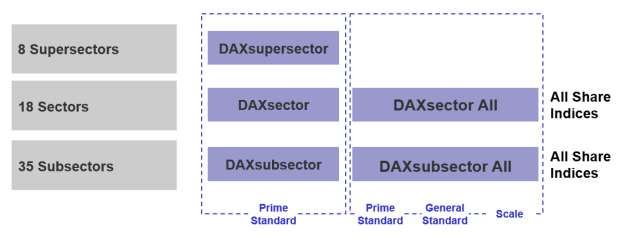
For both the Prime segment as well as the larger portfolio, 18 sector indices and 35
subsector indices are provided. In addition, eight super sector indices are calculated for the
Prime segment. Sector and subsector indices are designed as All Share indices, whereas only
companies with an ADTV5 of at least €1 million qualify for the super sector indices. The
various Prime sectors have been based on the historical index data of the CDAX® sector
indices since April 1999. In the appendix a table shows the different supersectors, sectors
and subsectors (section 11.3). The classification of companies into the respective traditional
or technology sectors is done on the basis of the subsectors (section 11.3). The diagram
below provides an overview of the sector indices:
5 ADTV = average daily trading volume
www.dax-indices.comSTOXX Ltd. Version 11.1.4
th
25 February 2021
Guide to the
DAX Equity Indices Page 24
3.4 International Indices
In order to provide a visibility platform for all German and foreign companies listed on the
FWB® Frankfurt Stock Exchange, STOXX Ltd. calculates international indices that each
contain 100 German and 100 foreign companies. These 200 companies listed in either
Prime Standard, General Standard or Scale segment are selected on the basis of their order
book volumes on Xetra® over the last three months. The DAX International 100 comprises
the first 100 companies based on the previous three months’ turnover and the subsequent
100 companies by the same criterion form the portfolio of DAX International Mid 100.
3.5 Index-Based Calculation Products
3.5.1 X-Indices
The X-indices X-DAX®, X-MDAX® and X-TecDAX® are calculated on the basis of events and
distributed from 8:00 am until 9:00 am (X-DAX®: until DAX-opening6) and from 5:30 pm
until 10:15 pm. The calculation of the X-DAX Index is based on the daily comparison of the
DAX® index values with the respective future. The calculation of the X-MDAX and the X-
TecDAX is based on “cost of carry”-adjusted MDAX® and TecDAX® futures prices. The X-
indices act as indicators for market development outside Xetra® trading hours.
The longer computation time of X-indices covers the entire trading time of US stock
exchanges.
XDAXDAX® is calculated and distributed as a combination of X-DAX® and DAX®. This serves
the need of market participants to monitor the price change of DAX® during the trading day
including pre and post DAX® indicators in one time series. With XDAXDAX® DAX® and X-
DAX® are merged and distributed using one ISIN.
6 Valid as of 8 February 2010.
www.dax-indices.comSTOXX Ltd. Version 11.1.4
th
25 February 2021
Guide to the
DAX Equity Indices Page 25
3.5.2 Late/Early Indices
Outside Xetra® trading hours, STOXX Ltd. calculates the indices L/E-DAX, L/E-MDAX, L/E-
SDAX and L/E-TecDAX every 60 seconds using prices traded on Börse Frankfurt. These
indices correspond in composition to the respective DAX ®, MDAX®, SDAX® and TecDAX®
indices. They serve as an indicator of market development outside the regular Xetra® trading
period for investors. All L/E indices are calculated as performance indices only.
www.dax-indices.comSTOXX Ltd. Version 11.1.4
th
25 February 2021
Guide to the
DAX Equity Indices Page 26
4 Regular Index Review
Depending on the concept of composition, indices are either designed to be All Share indices
(including Sector indices) or Selection indices.
4.1 Selection Indices
The Selection Indices represent the largest companies with the highest turnover listed on the
Regulated Market of Frankfurt Stock Exchange. These are selected according to free float
market capitalisation and order book volume. The indices are DAX®, MDAX®, SDAX®,
TecDAX®, HDAX®, General Standard Index, Scale 30 Index, DAX® ex Financials Index,
DAX® ex Financials 30 Index and ÖkoDAX.
The DAX 50 ESG represent the largest companies with the highest turnover that have
comparable good performance based on their Environmental, Social and Governance criteria.
These are selected according to market capitalisation, order book volume and Sustainalytics’
ESG score.
4.1.1 DAX, MDAX, SDAX and TecDAX
4.1.1.1 Basic Criteria
The basic criteria for including companies in DAX ®, MDAX®, SDAX® and TecDAX are:
• An existing listing on the Regulated Market of the FWB® Frankfurt Stock Exchange
• Continuous trading on Xetra®
• Minimum free float of 10%
• Legal headquarters or operating headquarters in Germany
• Publication7 of audited Annual Financial Report prepared according to the requirements
of WpHG8 9. The publication shall be completed within 90 days from the end of the
7 The term publication refers to the publication of the report on the company website. STOXX Ltd. will use the service of data providers that
collects the information from company websites to evaluate if requirements are met.
8 Sect. 114 Paragraphs 2 and 3 of the German Securities Trading Act (WpHG), and in case of group reporting requirements to Sect. 117 No.
1 WpHG
9 If the issuer is merely under the obligation to prepare individual Financial Statements, pursuant to Sect. 114 Paragraph 2 WpHG these
individual Financial Statements prepared and audited in compliance with
• the national legal requirements of the state where the company is registered, in case of issuers who have their registered office in a
member state of the European Union or of the Treaty on the European Economic Area,
• the legal requirements pursuant to HGB (subject to the “exemption options” mentioned below), in case of issuers who have their registered
office in a third country,
have to be published.
www.dax-indices.comSTOXX Ltd. Version 11.1.4
th
25 February 2021
Guide to the
DAX Equity Indices Page 27
reporting period, in accordance with recommendation F.2 of the German Corporate
Governance Code, but an additional grace period is given that allows the publication up
until 4 months after the end of the reporting period. In order to fulfil the obligation of
“publication of the audited Annual Financial Report" both the Annual Financial Report
and the complete audit certificate have to be published. The Annual Financial Report
must be provided in either German or English.
• Publication of half-yearly Financial Report (for the first six months of the fiscal year)
prepared according to the requirements of WpHG 10. The publication shall be completed
within 45 days from the end of the reporting period, in accordance with recommendation
F.2 of the German Corporate Governance Code11, but an additional grace period is given
that allows the publication until 3 months after the end of the reporting period. The half-
yearly Financial Report must be provided in either German or English. With regard to a
company that is newly listed on the Regulated Market of FWB, the company must fulfil
the requirement for the reporting period that ends immediately after its listing. The
Criterion is deemed met for the reporting periods ending prior to the company's listing.
• Publication of the Quarterly Statement or Quarterly Financial Report for the first and third
fiscal quarters. In terms of content, period coverage and format, the Quarterly Statement
or Quarterly Financial Report must fulfil the follow-up obligations of the Regulated
Market12 for Prime Standard, irrespective of the segment of Regulated Market which the
issuer is member of. The publication shall be completed within 45 days from the end of
Qontigo will also accept the publication of individual Financial Statements prepared in compliance with IFRS principles. However, if issuers
choose to publish IFRS-individual Financial Statements the reports published by them throughout the year will also have to be prepared
pursuant to IFRS-principles.
If the issuer is obliged to prepare consolidated Financial Statements, the issuer always has to publish the Statements prepared in compliance
with the Regulation (EC) No.1606/2002 of the European Parliament and of the Council of 19 July 2002 on the Application of International
Accounting Standards (Official Journal of the EC No. L 243 Clause 1). Therefore, the consolidated Annual Financial Statements as well as the
group Management Report prepared in compliance with the IAS/IFRS adopted by the EU and the interpretations related to these principles
have to be published.
In addition, also acceptable are consolidated Financial Statements and group Management Reports prepared in compliance with accounting
standards, which have been acknowledged as equal to IFRS by the EU-Commission in its decision of 12 December 2008 (2008/961/EC),
amended by the Commission Implementing Decision of 11 April 2012 (2012/194/EU), and by the Commission Regulation (EC) No.
1289/2008 of 12 December 2008 (these are: US-GAAP, Japanese GAAP as well as Chinese GAAP, Canadian GAAP and South Korean GAAP;
for business years beginning prior to 01 January 2015, third country issuers may also prepare their reports in compliance with Indian GAAP).
10 Sect. 115 Paragraphs 2 to 4 of the German Securities Trading Act (WpHG) and in case of group reporting requirements to Sect. 117 No.
2 WpHG.
11 https://www.dcgk.de/en/code/current-version/f-transparency-and-external-reporting.html
12 EU-Regulated Market and https://www.deutsche-boerse-cash-market.com/dbcm-en/primary-market/being-public/ipo-line-being-
public/regulated-market/!ipo-21956-60156
www.dax-indices.comSTOXX Ltd. Version 11.1.4
th
25 February 2021
Guide to the
DAX Equity Indices Page 28
the reporting period, but an additional grace period is given that allows the publication
until 75 days after the end of the reporting period. Quarterly Statement and Quarterly
Financial Reports must be provided in either German or English. With reference to a
Ranking List cut-off date, the Criterion is also deemed met provided that the company’s
Board of Directors and the Management Board have published on its website a statement
of intent that states the company will publish Quarterly Statements or Quarterly Financial
Reports for all preparation or reporting periods, respectively, ending after that cut-off
date. A company that fails to adhere to its statement of intents is deemed to be in breach
of the Criterion.
• Existence of an audit committee13 according to the recommendation D.3, C.10 and
compliance of the audit committee with recommendations D.9, D.10, D.11 of the German
Corporate Governance Code. The Criterion is assessed based on the Declaration of
Compliance published for the calendar year in course or, if its publication deadline is yet
to come, the previous year. If no such Declaration of Compliance is publicly available, or
if it does not confirm compliance with the requirements, the Criterion is considered
breached. With regard to foreign companies that are not required to publish a Declaration
of Compliance with the German Corporate Governance Code, or companies that are
newly listed on the Regulated Market of FWB and may have not issued the mandatory
annual Declaration of Compliance at the time of listing, the Criterion is also deemed met
provided that the company’s Board of Directors and the Management Board have
published on its website a statement that states the company has established an audit
committee in conformity with the aforementioned requirements. Foreign companies shall
publish such statement annually. With regard to newly listed companies that are required
to publish a Declaration of Compliance with the German Corporate Governance Code on
annual basis, the statement by the company’s Board of Directors and the Management
Board is considered valid until the due date of the annual Declaration of Compliance for
the year during which the listing takes place.
Expanded basic criteria for foreign companies:
Foreign companies must
• have a headquarter in Germany. Other than the legal headquarter this can also be
an operating headquarter
or
• have their focus of trading volume on FWB® Frankfurt Stock Exchange (see
section 2.6) and their Legal headquarters in an EU or EFTA country
13 Interim rule: For current components of the selection indices as per ranking list cut-off at end of February 2021, a grandfathering rule is
applied until August 2022 that waives the requirement for the existence of an audit committee. The grandfathering right is lost if a
component leaves the selection indices after February 2021.
www.dax-indices.comYou can also read


