HAWKES BAY FOREST INDUSTRY AND WOOD AVAILABILITY FORECASTS 2008 - MPI
←
→
Page content transcription
If your browser does not render page correctly, please read the page content below
Hawkes Bay
Forest Industry and
Wood Availability Forecasts
2008
Acknowledgements
The wood availability forecasts in this report were produced by Dr Bruce Manley, New Zealand School of Forestry, University
of Canterbury. The regional forest industry report was compiled by John Vaney with forestry data and peer review provided by
Mike Candy, Rosa Rivas Palma, Paul Lane, Doris Chan, and Geoff Cameron. Mike Plivelich and Glenn Russell prepared the
map of the Hawkes Bay forest industry. Thanks to Mike Candy, Claudia Riley, Janine Pollock and Dr Jaap Jasperse for editorial
and publishing services.

The Ministry of Agriculture and Forestry thanks the forest owners, managers and consultants who provided the forest
resource and harvesting intentions data that were essential for producing the wood availability forecasts. Thanks also to this
group for their input at several workshops, and for written comments on earlier versions of these forecasts. Special thanks are
also due to Brian Pritchard, General Manager Forestry and Logistics, Pan Pac Forest Products Ltd and Immediate Past
Chairman of the Hawkes Bay Forestry Group (HBFG), and Bob Pocknall, Branch Manager, PF Olsen Ltd, Napier and current
Chairman of the HBFG for their valued encouragement, support, advice and report peer review. Thanks also to Sheldon Ellis,
Supply Chain Analyst – Forests and Logistics, Pan Pac Forest Products Ltd for peer reviewing this report.

Photos provided courtesy of Pan Pac Forest Products and PWP (www.pwp.co.nz).

Enquiries

Any enquiries regarding the content of this report should be directed to John Vaney (tel.: +64 7 921 3407 or
email: john.vaney@maf.govt.nz).

Further copies
This report can be downloaded from www.maf.govt.nz or you can request printed copies from
policy.publications@maf.govt.nz.

Published by:
MAF Policy
Ministry of Agriculture and Forestry
Pastoral House, 25 The Terrace
P O Box 2526
Wellington 6140
New Zealand
Tel: 64 4 894 0100
Fax: 64 4 894 0741
Website: www.maf.govt.nz

© Crown copyright – Ministry of Agriculture and Forestry 2008

ISBN 978-0-478-32160-9 (Print)
ISBN 978-0-478-32163-0 (Online)

Material contained in this report may be reproduced or published without further licence provided it does not claim to be
published under government authority, is not reproduced for profit and the source is acknowledged.

Disclaimer
While every effort has been made to ensure the accuracy of the information contained in this publication, the Ministry of
Agriculture and Forestry accepts no liability for any errors or omissions. The information does not necessarily represent the
views of individual members of the National Exotic Forest Description (NEFD) Steering Committee nor the Ministry of
Agriculture and Forestry.
iii   contents

CONTENTS
LIST OF Figures                          iv   5 THE wood processing   INDUSTRY	                26
                                              Sawmilling                                       26
LIST OF tables                           iv   Secondary Wood Processing and Solidwood
                                              Manufacturing                                    28
1 INTRODUCTION	                          1    Pulping and Chipping                             29
                                              Production and Export Data                       29
2 OVERVIEW	                              2
                                              6 Indigenous Forests                             31
3 THE PLANTATION FOREST INDUSTRY	        5
Nurseries                                 5   7 Education and Training                         32
Forest Owners                             5   FITEC                                            32
Other Forest Owners                       7   Tairawhiti Polytechnic                           32
Species Composition                       8
Area–Age Class Distribution               8   8 INFRASTRUCTURE	                                33
Plantation Forest Location                9   Ports                                            33
Historical Roundwood Removals             9   road transport                                   33
Harvest Intentions Survey                10   Rail Transport                                   33
                                              Energy                                           34
4 wood availability forecasts            11
Scenarios for Radiata Pine               11   9 OPPORTUNITIES AND CONSTRAINTS	                 35
Discussion on Scenarios                  12   General Constraints                              35

Scenario for Douglas-fir                 15   Opportunities                                    36

Other Species                            15   Concluding Comments                              37

Data                                     15
Assumptions                              16   10 Website ADDRESSES                             38
Hawkes Bay Wood Availability Forecasts   17
Other Species                            25   11 References                                    39

                                              12 APPENDIX                                      40
iv Contents
LIST OF LIST OF
Figures tables
2.1: Map of the Hawkes Bay Forest Industry 4 2.1: Key Statistics for the Hawkes Bay
3.1: Area–Age Class Distribution for Hawkes Bay Forest Industry 3
Plantation Forests (All Species) 8 3.1: Owners and Managers of Plantation Forests
3.2: Estimated Annual Roundwood Removals in in Hawkes Bay (In hectares) 5
Hawkes Bay 9 3.2: Plantation Forest Areas by Territorial
4.1: The sequence of wood availability scenarios Authorities and Species (in hectares, as at
presented for radiata pine 13 1 April 2007) 9
4.2: Age-class distribution of Hawkes Bay 3.3: Harvest Intentions Survey Results (in
radiata pine – combined estate 17 cubic metres) 10
4.3: Hawkes Bay radiata pine availability under 4.1: Areas of other species in Hawkes Bay
scenario 1 17 (in hectares) 15
4.4: Age-class distribution of the Hawkes Bay 4.2: Volumes of radiata pine harvested
radiata pine estate – large-scale owners 18 in 2005–2007 16
4.5: Hawkes Bay radiata pine availability under 5.1: Fixed Sawmills Operating in Hawkes Bay 26
scenario 2 – large-scale owners 18 5.2: Sawn Timber Production in Hawkes Bay
4.6: Age-class distribution of the Hawkes Bay (in cubic metres) 29
radiata pine estate – small-scale owners 19 5.3: Sawn Timber Exports from Port of Napier
4.7: Hawkes Bay radiata pine availability under (in cubic metres) 30
scenario 2 – combined estate 20 5.4: Log Exports from Port of Napier
4.8: Hawkes Bay radiata pine availability under (in cubic metres) 30
scenario 3 21
4.9: Average radiata pine clearfell age appendix tables
in Hawkes Bay by ownership categories
1: Hawkes Bay harvest intentions survey results,
under scenario 3 21
large-scale owners 40
4.10: Hawkes Bay radiata pine availability under
2: Hawkes Bay radiata pine availability under
scenario 4 22
scenario 1, (unconstrained cut)
4.11: Average radiata pine clearfell age by
for all owners 41
ownership category in Hawkes Bay under
3: Hawkes Bay radiata pine availability under
scenario 4 22
scenario 2 42
4.12: Hawkes Bay radiata pine availability by log
4: Hawkes Bay radiata pine availability under
grade under scenario 4 23
scenario 3 43
4.13: Hawkes Bay radiata pine availability by target
5: Hawkes Bay radiata pine availability under
rotation age under scenario 5 24
scenario 4, by log grade, for all owners 44
4.14: Average radiata pine clearfell age in Hawkes
6: Hawkes Bay radiata pine recoverable volume
Bay by target rotation age under scenario 5 24
and average clearfell age for each target
4.15: Age-class distribution of Hawkes Bay
rotation age under scenario 5,
Douglas-fir – combined estate 25
for all owners 45
4.16: Hawkes Bay Douglas-fir availability
7: Wood availability and average clearfell age
– combined estate 25
for Douglas-fir in HAWKES BAY 46 Introduction
INTRODUCTION
This publication provides new wood availability forecasts
Readers intending to use these wood availability
1
and associated commentary for the Hawkes Bay region.
forecasts for planning or investment decisions are
Five forecasts have been prepared for radiata pine, and
urged to thoroughly review the forecasts or engage
one for Douglas-fir. They have been prepared in co-
the services of a professional forestry consultant who
operation with major forest owners and forest harvesting
is able to interpret the forecasts in the context of
consultants.
specific planning or investment decisions.
Descriptive information is also provided on the plantation
forest and wood processing industries in the region.
Opportunities and constraints facing the regional forest
industries are discussed.
The information contained in this report is intended to
assist the forestry industries, planning practitioners, and
infrastructure and service providers in assessing wood
processing opportunities, resource management planning,
and infrastructure issues. It will also assist the public
understand the nature of the forest industry in Hawkes
Bay.
References to Hawkes Bay and the Hawkes Bay region
involve the land areas of the Wairoa, Hastings, Central
Hawkes Bay Districts and Napier city.
This report is one of a series of publications on regional
forestry industries and wood availability forecasts being
produced by the Ministry of Agriculture and Forestry
(MAF). Overview
OVERVIEW
There is a well-established forest growing industry in the
2
The actual timing of the harvest from these forests will
Hawkes Bay wood supply region (referred to as “the depend on the decisions of a large number of small-scale
Hawkes Bay region”, or “Hawkes Bay”); it includes the owners. Market conditions and logistical constraints
land areas of the Wairoa, Hastings and Central Hawkes (availability of logging crews, transport capacity, and
Bay Districts and Napier City. wood processing capacity) will limit how quickly the
additional wood availability from small-scale owners’
To assist with future regional forest industry planning, the forests can be harvested in that period.
Ministry of Agriculture and Forestry has compiled wood
availability forecasts for the Hawkes Bay region, covering In the later part of the forecast period (post-2034) the
the period 2008 to 2040. These forecasts have been total harvest is projected to decline. This is in line with the
produced in association with the region’s major forest age structure of the resource. The timing (and level) of
growers. The forecasts show the range of harvest volumes decrease will depend on the rate at which the regions’
potentially available from the planted forest estate, of both post-1990 forests are harvested, the extent to which they
large and small-scale growers. The forecasts are supply- are replanted, and also the level of new land planting. The
based, but incorporate the short to medium-term forecasts are based on no new land planting. The area that
intentions of the large owners. In utilising these forecasts, is expected to be deforested in the Hawkes Bay between
users need to recognise that the ultimate determinant of 2008 and 2020 is predicted to be only around
harvesting activity at any particular time is the market 5500 hectares: this is quite low compared with some other
demand for logs. forestry regions.
The forecasts indicate that the availability of radiata pine While there is limited potential to increase harvest
from the Hawkes Bay will remain relatively static over the volumes over the next nine years, there are opportunities
next decade (2008–2015). While the forecasts indicate a to more fully utilise the available resource. A number of
static supply during this period, it is important to mills have moved (or are moving) to process some of the
recognise that short-term fluctuations are likely as market lower-quality logs that are currently exported.
conditions change.
The region has a modest range of wood processing
The forecasts show that an increase in wood availability is industries, dominated in size by Pan Pac Forest Products’
possible after 2016, when the Hawkes Bay regional harvest large integrated pulp mill and sawmill complex at
has the potential to increase from the current level of Whirinaki, and in number by small to medium-scale
about 1.7 million cubic metres, to around 3 million cubic sawmills (in a New Zealand context). A significant
metres after 2021. Most of the potential increase in wood proportion of processed wood products are exported
availability during this period is from the small-scale through the Port of Napier, while the volume of log
forest growers who established forests during the 1990s. exports has varied over recent years.
This increased harvest will provide logs for expansion of
local wood processing in the region with substantial The total wood processing capacity is based on the “usual”
benefit to the Port of Napier as the logical export port. number of working hours per day for a mill. The existing
capacity of the regional sawmills and the Pan Pac pulp Overview
mill is estimated to be about 1 101 000 cubic metres this will be driven by potential harvesting from the
(roundwood input) per year. resource planted in the 1990s by a large number of
small-scale forest owners. The pattern of harvesting from
Given that some logs are processed outside the region and this resource is less certain than harvesting from the
some are exported, this suggests that there is limited large-scale forest owners.
potential for installing additional wood processing
capacity for the next nine years unless logs are sourced
from outside the region. Beyond 2016 there is potential
for additional investment in wood processing capacity:
Table 2.1: Key Statistics for the Hawkes Bay Forest Industry1
statistic value
Stocked plantation forest area as at 1 April 2007 (ha) 132 000
Harvest – estimated roundwood removals – year ending March 2007 (m ) 3 3
1 653 000
Area weighted average age of plantation forest as at 1 April 2007 (years) 13.76
Sawn timber production – year ending March 2007 (m3) 351 000
Estimated log input to sawmills – year ending March 2007 (m3) 635 000
Market pulp annual production capacity (tonnes per year) 2
260 000
Estimated wood processing capacity (m ) – roundwood input
3 4
1 101 000
Log exports – year ending December 2007 (m3) 542 000
Sawn timber exports – year ending December 2007 (m3) 274 000
Wood chip exports – year ending December 2007 (BDU) 5
103 000
Direct employment, forestry and first stage processing as at February 2007 (FTE) 1 083
Sources
1. All statistics from Ministry of Agriculture and Forestry unless indicated otherwise.
2. Pan Pac Forest Products Ltd.
Notes
3. Estimated roundwood removals are derived from processing outputs and log exports. They do not account for inter-regional log flows. See discussion
under Historical Roundwood Removals (Chapter 3) for further explanation.
4. This is an estimate of the sum of the individual processing plants’ roundwood input capacities and does not take account of the Pan Pac Forest
Products pulp mill sourcing some fibre as chips from sawmills.
5. One BDU (bone dry unit) of softwood chips in roundwood equivalent is 2.63 cubic metres and weighs 1090 kilograms when oven dry. Overview
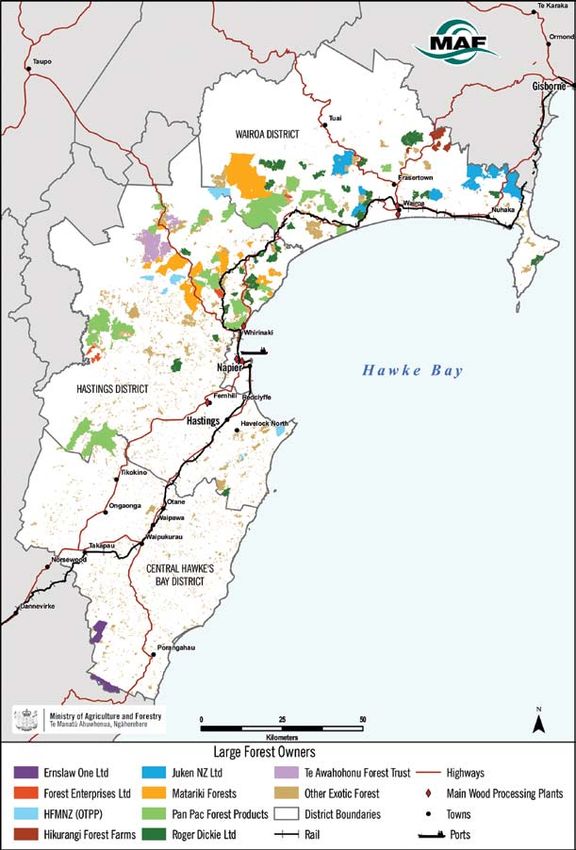
Figure 2.1: Map of the Hawkes Bay Forest Industry
Source
Ministry of Agriculture and Forestry. plantation forest industry
THE
PLANTATION FOREST INDUSTRY 3
Nurseries and Hikurangi Forest Farms are more likely to take any
Hawkes Bay has no forest nurseries or specialised production to Gisborne: this is where their significant
nurseries producing planting stock for the restocking of holdings, including wood processing plants, are located.
harvested areas and establishment of new forests. The Similarly, Te Awahohonu Forest Trust and some of the
most significant and closest forest nursery is the Arborgen Matariki and Hancock Natural Resources Group-managed
Australasia nursery at Puha in the Gisborne District, forests on State Highway 5 are equidistant from some of
although tree stocks are also sourced from nurseries in the the wood processing centres in the central North Island
central North Island and further afield, such as Murray’s and the Hawkes Bay.
Nurseries at Woodville.
Pan Pac Forest Products Ltd
Forest Owners Pan Pac Forest Products Ltd (Pan Pac) is an integrated
Table 3.1 identifies the larger plantation forest owners and forestry company. It owns forests, a saw mill and pulp
managers in the Hawkes Bay region, and the total area mill, a remanufacturing facility, and a chip export facility
owned by the small-scale forest owners. in the Hawkes Bay. The company is 100 percent owned by
Oji Paper. A major purpose of the original establishment
Pan Pac Forest Products Ltd manages 25 percent of the of Pan Pac was to provide wood fibre for its shareholders’
Hawkes Bay estate, and the four largest owners hold paper-making operations in Japan.
58 percent among them. This suggests that owners are
either very large or small with only a handful in the All Pan Pac’s forest resource has Forest Stewardship
medium range – effectively allowing the larger operators Council (FSC) certification and the forest estate consists
to have a significant presence in the region. Forest owners of five forest areas located between 15 and 70 km from
in the northern Hawkes Bay such as Juken New Zealand the company’s wood processing operation at Whirinaki.
The five main forest units are Esk Forest (Crown Forest
Licence – CFL), Gwavas Forest (CFL), Kaweka Forest
Table 3.1: Owners and Managers of Plantation (CFL and leasehold), Mohaka Forest (CFL and freehold)
Forests in Hawkes Bay (in hectares) and Tongoio Forest (freehold). Trees are intensively
Enterprise Stocked area (ha) managed to produce thinned and pruned stands and most
Pan Pac Forest Products Ltd 32 800 logs are supplied to Pan Pac’s own mill, with the balance
Matariki Forests 19 400 sold to other customers in the Hawkes Bay and beyond.
Roger Dickie (NZ) Ltd 13 900 About 70 percent of harvesting is undertaken using cable
Juken New Zealand Ltd 10 600 systems due to the steep nature of many of the forest areas;
Te Awahohonu Forest Trust 5 200 the target clearfell age is 30 years.
Ernslaw One Ltd 2 600
(www.panpac.co.nz/forest/forests_home/index.htm)
Hancock Natural Resources Group (OTPP) 2 100
Forest Enterprises Ltd 1 600
Matariki Forests
Hikurangi Forest Farms Ltd 1 600
Small-scale forest owners 42 000
Matariki Forests (Matariki) is a joint venture between
Total 131 800 Rayonier Inc. (40 percent), AMP Capital Investors Ltd
Sources (35 percent) and RREEF Infrastructure which is part of
Individual forest owners and Ministry of Agriculture and Forestry, 2008.
Deutsche Asset Management (Australia) Ltd (25 percent). plantation forest industry
Rayonier is a specialist “timberlands” company: originally exchange. Juken New Zealand was established in June
it bought 100 000 hectares of crown forest licences in 1990, originally as Juken Nissho Ltd and then renamed
Gisborne, Northland, southern and central North Island, as Juken NZ in September 2004. The company owns and
Nelson and Invercargill in 1992 before selling around manages forests in Northland and the East Coast as well as
half this area in the mid 1990s. In 2005 Matariki Forests the Wairarapa, and owns wood processing mills at Kaitaia,
purchased 95 000 hectares of Carter Holt Harvey (CHH) Gisborne and Masterton. The company has ISO 14001
forests in the Northland, Auckland, Hawkes Bay and and FSC certification for its forests in the Wairarapa. The
Canterbury regions. Matariki is currently the second other company forests are as yet not FSC certified, but are
largest exotic plantation forest owner in the Hawkes managed through the same environmental management
Bay with 19 400 hectares purchased from CHH, and the system, which is in compliance with the FSC. The
third largest in NZ with 143 000 hectares nationally. It is company has stated a commitment to the FSC and its
managed by Rayonier New Zealand Ltd, a 100 percent- processing plants have applied for FSC chain of custody
owned subsidiary of Rayonier Inc. certification.
(www.rayonier.com)
The JNL production forests in the Wairoa District are
Roger Dickie (New Zealand) Ltd intensively managed to produce pruned and thinned
Roger Dickie (NZ) Ltd was formed in 1971 and the stands. Target felling age is between 28 to 32 years.
company has established 26 000 hectares of syndicated (www.woodone.co.jp/company/english.html)
ownership forests in New Zealand. Each forest is
typically owned by a partnership comprising up to 30 Te Awahohonu Forest Trust
individual investors. Many of the partnership investors This forest was originally established jointly by the
are New Zealand citizens. Since 1990, Roger Dickie Trust and the Crown as a Māori lease forest. In April
New Zealand Ltd has deliberately concentrated its 1999 a joint venture was formed in the Hawkes Bay
activities in northern Hawkes Bay and on the East Coast. region with Rayonier, GMO Renewable Resources and
The region produces some of New Zealand’s highest forest the Te Awahohonu Forest Trust. Rayonier manages the
growth rates and land has been available at reasonable harvesting and marketing of the tree crop consisting of
prices. In the North Island, Roger Dickie has established 5200 hectares of radiata pine. After clearfell the replanted
forest blocks in Hawkes Bay, Gisborne, South Taranaki land is returned to the Trust. NZ Forest Managers Ltd
and Wanganui. Roger Dickie has established forests manages the forestry operations for the Trust.
with a total area of about 14 000 hectares in the Hawkes
Bay. These forests are all still immature, and harvesting Ernslaw One Ltd
decisions will be made by the individual partnerships. Ernslaw One Ltd is controlled by members of the Tiong
(www.rogerdickie.co.nz) family of Malaysia. Ernslaw One entered the New Zealand
forest industry in 1990 when it purchased the cutting
Juken New Zealand Ltd rights to some of the state forests as well as the Conical
Juken New Zealand Ltd (JNL) is a wholly owned Hill sawmill. It has expanded since then by buying new
subsidiary of Wood One Company Ltd, a Japanese land, as well as existing forests including the East Coast
housing construction and building materials business estate. It is a vertically integrated company and owns
based in Hiroshima and listed on the Japanese stock sawmills in Gisborne, Tangiwai and Tapanui, as well plantation forest industry
as a pulp mill at Tangiwai. Current forest holdings are four forests established in this area covering 1600 hectares.
91 000 hectares, with the majority in three regions: East (www.forestenterprises.co.nz)
Coast, central North Island, and Otago/Southland. Only a
relatively small area is in Hawkes Bay. Hikurangi Forest Farms Ltd
Hikurangi Forest Farms Ltd (HFF) is a medium-sized
Hancock Natural Resources Group forestry company based at Gisborne. It is a member of
Hancock Natural Resources Group (HNRG) facilitates TreeOne (NZ) Ltd which is wholly owned by Lingui
investments around the world for large institutional and Developments Berhad, a company listed on the Kuala
individual investors. Hancock Timber Resource Group Lumpur stock exchange. The HFF estate consists primarily
(HTRG) is a division of HNRG and in September 2005 of intensively managed radiata pine plantations. The
it announced that it had completed the acquisition of total estate area of HFF is about 35 000 hectares of which
Prudential Timber Investments, Inc. (PruTimber), the approximately 27 000 hectares is production forest, and
timberland investment management unit of Prudential 91 percent is freehold. The HFF estate was established
Financial, Inc. With the acquisition, HTRG assumed largely on pasture, buying farms and establishing them as
management responsibility for PruTimber’s approximately forests. HFF obtained FSC certification in August 2005.
60 000 hectares in New Zealand, which included around
2000 hectares of forest in the Hawkes Bay managed on The HFF estate in the Hawkes Bay is about 1600 hectares
behalf of Ontario Teachers Pension Plan (OTPP) Forest located mainly in the Wairoa District. It is most likely that
Investments. Hancock Forest Management (NZ) Ltd is the the logs will flow to the East Coast for processing
New Zealand representative of HNRG while PF Olsen Ltd or export.
is responsible for the operational management.
(www.hancocktimber.com) HFF is progressing plans to construct a processing facility
adjacent to the Prime Sawmill now owned by Ernslaw
Forest Enterprises Ltd One Ltd in Gisborne.
Forest Enterprises is a forestry investment company with (www.hff.net.nz)
more than 35 years experience. In 1972 the company
began offering forestry partnership investments in Other Forest Owners
New Zealand’s radiata pine plantation forests for both Approximately 32 percent of Hawkes Bay plantation
New Zealand and overseas investors. Nationally the forest estate is held by small-scale forest owners, mainly
company has over 6400 investors with 73 plantation individuals, forestry partnerships and small companies,
investment forests under management, comprising who own less than 1000 hectares each. The impact of these
22 000 hectares; some of these forests are now being small-scale forest owners on the development of the local
harvested and replanted. Forest Enterprises manage the industry has been highlighted in the wood availability
full rotation of radiata pine from establishment to harvest forecasts with their separation from the large-scale forest
and have forests located in Wairarapa, Gisborne and owners.
Hawkes Bay. Their business comprises forest management,
harvest management, investment administration and
marketing operations. The company began planting
forests in the Hawkes Bay region in 1996 and by 1999 had plantation forest industry
Species Composition Area–Age Class Distribution
Radiata pine makes up 99 percent (130 000 hectares) and The Hawkes Bay plantation forest area-age class
Douglas-fir less than 1 percent (600 hectares) of the forest distribution shows the peak in new forest area planted
area in the Hawkes Bay region. There are nearly 2000 during the mid to late 1990s which potentially enables
hectares of other exotic hardwood and softwood species an increasing area to be harvested from about 2017. The
in the Hawkes Bay; these have not been modelled in this average age of the Hawkes Bay exotic forest resource is
analysis. 13.8 years compared with the North Island average of
15.0 years, suggesting the presence of younger forests.
The forest areas are from the National Exotic Forest About 70 percent of the Hawkes Bay exotic forest resource
Description (NEFD) as at 1 April 2007 (MAF 2008). is aged 15 years or younger.
About 75 percent (96 000 hectares) of the radiata pine For detailed information on forest areas and age-class
estate is, or is expected to be, pruned to a height of at least distributions by species refer to the publication NEFD as
four metres. Approximately 11 percent (10 400 hectares) at 1 April 2007 (MAF 2008), accessible at: http://www.maf.
of pruned radiata pine is older than 25 years. govt.nz/mafnet/publications/nefd/national-exotic-forest-
2007/index.htm
Figure 3.1: Area–Age Class Distribution for Hawkes Bay Plantation Forests (all species)
������
������
������
���������
������
������
�
��� ���� ����� ����� ����� ����� ����� ����� ���
�����������
Source
NEFD as at 1 April 2007, MAF 2008. plantation forest industry
Table 3.2: Plantation Forest Areas by Territorial Authorities and Species (in hectares, as at 1 April 2007)
Territorial authority Radiata Douglas-FIR Other Hardwoods Total
pine softwoods
Wairoa District 53 999 167 519 235 54 920
Hastings District 60 893 350 359 221 61 823
Napier City 130 0 2 9 141
Central Hawkes Bay District 14 706 50 214 93 15 063
Region total 129 728 567 1 094 558 131 947
Source
Ministry of Agriculture and Forestry, 2008.
Plantation Forest Location They do not take account of inter-regional log flows,
for which data are not readily available. The main inter-
The majority of the forests (117 000 hectares out of regional flows are likely to be from JNL and HFF from
132 000 hectares) are established in the Wairoa and Wairoa to the East Coast, and some of Te Awahohonu
Hastings Districts, which means a significant volume of Trust, Matariki Forests and HNRG on State Highway 5 to
forests in the Hawkes Bay are located on a latitude north the central North Island. Some logs are transported from
of Napier. Matariki Forest and Pan Pac Forest Products south to Kiwi
Lumber at Dannevirke. Logs are currently transported
Historical Roundwood Removals into the region from the central and southern North
Estimated annual roundwood removals are derived from Island, and there is still potential for more logs to come
wood processing production data and the export of logs. from Gisborne District.
Figure 3.2: Estimated Annual Roundwood Removals in Hawkes Bay
����
����
����
�������������������
���
���
�
���� ���� ���� ���� ���� ���� ���� ���� ���� ���� ���� ���� ���� ���� ���� ���� ���� ����
Source
Ministry of Agriculture and Forestry.10 plantation forest industry
The decrease of roundwood removals from 2004 to Hancock Natural Resources Group (Tiaki Plantations Ltd
2006 reflects the difficult trading period for log exports and Ontario Teachers Pension Plan Forest Investments)
in particular. The decline in export production was was undertaken between late 2006 to early 2007, and
associated with a generally strong New Zealand dollar information was confirmed in July 2007. Data were
against the United States dollar, international prices that provided on the actual level of harvest from these forests
were often depressed and substantial increases in log for 2005 and the expected harvest for 2006. The harvesting
shipping costs. Roundwood removals peaked in 2003 and intentions for the next ten years were provided by species
fell away in 2005 before building again to present levels: for pruned, unpruned and pulp logs, along with the area
this is a result of improving export markets and some expected to be harvested.
deliberate cutting strategies to rationalise forest estates to
radiata pine. Land use change in the Hawkes Bay forests Table 3.3 provides a summary of the harvest intentions
has been relatively limited, explained by the fact that data. For detailed data by log type see Table 1 in the
many of the forests are generally located on more difficult Appendix (page 40). These figures make up the first ten
sites not entirely suited for dairy conversion; or they are years of the wood availability forecasts for the large-scale
generally too old to be considered for any other land use forests in Hawkes Bay. The harvest intentions of large-
at this stage. scale forest owners in Hawkes Bay show an increase in
volumes for the four-year period 2006–2009, to reach
Harvest Intentions Survey about 1.6 million cubic metres per annum. This reflects
A harvesting intention survey of Pan Pac Forest Products, their current cutting strategies and clearly indicates that
Matariki Forests, Juken New Zealand, Ernslaw One, any shortfall after 2009 will have to be uplifted from small
Hikurangi Forest Farms, Te Awahohonu Trust and forest owners in the region.
Table 3.3: Harvest Intentions Survey Results (in cubic metres)
Year ending 31 December Radiata pine Douglas-FIR Other Hardwoods Total volume Total area
soft-woods (m3) (ha)
2005 1
1 234 000 17 000 25 000 5 000 1 281 000 2 281
2006 1 561 000 6 000 25 000 3 000 1 595 000 2 818
2007 1 514 000 29 000 23 000 4 000 1 570 000 2 699
2008 1 624 000 18 000 22 000 1 664 000 2 783
2009 1 615 000 6 000 1 621 000 2 683
2010 1 547 000 8 000 1 555 000 2 545
2011 1 343 000 1 000 1 344 000 2 094
2012 1 312 000 1 000 1 313 000 2 083
2013 1 285 000 1 000 1 286 000 2 024
2014 1 242 000 1 000 1 243 000 1 921
2015 1 238 000 1 000 1 239 000 1 916
Sources
Individual forest owners covered by the harvesting intentions survey.
Note
1. Actual harvest.11 wood availability forecastS
wood availability forecasts 4
These forecasts show the range of harvest volumes that it owns or manages. Any change in harvesting
potentially available from the planted production forests strategies by forest owners affects the age-structure and
in the Hawkes Bay region for the period 2008–2040. They maturity of the forests they own. This in turn feeds back
are based on this region’s forest resource and the directly into future wood availability.
forecasting assumptions described later in this report.
There are different levels of certainty associated with the
The forecasts have been developed by incorporating the wood availability from each component of the estate. The
harvesting intentions of the region’s large-scale forest volumes forecast from the large-scale owners’ forests are
owners as outlined below; the results are amalgamated to subject to change because of changes in market conditions
ensure confidentiality. Large-scale owners (those with or changes in the resource description (areas and yields).
1000 hectares of forest or more) are: Yet, they have greater certainty than those forecast from
› Pan Pac Forest Products; the small-scale owners’ estate. Not only are harvest
› Matariki Forests; intentions less clear for small-scale owners, their resource
› Juken New Zealand; descriptions are likely to be less accurate also. To improve
› Ernslaw One; the levels of certainty, the forecasts incorporate the views
› Hikurangi Forest Farms; of the region’s forest managers and consultants. This
› Te Awahohonu Trust; feedback was critical for ensuring that the forecasts
› Hancock Natural Resources Group (Tiaki Plantations); represent a realistic range of future wood availability
› Hancock Natural Resources Group (Ontario Teachers scenarios.
Pension Plan Forest Investments).
Scenarios for Radiata Pine
The small-scale owners’ resource was defined using the Five wood availability scenarios have been modelled for
NEFD as at 1 April 2006 (MAF 2007) data. radiata pine. These scenarios indicate the ways the forests
in the region could be harvested in the future.
Five scenarios were modelled to indicate the potential
range of future wood availability. The scenarios indicate To ensure the scenarios presented here are reasonable,
that there are many different ways for the forest estate in they were developed in consultation with the NEFD
the Hawkes Bay to be harvested. A key issue is the timing Steering Committee and feedback was received from
of harvesting by the small-scale forest owners, which will major forest owners and consultants in the Hawkes Bay
be driven by a range of factors – including individual wood supply region.
forest owners’ objectives, forest age, log prices, demand by
local wood processing plants, and perceptions about Listed years are assumed to be to 31 December. For
future log prices and future wood supply. example, 2005 indicates the 12 months to 31 December
2005.
It needs to be recognised that forests are managed to
maximise the benefits to the enterprise that owns them.
Each enterprise has its own harvest strategy based on the
owners’ objectives, market conditions and the forest estate12 wood availability forecastS
Scenario 1: Harvest all areas at age 30 In scenarios 1 and 2 (Figures 4.1A and 4.1B, respectively),
All owners are assumed to harvest their trees at age 30. forests owned by small-scale owners are assumed to be
This scenario shows the potential future harvest in any harvested at age 30. In scenario 1 all forests (large and
given year, based on the area of radiata forest that reaches small-scale) are harvested at 30 years. In scenario 2, the
30 years of age in that year. small-scale forests are harvested at age 30, but the large-
scale forests follow their owners’ stated intentions. Both
Scenario 2: Large-scale owners harvest at stated scenarios show the “potential” availability of mature forest
intentions, small-scale owners harvest trees at age 30 in any given year and reflect directly the area of forest in
Large-scale owners’ wood availability is assumed to be at each age class in the Hawkes Bay. For practical reasons
stated harvest intentions for 2005 to 2015. After 2015, the already described, it is unlikely that the future harvesting
large-scale owners’ wood availability is assumed not to would occur this way. The two scenarios simply show the
decrease. Small-scale owners are assumed to harvest trees potential magnitude of wood availability under favourable
at age 30. market conditions in any given year.
Scenario 3: Non-declining yield (NDY) – target rotation Scenarios 3 to 5 (Figures 4.1C and 4.1D, respectively) are
30 years based on yield regulation. Under these scenarios, the
Large-scale owners’ wood availability is assumed to be at future harvesting model is generally constrained to be
stated harvest intentions (as for scenario 2). The total non-declining; that is, each year the volume must either
wood availability of radiata pine from the region is be the same or higher than in the previous year. Yield
modelled to be non-declining in perpetuity. regulation provides a more orderly harvesting volume
profile that takes logistical and market constraints into
Scenario 4: Split non-declining yield (NDY) – target account, to some extent.
rotation 30 years
This is the same as scenario 3 except that the total wood Scenarios 3 to 5 avoid the large year-to-year fluctuations
availability of radiata pine from the region is assumed to seen in scenarios 1 and 2. A fundamental property of the
step down from 2034 (at the end of the current rotation). forests in the Hawkes Bay (like many regions in
Thereafter, a reduction is assumed. New Zealand) is the large area of forests established
during the 1990s. Scenarios 4 and 5 illustrate the
Scenario 5: Target rotation age variations harvesting of these forests by applying a non-declining
This is similar to scenario 4 except target rotation ages of yield constraint for the period 2006 to 2034. Then once
28 and 32 years are also modelled. the “bulge” of forests planted during the 1990s have been
harvested, the model lets the volume decline again.
Discussion on Scenarios
With the exception of scenario 1, the small-scale forest The main limitations of scenarios 3 to 5 are that log prices
owners have been modelled separately from the large- and other market factors significantly determine
scale owners. This is because future harvesting by small- harvesting in any given year. When log prices go up,
scale owners is generally less certain than by large-scale harvesting will generally increase. When log prices fall,
owners. the level of harvesting will generally decrease. It is beyond
the scope of this analysis to predict future timber prices.13 wood availability forecastS
Figures 4.1A to 4.1D summarise the sequence of models
that are presented in the remainder of this report.
Figure 4.1: The sequence of wood availability scenarios presented for radiata pine
4.1A – Scenario 1 example: harvest all trees at age 30
���������
���������
���������
�����������������������
���������
���������
���������
���������
���������
��
���� ���� ���� ���� ���� ���� ���� ����
4.1B – Scenario 2 example: large-scale owners harvest at stated intentions, small-scale owners harvest
trees at age 30
���������
���������
���������
�����������������������
���������
���������
���������
���������
���������
��
���� ���� ���� ���� ���� ���� ���� ����14 wood availability forecastS
4.1C – Scenario 3 example: non-declining yield – target rotation 30 years
���������
���������
���������
�����������������������
���������
���������
���������
���������
���������
��
���� ���� ���� ���� ���� ���� ���� ����
4.1D – Scenario 4 example: split non-declining yield – target rotation 30 years
���������
���������
���������
�����������������������
���������
���������
���������
���������
���������
��
���� ���� ���� ���� ���� ���� ���� ����15 wood availability forecastS
Scenario for Douglas-fir areas of the small-scale owners’ estate, apart from the
One scenario is presented for Douglas-fir (all owners), investment syndicates managed by Roger Dickie
similar to scenario 4 for radiata pine. It is based on the New Zealand and Forest Enterprises, were reduced by
harvest intentions of large-scale owners for 2005 to 2015 15 percent because the area in this ownership category is
with yield regulated in subsequent years. Target rotation often reported on a gross area rather than net stocked area
age is 45 years for Douglas-fir. basis (which excludes unplanted areas, areas not
successfully established, streams, wetlands and so on). In
Other Species addition, reductions were made to the area of over-mature
Wood availability from other species has not been stands in the small-scale owner estate (as described later
modelled. The NEFD as at 1 April 2007 (MAF 2008) in the report).
records 1652 hectares of other species in Hawkes Bay, but
55 percent of this resource is less than 21 years old and, Method to develop yield tables
with the exception of some of the minor softwood species, In 2007 new yield tables for Hawkes Bay were developed
is unlikely to be harvested within the next ten years. In in the following manner:
addition, markets are not well established for some of the › large-scale owners provided yield tables for their estates;
hardwood species. › these were averaged on an area-weighted basis to get
regional yield tables for each croptype;
› yield tables for old (age 16+ years, planted in 1989
Table 4.1: Areas of other species in Hawkes
and earlier) radiata pine and Douglas-fir were then
Bay (in hectares)
calibrated to match the harvest intentions data provided
Area (hectares) Total area
age 21–40 years (hA) by large-scale owners: the assumption is that the harvest
Cypress species 38 222 intentions data provides the most accurate information
Other softwoods 221 872 available as it is based predominantly on detailed
Eucalypts 48 204 inventory;
Other hardwoods 131 352 › yield tables for young radiata pine croptypes (planted in
Total 438 1652 1990 and later) were also adjusted in consultation with
large-scale owners;
Source
Ministry of Agriculture and Forestry, 2008. › the yield tables developed for the large-scale owners’
estate were also applied to the small-scale owners’
estate.
Data
Method used to obtain forest areas Large-scale owners harvest intentions
Area figures were obtained from the NEFD as at 1 April Large-scale owners were asked to provide details of
2005 (MAF 2006). To reflect the regime split in the planned harvest volumes by log grades and areas from
harvest intentions data, 1534 hectares in the large-scale 2005 to 2015. These harvest intentions were included at
owners’ estate was transferred from the old pruned the beginning of the forecasts to provide the most realistic
croptype into the old unpruned croptype. In addition, the wood availability forecasts over this period.16 wood availability forecastS
Assumptions Harvest 2005–2007
The wood availability forecasts for Hawkes Bay are based The total volumes of radiata pine harvested by large and
on the following assumptions: small-scale owners in 2005–2007 are shown in Table 4.2.
The large-scale owners’ returns are based on the harvest
Replanting intentions data supplied to MAF and are estimates for the
All the area that is harvested is replanted (with a 2006 and 2007 years. The small-scale owners’ estimates in
regeneration lag of 1 year) except 5500 hectares in the 2005–2007 are based on feedback from the major forest
large-scale owners’ estate which is being deforested and owners and consultants in the Hawkes Bay wood supply
20 percent of the area in the small-scale owners’ estate. region.
The area awaiting replanting as at 31 March 2005 is
included as area at age 0 – that is, area to be replanted in
Table 4.2: Volumes of radiata pine harvested
the 2005 planting season.
in 2005–2007
Harvest year Large-scale Small-scale
Species/Regime owners (m3) owners (m3)
Areas are replanted into the same species and regime 2005 1 234 000 80 000
except that: 2006 1 561 000 200 000
› all Douglas-fir in the large-scale owners’ estate is 2007 1 514 000 160 000
replanted to radiata pine after harvest;
› in 2005–2019, 25 percent of the pruned area is
replanted into the unpruned croptype after harvest.
Subsequently (2020–2034) 10 percent of pruned area is Overmature stands
replanted into the unpruned croptype. For overmature stands it was assumed that any area of
radiata pine in the small-scale owners’ estate that was aged
over 40 years would not be harvested, so forests aged 41
years or older (54 hectares total) were removed from the
model.17 wood availability forecastS
Hawkes Bay Wood Availability Forecasts trees in 2018 in Figure 4.3 occurs because of the small area
Scenario 1: Harvest all areas at age 30 (687 hectares) at age 17 (planted in 1988) in Figure 4.2.
In this scenario, all trees are harvested at age 30, Conversely, the high point at 2024 (Figure 4.3) occurs
indicating the “pure” (unconstrained) availability of wood because of the large area (12 161 hectares) at age11
from Hawkes Bay. This means wood availability reflects (planted in 1994) in Figure 4.2.
the age-class distribution. Figure 4.2 shows the age-class
distribution of radiata pine in Hawkes Bay, and Figure 4.3 Figure 4.3 indicates that wood availability does not have
shows the wood availability. The low point of 30-year-old the potential to increase markedly over the next 15 years.
Figure 4.2: Age-class distribution of Hawkes Bay radiata pine – combined estate as at 1 April 2005
�������
�������
�������
������
���������
������
������
������
�
� � �� �� �� �� �� �� �� �� �� �� ��
�����������
Figure 4.3: Hawkes Bay radiata pine availability under scenario 1
���������
���������
���������
�����������������������
���������
���������
���������
���������
���������
��
���� ���� ���� ���� ���� ���� ���� ����18 wood availability forecastS
Scenario 2: Large-scale owners harvest at intentions, For this scenario, the availability of wood from large-scale
small-scale owners harvest trees at age 30 owners is based on stated harvest intentions for 2005 to
Large-scale owners’ estate 2015. Thereafter the availability is constrained to be non-
The age-class distribution of the large scale owners’ estate declining with a target rotation age of 30 years. The wood
(Figure 4.4) indicates a large variation in the area in age- availability of large-scale owners (Figure 4.5) is forecast to
classes. There is relatively little area in age-classes 14 to 18 decline after 2008 but increase from 2015 reaching
years because of limited planting in 1987 to 1991. The area 1.5 million cubic metres per year from 2022.
at age 0 is the area awaiting replanting as at 31 March 2005
(to be replanted in the 2005 planting season).
Figure 4.4: Age-class distribution of the Hawkes Bay radiata pine estate – large-scale owners
as at 1 April 2005
������
�����
������
������
���������
������
������
������
�
� � �� �� �� �� �� �� �� �� �� �� ��
�����������
Figure 4.5: Hawkes Bay radiata pine availability under scenario 2 – large-scale owners
���������
�����
��������� ��������
�������
���������
�����������������������
������
���������
���������
���������
���������
�������
��
���� ���� ���� ���� ���� ���� ���� ����19 wood availability forecastS
Small-scale owners’ estate Combined estate
The age-class distribution of the small-scale owners’ estate The wood availability from all owners is presented in
(Figure 4.6) is irregular with over 4000 hectares in each of Figure 4.7. For the large-scale owners’ estate, it is the same
ages 8 to 13 years (planted in 1992 to 1997) and much less as in Figure 4.5 (scenario 2, where the entire small-scale
in all other age-classes. Forecasting the availability from owners’ estate is assumed to be harvested at age 30). The
this estate depends on how the large area in ages 8 to 13 fluctuations in the total volume harvested reflect the
will be harvested: variation in the age-class distribution of the small-scale
› at a fixed rotation age (scenario 2); owners’ estate.
› spread over many years (scenario 3);
› spread over an intermediate number of years (scenarios The large increase in volume from 2022 (Figure 4.7)
4 and 5). occurs when the large areas from the small-scale owners’
estate in young age-classes (8–13) is harvested. For
example, the increase in 2022 is a consequence of the
4737 hectares planted by small-scale owners in 1992 (age
13 in Figure 4.6) being harvested at age 30 years.
Figure 4.6: Age-class distribution of the Hawkes Bay radiata pine estate – small-scale owners
as at 1 April 2005
������
������
�����
�����
���������
������
������
������
������
�
� � �� �� �� �� �� �� �� �� �� �� ��
�����������20 wood availability forecastS
Figure 4.7: Hawkes Bay radiata pine availability under scenario 2 – combined estate
���������
����������
���������
������������������
���������
�����������������������
���������
���������
���������
���������
���������
��
���� ���� ���� ���� ���� ���� ���� ����
Fluctuations in harvest volumes of the magnitude shown
in Figure 4.7 would be impractical for the local industry to
cope with, because of marketing and logistics realities.
There would not be enough harvesting capacity
(harvesting crews and equipment) to cut all the volume
available during the peak period, and it would be difficult
to get short-term sales contracts to cover this volume.
Rusticated siding, prior to being treated Inspecting and packing 1x12” trim boards for US
and primed. Destination US. market. These products will be LOSP treated and
Photos: PWP. www.pwp.co.nz double primed before export.21 wood availability forecastS
Scenario 3: Non-declining yield – target rotation to increase after 2016. The potentially available volume
30 years increases to 2.5 million cubic metres per year from 2020.
The third scenario assumes a non-declining yield, with a This scenario is similar to the base case scenario adopted
target rotation age of 30 years. An extra constraint was in the National Exotic Forest Description, National and
modelled so the total volume could not increase by more Regional Wood Supply Forecasts 2000 (MAF 2000).
than 10 percent annually. However, it results in the small-scale owners’ estate being
harvested at rotation ages that differ markedly from 30
Figure 4.8 indicates that when the small-scale owners’ years (Figure 4.9).
estate is harvested to complement the large-scale owners’
estate, the total volume (of radiata pine) has the potential
Figure 4.8: Hawkes Bay radiata pine availability under scenario 3
���������
����������
���������
������������������
���������
�����������������������
���������
���������
���������
���������
�������
��
���� ���� ���� ���� ���� ���� ���� ����
Figure 4.9: Average radiata pine clearfell age in Hawkes Bay by ownership categories under scenario 3
��
��
��
�����������������������������
��
��
��
��
������������������
��
������������������
�
�
���� ���� ���� ���� ���� ���� ���� ����22 wood availability forecastS
Scenario 4: Split non-declining yield – target rotation The main difference from scenario 3 is that the large area
30 years of young stands in the small-scale owners’ estate is
The fourth scenario is based on a split non-declining yield assumed to be harvested over a shorter period of time.
with a rotation age of 30 years. This scenario gives a Therefore the total volume was modelled to be non-
forecast wood availability that is similar to scenario 3 declining from 2007 to 2034, for the current rotation.
through to 2019 (Figure 4.10). Wood availability has the Thereafter an annual reduction of up to 10 percent was
potential to increase to 3.0 million cubic metres per year assumed, with the yield to be non-declining for the next
from 2021 before reducing to 2.2 million cubic metres per rotation (from 2037). As a consequence, the average
year from 2037. clearfell age for small-scale owners stays closer to the
target of 30 years than in scenario 3 (Figure 4.11).
Figure 4.10: Hawkes Bay radiata pine availability under scenario 4
����������
���������
������������������
���������
���������
�����������������������
���������
���������
���������
���������
�������
��
���� ���� ���� ���� ���� ���� ���� ����
Figure 4.11: Average radiata pine clearfell age by ownership category in Hawkes Bay under scenario 4
��
��
��
�����������������������������
��
��
��
��
������������������
��
������������������
�
�
���� ���� ���� ���� ���� ���� ���� ����23 wood availability forecastS
The total volume forecast for scenario 4 is broken down
by log grade in Figure 4.12.
Figure 4.12: Hawkes Bay radiata pine availability by log grade under scenario 4
�����
���������
��������
��������� �������
������
���������
�����������������������
���������
���������
���������
���������
�������
��
���� ���� ���� ���� ���� ���� ���� ����
Steep country cable logging operation at Ohane Forest Hawkes Bay. Photo: Pan Pac Forest Products.24 wood availability forecastS
Scenario 5: Target rotation age variations Figure 4.13 shows that there is the potential for a
Different wood availability profiles are generated if target significant increase in the Hawkes Bay harvest volumes by
rotation age is changed from 30 years to either 28 or 32 increasing the target clearfell age. However, there is a
years (Figure 4.13). Because of the limitations imposed by range of possibilities for both the timing of the increase
the current age-class distribution and large-scale owners’ and the level of the potential harvest volume.
stated harvest intentions, it takes some time to achieve
separation of average clearfell age (Figure 4.14). No
increase was assumed from 2008 to 2019 for the 32-year
variation in order to get separation in harvest volumes.
Figure 4.13: Hawkes Bay radiata pine availability by target rotation age under scenario 5
Figure 4.14: Average radiata pine clearfell age in Hawkes Bay by target rotation age under scenario 5
��
��
��
�����������������������������
��
��
��������
��
��������
��
��������
��
�
�
���� ���� ���� ���� ���� ���� ���� ����25 wood availability forecastS
Other Species The Douglas-fir harvest for the large-scale owners’ estate
Douglas-fir is based on intentions for 2005 to 2015. From 2015 to
The area of Douglas-fir in Hawkes Bay is less than 2049, clearfell volume is limited to an upper limit of
1000 hectares. The age-class distribution of Douglas-fir is 30 000 cubic metres per year (Figure 4.16).
not uniform (Figure 4.15).
Figure 4.15: Age-class distribution of Hawkes Bay Douglas-fir – combined estate as at 1 April 2005
�����
�����
�����
���������
�����
�����
����
�
� � �� �� �� �� �� �� �� �� �� �� ��
�����������
Figure 4.16: Hawkes Bay Douglas-fir availability – combined estate as at 1 April 2005
�������
����������
�������
������������������
�������
�������
�����������������������
�������
�������
�������
�������
�������
������
��
���� ���� ���� ���� ���� ����26 the wood processing industry
THE
wood processing INDUSTRY 5
Sawmilling forest owners within the Hawkes Bay region. The grades of
The sawmilling industry in Hawkes Bay is based around sawlogs utilised at this mill are pruned and part-pruned
one large processor and a number of small-scale logs (22 percent), and sawlog grade logs with 32 cm
operations located throughout the region. Those fixed minimum small end diameter.
mills (as opposed to portable mills) with annual
production levels above 500 cubic metres of sawn timber In 1997 Pan Pac invested $50 million on a refit to build a
are listed in Table 5.1. new highly automated sawmill and install new kilns and a
dry mill. The primary sawing equipment comprises an
The total installed sawmill capacity in the region is Optimil chipper canter and quad bandsaw combination,
conservatively estimated to be in the order of with a secondary Optimil chipper canter and twin
381 000 cubic metres of sawn timber per year (2006), bandsaw configuration. The higher-density outerwood is
based on mills’ usual hours of operation. converted into remanufacturing grades and the corewood
into packaging flitches and boards. The kiln
capacity at this sawmill is 200 000 cubic metres
Table 5.1: Fixed Sawmills Operating in Hawkes Bay
per annum. A total of 130 permanent staff are
Sawmill Location
employed at the mill which produces lumber for
A. Production level: 50 000–300 000 m3 sawn timber per annum
the following markets: New Zealand (27 percent),
Pan Pac Forest Products Ltd Whirinaki Japan (32 percent), China (25 percent), US
(6 percent) and other (10 percent).
B. Production level: 25 000–49 999 m3 sawn timber per annum
None (www.panpac.co.nz/lumber/lumber_home/index.
htm)
C. Production level: 10 000–24 999 m3 sawn timber per annum
Clyde Lumber Company Ltd Wairoa
East Coast Lumber Ltd Wairoa Clyde Lumber Company Ltd
Napier Pine Limited Napier
Clyde Lumber is owned by John Ebbett; over the
Waipawa Timber Supplies Ltd Hastings
Waitane Mill Ltd Napier last few years the mill has produced both radiata
pine and Douglas-fir lumber for niche export
D. Production level: 5 000–9 999 m3 sawn timber per annum
None markets. This sawmill is currently registered with
MAF’s Indigenous Forestry Unit to cut
E. Production level: 500–4 999 m3 sawn timber per annum
Watts to Mill/The Kiwibackyard Company Waipukurau indigenous timber from logs for which
sustainable forest management approvals have
Source
Individual sawmillers. been granted.
East Coast Lumber Ltd
Pan Pac Forest Products Ltd East Coast Lumber at Wairoa is owned by Ian McSporran
The Pan Pac sawmill at Whirinaki converts approximately and Mike Pollock and cuts 150 tonnes of pruned logs per
2000 cubic metres of logs every day for 250 days per year, day for the US, Australian, European and domestic
and has a capacity of around 300 000 cubic metres of markets. This mill also has low temperature drying and
lumber per annum. Logs are sourced from Pan Pac’s own CCA wood treatment facilities.
forests (50 percent) and the remainder mainly from otherYou can also read


