Heatwaves like 'the Blob' could decrease role of ocean as carbon sink
←
→
Page content transcription
If your browser does not render page correctly, please read the page content below
Heatwaves like 'the Blob' could decrease
role of ocean as carbon sink
28 October 2021

                                                        This 'biological pump' process is an important
                                                        mechanism for buffering the impact of human
                                                        activity on Earth's climate, said co-author Dr.
                                                        Colleen Kellogg, a research scientist with the Hakai
                                                        Institute. "The ocean is a huge global reservoir for
                                                        atmospheric carbon dioxide. If marine heatwaves
                                                        reduce the capacity for carbon dioxide to be
                                                        absorbed into the ocean, then this shrinks this
                                                        reservoir and leaves more of this greenhouse gas
                                                        in the atmosphere."

                                                        Microbes form the base of the marine food web,
                                                        performing critical functions such as synthesizing
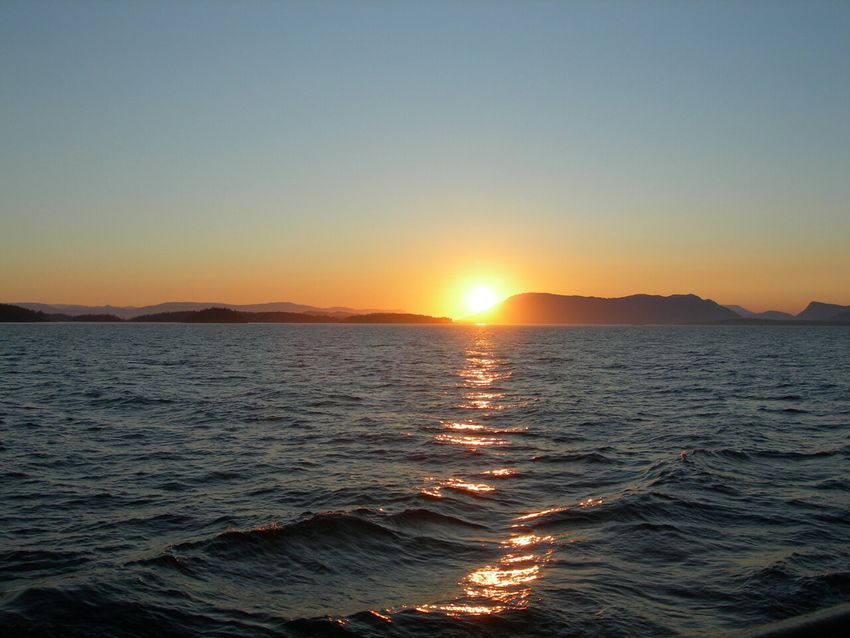
A major two-year heatwave may have temporarily          and recycling organic matter. Very little is known
dampened the Pacific's ability to sequester carbon,     about how these invisible community members are
according to research from the University of British    affected by marine heatwaves, but understanding
Columbia and University of Southern Denmark. Credit:    their responses can provide a vital sign for the rest
Jody Wright                                             of the marine food web.

Researchers have found the two-year heatwave
known as 'the Blob' may have temporarily
dampened the Pacific's 'biological pump,' which
shuttles carbon from the surface ocean to the deep
sea where it can be stored for millennia.

Canadian and European researchers, in
collaboration with the U.S. Department of Energy
Joint Genome Institute, conducted a large-scale
study of the impact of one of the largest marine
heatwaves on record—colloquially known as the
Blob—on Pacific Ocean microorganisms. Their
observations suggest that it's not just larger marine
life that is affected by abrupt changes in sea
temperature.
                                                        Water samples being taken along the Line P transect,
"Heatwaves such as the Blob may decrease the            Pacific Ocean. Credit: Glenn Cooper
ocean's biological role as a carbon sink for fixed
atmospheric carbon," said Dr. Steven Hallam, a
microbiologist at the University of British Columbia
and author of the paper published in Nature          "Marine heatwaves are one of the big challenges of
Communications Biology.                              climate change," explains Dr. Sachia Traving, lead
                                                     author on the study at the University of Southern

                                                                                                        1/3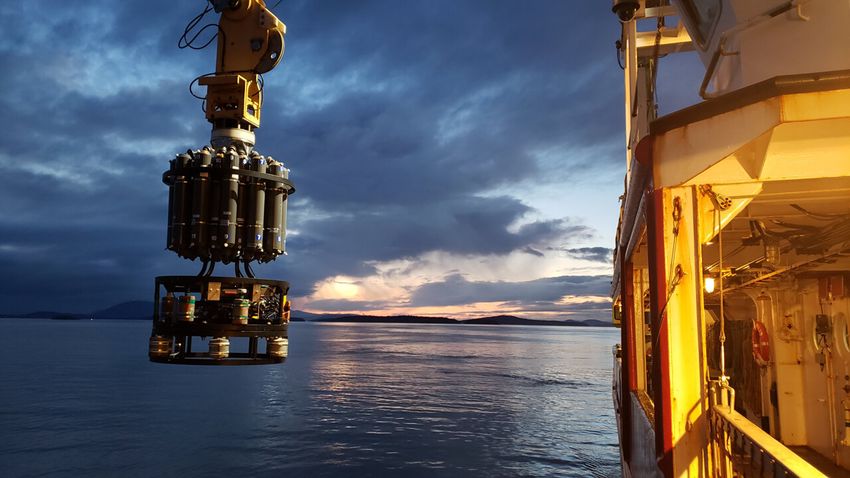
Denmark. "Knowing how they affect microbes—some More information: Sachia J. Traving et al,
of the smallest but most abundant organisms on    Prokaryotic responses to a warm temperature
earth—will help us understand how heatwaves will anomaly in northeast subarctic Pacific waters,
impact life in our future oceans."                Communications Biology (2021). DOI:
                                                  10.1038/s42003-021-02731-9
To investigate these responses, the study brought
together researchers from UBC, Fisheries and
Oceans Canada's Institute of Ocean Sciences, and
the Hakai Institute. They combined seven years of  Provided by University of British Columbia
DNA sequencing and oceanographic
measurements from an open-sea buoy known as
Ocean Station Papa (OSP) to chart how microbial
communities were structured before and during the
most severe marine heatwave in recent time.

OSP is the terminal station of the Line P transect.
Running continuously since 1956, Line P is one of
the longest running oceanographic time series in
the world, and is composed of 26 hydrographic
stations originating in the coastal waters of British
Columbia and heading westward to OSP, over
1,400 km from the coast.

A major impact researchers observed during the
Blob, which began in 2013, was a rise in microbes
specialized to survive under more nutrient limiting
conditions. That shift was likely a response to
changes in the composition of the region's
phytoplankton, which saw a decline in larger cells
that contribute to the formation of organic matter
particles. That decrease in large particles in turn
hinders the ocean's biological pump and ability to
act as a carbon sink.

Research has shown that marine heatwaves are a
direct consequence of climate change. These
anomalous warm water bodies are occurring with
increasing frequency as global temperatures rise,
and disrupt the ecosystems in which they appear.
Previous work on the Blob has documented its
extensive impacts on life in the Northeastern Pacific
Ocean, from phytoplankton, zooplankton and fish
populations to marine mammals and birds.

The current work extends these impacts to the
microbial food webs underlying carbon transport
and sequestration in the ocean while reinforcing the
need for continued time series measurements to
better predict the impacts of climate change on
essential ecosystem functions and services.

                                                                                              2/3
APA citation: Heatwaves like 'the Blob' could decrease role of ocean as carbon sink (2021, October 28)
                                   retrieved 24 November 2021 from https://phys.org/news/2021-10-heatwaves-blob-decrease-role-
                                   ocean.html

                                   This document is subject to copyright. Apart from any fair dealing for the purpose of private study or research, no
                                   part may be reproduced without the written permission. The content is provided for information purposes only.

                                                                                                                                                3/3

Powered by TCPDF (www.tcpdf.org)
You can also read


