Heavy Metals Content in Phaeophyceae from Malang Rapat Waters, Bintan
←
→
Page content transcription
If your browser does not render page correctly, please read the page content below
ILMU KELAUTAN: Indonesian Journal of Marine Sciences March 2021 Vol 26(1):57-62                           e-ISSN 2406-7598

  Heavy Metals Content in Phaeophyceae from Malang Rapat Waters, Bintan

                          Hilda Novianty1*, Emienour Muzalina Mustafa2, Suratno1
                 1Research    Division for Natural Product Technology, Indonesian Institute of Sciences
                     Jl. Jogja Wonosari Km 31.5, Gading, Playen, Gunungkidul, Yogyakarta 55861
                         2Faculty of Fisheries and Food Science, Universiti Malaysia Terengganu

                                        Kuala Nerus, Terengganu, Malaysia 21030
                                           Email: hildanovianty2012@gmail.com

                                                          Abstract

The use of brown-macroalgae (Phaeophyceae) as an alginate source is very broad, covering the food and non-food
industry, because of that it is necessary to know the safety of these natural resources, one of which is safe from
heavy metal contamination. The purpose of this study was to determine heavy metals concentrations accumulated
in several types of Phaeophyceae (brown macroalgae) as an alginate source from Malang Rapat waters, Bintan.
The method used was descriptive non-experimental. The determination of the location of sampling was done by
purposive sampling method. Samples were taken through free collection, identified species and measured of metal
contamination concentrations for As, Cd, and Pb. The data obtained were analyzed descriptively. The results
showed that Phaeophyceae found in Malang Rapat waters were Turbinaria conoides, Sargassum aquifolium,
Padina australis, Hormophysa cuneiformis with each metal concentration contamination of As 13.95 to 23.30 µg.g-
1 dry weight; Cd from 0.33 to 1.08 µg.g-1 dry weight and Pb from 4.72 to 9.92 µg.g-1 dry weight. This study showed

that all metal contamination ranges in all Phaeophyceae were on the verge of the maximum limit set by the National
Standardization Agency of Indonesia Indonesian (SNI) No 7387 of 2009 and National Agency of Drug and Food
Control of RI (BPOM) Regulation No 5 of 2018 for dried macroalgae product so that Phaeophyceae from Malang
Rapat waters - Bintan was not safe to be used as raw material for alginate source or other processed products of
brown-macroalgae.

Keywords: Phaeophyceae; macroalgae; heavy metal; coastal; Malang Rapat

Introduction                                                         gelling agent (Maharani et al., 2017), where it can be
                                                                     used as edible coating or edible film for food products
       Food safety is the main priority in using natural             (Parreidt et al., 2018) and the non-food product were
resources as the main raw material in the                            used for medicinal products, cosmetics, paints,
manufacture of food or non-food products. The flow                   ceramics, and insecticides (Prasetyaningrum and
of the food safety process begins from the source of                 Purbasari, 2002). Alginate is an extracted product
the raw materials used. One of the natural resources                 from     Phaeophyceae.        The     application    of
that have the potential to be used as a food or non-                 Phaeophyceae or its extract should be safe for
food product is Phaeophyceae (brown macroalgae)                      human, and the use of the raw materials must also
which contain secondary metabolites that are                         safe from any contamination.
beneficial to health, including alkaloid compounds,
glycosides, tannins, and steroids which are widely                           The regulation of National Standardization
used in medicine and pharmacy industry (Gazali et                    Agency of Indonesia No. 7387 of 2009 explains that
al., 2018). Mostly, Phaeophyceae are found in the                    contaminated foods are those that contain
coastal areas of Indonesia, which are Sargassum,                     contaminants exceed the maximum predetermined
Turbinaria, Cystoseira, Dictyopteris, Dictyota,                      threshold (National Standardization Agency of
Hormophysa, Hydroclathrus, and Padina (Atmadja,                      Indonesia, 2009). One of the contamination entry
1996), one of the coastal area is Malang Rapat-                      factors into raw materials are through their
Bintan. In these waters, many types of Phaeophyceae                  surrounding environment. Source of water
are found and have not been utilized. The safety of                  contamination could be from human activities, which
raw resources utilization is needed to make high                     are household waste, industry, and tourism activities,
quality of the product.                                              where the coastal area of Malang Rapat-Bintan has a
                                                                     variety of activities as mentioned above. Tourism
       Phaeophyceae is also known as a source of                     activities in the Bintan Regency area have the largest
alginate powder, which has functional properties                     source of contamination from plastic waste by
such as thickener, emulsifier, stabilizer, film-forming,             48.56% (Mulyadi et al., 2017). Part of Bintan area is

*) Corresponding author                    https://ejournal.undip.ac.id/index.php/ijms                 Received : 04-09-2020
© Ilmu Kelautan, UNDIP                         DOI: 10.14710/ik.ijms.26.1.57-62                        Accepted : 15-01-2021
ILMU KELAUTAN: Indonesian Journal of Marine Sciences March 2021 Vol 26(1):57-62
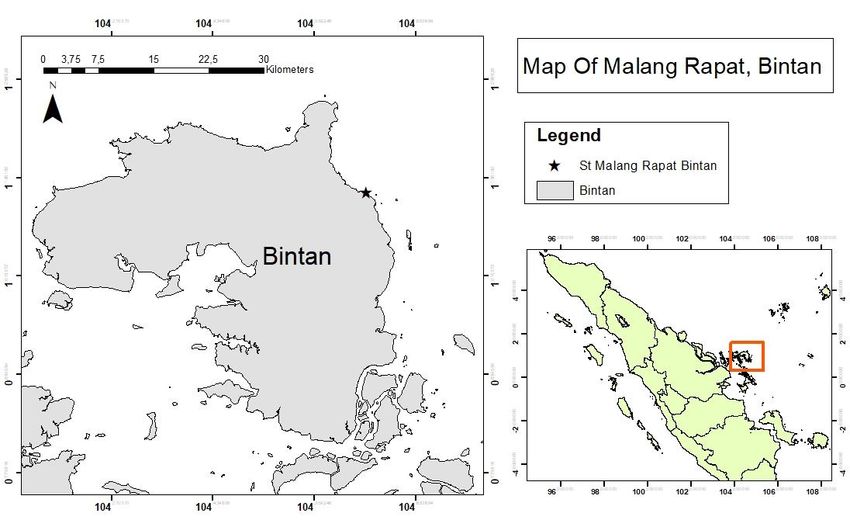
also explored for natural resources such as bauxite, sampling location area is shown in Figure 1.
granite, sand, andesite, quartz sand (Rohmana et al., Macroalgae were collected in 1.5 m areas in the right
2007), where mining activities can cause and left of 100 m of roll meter upright of coastal line.
environmental pollution. Macroalgae that live in a Samples were collected by purposive sampling
coastal area can be polluted through the method since the area has the potential brown
environment, including heavy metals contamination. macroalgae used for alginate powder production and
Heavy metals are dangerous for humans because has the possibility of the contamination. Macroalgae
they are toxic if it presents in large quantities in the in the same species directly soaked with seawater on
body (Ismarti et al., 2017). the area to remove debris.
Heavy metal pollution enters the coastal area The samples collected were kept in plastic zip-
through river flow intake and will be dissolved in water lock bag, labeled for species identification and heavy
and accumulated in sediment, which would increase metal measurement, before being put into a cooler
over time (Setiawan, 2013). This causes macroalgae, box and bringing it back to the laboratory. In the
which is lived by attached to the substrate and laboratory, the samples were store in freezer (-200C)
absorbs nutrients substances from the waters before analysis were conducted. Samples were
through its body surface (thallus), it will be identified for its species and dried in oven at 600C for
contaminated and accumulated in their bodies. 24 h, before it was grounded into powder by using a
Macroalgae are known to have the ability to absorb mortal for measurement of heavy metals (As, Cd, Pb)
heavy metals which are connected to their natural content.
lifestyle which attached themselves to the substrate
of mud, sand, coral, rock, or wood which settles on Measurement of heavy metals was carried out
the bottom of the waters and then is absorbed into in the laboratory of Occupational Health and Safety
the macroalgae tissue and eventually accumulates in Advisory Services Jakarta, Ministry of Health of
the thallus, and the bioaccumulation process occurs Republic of Indonesia. The method to measure it was
intensively (Manalu, 2017). referred to Bowen (2009). Dried samples were made
into powder and then weighed as much as 0,4-0,5 g.
Heavy metal contamination could be from Replicate the sample three times for one species.
Arsenic (As), Cadmium (Cd), and Lead (Pb). The After being weighed, the samples were put in a Teflon
maximum limit for those heavy metal contamination vessel and added 5 ml of distilled water and 5 ml of
for dried macroalga products are shown in Table 1 HNO3 and then put it in the microwave for 2x20
(National Standardization Agency of Indonesia, minutes at 1850C. After the heating process was
2009). The toxicity of heavy metals that enter the complete, the sample is removed and left it in the
human body through their food will cause room temperature and then transferred to a 25 ml
detoxification, excretion (liver and kidney) tissue volumetric flask and then added distilled water until
damage, and can lead to cancer potential gradually the measuring limit of 25 ml. Filtered the solution
(Agustina, 2014). Information on heavy metal through filter paper to make the solution is free from
contamination in brown macroalgae in the waters of
particles that can be interfered with the
Malang Rapat-Bintan is not yet available from the
measurement process and then measured by using
previous study. This study aims to determine the
an Inductively Coupled Plasma with Optical Emission
concentration of heavy metals that have accumulated
Spectrometer (ICP-OES Thermo 7400). Method
in several types of Phaeophyceae (brown
macroalgae) which have the potential as a source of Detection Limit (MDL) of instrumentation for As, Cd
alginate from the waters of Malang Rapat - Bintan. and Pb were 0.0021 mgL-1, 0.0003 mg.L-1 and
0.0013 mg.L-1 respectively. Method of Quantification
Limit (MQL) of instrumentation for As, Cd and Pb were
Material and Methods 0.0071 mg.L-1, 0.0008 mg.L-1and 0.0044 mg.L-1,
respectively. Internal standard of As, Cd and Pb were
Brown macroalgae were collected from used as spike to validate and standardization the
surrounding waters of Malang Rapat-Bintan in April methods with recovery results for As 91.04±0.7 %, Cd
2019 during low tide (0-10 cm). The map of the 86.12±0.5 % and Pb 102.28±1.0%, respectively.
Table 1. The maximum limit of heavy metal contamination for dried macroalgae
Max limit Max limit
Contaminated
No Product National Standardization Agency of National Agency of Drug and
heavy metal
Indonesia (2009) Food Control of RI (2018)
1. Arsenic (As) Dried 1.0 mg.kg-1 1.0 mg.kg-1
2. Cadmium (Cd) macroalgae 0.2 mg.kg-1 0.05 mg.kg-1
3. Lead (Pb) 0.5 mg.kg-1 0.20 mg.kg-1
58 The Heavy Metals Content in Phaeophyceae (H. Novianty et al.)ILMU KELAUTAN: Indonesian Journal of Marine Sciences March 2021 Vol 26(1):57-62
Data from the measurement of heavy metal threshold as referred to Table 1. It indicated that the
content (As, Cd, Pb) in various brown macroalgae dried macroalgae is not safe yet to be used as a food
types were tabulated and analyzed descriptively. The raw material content. As contamination in the
results of metal contamination of this study were environment can originated from volcanic eruptions
compared with the limit of metal contamination and industrial activities (metallurgy, glass factories,
measured for dried macroalgae product based on the production of colour materials, and industries that
regulation of National Standardization Agency of produce arsenic) (Agustina, 2014). Excess As in the
Indonesia No. 7387 of 2009 and National Agency of body will be lead to a decrease in the ability of
Drug and Food Control of Republic of Indonesia locomotion coordination, disorders of the nerves,
(2018) (Table 1).
breathing, and kidneys (Suhendrayatna, 2001).
Result and Discussion
Figure 3 and Table 2 showed the amount of Cd
The types of Phaeophyceae were found in the metal content in various types of Phaeophyceae that
waters of Malang Rapat-Bintan were Turbinaria were found in the waters of Malang Rapat- Bintan,
conoides, Sargassum aquifolium, Padina australis, ranged between 0.33 to 1.08 µg.g-1 in dried weight.
Hormophysa cuneiformis, which had potential as a The amount of Cd metal content in Phaeophyceae
source of alginate (Atmadja, 1996). These was above the maximum threshold for dried
macroalgae are widely used as raw materials in the macroalgae products based on Table 1. This
industrial sector for food, pharmacy, cosmetics, feed, indicates that Phaeophyceae is contaminated and is
fertilizers, textiles, and paper (Pakidi and Suwoyo, not safe yet to be used as raw material for alginate
2016). Waters of Malang Rapat-Bintan has abundant powder or other food processing. Cd metal
of Phaeophyceae. However, the location sampling contamination can come from volcanic eruptions,
area surroundings have the potential for pollution forest fires, industrial waste, the use of fertilizers and
input from resident, tourism, and mining activities pesticides, metal coating and smelting, dyeing,
sector so that it will lead to the possibility of intake of batteries, and the fuel industry (Agustina, 2014). If
contaminants into the coastal area environment. the Cd metal concentration in the human body
Meanwhile, the safety of Phaeophyceae utilization, it exceeds the threshold, it will lead to a risk of blood
is necessary to know the heavy metal contaminants vessels, resulting in lung disorders, emphysema, and
in it. The discussion about this study result will be chronic renal tubular disease (Suhendrayatna, 2001).
described in this session.
Figure 4 and Table 2 showed the concentration
The results of Arsenic (As) metal of Pb in several of Phaeophyceae were found in the
contamination was found in those samples were waters of Malang Rapat-Bintan were ranged from
shown in Figure 2 and Table 2, which ranged between 4.64 to 9.92 µg.g-1 in dried weight. All samples were
13.95 to 23.30 µg.g-1 in dried weight. All of the As above the maximum threshold for Pb contamination
concentration for all samples have been above the based on Table 1 for dried macroalgae products.
Figure 1. Map of Malang-Rapat, Bintan, showing collection site of Phaeophyceae sample with sign
The Heavy Metals Content in Phaeophyceae (H. Novianty et al.) 59ILMU KELAUTAN: Indonesian Journal of Marine Sciences March 2021 Vol 26(1):57-62
30.00
As metal contamination (µg.g-1)
25.00
20.00
dry weight
15.00
10.00
5.00
-
Turbinaria conoides Sargassum aquifolium Padina australis Hormophysa cuneiformis
Species of Phaeophyceae
Figure 2. Content of As heavy metal in several of Phaeophyceae from Malang Rapat waters
1.20
Cd metal concentration (µg.g-1)
1.00
0.80
dry weight
0.60
0.40
0.20
-
Turbinaria
Turbinaria conoides
conoides Sargassum aquifolium Padina australis Hormophysa cuneiformis
cineiformis
Species of Phaeophyceae
Figure 3. Content of Cd heavy metal in several of Phaeophyceae from Malang Rapat waters
It means the sample was not safe yet to use as raw 2017), and it becomes an indicator for bio-monitoring
materials for alginate production or other food to determine the level of heavy metal contamination
processing. Pb contamination could have comes from (Ismarti et al., 2017) in a water area.
mining, oil, and gas burning activities (Agustina,
2014). Excess Pb in the human body will lead to the The concentration of metal contaminants in
cause of disturbances in the nervous system, kidney Phaeophyceae can be seen in Table 2, which showed
work, hematologic, and hemotoxic (Suhendrayatna, 2001). the different levels of heavy metal concentration. This
is related to the different intake amount of heavy
Macroalgae can be contaminated with heavy metal in each macroalga in the waters. This also
metals through the intake that enters their happened to the research conducted by (Ismarti et
environment where it lives. This is because their al., 2017) was shown the same matter. This study
properties were easy to bind with organic matter, also showed that As metal contamination has the
settle in the waters, and unite with sediments (Ismarti greatest concentration compared to others. This is
et al., 2017). Macroalgae, which are benthic because the region of Bintan is an area where is
organisms and are attached to the bottom of the active in mining activities such as bauxite, granite,
waters and their body parts were called a thallus and quartz sand (Irawan, 2013; Rositasari, 2016).
(Suparmi and Sahri, 2009), live by absorbing Whereas As or arsenic, contamination is caused by
minerals from their environment through their body many natural resource exploration activities such as
surface (thallus). Therefore, mineral substances mining. The entry of arsenic into the waters can come
mixed with heavy metal contamination are also from mining activities, metal smelting, factory
absorbed by the thallus. Therefore, macroalgae can activities, and power generation (Suhendrayatna,
accumulate heavy metals in their bodies or what is 2001). According to Brunori et al. (2005), Grafe et al.
called a bio-accumulator (Cordova and Muhtadi, (2011), Heavy metal contaminants such as As, Cr, Ni,
60 The Heavy Metals Content in Phaeophyceae (H. Novianty et al.)ILMU KELAUTAN: Indonesian Journal of Marine Sciences March 2021 Vol 26(1):57-62
12
Pb metal concentration (µg.g-1)
10
8
dry weight
6
4
2
0
Turbinaria conoides Sargassum aquifolium Padina australis Hormophysa cineiformis
Species of Phaeophyceae
Figure 4. Content of Pb heavy metal in several of Phaeophyceae from Malang Rapat waters
Table 2. Heavy metals concentration level (mean ± SD) in several of Phaeophyceae were found in Malang Rapat Waters
Species of Phaeophyceae were found in Malang Rapat- As (µg.g-1) in dry Cd (µg.g-1) in dry Pb (µg.g-1) in dry
Bintan waters weight weight weight
Turbinaria conoides 23.30±0.81 0.38±0.01 4.72±0.89
Sargassum aquifolium 15.96±0.27 0.33±0.01 4.64±1.12
Padina australis 13.95±1.48 1.08±0.39 8.66±1.99
Hormophysa cuneiformis 14.80±0.16 0.96±0.18 9.92±7.10
Pb, Mo, V can occur in bauxite mining activities at the threshold according to the National Standardization
tailings process stage. Cd can also be found in small- Agency of Indonesia No 7387 of 2009 about
scale bauxite mining (Putra and Apriadi, 2018). concerning the limit of heavy metal contamination in
food (National Standardization Agency of Indonesia,
All the samples showed their amount of metal 2009) and National Agency of drug and Food Control
contamination concentration were above the of Republic of Indonesia No. 5 in 2018 about
threshold issued by National Standardization Agency concerning the maximum limit of heavy metal
of Indonesia No. 7387 of 2009 about concerning the contamination in processed food (National Agency of
limit of heavy metal contamination in food (National drug and Food Control of Republic of Indonesia,
Standardization Agency of Indonesia, 2009) and 2018). This indicate the utilization of those
National Agency of drug and Food Control of Republic Phaeophyceae were not safe yet to be use as raw
of Indonesia No. 5 of 2018 about concerning the material for alginate or other food processing. It is
maximum limit of heavy metal contamination in recommended periodically to monitor and evaluate
processed food (National Agency of drug and Food the coastal environment so that the process of
Control of Republic of Indonesia, 2018) so that the controlling contamination can be controlled and the
utilization of macroalgae from these waters for prevention of pollution in the environment can be
alginate production or other food processing is not adequately handled which will lead to the safety of
safe yet and needs further research so that the natural resources.
informations are more diverse. Environmental
maintenance matters from the government, Acknowledgment
business, and society to prevent further pollution
The authors also acknowledge the financial
must be done so that the negative impact of pollution
support from Riset Prioritas (COREMAP-CTI Program),
can be minimized, with the hope that all natural
Research Center for Oceanography-LIPI No: B-
resources in the waters of Malang Rapat Bintan can
5006/IPK.2/KP.06/I/2019 for the research and
be safely utilized.
publication support.
Conclusions References
Phaeophyceae were found in the waters of Agustina, T. 2014. Heavy Metal Contamination of
Malang Rapat-Bintan were Turbinaria conoides, Food and Its Impact on Health (In Bahasa).
Sargassum aquifolium, Padina australis, Teknobuga 1(1): 53-65. doi: 10.1529/jtbb.
Hormophysa cuneiformis were found above the v1i1.6405
The Heavy Metals Content in Phaeophyceae (H. Novianty et al.) 61ILMU KELAUTAN: Indonesian Journal of Marine Sciences March 2021 Vol 26(1):57-62
Atmadja, W.S. 1996. Introduction to the Types of National Agency of Drug and Food Control of Republic
Indonesian Seawed (In Bahasa): Atmadja, W.S., of Indonesia. 2018. Maximum Limit of Heavy
Ahmad, K., Sulistijo., Rachmaniar, S., (Eds.). Metal Contamination in Processed Food No 5 (In
Puslitbang Oseanologi LIPI ISBN 979-8105-46- Bahasa). National Agency of Drug and Food
X. Jakarta. p:91. Control of Republic of Indonesia. Jakarta. p:8.
Bowen, D.A. 2009. Food Safety Series-Accurate National Standardization Agency of Indonesia. 2009.
Analysis of Low Levels of Mercury in Fish by Maximum Limit of Heavy Metals Contamination
Vapour Generation AA. Thermo Fisher Scientific, in Food (In Bahasa). No 7387. National
Cambridge, UK. p:6. Standardization Agency of Indonesia. Jakarta. p:25.
Cordova, M.R. & Muhtadi. 2017. Screening of Pakidi, C.S. & Suwoyo, H.S. 2016. Potential and
Mercury Absorption in Brown Macroalgae Utilization of The Active Ingredient of Brown
Hormophysa triquetra and Red Macroalgae Algae (Sargassum sp) (In Bahasa) Octopus.
Gracilaria salicornia from Pari Island (In 5(2): 488-498.
Bahasa). Oseanologi dan Limnologi di
Indonesia. 2(3): 25-33. doi: 10.14203/oldi. Parreidt, T.S., Műller, K. & Schmid, M. 2018. Alginate-
2017.v2i3.93 Based Edible Films and Coatings for Food
Packaging Applications. Foods. 7(170): 2-38.
Gazali, M., Nurjanah. & Zamani, N.P. 2018. doi: 10.3390/foods7100170
Exploration of Brown Algae Bioactive
Compounds on Sargassum sp. Agardh as an Prasetyaningrum, A. & Purbasari, A. 2002. Alginate
Antioxidant from the West Coast of Aceh (In
Extraction from Seaweed and Its Application in
Bahasa). J. Pengolahan Hasil Perik. Indonesia,
Industry. Reaktor. 6(2): 63-67. doi: 10.14710/
21(1): 167-178. doi: 10.17844/jphpi.v21i1.
reaktor.6.2.63-67
21543
Irawan, A.B. 2013. Valuation of the Carrying Capacity Putra, R.D. & Apriadi, T. 2018. Study of Heavy Metal
of the Protection Function in Bintan Island, Riau Contamination (Pb and Cr) after Bauxite Mining
Islands Province (In Bahasa). J. Sains dan as a Potential Location for Aquaculture
Teknol. Lingkungan. 5(1): 48-65. doi: Activities. Intek Akuakultur, 2(1):1-15. doi: 10.
10.20885/jstl.vol5.iss1.art6 31629/intek.v2i1.273
Ismarti., Ramses., Amelia, F. & Suheryanto. 2017. Rohmana, Djunaedi, E.K. & Pohan, M.P. 2007.
Study of Heavy Metal Content in Plants from the Inventory of minerals from ex-mines in the
Waters of Batam, Riau Islands (In Bahasa). Bintan Island area, Riau Islands Province (In
Dimensi. 6(1): 1-11. doi: 10.33373/dms. v6i1.543 Bahasa). Proceeding Pemaparan Hasil Kegiatan
Lapangan dan Non Lapangan, Pusat Sumber
Maharani, A.A., Husni, A. & Ekantari, N. 2017. Effect Daya Geologi, 1-14.
of Extraction Methods on Characteristic of
SodiumAlginate from Brown Seaweed Rositasari, R. 2016. Bintan is a Wonderful Island (In
Sargassum fluitans (In Bahasa). J. Pengolahan Bahasa). Oseana. XL(4):15-24.
Hasil Perikan. Indo., 20(3):478-487. doi: 10.17
844/jphpi.v20i3.19768
Setiawan, H. 2013. Accumulation and Distribution of
Heavy Metals in Mangrove Vegetation in Coastal
Manalu, F.L. 2017. Study of the Heavy Metal Content
of Lead (Pb), Cadmium (Cd), Chromium (Cr), Waters of South Sulawesi (In Bahasa). J. Ilmu
Copper (Cu), and Manganese (Mn) in Seaweed Kelautan. 7(1):12-24. doi : 10.22146/jik.6134
(Sargassum sp.) in the Coast of Lampung Bay
Using Atomic Absorption Spectrophotometry (In Suhendrayatna. 2001. Bioremoval Heavy Metals
Bahasa). Thesis. Mathematic Faculty and Science, Using Microorganisms: a Literature Review (In
University of Lampung, Bandar Lampung. p:71. Bahasa). Seminar for 21st Century Indonesia,
Sinergy Forum-PPI Tokyo Institute of Technology.
Mulyadi, A., Yoswaty, D. & Ilahi, I. 2017. p: 9.
Environmental Impact of the Development of
Marine Ecotourism in the Trikora Bintan Suparmi & Sahri, A. 2009. Recognizing the Potential
Seagrass Conservation Area, Riau Islands (In of Seaweed: Study of Seaweed Utilization
Bahasa). Berkala Perikanan Terubuk, 45(1): 95- Resources from Industrial and Health Factors (In
111. doi: 10.31258/terubuk.45.1.95.20.20 111 Bahasa). J. Sultan Agung. XLIV (118): 95-116.
62 The Heavy Metals Content in Phaeophyceae (H. Novianty et al.)You can also read


