Hepatoprotective effects of chamazulene against alcohol-induced liver damage by alleviation of oxidative stress in rat models
←
→
Page content transcription
If your browser does not render page correctly, please read the page content below
Open Life Sciences 2020; 15: 251–258
Research Article
Xu Wang, Ke Dong, Yujing Ma, Qizhi Jin, Shujun Yin, Shan Wang*
Hepatoprotective effects of chamazulene
against alcohol-induced liver damage by
alleviation of oxidative stress in rat models
https://doi.org/10.1515/biol-2020-0026 Keywords: chamazulene, oxidative stress, antioxidant
received August 13, 2019; accepted February 18, 2020 enzymes, alcoholic liver injury, histopathology
Abstract: Liver injury and disease caused by alcohol is a
common complication to human health worldwide.
Chamazulene is a natural proazulene with antioxidant and
anti-inflammatory properties. This study aims to investigate 1 Introduction
the hepatoprotective effects of chamazulene against
ethanol-induced liver injury in rat models. Adult Wistar Liver-related ailments are commonly associated with several
rats were orally treated with 50% v/v ethanol (8–12 mL/kg causes such as genetic inheritance, toxic ingestion, viral
body weight [b.w.]) for 6 weeks to induce alcoholic liver infection, and excessive alcohol abuse. Among the causes,
injury. Chamazulene was administered orally to rats 1 h alcohol has a worldwide signature for liver disease [1]. The
prior to ethanol administration at the doses of 25 and liver functions to biotransform alcohol through metabolism
50 mg/kg b.w. for 6 weeks. Silymarin, a commercial drug for with internal enzymes and detoxifies by expelling alcohol
hepatoprotection, was orally administered (50 mg/kg b.w.) out of the body. Excessive alcohol consumption leads to
for the positive control group. Chamazulene significantly severe pathological changes in the liver, hence disrupting
reduced (p < 0.05) the levels of serum alkaline phosphatase, its function [2]. Alcoholic liver disease is characterized with
aspartate aminotransferase, alanine aminotransferase, and hepatic steatosis, cirrhosis, steatohepatitis, and fibrosis.
malondialdehyde, whereas the levels of antioxidant en- Untreated alcoholic liver disease turns into hepatocellular
zymes (glutathione peroxidase, catalase, and superoxide carcinoma, often causing mortality [3]. Although the
dismutase) and reduced glutathione were significantly underlying mechanism of alcoholic liver injury is not clear,
restored (p < 0.05) in contrast to the ethanol model group. oxidative stress and inflammatory response are the primary
The levels of pro-inflammatory cytokines (tumour necrosis factors involved in the progression of alcoholic liver disease.
factor-α and interleukin-6) were suppressed by chamazu- Previous studies using animal models have reported
lene (p < 0.05) with relevance to ethanol-induced liver increase in reactive oxygen species (ROS) and inflammatory
injury. Histopathological alterations were convincing in the response due to alcohol [4,5]. The activities of antioxidant
chamazulene-treated groups, which showed protective enzymes and pro-inflammatory cytokines are altered due to
effects against alcoholic liver injury. Chamazulene has a alcoholic liver disease causing oxidative stress [6]. The
significant hepatoprotective effect against ethanol-induced activities of liver antioxidant enzymes responsible for
liver injury through alleviation of oxidative stress and detoxification of alcohol are reduced; therefore, the
prevention of inflammation. biotransformed alcohol in the form of free radicals causes
damage to the hepatic cells.
Antioxidants were reported to ameliorate the effect
* Corresponding author: Shan Wang, Department of of oxidative stress and inflammation in liver-related
Echocardiography & Noninvasive Cardiology Laboratory, Sichuan ailments [7,8]. Natural products are rich in bioactive
Academy of Medical Sciences, Sichuan Provincial People’s compounds that are widely known to have pharmacolo-
Hospital, Chengdu, Sichuan, 610047, China, gical uses. Chamazulene is a natural proazulene majorly
e-mail: wangshanwangxu@sina.com
present in chamomile flower (Matricaria recutita L.).
Xu Wang, Ke Dong, Yujing Ma, Qizhi Jin, Shujun Yin: No. 2 Ward of
Hepatobiliary Surgery, Sichuan Academy of Medical Sciences,
Chamomile flowers are best known to possess anti-
Sichuan Provincial People’s Hospital, Chengdu, Sichuan, 610047, oxidant, anti-inflammatory, and anti-cancer properties
China [9,10]. Chamazulene is a strong aromatic bioactive
Open Access. © 2020 Xu Wang et al., published by De Gruyter. This work is licensed under the Creative Commons Attribution 4.0 Public
License.252 Xu Wang et al.
compound that is naturally found in essential oil extracts plus ethanol-treated positive control group. Dosages for
of several medicinal plants [11]. Pharmacological proper- chamazulene and silymarin were chosen from preliminary
ties of chamazulene include anti-inflammatory, free tests on antioxidant activities, and duration of treatment and
radical scavenging, inhibition of cyclooxygenase-2 en- protocols were followed according to the previous study on
zyme, and prevention of lipid peroxidation [12–15]. There alcoholic liver disease models by Ge et al. [5]. The control
are no previous studies on the hepatoprotective effects of group received oral administration of saline in distilled
chamazulene on animal models; therefore, this study is water throughout the experiment. All other groups received
the first to report the liver protective effects of chamazu- oral administration of ethanol (50% v/v) for 6 weeks at the
lene against alcoholic liver injury in rat models. dose of 8 mL/kg body weight (b.w.) per day for the first
2 weeks, followed by 12 mL/kg b.w. per day for the
remaining 4 weeks. Ethanol dosage for liver injury was
chosen based on a similar study performed by Ge et al. [5]
2 Materials and methods after confirmation through preliminary tests. Chamazulene
was orally administered 1 h before the administration of
ethanol at 25 mg/kg b.w. per day for the low-dose group and
2.1 Chemicals and reagents
50 mg/kg b.w. per day for the high-dose group for the whole
6 weeks. The positive control group rats were orally treated
Chamazulene (analytical standard), ethanol (purity
with silymarin at 50 mg/kg b.w. per day followed by ethanol
≥99.8%), biochemical analysis kits, ELISA assay kit,
following a similar procedure for 6 weeks. On the 43rd day
haematoxylin and eosin (H&E), and all other chemicals
after 24 h of last ethanol administration, the rats were
and reagents were either purchased from Sigma-Aldrich
anaesthetized to collect blood samples for serum biochem-
(St Louis, MO, USA) or Pure One Biotechnology Ltd
ical analysis and the liver tissues were dissected for
(Shanghai, China).
biochemical and histopathological analyses. The excised
wet liver was weighed for liver index measurement. Liver
index (%) was calculated by the formula: (liver weight [g]/
2.2 Experimental animals body weight of rat [g]) × 100%. Blood samples were left to
clot at room temperature and centrifuged at 3,000 rpm for
Thirty male Wistar rats weighing 150–180 g (6–8 weeks 10 min to obtain serum for enzymatic (aspartate amino-
old) were randomly divided into five groups with six rats transferase [AST], alanine aminotransferase [ALT], and
(n = 6) per group. The rats were acclimatized for 1 week alkaline phosphatase [ALP]) and cytokine (tumour necrosis
before the initiation of experiment, placed in plastic factor-α [TNF-α] and interleukin-6 [IL-6]) analyses. Excised
cages at room temperature with fresh air ventilation, and liver tissues were cleaned and homogenized (10%) in freshly
provided free access to water and chow ad libitum. The prepared sodium phosphate-buffered saline for liver enzy-
experiment was started at the beginning of June 2018 in matic and non-enzymatic antioxidant analyses. Portions of
the medical laboratory of Sichuan Academy of Medical liver tissues were fixed in 10% formaldehyde buffer for
Sciences. histopathological studies. The remaining samples were
frozen and stored at −80°C.
Ethical approval: The research related to animal use
complied with all the relevant national regulations and
institutional policies for the care and use of animals. The
animal ethical committee of Sichuan Provincial People’s 2.4 Determination of lipid peroxidation,
Hospital gave approval for the animal experiment reduced glutathione (GSH), and
(ethical number: scrmyy2019072301). antioxidant enzymes in tissue
Biochemical analysis of tissue enzymes, GSH, and lipid
peroxidation levels was performed according to the
2.3 Treatment protocol method of Li et al. [16]. Tissue homogenates (10%) were
centrifuged at 3,000 rpm for 10 min at 4°C to obtain the
Rats were divided into control group, ethanol-administered supernatant for the determination of lipid peroxidation,
alcoholic model group (EtOH), low dose and high dose of GSH, glutathione peroxidase (GPx), catalase (CAT), and
chamazulene plus ethanol-treated groups, and silymarin superoxide dismutase (SOD). Lipid peroxidation levelsHepatoprotective effects of chamazulene against oxidative stress 253
were analyzed using a commercial kit based on the the activities of pro-inflammatory cytokines were expressed
formation of thiobarbituric acid reactive substances in as picograms per millilitre of serum.
conjugation with malondialdehyde (MDA) following the
method of Ayidin et al. [17]. The GSH levels were
assayed using a commercial kit based on the formation
of 5-thiol-2-nitrobenzoic acid. The activities of anti- 2.7 Evaluation of liver histopathological
oxidant enzymes (SOD, CAT, and GPx) were determined changes
using commercially available assay kits following the
instructions provided by the manufacturer (Pure One Liver tissues fixed in 10% formaldehyde buffer were
Biotechnology Ltd) according to the method of Bacanli dehydrated and fixed in paraffin wax, sliced to 5 µm
et al. [18]. The biochemical results were spectrophoto- thick films, and stained with H&E. The sections of
metrically analyzed using an UV-Vis digital spectro- stained liver tissues were observed under a light
photometer (Shimadzu UV-1900, Japan). Total protein microscope for the evaluation of fatty changes, lympho-
concentration in the liver tissues was measured by a cytic infiltration, ballooning degeneration, and hepato-
standard Bradford protein assay. cellular necrosis following the method of Ge et al. [5].
2.5 Determination of serum AST, ALT, 2.8 Statistical analysis
and ALP
All the values are expressed as mean ± standard error of
The activities of serum biomarker enzymes for liver mean. Statistical package for social sciences software
damage such as ALP, AST, and ALT were analyzed using (SPSS 17.0, USA) was used for statistical significance
commercial kits according to the instructions given by the testing. Analysis of variance was performed together
manufacturer, following the guidelines of Gnanaraj et al. with Dunnett’s multiple comparison test for analysing
[3] and Li et al. [16]. The results for serum biomarker the difference between groups. Statistical significance
enzymes were given as units per litre of serum. was considered valid for p values less than 0.05.
2.6 Determination of pro-inflammatory 3 Results
cytokines using the ELISA assay
3.1 Effects of chamazulene on the liver index
The activities of serum pro-inflammatory cytokines
of ethanol-induced liver injury in rats
(TNF-α and IL-6) were determined using ELISA assay
kits (Pure One Biotechnology Ltd) according to the
instructions given in the reagent kits with reference to The final body weight and liver index of alcoholic liver
the protocols of Xu et al. [6]. The ELISA assay results for injury model rats are given in Table 1. The liver index of
Table 1: Effect of chamazulene on body weight and liver index of alcoholic liver injury in rats
Groups Final body weight (g) Liver index (%)
Control 220.33 ± 13.22 3.22 ± 0.46
Ethanol control 214.15 ± 12.18 4.88 ± 0.50a
Chamazulene 25 mg/kg b.w. + EtOH 216.64 ± 11.68 4.26 ± 0.38b
Chamazulene 50 mg/kg b.w. + EtOH 215.55 ± 10.14 3.85 ± 0.43b
Silymarin 50 mg/kg b.w. + EtOH 217.20 ± 11.26 3.42 ± 0.34b
Values are expressed as mean ± standard error of mean (n = 8) and analyzed by one-way analysis of variance followed by Dunnett’s
multiple comparisons test. The symbol ‘a’ represents significance (p < 0.05) as compared to the normal control group, whereas the
symbol ‘b’ represents significance (p < 0.05) as compared to the ethanol control group.254 Xu Wang et al.
the ethanol-induced liver injury model group shows a ethanol-induced model group (p < 0.05). The activities
significantly increased value compared to that of the of antioxidant enzymes, SOD, CAT, and GPx, were
normal control group. Chamazulene significantly reduced drastically depleted in the ethanol-induced model group
the liver index in a dose-dependent manner as compared (p < 0.05), but chamazulene increased the activities of
to the ethanol control group (p < 0.05). Silymarin also antioxidant enzymes at both 25 mg/kg b.w. and 50 mg/
showed a significantly lower liver index as compared to kg b.w. doses (p < 0.05). The results were comparable to
the alcoholic liver model group (p < 0.05). positive control silymarin.
3.2 Chamazulene restores GSH and 3.3 Chamazulene prevents MDA formation
antioxidant enzyme activities in and decreases serum ALP, AST, and ALT
alcoholic liver injury levels
The levels of GSH and activities of antioxidant enzymes The effects of chamazulene on MDA formation and serum
(SOD, GPx, and CAT) in ethanol-induced liver injury are biomarker enzymes for liver injury such as ALP, AST, and
shown in Figure 1. It is clearly shown that GSH was ALT are shown in Figure 2. The MDA level was clearly high
largely consumed in the ethanol-induced model group in the ethanol-induced model group compared to that of the
as compared to the normal control group (p < 0.05). normal control group (p < 0.05). Chamazulene at both
Chamazulene significantly restored the GSH levels 25 mg/kg b.w. and 50 mg/kg b.w. doses significantly
comparably better than the ethanol-induced model prevented MDA formation in comparison to the ethanol-
group (p < 0.05). Silymarin also showed significantly induced model group (p < 0.05). The activities of serum
increased levels of GSH as compared to those of the biomarker enzymes (AST, ALT, and ALP) were significantly
Figure 1: Effect of chamazulene on the activities of non-antioxidant GSH and antioxidant enzymes (GPx, CAT, and SOD) against ethanol-
induced liver injury. Results are displayed as the mean analysis of six rats (n = 6) and standard error of mean. The symbol ‘a’ represents
significance (p < 0.05) as compared to the normal control group, whereas the symbol ‘b’ represents significance (p < 0.05) as compared to
the ethanol control group. GSH = reduced glutathione; GPx = glutathione peroxidase; CAT = catalase; SOD = superoxide dismutase.Hepatoprotective effects of chamazulene against oxidative stress 255
high in the ethanol-induced model group compared to group (p < 0.05). Silymarin also suppressed the serum
those of the normal control group (p < 0.05). Chamazulene levels of TNF-α and IL-6 in comparison to the ethanol-
dose dependently was able to suppress the levels of serum induced model group (p < 0.05).
AST, ALT, and ALP compared to the ethanol-induced model
group (p < 0.05). Silymarin significantly reduced the levels
of MDA, ALP, AST, and ALP in contrast to the ethanol-
induced model group (p < 0.05). 3.5 Histopathological changes in alcoholic
liver injury due to chamazulene
administration
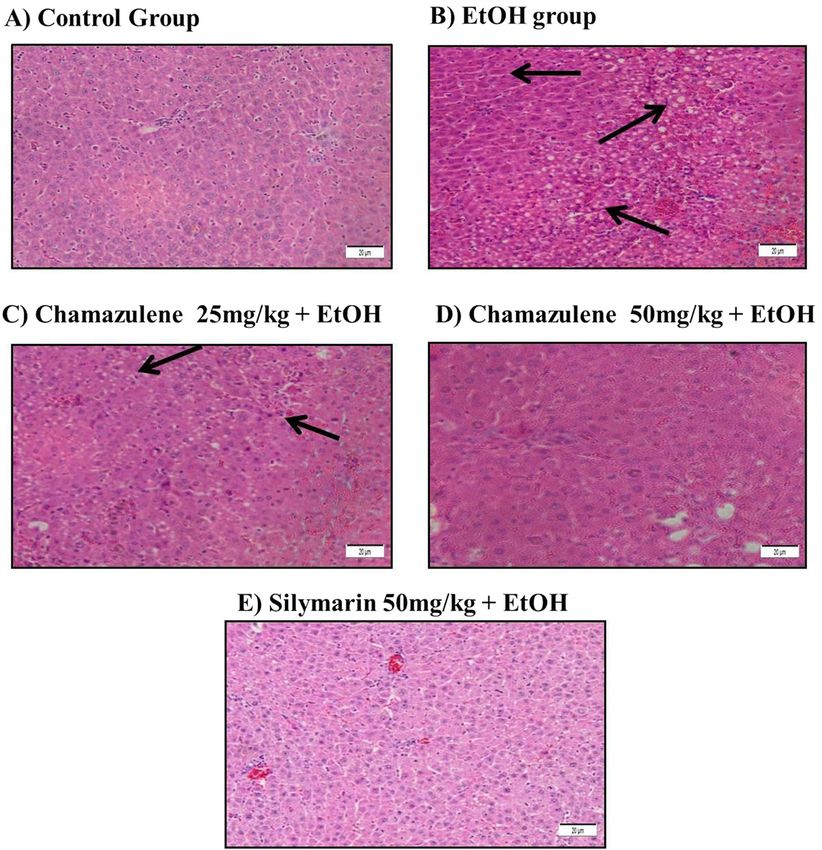
3.4 Preventive effects of chamazulene on Histopathological alterations (H&E) in the alcoholic liver
the levels of pro-inflammatory cytokines injury model and protective effect of chamazulene are
shown in Figure 4. The morphological arrangement of
ELISA assay results for the levels of pro-inflammatory liver cells in the normal control group showed healthy
cytokines (TNF-α and IL-6) in ethanol-induced liver signs with regular hepatocyte arrangements, distinct
injury are shown in Figure 3. The levels of TNF-α and IL- nucleus, and sinusoids. In contrast, the hepatocytes of
6 were significantly elevated in the serum of the ethanol- the ethanol-induced model group showed extensive
induced liver damage group as compared to those of the derangement with loss of sinusoidal spaces, inflamma-
normal control group (p < 0.05). Chamazulene was able tory signs with cell infiltrations were observed, necrotic
to suppress the levels of TNF-α and IL-6 in the serum of cells were found with loss of nuclear integrity, bal-
the 25 mg/kg b.w. treated group and 50 mg/kg b.w. looning degeneration, and fatty changes were clearly
treated group in contrast to the ethanol-induced model visible. Chamazulene administration reversed the
Figure 2: Effect of chamazulene on the levels of MDA formation and serum liver injury marker enzymes (ALP, AST, and ALT) against ethanol-
induced liver damage. Results are displayed as the mean analysis of six rats (n = 6) and standard error of mean. The symbol ‘a’ represents
significance (p < 0.05) as compared to the normal control group, whereas the symbol ‘b’ represents significance (p < 0.05) as compared to
the ethanol control group. MDA = malondialdehyde; ALP = alkaline phosphatase; AST = aspartate aminotransferase; ALT = alanine
aminotransferase.256 Xu Wang et al. Figure 3: Effect of chamazulene on pro-inflammatory cytokines (TNF-α and IL-6) against ethanol-induced liver damage. Results are displayed as the mean analysis of six rats (n = 6) and standard error of mean. The symbol ‘a’ represents significance (p < 0.05) as compared to the normal control group, whereas the symbol ‘b’ represents significance (p < 0.05) as compared to the ethanol control group. TNF-α = tumour necrosis factor-α; IL-6 = interleukin-6. Figure 4: H&E staining of ethanol-induced liver damage and the protective effects of chamazulene at 100× magnification. (A) Control group: normal arrangement of hepatocytes and sinusoidal spaces; (B) alcohol control group: heavy loss of sinusoidal spaces, presence of necrotic cells, lymphocytic infiltration, ballooning degeneration, and fatty changes are observed, indicated by black arrows; (C) chamazulene (25 mg/kg b.w. + EtOH) group: there are several necrotic hepatocytes and lymphocytic infiltrations present, indicated by black arrows but mostly sinusoidal spaces show recovery; (D) chamazulene (50 mg/kg b.w. + EtOH) group: hepatocytes show signs of protection against ethanol-induced liver injury with distinct sinusoidal spaces; and (E) positive control group: silymarin as a positive control significantly protected the liver against ethanol-induced injury which shows arrangement of hepatocytes almost similar to normal liver.
Hepatoprotective effects of chamazulene against oxidative stress 257
morphological changes caused by ethanol-induced liver Enhanced activities of serum enzyme markers (AST,
damage by restoring the hepatocyte arrangements, ALT, and ALP) are commonly known as liver damage
reduced inflammatory cell infiltration, and preserved indicators [4]. Serum biomarker enzymes (ALP, AST, and
sinusoidal spaces. The silymarin-treated group showed ALT) were largely increased in the ethanol-induced liver
positive morphology of liver with arrangement of injury model group, indicating that the liver damage
hepatocytes almost similar to normal liver. caused the leakage of these enzymes located within the
hepatocytes into blood stream. The chamazulene-treated
groups showed significantly reduced levels of serum ALP,
AST, and ALT towards normal, which proves that the
4 Discussion compound well protected the structure of hepatocytes.
These results can be attributed to the prevention of lipid
Excessive alcohol consumption is becoming a trend peroxidation by chamazulene as discussed earlier. These
among younger generations worldwide [2]. Therefore, findings are in agreement with the reports of Ge et al. [5]
most people are susceptible to alcoholic liver damage. and Taner et al. [21], indicating the prevention of serum
This study emphasized the importance of antioxidant biomarkers by antioxidant compounds in the ethanol-
compounds in reversing the effect of alcoholic liver induced liver injury model. Besides oxidative stress,
injury. Chamazulene, a bioactive compound with anti- inflammation is also a common occurrence in alcoholic
oxidative properties, was studied to determine its ability liver disease. Alcohol triggers the release of pro-inflamma-
to prevent alcoholic liver damage in ethanol-induced liver tory cytokines leading to aggravation of inflammatory
injury of rat models. Oxidative stress has a major role in response causing the development of liver damage [4].
the pathogenesis of alcoholic liver injury through break- TNF-α and IL-6 are the most persistent pro-inflammatory
down of the cell membrane by oxidation. Alcohol intake cytokines featured in ethanol-induced liver injury models
boosts the ROS generation within the liver, thus defeating [22]. TNF-α and IL-6 in the serum determined by the ELISA
the antioxidant defence mechanism that is supposed to assay showed highly increased activity in the ethanol-
scavenge the ROS [4]. It was found that chamazulene induced liver injury model group, due to the inflammatory
significantly prevented oxidative stress by alleviating the reaction caused by liver injury. The inflammatory response
activities of antioxidant enzymes and GSH levels towards was significantly suppressed by chamazulene by reducing
normal. The ethanol-induced liver injury model group the activities of pro-inflammatory cytokines (TNF-α and IL-6).
expressed high state of oxidative stress where the levels Antioxidant compounds are known to possess anti-
of GSH and activities of antioxidant enzymes (SOD, GPx, inflammatory activity through suppression of pro-inflam-
and CAT) were depleted. Similarly, previous studies by matory cytokines [23]. Suppression of TNF-α and IL-6 by
Zhang et al. [19] and Zhu et al. [20] also reported the chamazulene could be credited to its antioxidative and
revival of antioxidant defence upon antioxidant adminis- anti-inflammatory abilities. Anti-inflammatory potential
tration. Lipid peroxidation has been reported to be the of chamazulene in the alcoholic liver damage model is in
most dangerous reaction in ethanol-induced liver damage agreement when compared with previous findings of
[8]. Excessive alcohol consumption leads to overproduc- Flemming et al. [10] and recent research studies on
tion of MDA in liver due to lipid peroxidation, causing antioxidant compounds in alcoholic liver injury models
hepatic injury and apoptosis [6]. Pre-treatment with [6,16,19].
chamazulene was able to prevent free radicals from Alcoholic liver damage is normally characterized with
oxidizing the hepatocellular membranes. This was proven changes in the hepatocellular morphology [20]. Histopatho-
from the results of lipid peroxidation where the MDA logical alterations in the ethanol-induced liver injury model
levels in the ethanol-induced liver injury model group group evidenced the extent of liver injury, relating back to
were elevated above normal but chamazulene treatment the biochemical results of lipid peroxidation, serum
significantly reduced the MDA levels towards normal. The biomarker enzymes, and pro-inflammatory cytokines. Ad-
silymarin-treated positive control group also exhibited ministration of chamazulene widely prevented liver injury
reduced levels of MDA formations. It is well observed that through preservation of hepatocellular membrane integrity,
natural antioxidants are able to prevent oxidative stress prevention of oxidative stress, and suppression of inflam-
by donating electrons to scavenge free radicals. Similar matory responses. The histopathological findings are
results were presented in previous studies in support of comparable with the results of Xu et al. [6] and Al-Attar
the results of reduced MDA levels by antioxidant and Alomar [24], demonstrating the levels of hepatocyte
compounds in alcoholic liver injury models [19,20]. damage. Collectively, this study proves that chamazulene258 Xu Wang et al.
has remarkable hepatoprotective effects against alcoholic [7] Al-Harbi MS. Antioxidant, protective effect of black berry and
liver injury through alleviation of oxidative stress and quercetin against hepatotoxicity induced by aluminum
suppression of pro-inflammatory cytokines. chloride in male rats. Int J Pharmacol. 2019;15(4):494–502.
[8] Itoh A, Isoda K, Kondoh M, Kawase M, Watari A, Kobayashi M,
et al. Hepatoprotective effect of syringic acid and vanillic acid on
CCl4-induced liver injury. Biol Pharma Bull. 2010;33(6):983–7.
[9] Al-Dabbagh B, Elhaty IA, Elhaw M, Murali C, Mansoori AA,
5 Conclusion Awad B, Amin A. Antioxidant and anticancer activities of
chamomile (Matricaria recutita L.). BMC Res Notes. 2019;12:3.
[10] Flemming M, Kraus B, Rascle A, Jürgenliemk G, Fuchs S, Furst R,
In this study, chamazulene has shown its ability as a
et al. Revisited anti-inflammatory activity of matricine in vitro:
protective compound against oxidative stress and inflam- comparison with chamazulene. Fitoter. 2015;106:122–8.
matory response in the alcoholic liver injury model. [11] Ramadan M, Goeters S, Watzer B, Krause E, Lohmann K, Bauer R,
Chamazulene significantly reversed the effect of ethanol- et al. Chamazulene carboxylic acid and matricin: a natural profen
induced liver injury through modulation of liver marker and its natural prodrug, identified through similarity to synthetic
drug substances. J Nat Prod. 2006;69(7):1041–5.
enzymes, antioxidant enzyme activities, pro-inflammatory
[12] Safayhi H, Sabieraj J, Sailer ER, Ammon HPT. Chamazulene:
cytokines, and MDA formations. The extent of liver
an anti-oxidant-type inhibitor of leukotriene B4 formation.
protection shown by chamazulene against ethanol-induced Planta Med. 1994;60:410–3.
liver damage in rats proves that chamazulene could be [13] Sizova NV. Composition and antioxidant activity of essential oils
commercialized as a pharmaceutical drug for liver ailments. containing azulene derivatives. Pharma Chem J. 2012;46:369–71.
Further research is needed to validate the antioxidant effect [14] Rekka EA, Kourounakis AP, Kourounakis PN. Investigation of the
effect of chamazulene on lipid peroxidation and free radical
of chamazulene on other diseases caused by manifestation
processes. Res Comm Mol Pathol Pharmacol. 1996;92:361–4.
of oxidative stress and inflammation. [15] Capuzzo A, Occhipinti A, Maffei ME. Antioxidant and radical
scavenging activities of chamazulene. Nat Prod Res.
Conflicts of interest: The authors state no conflict of 2014;28(24):2321–3.
interest. [16] Li XX, Jiang ZH, Zhou B, Chen C, Zhang XY. Hepatoprotective
effects of gastrodin against alcohol-induced liver injury in
mice. J Physiol Biochem. 2019;75(1):29–37.
[17] Aydin S, Sahin TT, Bacanli M, Taner G, Basaran AA, Aydin M,
et al. Resveratrol protects sepsis-induced oxidative DNA damage
References in liver and kidney of rats. Balkan Med J. 2016;33(6):594–601.
[18] Bacanli M, Aydin S, Taner G, Goktas H, Sahin T, Basaran A, et
[1] Das SK, Mukherjee S, Vasudevan DM. Effects of long term al. Does rosmarinic acid treatment have protective role
ethanol consumption on cell death in liver. Ind J Clin Biochem. against sepsis-induced oxidative damage in Wistar Albino
2010;26(1):84–7. rats? Human Exp Toxicol. 2016;35(8):877–86.
[2] Richardson CT, Singal AK. Epidemiology of alcoholic [19] Zhang Y, Wang C, Yu B, Jiang J, Kong W. Gastrodin protects
liver disease. Clin Epidemiol Chron Liver Dis. against ethanol-induced liver injury and apoptosis in HepG2
2018;11:75–98. cells and animal models of alcoholic liver disease. Biol
[3] Gnanaraj C, Shah MD, Song TT, Iqbal M. Hepatoprotective Pharma Bull. 2018;41(5):670–9.
mechanism of Lygodium microphyllum (Cav.) R.Br. through [20] Zhu L, Li B, Liu X, Meng X. Hepatoprotective effects of
ultrastructural signaling prevention against carbon tetra- triterpenoid isolated from Schizandra chinensis against acute
chloride (CCl4)-mediated oxidative stress. Biomed alcohol-induced liver injury in mice. Food Sci Tech Res.
Pharmacother. 2017;92:1010–22. 2013;19(6):1003–9.
[4] Das M, Basu S, Banerjee B, Sen A, Jana K, Datta G. [21] Taner G, Aydin S, Bacanli M, Sarigol Z, Sahin T, Basaran AA,
Hepatoprotective effects of green Capsicum annum against Basaran N. Modulating effects of pycnogenol® on oxidative
ethanol induced oxidative stress, inflammation and apoptosis stress and DNA damage induced by sepsis in rats. Phytother
in rats. J Ethnopharmacol. 2018;227:69–81. Res. 2014;28(11):1692–700.
[5] Ge N, Liang H, Zhao Y, Liu Y, Gong A, Zhang W. Aplysin [22] Ajiboye TO, Lophirones B and C attenuate acetaminophen-
protects against alcohol-induced liver injury via alleviating induced liver damage in mice: studies on hepatic, oxidative
oxidative damage and modulating endogenous apoptosis- stress and inflammatory biomarkers. J Biochem Mol Toxicol.
related genes expression in rats. J Food Sci. 2016;30(10):497–505.
2018;83(10):2612–21. [23] Yang J, Li Y, Shi N. Attenuation of sepsis-induced rat liver injury
[6] Xu L, Yu Y, Sang R, Li J, Ge B, Zhang X. Protective by epigallocatechin gallate via suppression of oxidative stress-
effects of taraxasterol against ethanol-induced liver related inflammation. Trop J Pharma Res. 2018;16(12):2877.
injury by regulating CYP2E1/Nrf2/HO-1 and NF-κB [24] Al-Attar AM, Alomar MY. Effect of Basil leaves extract on liver
signaling pathways in mice. Oxid Med Cell Long. fibrosis induced by thioacetamide in male rats. Int J
2018;2018:8284107. Pharmacol. 2019;15(4):478–85.You can also read


