Historical Overview of the National Woman's Party
←
→
Page content transcription
If your browser does not render page correctly, please read the page content below
Historical Overview of the National Woman’s Party

Origins in the NAWSA Congressional Committee
          The origins of the National Woman's Party (NWP) date from December 1912, when
Alice Paul (1885-1977) and Lucy Burns (1879-1966) were appointed to the National American
Woman Suffrage Association’s (NAWSA) languishing Congressional Committee. Paul and
Burns were young, well-educated Americans who worked with Emmeline and Christabel
Pankhurst in the militant wing of the British suffrage movement. Radicalized by their
experiences in England–which included violent confrontations with authorities, jail sentences,
hunger strikes, and force-feedings–they sought to inject a renewed militancy into the American
campaign. They also endeavored to shift NAWSA’s attention away from winning voting rights
for women at the state and local levels to securing an amendment to the U.S. Constitution to
enfranchise women nationally.
          Their first activity on NAWSA’s behalf was to organize a massive national suffrage
                                                                    parade in Washington, D.C., in March 1913.
                                                                    This parade was modeled on the elaborate
                                                                    suffrage pageants held in Britain and local
                                                                    marches organized in New York by the
                                                                    Women’s Political Union (WPU) and its
                                                                    leader Harriot Stanton Blatch (1856-1940).
                                                                    Blatch, the daughter of Elizabeth Cady
                                                                    Stanton (1815-1902), married an Englishman
                                                                    and became active in the militant British
                                                                    suffrage campaign. She supported
                                                                    NAWSA’s appointment of Paul and Burns,
                                                                    who shared her enthusiasm for British-
 Contingent of women representing foreign countries in the March 3,
 1913, suffrage parade in Washington, D.C. L & M Ottenheimer.       inspired tactics.
 About this image                                                           The March 3, 1913, parade coincided
                                                                    with President Woodrow Wilson’s
inauguration and put the president-elect and Congress on notice that NAWSA would hold the
Democratic Party responsible if it failed to pass a women’s suffrage amendment. Bands, floats,
and more than 8,000 marchers participated, representing nearly every state and most
occupations.
          Despite assurances of police protection, crowds of men mobbed the parade route–some of
them threatening or injuring the marching women. The police declined to intervene, and the
public outcry was intense. Even NAWSA officials, leery of Paul’s affiliation with British
suffragettes, conceded afterwards that the parade and ensuing police debacle had “. . .done more
for suffrage, to establish firmly those who were wavering, and to bring to our ranks thousands of
others who would never have taken any interest in it.”1 (For a fuller description of the parade, see
“Marching for the Vote: Remembering the Woman Suffrage Parade of 1913.")
          Despite the publicity that such events generated, Anna Howard Shaw (1847-1919) and
later Carrie Chapman Catt (1859-1947), as presidents of NAWSA, remained skeptical. They
feared that militant tactics would endanger state victories, antagonize Congress, and make it
difficult to gain widespread support for ratifying women’s voting rights if a federal amendment
The Library of Congress | American Memory
Women of Protest: Photographs from the Records of the National Woman’s Party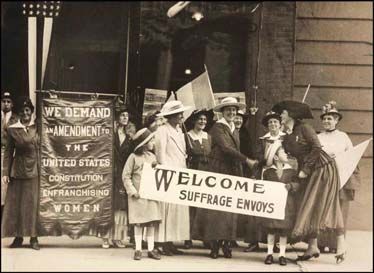
2

were passed by Congress. They believed that British-influenced tactics and the strategy of
targeting the party in power would not work in the United States where a bipartisan coalition
usually was needed to achieve the necessary two-thirds majority vote in Congress and states’
ratification.

Establishment of the Congressional Union and Its Early Tactics
           Increasingly at odds with NAWSA leadership and interested in raising funds and
pursuing activities outside NAWSA’s scope, Paul and Burns founded the Congressional Union
for Woman Suffrage (CU) in April 1913. The NAWSA Congressional Committee and the CU
were separate entities, but Paul chaired both, and the executive boards were identical. The CU,
initially consisting of women in the District of Columbia who supported the Congressional
Committee, established its own weekly journal, The Suffragist, in November 1913. One month
later, immediately following NAWSA’s annual convention, Paul was told that she could retain
her chairmanship of the Congressional Committee only if she resigned from the CU and
abandoned the policy of holding all Democrats responsible for congressional inaction on
suffrage. Paul refused, as did Lucy Burns and the other committee members. NAWSA removed
them and selected a new Congressional Committee. Two months later, in February 1914,
NAWSA and the CU went their separate ways when the NAWSA board voted against
readmitting the CU as an auxiliary member.
           From 1914 to 1917, the CU, with its national headquarters in Washington and state
branches throughout the country, instilled in the flagging American suffrage campaign an energy
                                                   and militancy reminiscent of the early radicalism of
                                                   Stanton and Susan B. Anthony (1820-1906). CU
                                                   members held street meetings, distributed pamphlets,
                                                   organized elaborate parades and pageants, heckled
                                                   candidates, collected signatures on suffrage petitions,
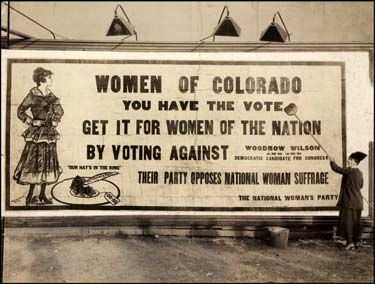
                                                   mounted billboards on public highways, and orchestrated
                                                   coast-to-coast automobile and train tours of suffrage
                                                   speakers. The CU also arranged for deputations of women
                                                   to meet with the president, encouraged western women
                                                   already enfranchised to vote as a bloc in the 1914
 Suffrage envoys from San Francisco greeted in New congressional and 1916 presidential elections, and kept an
 Jersey on their way to Washington to present a
 petition to Congress containing more than 500,000
                                                   extensive card index file on every member of Congress as
 signatures. November-December 1915.               an aid in its relentless lobbying effort. All of its tactics
 About this image
                                                   were designed to generate interest and publicity, attract
new supporters, and pressure public officials.

Formation of the National Woman’s Party
        In early June 1916, the CU sponsored a convention in Chicago for women in the West
who had achieved voting rights in their states. The National Woman’s Party (NWP)–also briefly
known as the Woman’s Party of Western Voters or simply the Woman’s Party–emerged as a
result of this conference. CU member and Washington lobbyist Anne Martin (1875-1951) of
Nevada became the NWP’s first chairman. The goal of the world’s “first women’s political
party” was to remain independent of the existing political parties and to campaign on a platform

The Library of Congress | American Memory
Women of Protest: Photographs of the Records of the National Woman’s Party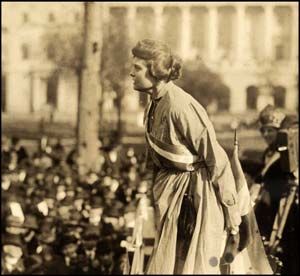
3

consisting of one plank–immediate passage of the Susan B. Anthony federal suffrage
amendment. The CU continued to exist in states where women did not have the vote; the NWP
replaced the CU in western states that had passed women’s suffrage. The two groups coexisted
until March 1917 when the voting and non-voting wings reunited in a single organization under
the NWP name.
          From June to November 1916, both the NWP and CU concentrated on the upcoming
                                                 elections. They picketed the national conventions, met
                                                 with presidential and congressional candidates, and sent
                                                 organizers into the enfranchised states to lobby for the
                                                 federal suffrage amendment and oppose all Democratic
                                                 Party candidates. In late October, suffrage speaker Inez
                                                 Milholland Boissevain (1886-1916) collapsed while
                                                 speaking on stage in Los Angeles. She died on November
                                                 25 and was widely regarded as the first martyr of the
                                                 American women’s suffrage movement. A memorial
                                                 service was held on Christmas Day in the U.S. Capitol,
                                                 and resolutions were prepared for President Wilson’s
 NWP member puts up a billboard in Denver during
 the 1916 election campaigns.                    attention. When Wilson angrily dismissed the suffragists’
 About this image                                demands, Paul decided, with Blatch’s urging, to escalate
                                                 their agitation.

Picketing, Arrests, and Imprisonment
                                      On January 10, 1917, the CU and NWP instituted the practice
                             of picketing the White House, the first political activists to do so. Every
                             day for the next two months, regardless of weather, women marched in
                             a line from CU headquarters to the White House, where they took up
                             their stations as “silent sentinels.” In order to keep the press interested,
                             special days were scheduled for picketing by college women, wage-
                             earners, and representatives from various states, occupations, and
                             professional affiliations. President Wilson initially tolerated the pickets,
                             waving to them as his car pulled through the gates. However, when the
                             United States entered World War I four months later, the political
                             climate changed, and criticism of the government became less
                             acceptable.
 “Silent sentinel” Alison T.
 Hopkins at the White House
                                      Unlike other suffragists, including longtime pacifists who
 gates on New Jersey Day.    stopped campaigning for the vote and devoted themselves to war work,
 January 30, 1917.
 About this image
                             the NWP neither publicly supported the war nor halted agitating for
                             women’s voting rights.
           The NWP highlighted the government’s hypocrisy of supporting democracy abroad while
denying its women citizens the right to vote at home. NWP criticism of the government was
viewed as unpatriotic by many and even seditious and subversive by some, especially the
soldiers and sailors who were among the most visible instigators of mob violence against the
pickets. The party firmly defended the rights of free speech, free assembly, and dissent.
NAWSA’s Catt publicly disassociated her organization from the NWP’s “unladylike” behavior
and the “unwelcome” publicity it generated, although NAWSA benefitted by appearing more

The Library of Congress | American Memory
Women of Protest: Photographs of the Records of the National Woman’s Party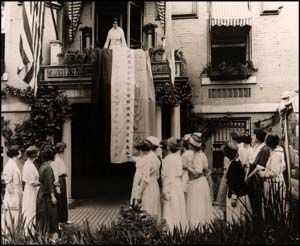
4

moderate and approachable to politicians who were beginning to rethink their antisuffrage
positions.
        On June 22, 1917, suffrage pickets began to be
arrested on the technical charge of obstructing traffic. As the
summer progressed, more arrests followed and longer prison
sentences were handed down. The women were imprisoned–
usually in unsanitary conditions, sometimes beaten (most
notably during the November 15 “Night of Terror” at
Occoquan Workhouse), and often brutally force-fed when
they went on hunger strikes to protest being denied political
prisoner status.
        Women of all classes risked their health, jobs, and     Suffrage prisoner Lucy Branham, in prison
reputations by continuing their protests. One historian         costume, being filmed while addressing an
                                                                open-air meeting [detail]. 1919.
estimated that approximately 2,000 women spent time on the      About this image
picket lines between 1917 and 1919, and that 500 women
were arrested, of whom 168 were actually jailed2. The NWP made heroes of the suffrage
prisoners, held ceremonies in their honor, and presented them with commemorative pins.
Women went on publicity tours dressed in prison garb and talked about their experiences in
prison in order to win public support for their cause.

Congressional Passage of 19th Amendment and Ratification Campaign
          Government officials found it increasingly difficult to refuse the vote to women who
were contributing so much to the war effort. Antisuffragist arguments about women’s mental and
                                                physical inferiority were difficult to sustain as women took over
                                                jobs vacated by men drafted into military service. In addition,
                                                the NWP’s militant tactics and the public support its members
                                                garnered from their imprisonment, combined with persistent,
                                                low-key lobbying, eventually forced President Wilson to
                                                endorse the 19th Amendment on January 9, 1918. The next day,
                                                it passed in the House of Representatives.
                                                        Obstructionists from southern and eastern states delayed
                                                passage in the Senate until June 1919, during which time NWP
                                                members continued to lobby and protest. They established
  Alice Paul unfurls the ratification flag from
  NWP headquarters after Tennessee              picket lines in front of the U.S. Capitol and the Senate Office
  becomes the 36th state to ratify 19th         Building in October 1918; started a watch fire campaign on
  Amendment. National Photo Co. August
  18, 1920.                                     January 1, 1919, in front of the White House to pressure
  About this image                              President Wilson to lobby recalcitrant senators to pass the
                                                suffrage amendment; burned Wilson’s words and image in
effigy; and sent suffrage prisoners on a cross-country speaking tour aboard a train named
“Democracy Limited” in February and March 1919.
          On May 21, 1919, the U.S. House of Representatives again passed the Susan B. Anthony
federal suffrage amendment, and on June 4, the U.S. Senate followed suit. The enactment of the
amendment initiated a 14-month campaign for ratification by 36 states. During this time the
NWP sent national organizers into key states to help local NWP members coordinate ratification
efforts. Finally, on August 18, 1920, Tennessee became the 36th state to ratify the 19th

The Library of Congress | American Memory
Women of Protest: Photographs of the Records of the National Woman’s Party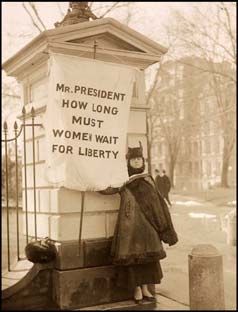
5

Amendment. Antisuffragists tried to overturn the vote, but after six more days of legal
maneuvering, the Tennessee governor signed the certificate of ratification and mailed it to
Washington on August 24. Two days later, on August 26, Secretary of State Bainbridge Colby
signed the 19th Amendment into law.

Equal Rights Amendment and Post-Suffrage Activities
          Once suffrage was achieved, the NWP regrouped and focused its attention on passing a
federal Equal Rights Amendment (ERA), drafted by Paul and first introduced in Congress in
December 1923. The party withstood attacks from women’s groups who opposed the ERA as a
threat to sex-based protective labor legislation and kept the issue alive for decades until the
renewed ERA campaign in the 1970s.
          Throughout the 20th century, the NWP remained a leading advocate of women’s political,
social, and economic equality. In the 1920s, the NWP drafted more than 600 pieces of legislation
                                                   in support of equal rights for women on the state and
                                                   local levels, including bills covering divorce and custody
                                                   rights, jury service, property rights, ability to enter into
                                                   contracts, and the reinstatement of one’s maiden name
                                                   after marriage. It launched two major “Women For
                                                   Congress” campaigns in 1924 and 1926 and lobbied for
                                                   the appointment of women to high federal positions. The
                                                   party also worked for federal and state “blanket bills” to
 NWP envoys, comprised mostly of western women,    ensure women equal rights and was instrumental in
 motor to Rapid City, South Dakota, to meet with a changing federal legislation to provide equal nationality
 vacationing President Calvin Coolidge and ask his
 support of the Equal Rights Amendment pending in  and citizenship laws for women, including the Cable Act
 Congress. July 1927.                              of 1922 and its subsequent revisions–the Dickstein-
 About this image
                                                   Copeland Bill of 1934 and the Equal Nationality Treaty
                                                   of 1934.
          Also in the 1930s, the NWP fought successfully for the repeal of Section 213 of the
Legislative Appropriations Act of 1932 (Economy Act), which prohibited federal employees
from working for the federal government if their spouses also were federal employees. NWP
lobbying helped to eliminate many of the sex discrimination clauses in the National Recovery
Administration’s codes and assisted in the adoption of the Fair Labor Standards Act of 1938.
          International feminism became an increasing interest of Paul and the NWP as early as the
1920s. Paul formed an International Advisory Council to the NWP in 1925 and assisted in the
establishment of the Inter-American Commission of Women (IACW) at the Sixth Pan-American
Congress in Havana, in 1928. She also formed a World Woman’s Party in 1938, which first
assisted Jewish women fleeing the holocaust and then became the NWP’s office for promoting
equal rights for women around the world, especially in the years immediately before and after
World War II. The NWP helped both Puerto Rican and Cuban women in their suffrage
campaigns and was instrumental in the lobbying for the establishment of a permanent United
Nations Commission on the Status of Women.
          The NWP successfully campaigned for the inclusion of Title VII in the Civil Rights Act
of 1964 and remained a political action committee until 1997. Its greatest impact, however, was
during the suffrage campaign (when its membership reached its height at 50,000) and the two

The Library of Congress | American Memory
Women of Protest: Photographs of the Records of the National Woman’s Party
6
decades thereafter, which is the 25-year period featured in Women of Protest: Photographs from
the Records of the National Woman’s Party.
For more detailed information on the NWP’s activities, see the Detailed Chronology
(PDF) associated with this Web presentation.
Notes
1. Mary Ware Dennett to Alice Paul, 3 February 1913, and Anna Howard Shaw to Alice Paul, 5
March 1913, National Woman’s Party Records, Group I, Manuscript Division, Library of
Congress. (Return to text)
2. Linda G. Ford, Iron Jawed Angels: The Suffrage Militancy of the National Woman’s Party,
1912-1920 (Lanham, MD.: University Press of America, 1991), 3. (Return to text)
The Library of Congress | American Memory
Women of Protest: Photographs of the Records of the National Woman’s PartyYou can also read


