How banks can use AI to transform the customer experience - May 2020 - In collaboration with - Efma
←
→
Page content transcription
If your browser does not render page correctly, please read the page content below
REPORT

How banks can use AI
to transform the
customer experience
May 2020

 In collaboration with

The expert’s point of view

Over the last 12 months, Efma’s senior advisor Rudradeb Mitra had the opportunity to interact with
bankers (C-level executives as well as department heads) from over 20 countries, from Africa, Asia,
Europe, and South America, and the most common question he encountered was – ‘Is AI all hype’?

Let me answer this question through the story of Segway Inc. Segway Inc. was founded by Dean Kamen with a
dream of making a zero-emission transportation vehicle. Right from the beginning, it got a lot of interest, and it
was speculated “to be the fastest company to reach $1 billion in sales” and “to become more important than
the internet”. It was backed by people like Amazon’s Jeff Bezos and Apple’s Steve Jobs. The rest is well-known
history. Segway never even came close to its promises and can be considered a failure.

There were many reasons for the failure of Segway but the most important reason, as mentioned by Ron Bills,
CEO of Segway in 2004, was a lack of focus on the value creation. What problems does a Segway solve? And
at what costs (a Segway is not affordable for the majority of people)? Where could it be integrated into traffic?
Where could it be charged? Most of these questions remained unanswered, and consequently, the Segway could
not live up to the initial hype.

Great technology does not necessarily make a successful product. Success is always based on the
value created. So keep it simple stupid and focus on creating value.

Artificial intelligence has all the right ingredients to be a disruptive technology. However, now it is time to lay the
foundation for the future. It can either become another over-hyped technology or the next internet or something
even more significant.

One of the key places where banks can create a lot of value is improving customer experience.

‘‘
       I think the most important thing is to have empathy and really listen to your
       customers. I cannotThe full  content ofenough
                                 emphasize        this report
                                                          howisimportant
                                                                   exclusively it isreserved   for talk as if
                                                                                      to not simply
       you are customer Efmacentric.
                               memberYou   institutions. If you
                                               need to live   andwish     to know
                                                                     breathe    this more
                                                                                       everyabout
                                                                                              day.
                         gaining    full access   to
       Ben Chisell, product director at Starling Bank.exclusive    content,   as   well  as other
                        benefits, go to www.efma.com/joinefma or contact
                                           membership@efma.com
In the past, the banking customer experience   was mostly restricted to in-branch, from the point a customer enters
a bank branch to the point she leaves it. In such a scenario, it was easier to listen to each individual customer
and build relations. These days, however, most customers interact with their banks via devices, which is both
an opportunity and a threat. Opportunities such as this give direct, 24/7 access to customers with a lot of
personalized data but can also be a threat if banks decide to keep on using old models of customer experience
and engagement.
                                                                                                                          3
In today’s digital era, banks need to build new customer-centric models to comfort actual
        psychology of decision making and offer personalized communications, interactions, and
        acquisitions. Such models will ensure that banks can bring every individual customer back
        to the forefront of their operations.

    Using machine learning to learn patterns in customer experience

‘‘
          The future of business is consumer to business, not business to consumer.
          Businesses must customize for consumers.
          Jack Ma, executive chairman at Alibaba.

    Let us look at a couple of ways how businesses can customize to customers and see how AI can help create new
    customer centric models. Figure 1 shows the focus areas of banks in terms of achieving operational excellence,
    and the corresponding column represents the relevance of artificial intelligence in achieving the goal.

    Figure 1: Focus areas for operational excellence and artificial intelligence [1]

                          Focus area                              Operational                  Artificial
                                                                  excellence                 intelligence
     Increase transparency and frequency
     in communication
     Refocus on client risk/return profile

     Focus on easy-to-access and easy-to-deal with
     private bankers and simplify process
                       The full
     Enhance pro-activeness andcontent  of this
                                anticipation of report is exclusively reserved for
     client needs     Efma member institutions. If you wish to know more about
                       gaining full access to exclusive content, as well as other
     Simplify certain products
                      benefits, go to www.efma.com/joinefma or contact
                                      membership@efma.com
     Reduce # of relationships per relationship
     manager

     Enhance array of products

     Enhance technical and product skill set of
     private bankers
     Produce more reliable, timely management
     information and comprehensive external
     reporting

                                                     Relevance           High             Medium              Low

4     How banks can use AI to transform the customer experience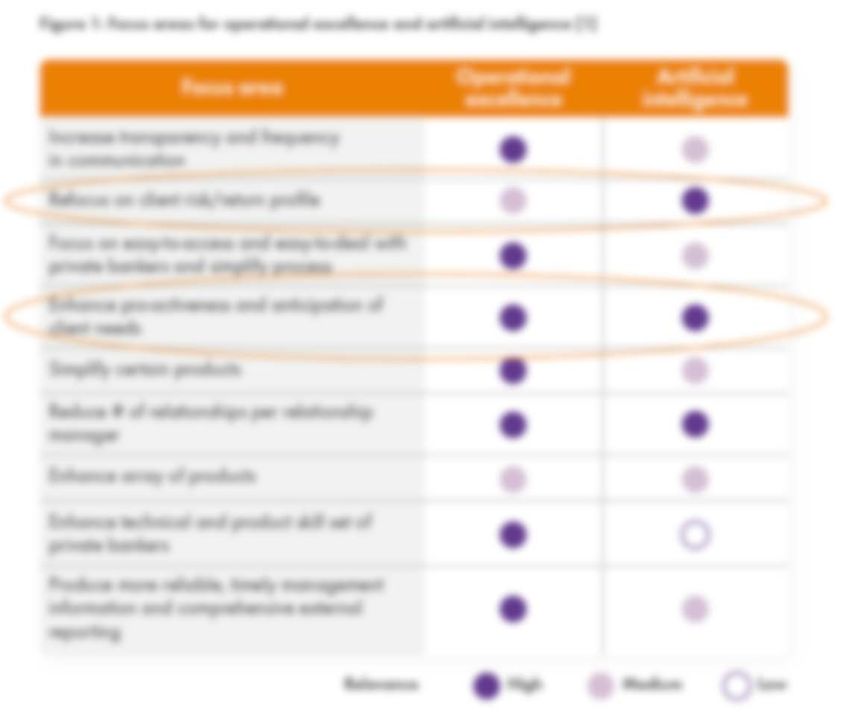
We will take two use cases from the focus areas and show how artificial intelligence can be used.

Case I: Predicting customer needs and creating customized communications

Imagine that you are a customer who is thinking of buying a car and around the same time, you receive a
communication from your bank informing you that you are entitled to excellent loan terms if you take out a car
loan in the next five days. Bingo! Won’t that make you feel like your bank values and cares for you?

Banks can model series of actions taken by customers in the past and use that to predict future behaviors. To
achieve this, Recurrent Neural Networks (RNNs) are the obvious candidate. One of the appeals of RNNs is
that they can be used to connect previous information to the present task. Long short-term memory (LSTM), for
example, is a type of RNN that can be trained with past behavior data and used to build an approximation
model of the process. Another algorithm that can be used is Word2Vec, which is a simple neural network that
can be used to model semantic relations between various parameters. For example, it can produce a model for
the following situation: If person X (with a certain persona) spends US$200 and earned US$500, then he is
likely to do activity Y this month.
                             The full content of this report is exclusively reserved for
                    Efma member institutions. If you wish to know more about
                     gaining
Figure 2: LSTM network [2]    full access to exclusive content, as well as other
                    benefits, go to www.efma.com/joinefma or contact
                                    membership@efma.com
                                      Customer history

           LSTM cell                            LSTM cell                            LSTM cell

     Behavior 1                           Behavior 2                           Behavior 3

       8:01 am                             12:11 am                             17:15 am

                                                                                                                 5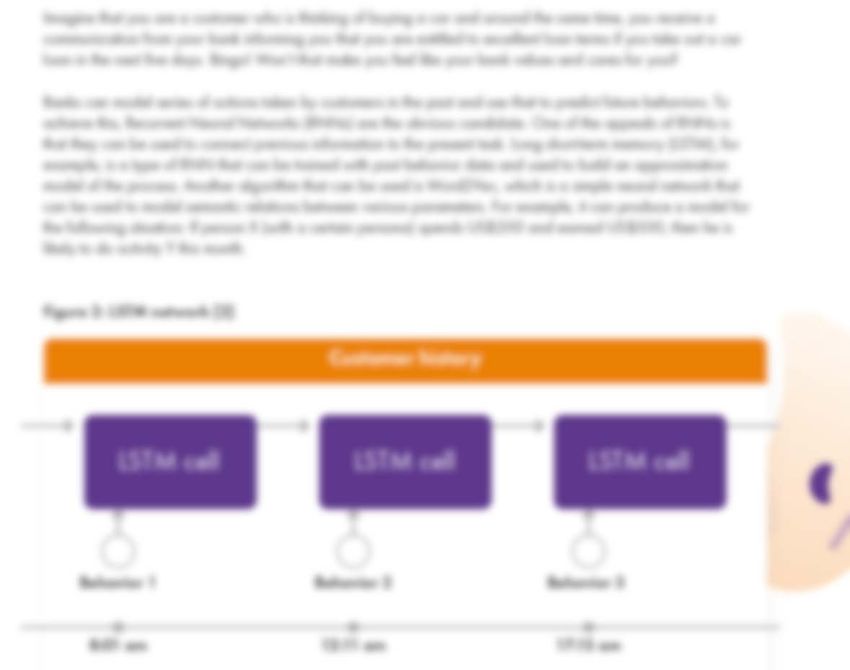
You can also read


