How will climate change affect Arctic caribou and reindeer? - Phys.org
←
→
Page content transcription
If your browser does not render page correctly, please read the page content below
How will climate change affect Arctic
caribou and reindeer?
1 December 2017, by Conor Mallory

                                                         languages across the world, such as tuktu in
                                                          Inuktitut.)

                                                         A complicated problem

                                                         Just how this iconic Arctic species will be affected
                                                         in a warming climate remains unclear.

                                                         Current predictions suggest that the climate will
                                                         continue to change for decades into the future,
                                                         regardless of the mitigation actions we take.

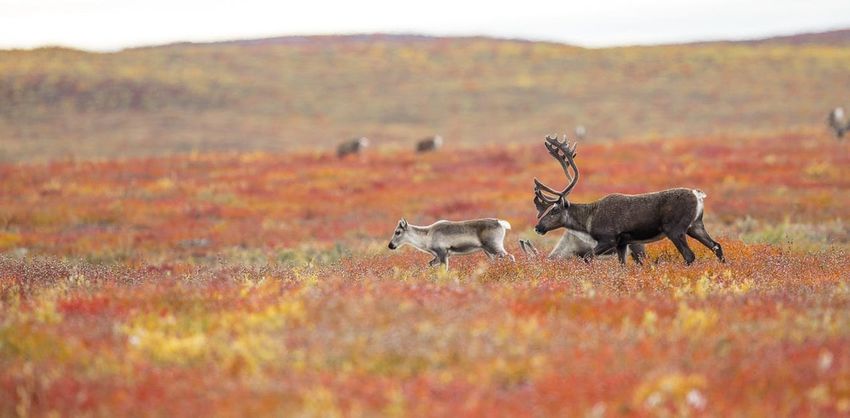
Barren-ground caribou in autumn near Kugluktuk,          Caribou and reindeer have tremendous
Nuanvut. Credit: Mathieu Dumond/Umingmak                 socioeconomic value in the north, and if we want to
Productions                                              maintain sustainable caribou harvesting and
                                                         husbandry in the future, we must understand how
                                                         they will respond to environmental change.

This spring, I spent close to two weeks flying over My colleagues and I reviewed hundreds of scientific
central Nunavut, peering out the window of a small  papers that studied caribou and reindeer from
plane at the rolling tundra below, looking for and  Alaska to Nunavut to Russia. By the end, we
counting caribou to monitor their numbers.          produced a complete picture of how climate change
                                                    may affect the caribou and reindeer species, based
The Qamanirjuaq barren-ground herd were arriving on current knowledge.
on their tundra calving grounds to give birth after
migrating from winter ranges in the boreal forest.  We found that it's challenging to make general
At times caribou dotted the landscape all the way predictions. The species has a circumpolar
to the horizon.                                     distribution and inhabits a variety of ecosystems,
                                                         both similar and distinct. How different populations
The terrain here is relatively pristine. There are few   will respond to varying effects of climate change in
communities or developments. Due to the                  this diverse range of systems is complex.
remoteness of the herd's habitat, it is, in some
ways, hard to imagine that human                         Summer effects
activities—whether climate change or industrial
disturbance—could ever be of much concern to             In many regions, climate change is causing longer
them.                                                    and warmer summers. In the context of caribou,
                                                         which live in colder regions, this typically means
And yet, we know that human activity and                 longer growing seasons and better access to
disturbance provide the most imminent threat to          nutritious plants throughout the summer months.
the persistence of many caribou and reindeer
populations. (Reindeer and caribou are the same          But plants are not the only part of the ecosystem
species, Rangifer tarandus, but have different           affected by longer and warmer summers.
English names in North America and Eurasia. Of
course, the species has many names in different          Parasitic flies, particularly warble flies and botflies,

                                                                                                           1/3
torment caribou during the summer months. These more calf deaths.
 insects aren't just looking for blood like mosquitoes
 and black flies—they're trying to lay their eggs on a Winter effects
 caribou's skin or in its nose.
                                                       Winter warming produces similarly complex
 As you can likely imagine, caribou want no part of effects.
 this. They will spend hours running to escape these
 parasites, which means they spend less time           Climate change is predicted to increase the
 feeding.                                              frequency of winter icing. Icing is usually caused by
                                                       rain-on-snow or thaw-freeze events, and presents a
 For a given region or herd, will increased plant      real problem for caribou.
 growth or increase insect harassment have more of
 an effect on caribou?                                 During the winter caribou dig in the snow to get to
                                                       food underneath. Icing events trap food beneath an
                                                       impenetrable layer of ice. These events have led to
                                                       mass starvation of Arctic caribou and reindeer in
                                                       the past.

                                                       On the other hand, longer autumns and earlier
                                                       springs shorten the winter period of food scarcity.
                                                       This should benefit caribou, but the net effect will
                                                       depend on the balance of these changes in a given
                                                       region.

                                                       These are just some of the wide-ranging potential
                                                       implications of climate change for Arctic caribou
                                                       and reindeer. They may also shift their ranges
                                                       northward and alter their migratory behaviour in
                                                       response to climate change, or begin sharing their
                                                       lands with new or increased competitor species
Svalbard reindeer are the smallest subspecies of       such as moose and white-tailed deer.
reindeer. Credit: Per Harald Olsen/Wikimedia
                                                       Importance of caribou and reindeer

                                                       Caribou and reindeer provide incredible value
We're already seeing some of these effects play        throughout the circumpolar world. In ecological
out.                                                   terms, they are the most abundant large terrestrial
                                                       herbivore. They have important grazing effects on
In Svalbard, Norway, warmer summers have been plant communities and support predator
generally positive for caribou, as better plant growth populations.
has led to heavier animals in the fall. But in Arctic
North America, more green growth has been              The ecological importance of caribou means that
associated with declines in caribou populations,       changes to caribou and reindeer populations affect
possibly due to the northward expansion of less        many other organisms, including wolves, Arctic
nutritious shrubs.                                     shrubs and lichens.

Research has shown that insects have been              They also have huge socioeconomic value. One
trouble for caribou in Arctic Finland. There, warmer   report conservatively suggests that three herds in
weather brought more insects that harassed             northern Canada provide the equivalent of $20
caribou calves, which led to less weight gain and      million dollars annually in food alone. Semi-

                                                                                                     2/3
domesticated reindeer similarly contribute huge
                                   value to those who herd them, including the Saami
                                   people of Finland, Russia, Norway and Sweden.

                                   If there is a silver lining to this, it's that we know
                                   caribou and reindeer live in a wide variety of
                                   environments and ecosystems—and this may
                                   provide them with some resilience.

                                   But we don't know if their ability to adapt is
                                   sufficiently agile to respond to the ongoing rapid
                                   environmental change in the north.

                                   Scientists like myself need to work together with
                                   wildlife managers and harvesters to unravel the
                                   complexity of responses to environmental change.
                                   This information will be key to making decisions
                                   about caribou going forward.

                                   This article was originally published on The
                                   Conversation. Read the original article.

                                    Provided by The Conversation
                                   APA citation: How will climate change affect Arctic caribou and reindeer? (2017, December 1) retrieved
                                   24 March 2021 from https://phys.org/news/2017-12-climate-affect-arctic-caribou-reindeer.html

                                   This document is subject to copyright. Apart from any fair dealing for the purpose of private study or research, no
                                   part may be reproduced without the written permission. The content is provided for information purposes only.

                                                                                                                                                3/3

Powered by TCPDF (www.tcpdf.org)
You can also read


