HSE Business Plan
2019/20
←
→
Page content transcription
If your browser does not render page correctly, please read the page content below
HSE Business Plan 2019/20
2 | HSE Business Plan 2019/20

Introduction

O   ur purpose to prevent work-related death,           The year ahead will be significant in supporting
    injury and ill health is as valid today as it       government-wide activities on EU matters and
has always been.                                        contributing to the government’s fundamental
                                                        reform of the building safety system following the
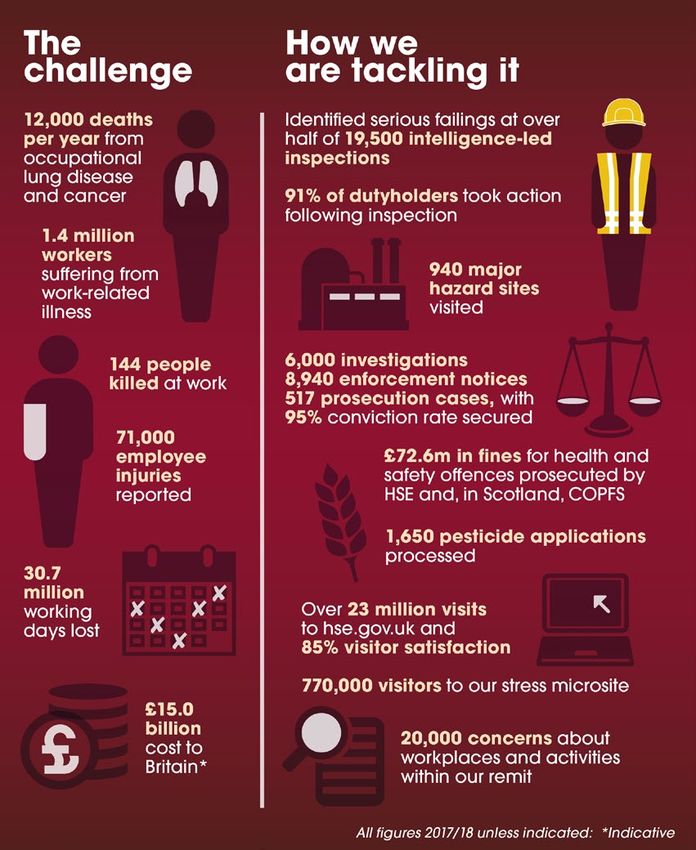
As the infographic opposite indicates, we apply         Grenfell Tower disaster.
a range of regulatory tools to improve health and
                                                        We are pleased that the recent independent Tailored
safety, bringing together different interventions
                                                        Review1 concluded that HSE is ‘a well-respected and
to achieve impact. We influence and engage
                                                        well-structured organisation that fulfils its statutory
stakeholders, create knowledge and awareness of
                                                        objectives effectively’, but we must continue to
health and safety risks, and encourage behaviour
                                                        evolve our regulatory approach to face fresh
change through assessments and direct interventions
                                                        challenges or to address existing problems in
including inspections and investigations.
                                                        new ways. We will therefore publish a new strategy
Our science, engineering and analytical capability      setting out our ambitions.
complements our policy and operational activities.
                                                        The world and our approach may change but one
It is internationally recognised for developing and
                                                        thing remains the same – the commitment of those
supporting practical solutions to workplace health
                                                        who work for HSE to reduce risk, protect people and
and safety problems.
                                                        the environment and to save lives.
This plan outlines our key areas of work for 2019/20;
                                                        We are privileged to lead them to deliver on the
reinforcing our existing commitment to:
                                                        commitments outlined in this plan.
●● lead and engage with others to improve
   workplace health and safety;
●● provide an effective regulatory framework;
●● secure effective management and control of risk;
●● reduce the likelihood of low-frequency, high-
   impact catastrophic incidents;
●● enable improvement through efficient and
   effective delivery.
Our work builds on the sound regulatory framework
HSE has helped develop and on our focus on
reducing workplace harm. We will:
●● continue to tackle long-standing problems
   such as work-related ill health and help smaller
                                                        Martin Temple                   David Snowball
   businesses to manage risks proportionately;
                                                        Chair                           Acting Chief Executive
●● deal with emerging risks such as the
   decommissioning and dismantling of offshore
   oil and gas infrastructure;
●● continue to work collaboratively with other
   regulators where our interests align;
●● hold people to account and take enforcement
   action when they fail to manage work-related risk.

                                                        1   www.gov.uk/government/publications/health-and-
                                                            safety-executive-tailored-review

                                                                      HSE Business Plan 2019/20 | 3
Contents

 5   Our plan on a page
 7   Lead and engage with others to improve workplace health and safety
11   Provide an effective regulatory framework
13   Secure effective management and control of risk
19   Reduce the likelihood of low-frequency, high-impact catastrophic incidents
23   Enable improvement through efficient and effective delivery
28   Financial outlook for 2019/20
29   Monitoring our delivery

4 | HSE Business Plan 2019/20

Our plan on a page

                                                       Our mission
                     The prevention of death, injury and ill health
                to those at work and those affected by work activities

                                                      Our objectives

Lead and engage                  Provide an             Secure effective               Reduce the likelihood of
with others to                   effective              management and                 low-frequency, high-impact
improve workplace                regulatory             control of risk                catastrophic incidents
health and safety                framework

                                             Our priorities for 2019/20
●● Continue to focus our         ●● Support the         ●● Target our inspections      ●● Provide assurance that
activity on tackling ill         government’s           on specific issues and         dutyholders are identifying
health as part of the Heath      fundamental            activities, including          and managing the major
and Work programme               reform of the          a sustained focus on           hazard risks they create
●● Promote proportionality       building safety        work-related ill health        ●● Strengthen major hazard
in health and safety             system following       ●● Investigate to              leadership and worker engagement
management                       the Grenfell           swiftly tackle and
                                 Tower disaster                                        ●● Deliver robust and consistent
●● Share the learning                                   reduce risks, securing         regulation of decommissioning
from our expert science          ●● Contribute to       accountability for             and dismantlement of offshore
and research with those          government-wide        victims and their families     oil and gas infrastructure
who can influence                activities on the      ●● Operate effective
                                 UK’s departure                                        ●● Secure improvements in
workplace health and                                    statutory schemes,             the effective management of
safety performance               from the EU            ensuring the safe              network assets including gas
                                                        use of potentially             risers in high-rise homes
                                                        harmful substances
                                                                                       ●● Drive dutyholders to reduce the
                                                                                       risk of offshore hydrocarbon releases
                                                                                       ●● Raise operators’ focus on cyber
                                                                                       security to ensure appropriate
                                                                                       protection against major incidents

          Enable improvement through efficient and effective delivery

                                                      Our enablers
●● Develop our strategy and put in place the            ●● Support our people to be          ●● Secure a sustainable
building blocks to ensure we are fit for the future     the best they can                    financial future for HSE

                                                                                     HSE Business Plan 2019/20 | 5
6 | HSE Business Plan 2019/20

Lead and engage with others to
improve workplace health and safety

O    ur Helping Great Britain work well strategy2
     recognises a need for broad ownership of
health and safety. Anyone who carries out or
                                                        work with others across government departmental
                                                        boundaries to address national issues, for example
                                                        improving health outcomes as described in the
influences workplace activities or behaviours has       NHS long-term plan for England.
a key role. We are committed to playing our part in
                                                        As well as tailoring direct interventions with
enabling others create healthier, safer workplaces.
                                                        individual businesses to achieve behavioural
Using our expertise, we are helping to reduce
                                                        change, we provide:
the cost of workplace injury and ill health to the
economy while helping improve productivity.             ●● focused engagement and collaboration
We have a key role in advising the GB and                  across networks with a strong interest in
devolved governments’ wider health and                     improving work-related health and safety. This
work priorities. As the governments’ chief                 includes employees and employers, trade
occupational health adviser,3 we have expertise            unions, industry associations, professional
in the causes of work-related ill health, and the          institutions and third-sector bodies, alongside
measures which can prevent or minimise it.                 other government agencies and regulators;
However, the health of the working population is        ●● guidance and advice which is accessible,
not solely related to workplace conditions.                understandable, meets the needs of users, and
Our aim is to reduce work-related ill health               encourages proportionate risk management;
through the application and enforcement                 ●● world-class science and evidence to
of health and safety legislation, and by                   support our regulatory activities, and provide
supporting and seeking to influence wider                  access to our know-how, specialist facilities
health interventions where they are linked                 and research to improve workplace health
with work and employment. For example, we                  and safety performance.
provide advice to the joint Work and Health Unit
at the Department for Work and Pensions and             We continue to work closely with local
Department of Health and Social Care.                   authorities (LAs) as co-regulators. Our joint LA/
                                                        HSE Statement of Commitment sets out the
We see opportunities in bringing our expertise to       shared vision for the ongoing co-regulatory
                                                        partnership. This describes how working together
2   www.hse.gov.uk/aboutus/strategiesandplans/          as effective, modern and professional regulators
3   www.hse.gov.uk/aboutus/strategiesandplans/health-
                                                        will secure the positive benefits of world-leading
    and-work-strategy/health-and-work-strategy.pdf      workplace health and safety.

    Our priorities for 2019/20

●● Continue to focus our activity on tackling ill health as part of the Heath and Work programme
●● Promote proportionality in health and safety management
●● Share learning from our expert science and research with those who can influence workplace
    health and safety performance

                                                                     HSE Business Plan 2019/20 | 7
Lead and engage with others to
improve workplace health and safety

Continue to focus on tackling ill health as part of the Health and Work programme

Overall approach to ill health                           Musculoskeletal disorders
2019/20 marks the third year of our focus on tackling    MSDs are the second most common reported cause
three major causes of work-related ill health –          of work-related ill health in Great Britain, accounting
musculoskeletal disorders (MSDs), occupational lung      for 35% of all cases and 25% of all working days lost
disease (OLD) and work-related stress (WRS).             due to ill health.
Each of the areas of ill health has its own priority     2019/20 continues to build on our work from previous
plan.4 Our success will be measured through overall      years and will inform future years’ activity.
changes in attitudes, behaviour and use of control
measures.
Alongside our primary regulatory role, we will             Our deliverables
continue to foster collaborative relationships with
other parts of government in England, Scotland             Complete a programme of MSD                     –
                                                           inspections and related communications
and Wales. Joining up approaches will build                activity with particular emphasis on
better outcomes on common health problems,                 the manufacturing sector. See ‘Secure
occupational health advice services and the wider          effective management and control of risk’
wellbeing agenda.                                          (pages 13–18)

                                                           In partnership with the transport and          Q2
                                                           logistics sectors, complete preparatory
                                                           studies on behaviour change in parcel
    Our deliverables                                       carriers
    Establish a Partnership Agreement with        Q4
    the new Public Health Scotland body
    (and occupational health services)

    Establish a Partnership Agreement with        Q3
    Healthy Working Wales

4    www.hse.gov.uk/aboutus/strategiesandplans/health-
     and-work-strategy/

8 | HSE Business Plan 2019/20
Lead and engage with others to
improve workplace health and safety

Occupational lung disease                              Work-related stress
Occupational respiratory disease is estimated to       Stress, depression or anxiety is the most commonly
result in approximately 12 000 deaths each year.       reported cause of work-related ill health in Great
Our work in 2019/20 focuses on reducing exposure       Britain, accounting for 44% of all cases, and 57% of all
to carcinogens and asthmagens, through the use of      working days lost due to ill health.
integrated intervention campaigns, with a particular   Our focus is on supporting the provision of
emphasis on reducing the cancer risk from exposure     appropriate tools to support the management
to welding fumes.                                      of stress.

 Our deliverables                                        Our deliverables
 Complete a programme of OLD inspections       –         Publish bespoke work-related stress            Q3
 and related communications activity                     material for public sector organisations,
 focusing on woodworking, bakeries and                   including ‘Talking Toolkits’ informed by
 fabricated metals. See ‘Secure effective                HSE’s public stress pilots and work on
 management control of risk’ (pages 13-18)               violence in the NHS and Prison Service

                                                         Publish updated advice for SMEs on            Q4
                                                         assessing work-related stress risks using
                                                         the Management Standards

                                                                      HSE Business Plan 2019/20 | 9
Lead and engage with others to
improve workplace health and safety

Promote proportionality in health and                      Share learning from our expert science
safety management                                          and research with those who can influence
                                                           workplace health and safety improvement

Many small and medium enterprises (SMEs) still feel
health and safety places excessive or unnecessary
demands on them. Often these are driven by health
and safety ‘rules’ set by third parties (referred to as
‘blue tape’), not regulations. For SMEs trying to do the
right thing, the difference may be unclear.
Our own insight work has confirmed that some SMEs
find HSE’s website difficult to navigate and it can be
challenging to find the information they need. Our
areas of focus to support SMEs are:
●● improving our guidance material, designing it
   specifically around user needs;
●● continuing to put in place the necessary                Our approach is outlined in our Science and
   building blocks to improve website user                 evidence strategy.5
   experience from 2020/21;                                We will continue to support the health and safety
●● developing new relationships to increase our            system through evidence from applied health and
   reach and promote our guidance offer;                   safety research, and our work to address challenges
●● reducing the perceptions that good health and           from new working practices to enable the healthy
   safety management is a burden.                          and safe introduction of new technologies.
                                                           We will make our science available to those who
                                                           need it, in a form which meets their needs. We aim to
                                                           ensure that the data and knowledge we generate is
  Our deliverables
                                                           promoted and used to maximise its impact.
  Publish a summary report of blue-tape          Q1        The quality of our practical, solution-oriented
  evidence
                                                           science means the knowledge we generate can
  Report to the Board on progress to             Q4        help dutyholders improve their performance while
  address the issues in the blue-tape                      protecting the health and safety of their employees
  evidence report                                          and the public.
  Develop new guidance focusing on risk          Q4
  management and control, which will be
  subject to user testing in 2020/21
                                                               Our deliverables
                                                               Informed by our measuring strategy,           Q2
                                                               implement a coordinated and consistent
                                                               approach to measurement to assess
                                                               the impact of the health and work
                                                               programme, and make this approach
                                                               visible nationally and internationally

                                                               To coincide with British Science Week,        Q4
                                                               publish a series of case studies within the
                                                               Annual Science Review which link to HSE’s
                                                               2019/20 campaigns

                                                           5    www.hse.gov.uk/research/content/science-evidence-
                                                                strategy-1620.pdf

10 | HSE Business Plan 2019/20
Provide an effective
regulatory framework
T he goal-setting and risk-based health and
safety regulatory framework is founded on
two enduring principles:
We maintain our regulatory framework in
keeping with the government’s Better Regulation
principles (targeted, proportionate, consistent,
transparent and accountable). We share
●● those who create risks have a responsibility to
examples of good practice with others and
manage them;
build a common understanding of what a
●● action should be proportionate to the risks proportionate management approach to
that need managing. health and safety looks like.
It is mature and well developed and has stood We also conduct our activities in line with
the test of time and recent scrutiny. the Regulators’ Code,6 including taking
economic growth into account.
We have worked hard to reduce unnecessary
complexity, repeal outdated laws, and cut We will continue to contribute to the
out duplication without reducing standards or government’s work on the UK’s exit
compromising protection. All new regulations from the European Union (EU), including
are subject to post-implementation reviews helping to deliver the government’s
to establish whether they have achieved their commitment to protect workers’ rights.
original objectives, remain proportionate and
Our contribution to the government’s
are still required.
fundamental reform of the building safety
HSE plays its part in supporting the government’s system following the Grenfell Tower
Better Regulation agenda and the ambitions disaster will be a continuing priority for
of the Industrial Strategy, ensuring we support HSE over the forthcoming years.
innovation, introduction of new technology and
enabling improvements in productivity.
6 www.gov.uk/government/publications/regulators-code
Our priorities for 2019/20
●● Support the government’s fundamental reform of the building safety system following
the Grenfell Tower disaster
●● Contribute to government-wide activities on the UK’s departure from the EU
HSE Business Plan 2019/20 | 11Provide an effective
regulatory framework
Support the government’s fundamental Contribute to government-wide activities
reform of the building safety system on the UK’s departure from the EU
following the Grenfell Tower disaster
Based on the findings of Dame Judith Hackitt’s
independent review,7 the Ministry of Housing,
Communities and Local Government (MHCLG)
published Building a Safer Future – An Implementation
Plan8 in December 2018. This outlines the next steps
in transforming the regulatory and accountability
framework for building safety.
We are committed to helping transform that
framework and are a member of the independently-
chaired Joint Regulators Group (JRG), set up to
develop and test reforms to the regulatory system.
We are also engaging with the Scottish and Welsh
governments on their response to Grenfell. The development of standards on health and
HSE is deploying operational capability in support safety is increasingly global and HSE will develop
of the remediation and management of the Grenfell its international engagement to ensure it continues
Tower site and to the Metropolitan Police Service to deliver strong influence on outcome-focused
investigation, Operation Northleigh. standards.
Through targeted inspections with building control The UK’s withdrawal from the EU will require changes
and fire safety regulators, we are also providing to the chemicals regime to ensure its continued
assurance that the aluminium composite materials operability.
(ACMs) cladding replacement programme is being We will progress our two-year transition programme
carried out safely. to move from post-EU Exit status of ‘interim operating
capability’ to ‘future operating capability’. This
will enable HSE to deliver an effective regulatory
Our deliverables framework for the supply and use of chemicals.
Actively contribute to the fundamental Ongoing
reform of the building safety system as
a member of the JRG and its working Our deliverables
groups [subject to appropriate funding
from MHCLG] HSE will contribute as necessary to Ongoing
Key deliverables will be in line with delivery of the government’s objectives
the JRG workplan and will include for exit from the EU
contributing to the response plans for
Scotland and Wales
Working with Defra, the devolved Q1
administrations and other key regulators
including the Environment Agency, deliver
Carry out a programme of inspections Q4 a suite of regimes for regulating the
of ACM cladding removal to support the
MHCLG Building Safety Programme supply and use of chemicals
7 www.gov.uk/government/collections/independent-
review-of-building-regulations-and-fire-safety-hackitt-
review#final-report
8 www.gov.uk/government/publications/building-a-safer-
future-an-implementation-plan
12 | HSE Business Plan 2019/20Secure effective management
and control of risk
O ne of the foundations of our role as
a regulator is to secure the effective
management and control of risk. We use different
lessons and ensure necessary measures
are in place to prevent recurrence.
interventions to assess and secure effective Where businesses are not managing risks
management and control of hazards and to people’s safety or health, we secure
remove risk from the workplace. These include improvements in line with our enforcement
inspections, investigations, permissioning and policy and enforcement management model.
licensing regimes. Our activities are based on Through proportionate enforcement action,
intelligence and targeting in line with published we seek to prevent harm, secure sustained
sector strategies. improvement in the management of health and
Our oversight of the chemicals industries enables safety risk and hold people to account when they
the safe and sustainable use of thousands of fail to meet their obligations to protect people.
pesticides and biocides. Through our work we
Where appropriate, we prosecute those who
reduce the potential harm to people or the
behave in a reckless way or where there has
environment and ensure essential products
been a serious breach of duty.
remain on the market and can be used safely.
We investigate incidents, causes of ill health Our approach supports a level playing field for
and health and safety concerns (complaints), those who invest appropriately in managing risk
in line with our published selection criteria. and working safely, deterring those businesses
In addition to drawing upon our science who fail to meet their obligations or deliberately
and engineering specialists and facilities to break the law and place people at risk.
provide forensic analysis, we work with other We amplify the outcomes from our frontline
regulators, the police and local authorities, inspection, investigation and enforcement
to determine causes, learn and share activities with modern communication techniques.
Our priorities for 2019/20
●● Target our inspections on specific issues and activities, including a sustained focus on
work-related ill health
●● Investigate to swiftly tackle and reduce risks, securing accountability for victims and
their families
●● Operate effective statutory schemes, ensuring the safe use of potentially harmful substances
HSE Business Plan 2019/20 | 13Secure effective management
and control of risk
Target our inspections on specific issues and activities, including a sustained focus on
work-related ill health
Our inspection campaigns for 2019/20 align
with the specific issues outlined within our
sector plans9 and health priorities.
These will be supported by communications
activity and, where appropriate, we will revisit sites
previously inspected to evaluate whether there is
evidence of sustained and improved compliance.
Manufacturing
Fabricated metals
Previous inspection campaigns found significant
levels of uncontrolled risk, particularly in relation to
activities and processes that can cause ill health.
Inspections will focus on the control of carcinogens
and asthmagens specifically associated with welding
fumes and metalworking fluids.
Food and drink manufacture
Inspections will focus on the movement, storage and
handling of heavy loads and from repetitive tasks
which cause MSDs.
We will also focus on the control of asthmagens
arising from flour dust in bakeries.
Woodworking
Inspections will focus on ill-health risks, particularly
occupational asthma and sino-nasal cancer which
can result from poor control of exposure to wood dusts.
Our deliverables
Woodworking – Programme of inspections Q1
to approximately 1 in 10 premises
Food and drink – Programme of inspections Q2
to approximately 1 in 5 premises
Fabricated metals – Programme of Q4
inspections to approximately 1 in 15
premises
9 www.hse.gov.uk/aboutus/strategiesandplans/sector-
plans/
14 | HSE Business Plan 2019/20Secure effective management
and control of risk
Waste and recycling Agriculture
Building on previous campaigns, inspection activity The agriculture sector continues to have a high rate
will focus specifically on the management of of workplace fatalities, injuries and ill health.
maintenance activities and safe isolation practices to Inspections will include those businesses invited
prevent fatal and serious incidents within this industry. to attend our insight-led agricultural compliance
We will also inspect selected premises to assess how events and will focus on the range of workplace risks
effectively the health risks associated with exposure to covered in those events.
bioaerosols are being managed. We will also inspect selected premises to assess the
management of risks associated with livestock in
response to persistent fatal incident rates in this area.
Our deliverables
Programme of inspections to Q3
approximately a third of premises where Our deliverables
intelligence received from other regulators
indicates known poor performance Programme of inspections to 10% Q4
of businesses invited to attend an
agricultural compliance event.
These will be split (pro-rata) between
attendees and non-attendees
HSE Business Plan 2019/20 | 15Secure effective management
and control of risk
Construction Fairgrounds
Construction remains a hazardous industry, and while Industry performance in relation to public safety
performance has improved, the levels of incidents is comparatively good, given the number of
and ill health remain high. Our inspection activities visitors to fairgrounds and theme parks, and
will focus on: number of rides taken annually. However,
●● SMEs carrying out refurbishments; recent incidents highlight the risk of failure or
incorrect operation of some rides which can
●● embedding the requirements of the Construction result in fatalities and multiple serious injuries.
Design and Management Regulations 2015 (CDM)
through targeted inspections of dutyholders Public safety is our inspection priority alongside the
providing principal designer services; control of risks to the public both from fixed and
travelling fairgrounds. Our emphasis will be on the
●● prevention and control of occupational lung standards of inspection and maintenance of rides
disease (especially asbestos and dust) and and the control of risks associated with inflatables.
musculoskeletal disorders.
Our deliverables
Our deliverables
Programme of inspections both to fixed Q3
Two health-focused inspection initiatives Q1 & and travelling fairgrounds
to approximately 2000 dutyholders
covering a representational range of site Q3
types and activities
16 | HSE Business Plan 2019/20Secure effective management
and control of risk
Investigate to swiftly tackle and reduce Operate effective statutory schemes,
risks, securing accountability for victims ensuring the safe use of potentially
and their families harmful substances
Investigation work, whether measured by its impact Chemicals industry
on health and safety or by the speed, ease and Our oversight of the chemicals industry enables the
efficiency of our processes, continues to be one of safe and sustainable use of thousands of pesticides
our priorities. and biocides.
We will continue to investigate incidents and health HSE has a statutory role to identify chemical risks and
and safety concerns in line with our published ensure those responsible reduce these risks to levels
selection criteria and we will seek timely completion that are acceptable to society.
of both fatal and non-fatal investigations.
We will continue to:
When consistent with HSE’s enforcement policy,
we will prosecute those who commit serious ●● evaluate and make regulatory decisions on the
breaches of the law. authorisation of biocidal and plant protection
products, and approval of active substances
before they can be sold on the UK market;
●● monitor maximum residue levels of pesticides
Our deliverables
in food.
Fatal investigations – Complete 80% Ongoing
of fatal investigations within 12 months
of HSE receiving primacy
Our deliverables
Non-fatal investigations – Complete Ongoing
90% of non-fatal investigations within Aim to complete plant protection Ongoing
12 months of the incident product evaluations and authorisations
within the relevant deadlines
Aim to complete biocide product Ongoing
evaluation and authorisations within
the relevant deadlines
HSE Business Plan 2019/20 | 17Secure effective management and control of risk Asbestos licensing Work with asbestos requires a high degree of regulatory oversight. Asbestos can still be present in any building built or refurbished before the year 2000. Classed as a category 1 carcinogen, asbestos-related disease still kills around 5000 people each year. As part of this oversight, HSE operates a statutory asbestos licensing regime – granting and renewing licences to carry out higher-risk work with asbestos subject to sufficient demonstration and assessment that required standards can be met. We evaluate all licence applications and carry out a proportionate inspection programme of notified licensed asbestos removal work to ensure compliance. Our deliverables Programme of inspections of Q4 individual licensed contractors to ensure compliance with Control of Asbestos Regulations 2012 by individual licensees Complete asbestos licence Ongoing applications to time 18 | HSE Business Plan 2019/20
Reduce the likelihood of low-frequency,
high-impact catastrophic incidents

G    reat Britain has highly specialised,
     strategically important industries which are
essential to the country’s economy and social
                                                     ●● take proportionate action, including
                                                        enforcement, to ensure dutyholders make
                                                        improvements where there is evidence of
infrastructure but whose processes and hazard           significant shortfalls in control measures;
potential can cause great harm to their workers,
                                                     ●● provide advice to the planning system
the environment and the public.
                                                        to protect people around major hazard
A single incident with catastrophic                     sites, major hazard pipelines and licensed
consequences can undermine entire sectors               explosive sites.
by eroding public trust and acceptance of the
                                                     We work collaboratively with other regulators,
need for such activities.
                                                     agencies, government departments and
HSE’s regulatory approach is to provide              devolved administrations to promote
assurance that risks are being properly              cooperation, minimise duplication, coordinate
managed. The approach is described in our            joint regulatory activities, and share information
Major Hazard Regulatory Model.10                     and intelligence. We will not intervene if another
                                                     regulator has specific responsibility.
The aim of our regulatory activities in major
hazard sectors is to:                                We work closely with established stakeholder
                                                     fora in major hazard industries to drive and
●● confirm dutyholders have properly focused
                                                     influence behavioural change.
   their risk management efforts on major
   accident hazards, are controlling risks and
   complying with the law;

10 www.hse.gov.uk/regulating-major-hazards/major-
   hazards-regulatory-model.pdf

   Our priorities for 2019/20

●● Provide assurance that dutyholders are identifying and managing the major hazard risks
    they create

●● Strengthen major hazard leadership and worker engagement
●● Deliver robust and consistent regulation of decommissioning and dismantlement of offshore oil
    and gas infrastructure

●● Secure improvements in the effective management of network assets including gas risers in
    high-rise homes

●● Drive dutyholders to reduce the risk of offshore hydrocarbon releases
●● Raise operators’ focus on cyber security to ensure appropriate protection against major incidents

                                                                HSE Business Plan 2019/20 | 19
Reduce the likelihood of low-frequency,
high-impact catastrophic incidents
Provide assurance that dutyholders are Strengthen major hazard leadership and
identifying and managing the major worker engagement
hazard risks they create
We use intelligence from multiple sources to deliver a Our priority is to promote effective leadership across
programme of regulatory activities including: high hazard industries and gain commitments to
●● targeted Inspections to test dutyholders’ risk sustained improvement, so that ownership of risks is
management systems; taken by those with the responsibility to reduce them.
●● assessment of safety cases and reports by which Offshore workforce engagement will also be a key
dutyholders demonstrate how they control major inspection priority, promoting a strong proactive
hazards; safety culture supported by all who work in, and have
an influence on, the offshore working environment.
●● issuing licences, classifications and authorisations
for explosives manufacture, storage and transport
and genetically modified organism assessments;
Our deliverables
●● advising planning authorities on proposals for
hazardous substance consents and developments Complete an initial targeted programme Q4
around major hazard sites. of inspections at COMAH sites, assessing
senior executives and board leadership in
major hazard control, as a core element
of safety management systems
Our deliverables Complete an inspection programme in Q4
the offshore sector focusing on worker
A programme of proactive inspections Q4 engagement – in particular requiring
to address priority areas at major
hazard sites those we inspect to demonstrate that the
workforce is capable of playing their part
Roll out a three-year intervention strategy Q4 in managing offshore major accident
to 95% of Control of Major Accident hazards
Hazards (COMAH) establishments
Assess safety cases and reports to Ongoing
agreed timescales
Assess licences, classifications, Ongoing
notifications and authorisations to
statutory or published timescales
20 | HSE Business Plan 2019/20Reduce the likelihood of low-frequency,
high-impact catastrophic incidents
Deliver robust and consistent regulation Secure improvements in the effective
of decommissioning and dismantlement management of network assets including
of offshore oil and gas installations gas risers in high-rise homes
Offshore oil and gas infrastructure decommissioning The Grenfell fire highlighted specific issues relating
and dismantlement has increased significantly over to multiple-occupancy, high-rise buildings, where
the last two years and is set to accelerate. interaction between utilities and building control had
Working with other regulators, HSE will provide a failed to monitor and manage the development of
collaborative environment where industry can risk factors.
engage with regulators and explore the technical Gas network installations incorporating both buried
and regulatory requirements of offshore oil and gas and above-ground pipes of poor or unknown
decommissioning to better manage the risks. condition must be subject to inspection, maintenance
and replacement to provide assurance that risks are
being effectively managed.
Our deliverables This year HSE will carry out a programme of work
to indicate whether dutyholders are effectively
Develop a regulatory intervention strategy Q3 managing network assets including gas risers and
for decommissioning and dismantlement
pipeline isolation valves.
Our deliverables
Feedback to industry via the stakeholder Q1
forum Gas Transporters Operational
Safety Group on HSE’s findings from our
interventions in 2018/19
Building on previous activity, complete Q4
a programme of work to track progress
with required improvements. This will
include targeted inspections to seek
industry-wide improvements in the design,
installation, inspection maintenance and
risk profiling of legacy systems
HSE Business Plan 2019/20 | 21Reduce the likelihood of low-frequency,
high-impact catastrophic incidents
Drive dutyholders to reduce the risk of Raise operators’ focus on cyber security
offshore hydrocarbon releases to ensure appropriate protection against
major incidents
Although the number of hydrocarbon releases (HCRs) The National Cyber Security Centre has indicated
in the offshore oil and gas industry has continued threat levels to cyber security within the UK’s major
to fall year on year, the reduction has largely been hazard industries are increasing.
achieved by eliminating minor leaks. Major releases Greater integration of IT and industrial control systems
continue to occur, and there have been several requires greater precautions against cyber attacks on
in recent years that have come perilously close to systems delivering major accident controls.
disaster, risking multiple fatalities.
Our priority is to raise operators’ focus on cyber
Underlying causes include insufficient focus on security to ensure appropriate protection against
operating integrity. Ineffective leadership, inadequate major accidents. We will do this through targeted
audit and monitoring systems, together with inspections and influencing through our engagement
weaknesses in operational controls, have typically in stakeholder fora.
been significant causal factors.
In addition, on behalf of the Department for Business,
Our priority is to secure greater focus by operators Energy and Industrial Strategy, we will carry out
to improve their process safety leadership, systems inspections and investigations under the Network and
for assurance and operational integrity so the risk of Information Systems (NIS) Regulations.
HCRs is reduced.
Our deliverables
Our deliverables
Publish report of our findings from earlier Q2
Host an industry workshop to agree and Q2 trial inspections on cyber security at
launch an action plan for industry to major hazard installations
reduce the number of major HCRs
Complete a programme of cyber security Q4
Hold a series of feedback events with Q4 inspections at operators’ sites deemed
dutyholders to share good practices and as Critical National Infrastructure, using
learnings on HCR reduction the data and intelligence obtained from
the NIS Cyber Assessment Framework
self-assessment reports
Complete a programme of inspections of Q4
targeted major hazard sites (non-NIS) to
assess risks from accidental introduction
of malware or cyber attacks on industial
control systems
22 | HSE Business Plan 2019/20Enable improvement through
efficient and effective delivery
T o maximise our potential to affect positive
change HSE must continue to use our
resources efficiently and effectively.
Our finances
Since 2010, we have delivered more than
£100m of savings to government through
We are currently developing a new strategy to a combination of reducing our running
reflect how we want HSE to adapt to a changing costs and generating income through cost-
world of work while retaining our core regulatory recovery and commercial activity.
skills and purpose. This is likely to involve a
The recent Tailored Review of HSE concluded:
significant programme of change.
‘HSE has made considerable efforts to
Our people meet the efficiency challenge imposed by
the 2015 Spending Review through a series of
Our people are at the heart of what we do efficiency measures.
and the difference we make. We need to
continue to make HSE an excellent place In light of these savings, there will be fewer,
to work – building a more diverse and immediate obvious opportunities for further
inclusive workplace, where everyone feels savings should these be required in the next
valued, treated with dignity and respect. Spending Review, without an impact on output,
which may risk compromising outcomes.’
Our people are at their best when they can be
themselves. HSE is fully engaged with the wider However, HSE will have a continued and rigorous
Civil Service aim of being a Brilliant Civil Service focus on driving efficiency and continuous
and the UK’s most inclusive employer by 2020. improvement in the delivery of its functions.
As we enter the Spending Review for 2019, it is
essential that we secure a sustainable financial
footing for HSE.
Our priorities for 2019/20
●● Develop our strategy and put in place the building blocks to ensure we are fit for the future
●● Support our people to be the best they can
●● Secure a sustainable financial future for HSE
HSE Business Plan 2019/20 | 23Enable improvement through
efficient and effective delivery
Develop our strategy and put in place the building blocks to ensure we are
fit for the future
HSE strategy Building blocks
We are developing a new strategy for how we want Our priority is to put in place building blocks to ensure
HSE to look and act in the future. we are fit for the future including:
We will need to know whether our strategy is ●● a framework to enable us to manage our future
successful and will scope work to demonstrate the workforce needs in line with our organisational
value and impact of HSE’s activities. objectives, and maintain a capable, high-
performing and adaptable workforce;
●● a framework to help us understand our
Our deliverables development needs in line with our organisational
objectives;
Publish HSE strategy Q2
●● a more integrated and consistent approach to
Present proposal to develop an outcome- Q3 change management;
based performance framework which
●● a more robust IT platform by addressing the
aligns to the new strategy to the HSE
Board for agreement findings of the IT assurance review.
We recognise that our new strategy may require us
to undertake significant change and will begin to
prepare for that over this year.
Our deliverables
Develop a framework to support a Q2
strategic approach to workforce planning
Develop a framework to support a Q2
strategic approach to understand and
progress our development needs
Develop and apply a new change Q2
management framework to help deliver
the strategy
Implement IT assurance review Q4
recommendations as agreed by
Management Board
24 | HSE Business Plan 2019/20Enable improvement through
efficient and effective delivery
Support our people to be the best they can
Health, safety and wellbeing (HSW) Engagement
Led through our people and underpinned by our Keeping our colleagues informed, listening to their
systems, we will continue to build a healthy and safe views and involving them in our purpose, priorities
working environment. and plans is central to our engagement strategy. This
year our focus is on three areas:
●● our vision and strategy – explaining and helping
Our deliverables colleagues understand our ambitions and how
we’ll work together to achieve them;
Strengthen our systems and develop our
culture through the following: ●● our people – showcasing the brilliant work our
colleagues do every day to save lives;
●● Update our HSW roles, responsibilities Q1
and capabilities to manage risk ●● our future – helping colleagues understand how
we need to work in the future and what this means
●● Implement a new HSW leadership Q2 for them.
excellence development programme
●● Publish new arrangements for how Q3
we prevent mental ill health, promote
wellbeing and support colleagues Our deliverables
where the need arises
Management Board complete From
Achieve an average working-days lost Ongoing programme of face-to-face visits and Q1
of 6.0 days per full-time equivalent virtual discussions with all colleagues
Hold a series of all staff events Q3
Achieve an Engagement Index of 57% Q3
(a 3% improvement) as measured through
the Civil Service People Survey
HSE Business Plan 2019/20 | 25Enable improvement through
efficient and effective delivery
Secure a sustainable financial future
for HSE
Diversity and Inclusion Spending Review (SR) 2019
With improvements in engagement and attendance, The next SR will take place this financial year. HSE will,
we will continue to make HSE a place where our like other public bodies, put forward its case for its
people can be their best. Working with trade unions future government funding.
and our diversity networks, we endeavour to make We will ensure we deliver the outcome of the SR in the
our organisation an inclusive and diverse workplace most appropriate way to ensure we continue to play
where You Can with HSE. our part in reducing risks and protecting people.
We have improved our targeting of women in under- We will deliver our regulatory activities in a way which
represented groups, in terms of recruitment, and are maximises value for money as far as possible.
further developing our gender pay gap action plan.
Our deliverables
Our deliverables
Develop our SR 2019 case tbc
Achieve Disability Confident Level 3 Q3
Complete a pilot of black, asian and Q3
minority ethnic panels for recruitment
and promotion, and report findings and
recommendations to Management Board
Achieve a 3% reduction (to 10%) in Q3
the percentage of staff who have
personally experienced bullying or
harassment at work during the past
12 months as measured by the Civil
Service People Survey
26 | HSE Business Plan 2019/20Enable improvement through
efficient and effective delivery
Cost recovery Sustainable funding of an effective scientific
In line with the recommendations of the Regulatory evidence base
Futures Review and the independent Tailored Review, We have started a review looking at how the scientific
the Cost Recovery Programme aims to ensure that evidence base can be sustained in an affordable
HSE recovers the full cost of its activity from existing way over the next ten years. This is driven by the need
regimes and identifies other regulatory activity where to ensure all activities funded by public money are
cost recovery is appropriate. proportionate, outcome focused and deliver value
for money.
We will continue to capitalise on our know-how
Our deliverables and specialist facilities in the UK and internationally
(see page 10).
Submit proposals for future fees and Q1
charges strategy to HSE Board Alongside the financial benefit, we will continue
externally funded activities which allow us to use our
expertise to prevent work-related deaths, injury and ill
health by:
●● working directly with individual dutyholders to
help them understand and mitigate their risks;
●● sharing our knowledge through training and events;
●● conducting externally funded research, for
example on risks posed by new technology.
Our deliverables
Submit proposals regarding the future Q3
strategy to sustain the scientific evidence
base in an affordable way to HSE Board
Maintain the rate of growth of our Q4
externally funded income achieved in the
period 2015/16–2018/19
HSE Business Plan 2019/20 | 27Financial outlook for 2019/20
T he Spending Review 2015 (SR) and Autumn We will be preparing for the next SR during 2019/20.
Statement 2015 set out the government’s plans Our budget for 2019/20 comprises:
to ensure the UK’s long-term economic security.
●● planned total expenditure of £226m;
Over the SR period, HSE, like many other public
●● £97m (43%) recovered through income;
bodies, has received reduced government
funding. ●● £129m (57%) funded through grant in aid;
Our response has been to: ●● costs recovered from regulatory work will increase
in line with the recommendations made in the
●● maintain regulatory activities at existing levels; Regulatory Futures Review (see page 27).
●● invest in updating our infrastructure, including
information technology; HSE Funding 2019/20 (£226m)
●● reduce reliance on taxpayer funding through
commercial growth, increased cost recovery,
and delivering cash-saving efficiencies in estates,
procurement and natural turnover.
Taxpayer funded income to HSE11
(Grant in Aid)
£ million
2019/20 129.2 Income £97 million
2018/19 129.3 Taxpayer funded £129 million
2017/18 135.6
HSE Expenditure 2019/20 (£226m)
2016/17 140.1
2015/16 142.6
11
Staff costs £140 million
Staff related £9 million
Estates £30 million
IS/IT £9 million
Technical support £5 million
Depreciation £7 million
Other £18 million
Capital £8 million
11 Excluding EU Exit funding
28 | HSE Business Plan 2019/20Monitoring our delivery
H SE publishes a range of statistics relating to Within this reporting framework, the Board,
the health and safety performance of Great Management Board, Audit and Risk Assurance
Britain. Using a variety of data sources, including Committee (ARAC) and the DWP Partnership Board
surveys and surveillance schemes, we provide receive reports which enable them to:
statistics on: ●● consider and challenge how the most significant
risks are managed across HSE;
●● work-related ill health and disease;
●● decide on any new control measures;
●● workplace injury;
●● consider any emerging risks;
●● enforcement of health and safety legislation;
●● agree expected risk ratings given the respective
●● working days lost and costs to Britain as a result of
direction of travel;
health and safety incidents;
●● review the effectiveness of respective control
●● working conditions and management of health
measures and the outcome of assurance reviews
and safety in the workplace.
– including reference to, and consideration of,
The latest 2018 statistics can be found on our website12 selected key performance indicators.
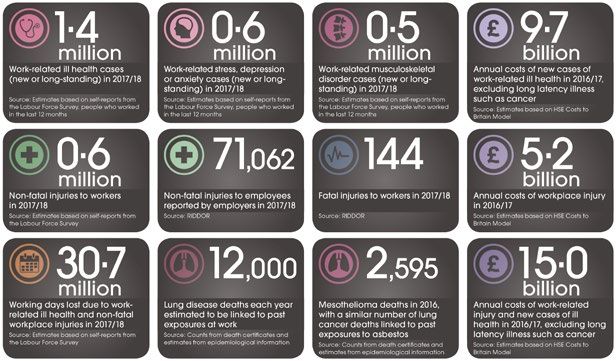
and a visual summary is provided below:
ARAC’s function also includes monitoring the
Risk and performance management plays a key role management of risk and providing assurance
in our governance process to support us to meet our to the HSE Board on the effectiveness of our risk
objectives, while protecting our assets and reputation. management processes and control framework.
We monitor our performance and delivery through In response to the Tailored Review, we will be
a suite of integrated risk and performance reporting refreshing our performance framework to move
which emphasise the links between our most to a more outcome-based performance framework
significant risks and their potential to impact on (see page 24). Until the new framework is embedded,
performance. we will continue to monitor our delivery through our
existing suite of performance indicators.
12 www.hse.gov.uk/statistics/overall/hssh1718.pdf
HSE Business Plan 2019/20 | 29Monitoring our delivery
Our key performance indicators and targets for 2019/20 include:
2016/17 2017/18 2018/19 2019/20
Target
Milestones in plan delivered 99% 100% 94% 90%
Secure effective management and control of risk
Fatal investigations:
Completed within 12 months of HSE assuming primacy 72% 81% 65% 80%
Non-fatal investigations:
Completed within 12 months of the incident 90% 90% 90% 90%
Health and safety concerns:
Completed within agreed timescales 79% 80% 75% 75%
Enable improvement through efficient and effective delivery
Financial:
Deliver a balanced budget Yes Yes Yes Yes
People: Engagement:
Engagement Index 52% 51% 54% 57%
(as measured by the Civil Service People Survey)
People: Health and safety of our staff:
Average working-days lost per full-time equivalent 7.7 7.6 6.2 6.0
People: Bullying, harassment and discrimination:
Percentage of staff who have personally experienced 12% 12% 13% 10%
bullying or harassment at work during the past 12 months
(as measured by the Civil Service People Survey)
30 | HSE Business Plan 2019/20HSE Business Plan 2019/20 | 31
You can also read


