Impact of the COVID-19 Pandemic on Online Obsessive-Compulsive Disorder Support Community Members: Survey Study
←
→
Page content transcription
If your browser does not render page correctly, please read the page content below
JMIR MENTAL HEALTH                                                                                                                  Kaveladze et al

     Short Paper

     Impact of the COVID-19 Pandemic on Online
     Obsessive-Compulsive Disorder Support Community Members:
     Survey Study

     Benjamin Kaveladze1*, BA; Katherine Chang1*; Jedidiah Siev2*, PhD; Stephen M Schueller1,3*, PhD
     1
      Department of Psychological Science, University of California, Irvine, Irvine, CA, United States
     2
      Department of Psychology, Swarthmore College, Swarthmore, PA, United States
     3
      Department of Informatics, University of California, Irvine, Irvine, CA, United States
     *
      all authors contributed equally

     Corresponding Author:
     Benjamin Kaveladze, BA
     Department of Psychological Science
     University of California, Irvine
     School of Social Ecology (Attn: Irice Castro)
     5315 Social and Behavioral Sciences Gateway
     Irvine, CA, 92697-7050
     United States
     Phone: 1 (949) 342 6253
     Email: bkavelad@uci.edu

     Abstract
     Background: People with obsessive-compulsive disorder (OCD) have faced unique challenges during the COVID-19 pandemic.
     Research from the first two months of the pandemic suggests that a small proportion of people with OCD experienced worsening
     in their OCD symptoms since the pandemic began, whereas the rest experienced either no change or an improvement in their
     symptoms. However, as society-level factors relating to the pandemic have evolved, the effects of the pandemic on people with
     OCD have likely changed as well, in complex and population-specific ways. Therefore, this study contributes to a growing body
     of knowledge on the impact of the COVID-19 pandemic on people and demonstrates how differences across studies might emerge
     when studying specific populations at specific timepoints.
     Objective: This study aimed to assess how members of online OCD support communities felt the COVID-19 pandemic had
     affected their OCD symptoms, around 3 months after the pandemic began.
     Methods: We recruited participants from online OCD support communities for our brief survey. Participants indicated how
     much they felt their OCD symptoms had changed since the pandemic began and how much they felt that having OCD was making
     it harder to deal with the pandemic.
     Results: We collected survey data from June through August 2020 and received a total of 196 responses, some of which were
     partial responses. Among the nonmissing data, 65.9% (108/164) of the participants were from the United States and 90.5%
     (152/168) had been subjected to a stay-at-home order. In all, 92.9% (182/196) of the participants said they experienced worsening
     of their OCD symptoms since the pandemic began, although the extent to which their symptoms worsened differed across
     dimensions of OCD; notably, symmetry and completeness symptoms were less likely to have worsened than others. Moreover,
     95.5% (171/179) of the participants felt that having OCD made it difficult to deal with the pandemic.
     Conclusions: Our study of online OCD support community members found a much higher rate of OCD symptom worsening
     than did other studies on people with OCD conducted during the current COVID-19 pandemic. Factors such as quarantine length,
     location, overlapping society-level challenges, and differing measurement and sampling choices may help to explain this difference
     across studies.

     (JMIR Ment Health 2021;8(2):e26715) doi: 10.2196/26715

     KEYWORDS
     obsessive-compulsive disorder; COVID-19 pandemic; online support communities; mental health

     http://mental.jmir.org/2021/2/e26715/                                                               JMIR Ment Health 2021 | vol. 8 | iss. 2 | e26715 | p. 1
                                                                                                                    (page number not for citation purposes)
XSL• FO
RenderX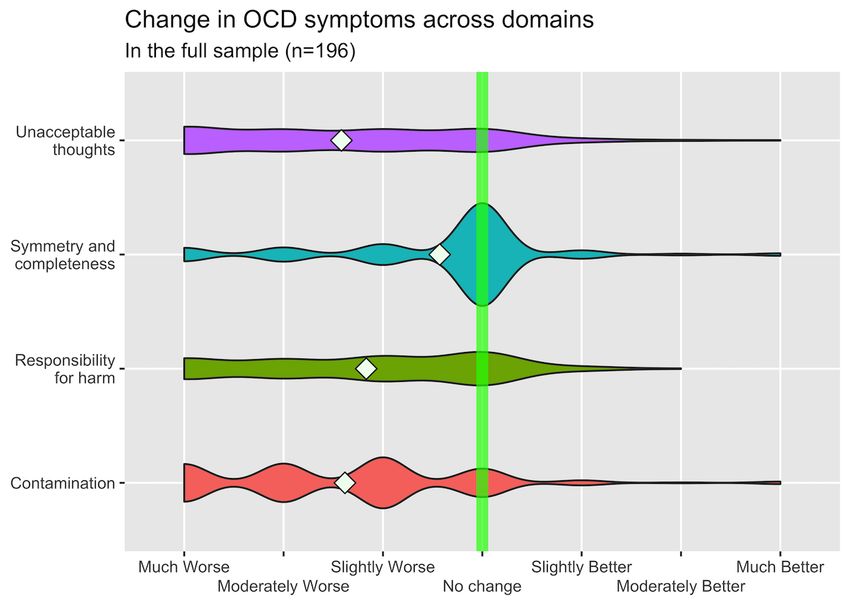
JMIR MENTAL HEALTH                                                                                                           Kaveladze et al

                                                                        [8], had changed since the pandemic began, with values ranging
     Introduction                                                       from 0 (much worse) to 6 (much better) that were transposed
     The COVID-19 pandemic has led to population-level decreases        to –3 to 3, respectively, in our analyses for interpretability.
     in psychological well-being globally [1]. However, people with     Participants also indicated how much their OCD symptoms
     obsessive-compulsive disorder (OCD) may experience distinct        made living during the pandemic more difficult, with scores
     pandemic-related stressors compared to the general population.     ranging from 0 (not at all more difficult) to 4 (much more
     Although many people with OCD might be particularly sensitive      difficult). The significance level for the statistical analysis was
     to pandemic-related stressors (eg, stressors related to            set at P
JMIR MENTAL HEALTH Kaveladze et al
Figure 1. Changes in obsessive-compulsive disorder symptom severity across dimensions, as defined by the Dimensional Obsessive-Compulsive Scale.
White diamonds correspond to sample means. Participants indicated the extents to which their symptoms across the four dimensions of
obsessive-compulsive disorder (“unacceptable thoughts,” “symmetry and completeness,” “responsibility for harm,” and “contamination”) had changed
since the onset of the COVID-19 pandemic, with scores ranging from −3 (much worse) to 3 (much better).
http://mental.jmir.org/2021/2/e26715/ JMIR Ment Health 2021 | vol. 8 | iss. 2 | e26715 | p. 3
(page number not for citation purposes)
XSL• FO
RenderXJMIR MENTAL HEALTH Kaveladze et al
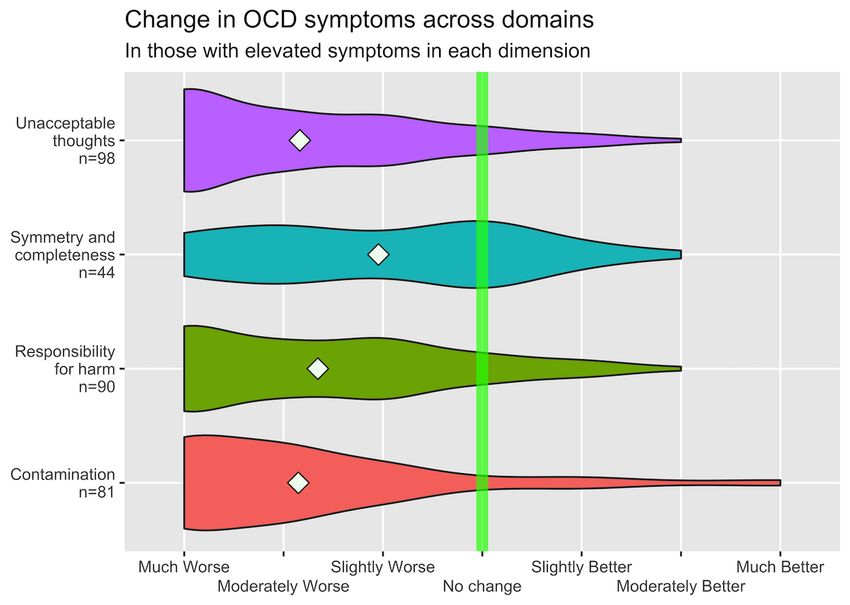
Figure 2. Changes in obsessive-compulsive disorder symptom severity across dimensions evaluated among only those participants with clinically
elevated symptoms for a given dimension of obsessive-compulsive disorder, as defined by the Dimensional Obsessive-Compulsive Scale. We considered
participants to have clinically elevated symptoms for a given symptom dimension if they scored an average score of 2 (range 0-4) across each item in
that symptom dimension, which corresponds to moderate symptoms. White diamonds correspond to sample means. Participants indicated the extents
to which their symptoms across the four dimensions of obsessive-compulsive disorder (“unacceptable thoughts,” “symmetry and completeness,”
“responsibility for harm,” and “contamination”) had changed since the onset of the COVID-19 pandemic, with scores ranging from −3 (much worse)
to 3 (much better).
increased considerably more between April and June 2020 than
Discussion they did between April and June 2019 [11].
Principal Findings Second, previous similar studies were conducted in Israel [4],
Our results align with those of similar studies in some regards Italy [5], India [6], and Japan [7], whereas most participants in
but differ importantly in other ways [4-7]. Similar to the findings our survey were from the United States. The mental health toll
reported by Littman et al [4], our results indicate that symmetry of COVID-19 is inextricable from location-specific factors;
and completeness symptoms were less likely to worsen during these include government decisions about the pandemic, media
the pandemic than symptom dimensions typically associated reports that might influence beliefs and reduce or increase
with harm. Overall, however, a much higher proportion of psychological distress [12], and co-occurring collective
participants in this study reported worsening OCD severity challenges such as political unrest [13].
during the pandemic, as compared with other studies. We believe Third, online OCD support communities are likely
that several factors may underlie the different results. disproportionately used by people seeking help because they
Comparison With Prior Work are experiencing elevated symptoms. As a result, the
communities we surveyed might have had higher proportions
First, other studies were conducted in April and May 2020, that
of people who felt their symptoms worsened since the
is, only a few weeks after quarantine measures were first
COVID-19 pandemic began, compared to in-person populations
instituted in their respective participants’ communities, whereas
(such as patients of an OCD clinic). Although Littman et al [4]
we conducted surveys between June 28 and August 10, 2020,
also recruited a majority of their study sample from online OCD
that is, roughly 3 months after quarantine measures began for
support groups, the communities they studied may have differed
most of the US population. The mental health toll of pandemics
from the ones we studied with regard to the proportion of people
may increase over time as anxiety, boredom, and frustration
seeking help in them.
compound (as reviewed in [10]). Indeed, in the United States,
symptoms of anxiety and depressive disorders in the population
http://mental.jmir.org/2021/2/e26715/ JMIR Ment Health 2021 | vol. 8 | iss. 2 | e26715 | p. 4
(page number not for citation purposes)
XSL• FO
RenderXJMIR MENTAL HEALTH Kaveladze et al
Limitations Conclusions
We must note some limitations to our study. First, because we Intersecting moderator variables such as quarantine length,
recruited our sample by posting advertisements on online OCD location, overlapping society-level challenges, and public
support communities and we do not know which members of sentiment about quarantine measures complicate efforts to
these communities chose not to take the survey, our sample is identify how the COVID-19 pandemic has affected people with
not representative of any population of people with OCD. OCD. Further, participants recruited from online support
Second, our measure of OCD symptom change relied on communities might be more likely to have sought help and
retrospective self-report about the impact of the COVID-19 experienced elevated symptoms at the time of data collection
pandemic, asking participants how much their symptoms than typical in-person samples. The marked difference in the
changed since the pandemic began; however, comparable studies results between our study and other studies with similar goals
either directly compared OCD measures before and after the and methodologies highlights the importance of considering
pandemic using longitudinal data or did not mention the these variables. As more studies on this topic are published,
pandemic when asking respondents about their symptom change. future works should use meta-analyses to investigate which
As such, it might be most accurate to describe our findings as sociocultural variables (eg, health care availability and trust in
perceived worsening of symptoms. Despite these important government) and researcher variables (eg, sampling and
limitations, we believe the extremely high rate of OCD symptom measurement choices) predict observed changes in OCD
worsening among our survey participants remains noteworthy. symptom severity during the COVID-19 pandemic.
Acknowledgments
We thank Ran Littman, Hadar Naftalovich, Jonathan D Huppert, Eyal Kalanthroff, and Angela Fang for their thoughtful
correspondence, and the members of r/OCD, r/OCDmemes, and r/ROCD for their enthusiastic participation in this research.
Conflicts of Interest
SMS reports personal consulting fees from Otsuka Pharmaceuticals, outside the submitted work. BK, KC, and JS declare no
conflicts of interest.
References
1. Xiong J, Lipsitz O, Nasri F, Lui LMW, Gill H, Phan L, et al. Impact of COVID-19 pandemic on mental health in the general
population: a systematic review. J Affect Disord 2020 Dec 01;277:55-64 [FREE Full text] [doi: 10.1016/j.jad.2020.08.001]
[Medline: 32799105]
2. Park A, Conway M, Chen AT. Examining thematic similarity, difference, and membership in three online mental health
communities from Reddit: a text mining and visualization approach. Comput Human Behav 2018 Jan;78:98-112 [FREE
Full text] [doi: 10.1016/j.chb.2017.09.001] [Medline: 29456286]
3. De Choudhury M, De S. Mental health discourse on reddit: Self-disclosure, social support, and anonymity. Proceedings of
the International AAAI Conference on Web and Social Media 2014 May;8(1) [FREE Full text]
4. Littman R, Naftalovich H, Huppert JD, Kalanthroff E. Impact of COVID-19 on obsessive-compulsive disorder patients.
Psychiatry Clin Neurosci 2020 Dec;74(12):660-661. [doi: 10.1111/pcn.13152] [Medline: 32920936]
5. Benatti B, Albert U, Maina G, Fiorillo A, Celebre L, Girone N, et al. What happened to patients with obsessive compulsive
disorder during the COVID-19 pandemic? A multicentre report from tertiary clinics in Northern Italy. Front Psychiatry
2020;11:720 [FREE Full text] [doi: 10.3389/fpsyt.2020.00720] [Medline: 32793008]
6. Chakraborty A, Karmakar S. Impact of COVID-19 on obsessive compulsive disorder (OCD). Iran J Psychiatry 2020
Jul;15(3):256-259 [FREE Full text] [doi: 10.18502/ijps.v15i3.3820] [Medline: 33193776]
7. Matsunaga H, Mukai K, Yamanishi K. Acute impact of COVID-19 pandemic on phenomenological features in fully or
partially remitted patients with obsessive-compulsive disorder. Psychiatry Clin Neurosci 2020 Oct;74(10):565-566 [FREE
Full text] [doi: 10.1111/pcn.13119] [Medline: 32697002]
8. Abramowitz JS, Deacon BJ, Olatunji BO, Wheaton MG, Berman NC, Losardo D, et al. Assessment of obsessive-compulsive
symptom dimensions: development and evaluation of the Dimensional Obsessive-Compulsive Scale. Psychol Assess 2010
Mar;22(1):180-198. [doi: 10.1037/a0018260] [Medline: 20230164]
9. Kaveladze B, Siev J, Schueller S, Chang K. Living with OCD during the COVID-19 Pandemic. OSF. 2020 Jun 25. URL:
https://osf.io/3hs6a/ [accessed 2021-02-10]
10. Brooks SK, Webster RK, Smith LE, Woodland L, Wessely S, Greenberg N, et al. The psychological impact of quarantine
and how to reduce it: rapid review of the evidence. Lancet 2020 Mar 14;395(10227):912-920 [FREE Full text] [doi:
10.1016/S0140-6736(20)30460-8] [Medline: 32112714]
11. Czeisler MÉ, Lane R, Petrosky E, Wiley JF, Christensen A, Njai R, et al. Mental health, substance use, and suicidal ideation
during the COVID-19 pandemic - United States, June 24-30, 2020. MMWR Morb Mortal Wkly Rep 2020 Aug
14;69(32):1049-1057 [FREE Full text] [doi: 10.15585/mmwr.mm6932a1] [Medline: 32790653]
http://mental.jmir.org/2021/2/e26715/ JMIR Ment Health 2021 | vol. 8 | iss. 2 | e26715 | p. 5
(page number not for citation purposes)
XSL• FO
RenderXJMIR MENTAL HEALTH Kaveladze et al
12. French I, Lyne J. Acute exacerbation of OCD symptoms precipitated by media reports of COVID-19. Ir J Psychol Med
2020 Dec;37(4):291-294 [FREE Full text] [doi: 10.1017/ipm.2020.61] [Medline: 32434605]
13. Silver RC, Holman EA, Garfin DR. Coping with cascading collective traumas in the United States. Nat Hum Behav 2021
Jan;5(1):4-6 [FREE Full text] [doi: 10.1038/s41562-020-00981-x] [Medline: 33106630]
Abbreviations
OCD: obsessive-compulsive disorder
Edited by J Torous; submitted 28.12.20; peer-reviewed by E Da Silva, A Rovetta; comments to author 26.01.21; revised version
received 28.01.21; accepted 28.01.21; published 17.02.21
Please cite as:
Kaveladze B, Chang K, Siev J, Schueller SM
Impact of the COVID-19 Pandemic on Online Obsessive-Compulsive Disorder Support Community Members: Survey Study
JMIR Ment Health 2021;8(2):e26715
URL: http://mental.jmir.org/2021/2/e26715/
doi: 10.2196/26715
PMID: 33595449
©Benjamin Kaveladze, Katherine Chang, Jedidiah Siev, Stephen M Schueller. Originally published in JMIR Mental Health
(http://mental.jmir.org), 17.02.2021. This is an open-access article distributed under the terms of the Creative Commons Attribution
License (https://creativecommons.org/licenses/by/4.0/), which permits unrestricted use, distribution, and reproduction in any
medium, provided the original work, first published in JMIR Mental Health, is properly cited. The complete bibliographic
information, a link to the original publication on http://mental.jmir.org/, as well as this copyright and license information must
be included.
http://mental.jmir.org/2021/2/e26715/ JMIR Ment Health 2021 | vol. 8 | iss. 2 | e26715 | p. 6
(page number not for citation purposes)
XSL• FO
RenderXYou can also read


