Impact of the COVID-19 pandemic on the labour market in Wales - Gyrfa Cymru Careers Wales
←
→
Page content transcription
If your browser does not render page correctly, please read the page content below
Gyrfa Cymru
                                       Careers Wales

Careers Wales LMI Bulletin: November 2020

Impact of the COVID-19 pandemic
on the labour market in Wales

Issue 6 : Published 30 November 2020
Date of next issue: January 2021
Gyrfa Cymru
1. Introduction
Careers Wales
A second coronavirus wave and the associated lockdowns and restrictions in the run up to
Christmas are once again impacting the economy, jobs and job recruitment and slowing the
signs of recovery we had begun to see. The hospitality, accommodation and food sectors are
being hit the hardest once again during their traditionally busy periods. Where the economy
can reopen, many businesses feel that they are no longer viable with social distancing
measures limiting customer numbers and behaviour or when furlough support and other
support schemes end.
Official statistics are starting to show the real impact of the pandemic with unemployment
rate in Wales now at 4.6% , the fastest increasing unemployment rate in all of the regions
in the UK and closing the gap to the UK rate at 4.8%. The redundancy rate has jumped to
11.3 per 1,000 employees in the UK, getting close to its peak of 12.2 during the recession
of 2009. Over 500,000 planned redundancies had been notified to government by the end
of the October and in the last few weeks the latest casualties of the big high street names
Debenhams and Arcadia group have added 1,000s of further job losses.
At the same time news of the vaccine brings hope for recovery and a return to some
normality as 2021 progresses and trends for the medium to longer term are positive,
predicting that more jobs will be created than lost by 2025.
In the turbulent situation, trying to make sense of the labour market is difficult. The latest
emerging thoughts among experts is that while the economy and labour market are being
disrupted by the short term impacts of the pandemic, the longer term trends we expect
associated with technological and digital advances, automation and artificial intelligence
remain the same but accelerated by the pandemic.
The labour market is therefore being hit by a ‘double-disruption’ scenario, the immediate
disruptive impact of the pandemic causing economic downturn and so creating short term
job losses, alongside the longer term trends of technological advances; automation, artificial
intelligence, data and cloud computing which will change the nature and mix job roles going
forward. The World Economic Forum has published its Jobs of the Future Report 2020 early,
giving a valuable forecast of the trends expected over the next 5 years 2020-25 which is a
recommended read for all - see Section 3.
In the short term, for those still in employment, facing redundancy, unemployment or trying
to enter the labour market, as well as their employers, the UK and Welsh government
support schemes such as Kickstart, Jets Scheme and in Wales Redundancy support, the new
ReAct funding and employer support schemes cannot come quickly enough. See a summary
of the key short-term support schemes for both job seekers and employers in section 4.
We continue to welcome feedback from staff on the relevance of the data and key messages
included in this bulletin. Please send your feedback to information@careerswales.gov.wales.
gyrfacymru.llyw.cymru | careerswales.gov.walesGyrfa Cymru
1. Introduction
Careers Wales
The topics featured in this issue:
1. Introduction
2. Summary monthly stats
3. Emerging theme: The Future of Jobs Report 2020-2025 (World Economic Forum,
October 2020)
4. Welsh Government & UK response: A summary of key funding and support schemes
5. Impact on job postings in Wales
6. Occupations most severely hit or seeing growth
7. Sectors most severely impacted by the COVID-19 Crisis
8. Redundancies & Furlough
9. Unemployment/Employment and Claimant count
10. Key Coronavirus update and support links
Data use caution:
We need to use LMI data with caution in the current environment,
please see Cautionary notes at the end of the bulletin.
gyrfacymru.llyw.cymru | careerswales.gov.walesGyrfa Cymru
2. Summary monthly stats
Careers Wales
Summary stats
• The number of job postings in Wales continues to rise. However, the rate of increase
shows some signs of slowing through October and November, reflecting the second
wave of restrictions. Monthly online job postings rose by 7053 (9.67%) to a total of
70,000 in October 20.
• In the latest 30 days to 29th November, the occupations with the highest total number
of online job vacancies in Wales continued to be Nurses, Care Workers, Delivery and
storage roles, Sales, but also included Metal workers and fitters, programmers and
finance roles.
• Overall, the rate of increase in postings shows some slowing down through October
and November, but in the latest 30 days we see large % increases for jobs where lifted
restrictions has allowed services to start up again like Driving Instructors and Fitness
instructors.
• In the latest 30 days to 29th November we see falls in demand for hospitality staff and
other service roles in response to the second wave of restrictions.
• The number of furloughed workers was down to 9% during the period 19 October to 1
November.
• More than 9m jobs at more than 1m companies in Britain have been furloughed since
the launch of the government’s wage subsidy scheme in March.
• The Arts, entertainment and recreation industry continues to have the highest
proportion of its workforce on partial or full furlough at 34%. Followed by
Accommodation and food services with 21.9% of its workforce still on furlough by 1st
November. We are likely to see furlough rates rise again as pre-Christmas restrictions
are put into place in the hospitality industry, particularly in Wales.
• The number of apprentices furloughed is down to a total of 1,760 still furloughed on
30 October 2020. At its peak, nearly 8000 (7770) apprentices were furloughed in May
2020.
• Official data for redundancies in the UK is just beginning to reveal the real picture of
how many redundancies may be caused by the pandemic. The number of redundancies
rose to a record high of 314,000 in the latest 3 month rolling period, July to September
2020.
gyrfacymru.llyw.cymru | careerswales.gov.walesGyrfa Cymru
2. Summary monthly stats
Careers Wales
• The number of redundancies per 1,000 workers across all sectors in the UK, has jumped
to 11.3 per 1000 employees. The upward trend continues to reflect the growing number of
companies reporting job losses.
• Whilst just over 300,000 redundancies have officially been counted in the latest ONS data
release at the end of September, the real total is expected to far exceed this. Nearly half
a million (480,000) planned redundancies were notified by 1,000’s of employers to the
UK government in the first 5 months of the pandemic up to August. During September,
a further 1,734 employers planned redundancies, the highest levels since 2006, and 842
more employers in October. This adds a further 100,000 planned redundancies to the end
of October.
• The actual total number of redundancies that will result from the pandemic remains
unknown, but experts predict that around of 10% of furloughed jobs will become
redundancies once the Furlough scheme is lifted.
• At the end of the latest survey period, to 1st November, 16.5% of all industries were
still temporarily closed or permanently ceased trading. The industries with the highest
percentage closed were:
Accomodation and food service activities 35.2%
Arts Entertainment and Recreation 24.2%
Administrative and Support Services 20.1%
All industries 16.5%
• The accommodation and food service activities industry had the highest percentage (34%)
of businesses with no or low confidence that their businesses would survive the next three
months.
• Unemployment has risen faster in Wales than anywhere else in the UK. There was 70,000
unemployed in Wales for the period July to September 2020.
• The LFS: ILO Unemployment rate has risen to 4.6% in Wales , a rise of 1.9% on the
previous period. Unemployment rate in Wales remains below the UK rate at 4.8% but the
gap is closing.
• Since the start of the pandemic young people have been hardest hit in terms of
unemployment and employment The UK unemployment rate (the proportion of the
gyrfacymru.llyw.cymru | careerswales.gov.walesGyrfa Cymru
2. Summary monthly stats
Careers Wales
economically active population who are unemployed) for 16-24 year olds was 14.6% in
July-September 2020. This is up from 12.9% in the previous quarter and from 11.9% a year
before. (ONS, Nov 2020)
• In October, the number of claimants totalled 114,216 claimants in Wales (7.5%) and
2,633,724 (7.3%) in the UK.
• Claimant count numbers have increased by 112% the UK since March 2020.
gyrfacymru.llyw.cymru | careerswales.gov.walesGyrfa Cymru
3. Emerging theme: The Future of Jobs
Careers Wales
Report 2020-2025 (World Economic Forum, October 2020)
The COVID-19 pandemic induced lockdowns causing global recession has created a very
uncertain future outlook for labour markets both in the short and longer term, here in Wales
and across the world. The World Economic Forum has published its Future Jobs Report early
to try and make sense of the double disruption of:
a) The impact of the pandemic related disruption, and
b) The expected trends for technology development and its impact on jobs and skills in the
next 5 years.
Key Findings
• Technology racing. The pace of technology adoption is expected to continue and
accelerate in some areas like:
• Cloud computing
• Big data
• e-commerce
• Encryption
• Non-humanoid robots
• Artificial Intelligence
• D
ouble disruption on jobs. The ‘double disruption’ scenario of the pandemic with
automation will transform the job opportunities and skills needed by 2025. By 2025 the
time spent on current tasks in work by humans and machines will be equal.
• M
ore jobs will be created than lost. By 2025 jobs created due to technology will be
greater than the jobs lost. The WEF estimates that 85 million jobs will be lost because of
the shift of labour from humans to machines, but 95 million new roles may emerge that
are more adapted to the new division of work between humans, machines and algorithms
(computers and data).
• S
kills in demand. Skills-gaps in the workforce continue to be high as the in-demand skills
change in the next 5 years. Top skills that employers see increasing in demand include:
• Critical thinking & Analysis
• Problem solving
• Active learning
gyrfacymru.llyw.cymru | careerswales.gov.walesGyrfa Cymru
3. Emerging theme: The Future of Jobs
Careers Wales
Report 2020-2025 (World Economic Forum, October 2020)
• Resilience
• Stress Tolerance
• Flexibility
‘94% of business leaders expect employees to pick up new skills on the job by 2025’
• D
igital and remote working to increase. 84% of employers are set to digitalise working
processes including a significant rise in remote working. To address the concerns of
productivity and well-being, a third of employers expect to create a sense of community,
connection and belonging among employees through digital tools to tackle the well-being
challenges of working remotely.
• O
nline learning and training on the rise. More workers are seeking out opportunities for
learning online through their own initiate, and more employers are providing online learning
for their workforces. Those in employment are placing greater emphasis on personal
development courses, whilst the unemployed are seeking learning on digital skills like data
analysis, computer science and information technology.
• The window for upskilling has become shorter. 50% of all employees will need reskilling by
2025.
• The value of human resource. Despite the current economic downturn, most employers
recognize the value of human capital investment.
• Workers to be redeployed. Businesses hope to redeploy 50% of workers displaced by
technology and augmentation
• Public sector needs to provide stronger support for reskilling and upskilling for at risk or
displaced workers.
You can find the full report and useful supporting resources, including infographics and
videos, @The Future of Jobs Report 2020: World Economic Forum
And some local good news ….
• Ammanford firm expands manufacturing capacity with Welsh Government support | GOV.
WALES
• Wrexham Pharmaceutical Laboratory providing ‘salvation for humanity
gyrfacymru.llyw.cymru | careerswales.gov.walesGyrfa Cymru
4. Welsh Government & UK response:
A summary of key funding and support schemes Careers Wales
During October the Chancellor announced a further extension of the Furlough scheme. The
Coronavirus Job Retention Scheme (CJRS) - also known as the Furlough scheme - will now
remain open until March 2021, with employees receiving 80% of their current salary for hours
not worked, up to a maximum of £2,500.
Under the extended scheme, the cost for employers of retaining workers will be reduced
compared to the previous scheme, which ended on 31 October 2020.
Welsh Government have announced a range of funding and support schemes for those made
redundant, the unemployed, the young unemployed, those facing economic barriers and
employers. Here is a summary of some of the key support schemes:
• Kickstart: six-month work placements for young people between 16-14 on Universal
credit. Referral through Job Centre plus
• Business Wales Start up Barriers Fund: Grants to support the unemployed who are facing
greater economic barriers to start a business
• Business Wales Employer incentives to employ apprentices under 25
• Job Entry Targeted Support (JETS) – help and support for those out of work for three
months to move into targeted growth sectors
• £340m support for Welsh Hospitality and leisure sectors as new coronavirus rules
announced
• Small Business Research Initiative (SBRI): Welsh Government challenge for innovative
ideas in response to coronavirus pandemic | GOV.WALES
• North Wales partners working together to support region | GOV.WALES
• Minister for Economy, Transport and North Wales, Ken Skates on the latest Labour Market
Statistics | GOV.WALES
• UK gov coronavirus Guidance and Support
• Wales.gov Coronavirus Support
• Business Wales COVID-19 Support for Businesses
• Uk.gov Business Support
• Self-employment income support
gyrfacymru.llyw.cymru | careerswales.gov.walesGyrfa Cymru
4. Welsh Government & UK response:
A summary of key funding and support schemes Careers Wales
Working Wales / Careers Wales
• New extended ReAct funding for redundancy and unemployed
• Personal Learning Accounts: For low paid employed, on furlough or job at risk
• Job Vacancy Bulletin
• Apprenticeship Search
• Jobs Growth Wales
• Employers who offer Apprenticeships
• Getting a job
• Redundancy Support
• Furlough support
• Employers recruiting now
• Start learning today : New online learning platform
Support resources from DWP
• ‘Find A Job’ Job vacancies
• ‘Employer Help’
• ‘Job Help’
Additional Support Resources
• The Money Advice Service: Money Navigator Tool
• MoneySavingExpert (Martin Lewis) Coronavirus Guides
gyrfacymru.llyw.cymru | careerswales.gov.walesGyrfa Cymru
5. Impact on job postings in Wales
Careers Wales
Monthly fluctuations in online Job postings continue to provide us with a crude but
responsive indication of how the job market is responding as restrictions imposed due to
COVID-19 are constantly being revised. (The absolute numbers should be used with caution
as they provide only a snapshot of the total recruitment picture. By their nature, posting
numbers fluctuate daily and methods for collection vary but the general trends seen can give
us an idea of how job opportunities in Wales are being impacted.
Recruitment trend in Wales 2020
The number of job postings in Wales continue to rise. However, the rate of increase shows
some signs of slowing through October and November, possibility reflecting the second
wave of restrictions. Monthly online job postings rose by 7053 (9.67%) to a total of 70,000 in
October 20.
Monthly Online job postings in Wales since January 2017
MONTHLY ONLINE JOB POSTINGS IN WALES SINCE JANUARY 2017
Lockdown measures start
80000 February 20
70,000
70000
60000
50000
40000
30000
20000
10000
0
Jan 17 October 20
Source: Emsi, Job Posting Analyst
gyrfacymru.llyw.cymru | careerswales.gov.walesGyrfa Cymru
5. Impact on job postings in Wales
Careers Wales
Unique Job Posting Intensity
% Monthly change
(number of postings
postings per unique job vacancy)
January 2020 49,011 6.1
February 2020 55,756 +13.8% 6.1
March 2020 53,376 -4.3% 6.1
April 2020 43,738 -18% 7.1
May 2020 40,214 -8% 7.1
June 2020 44,158 +9.8% 6.1
July 2020 50,068 +13.4% 6.1
August 2020 56,773 +13.4% 6.1
September 2020 63,826 +12.4% 7.1
October 2020 70,000 +9.67 7.1
gyrfacymru.llyw.cymru | careerswales.gov.walesGyrfa Cymru
6. Occupations most severely hit or
Careers Wales
seeing growth
Top occupations advertised in the latest 30 days to 29th November
In the latest 30 days to 29th November, the occupations with the highest total number of
online job vacancies in Wales continued to be Nurses, Care Workers, Delivery and storage
roles, Sales, but also included Metal workers and fitters, programmers and finance roles.
Nurses 5,125
Care workers and home carers 2,916
Van drivers 1,840
Sales accounts and business development managers 1,530
Elementary storage occupations 1,500
Other administrative oocupations 1,435
Medical practitioners 1,309
Teaching assistants 1,297
Primary and nursery education teaching profeesionals 1,186
Cleaners and domestics 1,176
Metal working production and maintenance fitters 1,101
Programmers and software development professionals 1,099
Finance and investment analysts and advisers 1,053
Table: 1 Total Number Of Unique Job Postings (Active) In Wales In The Latest 30 Days
(31st October - 29th November, 2020)
Avg. Posting
Occupation (SOC) Latest 30 days1 Latest 30 days
Intensity3
Unique Postings Unique Postings %
(Occupations with >50 postings in latest 30 days) (May 2020 - Jun
(Active) Change2 (Active)
2020)
Nurses 5,125 (5.1%) 9:1
Care workers and home carers 2,916 (1.7%) 7:1
Van drivers 1,840 (12.3%) 7:1
Sales accounts and business development managers 1,530 0.7% 6:1
Elementary storage occupations 1,500 (13.2%) 10 : 1
Other administrative occupations 1,435 4.8% 6:1
Medical practitioners 1,309 (8.1%) 5:1
Teaching assistants 1,297 6.2% 9:1
Primary and nursery education teaching professionals 1,186 (0.4%) 8:1
Cleaners and domestics 1,176 (12.3%) 6:1
gyrfacymru.llyw.cymru | careerswales.gov.walesGyrfa Cymru
6. Occupations most severely hit or
Careers Wales
seeing growth
Avg. Posting
Latest 30 days1 Latest 30 days
Intensity3
Occupation (SOC) Unique Postings Unique Postings %
(May 2020 - Jun
(Active) Change2 (Active)
2020)
Metal working production and maintenance fitters 1,101 3.8% 8:1
Programmers and software development professionals 1,099 (7.7%) 9:1
Finance and investment analysts and advisers 1,053 6.9% 6:1
Sales and retail assistants 993 (16.7%) 7:1
Human resources and industrial relations officers 984 8.6% 6:1
Nursing auxiliaries and assistants 924 (1.8%) 5:1
Book-keepers, payroll managers and wages clerks 888 0.2% 8:1
Production managers and directors in manufacturing 858 1.3% 8:1
Business and financial project management 838 6.2% 6:1
professionals
Business sales executives 806 (7.9%) 7:1
Social workers 792 (5.5%) 8:1
Customer service occupations 735 (5.6%) 6:1
Engineering technicians 713 1.1% 9:1
Youth and community workers 712 (8.0%) 5:1
Kitchen and catering assistants 694 (10.6%) 4:1
Legal associate professionals 656 10.3% 7:1
Science, engineering and production technicians 642 (3.2%) 8:1
Residential, day and domiciliary care managers and 641 (1.5%) 6:1
proprietors
Business and related associate professionals 617 (0.2%) 5:1
Fitness instructors 603 252.6% 4:1
Secondary education teaching professionals 601 (7.1%) 9:1
Information technology and telecommunications 600 9.3% 9:1
professionals n.e.c.
Security guards and related occupations 593 (1.0%) 6:1
Managers and directors in storage and warehousing 591 (7.9%) 7:1
Solicitors 589 (0.5%) 7:1
Electricians and electrical fitters 550 2.0% 9:1
Financial administrative occupations 523 34.4% 6:1
Production and process engineers 520 1.8% 9:1
Civil engineers 512 (2.7%) 9:1
Marketing associate professionals 511 (12.2%) 6:1
Educational support assistants 511 0.0% 6:1
gyrfacymru.llyw.cymru | careerswales.gov.walesGyrfa Cymru
6. Occupations most severely hit or
Careers Wales
seeing growth
Source: Emsi Job Posting Analyst, November 2020
1
Latest 30 days: October 31st-November 29th, 2020
2
Latest 30 days % change in unique active postings: Comparing October 1st-October 30th to
October 31st-November 29th
3
Posting intensity = number of postings per unique job vacancy
Occupations with increasing demand in the latest 30 days to 29th November
The % increases and decreases in postings we see each month show the rapidly changing
needs of the labour market. We get an immediate (if crude) indication of which occupations
are bouncing back or in demand. However, since the start of the pandemic, we have seen
unusual spikes and troughs as restrictions are lifted or reinforced, so it is difficult to
determine what the more permanent trends might be.
Overall, the rate of increase in postings shows some slowing down through October
and November, but in the latest 30 days we see large % increases for jobs where lifted
restrictions has allowed services to start up again like Driving Instructors and Fitness
instructors.
Table: 2 % Change (Increasing) in Unique Job Postings (Active) In Wales In the latest 30 Days
(Oct 31st-Nov 29th, 2020)
Occupation (SOC) Latest 30 Days1 Latest 30 Days Unique
Postings % Change2
(Occupations with >50 postings in latest 30 days) 1
Unique Postings (Active) (Active)
Driving instructors 261 832.1%
Fitness instructors 603 252.6%
Market research interviewers 64 106.5%
Financial administrative occupations 523 34.4%
Financial managers and directors 269 26.3%
Chartered and certified accountants 134 24.1%
Finance officers 60 22.4%
Chemical scientists 56 21.7%
Plasterers 59 20.4%
Metal machining setters and setter-operators 84 20.0%
Teaching and other educational professionals 223 18.0%
Human resources administrative occupations 309 17.9%
IT engineers 127 17.6%
Property, housing and estate managers 254 17.1%
gyrfacymru.llyw.cymru | careerswales.gov.walesGyrfa Cymru
6. Occupations most severely hit or
Careers Wales
seeing growth
Occupation (SOC) Latest 30 Days1 Latest 30 Days Unique
Postings % Change2
(Occupations with >50 postings in latest 30 days) 1
Unique Postings (Active) (Active)
Medical radiographers 171 16.3%
Natural and social science professionals 94 16.0%
Construction and building trades 121 15.2%
Welfare and housing associate professionals 262 12.4%
Further education teaching professionals 263 12.4%
Construction project managers and related professionals 90 11.1%
Chief executives and senior officials 105 10.5%
Legal associate professionals 656 10.3%
Quantity surveyors 205 10.2%
Source: Emsi Job Posting Analyst, November 2020
1
Latest 30 days: October 31st – November 29th, 2020
2
Latest 30 days % change in unique active postings (comparing October 1st—October 30th to October 31st—
November 29th)
Data use caution:
Remember a high % change does not necessarily mean the highest
total number of active vacancies. Job posting figures fluctuate from
day to day, and sources of data vary.
Occupations with falling demand in the latest 30 days to 29th November
In the latest 30 days to 29th November we see falls in demand for hospitality staff and other
service roles in response to the second wave of restrictions. The occupations with highest %
decreases in the number of job postings include:
• Catering and bar managers • Chefs
• Bar staff • Medical and dental technicians
• Mobile machine drivers and operatives n • Fork-lift truck drivers
• Caretakers • Childminders and related occupations
• Leisure and sports managers • Pharmaceutical technicians
• Biological scientists and biochemists • Nursery nurses and assistants
• Ophthalmic opticians
gyrfacymru.llyw.cymru | careerswales.gov.walesGyrfa Cymru
6. Occupations most severely hit or
Careers Wales
seeing growth
Table:3. % Change (Decreasing) In Unique Job Postings (Active) In Wales In The Latest 30 Days
(October 31st-November 29th, 2020)
Occupation (SOC) Latest 30 Days1 Latest 30 Days
Unique Postings %
(Occupations with >50 postings in latest 30 days) Unique Postings (Active) Change2 (Active)
Catering and bar managers 51 (42.7%)
Bar staff 59 (37.9%)
Mobile machine drivers and operatives 329 (32.7%)
Caretakers 51 (29.2%)
Leisure and sports managers 50 (28.6%)
Biological scientists and biochemists 122 (28.2%)
Ophthalmic opticians 110 (25.2%)
Chefs 381 (25.0%)
Medical and dental technicians 58 (24.7%)
Fork-lift truck drivers 104 (23.5%)
Childminders and related occupations 68 (22.7%)
Pharmaceutical technicians 86 (22.5%)
Nursery nurses and assistants 154 (20.6%)
Planning, process and production technicians 181 (18.5%)
School midday and crossing patrol occupations 123 (18.0%)
Product, clothing and related designers 73 (18.0%)
Medical secretaries 99 (17.5%)
Sales and retail assistants 993 (16.7%)
Credit controllers 72 (16.3%)
Large goods vehicle drivers 481 (15.9%)
Speech and language therapists 96 (15.8%)
Construction operatives 312 (15.4%)
Estate agents and auctioneers 77 (15.4%)
Skilled metal, electrical and electronic trades supervisors 79 (15.1%)
Authors, writers and translators 74 (14.9%)
Marketing and sales directors 81 (14.7%)
Health professionals 177 (14.1%)
Elementary construction occupations 200 (13.4%)
Telephone salespersons 72 (13.3%)
gyrfacymru.llyw.cymru | careerswales.gov.walesGyrfa Cymru
6. Occupations most severely hit or
Careers Wales
seeing growth
Occupation (SOC) Latest 30 Days1 Latest 30 Days
Unique Postings %
(Occupations with >50 postings in latest 30 days) Unique Postings (Active) Change2 (Active)
Elementary storage occupations 1,500 (13.2%)
Refuse and salvage occupations 115 (12.9%)
Cleaners and domestics 1,176 (12.3%)
Van drivers 1,840 (12.3%)
Marketing associate professionals 511 (12.2%)
Carpenters and joiners 210 (11.8%)
Managers and directors in transport and distribution 93 (10.6%)
Kitchen and catering assistants 694 (10.6%)
Financial accounts managers 115 (10.2%)
Merchandisers and window dressers 152 (10.1%)
Office supervisors 90 (10.0%)
Managers and proprietors in other services 101 (9.8%)
Health services and public health managers and directors 277 (9.8%)
Sales administrators 161 (9.6%)
Call and contact centre occupations 149 (9.1%)
Other skilled trades 50 (9.1%)
Legal professionals 102 (8.9%)
Psychologists 277 (8.9%)
Receptionists 292 (8.8%)
Purchasing managers and directors 161 (8.5%)
Managers and directors in retail and wholesale 282 (8.4%)
Food, drink and tobacco process operatives 143 (8.3%)
Medical practitioners 1,309 (8.1%)
Youth and community workers 712 (8.0%)
Managers and directors in storage and warehousing 591 (7.9%)
Business sales executives 806 (7.9%)
Programmers and software development professionals 1,099 (7.7%)
Plumbers and heating and ventilating engineers 290 (7.6%)
Secondary education teaching professionals 601 (7.1%)
Gardeners and landscape gardeners 66 (7.0%)
Web design and development professionals 477 (7.0%)
Quality assurance technicians 213 (7.0%)
Health and safety officers 200 (7.0%)
gyrfacymru.llyw.cymru | careerswales.gov.walesGyrfa Cymru
6. Occupations most severely hit or
Careers Wales
seeing growth
Occupation (SOC) Latest 30 Days1 Latest 30 Days
Unique Postings %
(Occupations with >50 postings in latest 30 days) Unique Postings (Active) Change2 (Active)
Cleaning and housekeeping managers and supervisors 148 (6.9%)
Electrical engineers 121 (6.2%)
Buyers and procurement officers 145 (5.8%)
Restaurant and catering establishment managers and proprietors 83 (5.7%)
Pharmacists 300 (5.7%)
Customer service occupations 735 (5.6%)
Electrical and electronic trades 436 (5.6%)
IT operations technicians 319 (5.6%)
Social workers 792 (5.5%)
IT specialist managers 489 (5.2%)
Nurses 5,125 (5.1%)
Transport and distribution clerks and assistants 190 (5.0%)
Source: Emsi Job Posting Analyst, November 2020
1
Latest 30 days: October 31st – November 29th, 2020
2
Latest 30 days % change in unique active postings (comparing October 1st—October 30th to October
31st—November 29th)
gyrfacymru.llyw.cymru | careerswales.gov.walesGyrfa Cymru
7. Sectors most severely impacted by the
Careers Wales
Covid-19 Crisis
At the end of the latest survey period, to 1st November, 16.5% of all industries were
still temporarily closed or permanently ceased trading. The industries with the highest
percentage closed were:
Accommodation Arts, Entertainment Administrative and All industries
and Food Services and Recreation Support Services
35.2% 24.2% 20.1% 16.5%
The accommodation and food service activities industry had the highest percentage (34%)
of businesses with no or low confidence that their businesses would survive the next three
months.
The arts, entertainment and recreation industry had the highest proportion of its workforce on
partial or full furlough leave, at 34%, compared with 9% across all industries.
Across all industries, 7% of businesses expect to temporarily or permanently close a business
site in the next two weeks, with 25% of businesses in the accommodation and food service
activities industry expecting to close a business site.
ONS Fortnightly business survey (relating to period 19 October to 1 November 2020)
Read the latest reports from ONS:
• The impact of the coronvirus so far: the industries that struggled or recovered
• Business insights and impact on the UK and sub-national economy (including for Wales
and Welsh Unitary Authorities )
gyrfacymru.llyw.cymru | careerswales.gov.walesGyrfa Cymru
8. Redundancies & Furlough
Careers Wales
Redundancy data
Official data for redundancies in the UK is just beginning to reveal the real picture of how
many redundancies may be caused by the pandemic. The number of redundancies rose to a
record high of 314,000 in the latest 3 month rolling period, July to September 2020
The number of redundancies per 1000 workers across all sectors in the UK, has jumped to
11.3 per 1000 employees. The upward trend continues to reflect the growing number of
companies reporting job losses.
During the last recession, the redundancy rate was 12.2 per 1000 employees at its peak
(Feb-April 2009)
LFS; ILO Redundancy rate UK LFS:
since 2008
ILO (per 1,000
Redundancy workers)
rate UK since 2008
(per 1,000 workers)
14.0
Financial crisis (Feb-Apr 2009)
11.3
12.0
12.2
10.0
Redundancy rate
8.0
6.0
4.0
2.0
0.0
Dec-Feb 2008 Jul-Sept 2020
(Source: ONS, November 2020)
gyrfacymru.llyw.cymru | careerswales.gov.walesGyrfa Cymru
8. Redundancies & Furlough
Careers Wales
Redundancy and planned job losses across Wales, UK and Globally announced in the press
since the start of the pandemic
Since the last bulletin, Wales and the UK have been forced into further lockdowns and
restrictions, in response to a second coronavirus wave. Redundancy announcements
increased through September and October in response. The latest major redundancy
announcements across the UK, have come from the closures of big high street names with
12,000 redundancies at Debenhams and 13,000 at the Arcadia group.
For Wales, the postponing of the Urdd Eisteddfod 2021 to 2022 will have a major impact
for construction and events jobs, hospitality and leisure and the wider supply chain for this
National event.
See a summary of some of the redundancy announcements made in the press since the
beginning of the crisis are as follows:
Company Planned job cuts or jobs at risk
Aberthaw Power Station 170
Acadia (Topshop, Miss Selfridge, Burton, Dorothy
13000
Perkins)
Aer Lingus 900
Airbus Broughton and Filton 1435 @ Broughton
Airbus Magellan plant Wrexham 240
Airbus 1700
Arup 350
Ask Italian & Zizzi 1200
Aston Martin Lagonda 500
Bathstore 531 across UK
BBC Cymru Wales 60
BBC Media 70
BBC 970
Bentley 1000
Bombardier 600
Book People 450 (250 Bangor)
Boots 4000
gyrfacymru.llyw.cymru | careerswales.gov.walesGyrfa Cymru
8. Redundancies & Furlough
Careers Wales
Company Planned job cuts or jobs at risk
BP 10000 global
Braka Foods (Rhondda) 84
Bright house 1000 across UK
British Airways 1000 (Welsh sites)
British Airways 12000
Burberry 500
Burger King 1600
Cambrian printers (Aberystwyth ) 60
Cardiff University 169
Castell Howell 700 staff warned of possible job losses
Casual Dining 1900
Caterpillar 700
Celtic Manor 450
Centrica (British Gas) 5000
Cineworld 5,500
Clarks 900
Costa 1,600
Debenhams 12,000
DHL 2000
Dixons Carphone 800
DW Sports 1700
Dyson 600 UK (900 worldwide)
Easy Jet 1300 crew; 727 pilots
Ford Bridgend 1700
G4S 1150
Gaia Technologies Bangor 150
General Electric (GE), Caerphilly 369
Genting 1642
Greggs 820
gyrfacymru.llyw.cymru | careerswales.gov.walesGyrfa Cymru
8. Redundancies & Furlough
Careers Wales
Company Planned job cuts or jobs at risk
Guardian Media Group 180
Guidant Global 450
Harlech Foods 15
HSBC 35000 global
Jaguar Land Rover 1100
JCB 950 UK wide (400 currently employed Wrexham)
John Lewis 1500
Johnson Matthey 2500
Around 200 redundancies to date although Welsh
Laura Ashley Mid Wales
Government task force announced to support.
M&S 7,000
Magnox 175
Up to 1450 across Marriott Internationals UK
Marriott Hotel
portfolio
Marstons 2150
Media Wales 70
Metal Improvement Company, Broughton 60
Millenium Centre 250
Mitchell & Butlers 1300
Monsoon Accessorize 545
Mulberry 470
Nat West 500
National Trust 1200 UK
Northwood Hygiene Products 94
Oasis and Warehouse 1800 across UK
Ovo Energy 2600
P&O Ferries 1100
Pizza Express 1000
Pizza Hut 450 jobs at risk (29 UK restaurants)
Post office 134 UK (Branch Managers)
Poundstretcher 2000
gyrfacymru.llyw.cymru | careerswales.gov.walesGyrfa Cymru
8. Redundancies & Furlough
Careers Wales
Company Planned job cuts or jobs at risk
Pret a Manger 1000
Reach plc 550
9600 (UK jobs but implications for supply
Rolls Royce
chain & impact for Wales)
Royal Dutch Shell Energy 9,000
Royal Mail 2000 Management roles UK
Ryanair 3000-3500
Sainsburys 3500
Selfridges 450
Shell 9000 globally
Sidoli 148
Signature Living (Cardiff Hotel) Expected to be dissolved.
2600 (across UK - Meter readers, home ser-
SSE
vice engineers)
SSP Group (Upper Crust ) 5000 jobs across UK
Swissport 4175
Ted Baker 500
Tesco 4500 153 UK outlets
The Restaurant Group 1500
Timet Uk (Swansea) 142
TM Lewin 600 UK
Tomlinson’s Dairy 200
Travelex 1,300
Travis Perkins 2500
Triumph Office Furniture 252
TSB 929
TUI 8,000 globally
Tyson Foods 71
Urdd Gobaith Cymru 80 jobs plus a further 70 casual posts
Vauxhall 200
gyrfacymru.llyw.cymru | careerswales.gov.walesGyrfa Cymru
8. Redundancies & Furlough
Careers Wales
Company Planned job cuts or jobs at risk
Victoria and Albert Museum 10% of workforce
Virgin Atlantic 3000
Webhelp 254
WH Smith 1,500
Whitbread (Premier Inn, Brewers Fayre ) 6,000 Mostly UK
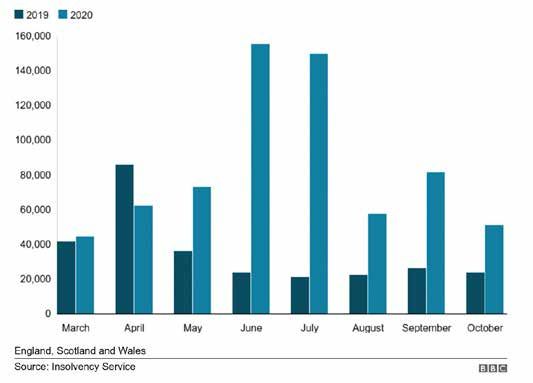
How many redundancies can we expect?
Over 300,000 redundancies have officially been reported in the latest ONS data available
to the end of September 2020. (Source: ONS) However the real total is expected to far
exceed this. Nearly half a million (480,000) planned redundancies were notified by 1,000’s of
employers to the UK government in the first 5 months of the pandemic up to August. During
September, a further 1,734 employers planned redundancies, the highest levels since 2006,
and 842 more employers in October. This adds a further 100,000 planned redundancies to
the end of October.
Planned redundancies notified to UK Government. March to Oct
(Source: BBC News October redundancies double last year’s rate - BBC News)
gyrfacymru.llyw.cymru | careerswales.gov.walesGyrfa Cymru
8. Redundancies & Furlough
Careers Wales
An ACAS-commissioned survey reported that 1 in 3 (37%) firms say they are likely to make
redundancies before Christmas. (Personnel Today, Oct 2020)
The real total number of redundancies that may result from the pandemic remains unknown,
but experts predict that around of 10% of Furloughed jobs will become redundancies once the
Furlough scheme is lifted.
Furloughed workers
The number of furloughed workers was down to 9% during the period 19 October to 1
November,
The Arts, entertainment and recreation industry continues to have the highest proportion of
it workforce on partial or full furlough at 34%. Followed by Accommodation and food services
with 21.9% of its workforce still on furlough by 1st November. We are likely to see Furlough
rates rise again as pre-Christmas restrictions are put into place in the hospitality industry,
particularly in Wales.
More than 9m jobs at more than 1m companies in Britain have been furloughed since the
launch of the government’s wage subsidy scheme in March. (Guardian, Nov 2020)
Apprentices furloughed or made redundant in Wales during the coronavirus pandemic to
28 August 2020
Main points
• The number of furloughed apprentices continued to fall by 1,220 in October. At its peak,
nearly 8000 apprentices were furloughed in May 2020.
• A total of 1,760 apprentices were still furloughed on 30 October 2020.
• 125 apprentices had their apprenticeship terminated due to redundancy.
• An additional 165 apprentices had been made redundant but remain in learning whilst their
provider tries to source an alternative employer.
gyrfacymru.llyw.cymru | careerswales.gov.walesGyrfa Cymru
8. Redundancies & Furlough
Careers Wales
In every category the number of apprentices furloughed has fallen, but the apprentices still
most affected were:
• young
• male
• white or mixed race
• working in hair and beauty; hospitality; or construction
• not studying higher apprenticeships
• working for companies with less than 10 employees
• not working in the public sector
• living in less deprived neighbourhoods
• those who self-identified as having a ‘primary disability and/or learning difficulty’
• living in Wrexham or Flintshire
(Source: gov.wales, Nov 2020 )
gyrfacymru.llyw.cymru | careerswales.gov.walesGyrfa Cymru
9. Unemployment and Claimant count
Careers Wales
Unemployment
Unemployment has risen faster in Wales than anywhere else in the UK . There was 70,000
unemployed in Wales for the period July to September 2020.
The LFS:ILO Unemployment rate has risen to 4.6% in Wales , a rise of 1.9% on the previous
period. Unemployment rate in Wales remains below the UK rate at 4.8% but the gap is closing.
Unemployment Rate Wales and UK since 2008
UNEMPLOYMENT RATE WALES & UK SINCE 2008
12
10
Unemployment rate (%)
8 Wales
UK
6
4.8%
4
4.6%
2
0
Feb-Apr 2008 Jul-Sep 2020
Source: ONS Labour Force Survey, July – September2020
gyrfacymru.llyw.cymru | careerswales.gov.wales9. Unemployment
and Claimant count Gyrfa Cymru
Careers Wales
Claimant count
In October, the number of claimants totalled 114,216 claimants in Wales (7.5%) and 2,633,724
(7.3%) in the UK.
Claimant count numbers have increased by 112% the UK since March 2020.
Clamiant count: Wales & UK since 2008
CLAIMANT COUNT: WALES & UK SINCE 2008
9.0
7.5%
8.0
7.0
7.3%
6.0
Claimant Count %
5.0
4.0
3.0
2.0
1.0
0.0
Feb 2008 October 2020
Wales UK
Source: NOMIS: ONS Claimant Count: Seasonally Adjusted, October 2020
Claimant Count % = number of claimants as % of claimants + total workforce jobs
gyrfacymru.llyw.cymru | careerswales.gov.walesGyrfa Cymru
10. Key Coronavirus update and stats links
Careers Wales
• UK gov coronavirus Guidance and Support
• Wales .gov
• Welsh Government Examinations and assessments guidance : 2020-21
• Welsh Government Announcements
• ONS Coronavirus and the economic impacts on the UK :
• ONS Coronavirus (COVID-19) roundup
• Welsh dashboard for Universal Credit
• Gov.wales COVID-19 and the production of statistics and social research
• Public Health Wales Rapid COVID-19 surveillance - COVID-19 cases, deaths and testing in
Wales
• Coronavirus (COVID-19) in 10 charts
• UK coronavirus job losses: the latest data on redundancies and furloughs | World news |
The Guardian
Cautionary notes on the use of LMI data sources in the current environment
• Job posting figures are one of the first data sets to give an immediate indication of the
impact on the labour market but are only an indication given:
• They only reflect a proportion of all job vacancies, excluding informal recruitment..
• In these exceptional times usual recruitment methods have changed drastically,
particularly for Health and Care workers who have been recalled directly, head hunted etc.
• Real impact will only start to be seen when lock down lifts, furlough support begins
to ease etc.
• The absolute numbers should be used with caution as they provide only a snapshot
of the total recruitment picture, and the method of collection is constantly being
improved but the general trends seen can give us an idea of how job opportunities in
Wales are being impacted.
• Projections of employment which we usually use from our data suppliers such as EMSI are
‘estimates of future trends based on past and current trends’ so where projections are used
they may be based on pre-crisis trend data, until Economic forecasting is available that
models forecast scenarios of the impact of current events.
gyrfacymru.llyw.cymru | careerswales.gov.walesYou can also read


