Improving nutrition through agriculture - Ifad
←
→
Page content transcription
If your browser does not render page correctly, please read the page content below
Improving nutrition through agriculture
Good nutrition for increased                                            Over their lifetimes, malnourished individuals can
                                                                        earn 10 per cent less than well-nourished ones.
productivity, reduced poverty                                           One study found that undernutrition in Africa
and better lives                                                        causes economic losses that vary by country from
Improving the livelihoods of the rural poor is at the                   1.9 to 16.5 per cent of GDP. In addition,
heart of IFAD’s work, and maximizing agriculture’s                      governments end up spending billions of dollars on
contribution to improving nutrition is an essential                     programmes in order to deal with poor nutrition and
part of that mission. Of course, other sectors have                     its effects.
roles to play, but good nutrition begins with food
and agriculture.                                                        Good nutrition is thus not just an outcome of
                                                                        economic growth and social development but an
Malnutrition takes many forms: undernutrition,                          essential input as well. Investing in nutrition through
micronutrient deficiencies, and obesity and being                       agriculture is more than a social good. It is sound
overweight.1 Undernutrition is the largest contributor                  development policy and good economics.
to child mortality worldwide, and nearly 25 per cent
of children under 5 are chronically malnourished.                       The challenges of achieving good nutrition, however,
However, in South Asia and sub-Saharan Africa,                          are increasingly complex. The consumption of
home to three quarters of these children, the figure                    processed foods and the more sedentary lives of an
is 40 per cent. More than 2 billion people suffer                       increasingly urban population are amplifying the
from micronutrient malnutrition. And it should                          prevalence of overweight, obesity and diet-related
be remembered that three quarters of the world’s                        illnesses, such as heart disease and diabetes, even in
hungry people live in rural areas, and, paradoxically,                  the low- and middle-income countries where IFAD
many of them are smallholder farmers.                                   works. At the same time, in many of these same
                                                                        countries, adult undernutrition and micronutrient
Malnutrition blights lives and undercuts social                         deficiencies persist.
and economic development. Children who are
chronically malnourished in the critical first                          IFAD’s work brings the benefits of agriculture to
thousand days beginning at conception can                               bear on the problem of malnutrition. IFAD supports
suffer irreversible damage to their physical and                        projects that help shape agriculture and food systems
mental development.                                                     in ways that improve the nutrition, incomes and
                                                                        productivity of smallholders and the rural poor.
                                                                        By affecting food systems as a whole, these efforts
                                                                        benefit the entire population – rural and urban alike.

1 Malnutrition is caused by inadequate, excessive or imbalanced intake of carbohydrates, protein,
or fats (macronutrients) and vitamins and minerals (micronutrients). Undernutrition results from
deficiencies in adequate nutrition, whereas overweight and obesity result from an excess of certain
food components, such as fats and sugars, relative to levels of activity. Micronutrient malnutrition
results from deficiencies or excesses of specific vitamins and minerals.

                                                                                                                          3
2 In June 2013, world leaders came together in London to endorse a global Compact on
                                 Nutrition for Growth that will prevent at least 20 million children from being stunted and save at
                                 least 1.7 million lives by 2020.

                             4
©IFAD/Santiago Albert Pons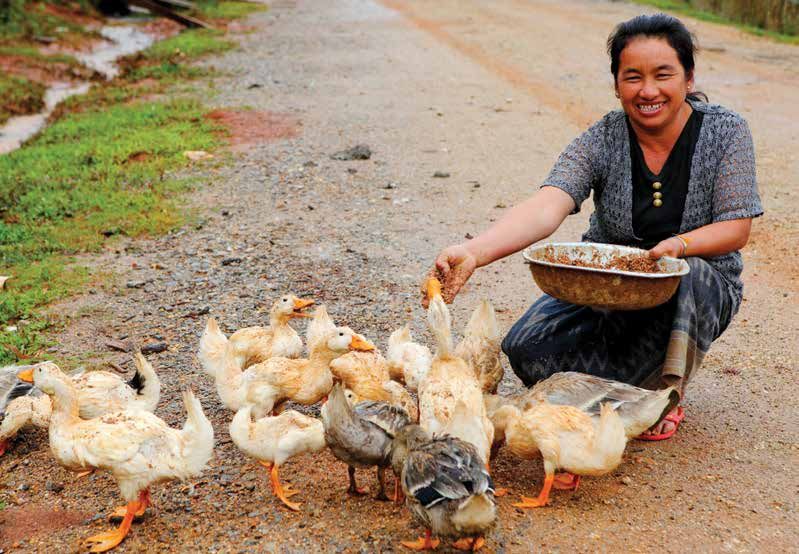
IFAD’s renewed focus                                                      How can nutrition be improved
on nutrition                                                              through agriculture?
At IFAD, nutrition has always been a concern.                             In addressing malnutrition, agriculture’s essential
The 1977 Agreement Establishing IFAD called                               and singular role is to ensure that diverse, nutritious
for improving the nutritional status of the                               foods, adequate to meet the needs of people of all
poorest populations, and IFAD’s lending policy                            ages, are available and accessible at all times, either
underscores improved nutrition as a key principle                         from the market or from farmers’ own production.
of poverty reduction.
                                                                          Traditionally, agricultural interventions have focused
With the recent emergence of nutrition-focused                            on increasing food production and raising incomes
initiatives such as the UN Scaling Up Nutrition                           to reduce malnutrition, hunger and poverty.
Movement (SUN) and the commitments resulting                              Although this remains part of a valid approach,
from the 2013 Nutrition for Growth meeting,2                              it is now recognized that higher levels of production
nutrition has become a prominent global                                   and income alone have limited impact on
development issue. Nutrition is also a highlight                          improving nutrition.
of discussions around the post-2015 development
agenda, to which IFAD has provided important                              A more comprehensive approach is necessary to
input on issues that matter to smallholders and                           optimize agriculture’s contribution to good nutrition
other rural people.                                                       and make agriculture nutrition sensitive. Such an
                                                                          approach identifies constraints and opportunities to
                                                                          leverage agriculture for better nutrition throughout a
                                                                          food system, without detracting from the agricultural
                                                                          sector’s conventional goals. It explicitly takes

2 In June 2013, world leaders came together in London to endorse a global Compact on
Nutrition for Growth that will prevent at least 20 million children from being stunted and save at
least 1.7 million lives by 2020.

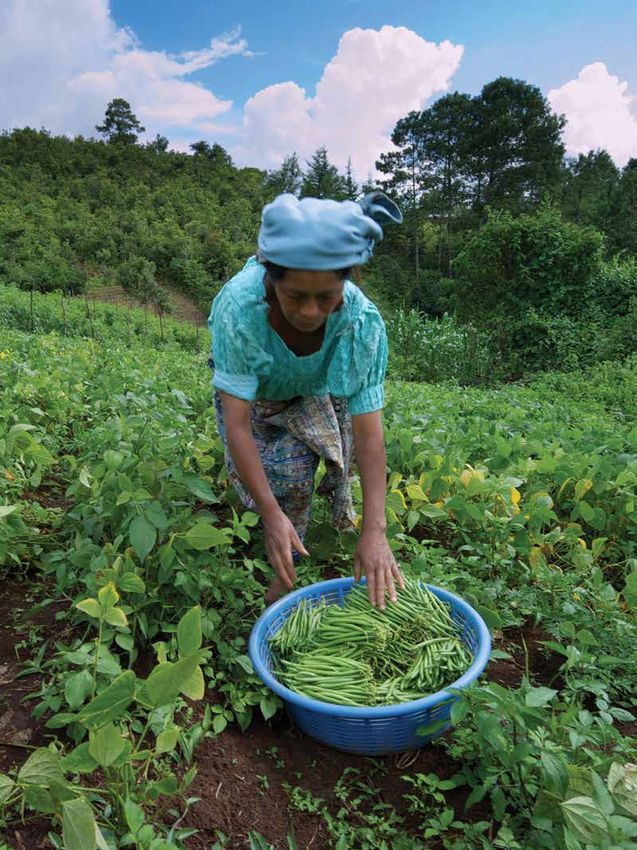
In Guatemala, through an IFAD-supported project more than
13,000 coffee-growing families benefited from introduction
of low-cost irrigation technology. In addition, the project
provided water purifiers to 5,000 families, which helped reduce
the prevalence of diarrhoeal disease, a major contributor to
malnutrition in young children. The project also promoted
nutrition education and vegetable gardens at the household level
and through schools. The combination of nutrition education
and gardens encouraged households to start consuming new
local varieties of vegetables, channelling increases in incomes to
improvements in diets.
                                                                                                                            5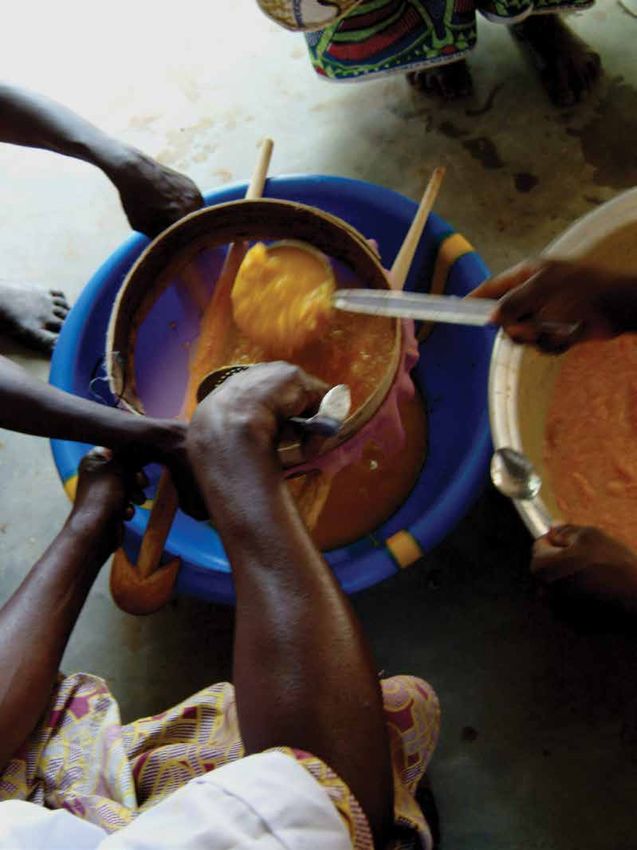
nutrition outcomes into account in the design and       Education and information are essential to ensuring
implementation of agricultural interventions            that expanded and more diverse production
to ensure that impacts on nutrition are positive        translates into healthier diets and better nutrition,
and significant.                                        particularly for smallholders. Without social and
                                                        behavioural changes, food storage and preparation
For example, certain targeted actions can promote       and diets may stay the same, even if incomes,
the availability, accessibility and consumption         production and productivity increase.
of nutritious foods, including by increasing
the nutritional value of the foods themselves.          Given that the causes of malnutrition cut across
Increases in production and productivity can raise      sectors, multisectoral action is essential. Agriculture
incomes, which can be used to purchase food.            must partner with other sectors, particularly health,
Biofortification and improvements in soil health        water and sanitation, and education. But there also
can raise the nutrient value of crops, as can better    has to be convergence – that is, actions in various
storage, preservation and processing. Improved          sectors have to take place in a coordinated way so
production, processing or marketing efficiency, as      they arrive at the same place at the same time.
well as reduction of waste, can reduce the relative
prices or the amount of time it takes to prepare more   The role of women and
nutritious foods, making them more attractive as
                                                        good nutrition
part of the diet. Diversification of production can
be achieved through adoption of new crops or new        Women make up a large percentage of the workforce
production systems. Agricultural technologies and       in agriculture and food systems in developing
production systems can increase the diversity and       countries. Along with productive and reproductive
nutritional value of production.                        gender roles, women’s education, social status, health
                                                        and nutritional status, and control over resources
At the macroeconomic level, policies, including         are key factors that influence outcomes on nutrition.
trade, and public investments guided by agricultural    Gender-sensitive agricultural projects can ensure that
and rural development strategies can affect prices of   women retain greater control over resources and that
more nutritious foods and also shape food systems.      they have a say in choice of crops. Preparing and
                                                        cooking meals, carrying water, working in the fields
                                                        or at the family business, as well as multiple other

                                         In Laos, IFAD is working with the national government,
                                         UNICEF and WFP to develop the country’s first
                                         coordinated multisectoral response to undernutrition.
                                         The plan embraces a set of priority interventions from the
                                         Ministries of Agriculture, Health and Education. The
                                         government plans to pilot the approach in three provinces.
                                         Rather than reducing undernutrition by 1 percentage point
                                         per year (Laos’s experience over the past decade), this
                                         approach is expected to quadruple that figure, for a
                                         reduction in stunting of 4 percentage points per year.

   6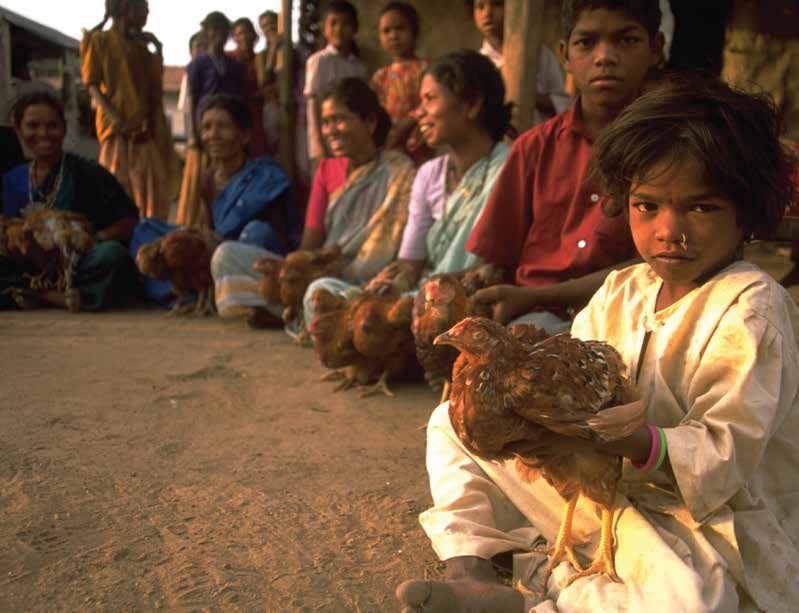
Smallholder farmers – at the heart of food security,
nutrition and rural transformation
The estimated 500 million smallholder farms in the developing world support the livelihoods of
almost 2 billion people. These smallholder farms are responsible for about 80 per cent of the
food produced in sub-Saharan Africa and parts of Asia. Yet, smallholder farmers themselves
are often in a permanent state of food and nutrition insecurity. They suffer from poor quality
diets and malnutrition due to inadequate consumption out of their own production and lack of
access to other food. The role of smallholders in improving nutrition must consider that they
provide food for themselves and also for their communities and a growing urban population.
Nutrition-sensitive programmes can reduce poverty and malnutrition among smallholder farmers
in their roles as both producers and consumers and help them to optimize their contribution to
agricultural production and to food systems as a whole.

                                                                                                     ©IFAD/GMB Akash

                                                                                                 7
©IFAD/Alex Webb
©BIRDP/IFADHow can an agricultural project be made more
nutrition sensitive?
• As a first step, explicitly incorporate improved nutrition as an objective of the project and
identify specific actions that will make project components nutrition sensitive. For example, in a
project to increase crop production, choose to promote a nutrient-dense biofortified crop such
as orange-fleshed sweet potato (OFSP).
• To ensure the project has an impact on nutrition, trace the steps from production to
consumption needed for this intervention to improve nutrition – the “impact pathway.”
Factor those actions into design and implementation. For example, determine if a change in
dietary habits is needed to encourage the consumption of OFSP or, on the production side,
if a vine distribution system needs to be established.
• Through actions such as policy dialogue and partnerships, address opportunities and
constraints that can affect the impact pathway and the effectiveness of the intervention, such
as the institutional environment, gender or environmental sustainability. For example, determine
how promotion of OFSP affects women in terms of their time or income; how production
affects the environment, or how climate change affects the crop; and what other actors need
to be involved so that the activity improves nutrition.
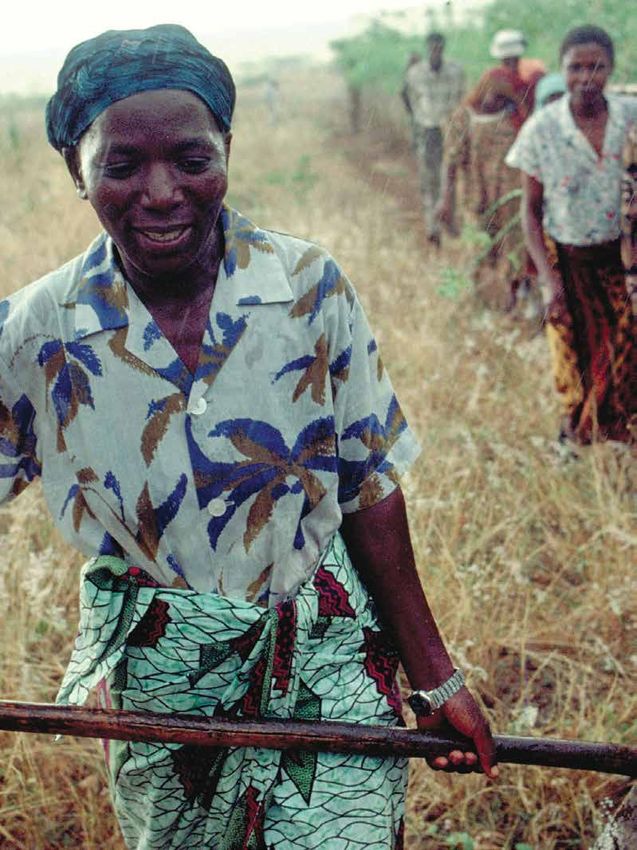
In Sudan, the IFAD-supported Gash Sustainable Livelihoods
Project focused on irrigation and infrastructure rehabilitation
and governance of land and water resources. Increasing
project effectiveness also meant providing training in life and
vocational skills and raising awareness among women and
men about the importance of including women in social and
economic life. In sessions on nutrition and food processing,
women learned about the nutritional benefits of foods not
commonly consumed, like vegetables, eggs and milk. They
learned how to prepare a variety of dishes with high nutritional
value and about the importance of good hygiene. Diets
became more diverse, and the training sessions allowed
women to socialize among themselves more frequently,
when earlier they had met only for special occasions such
as weddings and funerals. Seeing the positive results of the
training on their families, men also became less resistant to
allowing their wives to participate.
9activities create significant demands on a woman’s IFAD moving forward
time and energy and her ability to care for herself
and her family. Making sure agricultural investments IFAD’s approach draws on the broad understanding
are designed to empower women and achieve gender of the ways agriculture can improve nutrition,
equality, allow women time to take care of their beyond increased production and productivity.
children and other family members, and improve
their nutritional knowledge and dietary and hygiene IFAD seeks to mainstream nutrition into agricultural
behaviours can help reduce undernutrition. and rural development activities, rather than
designing a stand-alone intervention.
Because inputs from multiple sectors are needed,
agriculture cannot be solely responsible for fostering The specific adjustments to policies, investments
a child’s growth and development. But through and programmes needed to improve nutrition will
its contribution to nutritious diets for mothers depend on the dynamics, context and the nutrition
and children, especially the use of nutrient-dense problem at hand. But the main nutritional objective
food-based complementary foods, and its impact is the same: to improve diets for all individuals
on women’s time and equality, agriculture has a throughout their lives and to create more supportive,
significant role to play. nutrition-sensitive agriculture and food systems.
Mainstreaming nutrition requires applying a
Climate change and good nutrition lens at each stage of a project from the
nutrition outset, so that the project is designed, implemented,
Changes in temperature and rainfall patterns affect managed, monitored and measured to maximize
production and productivity, as well as storage, impact on nutrition. In this way, IFAD also ensures
packing and transport. This in turn affects the kinds that the project does not have unintended negative
of crops that can be grown or animals that can be effects on nutrition (for example, an agricultural
raised or captured and their nutritional content. intervention that increases the burden on women’s
Since many smallholders eat what they produce, time). Relevant, specific nutrition objectives and
this directly affects diets and nutrition and disease actions can be incorporated into projects and country
patterns. Integrating measures into investments to strategies, as is done for gender and environmental
address climate change and nutrition can be achieved sustainability. IFAD will work closely with local
by promoting diversified food systems that are more partners to ensure that design and operation reflect
resilient and have benefits in terms of more stable the country context.
income and dietary quality.
In the Sahel, IFAD is promoting agroforestry systems.
Farmers increasingly plant, protect and manage woody
species. The management of trees brings multiple benefits,
including nutritional benefits achieved by growing trees
such as Adansonia digitata, or Baobab, whose leaves and
fruit offer high-quality nutrition, and Vitellaria paradoxa,
which provides highly nutritious fruit that boosts food
supply in the lean period.
10©IFAD/Amadou Keita
Chalasani
    ©IFAD/Joanne Levitan
    ©IFAD/Radhika

                                   In India, IFAD is mainstreaming nutrition into a new project
                                   to improve living conditions of tribal communities in Odisha.
                                   Nutrition experts on the design team have carried out field visits
                                   to understand community needs and possibilities, and discussed
                                   with the state government how to link project activities with
                                   ongoing programmes in health, thus ensuring programmatic
                                   convergence. Under the project, improved land and water
                                   management can extend the growing season and allow additional,
                                   more nutritious crops, such as fruits and vegetables and
                                   iron-rich millet, to be grown. Links can be established with national
                                   agricultural research centres to determine optimal, potentially
©IFAD/Amadou Keita

                                   biofortified, varieties for production. Development of the value
                                   chain for these crops will increase producer incomes.
                                   The integration of home extension activities will ensure that
                                   increased production diversity also increases dietary diversity and,
                                   through attention to preservation and storage, increases the foods
                              12
                                   that families have available throughout the year.
IFAD has already taken significant steps in advancing • Advocacy. By participating in SUN and other
its commitment to nutrition-sensitive agriculture and initiatives and through collaboration with other
rural development: organizations, IFAD connects global advocacy,
strategic alignment and partnerships to country
• Investments. IFAD loans and grants finance action and takes an active role in the issue of
and support specific actions that can re-shape nutrition-sensitive agriculture at global and local
agriculture and food systems to improve levels. IFAD participated in the ground-breaking
nutrition. Working with country partners, IFAD Nutrition for Growth Summit in 2013 and recently
supports the process from concept and design to collaborated with the Rome-based UN agencies to
implementation, supervision and evaluation. develop technical recommendations on targets and
indicators around food, nutrition and sustainability
• Partnership and policy dialogue. IFAD promotes for the post-2015 development agenda.
dialogue among concerned partners, including
ministries of agriculture and health as well as
Measuring results and enabling
other parts of government and society. This can
strengthen understanding, broker collaboration actions on nutrition
and convergence, and promote operational links IFAD is serious about delivering results.
for nutrition-sensitive agriculture. Partnerships are IFAD requires every project to apply a common
an essential part of IFAD’s scaling-up strategy. By assessment framework, its Results and Impact
working with partners, IFAD leverages the impact Management System (RIMS), which uses chronic
of its investments and enhances their sustainability. malnutrition as an anchor indicator. Work is under
way to revise RIMS to measure household dietary
• Knowledge. IFAD is building the knowledge base diversity as well, a contributor to good nutrition that
around policies and programmes for nutrition- reflects IFAD’s work in agriculture and food systems.
sensitive agriculture, including learning from Many projects carry out additional studies and
monitoring and evaluation of its own investments. evaluations that provide further insights into how to
IFAD uses this evidence to improve project improve project design, management and impact.
design and management, policy dialogue and
results. IFAD is also tapping other reservoirs of An increased commitment to nutrition requires
knowledge, and commissions or collaborates with a corresponding increase in capacity. Supported
other institutions with specialized research skills, by a multi-year grant from the Government of
such as national agricultural research centres or Canada specifically earmarked for mainstreaming
international institutes, including those of the nutrition into IFAD’s work, IFAD is strengthening
Consultative Group on International Agricultural its technical capacity to support integration of
Research (CGIAR). With funding from the German nutrition into design and supervision of operations.
government, IFAD is developing a tool for the IFAD has committed to introducing nutrition-
design of nutrition-sensitive value chains in two specific designs in 20 per cent of its new projects
middle-income countries, expanding its expertise and making 30 per cent of all new results-based
and enhancing South-South cooperation. country strategic opportunities programmes
(COSOPs) nutrition sensitive. With this grant, IFAD
can provide additional resources and support to
13country programme managers and others in the In its renewed focus on nutrition, IFAD is deepening
organization to integrate nutrition into their work its commitment to its mission while building on its
more effectively. own experience, expertise and areas of comparative
advantage. The challenges are great, but the benefits
Additional resources will be needed to support are greater. Making agriculture and food systems
country actions at national and local levels to more nutrition sensitive will contribute to improving
make agriculture more nutrition sensitive, to the livelihoods and nutrition of smallholder farmers
improve capacity for analysis, design, coordination, and the rural poor, and thus to the achievement of
implementation and evaluation, and to fund the IFAD’s core mission. But this effort has ramifications
investments themselves. that go far beyond the smallholder farms of the
developing world: investment in nutrition-sensitive
agriculture pays dividends for all of society, whether
in urban or rural areas, and contributes to the
stability, health, and social and economic growth
and development of all countries.
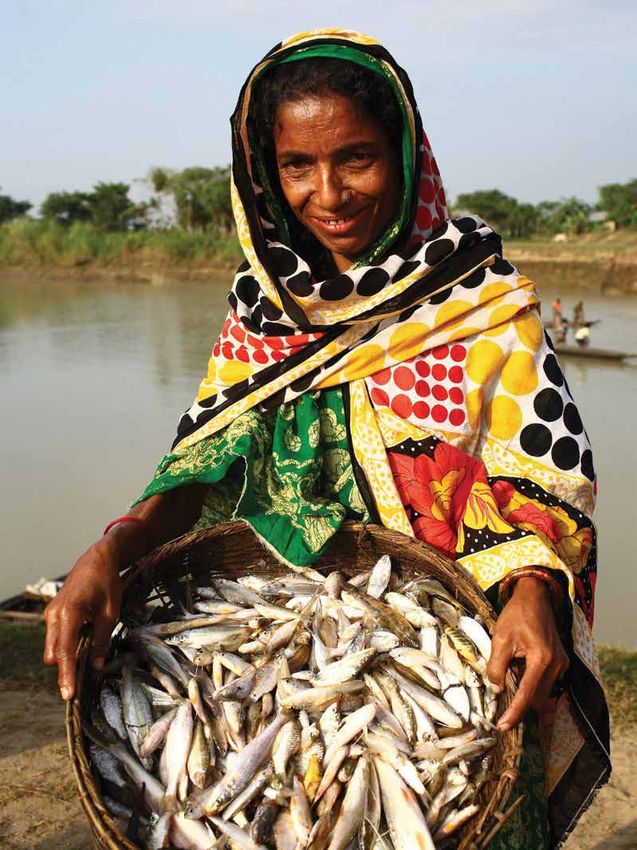
In Bangladesh, IFAD provided a grant to the World Fish
Centre to explore the potential of farming nutrient-rich small
fish to increase household incomes and improve nutrition.
This meant overcoming beliefs that production would suffer
by raising large and small fish in the same ponds. The World
Fish studies found that technologies to raise small and large
fish together actually increase total fish production. Promotion
of these technologies in wetlands and ponds, when combined
with education, can increase consumption of fish and
micronutrients, especially in women and children. Raising the
nutrient-rich small fish, mola, in the 4 million small, seasonal
ponds in Bangladesh has the potential to meet the annual
recommended vitamin A intake for over 6 million children.
This approach is now being considered for expansion into
other countries in the region.
1415 ©IFAD/G.M.B.Akash
IFAD is an international financial institution and a specialized United
Nations agency dedicated to enabling poor rural people to improve
their food and nutrition security and escape poverty. IFAD champions
smallholder farmers and rural entrepreneurs in international forums,
providing a global platform to spur discussion of rural policy issues and
increase awareness of why greater investment in agriculture and rural
development is essential.

The Fund provides low-interest loans and grants to developing countries to
finance innovative agricultural and rural development projects. It is among
the top three multilateral institutions working in agriculture in Africa. Since its
creation in 1977 it has:
• Mobilized over US$22 billion in cofinancing and funding from domestic
   sources for rural development, in addition to IFAD’s own contribution of
   about US$15.8 billion in loans and grants
• Empowered some 430 million people to grow more food, learn new skills,
   start small businesses, build strong organizations and gain a voice in the
   decisions that affect their lives

International Fund for Agricultural Development
Via Paolo di Dono, 44 - 00142 Rome, Italy
Tel: +39 06 54591 - Fax: +39 06 5043463
E-mail: ifad@ifad.org
www.ifad.org
www.ruralpovertyportal.org
   ifad-un.blogspot.com
   www.facebook.com/ifad
   instagram.com/ifadnews
   www.twitter.com/ifadnews
   www.youtube.com/user/ifadTV

June 2014
                                                                                      ©IFAD/GMB Akash
You can also read


