Self-Reported Prevalence of Allergies in the USA and Impact on Skin-An Epidemiological Study on a Representative Sample of American Adults - MDPI
←
→
Page content transcription
If your browser does not render page correctly, please read the page content below
International Journal of
           Environmental Research
           and Public Health

Article
Self-Reported Prevalence of Allergies in the USA and
Impact on Skin—An Epidemiological Study on a
Representative Sample of American Adults
Sophie Seité 1, * , Alyce Mei-Shiuan Kuo 2 , Charles Taieb 3 , Tamara Lazić Strugar 2 and
Peter Lio 4
 1    La Roche-Posay Dermatological Laboratories, 92300 Levallois-Perret, France
 2    Icahn School of Medicine at Mount Sinai, New York, NY 10029, USA;
      alyce.kuo@icahn.mssm.edu (A.M.-S.K.); tamara.lazic@aya.yale.edu (T.L.S.)
 3    European Market Maintenance Assessment, 94120 Fontenay-sous-Bois, France; charles.taieb@emma.clinic
 4    Medical Dermatology Associates of Chicago, Chicago, IL 60654, USA; peterlio@gmail.com
 *    Correspondence: sophie.seite@loreal.com; Tel.: +33-1-49-64-33-40

 Received: 5 March 2020; Accepted: 6 May 2020; Published: 12 May 2020

 Abstract: Background: The rising prevalence of allergies can substantially impact the skin, which is
 one of the largest targets for allergic and immunologic responses. Objective: Here, we describe
 the results of an online survey assessing self-reported allergy prevalence in Americans, outline the
 populations who report allergies, and characterize the skin conditions associated with allergy.
 Methods: An online survey was conducted in the USA of 2008 adults as a representative sample of
 the general American population. Results: 41.7% of American adults (mean age 44.7 ± 15.3 years old)
 reported having allergies. Reported allergies included respiratory allergies (45.2%), skin allergies
 (41.4) and food allergies (33.9%). 47.7% of those who reported allergies also reported experiencing
 associated skin reactions. In addition, those who reported allergies were 2 to 4.5 times more likely to
 report a cutaneous skin disease, 7 times more likely to report sensitive skin, and twice as likely to
 report experiencing skin reactions when using skincare products compared to those who did not
 report allergies. Conclusions: It is estimated that over 100 million American adults have allergies.
 These results will help raise awareness about the burden of allergies and the need to develop solutions
 to mitigate their impact on health.

 Keywords: allergies; food allergy; skin allergy; respiratory allergy; prevalence; skin side effects

1. Introduction
     In the Western world, the prevalence of allergies, including hay fever, asthma, and especially now
food allergy, has been on the rise, a phenomenon referred to as the “allergy epidemic” [1]. For instance,
in children, hospital admissions due to food anaphylaxis doubled in the United States between 2000 and
2009 [2,3].
     The term “allergy” is broad and can refer to many types of food, respiratory, and skin reactions.
In the United States, common food allergens include milk, eggs, soy, and peanuts, with allergy
symptoms ranging from hives, coughing, or vomiting, to difficulty breathing and loss of consciousness.
Although food allergies are most common in children, many adults continue to face food allergies
developed in childhood and can also develop new ones [4]. Respiratory allergies include allergic
rhinitis and allergic asthma, which share many features and are frequently associated with air pollution
and pollens [5,6]. The haptens involved in skin allergies are diverse and can include preservatives,
fragrances, and metals [7]. While these allergies may present with varied symptoms, they share
immunologic foundations and pathways. This is especially evident in processes such as atopic march,

Int. J. Environ. Res. Public Health 2020, 17, 3360; doi:10.3390/ijerph17103360   www.mdpi.com/journal/ijerph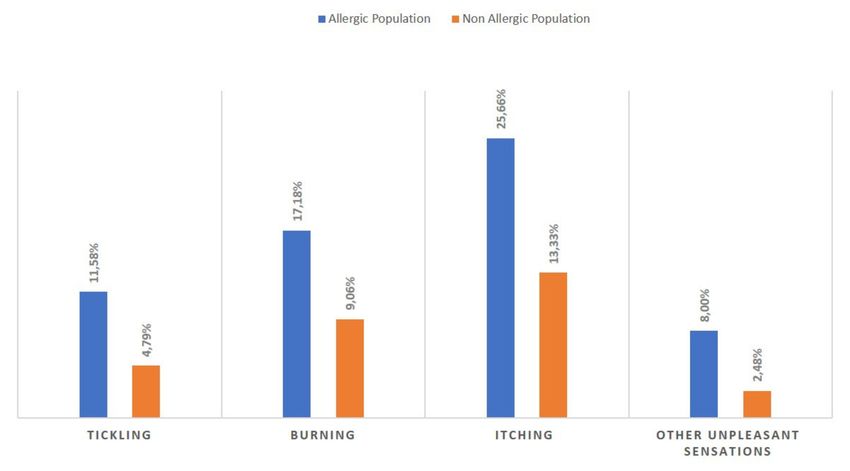
Int. J. Environ. Res. Public Health 2020, 17, 3360                                                    2 of 9

where in infancy, the development of atopic dermatitis, a skin condition, can lead to food allergies as
well as allergic rhinitis and asthma later in life [8].
     To diagnose clinically, allergies can require tests such as oral food challenge or patch testing,
which provoke symptoms, making the prevalence of allergy difficult to estimate. Nonetheless, it is
necessary to make this assessment to better understand the tremendous impact of allergies. Here,
we describe the results of an online survey assessing self-reported allergy prevalence in Americans,
outline the populations who report allergies, and characterize the skin conditions associated with allergy.

2. Materials and Methods

2.1. Study Population
     A polling institute (HC Conseil Paris, France) conducted the current survey between December 2018
and January 2019. A sample of the general US adult population, over 18 years of age, was recruited.
Proportional quota sampling was applied to render the study population representative of the US
general adult population following data available and published (U.S. Census Bureau, June 2017).
These quotas were based on the following aspects: sex, age, socio-professional status, and regional
distribution (Table 1).

                                    Table 1. Quota used to select the study population.

                                   US Sex and Age Breakdown         Males      Females
                                                     18–24           7%          7%
                                                     25–34           10%         10%
                                                     35–44           9%          9%
                                                     45–54           10%         10%
                                                     55–64           8%          9%
                                                     65–74           5%          6%
                                             USA Regions
                                                     West            23%
                                                Midwest              23%
                                                     South           36%
                                        Northwest/Northeast          18%
                                   USA Annual Income in US$
                                           Less than 40,000          40%
                                           More than 40,000          60%

     Data were collected via Internet by random selection of 2008 US people among the large number
of internet users over 18 years of age who agreed to participate. Each participant was contacted by
e-mail, and if the contact failed or questionnaire was not entirely completed, another participant with
the same characteristics was randomly selected. Missing data were not allowed and respondents were
required to provide an answer to all questions.

2.2. Survey
     This research employed completely anonymized data without involving direct patient contact,
and institutional review board approval was not necessary prior to study initiation. Respondents were
asked a range of sociodemographic questions including gender, age, occupation, social class, area of
residence, and tobacco use. They were also asked questions about skin phototype, occurrence of
allergies, types of allergies, allergens, medical diagnosis confirmation, therapeutic treatment, symptoms,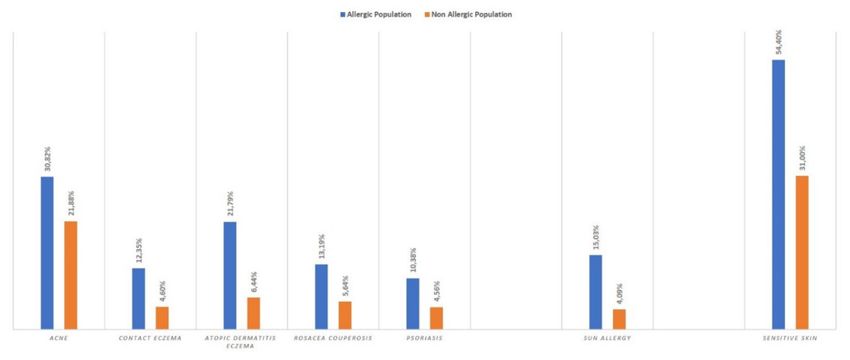
Int. J. Environ. Res. Public Health 2020, 17, 3360                                                   3 of 9

skin pathologies, skin effects, and skin symptoms. Questions regarding the impact of environmental
factors such as exposure to environmental pollution and sun were also asked.

2.3. Statistical Analysis
     In this descriptive study, participants who reported allergies were compared to participants who
did not report any allergies. Quantitative variables were expressed as mean and standard deviation.
Qualitative variables were expressed as frequencies and percentages. Comparisons between groups
were performed using the Student test in the case of quantitative variables; for categorical variables,
intergroup comparisons were done with the χ2 test. Relative risk (RR) was calculated for comparison
of the population who reported allergies to the population who did not reported allergies. The level
of significance was set at 5%. Statistical analyses were performed using R software version 3.6.1
(Vienna, Austria).

3. Results

3.1. General Population
     Of the 2008 respondents (18–74 years, 49% men, 51% women), 41.7% of participants
(mean age 44.7 ± 15.3 years) reported having allergies (44.6% men, 55.4% women). Of the total
population, 25.4% lived in rural areas (≤50,000 residents), 48.9% in suburban or medium size cities
(50,000–1,000,000 residents), and 25.7% in large cities (≥1,000,000 residents), and 25% were smokers.
The phototype distribution of the total population was 21.1%, 23%, 35.5%, 12.5%, 4.3%, and 3.6% for
phototypes I to VI, respectively.
     Reported allergies included respiratory allergies (45.2%), skin allergies (41.4%), and food allergies
(33.9%). Of the total, 68.4% reported their allergies had been diagnosed by at least one doctor, who most
frequently was either a general practitioner, allergy specialist, or dermatologist (Table 2). However,
many with allergies reported not using any treatments such as corticosteroids or antihistamines—29.8%,
46.1%, and 55.6% of those with respiratory, skin, and food allergies, respectively.
     Only 39.7% were able to identify the allergen(s) responsible for their allergies (mainly pollens,
mites, and mold), as well as the main symptoms associated with their allergies, such as allergic rhinitis
or asthma (Table 3).

                                          Table 2. Doctors who diagnosed allergies.

                                                                                      n     %
                         Participants Reporting an Allergy                        838     41.73%
                         Subjects able to name the allergy                        333     39.74%
                         Percentage of Participants Diagnosed by A Doctor         573     68.38%
                         Health professional who diagnosed the allergy
                         General practitioner                                     259     45.20%
                         Allergy specialist                                       145     25.31%
                         Dermatologist                                            94      16.40%
                         Pediatrician                                             33      5.76%
                         Otolaryngologist                                         14      2.44%
                         Pulmonary specialist                                     10      1.75%
                         Acupuncturist                                                2   0.35%
                         Homeopathic doctor                                        1      0.17%
                         Another specialized physician                            15      2.62%
                                                     n: number of participants.
Int. J. Environ. Res. Public Health 2020, 17, 3360 4 of 9
Table 3. Symptoms and allergens related by the allergic population.
n %
Symptoms Associated with Allergy Reported by Participants
Allergic rhinitis (hay fever) 367 43.79%
Asthma 220 26.25%
Eczema/Atopic dermatitis 188 22.43%
Bronchitis with wheezing 151 18.02%
Conjunctivitis 61 7.28%
Edema 35 4.18%
Other 195 23.27%
Allergens Reported by Participants n %
Pollens 529 63.13%
Dust mites 353 42.12%
Mold 294 35.08%
Dogs, cats, ferrets, other animals 214 25.54%
Food allergens 177 21.12%
Latex 60 7.16%
Cockroaches 59 7.04%
Hymenoptera (bees, wasps, hornets, etc.) 50 5.97%
Other 125 14.92%
n: number of participants.
Of those who reported allergies, 47.7% also reported experiencing associated skin reactions.
In 47.2% of these cases, a doctor diagnosed this skin reaction, and 37% reported using topical and/or
oral treatments (Table 4).
Table 4. Skin reactions associated with allergies.
n %
Percentage of Participants Reporting Skin Reaction 400 47.73%
Percentage managed by a doctor 189 47.25%
Who is the Health Professional Who Managed the Skin Reaction?
General practitioner 88 46.56%
Allergy specialist 59 31,22%
Dermatologist 26 13.76%
Participants Reporting Prescribed Treatment for Skin Reaction 148 78.30%
What kind of treatment was prescribed for your skin reaction?
Topical 106 71.62%
Oral 66 44.59%
Skincare products 21 14.19%
n: number of participants.Int. J. Environ. Res. Public Health 2020, 17, 3360 5 of 9
3.2. Allergic Population Versus Non-Allergic Population
The population who reported allergies was slightly older (mean age 44.7 ± 15.3 vs 43.1 ± 15.7 years,
p < 0.00307) than the population who did not report allergies. The population with allergies also
included significantly more women (55.4% vs 48%, p = 0.0011). However, the two populations were
similar in distributions regarding their geography, skin phototypes, and smoking statuses.
Those who reported allergies were 1.4 to 3.7 times more likely to also report a skin disease such as
eczema or atopic dermatitis (RR = 3.39 [2.60–4.39]), sun allergy (RR = 3.68 [2.64–5.11]), contact eczema
(RR = 2.68 [1.93–3.72]), psoriasis (RR = 2.28 [1.62–3.18]), rosacea/couperosis (RR = 2.34 [1.73–3.51]),
or acne (RR = 1.41 [1.21–1.63]), and close to 2 times more likely to report sensitive skin (RR = 1.7
[1.57–1.95]) compared to those who did not report any allergies (Figure 1).
Figure 1. Skin diseases in the two populations.
They were significantly more likely to report sensitive skin (54.3% vs 31.0%), particularly very
sensitive skin (18.7 vs 6%, p < 0.0001), sensitive eyes (53.9% vs 25.7%, p < 0.00006), and having parents
with sensitive skin (33% vs 17.7%, p < 0.0001). Notably, 24.7% of those who reported allergies also
reported having atopic dermatitis during childhood compared to only 9.9% in those who did not report
any allergies (p < 0.00001).
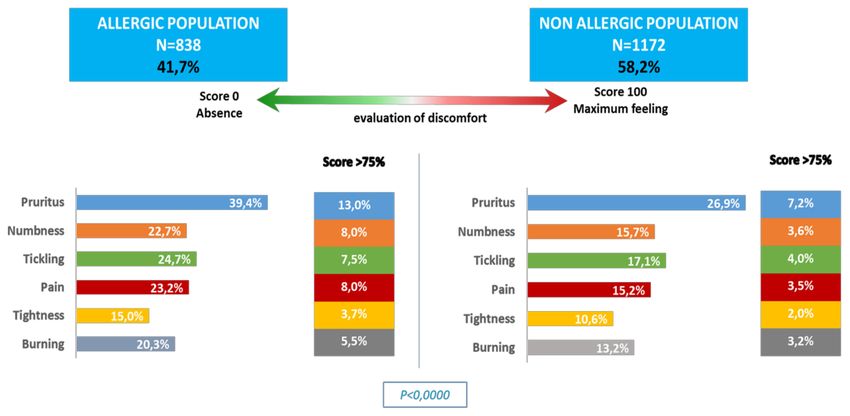
Additionally, those who reported allergies were more likely to experience skin discomfort and
reported a higher incidence of severe skin discomfort (Figure 2). They were also more likely to report
experiencing skin reactions (pruritus: RR = 1.92; burning: RR = 1.90; tickling: RR = 2.42 p < 0.001)
when using skincare products (Figure 3).
3.3. Environmental Impact
The population who reported allergies was significantly more impacted by air, water, ground,
noise, light, and radiation pollution (p < 0.0001) than the population who did not report allergies
(Table 5). They more frequently claimed that pollution affected their way of life (53.6% vs 34.5%,
p < 0.0001) and impacted their health and well-being (71.1% vs 53.2%, p < 0.0001). They also more
commonly noted an impact of pollution on their skin (29.5% vs 17.8%, p < 0.002). In those with allergies,
32.6% reported that the impact pollution made on their skin was quite or very important compared to
17.9% in those without allergies (p < 0.0001). Those with allergies were also more likely to use skincare
products to protect their skin against pollution (5% vs 2.8%, p < 0.0001).Int. J. Environ. Res. Public Health 2020, 17, 3360 6 of 9
Figure 2. Skin discomforts in the two populations.
Figure 3. Skin discomforts associated with skincare products in the two populations.
Table 5. Impact of pollution in the two populations.
Impacted Worried
Allergic Non-Allergic Allergic Non-Allergic
n = 838 n = 1172 n = 838 n = 1172
Air 74.22% 61.28% 51.19% 34.96%
Water 29.47% 22.65% 6.56% 7.18%
Soil 12.05% 6.75% 2.86% 1.62%
Noise 35.92% 27.01% 11.22% 13.59%
Light 31.86% 22.31% 9.31% 5.98%
Radiation 18.26% 15.13% 4.06% 4.79%
n: number of participants.Int. J. Environ. Res. Public Health 2020, 17, 3360 7 of 9
A significantly larger part of those with allergies had moderate and intense daylight solar exposure
than in those who did not report allergies (51.8% vs 39.8%, p < 0.0004). Nonetheless, only 19% of those
with allergies reported not using any photoprotection in comparison to 28.5% of those without allergies
(p < 0.0001). Those with allergies were also more likely to apply sunscreen during outdoor activities
(37.4% vs 27.9%, p < 0.0001), when working outdoors (34.2% vs 27%, NS), and during intense sun
exposure (52.5% vs 48.4%, NS).
4. Discussion
In this self-reported survey of a representative sample of the general American population,
41.7% of survey respondents reported having allergies. This figure closely resembles the results of an
earlier study of allergic sensitization using data from the National Health and Nutrition Examination
Survey (NHANES) 2005–2006, which found that 44.6% of the sampled population tested positive to at
least one specific allergen based on serum IgE testing [9]. However, while the NHANES data showed
that prevalence of allergic sensitization was higher in men, this survey found that self-reported allergy
was more prevalent in women. The survey results parallel research showing that due to a combination
of societal and biological factors, women tend to have poorer self-reported health [10]. One possible
explanation for this discrepancy is that in general, women tend to be more health conscious [11]. It is
possible that although men have higher rates of allergen sensitization, women are more likely to notice
the allergy symptoms resulting from sensitization and self-report it.
The self-perceived diagnosis or symptoms of allergies may be one limitation of this study, as only
68.4% of the respondents who reported allergies said that these allergies had been officially diagnosed
by a doctor. This can be problematic because participants frequently overreport symptoms of allergic
disease, and a non-immunologically based adverse response to a food may easily be misconstrued
to be an allergic reaction and self-reported as such [12]. Although assessing clinical response to
allergens, such as through food challenge, is more objective, it can also put patients in danger. Thus,
accurate allergy prevalence can be challenging to estimate [13]. Another limitation of this study is that
only adults 18 years and older were sampled when allergy rates are increasing most rapidly among
children [3].
There are many theories attempting to explain the ongoing escalation in allergy prevalence, one of
which is the hygiene hypothesis. The hygiene hypothesis proposes that decreased exposure to infections
has led to increased immune response to allergens. It postulates that IgE antibodies, which defend the
body against parasitic infections, may be redirected toward less offensive environmental allergens such
as pollen, generating allergies [14]. Although improved hygiene may indeed play a role, other lifestyle
changes in westernized countries such as decreased physical activity, shifts in diet to include more
processed foods, and changes in daily ways of living likely make an impact as well. For example,
increased bathing of babies can alter skin permeability, leading to increased allergic sensitization [15,16].
The role of the skin barrier in allergic sensitization has been well-described. Specifically, dysfunction
of the skin barrier can increase the likelihood of allergens coming into contact with the immune system,
which can trigger sensitization [17]. However, the impact of allergies on other skin conditions has been
less thoroughly characterized. Nonetheless, the survey results presented here show a clear association
between reporting any type of allergy and also reporting a skin disease or skin sensitivity. While some
of these links are relatively well-established, such as that between food allergy and atopic dermatitis,
others are less clear [18]. Emerging research is beginning to look into these associations, such as the
recent discovery of a shared IL-17 immunophenotype between psoriasis and asthma, but we are far
from having a complete understanding of the relationship between various types of allergies and skin
diseases [19].
Understanding allergy is critical to providing care to the vast proportion of Americans who suffer
from its symptoms. For the millions of people coping with allergies, allergies can create significant
burden on day to day life. Anxiety, impact on relationships, embarrassment, and frequent interruptionsInt. J. Environ. Res. Public Health 2020, 17, 3360 8 of 9
to normal tasks brought on by respiratory, food, and skin allergy symptoms all contribute to poorer
quality of life in those with allergies [20–22].
Much work still needs to be done in developing ways to manage allergies. For food allergies,
strict avoidance of the causative food allergen has been traditionally recommended; however, there has
been research into developing tolerance through oral, sublingual, or epicutaneous immunotherapy [23].
Meanwhile, respiratory allergies are frequently treated with corticosteroids, and minimizing skin
barrier dysfunction may be one way to prevent skin allergies [17,24]. These approaches to management
can grow taxing, as allergies are lifelong, chronic conditions. Additionally, strategies such as avoidance
can be challenging, as only 39.7% of survey respondents are able to identify the causative allergens.
Without well-developed solutions and cures to allergies in place, the prevalence of allergies is bound
to continue to rise, even as incidence stabilizes [2].
5. Conclusions
With the rising prevalence of allergies in the Western world, it is increasingly important to better
characterize the nature and implications of this epidemic. Until the pathogenesis is fully understood,
the skin and its barrier function remain important targets for study, especially given the large number
of unidentified allergens.
Author Contributions: Conceptualization, C.T.; methodology, C.T.; project administration, S.S.; resources, C.T.;
validation, S.S.; writing—original draft, S.S.; writing—review and editing, A.M.-S.K., T.L.S., and P.L. All authors
have read and agree to the published version of the manuscript.
Funding: This work was supported by La Roche-Posay Dermatological Laboratories, France.
Acknowledgments: The authors acknowledge the great technical support of G. Le Dantec and M. Fortuné.
Conflicts of Interest: S.S. is employee of La Roche-Posay, France. P.L. has served as a consultant and speaker for
L’Oreal/La Roche-Posay. He has also been a consultant/advisor for Micreos, Pierre-Fabre, Johnson & Johnson,
Syncere Skin Systems, Altus Labs, AOBiome, Galderma, IntraDerm, Theraplex, and Unilever and is a board member
of the National Eczema Association. T.L.S. and C.T. have served as a consultants for L’Oreal/La Roche-Posay.
References
1. Okada, H.; Kuhn, C.; Feillet, H.; Bach, J.-F. The ‘hygiene hypothesis’ for autoimmune and allergic diseases:
An update. Clin. Exp. Immunol. 2010, 160, 1–9. [CrossRef] [PubMed]
2. Tang, M.L.; Mullins, R.J. Food allergy: Is prevalence increasing? Intern. Med. J. 2017, 47, 256–261. [CrossRef]
[PubMed]
3. Jackson, K.D.; Howie, L.D.; Akinbami, L.J. Trends in allergic conditions among children: United States,
1997–2011. NCHS Data Brief 2013, 121, 1–8.
4. Grief, S.N. Food Allergies. Prim. Care Clin. Off. Pract. 2016, 43, 375–391. [CrossRef]
5. Molinari, G.; Colombo, G.; Celenza, C. Respiratory Allergies: A General Overview of Remedies, Delivery
Systems, and the Need to Progress. ISRN Allergy 2014, 2014, 326980. [CrossRef]
6. Schiavoni, G.; D’Amato, G.; Afferni, C. The dangerous liaison between pollens and pollution in respiratory
allergy. Ann. Allergy Asthma Immunol. 2017, 118, 269–275. [CrossRef]
7. Kostner, L.; Anzengruber, F.; Guillod, C.; Recher, M.; Schmid-Grendelmeier, P.; Navarini, A. Allergic Contact
Dermatitis. Immunol. Allergy Clin. North Am. 2017, 37, 141–152. [CrossRef]
8. Bantz, S.K.; Zhu, Z.; Zheng, T. The Atopic March: Progression from Atopic Dermatitis to Allergic Rhinitis
and Asthma. J. Clin. Cell. Immunol. 2014, 5, 1–8.
9. Salo, P.M.; Arbes, S.J.; Jaramillo, R.; Calatroni, A.; Weir, C.H.; Sever, M.L.; Hoppin, J.A.; Rose, K.M.; Liu, A.H.;
Gergen, P.J.; et al. Prevalence of allergic sensitization in the United States: Results from the National Health
and Nutrition Examination Survey (NHANES) 2005-2006. J. Allergy Clin. Immunol. 2014, 134, 350–359.
[CrossRef]
10. Boerma, T.; Hosseinpoor, A.R.; Verdes, E.; Chatterji, S. A global assessment of the gender gap in self-reported
health with survey data from 59 countries. BMC Public Health 2016, 16, 675. [CrossRef]
11. Kandrack, M.A.; Grant, K.R.; Segall, A. Gender differences in health related behaviour: Some unanswered
questions. Soc. Sci. Med. 1991, 32, 579–590. [CrossRef]Int. J. Environ. Res. Public Health 2020, 17, 3360 9 of 9
12. Sicherer, S.H. Epidemiology of food allergy. J. Allergy Clin. Immunol. 2011, 127, 594–602. [CrossRef] [PubMed]
13. Dunlop, J.H.; Keet, C.A. Epidemiology of Food Allergy. Immunol. Allergy Clin. N. Am. 2018, 38, 13–25.
[CrossRef] [PubMed]
14. Ring, J.; Krämer, U.; Schäfer, T.; Behrendt, H. Why are allergies increasing? Curr. Opin. Immunol. 2001, 13,
701–708. [CrossRef]
15. Platts-Mills, T.A. The allergy epidemics: 1870–2010. J. Allergy Clin. Immunol. 2015, 136, 3–13. [CrossRef]
16. Lambrecht, B.N.; Hammad, H. The immunology of the allergy epidemic and the hygiene hypothesis.
Nat. Immunol. 2017, 18, 1076–1083. [CrossRef]
17. Strugar, T.L.; Kuo, A.; Seité, S.; Lin, M.; Lio, P. Connecting the Dots: From Skin Barrier Dysfunction to Allergic
Sensitization, and the Role of Moisturizers in Repairing the Skin Barrier. J. Drugs Dermatol. 2019, 18, 581.
18. Bergmann, M.M.; Caubet, J.-C.; Boguniewicz, M.; Eigenmann, P. Evaluation of Food Allergy in Patients with
Atopic Dermatitis. J. Allergy Clin. Immunol. Pract. 2013, 1, 22–28. [CrossRef]
19. Östling, J.; Van Geest, M.; Schofield, J.P.; Jevnikar, Z.; Wilson, S.; Ward, J.; Lutter, R.; Shaw, D.E.; Bakke, P.S.;
Caruso, M.; et al. IL-17–high asthma with features of a psoriasis immunophenotype. J. Allergy Clin. Immunol.
2019, 144, 1198–1213. [CrossRef]
20. Schmier, J.K.; Chan, K.S.; Leidy, N.K. The impact of asthma on health-related quality of life. J. Asthma 1998,
35, 585–597. [CrossRef]
21. Bacal, L.R. The impact of food allergies on quality of life. Pediatr. Ann. 2013, 42, 141–145. [CrossRef]
[PubMed]
22. Kalboussi, H.; Kacem, I.; Aroui Kalboussi, H.; Kacem, I.; Aroui, H.; El Maalel, O.; Maoua, M.; Brahem, A.;
El Guedri, S.; Chatti, S.; et al. Impact of Allergic Contact Dermatitis on the Quality of Life and Work
Productivity. Dermatol. Res. Pract. 2019, 2019, 3797536. [CrossRef] [PubMed]
23. Burks, A.W.; Sampson, H.A.; Plaut, M.; Lack, G.; Akdis, C.A. Treatment for food allergy. J. Allergy
Clin. Immunol. 2018, 141, 1–9. [CrossRef] [PubMed]
24. Del Giacco, S.R.; Bakirtas, A.; Bel, E.; Custovic, A.; Diamant, Z.; Hamelmann, E.; Heffler, E.; Kalayci, Ö.;
Saglani, S.; Sergejeva, S.; et al. Allergy in severe asthma. Allergy 2016, 72, 207–220. [CrossRef]
© 2020 by the authors. Licensee MDPI, Basel, Switzerland. This article is an open access
article distributed under the terms and conditions of the Creative Commons Attribution
(CC BY) license (http://creativecommons.org/licenses/by/4.0/).You can also read


